Category Archives: New Products

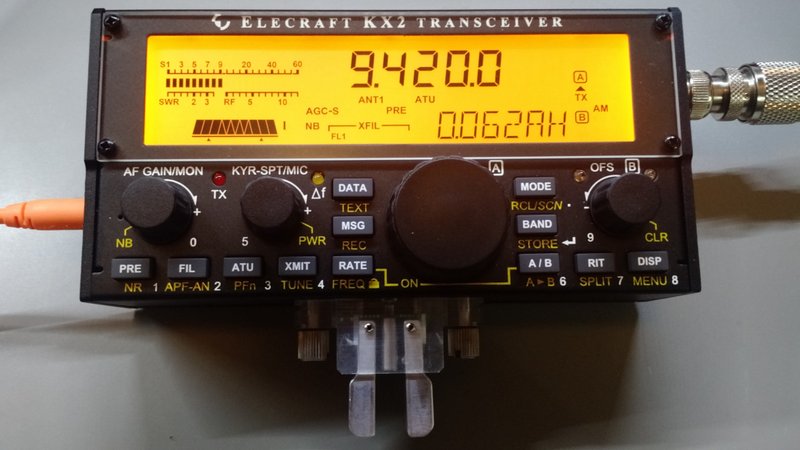
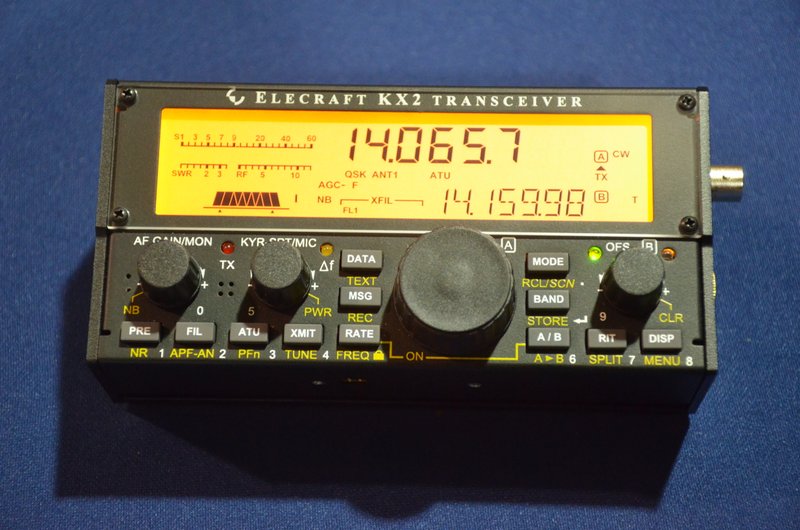
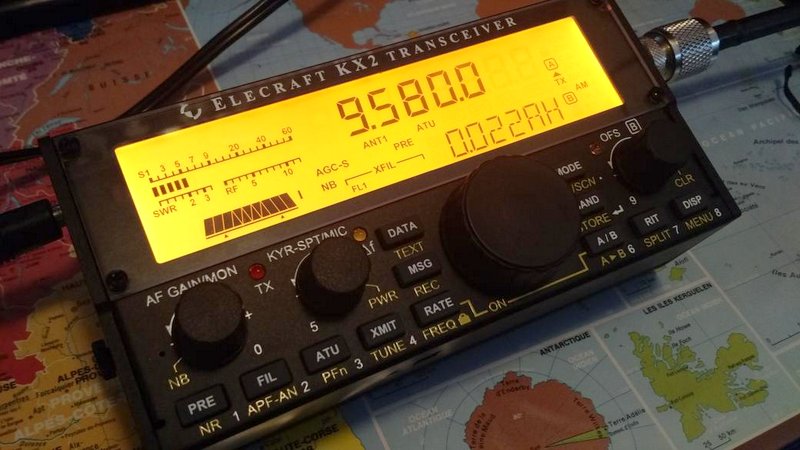
The Elecraft KX2 now has AM mode!

Elecraft-KX2-6

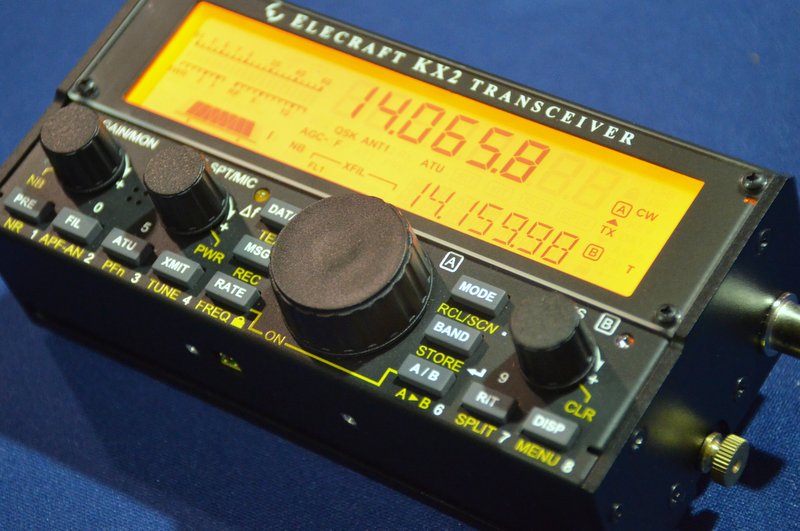
The Elecraft KX2 at the 2016 Hamvention

Many thanks to a number of SWLing Post readers (including, Eric, Dave, Jim and Greg) who shared the following message from Wayne (N6KR) on the Elecraft message boards:

We added AM mode to the KX2 today, both transmit and receive. Its primary purpose is for SWL (short-wave listening), i.e. copying commercial AM stations. (Remember that the KX2’s sensitivity drops off rapidly below 2 MHz due to protective high-pass filtering, so it wouldn’t be your first choice for AM brodcast-band DXing.)

AM transmit is far less efficient than SSB, so it would typically be used only if the target receiver can’t demodulate SSB, or for special applications. For example, there’s some AM activity and experimentation in the ham bands, notably around 3.870 kHz at night. I’ll have to drop in with 10 watts (carrier + sidebands) and get a report 🙂

While the KX2 was optimized for SSB, AM mode sounds fine, and of course is easier to tune than when using SSB modes with AM. In AM mode, the operator can select 1, 5, 9, or 10 kHz steps for course tuning using the VFO CRS menu entry. (Yes, some countries use 9 kHz intervals between stations.)

If you’re interested in testing AM mode on the KX2, please email me directly.

73,
Wayne
N6KR

On Sunday, I ordered a KX2 (with ATU, rechargeable battery pack, quick charger and paddles)–it should arrive next Monday. First thing I’ll do is upgrade the firmware so it’ll have AM mode.

Many thanks to Wayne (N6KR) for putting this KX2 upgrade at the front of the (long) line of requests.  I’ll be reviewing the KX2 for the November issue of The Spectrum Monitor magazine and, as an avid SWL, AM mode adds an important dimension to my evaluation. (Truth is, I know that Wayne has a soft spot for SWLing too.)

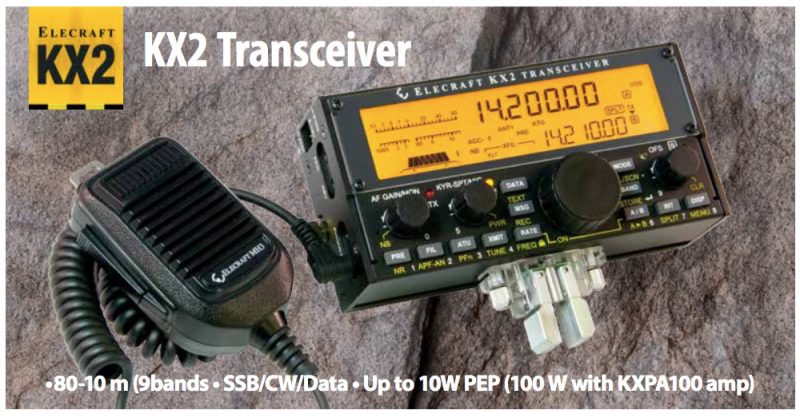
Elecraft-KX2-Data-SheetClick here for a previous post with more information and photos of the Elecraft KX2.

Click here to view the KX2 on Elecraft’s website.

Details Emerge: The PantronX Titus II DRM Portable Receiver

TitusII-DRM-Receiver

Many thanks to SWLing Post contributor, Harald Kuhl (DL1ABJ), who shares more details about the new Titus 2 DRM receiver via the DRM Consortium Chairman, Ruxandra Obreja:

NEW DRM RECEIVER UNVEILED at HFCC MEETING IN MIAMI, FLORIDA THIS WEEK!

The HFCC meeting is being held 22-26 August in Miami and on this occasion there was a live DRM transmission form Radio Vaticana received on  the new Titus2 DRM receiver (pls. see attached document with picture and details) http://www.drmna.info/.

Here is also a little testimony of how this prototype to be sold “at under 100 dollars” performed from Ray Robinson, Operations Manager at KVOH (Voice of Hope / Voz de Esperanza):

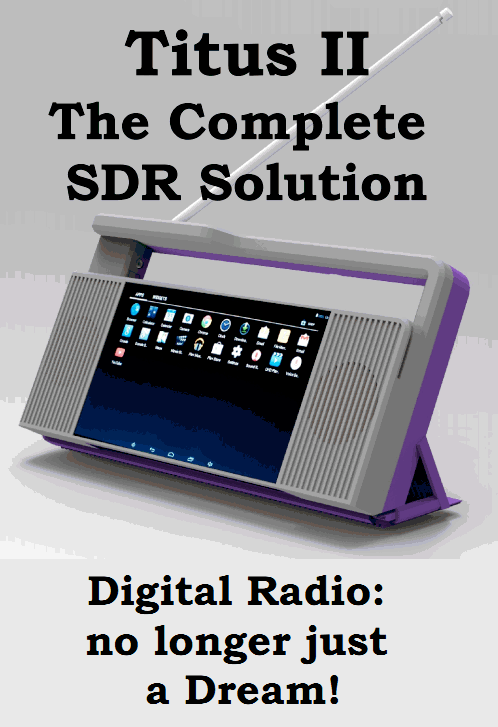
I’m currently at the HFCC conference in Miami, and reception of the DRM broadcast here this afternoon was very successful.  Reception was made outside the hotel on two receivers – a  NewStar DR-111 and a brand new pre-production receiver from Pantronix called the Titus 2, with a cluster of attendees gathered round taking photos and videos.  The latter receiver is based on an Android tablet in a stereo radio format with one speaker each side of the central horizontal tablet.  Reception on both radios was solid throughout, on a day when analog reception on 16m was plagued with a lot of atmospheric noise.  We haven’t done detailed calculations, but figure there were probably at least three hops from Italy to Miami, and for a daylight path, the reception quality was nothing short of astounding.

Click here to download the Titus II PDF brochure.

TitusII-DRM-Receiver-Specifications

The PantronX Titus II: A New DRM Receiver

titus 2 big

I had heard rumors that a new DRM receiver was in the works, but had not yet seen any specifications. DRMNA.info has just posted a few specs:

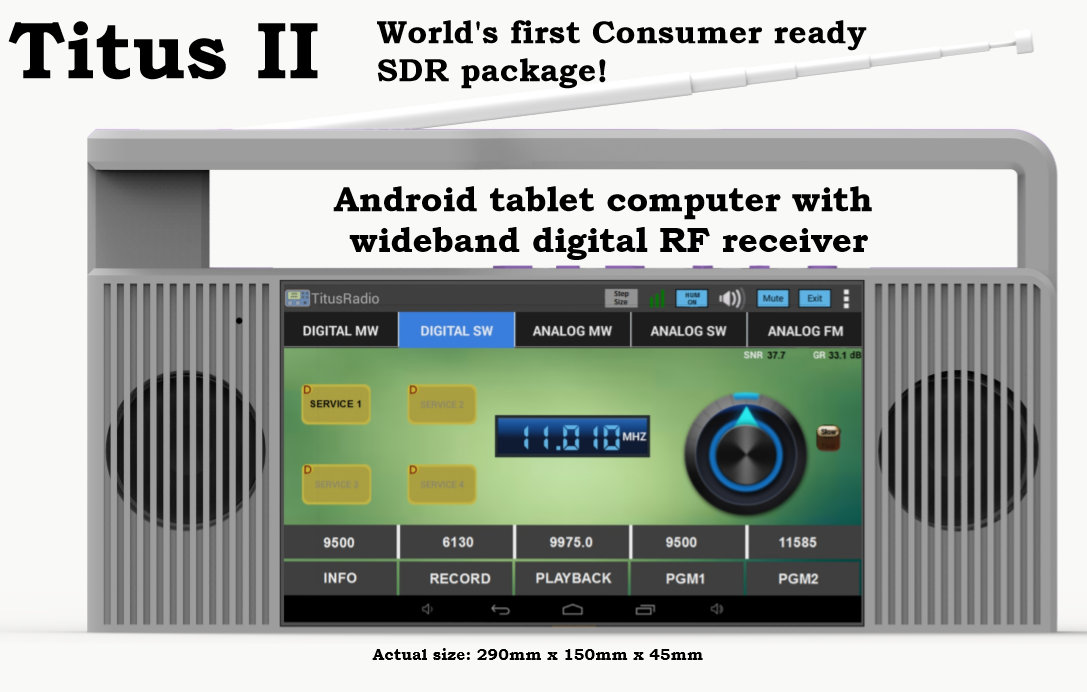
The PantronX Titus II is actually a full SDR solution in a boombox case. Few details yet, but it is running Android, has a 100 kHz to 2 GHz receiver on-board and decodes AM, FM, SSB and DRM natively.

It uses a Quad-core Arm A53 @ 1.2 GHz, 1 Gig of RAM and 8 Gig of on-board Flash. 7″ TFT display and supports Android 5, 6 or custom remixes.

Click here to read the full post at DRMNA.info…

Creating a global network of inexpensive remote SDRs

U_Twente_SDR

Many thanks to SWLing Post contributor, Mark Fahey, who replies to Ivan’s preliminary review of the V3 RTL-SDR dongle:

With Shortwave SDRs (the receiver dongle) now costing less than $20, the time has come for us to set up a global group of receivers that we can all log into at will!

RTL-SDR-RTL2832U-e1471375714199Have a look at SDR.hu – here you can put your SDR dongle on line and share it with anyone and they have full control of the receiver just as if it was in their own shack.

Imagine receivers scatted around the world – South America, Tropical Asia, Africa! The cost is now virtually nothing, all that is needed is the dongle, antenna (doesn’t have to be anything special – even a long wire or whip) and a small low cost CPU (Raspberry Pi for example).

Anyone else interested in this dream? Lets get together, get some receivers setup and then talk about our experience in a kick-ass presentation at the 2017 SWL WinterFest in PA!

Also… I am very soon to receive my KiwiSDR matched to a BeagleBone CPU. It will be online at SDR.hu and four remote listeners will be able to tune the full shortwave bands independently, its like my own Twente setup! Heaps of others are getting receivers online in the next few months with KiwiSDRs, this is going to be totally amazing!

I agree, Mark! While there is already quite a network of remote SDRs and receivers in the world, the barrier of entry keeps getting lower and lower. It’s hard to imagine that $25 can buy an SDR that natively covers the shortwave and mediumwave bands!

There’s only one other requirement for an online SDR that Mark didn’t mention: a decent Internet connection. Sadly, this is the only thing keeping me from hosting a remote SDR here at my home. I considered purchasing a KiwiSDR like Mark, but my upload speed (0.2-0.3 mbps) is so terrible and so unreliable that I could only host one listener at a time at best. You can bet that as soon as my ISP upgrades our service, I’ll launch a web SDR as well.

Of course, I’m willing to bet that most SWLing Post readers have more than enough bandwidth to host a $25 remote receiver! Let’s make Mark’s vision a reality!

Ivan’s preliminary review of the new RTL-SDR dongle on shortwave/mediumwave

RTL-SDR-RTL2832U-e1471375714199Many thanks to SWLing Post contributor, Ivan Cholakov (NO2CW), who shares the following video review of the new RTL-SDR dongle on the shortwave and mediumwave bands.

Ivan notes:

This is daytime reception comparison. Nighttime could be a different picture. [The RTL-SDR dongle] tunes and frequency is 100% on spot.

Using SDR Sharp you have several AGC settings to play with and find the best combination. The best setting seems to vary with band and signal strength.

The [SDR receiver] comes with a short (20 cm) and long (120cm) telescopic antennas. Neither one is usable for HF or Medium wave.

When ordering the radio you have to get a USB extension cord for the dongle. When plugged in directly into a laptop and then antenna coax it can become bulky. You also will most likely need an SMA adapter to BNC and SO 238.

I hope this helps.

Click here to view on YouTube.

Many thanks for sharing your video, Ivan! For a $25 SDR, I’m pretty impressed so far! I’m also very curious how it will hold up to stronger nighttime signals and, especially, adjacent signal interference. I imagine it may be prone to overloading as well. Please keep us posted!

Have any other Post readers tested the new RTL-SDR dongle on HF? If so, please comment! 

Icom’s announcement includes two new receivers: the IC-R8600 and IC-R30

The IC-R8600 (Photo source: QRZ Now)

The IC-R8600 (Photo source: QRZ Now)

Many thanks to SWLing Post contributor, Dave Zantow (N9EWO), who shares the following info about Icom’s announcements at the Tokyo Ham Fair:

Well the cat is now really out of the bag now !! Icom announced 2 new RECEIVERS at the Tokyo 2016 JARL Ham Fair.

We can almost say for certain that the new IC-R8600 is a SDR based design.

[…]The new IC-R30 handheld probably is SDR too, but not sure yet. Pretty large bugger (no real good picture as of of me typing this). Will it be able to do at least P25 Phase one?

I’ll admit it: I was a little surprised to hear that Icom had announced new receivers. I’m happy to see that it’s an IC-R8500 replacement/update. I love the touch screen color display.

I also very much like the idea of a handheld wideband–possible SDR–receiver.  I did a little extra digging and found the most concrete details about the new models on Icom UK’s website:

After an online teaser campaign featuring silhouettes of mystery radio models, the secret is out and Icom Inc. has shown the very first samples of the IC-7610, IC-R8600, IC-R30 and ID-51 PLUS2 to the public at the Tokyo Ham Fair 2016 (August 20-21, 2016). Details are relatively scarce but here are the basic details we have so far on these models.

The new IC-7610 (Photo: Icom UK)

The new IC-7610 (Photo: Icom UK)

IC-7610 HF/50MHz Transceiver (Base Station)
The IC-7610 is the successor to the IC-7600 and will be a dual-watch capable HF+50MHz 100W base station with built-in antenna tuner. The LCD will be touch screen and you will be able to connect an external display.

IC-R8600 Wideband Receiver (Base Station)
The IC-R8600 replaces the IC-R8500 wideband receiver and will feature the technology incorporated into Icom’s best selling IC-7300. The IC-R8600 will be able to receive a wide frequency range from 0.01-3000MHz frequency in analogue and various digital modes (D-STAR, P25, NXDN and dPMR). The IC-R8600 will feature a larger 4.3 inch touch screen display which will feature fast moving spectrum scope and waterfall display.

IC-R30 Communications Receiver (Handheld)
The IC-R30 is the successor to the popular IC-R20 compact handheld receiver. The IC-R30 can listen to two signals under certain conditions (analogue + analogue or analogue + digital). The IC-R30 will be able to decode D-STAR, P25, NXDN and dPMR digital (conventional) modes.

ID-51 PLUS2 Dual Band D-STAR Digital Transceiver (Handheld)
The ID-51 PLUS2 handportable is a special edition model which will come in several colours/patterns. The new ‘Terminal Mode’ and ‘Access Point Modes’ enable you to make D-STAR calls through the Internet, even from areas where no D-STAR repeater is accessible.

More details will be available nearer to each product’s launch. There are currently no details about pricing and availability.

Stay tuned to this website and our social media pages for further announcements.

I can’t wait to learn what the price point will be for the IC-R8600. I hope it’s at least in-line with the IC-7300 or (its predecessor) the IC-R8500. I also hope that, perhaps, the new IC-R30 will have full-mode HF capabilities.

We’ll post news about these new rigs as it becomes available–so will Dave Zantow. Stay tuned!

New RTL-SDR dongles feature HF reception

RTL-SDR-RTL2832U-e1471375714199

Many thanks to SWLing Post contributor, Aaron Kuhn, who writes:

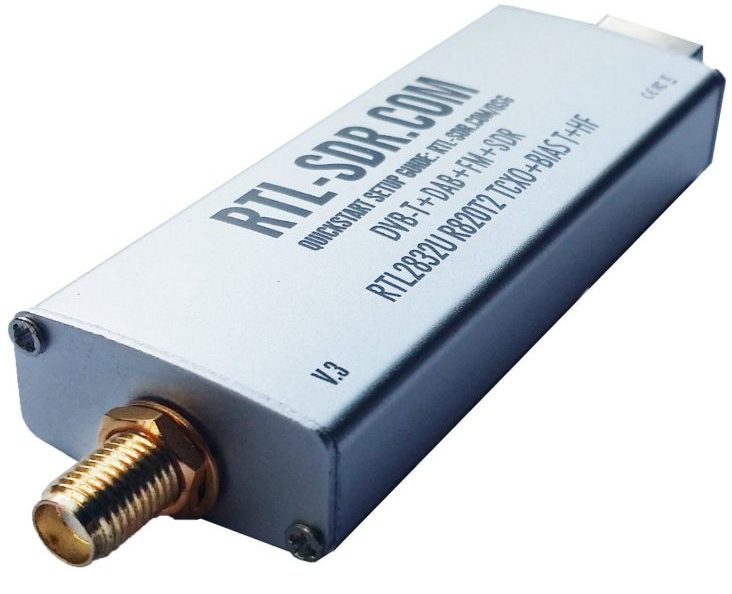
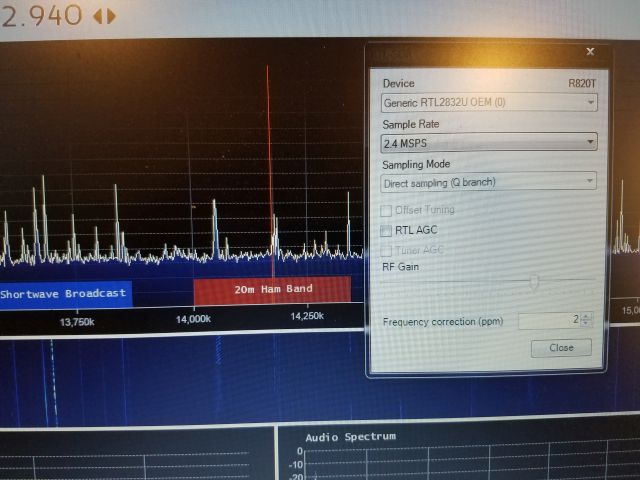
[T]he newest v3 RTL2832U USB receivers now have HF reception via Direct sampling over the SMA antenna connector directly out of the box with no hardware modding required.

I think this might make it the cheapest, out-of-the-box HF SDR possible at this point.

9:1 balun for longwire puts the whole thing under $50 still

Wow! Now you’re making me wish I would’ve waited a few more months before finally purchasing an RTL-SDR. I like the folks over at the RTL-SDR blog, so I purchased their model.

Amazingly,  the V3 RTL2832U only costs $24.95 on Amazon.com. What a value!  Anyone care to write a review of the HF performance? Please contact us.