Category Archives: News

Forbes: “How To Make Music (And Money) From Shortwave Radio”

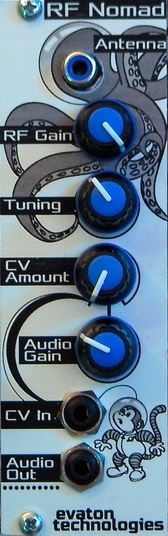
RFNomadModularGridTwo weeks ago, we posted a video of Evaton Technologies RF Nomad: a modular synthesizer that employs shortwave radio to create unique sounds. As someone who has always been fascinating with music and the sonic texture of the shortwaves, of course I find this product fascinating.

Forbes magazine does too. This morning, @UlisK3LU shared an article in Forbes where Russell Hoffman, who runs Evaton Technologies, explains why he believes using shortwave radio in new RF Nomad will be a hit:

“What’s interesting about shortwave radio is that it isn’t necessarily musical by design, but there are interesting sounds to be found when the station tuning is less than perfect,” he said. “You can hear all sorts of sounds on shortwave, from voice, to music, to Morse Code or encoded digital transmissions. In addition to the sounds that are transmitted intentionally, there are sounds that are artifacts of the medium itself like heterodynes, pops, crackles, hiss, static crashes, fading and the like.”

But here’s my favorite bit:

“Shortwave radio has a long and storied history, full of intrigue, espionage, piracy, rebellion, propaganda, and subterfuge,” he added. “It propagates around the world and can be received on inexpensive equipment. It is universal, because it can be heard anywhere; and yet at the same time, in a world of internet, TV, and satellite radio, it is also the underground — a hidden world parallel to that of our daily experiences. It offers an additional perspective.”

I couldn’t have said it better myself. Thank you, Mr. Hoffman.

Click here to read “How To Make Music (And Money) From Shortwave Radio” in Forbes magazine.

Check out Evaton Technologies and RF Nomad announcements by clicking here.
BBC World Service longevity vs. commercialization

(Image source: BBC)

(Image source: BBC)

Back in October 2010, we learned that the BBC would take over the cost of the World Service from the Foreign Office from April 2014. Shorty thereafter, the BBC World Service was dealt a 20% budget cut which eventually lead to the loss of 550 jobs. Now April 2014 is upon us.

The BBC, which is largely funded by a mandatory TV license fee, must now share its budget with the World Service. But even after the announcement of this consolidation, the TV license fee was not increased accordingly.

And then there’s another over-arching question: Will the BBC be a good steward of the World Service? BBC World Service boss, Peter Horrocks was recently asked this question by The Guardian:

“The switch from government to licence fee funding prompted fears that if the BBC faces further downward pressure on budgets – surely inevitable – it will be the World Service that suffers rather than a domestic channel such as BBC2. “Of course there may be people who make those arguments,” concedes Horrocks. But he argues that licence fee payers directly benefit from the World Service’s role as an ambassador for the UK and from its journalists who increasingly contribute to the BBC’s domestic output. Plus, it has nearly 2 million listeners in the UK every week (including its overnight broadcasts on Radio 4).”

Horrocks is being optimistic. After all, while not on the scale of the BBC, the death of Radio Canada International had much to do with the fact that the domestic news arm, the CBC, found RCI an easy cut. When the CBC was dealt a 20% overall budget cut, it cut RCI’s budget by 80%, effectively firing Canada’s radio “ambassador.”

Moving forward, the BBC World Service is dipping its feet into commercialization to prop up their relatively meager budget and to lighten the load on the TV license payee. As my buddy Richard Cuff says, this is a slippery slope–and as Peter Horrocks states, It’s not that easy to get advertising in Somalia.

If you would like to read more about the changes at the BBC World Service, check out these most recent articles:

You can also follow our tag: BBC World Service Cuts

A second life for the VOA Delano site?

VOA-Delano

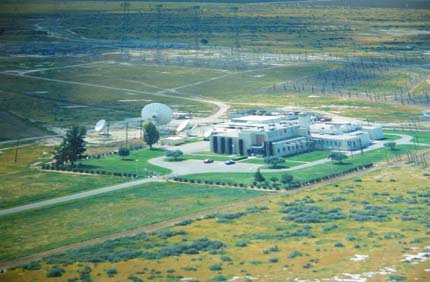
VOA Delano campus

Much like VOA Site A, the VOA Delano, California site has been turned over to the Government Services Administration (GSA). After consideration for federal use, the GSA reached out to the U.S. Department of Housing and Urban Development (HUD), who expressed an interest in the site. If approved, HUD could use the site to house the homeless or, possibly, create an affordable housing campus. We won’t know the future of the site until later this year.

Many thanks to several of you who sent a link to this recent article in The Bakersfield Californian which not only talks about the history of the Delano site, but also its future.

Though I know it’s not in the realm of possibility, I would love to see the site donated to a non-profit broadcaster or university who could carry out HF broadcasts and/or research.

On a side note, several months ago, I came across a declassified 2005 Report of Inspection for the Delano Transmitting Station. It makes for a fascinating look into Delano when it was once fully operational.

Click here to download the Report of Inspection as a PDF.

The Voice of Korea and an inspirational story

FlagNorthKoreaMany thanks to Frank, a contributor at the Shortwave Radio Audio Archive, for this recording of the Voice of Korea’s English language service.

Frank recorded VOK from his home in Europe on March 27, 2014, on 7,570 kHz, starting at 21:00 UTC, using a Kenwood R-5000 receiver and a Wellbrook ALA 1530+ antenna.

Click here to download the recording as an MP3, or simply listen via the embedded player below:

Of course, the Voice of Korea is all about broadcasting hard-core propaganda–a type of broadcast I find incredibly fascinating. But let there be no mistake, to live in the DPRK is to live under one of the world’s most oppressive regimes. If you want to hear a moving, inspirational story about one North Korean woman’s escape from the DPRK, check out Hyeonseo Lee’s: My escape from North Korea, a TED Talk:

Remember, you can subscribe and download the Shortwave Radio Audio Archive collection (free!) as a podcast via iTunes or the SWAA RSS feed.

WBCQ celebrates Radio Caroline this weekend

wbcq-logo(Source: WBCQ)

WBCQ  celebrates the 50th anniversary of the first broadcast of Radio Caroline with special programming

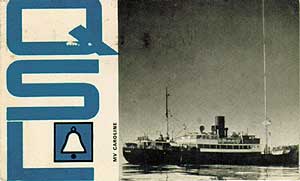
On March 28, 1964, Radio Caroline began broadcasting on 199 meters (1520 KHz) from the MV Caroline , anchored off the coast of England. Radio Caroline went on to revolutionize radio and popular music in the United Kingdom and the world, and influenced an entire generation.

WBCQ will be airing special programming celebrating the legacy of Radio Caroline and offshore free radio starting Friday night, March 28, 2014, at 8:00pm US eastern time (0000 UTC Saturday) on 5.110, 7.490, and 9.330 MHz with Allan Weiner Worldwide. Special programming will continue on 5.110 MHz following Allan’s show this evening and for the next week.

Also check out the special Radio Caroline broadcast from IRRS this weekend.

Radio Caroline shortwave special Friday/Saturday via IRRS

(Source: RadioCaroline.co.uk)

(Source: RadioCaroline.co.uk)

Many thanks to Andrea Borgnino (@aborgnino) for this tip via IW0HK:

This is the schedule of 16 Gwendoline Street and its special sixty minute program on Radio Caroline’s on the air on March 28-29, 2014 on IRRS-Shortwave and Medium Wave frequencies:

Fri March 28, 2014:
19:00 UTC / 20:00 UTC on 7120 Shortwave & 1368 kHz Medium Wave 22:00 UTC / 23:00 CET on 1368 kHz Medium Wave

Saturday 29 March, 2014:
00:30 CET (23:30 UTC on previous day) on 1368 kHz Medium Wave 06:30 CET / 05:30 UTC on 1368 kHz Medium Wave 10:00 CET / 09:00 UTC on 9510 kHz Shortwave & 1368 kHz Medium Wave 22:30 CET / 21:30 UTC on 1368 kHz Medium Wave

Audio will be also available on streaming at:

http://mp3.nexus.org:8000/irn.mp3.m3u

or at:

http://mp3.nexus.org (IRRS / EGR audio link)

Click here to read our previous post regarding Radio Caroline’s 50th anniversary.

Happy 50th, Radio Caroline!

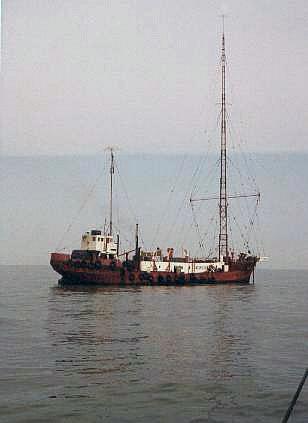
The MV Mi Amigo, c. 1974, which had been used as the home of Radio Caroline South from 1964-1967 (Photo: Albertoke from NL)

The MV Mi Amigo, c. 1974, which had been used as the home of Radio Caroline South from 1964-1967 (Photo: Albertoke from NL)

I wish my schedule and travel funds would have allowed me to attend Offshore Radio Day 2014, held in the Netherlands last week. Fortunately for those of us who couldn’t attend, Jonathan Marks posted an excellent set of photos and commentary from the event.

Of course, Radio Caroline dominated the show–after all, she turned 50 this year. Yesterday morning, I noticed an article from ITV, whose first paragraph sums up the impact of the offshore radio movement created by Radio Caroline:

“Precisely 50 years ago this Friday, test transmissions began for a radio station that would help to change the face of broadcasting across the UK. It would shape the laws of our land, and make superstars of the people on air. That radio station was Caroline – an unlicensed, “pirate” broadcaster, transmitting from a ship anchored just outside British waters.”

Read the full article here.

If you’ve been an SWLing Post reader for long, you’ll know how much I dig pirate radio. Not only are pirate stations great fun to hunt down and listen to on the radio, but these stations are still movers, shakers, and innovators in a world where large media conglomerates buy up and attempt to control local radio markets.  Pirates prevent the homogenization of our radio landscape, with offerings of genuine musical diversity.  Indeed, I’d wager that I’ve purchased over a dozen highly varied songs and/or albums on iTunes and Amazon, truly unique music, all brought to my attention by shortwave pirates.

So raise your glass to Radio Caroline this week! Long may she sail.  If you’d like to learn a little more about RC‘s history, check out some of these links: