Shortwave listening and everything radio including reviews, broadcasting, ham radio, field operation, DXing, maker kits, travel, emergency gear, events, and more
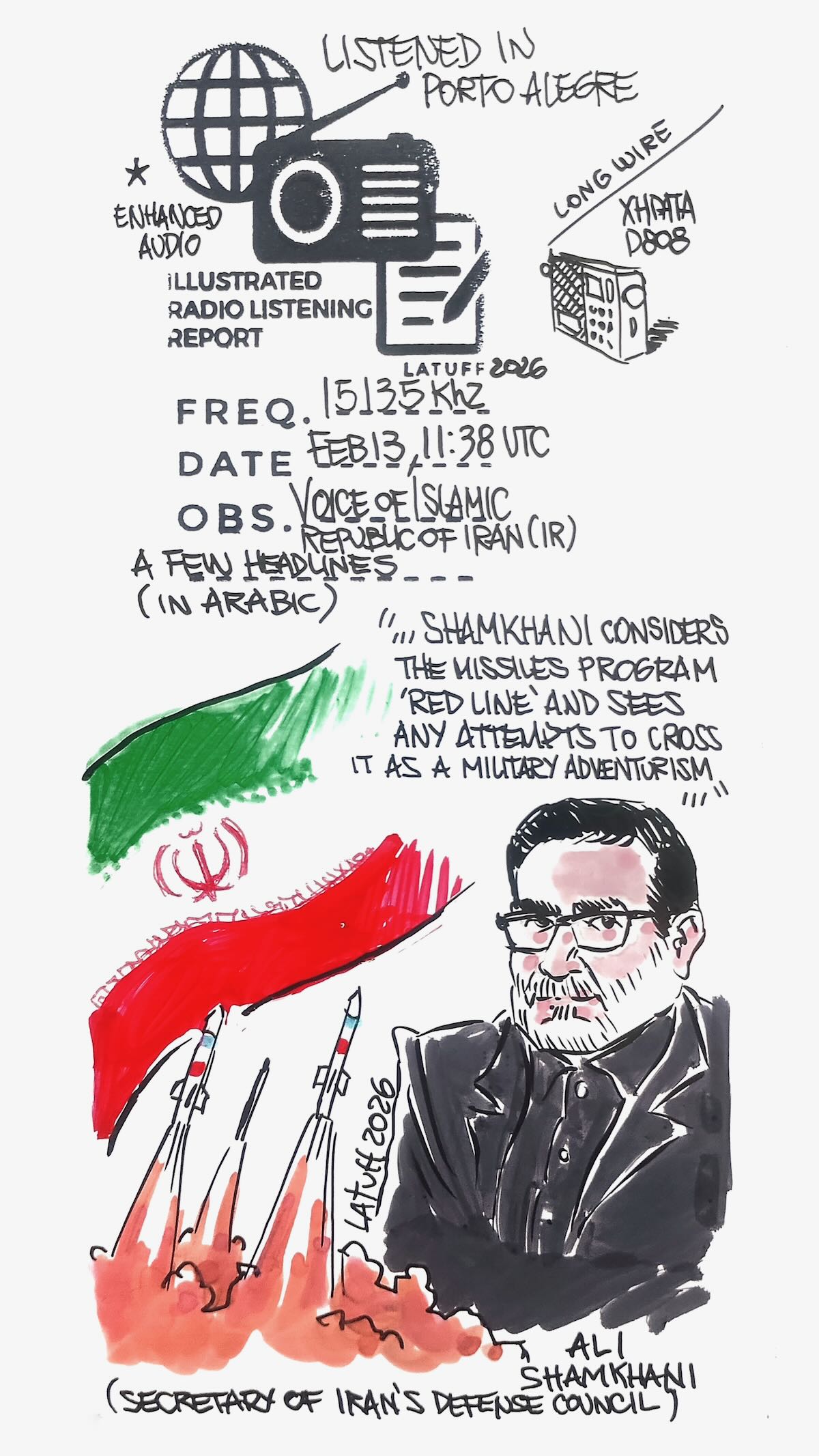
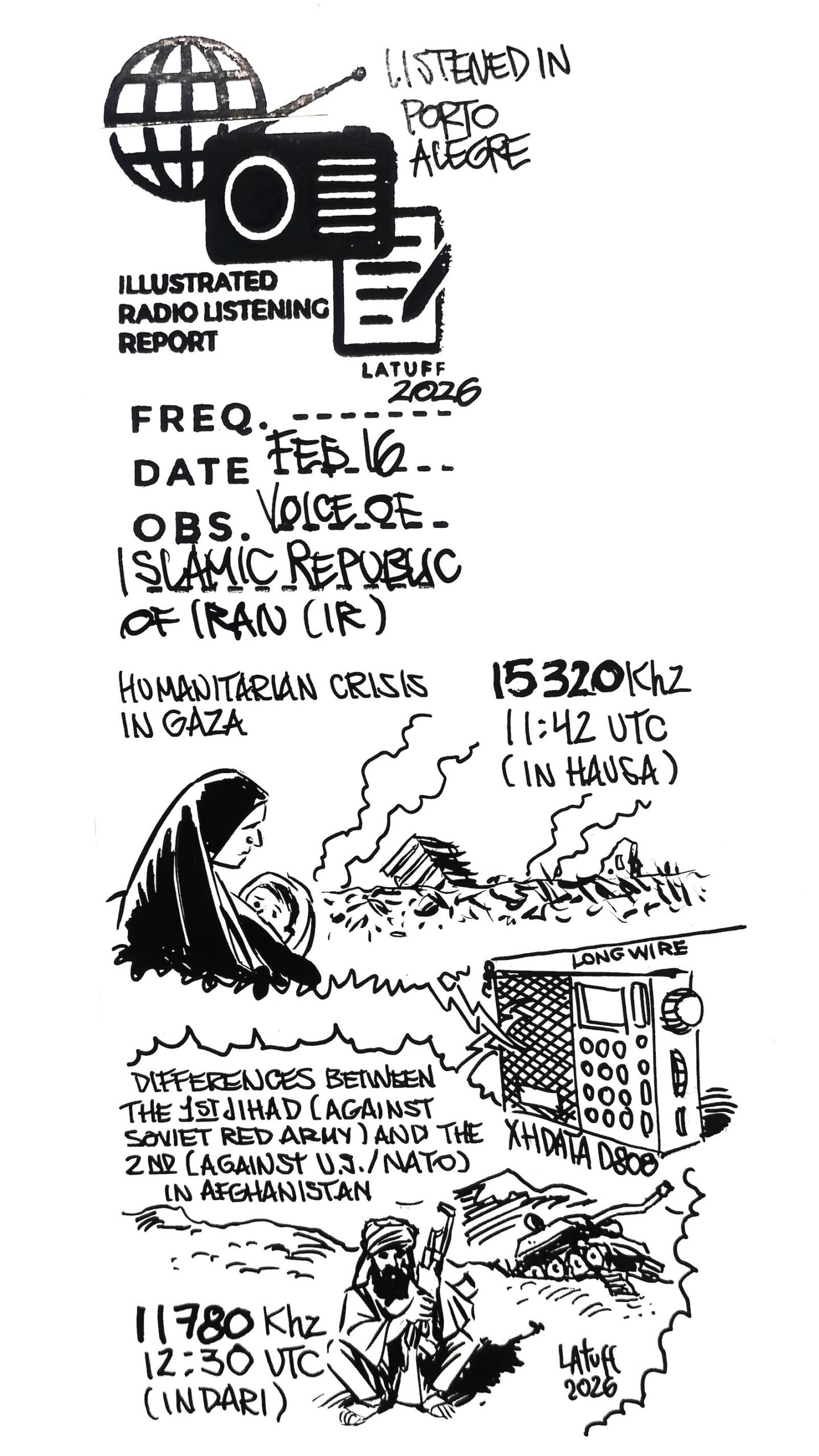
Many thanks to SWLing Post contributor and noted political cartoonist, Carlos Latuff, who shares the following illustrated radio listening report of a recent Voice of Islamic Republic of Iran broadcast.
Carlos notes:
Voice of Islamic Republic of Iran (in Hausa and Dari)
Many thanks to SWLing Post contributor Don Moore–noted author, traveler, and DXer–who shares the following post:
A Beginner’s Guide to ALE: Part Two
By Don Moore
Don’s traveling DX stories can be found in his book Tales of a Vagabond DXer[SWLing Post affiliate link].If you’ve already read his book and enjoyed it, do Don a favor and leave a review on Amazon.
In the first part of this series, I explained what the digital ALE mode is and looked at an easy way to get started monitoring ALE stations. In part three, I’ll look in detail at the dozens of countries and hundreds of stations that can be logged in ALE mode. But first, let’s look at a way to let software do the hard work in adding those hundreds of stations.
The Black Cat Approach
Run by longtime DXer Chris Smolinski, Black Cat Systems is a provider of over two dozen quality software programs for radio hobbyists. The one we’re interested in is the Black Cat ALE Vacuum Cleaner. The name describes exactly what it does. The user feeds it a large number of SDR spectrum recordings, and the Vacuum Cleaner sucks up the ALE DX and lists them in a file.
Let’s step through the basics of using the program. But first, you need at least an hour or two of SDR spectrum recordings covering frequencies with lots of ALE traffic. Some of my favorite ranges are 7500-9200 kHz, 10100-11500 kHz, and 15500-16500 kHz.
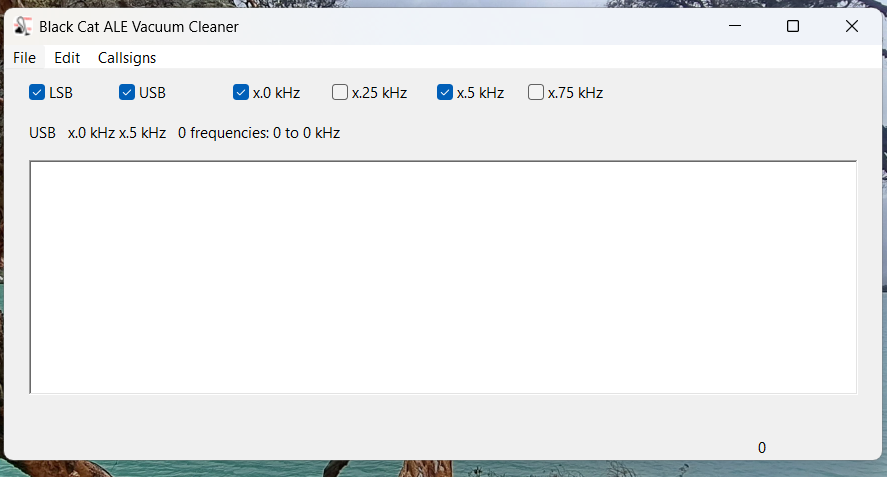
Here’s the main screen on the Vacuum Cleaner:
I recommend you check both USB and LSB. In the logs reported to the Utility DXers Forum, about 97% of all ALE transmissions are in USB mode. From my experience, if LSB is unchecked, the Vacuum Cleaner will step through the files about twenty percent faster, but you will miss a tiny number of stations.
The kHz settings determine how finely the application will tune in looking for ALE signals. I recommend just checking x.0kHz and x.5kHz. Almost all ALE signals on shortwave are transmitted on frequencies that end in either point-zero or point-five kilohertz. The main exception is the US Department of State, which uses frequencies ending in point-six kilohertz (e.g., 8058.6 kHz). Fortunately, the one-hundred Hertz difference from the point-five kilohertz setting isn’t enough to make a difference except maybe with the weakest of signals.
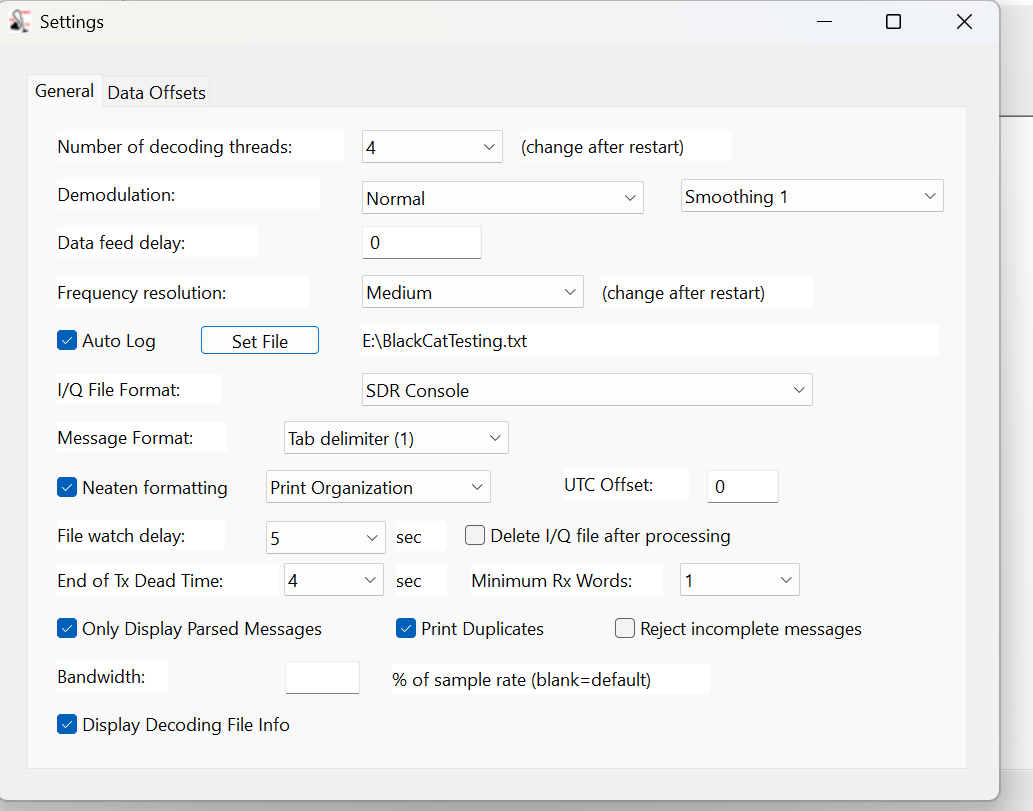
The next step is the Settings, which are found under the Edit menu. Most values can be left at the defaults.
At the top, the number of decoding threads should be no more than the number of cores that your CPU has. Check the Auto Log box, then enter a destination path to record logs to a file. (Otherwise, the logs that show up in the window will be gone when you close the program.) Next, select the file format of the SDR program used in making the I/Q recordings. Finally, set the file format for your logs. I prefer the single tab format so that I can later import the logs into Excel and sort by frequency.
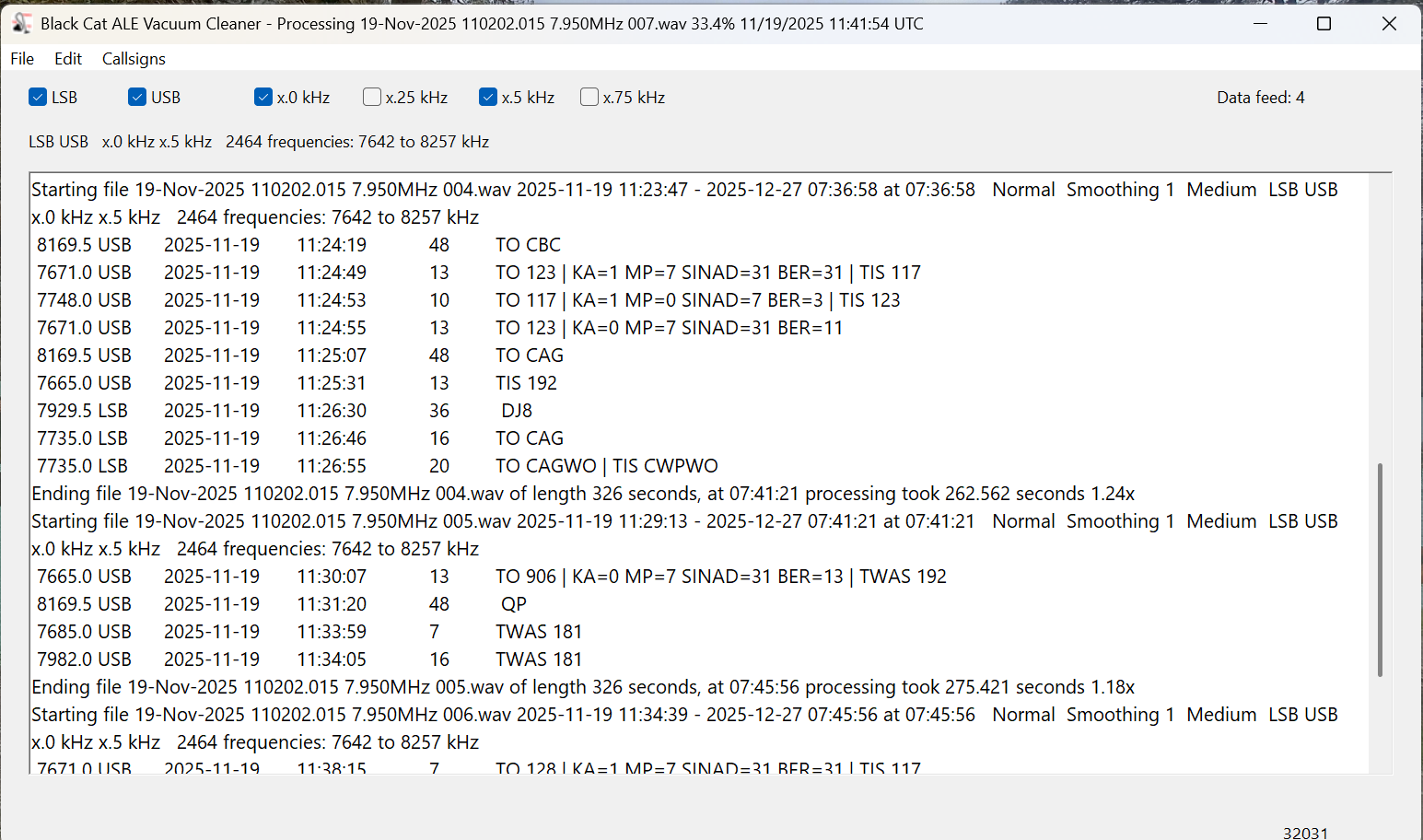
Now it’s time to decode. Under the File menu, select Open I/Q Files and browse to a folder of spectrum recordings to decode. Click on Open in the file selection box, and the Vacuum Cleaner will start decoding the files. Now take a break and come back in fifteen or twenty minutes. The main screen should look like this.
The current settings and the frequencies being scanned are displayed at the top, under the settings checkboxes. There are actually only 1232 distinct frequencies in that range, but the number is doubled as each one is being checked in both LSB and USB. Below that, the output window lists each file as it is being scanned and ALE logs as they are found. (But be sure you are also recording these to a text file.)
To see a list of files still in the queue, select File > Show I/Q Files Awaiting Processing. After a few files have been processed, this will also show an estimate of how much time is needed to complete the queue. To add additional files to the queue, select File > Pause Processing, add the files, and then select File > Resume Processing. Note that the Vacuum Cleaner processes files in date/time order. If you add files that were recorded earlier, they will go to the front of the queue.
How Long Does This Take?
In the above image, notice that after each file is finished, the time taken to decode it is displayed. These files were all exactly 326 seconds long, and the first one took 262 seconds to decode for a speed of 1.24x actual time. That may not seem important, but it depends on how much you have to decode. In a couple of days of serious DXing with my three Airspy receivers, I can easily accumulate a couple of terabytes of spectrum recordings.
Processing time depends on several factors. The first is the bandwidth/sampling rate. Those files above were recorded with SDR-Console at 768 kHz wide. All other things being equal, a narrower sample will process faster and a larger one more slowly. Depending on the band being monitored, I sometimes record with my Airspys at the 912 kHz bandwidth. Those typically take about 25% longer to decode than 768 kHz files.
Another factor is whether or not the Vacuum Cleaner has to share processing power with other running applications. That slows things down. I mostly decode overnight or at times when I’m not otherwise using the laptop. Under those conditions, my 768 kHz files decode at 1.75x and my 912 kHz ones at 1.45x. But those numbers are for my nearly four-year-old main laptop. An older laptop I have at home tops out at around 1.40x on 768 kHz files with nothing else running. If you have a high-performance gaming laptop, you should get much better numbers than I.
Then there are differences between the various SDR applications in how they store data. I won’t go into the technical details that Chris explained to me, but SDR-Console is more efficient in this regard. In my own testing, I found that files of similar bandwidth and time length recorded with SDR-Console decode at least fifty percent faster than those recorded with the default Elad and Perseus software. I’m satisfied with SDR-Console, so I haven’t tried any other programs. If you have other favorite SDR applications, I suggest doing some comparison tests to see what works best for you.
One application that you shouldn’t use is HDSDR. Chris didn’t have good documentation on the file format for this one and wasn’t fully successful in reverse-engineering it. The Vacuum Cleaner will work with HDSDR, but almost all the callsigns that it finds will be errors. And that brings us to an important question.
How Accurate Is It?
When I started using the Vacuum Cleaner, my main concern was whether it would miss valid signals. There was only one way to find out, so I ran several tests. I would give the Vacuum Cleaner a few hours of I/Q recordings to decode, and then I would process the same recordings manually using Sorcerer, as described in part one. Black Cat not only correctly identified every single ALE transmission that I found with my eyes but went way beyond that. It also found and decoded weak and noise-covered signals that I couldn’t see in the Data Analyzer window but were there when I played them back.
As Chris points out in his documentation, the emphasis on weak signal detection does cause the application to sometimes falsely report bogus callsigns. Some of these are produced by random noise, fooling the system. Others come from poorly received signals. He could have taken a ‘high confidence’ approach and only presented callsigns that had been clearly received. But that would have meant some valid callsigns not being reported. Instead, he went with displaying everything. It’s up to the user to weed those out.
If the decode doesn’t contain any of the keywords (TO, TIS, and TWAS) then it’s probably an error. But poorly received signals can cause partial and incorrect callsigns to be reported with a keyword. Spotting those just takes the knowledge and practice that comes from using the program and ALE reference materials. (That’s the topic of part three.)
Is It Worth the Price?
Black Cat ALE Vacuum Cleaner is a high-quality software available for Windows and macOS, and you can try it before buying. The cost is $99.99.
Is it worth it? If all you want to do is sample what ALE is all about, then probably not. But if you get serious about ALE monitoring and want to add hundreds of ALE stations to your logbook, this is the way to do it. I am 100% satisfied with the Black Cat ALE Vacuum Cleaner. I’ve decoded several thousand hours of I/Q files with it over the past few years. (When running multiple SDRs at a DXpedition, it’s easy to accumulate seventy or eighty hours per day.) The program also has a few other tricks I haven’t covered. For example, it is possible to actively monitor a folder and decode I/Q recordings as they are created.
In part three of this series, I’m going to take an in-depth look at the countries and stations that can be logged in ALE mode. Once you’ve seen how much DX there is to log, you might just be convinced, like me, that the program is worth the price. And you married guys can tell the wife that you’re buying a new vacuum cleaner that only you will use, hi!
The Vacuum Cleaner isn’t the only program that Chris has for ALE monitoring. Black Cat ALE is a different program that does live monitoring of up to twenty-four ALE frequencies simultaneously with SDR-Console, assuming your laptop has the resources to handle that.
Finally, Chris tells me that he’s been experimenting with using the Vacuum Cleaner with wide-bandwidth I/Q recordings on high-end laptops. On his M4 Max MacBook Pro, he’s able to process 32-MHz wide recordings at about 0.50X real time and 16-MHz wide recordings at about 0.97X real time. As he says, it won’t be long until it will be possible with the right equipment to monitor the entire HF spectrum for ALE signals in real time. And that will be fun!
Whenever I ask myself that question, I can’t help thinking of a couple analogies. Let me explain one. In the mid-80s, there were three contenders for the home computing market: IBM, Apple, and Commodore. There were others, but those were the main ones. It was not uncommon for entrepreneurs to rent out halls and host fairs at which vendors for all three platforms would display the latest peripherals and software. The IBM PC was incompatible with the Apple IIe; each, in turn, was incompatible with the Commodore 64. Most of the software came at premium prices. Why? I was told that developers had to recoup their cost from the existing group of owners of each specific platform. Being the early days of home computing, these groups were relatively small, and consequently, this determined the cost of software. This situation was euphemistically known as the “installed base” ? an existing population of users who owned computers for the targeted software.
Applying this to radio, is there an installed base to warrant more international shortwave broadcasting? From all appearances, there are more shortwave radios being marketed now than I can ever recall. I searched for “shortwave radios” on Amazon, hoping to get a reasonable model count, but soon gave up.
Without getting into the politics of the issue, the Chinese are the dominant player in shortwave use today. They are making most of the shortwave radios and doing most of the shortwave broadcasting. The targeted audience is both domestic and international. The radios they make are marketed around the world, apparently quite successfully. An AI inquiry on the Internet can’t put a number on it, but states that there has been a resurgence of interest in shortwave, particularly since the COVID-19 pandemic and subsequent global conflicts. Isn’t it reasonable to assume there is now a sizeable installed base of potential shortwave listeners?
If I may be allowed one more analogy, in 1950 the physicist Enrico Fermi asked the cosmic question, “But where is everybody?” He was referring to the scope of the universe, the real probability that there are enough other habitable planets such that some others should support life. His paradox is that we have not yet heard from anyone else.
Again, translating this to radio, given the proliferation of shortwave radios and listeners, where are all the broadcasters? Hasn’t the quality, performance, reasonable cost, and availability of shortwave radios been the seed to start the resurgence of shortwave broadcasting?
The well-worn argument is that times have changed. We now have the Internet and cell phones to instantaneously bring us an incomparable mass of information and entertainment, all of this on demand. Why contend with noise, interference and weak signals? Why wait for desired content to be available on a certain day at a certain hour? Further, and just as important, public broadcasting is costly in terms of production and delivery. To put a face on it, shortwave radio does not permit one to fasten a $200 GoPro to the front of his bicycle, video his ride, post it on YouTube, and garner thousands of likes.
All of that is strong poison. On the other hand, radio waves are an immutable form of electromagnetic radiation. The medium is not going away. With a high degree of certainty, it will eventually be repurposed, possibly in digital form or with some method of modulation which is yet unknown. The content may be commercial, military, private, or public. Someone is going to figure out a way to use it.
In the meantime, why can’t we use it just the way it is? One advantage of radio is real-time broadcasting – talk radio, spontaneous news reporting, and emergency information. While this is possible on the Internet, its implementation has been tangential. For example, I can go for a live cab ride with a truck driver, watch trains run around Horseshoe Curve, or listen to a techno-specialist field viewer questions – all live it’s true, but still not quite the same thing. Perhaps it is just a matter of time for the Internet to catch up.
The Internet is better for drawing maps and ordering products for home delivery. Ultimately, however, it fails to engage the imagination. Instead, the world is presented to us in vivid color leaving no detail in question. With radio, the listener’s faculties are permitted much wider freedom. One is allowed to color between the lines, “a fiery horse with the speed of light, a cloud of dust…” Even the fading or hollow aural echo of a distant shortwave signal can stimulate further vision. That is radio’s ace in the hole. It just needs the initiative of one visionary to give the ball a push and start it rolling.
Many thanks to SWLing Post contributor Dan Robinson, who shares the following review:
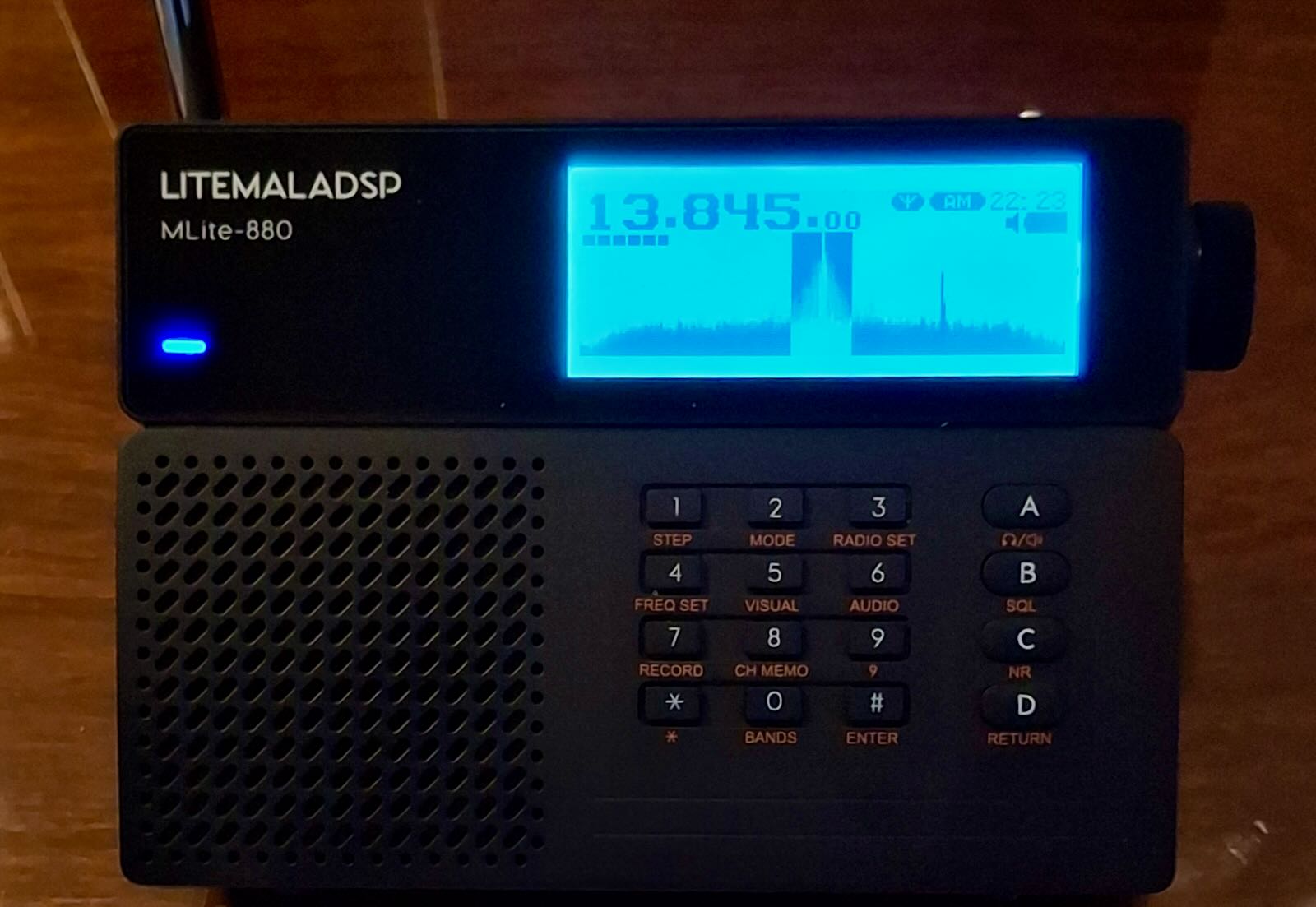
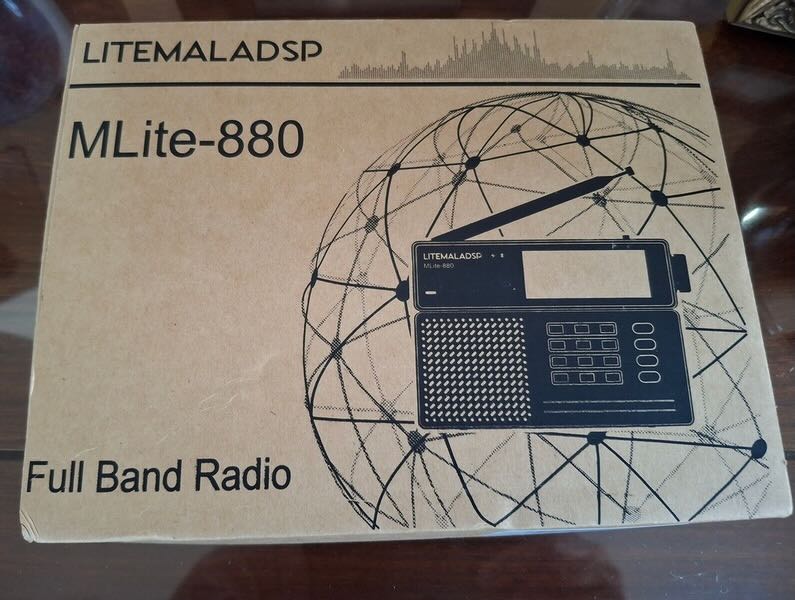
MLite-880 Spectrum Display Portable: Advanced SDR Performance in Traditional Portable Clothes
by Dan Robinson
For years, radio listening hobbyists (as many of us who are still around in 2026) have had numerous choices when it comes to portable receivers. Those of us who got our start as DX’ers/SWLs in the 1960’s (some earlier) or 1970’s have seen a lot of hardware come around the corner.
Some years ago, the Malahit/DSP receivers, firmware, and hardware designed and made in Russia appeared. There was the Belka, amazingly small but a superb receiver that many of us still use. Although shortwave broadcasting has generally been on the decline, we were lucky that companies such as Tecsun, Sangean (reported to have now stopped all production of SW portables), and other China/Taiwan-based companies continued to make impressive portables.
ICOM, Yaesu and Kenwood began putting spectrum scopes in displays a long time ago. ICOM’s IC-R9000 (produced 1989 to 1998) was the first to bring that feature. The more recent Icom 7300, 8600, and 9500 demonstrated far more advanced spectrum displays, as did Kenwood. Ten Tec in its original form put rudimentary spectrum display capability in its RX-350/Jupiter receiver/transceiver.
Today, we’re seeing a number of HT units with some kind of spectrum display. The Radtel 950Pro is one example of this. ICOM’s IC-R30, discontinued but a superb wide band unit, also has a spectrum option though quite limited. Various China-based companies started putting spectrum displays into the ATS series of receivers, and scope displays became standard on transceivers by Xiegu and others.
Malahiteam in Russia licensed firmware out to a range of China-based manufacturers. The China-made “ATS” portables available from AliExpress and Banggood have been through numerous versions, including the ATS25 Pro + AIR desktop, the ATS25 Ultra, ATS25 XF (see https://www.youtube.com/watch?v=LJC-pAu4nUk), and these are increasingly emphasizing the spectrum option on the display. There have been some very interesting front panel designs such as the DP-666 based on the TF6686 chip, and the AMNVOLT ESP138, the first with dual 4732/6686 architecture (see: https://www.youtube.com/watch?v=m1njJskDSUI&pp=ygUMZXNwMTM4IHJHzGlv)
What we had not seen until recently was anyone putting a spectrum display into a “traditional” portable cabinet (some years ago, I had suggested to County Comm/Maratac which has carried a re-badged Tecsun PL-368 that they consider doing so. At one point I received from them a photo of a prototype which looked like a PL-368 with a spectrum display at the top. But to my knowledge nothing was done to advance that to market).
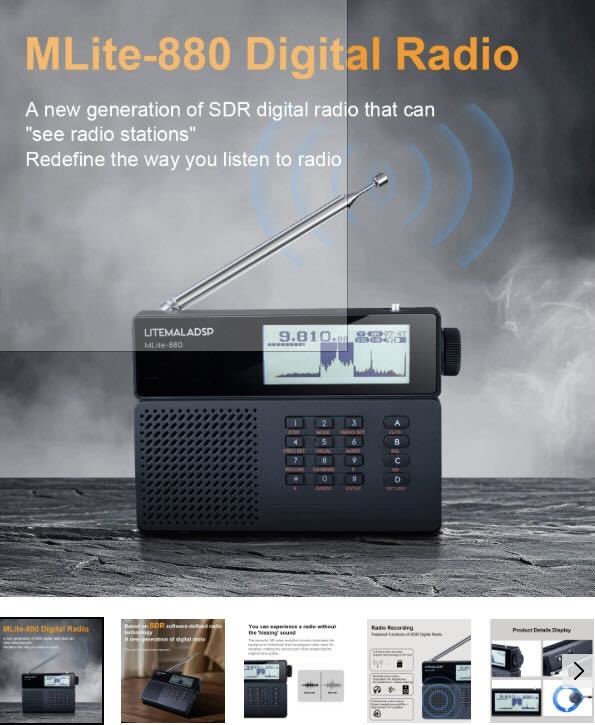
The major feature can be seen at power on. Instead of just a digital/numerical display of frequency we see the frequency AND below, a 40 kHz slice of spectrum. As the advertising description on the Elecevolve.com website states:
“A new generation of SDR digital radio that can “see” radio stations” . . . and “the radio in people’s impressions stays in the last century.”
The message that Malahiteam wants to convey is clear: this is a major step forward from portable design of the past.
The radio is very light, with a back-stand and a fairly robust whip antenna which stands at an angle when the receiver is being used with the back-stand (unfortunately, the antenna base does not allow it to go vertical).
Around the cabinet, there are a minimum of controls: on top, we have a simple power-on/off switch and a microSD slot (more about that later). USB-C and headphone jack are on the right, and an external antenna jack on the left. The frequency display module of the radio looks like just that — it’s on top above the multi-function keypad and ABCD keys. As for mode displays, there are battery and Bluetooth lights below and next to the LITEMALADSP letters. On the back, we find the 21700 battery compartment, and on the back-stand, we find information about the receiver, but no “Made in…” information whatsoever.
From the videos, and certainly from the name of the radio (LITEMALADSP) we have the impression that the MLite-880 is a cost-reduction version of the Russian DSP/2/3 receivers. Neither 4732 nor TEF 6686 chips are used. While one video review states that an MSI-SDR-M1 chip is inside, Georgiy at Malahiteam states that this is not so.
There was obviously a deliberate choice of the 21700 battery rather than 18650 used in Tecsun, Choyong, and other portables. First adopters say that so far, this battery keeps the receiver going for hours, something I can confirm. Anyone unfamiliar with professional type batteries like this should invest in a good standalone charger; if you already own a Tecsun PLxxx or D808 portable you will be familiar with 18650 and similar cells. [UPDATE]: Larger size 21700 battery does not fit — the battery provided with the radio is a EVE INR21700/50E
The inclusion of a backstand is very welcome, since Russian DSPs and China-made SDR portables often lack one. The whip antenna is not thin and flimsy like those found on some China-made small portables. There’s a mini to SMA adapter included in the box.
One reviewer notes that high-speed microSD cards are needed because files are recorded in WAV format. Georgiy at Malahiteam states that 16 and 32 GB cards have worked, BUT one user reports a 256GB card worked. Recording capability is a feature seen on other portables like the Raddy RF919. A good sized speaker is on the left. The tuning knob has a dual push-pull function for volume and frequency change.
And the radio has Bluetooth capability, which worked fine when I first tried it with a Bluetooth speaker.
In menus under “About” we see “Designed in Russia/Made in China.” I recommend that readers view the various videos available online. While I was in the process of writing, I was surprised when the MLite-880 I had ordered from Banggood showed up on my doorstep. So, I’m able to provide initial impressions, and when a second unit arrives here, I’ll do some unit-to-unit comparisons. [NOTE: Testing done using only the onboard whip antenna]
If this is supposed to be a “Lite” version of the Malahit DSP receivers, whether the original Russian-made units or those from China, that would not be apparent to someone using this receiver for the first time. Numerous options are brought over from the Malahiteam DSP. We have synchronous reception (but see below) and the ability to correct calibration variations. Recalibration and BFO fine adjust is something we see on Tecsun portables, and China-made SDRs, and the AFEDRI SDR.
I won’t list everything, but we also see Hi-Z/50 Ohm, BiasT, Attenuation, and options for adjusting display brightness, spectrum average, spectrum fill, and RDS view. That is quite a lot of flexibility and reminds me of what we find on receivers costing thousands of dollars. Under Audio settings, we see Filter Type, Filter Low Freq, Filter High Freq, and variable Noise Reduction. One reviewer asserted that NR “works significantly better than on the Russian-made DSP-3, which costs near $500,” and based on my first tests, I agree. NR runs from 0 to 15 and, once set, can be quickly activated by pressing the C button on the right labeled NR. Overall filtering ranges: 0 to 8 Hz, 0 to 12 Hz, 0 to 15 Hz for the three designated filter positions.
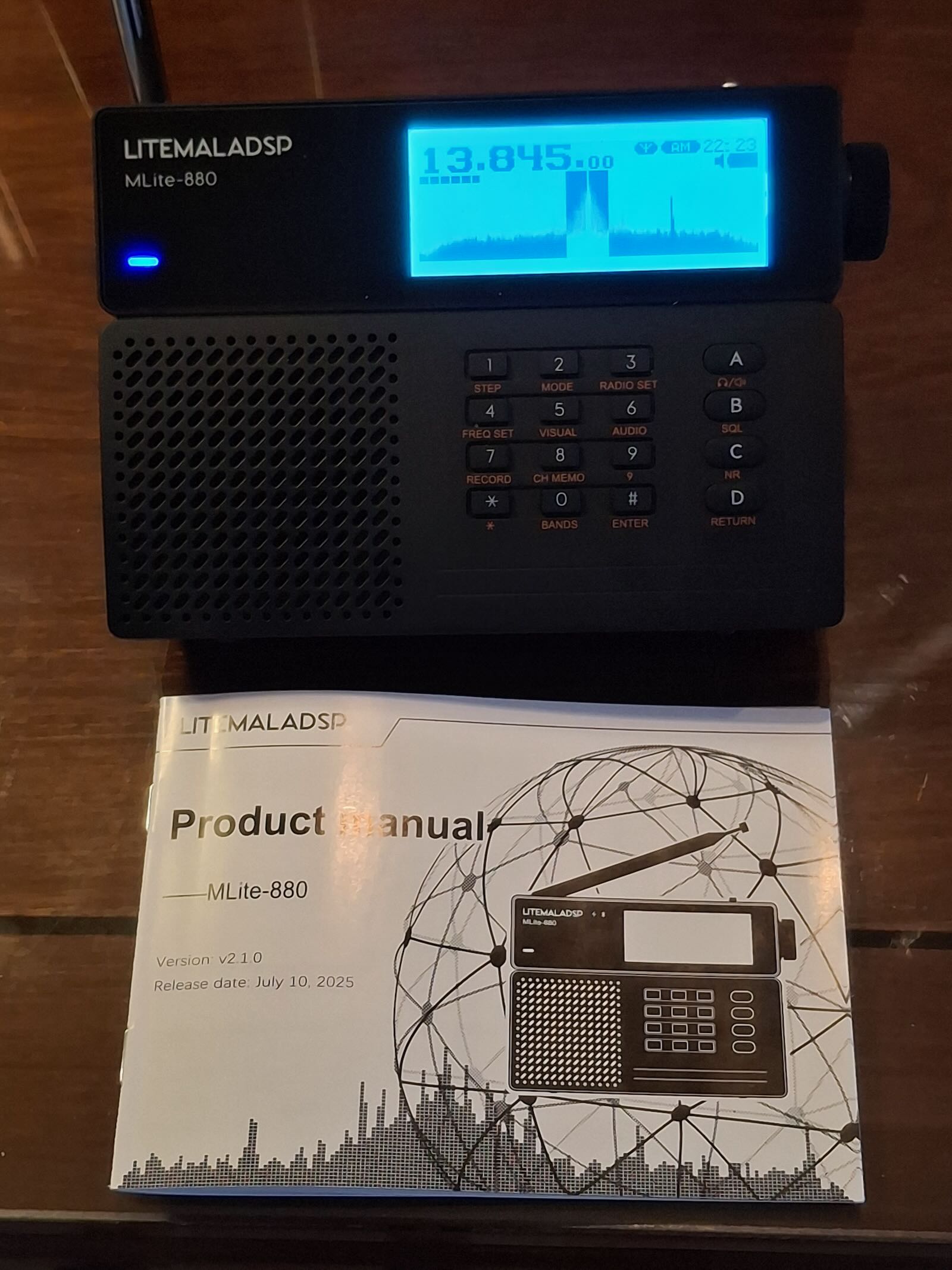
AGC settings include AGC limit, AGC gain, and manual control, all settable in dB. On a third page of options, we find NB Mode, NB Threshold, Equalizer Type, Key Beep Level, and SQUELCH Threshold. Recording is accomplished with a direct access button (NOTE: I had some problems getting record working with a 1GB microSD but switched to a FAT32 8 GB and it worked). A quite nice printed manual shows the modes: USB, LSB, CW, DSB, AM, SAM, NFM, WFM. Steps are listed as: 100 Hz, 500 Hz, 1 kHz, 2.5 kHz, 5 kHz, 6.2 kHz, 8.3 kHz, 9 kHz, and 10 kHz.
The MLite-880 contains band ranges selected by pressing the appropriate key and then A/B to scroll through those ranges. Coverage is from 100 kHz to 519 kHz, from 520 kHz to 1710 kHz, and up to 29,999khz. But one can directly enter any frequency in this entire range, regardless of the ranges. Under AMATEUR BANDS, we find 135.70 kHz to 137.80 kHz (2200m), 472 kHz to 479 kHz (630m), 1800 kHz to 2000 kHz, 3500 kHz to 3800 kHz, 5351.5 kHz to 5366.5 kHz, 7000 kHz to 7200 kHz, and on up to 29.700 kHz, with 70 mHz to 70.5, and 144 mHz to 148 mHz. Finally, FM/VHF bands include 65.9 mHz to 74 mHz (OIRT), 76 mHz to 108 mHz, and AIR band 118 to 137 mHz.
The spectrum display on the MLite-880 is 40 kHz. For most people, especially those coming from a portable with just a digital numerical readout, I don’t think this is going to be a problem. The 880 obviously has a smaller spectrum display than the full Russian DSP or Chinese-originated portables. Under VISUAL settings, we have choices of: BRIGHTNESS LEVEL, BRIGHTNESS OFF TIME, SPECTRUM AVERAGE, SPECTRUM FILL.
I have not opened my MLite-880, but RADIOCHIEF.RU on YouTube shows the cabinet back removed (around the 29-minute mark). We see extensive shielding with metal covers over key sections. Very impressive, and it finds me wishing that other manufacturers would have done this. How much better the short-lived “Elite Satellit” by Eton might have been with better internal shielding.
What remains to be seen is the extent to which the MLite-880 monochrome display throws off interference, a well-known issue with the original Russia-made Malahit units and China-made portables. See my interview with Georgiy of Malahiteam, who notes that not all noise is gone. “We weren’t able to completely eliminate the noise,” he says, adding that “it still occurs in places, mostly on the long and medium wavelengths. However, significant attention was paid to the screening, and turning off the display completely solves the issue.” The screen shutoff he mentions is accomplished as of now by pressing the “9” key.
We learn from the few available YouTube reviews that the main microcontroller in the MLite-880 is the STM32H743, which one reviewer says is “about the same as the older version in the Malahit DSP-3”. And he adds: “It’s a full-fledged SDR like the DSP-3 that is, unlike all sorts of superhet Tecsuns and DEGENs on chips with all sorts of soft mutes, the Malachite works just as well but significantly better. . .”
Unfortunately, so far we see that firmware updating is accomplished using the STMCube program used by the Russia and China units and the excellent AFEDRI. I find STMCube to be clunky and often frustrating, though it seems straightforward when explained in the ML-880 manual.
RADIOCHIEF.RU on YouTube provides a demonstration of the MLite-880, comparing it with an ICOM IC-R20 and a DSP-3. He notes that while there are flaws in the 880 they appear to be fixable via firmware upgrades. In the downloads section of the elecevolve website we see version 1.2 dated 6 February 2026. The unit delivered here has 1.1 The printed manual shows “v2.1.0 Release date July 10, 2025”. I’m not aware of videos or other online presence of the ML 880 before January 2026.
WHAT’S THE BIG DEAL?
SWLing Post readers, whether SWLs or amateur operators, may be asking what the big deal is with the MLite-880. That’s understandable, but let me explain the significance. Much as the Choyong LC-90 became the first receiver to provide HF and Internet radio in a traditional radio cabinet (though without any spectrum display), the 880 shows that placing such a display in a traditional portable cabinet has been quite possible for some time — it just took someone to go ahead and do it. Continue reading →
Many thanks to SWLing Post contributor and noted political cartoonist, Carlos Latuff, who shares the following illustrated radio listening report of a recent Voice of Islamic Republic of Iran broadcast.
Carlos notes:
Shamkhani: Our missile capabilities are non-negotiable. Voice of the Islamic Republic of Iran, 15135 kHz
To mark World Radio Day, Radio Prague International spoke with Iryna Slavinska, Director of Radio Culture – the third channel of Ukraine’s public broadcaster Suspilne. What role does radio play in war-torn Ukraine? And what can a station focused specifically on culture contribute?
Iryna Slavinska joined Radio Culture in 2018. A philology graduate, she also brings extensive experience in education and cultural work, and is fluent in French.
“For me, radio remains something very powerful, very influential and very transparent. Radio has no borders,” she describes.
This has become particularly evident since the full-scale invasion in February 2022, when, as Slavinska notes, radio often became the only Ukrainian media outlet accessible to people under Russian occupation. [Continue reading…]

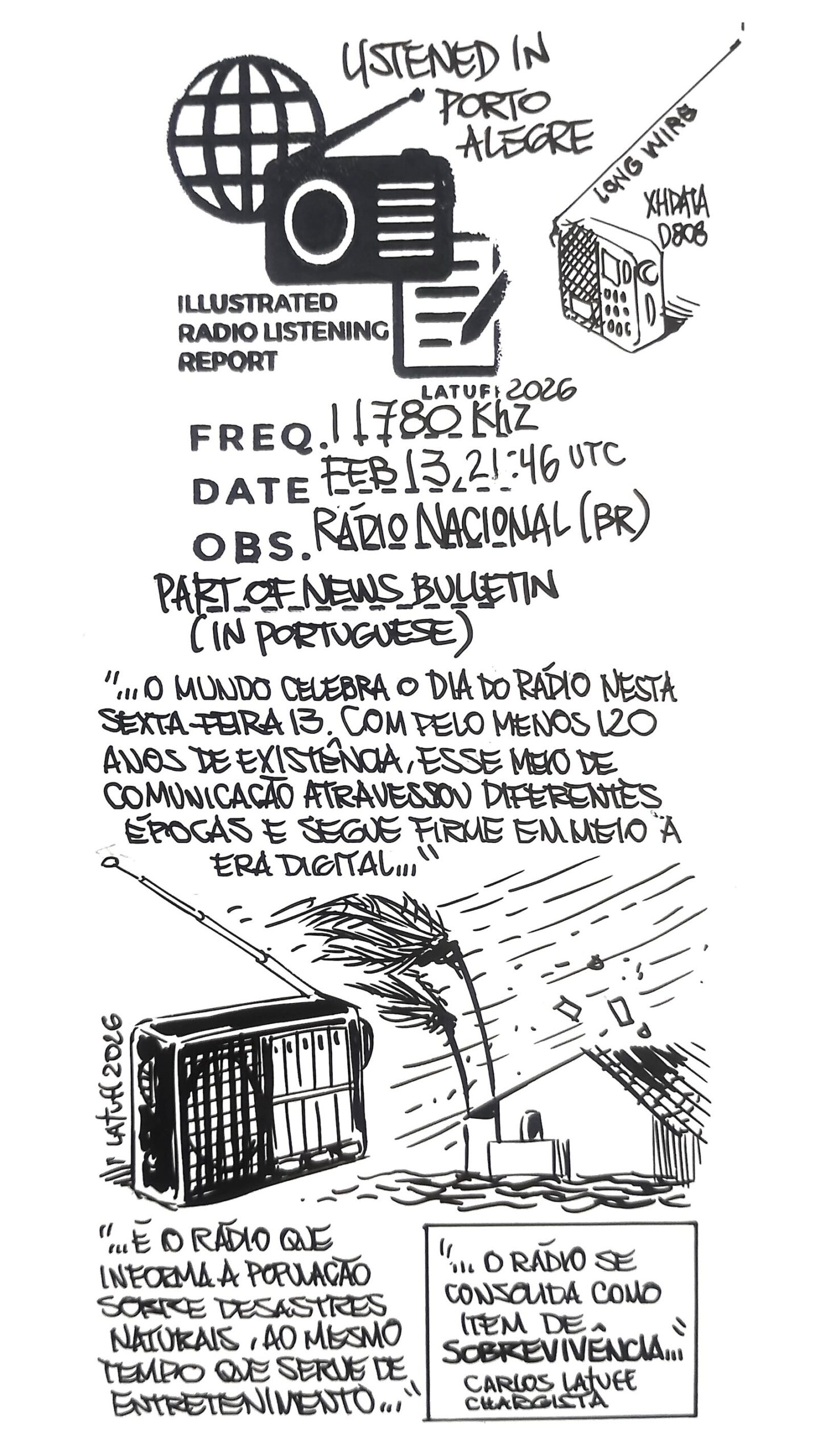
 Carlos notes: