Shortwave listening and everything radio including reviews, broadcasting, ham radio, field operation, DXing, maker kits, travel, emergency gear, events, and more
Many thanks to SWLing Post reader, Paul Walker, who writes:
I am a radio personality here in the USA as well as a SW and MW DX’er.
I appeared on the 11092.5 USB during Radio Saint Helena Day 2009 and have several short recordings, which are attached. That’s my voice doing the station identification/promotional announcements.
Sample 1
Sample 2
Very cool, Paul! It’s quite amazing to hear studio quality audio from Radio St. Helena Day as so many of us had to strain to hear their signal from across the Atlantic! Glad you were able to be a part of such an amazing little station.
I miss those Radio St. Helena Days and, though I know it’s doubtful, certainly hope the station considers firing up a shortwave transmitter again.
Many thanks to SWLing Post and Shortwave Radio Audio Archive contributor, Brian Smith, for the following guest post and vintage recording:
Shortwave Radio 1974: Canada, Argentina, Spain, West Germany, Albania, utility stations
-Brian Smith (W9IND)
Want to know what shortwave radio sounded like in 1974? This 55-minute recording, recovered from a cassette, was never intended to be anything but “audio notes”: I was an 18-year-old shortwave listener who collected QSL cards from international stations, and I was tired of using a pen and a notepad to copy down details of the broadcasts. I wanted an easier way to record what I heard, and my cassette tape recorder seemed like the perfect means to accomplish that goal.
But it wasn’t. I soon discovered that it was simpler to just edit my notes as I was jotting them down — not spend time on endless searches for specific information located all over on the tape. To make a long story shorter, I abandoned my “audio notes” plan after a single shortwave recording: This one.
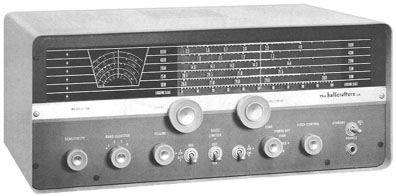
Hallicrafters S-108 (Image source: DXing.com)
Still, for those who want to experience the feel of sitting at a shortwave radio in the mid-1970s and slowly spinning the dial, this tape delivers. Nothing great in terms of sound quality; I was using a Hallicrafters S-108 that was outdated even at the time. And my recording “technique” involved placing the cassette microphone next to the radio speaker.
Thus, what you’ll hear is a grab bag of randomness: Major shortwave broadcasting stations from Canada, Argentina, Spain, Germany and Albania; maritime CW and other utility stations; and even a one-sided conversation involving a mobile phone, apparently located at sea. There are lengthy (even boring) programs, theme songs and interval signals, and brief IDs, one in Morse code from an Italian Navy station and another from a Department of Energy station used to track shipments of nuclear materials. And I can’t even identify the station behind every recording, including several Spanish broadcasts (I don’t speak the language) and an interview in English with a UFO book author.
The following is a guide, with approximate Windows Media Player starting times, of the signals on this recording. (Incidentally, the CBC recording was from July 11, 1974 — a date I deduced by researching the Major League Baseball scores of the previous day.)
Guide To The Recording
00:00 — CBC (Radio Canada) Northern and Armed Forces Service: News and sports. 07:51 — RAE (Radio Argentina): Sign-off with closing theme 09:14 — Department of Energy station in Belton, Missouri: “This is KRF-265 clear.” 09:17 — Interval signal: Radio Spain. 09:40 — New York Radio, WSY-70 (aviation weather broadcast) 10:22 — Unidentified station (Spanish?): Music. 10:51— Unidentified station (English): Historic drama with mention of Vice President John Adams, plus bell-heavy closing theme. 14:12 — Unidentified station (Spanish?): Male announcer, poor signal strength. 14:20 — Unidentified station (Spanish): Theme music and apparent ID, good signal strength. 15:16 — Unidentified station (foreign-speaking, possibly Spanish): Song, “Chirpy Chirpy Cheep Cheep.” 17:00 — Deutsche Welle (The Voice of West Germany): Announcement of frequencies, theme song. 17:39 — Unidentified station (English): Interview with the Rev. Barry Downing, author of “The Bible and Flying Saucers.” 24:36 — One side of mobile telephone conversation in SSB, possibly from maritime location. 30:37 — Radio Tirana (Albania): Lengthy economic and geopolitical talk (female announcer); bad audio. Theme and ID at 36:23, sign-off at 55:03. 55:11 — Italian Navy, Rome: “VVV IDR3 (and long tone)” in Morse code.
Brian, this is a brilliant recording–regardless of audio quality–and we’re very thankful you took the time to share it. Propagation has left something to be desired as of late, so time traveling back to 1974 has been incredibly fun.
Post Readers: If, like Brian, you have off-air recordings on tape that you’d like to share, please contact me! Even if you don’t have the means to transfer your tapes to a digital format, I’m a part of a small community of shortwave radio archivists who would be quite willing to help.
Many thanks to SWLing Post contributor, Moshe, who writes:
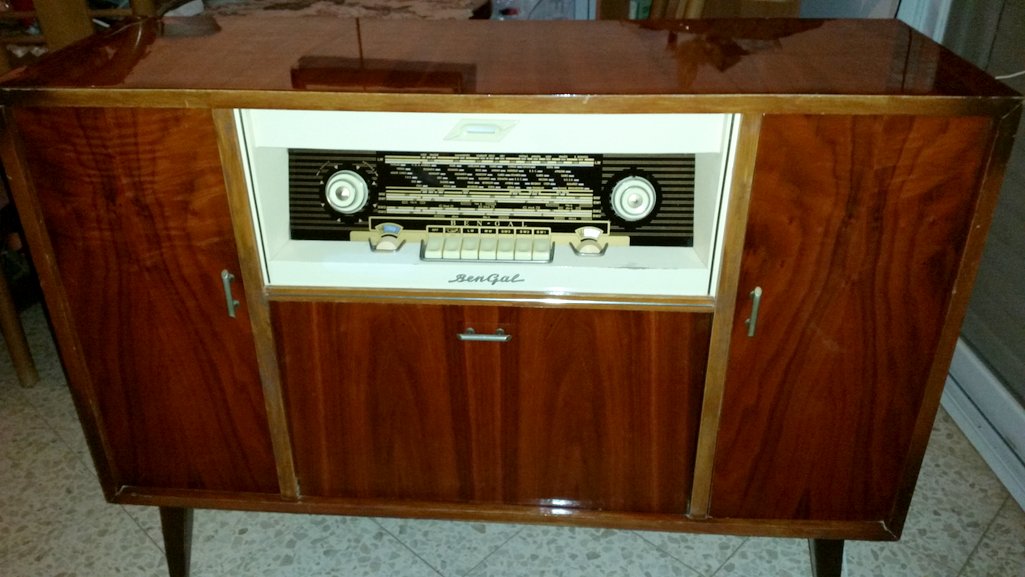
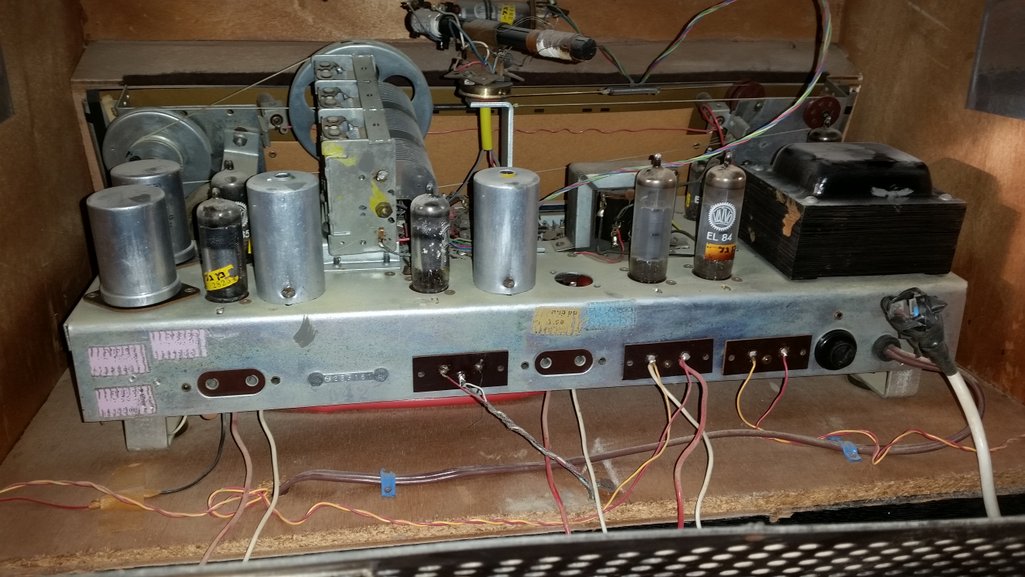
About 2 weeks ago, a very good friend called me and exclaimed, “you just have to see this radio…I’m keeping it for you!”–so, I drove to his aunt’s house and saw this beauty.
After hauling the radio to my place, I started to check it out, to see what would be needed for restoration; it was working, with bad contacts, poor frequency response and low output.
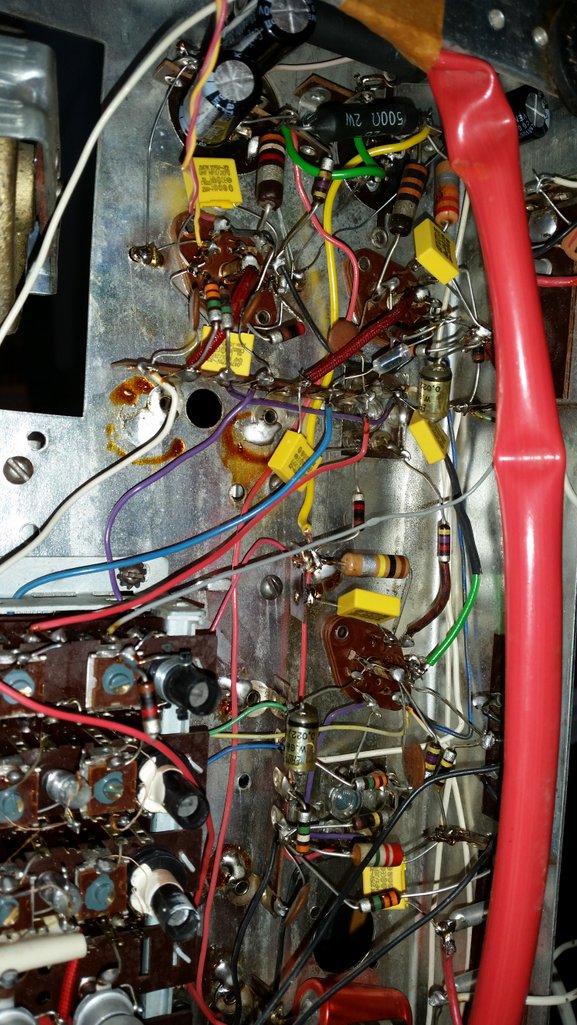
I took hi-res pictures of this radio, some during restoration. Now the radio sounds great. It has been recapped, a couple of bad resistors and bad wires replaced, contacts have been cleaned, and some good cleaning for the chassis as well.
As I wanted to keep the original appearance of the chassis, I kept the original filter capacitors on board, but disconnected them from the circuit, added terminal strips and new capacitors from underneath.
The radio uses an EF85 tube as the RF stage. With the addition of a grounding connection and random wire antenna, it’s very sensitive on shortwave.
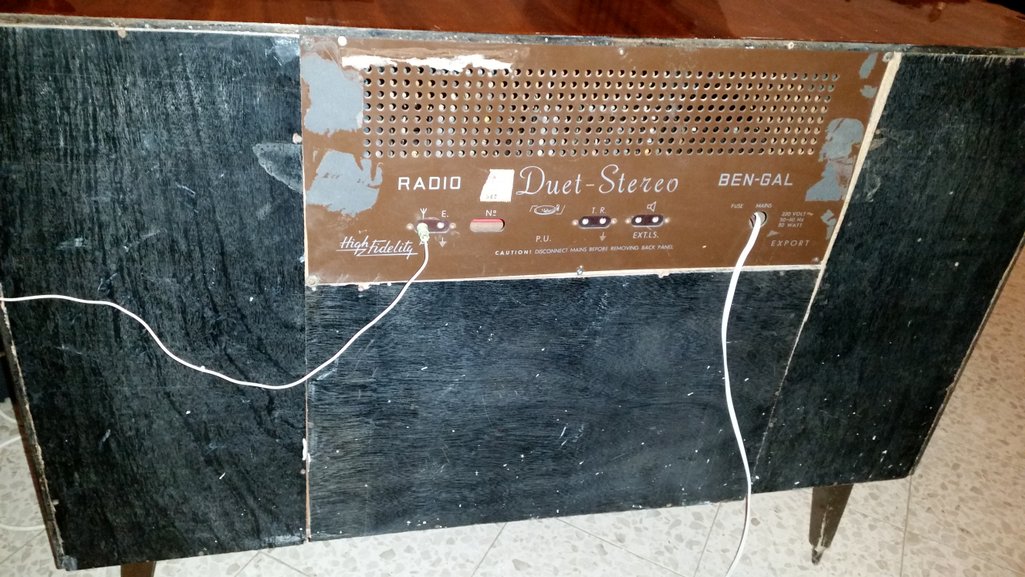
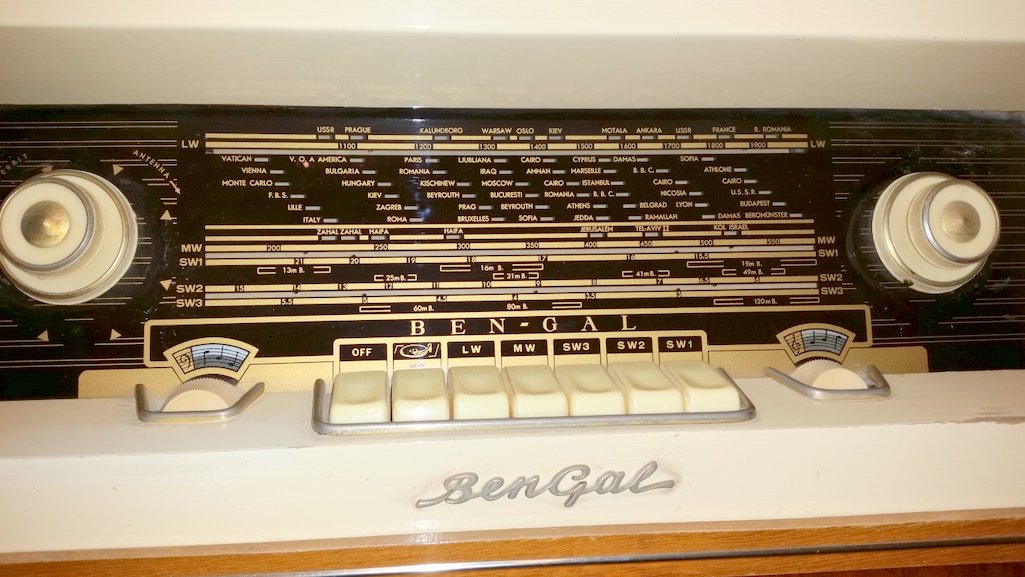
About the Ben-Gal Duet-Stereo:
It was made in Israel by Ben-Gal, a label inside shows it was made at 12th of December, 1965.
It is a console model with record player. As the model name suggests, the amplifier and record player are stereo (though the tuner is not…).
The radio has longwave (marked in meters), mediumwave (marked in meters) and 3 shortwave bands (with megacycle and meter band marks).
The shortwave bands overlaps with each other, so cover is continuous:
SW3 2.3MHz to 6MHz,
SW2 5.5MHz to 15.5MHz,
and SW1 14.5MHz to 23MHz.
Many thanks, Moshe, for sharing photos and this description of this beautiful Ben-Gal Duet-Stereo. I bet the audio fidelity is amazing. My father has a 1960’s console–with a similar configuration–made by Admiral, though it was limited to mediumwave and FM reception. Some day, I will try to restore it to its former glory!
“There was nothing remarkable to see on Chopmist Hill in 1940 when, a year before the Japanese would attack Pearl Harbor and bring America into the war, a Boston radio technician by the name of Thomas B. Cave drove up Darby Road.
[…]Cave worked for the Intelligence Division of the Federal Communications Commission, charged with finding a hilltop in southern New England that could serve as one of several listening posts to detect radio transmissions from German spies in the United States.
What he discovered up at William Suddard’s 183-acre farm was nothing short of miraculous.
Because of some geographic and atmospheric anomalies, Cave reported he could clearly intercept radio transmissions coming from Europe — even South America.
As a Providence Journal story revealed after the war, military officials were initially skeptical. They wanted Cave to prove his remarkable claims that from Chopmist Hill he could pinpoint the location of any radio transmission in the country within 15 minutes.
The Army set up a test. Without telling the FCC, it began broadcasting a signal from the Pentagon. From atop the 730-foot hill in the rural corner of Scituate, it took Cave all of seven minutes to zero in on the signal’s origin.
In March 1941, the Suddards obligingly moved out of their 14-room farmhouse, leasing the property to the FCC.
Workers set off erecting scores of telephone poles across the properly, purposely sinking them deep to keep them below the tree line. They strung 85,000 feet of antenna wire — the equivalent of 16 miles — around the poles and wired it into the house.[…]”
Many thanks to SWLing Post reader Mike, who shares a link to this story from the blog République No.6:
Growing up in Piennes Lorraine, Radio Caroline the making of a rebel
[A]t night with my younger brother we would listen to a “pirate radio station” on a boat that would put real good music on, crusing the international waters between England and France. He burst in laughter and told me: That’s Radio Caroline“. That was it. My brother and I would listen to that station nearly every night on an old “galena radio receiver” with a huge antenna hidden in the attic built with copper wire we stole at the mine. I mean we didn’t really steal it, it was everywhere. It was the wires used by miners to connect detonators to batteries when blowing new tunnels and locals were using it for all sorts of things, like holding parts in chicken coop to tie tomato or green bean plants to stakes and could be found everywhere.
Actually at first we set the antenna in our bedroom but somehow it wasn’t long enough not to mention mom who saw it and tore it down giving her an other excuse to punish us. So we decide it to place it in the attic where no one ever went.
The most difficult part was going to the attic, there wasn’t any stairs. We had to bring a ladder to the trap leading to it. Mom was watching us like a hawk, looking for any excuses to punish us.[…]
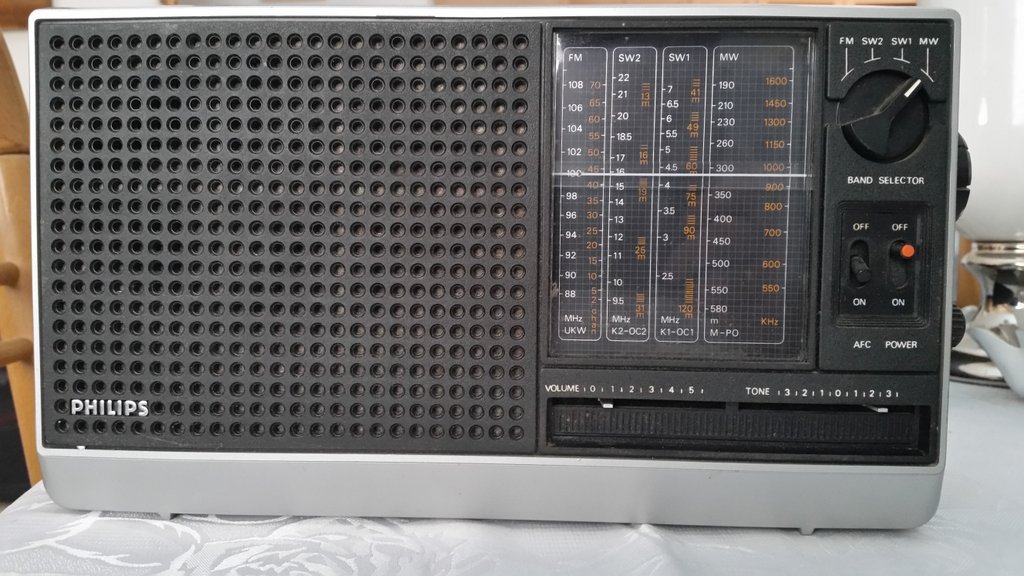
My Grandfather had the same exact radio. I used to play around with the radio as a child, (especially with the shortwave bands, looking for number stations…). When my Grandfather died, about 23 years ago, the radio disappeared.
I decided this is the radio I want for my birthday. I could not remember the maker of the radio, nor it’s model, but I remembered how it looked.
I spent many days looking for all variations like “portable transistor radio” and so on, until I found a photo on the Internet: I was looking for a Philips 90AL765 radio.
I found it on Ebay. A very kind seller from Australia had it.
I purchased and receive the radio on the 26th of June (my birthday was the 12th of July). As soon as I got the radio, I opened it up; it needed cleaning (the case itself and the contacts).
After cleaning the contacts and washing the case, the radio runs (and looks) like new. I thought I would have to recap the radio, but it sounded perfect and without even a hint of hum, so I left it as it is.
It has the volume and tone knobs missing, but it can be operated with no problem. Sound quality is amazing (I added a video of the radio playing All India Radio on 6155 kHz)–it works very well on all bands and is very sensitive. By ear, the bandwidth sounds like 8 kHz or more. Radio bands are: MW, SW (2 bands) And FM.
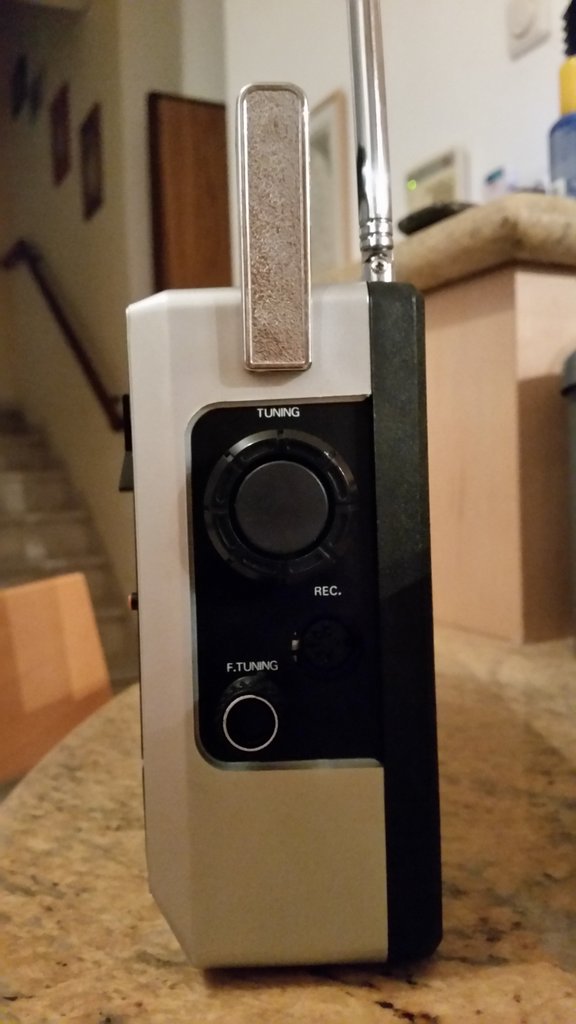
The shortwave band is divided in two: SW1: 2.3MHz- ~7.4MHz, SW2: ~9.4MHz- 22.5MHz. For fine tuning on shortwave, the radio has a “Fine Tuning” control, which is a potentiometer connected to a varicap.
If you place the control in the middle (It lacks a detent spot) and tune in a station, this control will put you spot-on (the receiver is very stable).
Some info about the radio: According to Radiomuseum.org, the radio is dated to 1977, and was made in Austria (mine and my Grandfather’s were made in Singapore).
It contains 13 transistors, 3 of them are can transistors (not plastic).
Tuning is slide ruler type, and the only connection is A DIN5 for recording (wired for mono).
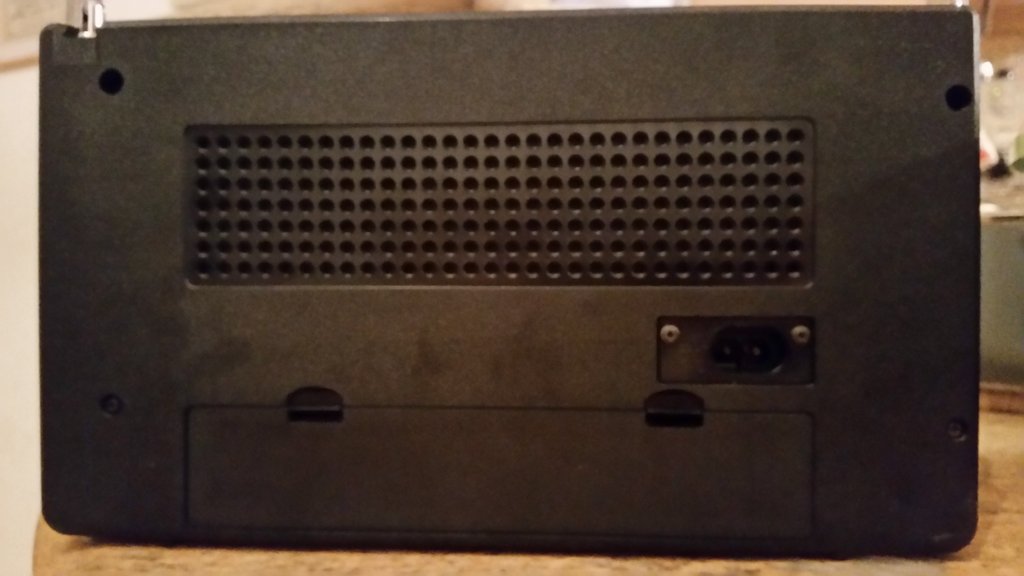
The radio can be operated from 4 D cells, or directly from AC (in the picture you can see the transformer). It can be operated from 230V or 120V. Note that if you move the plastic pin cover from the left pin to the right one, the center pin remains visible at all times. Also you will have to move the plastic cover piece on the back to the left.
The Ferrite is 14cm long, the telescopic antenna is 79cm fully extended, and it has an elbow joint that allows you to place the radio in your lap and still the antenna will point up with no problem. Only thing is that if the antenna is extended, the handle cannot change position since the antenna is in the way.
Width of the radio itself is 29cm (31cm with the handle and the knobs).
Depth is 7cm.
Height is 16.5cm (21cm with the handle).
All in all, it is a very fine radio and I love it!
Moshe, thanks so much for sharing your story!
Perhaps, one of the true virtues of sites like eBay is that they allow us to search the world for somewhat obscure devices that have such a strong family and nostalgic connections. Congratulations on your find!
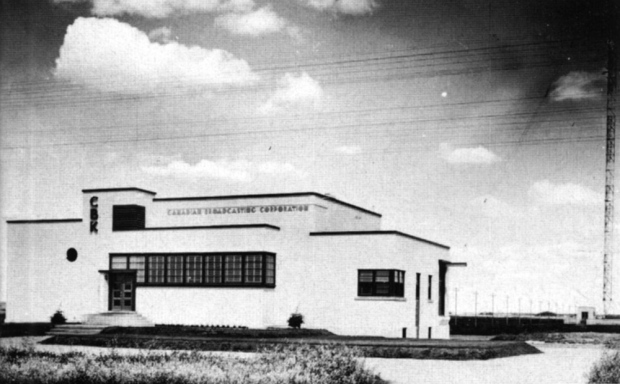
Historic CBK transmitter building in Watrous to be demolished
Most people who have grown up in the prairie provinces will have received their news via the CBC broadcast tower in Watrous.
The massive CBK building was established in 1939 as part of an overall CBC plan to bring programming to all parts of Canada. This was done with several well-placed 50,000 watt transmitters.
CBK was designed to serve all the prairie provinces, which is why Watrous was chosen as the site.
It is located in the centre of the populated portion of the prairies, and as a bonus it is located on a potash vein, making its ground conductivity one of the best on the continent.
In those days the technology for a single transmitter took up two floors of the building.
About 371 square metres was for the transmitter. That amount of equipment required a staff of six to maintain.
There was also a manager and living quarters for the staff.
During the Cold War, nuclear threat was a very real concern.
“The site was deemed important enough for communications that there was an armed guard protecting the transmitter,” said Stephen Tomchuk, transmitter supervisor for Saskatchewan.
“There was a fallout shelter built in the basement of the building that contained full facilities to be able to broadcast in the event of nuclear war,” added Tomchuk.[…]