Shortwave listening and everything radio including reviews, broadcasting, ham radio, field operation, DXing, maker kits, travel, emergency gear, events, and more
In reply to our Caveat Emptor post, many thanks to SWLing Post contributor, Zack (N8FNR), who writes:
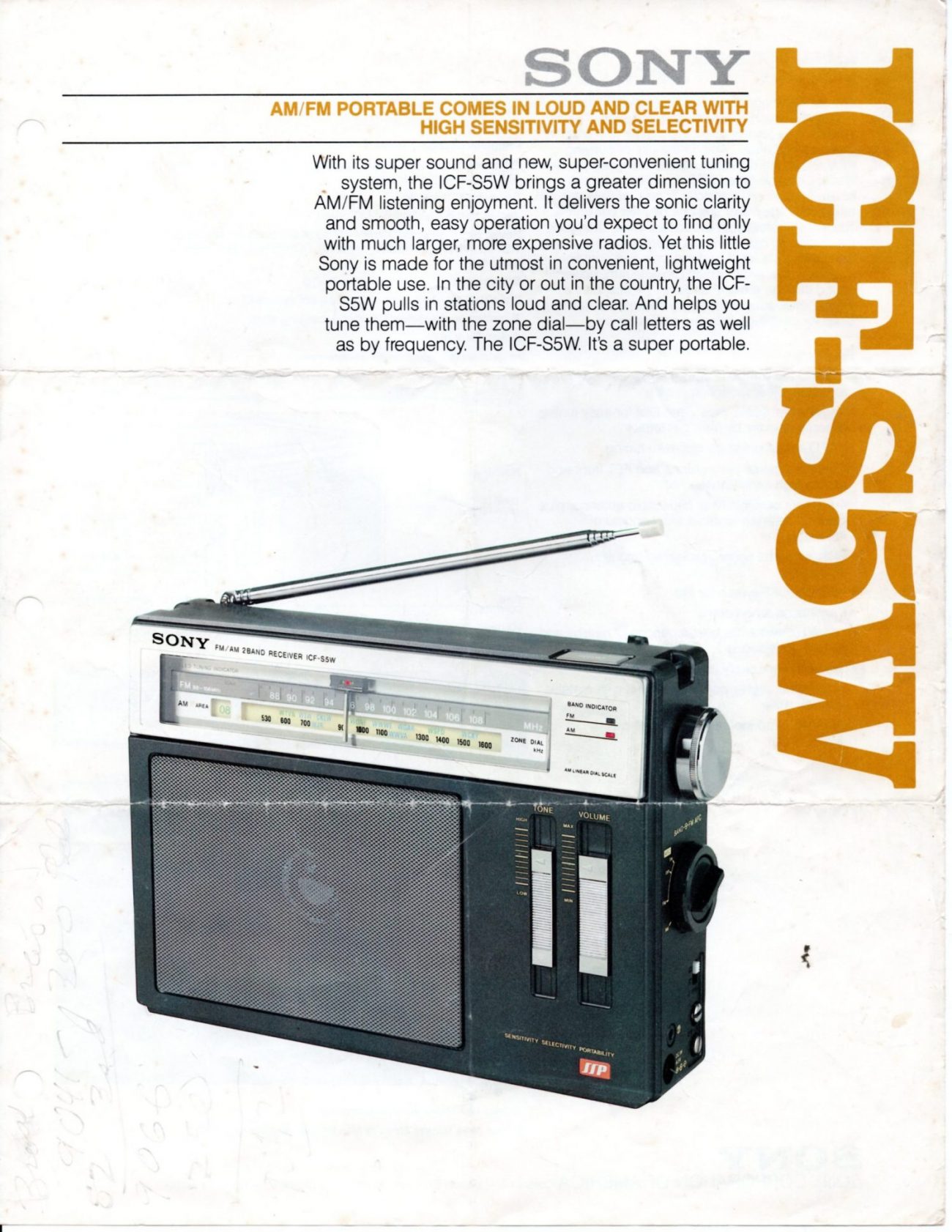
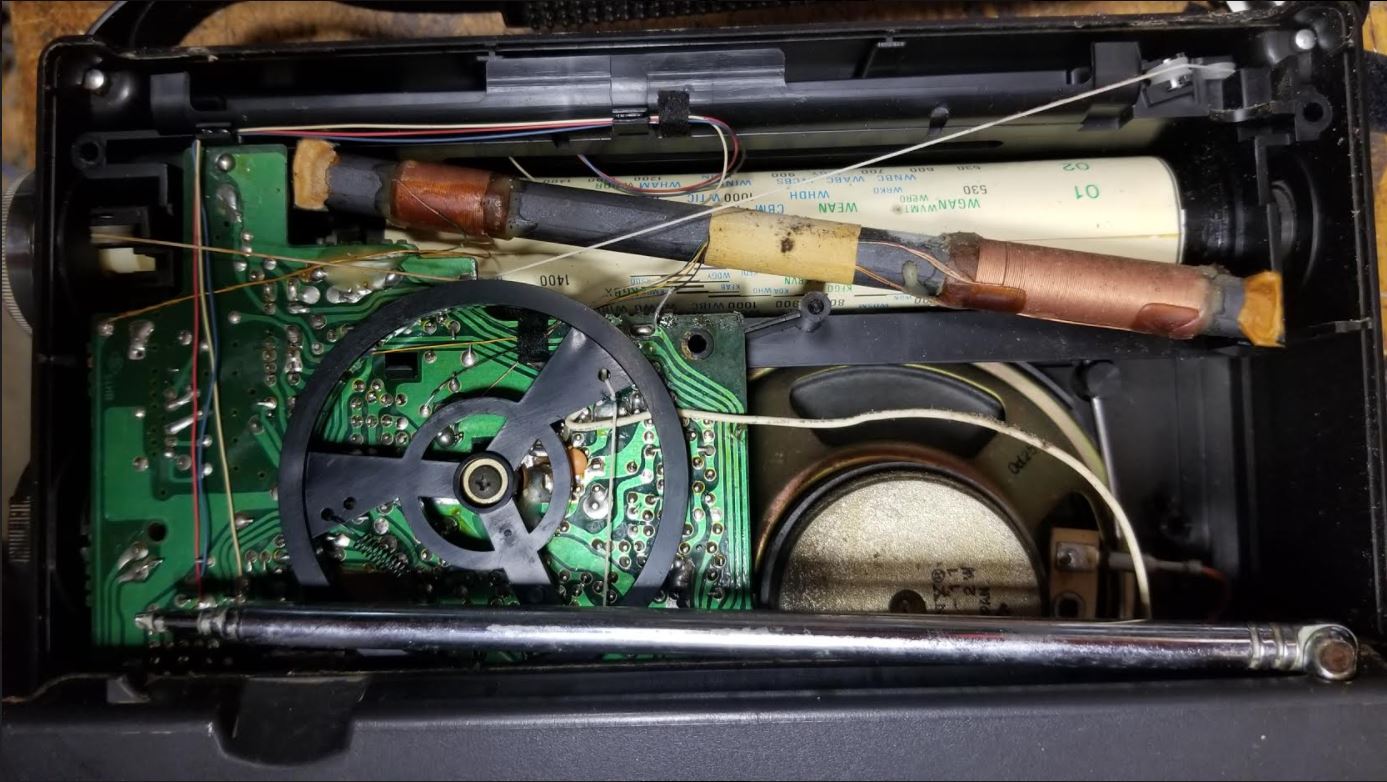
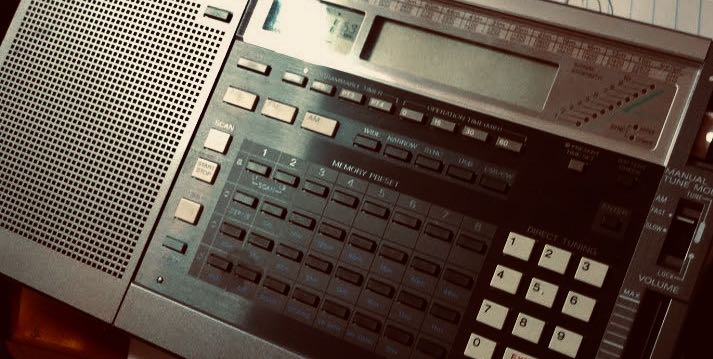
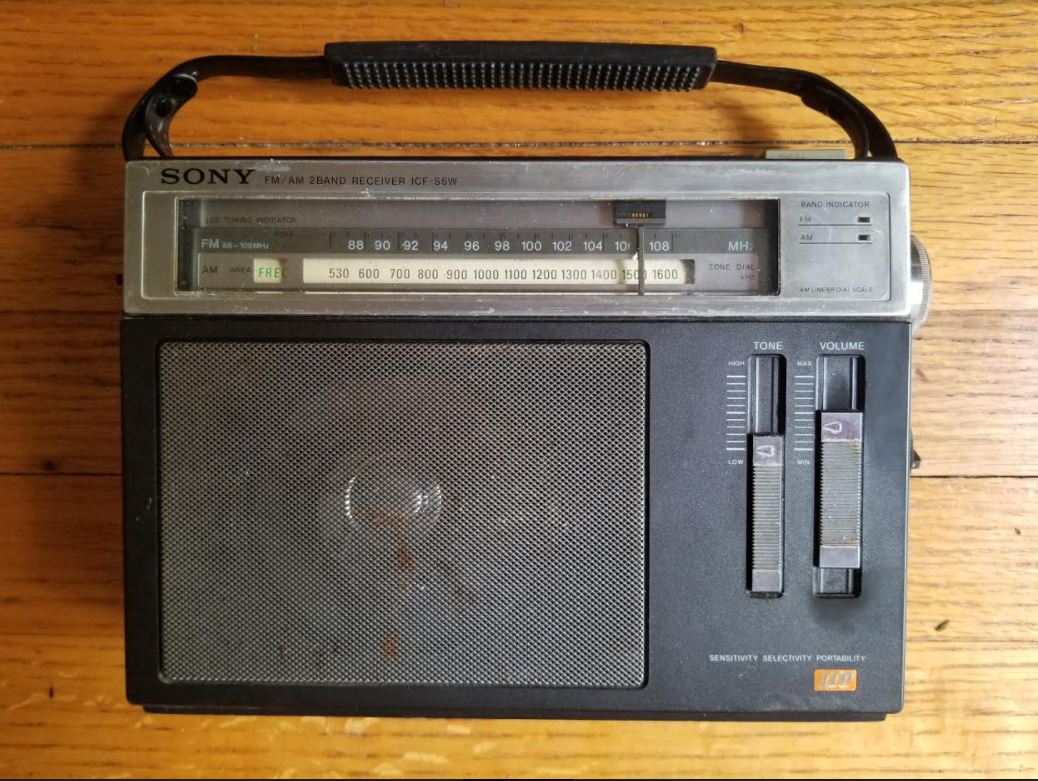
Attached is a copy of the Sony brochure for the ICF-S5W, a photo of the front and also the inside. This is a fairly old rare radio and some of your readers might enjoy the following.
I just wrote to Dr. Vlado asking if he can restore my fairly rare Sony ICF-S5W. Luckily I have three of them, two of which are dead so I could send all three and he could possibly cannibalize them to make one good working rig. I also have an original copy of the manual.
Few people have heard of the ICF-S5W as it was only made from 1980-81. One of the interesting features of the radio is that the Sony engineers put the 16cm ferrite antenna at an angle as they claimed it improved incoming signals.
Many reviewers at the time claimed that it was better than the GE Superradio of that vintage.
If you would like to know more about this radio below are a few reviews.
Thank you for sharing this, Zack. I was not familiar with the Sony ICF-S5W. I love the simplicity of this radio–and that nearly diagonal ferrite bar? I can’t think of any other radio I’ve seen with that!
And having spare “parts” radios is a solid plan if you have a particular radio you love and want to keep it in working order over the long term.
Any other ICF-S5W owners out there? Please comment!
Radio Waves: Stories Making Waves in the World of Radio
Because I keep my ear to the waves, as well as receive many tips from others who do the same, I find myself privy to radio-related stories that might interest SWLing Post readers. To that end: Welcome to the SWLing Post’sRadio Waves, a collection of links to interesting stories making waves in the world of radio. Enjoy!
Many thanks to SWLing Post contributors David Shannon, Sheldon Harvey (Int. Radio Report), Jorge Garzón Gutiérrez, and Ulis Fleming for the following tips:
European DX listeners have recently discovered a wonderful new target. On 27 MHz it is possible to receive Catholic mass celebrations from Ireland and Northern Ireland. Hundreds of local churches around the island are broadcasting holy masses live. If you tune in between 27000 and 28000 kHz, you might be able to hear many interesting churches. The transmitter power is usually only 3 watts, so a strong F2 opening is needed. Luckily with the current solar maximum this happens quite often.
How did all this start? This is a fascinating story, told by a Father, who has been helping the idea to become reality.
The broadcasting of Masses was introduced in a rural Irish diocese over 30 years ago when the resident priest was considering a way of reaching out to those who were housebound in his parish. They had access to religious broadcasts on National Radio and TV, but he knew that it was no comparison to a local broadcast. There were many incidents of families coming home from Mass on Sunday and their housebound parent or grandparent had ‘all the news’ (they were aware of all the happenings in the parish) when they arrived home.[…]
Decades before Spotify, Pandora, and even satellite radio, terrestrial (land-based) AM and FM radio reigned supreme. Many listeners, including Utica resident Ron Robinson, idolized the disc jockeys just as much as the artists they played.
Robinson, 51, is working on a documentary film entitled “Radio Dayz… The Movie,” which focuses on the history of radio, including the early days of Detroit radio. “(The film) tells the story of radio through the people who worked in radio,” he said.
Robinson interviewed several well-known radio personalities such as Paul W. Smith, Dick Purtain, Fred Jacobs, Dick Kernen, and more for the film. Robinson, who worked for WJR for 20 years before starting his own production company, has several connections in the industry. He started interviewing for the documentary in 2013.
“Most people think of radio, they think of New York, California, and Chicago, and rightfully so. But, Detroit has been an important and ground-breaking city for the medium of radio,” Robinson said.
The documentary is a chronological look at the history of radio, starting with the first radio stations. It also takes aim at the first radio “celebrity,” Fr. Charles Coughlin. The Detroit-area priest took to the airways in the 1920s and eventually garnered an audience of 30 million to his weekly radio show. Coughlin would later become a polarizing figure as World War II approached. “He’s on the wrong side of history, if you will,” Robinson said.
Often I get surprised when I listen to the FM Band with my autoradio. It has no bandwidth options, no filters, but sensitivity and selectivity are much better than most of the well-know portables. Mine is inserted into the Skoda console so I have no way to know who manufactured it, the brand/model or its tech specifications. Most of the times I wonder why other portable firmwares does not include, for instance, similar choices like the high speed decoding RDS info. Then I thought… Will be my ULR Sangean DT-800 up to the task?
An autoradio like mine (SKODA Spaceback car) decodes RDS and hears weak signals at once. It is part of a well balanced system: receiver-feedline and rubber antenna on the metallic car roof. My pocket ultralight radios use the earphone cable as an aerial, so even being very good receivers, the antenna is far to be reliable with tricky and changing reception as it depends on the cable position at every moment. Uhmmm! I needed to find a better way to listen using my small toys.
In the shack I had some whips with male BNC and PL-359 connectors, but the Pocket ULR has a 3,5 mm female plug-in, so I found a “female BNC > male jack 3,5 mm” adapter and connected the whip. I chose a telescopic antenna 20/115 cm long folded/unfolded to test the Sangean DT-800T versus the SKODA autoradio, focused on the BOTB from 87,5 to 91,5 MHz. When a long whip is used some unwanted effects come into the scene. The first is related with audio; connecting the whip the sound must be heard via the small speaker so don’t forget to choose a quiet environment not to miss weak stations. The second one is pure physics; due to the whip length, the ULR 3,5 mm female plug-in gets extra strain and that could damage the inner weldings, so extra care must be kept in mind at any time.[…]
Many thanks to SWLing Post contributor, Matt, who shares a link to a radio classifieds site he has created. Check it out!
The UsedRadioMall.com web site lists radios and items related to the subject of radio. The list may include receivers, transmitters, transceivers, amplifiers, antennas, parts, and components related to amateur radio, two-way radio, cb radio, broadcasting, recording, production, and hi-fi.
Introduction
Changes in ionospheric electron density caused by space weather and diurnal solar changes are known to cause Doppler shifts on HF ray paths. For example, see Figure 7 in Boitman et al., 1999. As part of the WWV centennial, 50 stations collected Doppler shift data for the original Festival of Frequency Measurement, demonstrating the value of volunteer participation in collecting this data. This June, we request that all amateur radio stations, shortwave listeners, and others capable of making high-quality HF frequency measurements help us collect frequency data for the June 10 annular eclipse. Researchers will use the crowdsourced data to investigate the superimposed effects of auroral particle precipitation and the eclipse on Doppler shift.
All you need to collect data is an HF rig connected to a computer running open-source software. A precision frequency standard, such as a GPS-disciplined oscillator, is desired but not required to participate. All ham operators and shortwave listeners around the globe are invited to join in, even if your station is far from the path of totality. Last year’s eclipse festivals included over 100 participants from 45 countries. The experiment will run from 7-12 June. All participants will receive QSL certificates and updates as the data is processed. This is a pilot experiment for HamSCI’s Personal Space Weather Station project, which seeks to develop a global network monitoring the geospace environment.
Many thanks to SWLing Post contributor, Mario Filippi, who writes:
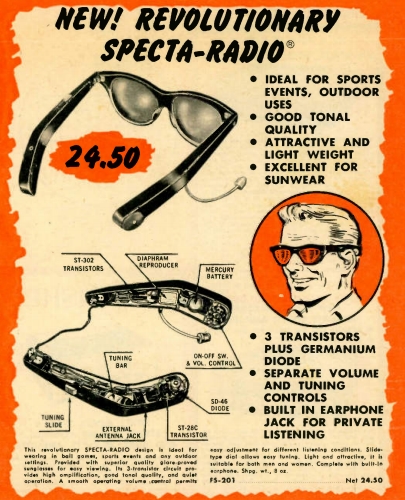
While perusing through a 1959 Lafayette Radio sales flyer, this hybrid radio/sunglasses radio was spotted (see image above). Put a huge smile on my face–a three-transistor, germanium diode model hihi. Runs on a Mercury battery which were common years back.
That is fantastic, Mario! Love it.
I can tell you that I think Spectra-Radio seem a lot cooler than Google Glasses! Thank you for sharing!
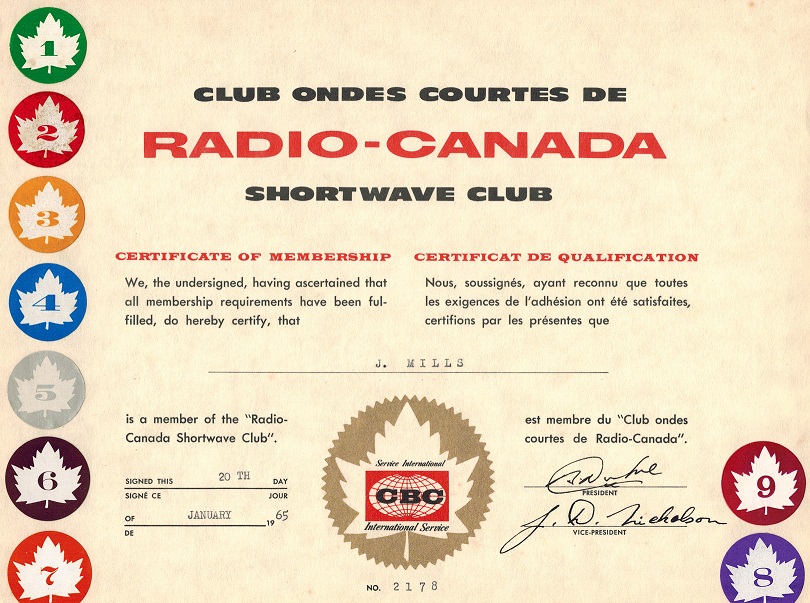
I still have my RCI Shortwave Club certificate issued in 1965 when I was only 14 years old!
In those days you had to monitor their broadcasts regularly and send listening reports on (if I remember correctly) green airmail reception forms every month.
Hope the attached may give other readers some memories.
73
John G3VUO
Wow! Thank you for sharing this, John. Those were, indeed, the halcyon days of shortwave radio listening!
Post readers: Please comment if you’ve also received a certificate from RCI!
Radio Waves: Stories Making Waves in the World of Radio
Because I keep my ear to the waves, as well as receive many tips from others who do the same, I find myself privy to radio-related stories that might interest SWLing Post readers. To that end: Welcome to the SWLing Post’sRadio Waves, a collection of links to interesting stories making waves in the world of radio. Enjoy!
Many thanks to SWLing Post contributors Paul, Richard Langley, Troy Riedel, and the Southgate ARC for the following tips:
Solar-powered portable radios that put audio quality second are nothing new. But a solar-powered portable radio that sounds as good as a non-solar high-fidelity radio: This is worth talking about.
The new CCRadio Solar from C.Crane fits this double-barreled description. With its generous top-mounted solar panel (3.75 by 1.5 inches) plus back-mounted generator crank for recharging its Lithium-Ion battery pack, this is a radio for blackouts and other emergency situations.
After an initial conditioning charge-up of the Lithium-Ion battery from a 5V DC adaptor, just leave it in a sunny window, and the radio is always ready to go.
In non-emergency situations, the CCRadio Solar can be powered with three AA batteries or a 5V DC charger plugged into its micro-USB port.[…]
The U.S. Congress is reportedly taking steps to officially recognize the important contributions made by amateur radio operators.
According to an article on the website of the ARRL, Congresswoman Debbie Lesko (AZ) has introduced a bipartisan resolution to designate April 18, 2022 as National Amateur Radio Operators Day. April 18th is the anniversary of the founding of the International Amateur Radio Union (IARU) which was established in 1925.[…]
YOUR GRANDPARENTS’ ancient transistor radio might still turn on and tune in to stations broadcasting conventional AM or FM signals. But in this Internet age, a blizzard of content is available from sources accessible only via the Web. What’s more, instead of speakers that flood a room with sound, we’ve grown accustomed to personal listening using earbuds and headphones. Now engineers like Guillaume Alday, founder of Les Doyens in Bordeaux, France, have come to the radio’s rescue. Alday keeps old-school radios from slipping into obsolescence by retrofitting their innards with components that transform them into Wi-Fi- and Bluetooth- enabled devices.[…]
The BBC reports the first message sent back to Britain by a ‘trailblazing’ special agent in World War Two has been commemorated, 80 years on, by radio amateurs using GB1SOE
Georges Begue, of the Special Operations Executive, was parachuted into occupied France in 1941 to set up wireless communications with the UK.
Amateur radio enthusiasts have marked his achievement by sending and receiving messages at Bletchley Park.
On Thursday and Friday May 6-7, Milton Keynes Amateur Radio Society is using replica equipment to transmit Morse code messages from the National Museum of Computing at Bletchley to fellow radio enthusiasts in central France, stationed less than a mile from where Begue landed.
Turkey celebrated Radio Day on the 94th anniversary of the start of radio broadcasting in the country.
“Radio broadcasting in Turkey started 94 years ago today with the first announcement,” Turkey’s Presidential Communication Director Fahrettin Altun wrote on Twitter.
“Our radios, which have been working devotedly to bring our beloved nation together with the truth for years, have become one of the most important parts of our lives,” he added.
Altun also congratulated all radio workers on Radio Day too.
Türkiye Radyolar? (Radios of Turkey) has started first radio test broadcasts in 1926, with a studio built in Istanbul. The first radio broadcast in the country, however, began on May 6, 1927.[…]
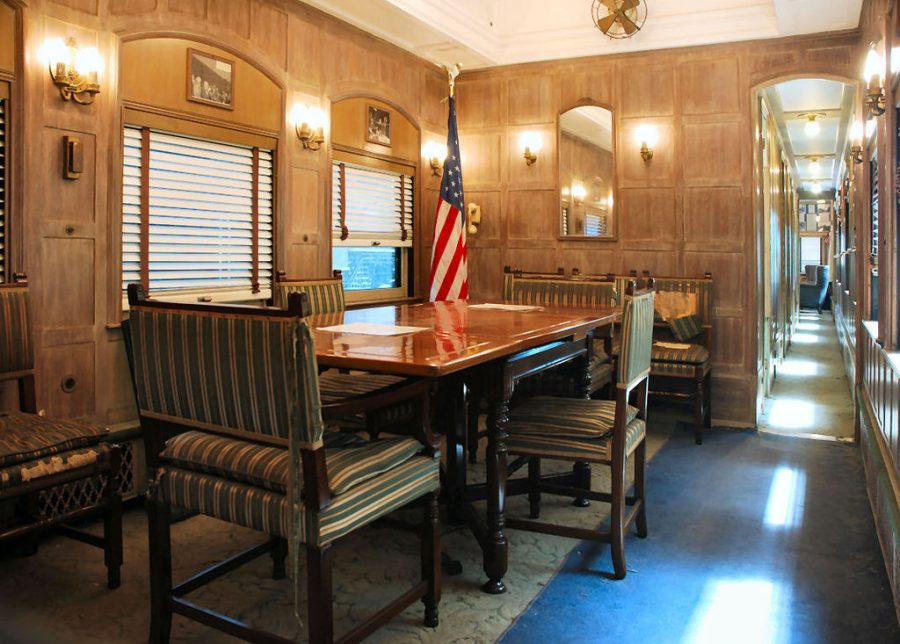
The Magellan Rail Car Dining Room (Source: Wikimedia Commons)
Many thanks to SWLing Post contributor, Ron H, who writes:
[Check out] the following link to a story about the communications car that was part of the Presidential train. [This] was originally posted on the Hammarlund listserve:
Many thanks to SWLing Post contributor, Jerome van der Linden, for the following guest post:
Experiences as an SWL in Saudi Arabia 1990 /91
by Jerome van der Linden
From about 1986 I worked for the Broadcasting Division of Telecom Australia (now “Telstra”), in Adelaide, South Australia. This Division of Telecom Australia had responsibility for installation, maintenance and operation of Australian Government funded broadcasting services (radio & TV) such as ABC (including Radio Australia) and SBS. In later years responsibility for this was taken away from Telecom Australia and handed to BAI.
I already had a life long interest in Broadcasting and short wave radio in particular, and I was recruited into a new non technical managerial position in the then new Broadcasting Division of Telecom Australia: it was the perfect job to my mind. In this period of the late 1980s, the organisation was heavily involved in the capital works to get Radio Australia Cox Peninsula (Darwin) back into operation, after it was largely destroyed by cyclone Tracy in 1975, as well as building the three Northern Territory vertical incidence (“shower”) services at Katherine, Tennant Creek, and Alice Springs (VL8K, VL8T, and VL8A respectively). (The NT is probably about the size of a major US state like Texas). Apart from doing my non technical work, I took every opportunity to learn more and get involved in the technical side of things. On one occasion, when I knew that the technical staff would be testing the new transmission facilities on a range of frequencies, I was able to confirm with the onsite technician a booming signal into Adelaide from the Alice Springs transmitter he was briefly testing on 11715kHz in the daytime.
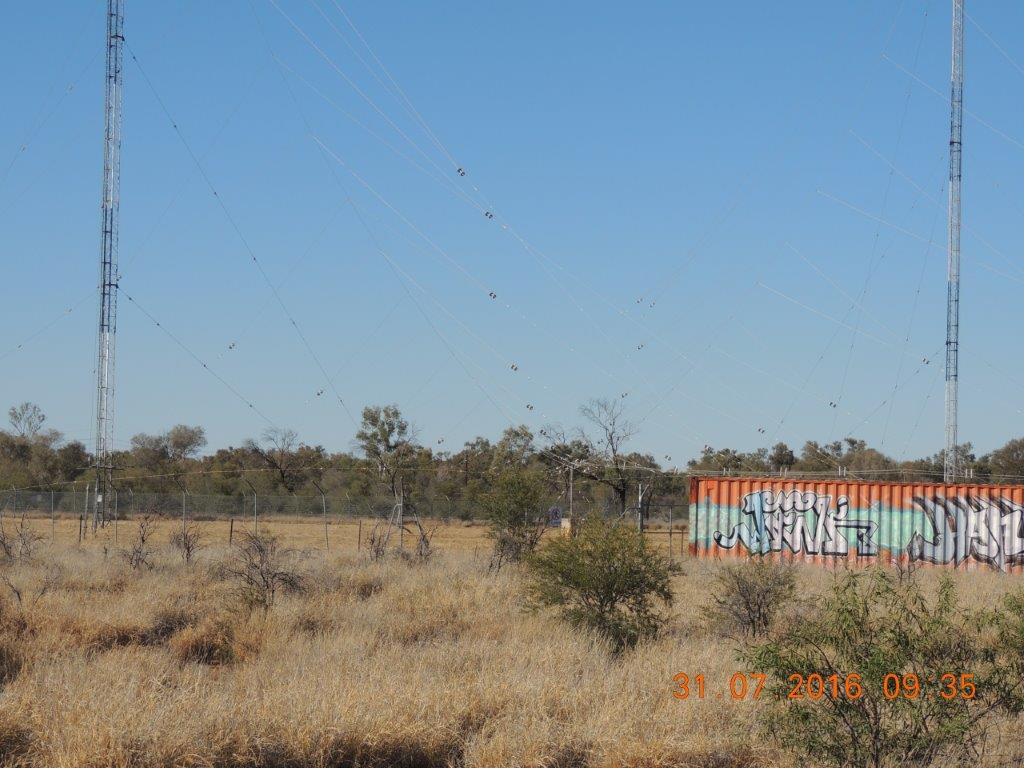
Alice Springs (VL8A) transmitter site in the last year is was operating (Photo by Jerome van der Linden).
As the opportunity arose, and as I was also part of the Southern Cross DX Club, I regularly participated in the Radio Australia DX program (I cannot even remember its name, 30 years later) that was produced by Mike Bird. I also contacted many rural cattle stations (equivalent to “ranches” in the US) that were spread throughout the Northern Territory to get them to report on how they were receiving the new NT HF service broadcasting stations when they came on the air. I saw it as a way of promoting the shortwave radio services throughout the Northern Territory.
My work gave me the opportunity to visit not just each of the new NT HF transmitter stations, but also included several visits to the Radio Australia (RA) facility at Cox Peninsula. While I also saw the old RA Receiving station on Cox Peninsula (dating from the period when signals were received from RA Shepparton and then re-transmitted from Darwin, in the period pre cyclone Tracy), this was at a time when that facility had already been largely dismantled.
In early 1990, I sought and was awarded a contract position with Telecom Australia’s Saudi project, and I was seconded to that from my job in the Broadcasting Division. From my own research, I knew that radio and TV in Saudi Arabia was quite unlike what I was used to, and I made it a point to take with me, on loan, a Sony ICF 2001D receiver. So it was in March 1990 that I arrived in Riyadh on a single person’s contract. I was allocated a 2 storey 3 bedroom villa for my own use among a large number of other identical villas occupied by other Telecom Australia staff, that were all located within a walled compound close to the Saudi Telecom offices.
Almost immediately, it was obvious that I would have to rely on the BBC World Service for my English news, as the KSABS radio services were nearly all in Arabic, and its TV service was even less appealing to me. I managed to string up some long wire antennas on the roof, and it was not long before I was also able to pick up services from Radio Australia. I got in touch with Nigel Holmes, then RA’s Frequency Manager in Melbourne, and was able to let him know how signals were being received in the Middle East, even though South Asia was about the limit of RA’s intended reach at that time. As my office was in the city of Riyadh some distance away, I was allocated a car for my own use, and – having found these were quite common – soon fitted it with a Short Wave capable car radio. In fact it was the one I reviewed in the 1991 WRTH.
The compound housing the many Australians and their families had its own CCTV system, and the Aussies were entertained by a regular supply of Australian VHS TV tapes. The same CCTV network was also used by Australians from the project making out as wannabee disk jockeys with their own programs before 7am and into the evenings.
As many people will recall, in mid 1990, Sadam Hussein, the then leader of Iraq, invaded Kuwait, and there was some concern he might continue and invade Saudi Arabia. As a direct consequence, radio with World news became even more important for the Australians, and the many other expats working in the Kingdom of Saudi Arabia (KSA).
An unexpected benefit to the expats living in Riyadh was the arrival of thousands of US ground forces, who brought with them their very own AFN broadcasting services which operated on FM with their own high pitched professional female DJs who played the latest pop music. This was at a time when this type of music was not heard at all on local Saudi radio, and the only source we had of modern music was the many bootlegged copies of cassette music which were for sale everywhere (in addition to pirated copies of software).
When Sadam Hussein decided to stop international residents from leaving Iraq to travel home, their roles as ‘hostages’ caused international broadcasters to improve their services into the Middle East.
That included Radio Australia, and at least one of its Cox Peninsula transmitters was used to improve the signal to the Middle East in the hours up to its daily shutdown at midnight Darwin time (1430UTC). The strongest signal in those days was a 21MHz frequency, and it mostly boomed in. I recall one evening when the transmitter’s audio sounded very suspect to me. I made a quick international phone call direct to Cox Peninsula; spoke to the duty shift supervisor who I knew personally; described the signal to him; he picked the problem; switched the transmitter off and placed another transmitter online on the same frequency which gave clean audio, that I was able to confirm to him.
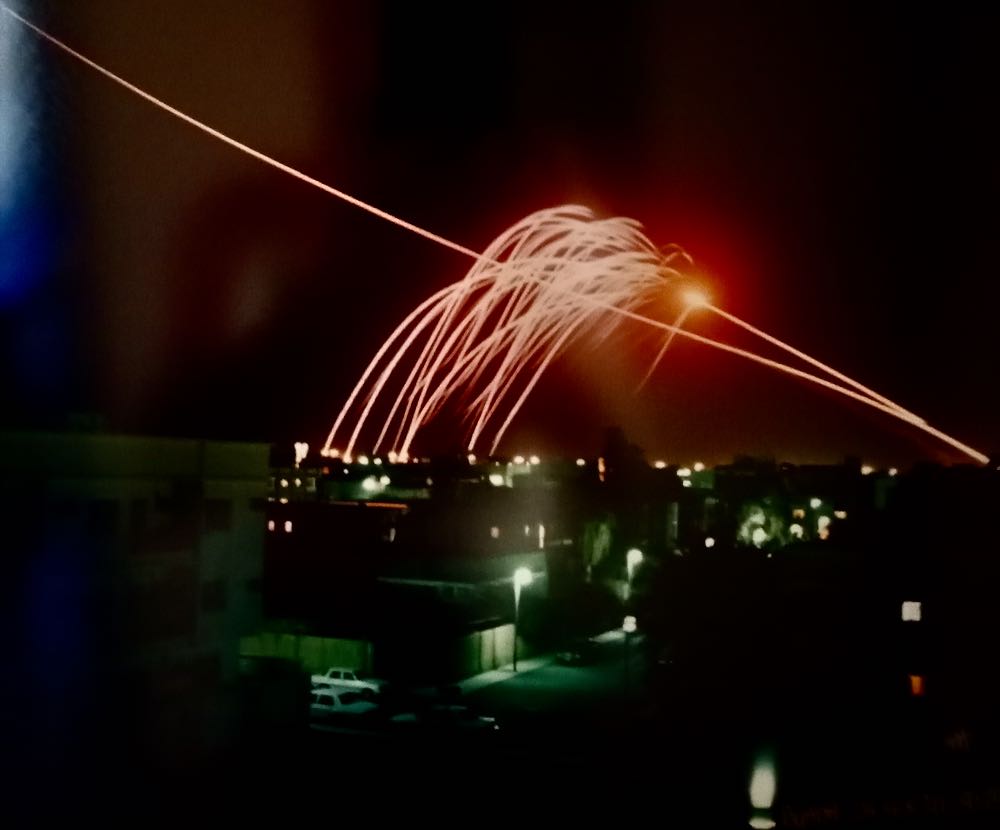
A Patriot missiles being fired to intercept a scud missile on 24 Feb, 1991 (Photo by Jerome van der Linden)
It was about this time that I realised my Sony ICF2001D had a feature I could use to the benefit of all my fellow Australians in the compound. In the first instance, I was able to arrange for an audio feed from the 2001D in my villa into the compound’s CCTV system, so that – provided someone plugged the audio in correctly – the signal from my Sony radio’s line out was relayed to every other villa that cared to listen. As I was absent during most of the working day, I used the Sony’s programming feature that allowed for up to 4 separate listening sessions to be set up. Each program required a SW frequency and start/stop times to be programmed. I think each session had a time limit of perhaps 4 hours. This enabled me to set the radio up to relay BBC World Service for most of the day switching automatically to certain frequencies as appropriate, and also provided the people with some brief Radio Australia segments with news from home.
In the period prior to January 1991’s, when George Bush had promised to retake Kuwait if Sadam Hussein did not withdraw, it was also interesting to pick up Iraqi broadcasts intended for (and to try to demoralise) American servicemen. Very strong signals from Baghdad were regularly audible, I seem to recall 11825kHz being one such frequency.
In the event, about January 16, 1991 the allies invaded Kuwait from Saudi Arabia, and made devastating air based attacks on Iraqi facilities. Radio Baghdad’s shortwave service did not seem to last very long after that.
We Australians were told in no uncertain fashion that Iraqi “Scud” missiles were ballistic (hence not accurately targeted), and would definitely not have the range to reach Riyadh in Saudi Arabia. The experts were wrong however, and a couple of scuds did reach Riyadh. As our compound was in the “flight path” from Iraq to the Riyadh airbase the Americans were using, it turned out we were not in the best location! The American forces had “Patriot Missiles” set up to intercept any Scuds that got through, but nobody told us that the Patriots break the sound barrier seconds after being fired, and that they’re only capable of intercepting Scud missiles just before they hit the ground. You can imagine the sonic booms that went off the first night Scud missiles arrived: I have photo in my home that some daredevil took outside, that proves all this.
We had been told to tape up the glass on our villas in case it should shatter, and that we should leave our TV sets tuned to our CCTV channel turned on at all times, with the volume up so that if there was an air raid the staff and their families could be alerted by means of a piercing alarm sound that someone had fiendishly created. And so it was that one Thursday, when Jonathan Marks had scheduled a telephone interview with me for Radio Netherland’s Media Network, we were discussing media events in Saudi Arabia when the air raid alarm went off, and we had to postpone the rest of the interview. I seem to recall that he did call me again later the same night and we finished things off. I never did get to hear the program, or I would have recorded it! As far as I know, it’s not one of the programs that Jonathan has been able to find to include in his on line media vault. If anyone else has a copy of this early 1991 edition, I’d love to hear it again.
As the experts had been wrong in their assessment, it was decided that most of the Australians would be removed from Riyadh, and I was sent to do my work from Jeddah, for about 6 weeks. Again it was a slightly different media environment, and while interesting, I missed the ICF2001D, and bought a cheap multi band analogue portable to be able to keep up to date with BBC World Service News broadcasts.
By early March 1991, most of the fighting was over, and it was safe for me to return to Riyadh, where I worked for another two or three months, before returning to my normal job and family in Australia.
Off-Air Audio Recordings
Radio Baghdad to US Troops (1990):
BBC World Service News of the start of Desert Storm (January 16, 1991):
Radio Australia announcement by the acting Foreign Affairs Minister (January 16, 1991):
AFN Riyadh (Brief clip of Army Sergeant Patty Cunningham signing off her shift):

 In reply to our Caveat Emptor post, many thanks to SWLing Post contributor, Zack (N8FNR), who writes: