Category Archives: Nostalgia

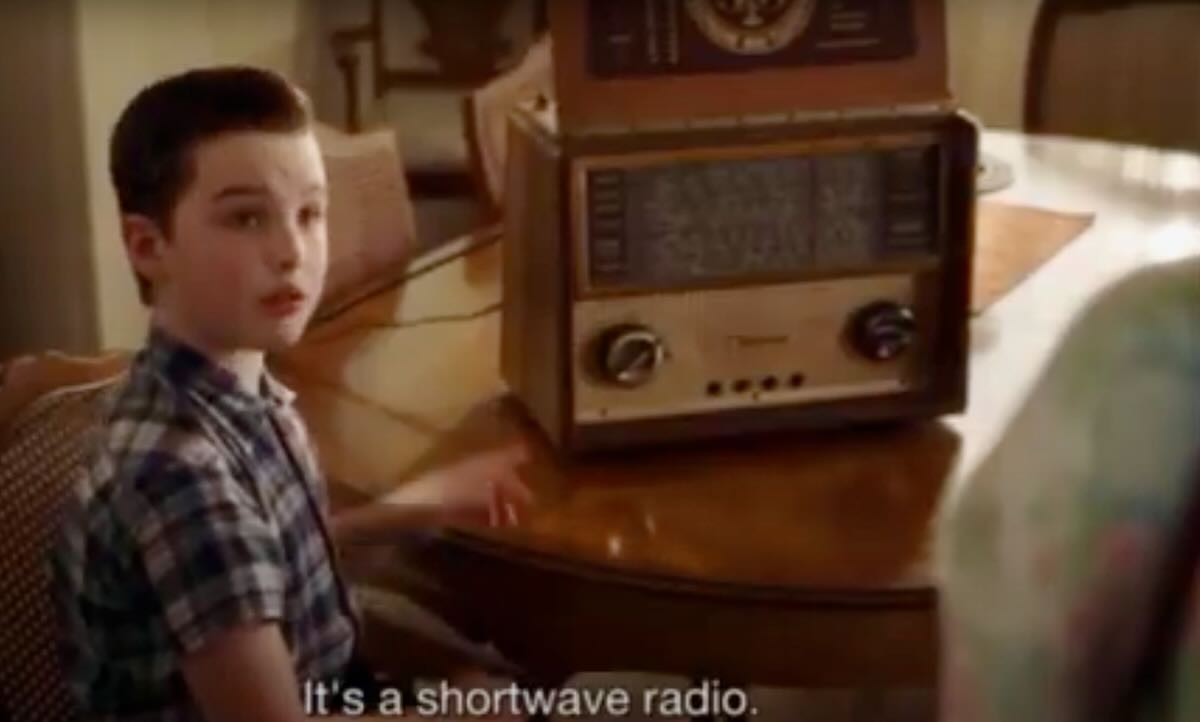
Can you identify this radio and loop antenna in “Young Sheldon”?

Many thanks to SWLing Post contributor Bruce, who writes:

This episode, S02E22, was aired on May 16, 2019. In the story the year is circa 1990. The “broadcasts” of CHU (not named) and Radio Sweden International are not actual ones.

I give this episode high marks for taking the time to demonstrate a Shortwave Radio and an Antenna, more than anything I’ve seen before on any TV show or movie.

Can anyone identify the radio and the loop antenna? Please comment!

How Radio Carried the News of D-Day: Broadcasts from June 6, 1944

American GIs heading toward the shoreline of Omaha Beach around June 7, 1944. (Photo Courtesy of The National WWII Museum)

Today marks the anniversary of D-DayOperation Overlord—the Allied invasion of Normandy on June 6, 1944.

If you’ve never listened to how the news broke here in the U.S., the Internet Archive hosts a remarkable collection of recordings from that historic day. It’s fascinating to hear the unfolding coverage in real time—an extraordinary window into the role of radio during one of the most pivotal moments in history.

Complete Broadcast Day – D-Day (June 6, 1944)

Hallicrafters’ 1944 Film, “Voice of Victory”

Many thanks to SWLing Post contributor Fred Waterer, who writes:

I’ve fallen down a YouTube rabbit hole.

This time a video that is part propaganda, part Hallicrafters ad, and part documentary.

Pretty interesting how they adapted the radios to wartime conditions:

Click here to view on YouTube.

Spotted in Countdown: Can You Identify This Radio?

Many thanks to SWLing Post contributor Robert, who writes:

Hi Thomas – I am a huge fan of space movies and recently watched the 1967 film “Countdown” starring James Caan and Robert Duvall. There is a radio sitting on the nightstand in a hotel room in this scene.

Maybe your readers can identify it?

Cheers,

Robert

Thanks, Robert! This photo isn’t high definition, but I bet some of our intrepid radio sleuths will soon find the model number of this tabletop radio. Please comment!

Rafael Spots Several Radios in “Young Ones”

Many thanks to SWLing Post contributor Rafael Rodriguez, who writes:

Hi Thomas

Greetings from Colombia. Yesterday, I saw a movie called “Young Ones” (2014). It is about an apocalyptic future where water is the most precious resource.

In the film, radio is present through a station called “The Voice of the West shortwave”, which even has the slogan: “Where the airwaves live free”

A pair of radios are also shown, the first one seems to be a Sony 7600d and then an HF transceiver that I can’t recognize, a Handie also appears.

Interestingly, it shows a way to mark an agricultural robot so that whoever finds it can communicate with its owner via citizen band.

I hope it is of interest to you and the readers of The SWLing Post.

Bye and good DX

Rafael Rodriguez R

Patrolling The Ether: A 1944 Film About Tracking Down Nazis With Radio!

Many thanks to SWLing Post contributor Fred Waterer, who tipped us off to Patrolling the Ether—a 1944 short film produced by the U.S. Office of War Information. This wartime documentary highlights how amateur radio operators and federal agents collaborated to monitor the airwaves and track down enemy spies. A fascinating glimpse into radio’s role in World War II era homeland security:

Click here to view on YouTube.

Don Moore’s Photo Album: Guatemala (Part Seven) – Radio Maya de Barillas

Image: Radio Maya via Facebook

Don Moore’s Photo Album:
Guatemala (Part Seven) – Radio Maya de Barillas

by Don Moore

More of Don’s traveling DX stories can be found in his book Tales of a Vagabond DXer [SWLing Post affiliate link]. If you’ve already read his book and enjoyed it, do Don a favor and leave a review on Amazon.

Given the subject of this final part you might assume that I eventually did make it to Barillas and get to visit Radio Maya. I wish it were so, but no. When writing part six of this series I tried to find a few interesting links about Radio Maya to include. I came across a 38-minute video about the history of the station issued on its 50th anniversary in 2012. The video is a series of still photos (most very old) narrated in Kanjobal.

Actually I’m assuming that it’s Kanjobal as that is the Mayan language spoken in Barillas. I don’t speak Kanjobal, but the Mayan languages use Spanish for numbers, dates, and modern ideas such as technical terms. Between the Spanish words and the context provided by the photographs, I was able to somewhat understand the video. Instead of expecting you to watch the 38-minute video, I’ve copied the most interesting pictures below. (I don’t think you want to see pictures of all the people involved over the years.)

Beginnings

There had been an Evangelical mission in Barillas since the mid-1950s. The name of whoever decided to put a radio station in Barillas is lost to history. But, like Father John Rompa of the Catholic station La Voz de Nahualá, they realized that radio was the best way to reach the Mayan people scattered across remote mountain towns and villages. Also lost to history is why they picked a place as remote as Barillas. Not only was the town at the end of the road, but in the early 1960s the last stretch of road wasn’t even drivable. Hauling in equipment for the new broadcaster was a challenge.

Here a man carries part of the transmitter on his back:

The transmitter eventually arrived in Barillas on an oxcart:

In these next two pictures about two dozen men haul the generator over a rough stretch of road:

The original building in 1962:

The next step was putting up the antenna. Here villagers prepare to erect a wooden pole as a center support for the antenna wires:

One of two shorter poles to hold up the lower ends of the wire:

When the pole was in place a very brave (or foolhardy?) man climbed to the top to attach the wires:

The finished tower. The antenna wires, attached at the top, aren’t visible. The lower wires are for support:

From its beginnings until the late 1970s, Radio Maya de Barillas only broadcast on 2360 kHz with this 250-watt transmitter. Later a one-kilowatt transmitter was added for 3325 kHz.

Installing the generator:

The Radio Maya studio in the 1960s:

Getting Bigger

In 1969 a plot of land was purchased on the edge of town and over the next three years a new building was constructed with help from American missionaries. Continue reading