Category Archives: Nostalgia

Voice of America Museum director to present history of Bethany transmitting station

(Source: Cincinnati.com)

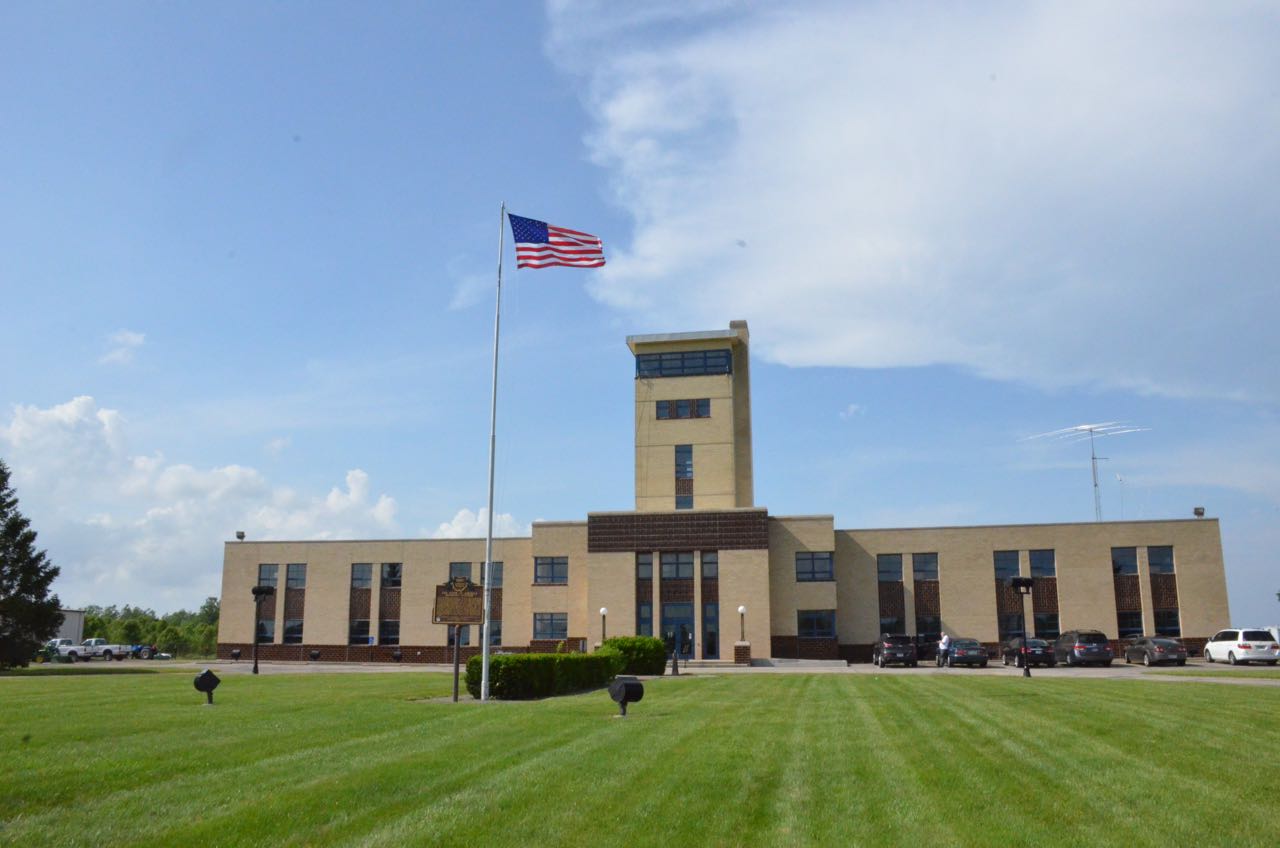
If you’ve ever wondered why the VOA-Bethany Station needed a secured, square mile of land surrounding its 1944 art deco building in West Chester, Jack Dominic has the answer.

Dominic, the National Voice of America Museum of Broadcasting director, will speak on the “History of the VOA-Bethany Station and the VOA Museum Today” Wednesday, April 3, from 7 to 8:30 p.m. at the MidPointe Library in West Chester’s community room.

The free event is the second of a four-part series, “The Voice of Truth in America: Celebrating 75 Years of the VOA Bethany Station,” with the MidPointe Library System.

The VOA museum hosts other free events this year to commemorate the 75th anniversary of the VOA-Bethany Station, which now houses the Cold War-era history and broadcasting museum.

“From World War II through the Cold War, the VOA-Bethany Station played a vastly important role in transmitting real news via shortwave radio to people living in countries that lacked a free press,” said Ken Rieser, VOA museum board president. “And it all started here in Cincinnati, with two brothers who developed the technology that evolved into the commercial radio industry.”[…]

The VOA museum will host its fourth annual “75 Years of Rockin’ the Radio” fundraiser Saturday, Sept. 21, with dinner and dancing. Sponsorships are now available.

Museum hours are 1 to 4 p.m. Saturdays and Sundays at 8070 Tylersville Road. Admission is $5 for adults and $1 for children.

For a complete schedule of 2019 VOA museum events, “The Voice of Truth in America,” series and WCARA events, visit www.voamuseum.org, www.midpointelibrary.org and www.wc8VOA.org.

Read the full new release at Cincinnati.com.

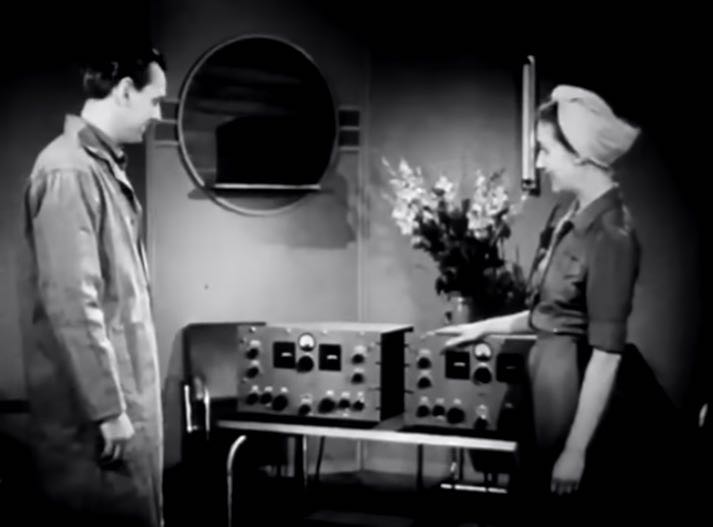
WWII Machine Shop Supervision film includes the Hammarlund Super Pro

Many thanks to SWLing Post contributor, Colin Snow (KM6NTW), who notes that the following 1944 film “Maintaining Workers’ Interest” from the US Office of Education, features the Hammarlund Super Pro.

The video starts at the point in the film where the Super Pro is featured. To view the film from the beginning, click here.

https://vimeo.com/399908150

Click here to view on YouTube.

Guest Post: Indian DXer enters into Limca Book of Records

Many thanks to SWLing Post contributor, Sandipan Basu Mallick (VU3JXD), for sharing the following guest post:


Indian DXer enters into Limca Book of Records

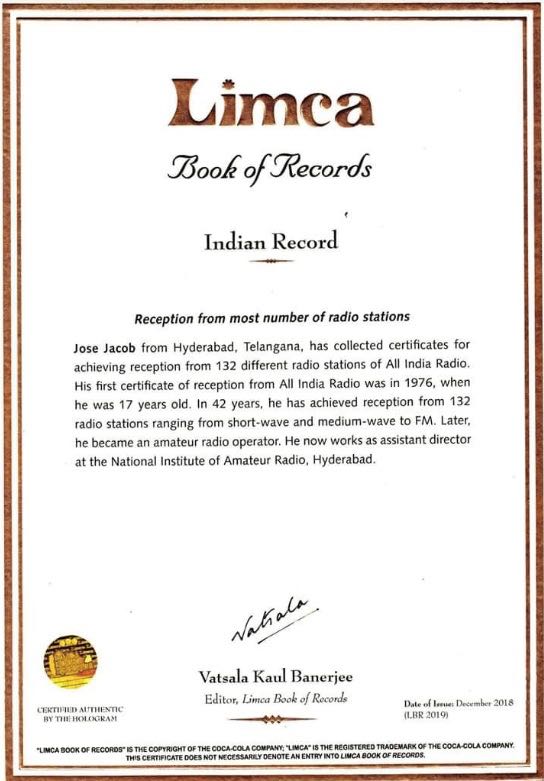
Jose Jacob from Hyderabad, India has collected QSL from 132 different stations of All India Radio over a period of 42 years. Radio stations ranging from Shot wave, Medium wave, FM to the latest DRM mode. In the process he has achieved the feat of creating an Indian Record of collecting maximum number of QSL of different stations of a radio broadcaster in India.

As a teenager Jose started listening to radio and started to write to stations way back in 1973, when in his school days. Few years later in 1976 he first wrote to All India Radio, when his reception report was first verified with a QSL. Over next 42 years, he has used various mediums, ranging from inland letters, post cards to emails, for sending reception reporting. Currently he has over 2500 QSL from 130 different countries, many of which left the airwaves.

Over the years, with his special interest in All India Radio, he is one of key country contributors, from India, of World Radio TV Handbook updating about All India Radio to the directory of global broadcasting.

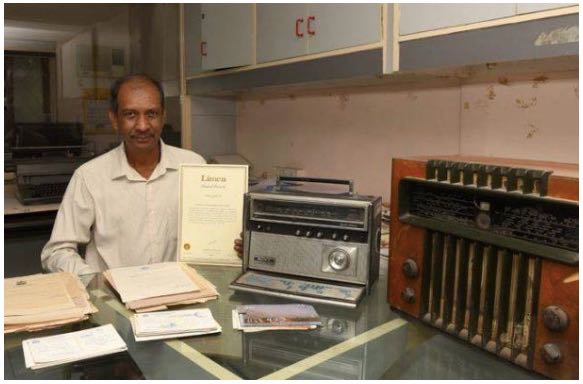
Jose Jacob, is also a licensed amateur radio operator with call sign VU2JOS currently serving as Asst. Director at the National Institute of Amateur Radio (NIAR) www.niar.org

Jose Jacob (VU2JOS) with Certificate from Limca Book of Records

Limca Book of Records is an annual reference book published in India documenting human and natural world records. The world records achieved by humans are further categorised in education, literature, agriculture, medical science, business, sports, nature, adventure, radio, and cinema with Limca book of Records rules. (https://www.coca-colaindia.com/limca-book-of-records)

Limca Book of Records has recognized the feat as one of the Indian records in the radio category and awarded the certificate acknowledging the achievement.

QSL received in 1997 from All India Radio, Nagpur

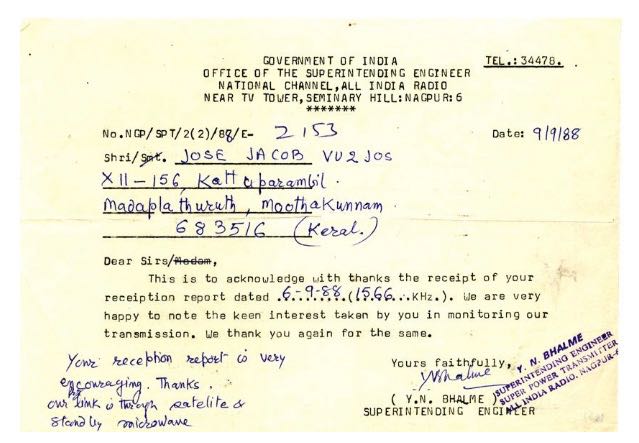
QSL received in 1988 from All India Radio, Nagpur

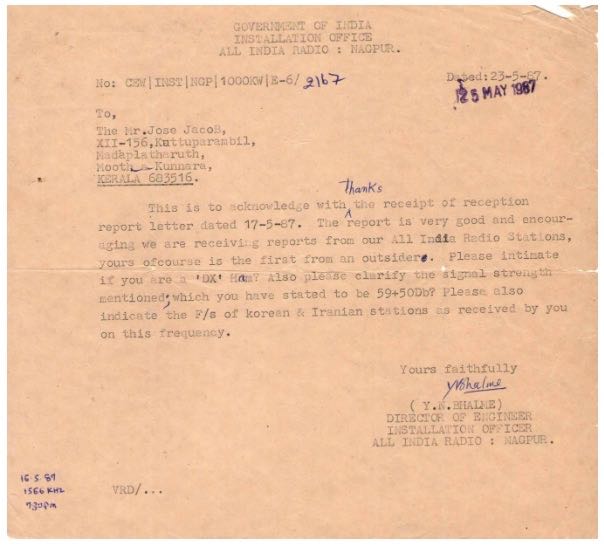
QSL received in 1987 from All India Radio, Nagpur


Congratulations to Jose Jacob VU2JOS for an amazing accomplishment!  Thank you for sharing this news, Sandipan!

CNN Travel features the abandoned Duga Radar site near Chernobyl

(Source: CNN Travel via Heath Hall)

(CNN) — The peaceful untouched forest north of Ukraine’s capital, Kiev, is a perfect spot to enjoy the outdoors — save for one fact.

It contains the radiation-contaminated Chernobyl Exclusion Zone, established in 1986 after the world’s worst nuclear disaster sent a wave of radiation fallout across Europe.

Since 2011 it’s been a major draw for adventurous tourists, but the forests here conceal another legacy of the Cold War, with a far more sinister and mysterious reputation.

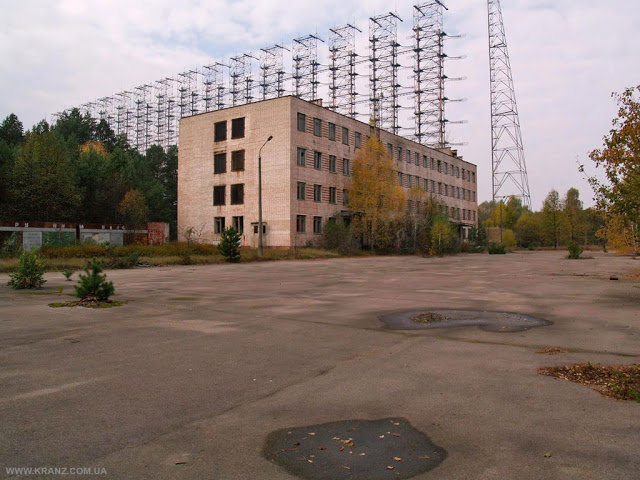
The Duga radar.

Though once a closely guarded secret, this immense structure can be seen for miles around, rearing up through the mist over the horizon — a surreal sight.

From a distance, it appears to be a gigantic wall. On close inspection, it’s an enormous, dilapidated structure made up of hundreds of huge antennas and turbines.

The Duga radar (which translates as “The Arc”) was once one of the most powerful military facilities in the Soviet Union’s communist empire.

It still stands a towering 150 meters (492 feet) high and stretches almost 700 meters in length. But, left to rot in the radioactive winds of Chernobyl, it’s now in a sad state of industrial decay.

Anyone exploring the undergrowth at its feet will stumble upon neglected vehicles, steel barrels, broken electronic devices and metallic rubbish, the remainders of the hasty evacuation shortly after the nuclear disaster.[…]

Click here to continue reading the full article and explore the photo gallery at CNN Travel.

Photos from the 2019 Charlotte Hamfest

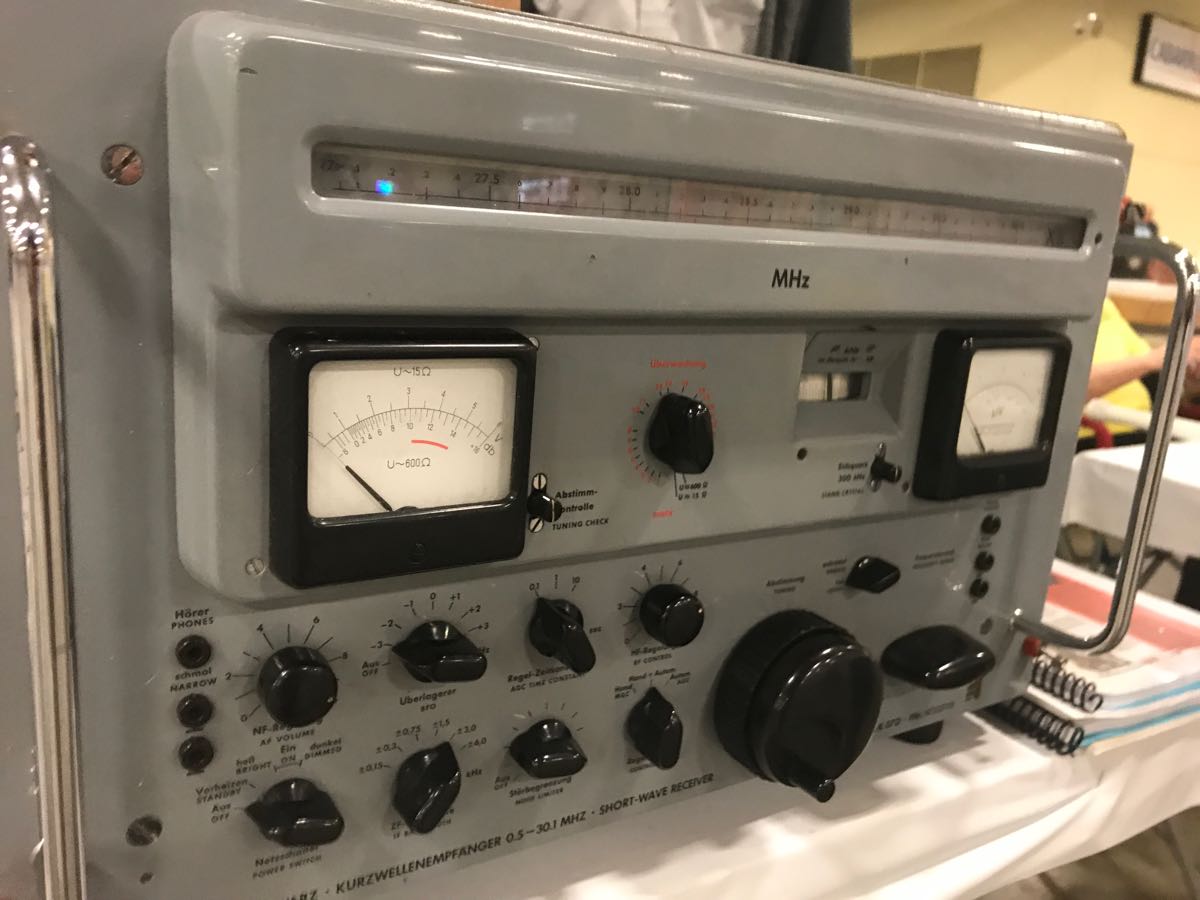
This RS HF receiver was pristine. If I had the budget and the shack space, it would have gone back with me. See more photos in our gallery below.

Yesterday morning around 5:30 AM I started my nearly three hour pilgrimage to the 2019 Charlotte (North Carolina) Hamfest. The Charlotte Hamfest is one of the larger regional hamfests in the area–due to its central location, it attracts people from all of the surrounding states.

The Charlotte Hamfest typically falls on the heels of (or the same weekend as) the Winter SWL Fest in Pennsylvania so I usually don’t even put the dates in my calendar. Indeed, the last time I attended the Charlotte Hamfest was about twenty years ago! It was at a different location and, back then, was also very much a computer show. Today it’s almost purely radio.

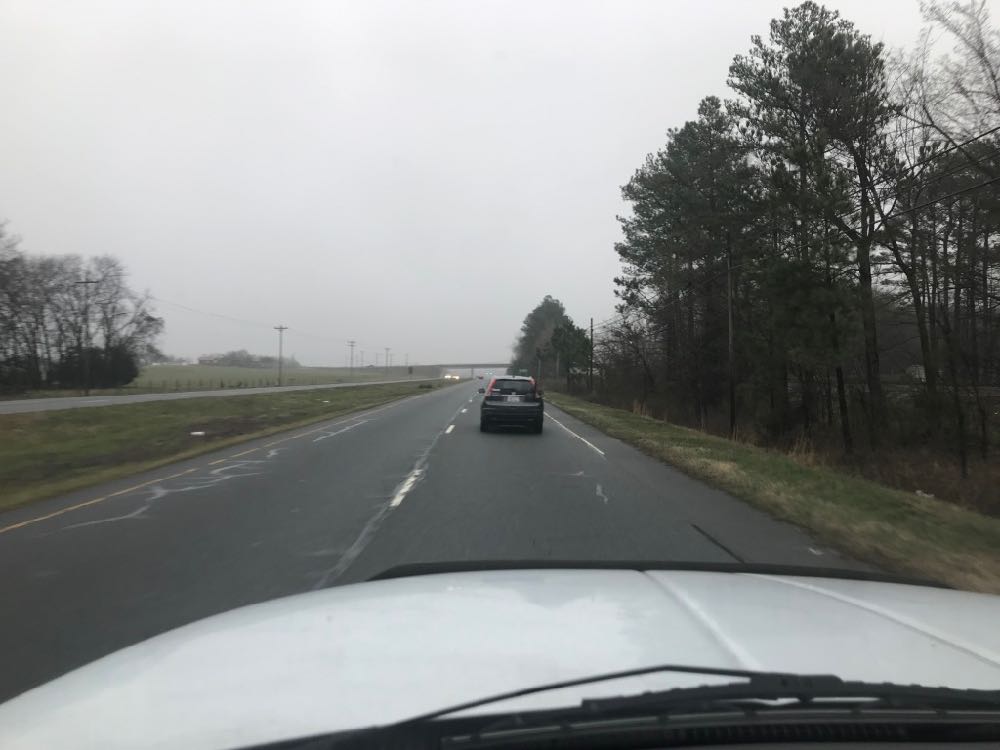
Following Vlado to the hamfest site on a very foggy, rainy Saturday morning.

The Charlotte Hamfest is a Friday/Saturday event held at the Cabarrus Arena & Events Center in Concord, NC. The center is a superb hamfest venue: it’s well lit, clean, spacious and can easily house all of the vendors indoors–a huge bonus as weather was less than desirable.

My buddy, Vlado (N3CZ) reserved two vendor tables and packed it with gear to sell–I also brought along a handful of items.

I was very impressed with the turnout–indeed, it was one of the busiest regional hamfests I’ve attended in ages. I sold a couple of items and Vlado sold a lot (he also purchased a lot, but that’s another story!).

I believe I’ll start putting the Charlotte hamfest in my calendar–even though timing isn’t always convenient for me, I think it’s well worth the trip!

Kudos to the Mecklenburg Amateur Radio Society for putting on such a great show!

Photos

I’ve embedded over 140 photos of the Charlotte Hamfest below–click each one to enlarge. Being a lover of vintage radios, my photos feature a lot of boat anchors. Note that when possible, I try to include the price tags for each item.

Note: If you can’t view the embedded photos below in our email digest, click here to view them on the web.

Do you enjoy the SWLing Post?

Please consider supporting us via Patreon or our Coffee Fund!

Your support makes articles like this one possible. Thank you!

Advice on preserving 1940s era homemade records

At the Winter SWL Fest last week, my friend, Andrew Yoder (author of the Pirate Radio Annual) told me about a recent find: homemade records by amateur radio operator W3JJN.

Andrew wrote about these recordings on his blog:

[…]Before open-reel decks were wire recorders. Information was magnetized onto a fine reel of stainless steel wire. It was essentially the same concept as tape decks, whether open reel or cassette, only the tape system was a refinement (an oxide coating on a plastic tape), rather than trying to magnetize a wire.

[…]Before wire recorders were record recorders. These took an audio source and the needle cut a blank disc with grooves. From what I understand, these homemade discs weren’t meant to be played back too many times because the needles wore into the grooves more quickly than commercially manufactured records. I’m not sure what they were all made from, but I know that some were aluminum discs with a thin layer of plastic.

I always look for the homemade records because there weren’t too many options for audio sources back then. By the open-reel tape era, a lot of people were recording entire albums to tape, so they weren’t necessarily recording the radio. But, for example, in 1940, the options were basically either family greetings, someone singing or a band playing, or the radio. And chances are good that any recording you find is the only one in existence.

I found three of these on Saturday.

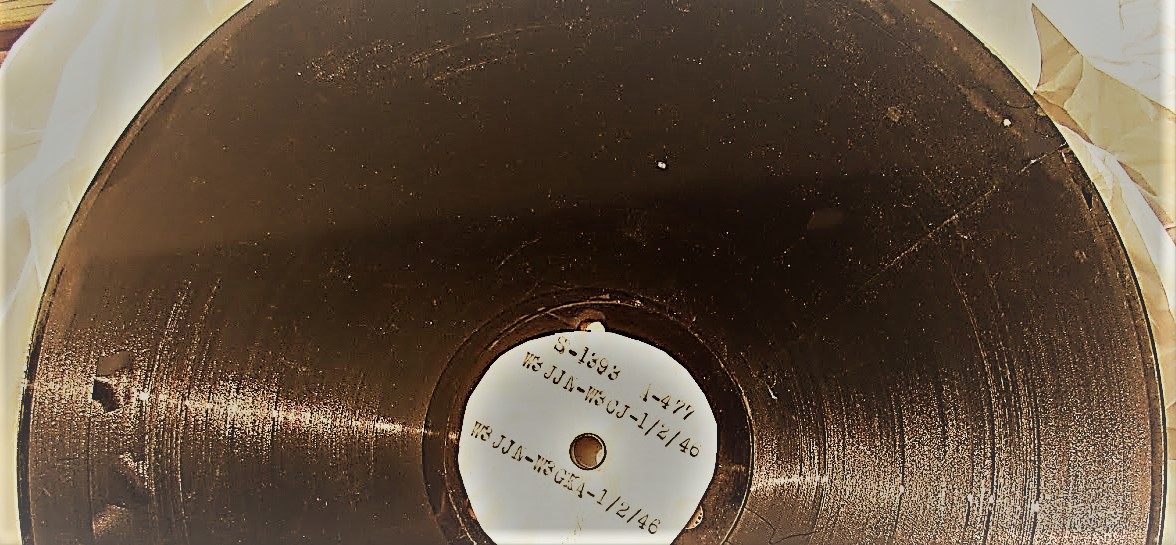
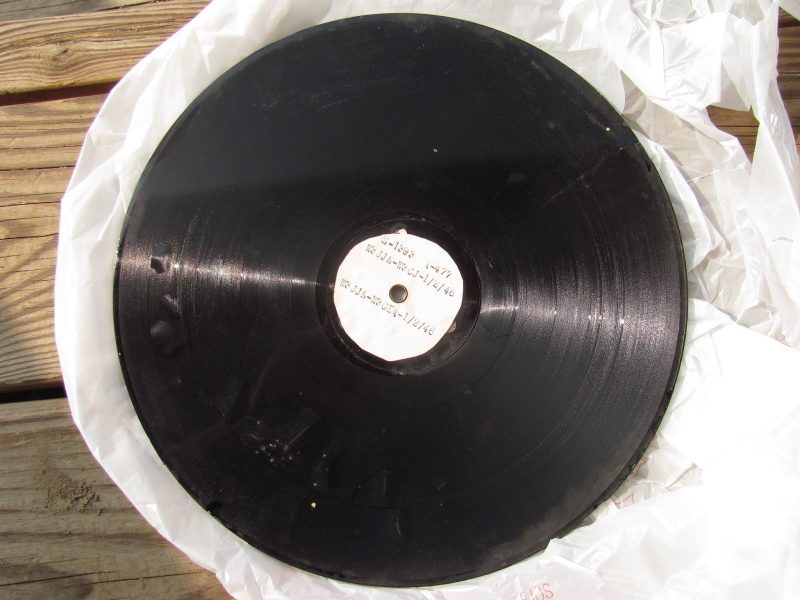
Here’s a photo of one.

They are amateur radio QSOs from W3JJN to a couple of other operators. W3JJN cataloged the discs by side . . . and this was number 477. So, at least 237 other records existed in his homemade record collection at one time. The sides that I have are dated in late 1945 and early 1946. To me, this is an astounding find because I’m not sure how many recordings exist of any amateur radio operations prior to 1950, not to mention that this is still very early in the post-war period.

I did some searching on W3JJN and he was William E. Belz, who lived at that time on 1509 Linden Avenue in Baltimore, Maryland. He was a TV repairman who was born in Duncansville, PA, and died in 1981 after a lengthy illness.

My big problem here is that these records are disintegrating. The plastic layer is cracking badly and separating from the aluminum discs. I guess what I really need is one of the laser turntables that can play back audio from broken discs and won’t damage the grooves. I don’t think I can risk playing any of these on a regular turntable, but I want to recover the audio quickly before the discs degrade further.

Click here to read the full article.

Post readers: Any advice on preserving these recordings? It sounds like using an actual needle to make a digital copy might be a little too destructive.  Are there alternatives?  Please comment if you have any experience or suggestions!

Guest Post: Repairing the National Panasonic DR22, the Panasonic RF-2200’s Euro-Sibling

Many thanks to SWLing Post contributor, Mario Filippi (N2HUN), who shares the following guest post:


National Panasonic DR22, the Panasonic RF-2200’s Euro-Sibling

By Mario Filippi, N2HUN

(All photos courtesy of author)

Thomas, your recent and thoroughly excellent post on the Panasonic RF-2200 was the inspiration for this short review of the RF-2200’s European sibling, the National Panasonic DR22.

A few years back when I was hunting for a used RF-2200, a second-hand National Panasonic DR22 was for auction on eBay. These radios were sold in Europe and are almost an exact match for the RF-2200, with a few minor cosmetic differences.  It was so close in appearance that I decided to bid and won the auction. The cost was around $150.00 plus shipping.
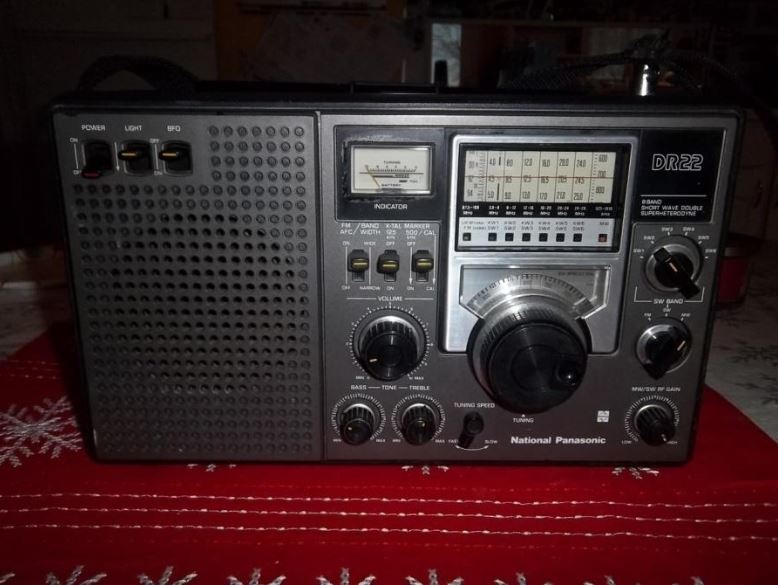
Author’s National Panasonic DR22, a.k.a. RF-2200BS

The seller described the unit as working, not a tech special, and was complete except for the original earphone.  The strap, which can be missing on some used models was in place, the antenna and all the knobs were there. When the radio was received, all appeared to be working well and most importantly the rotatable ferrite antenna was fully functional.  With the exception of tiny paint specks and years of accumulated dust the unit was cosmetically acceptable for a 40 plus year old radio. After a close olfactory inspection (smelling the unit hi hi) it was determined the radio was from a smoke-free home, which is important as smoke not only causes yellowing of plastic components, but it inundates the internal electronic components and coats them with a yellowish-brown stain.
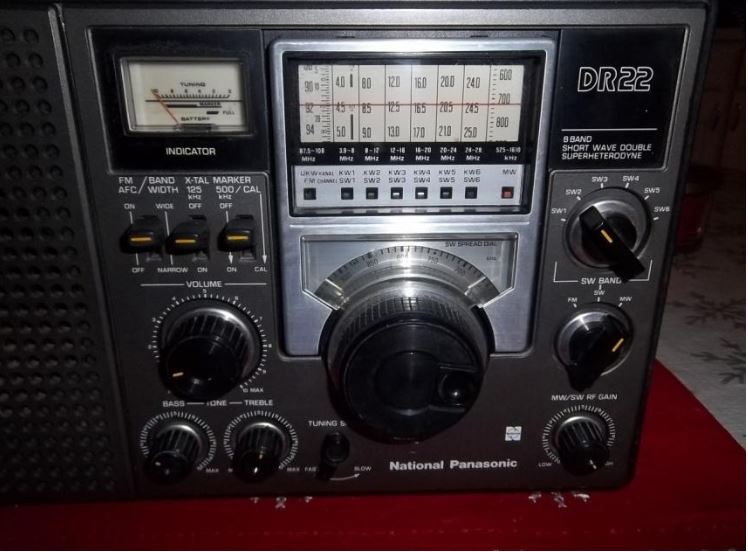
National Panasonic DR22 Dashboard Shows Slight Labeling Differences

On close inspection, the unit differs slightly from the RF-2200, in that it is branded as a “National  Panasonic” along with the “DR22” designation on the upper right of the unit. And, the National Panasonic logo can be seen to the left of the AM/SW gain control.  Another difference is the additional labeling found above each shortwave band, the designations are KW1, KW2, etc.
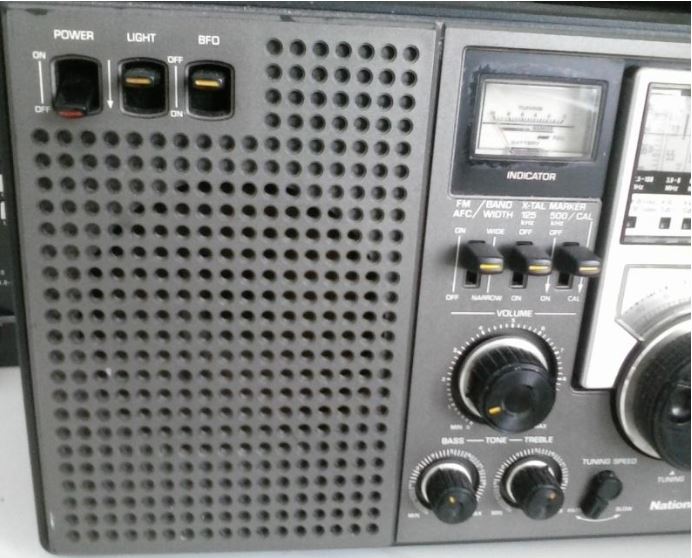
Power, Dial Light, and BFO Switches Are Identical to RF2200

As for the rear panel of the DR22, a major difference is the presence of a voltage selector which allows one to switch from European voltage (220) to the US standard (110).   Inside the unit there’s a transformer that handles this option. Alternatively you can simply use four “D” batteries to power the unit.
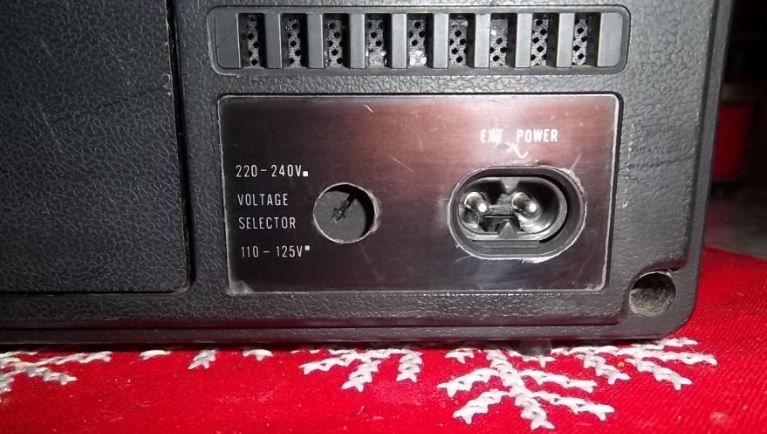
DR22 Line Voltage Selector Switch

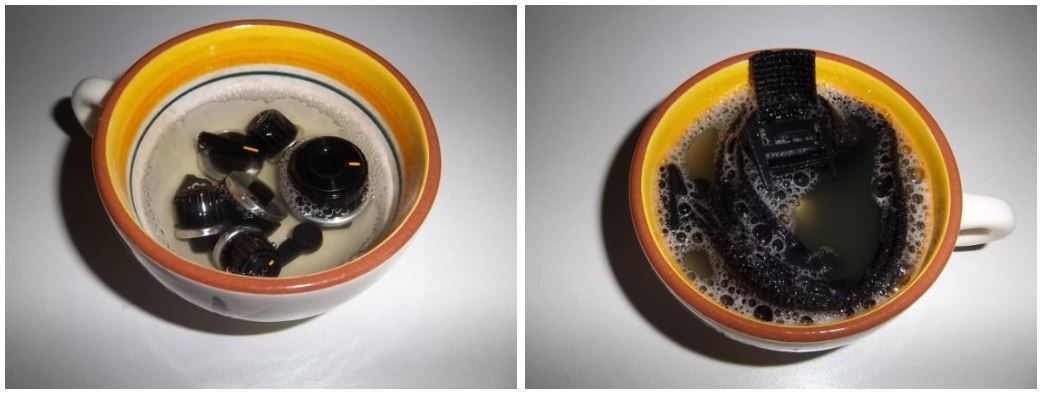
After receiving the unit, first order of business was a good cleaning of the outer case with mild soap and water.  All the knobs and carrying strap were removed and soaked in a warm soapy solution. A toothbrush was put to work to remove years of human tactile residue from the sides of the knobs.
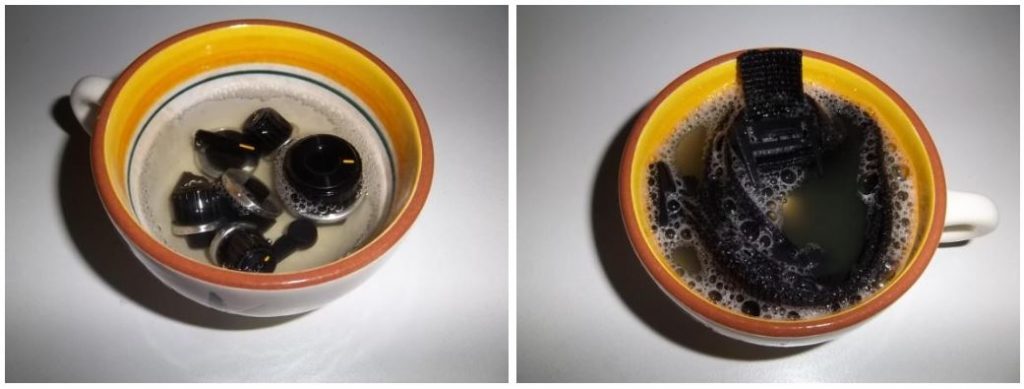
Knobs (left) removed for cleaning. Carrying strap (right) was inundated with decades of dirt.

Next on the “to do” list was to obtain a copy of the service manual, available on line.  You’ll find it under the title of National Panasonic RF-2200BA. It’s an excellent manual with detailed photos of the circuit boards, exploded diagrams of the mechanical parts, parts list, schematics, and of course the alignment procedure.   Cracking open the case required removal of all the case screws and very gently coaxing of the two panels apart. Years of use, rust on the screws, and dirt/dust buildup all contribute to the challenge of this endeavor.
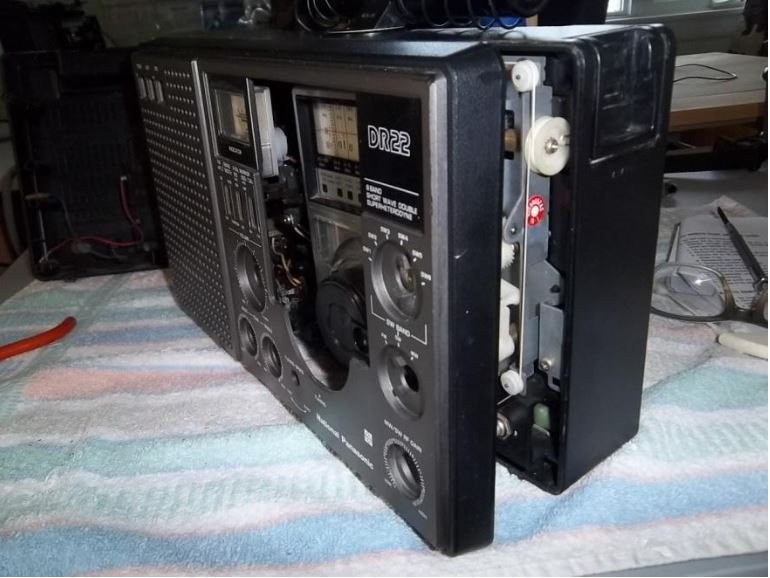
DR22 Case Disassembly

The alignment took several weeks as the radio was worked on in my spare time.  Note that I did not replace any electrolytic capacitors, and yes it was the lazy man’s way but a basic inspection of the caps for any evident leaks, explosions, or burns was conducted.  In short I did not want to replace capacitors at this time since the radio, as received from the former owner, was working well on all bands. Surely, as other operators have reported, cap replacement will restore full operational excellence but I felt if the radio passes the alignment specifications  that was good enough for me at this point.
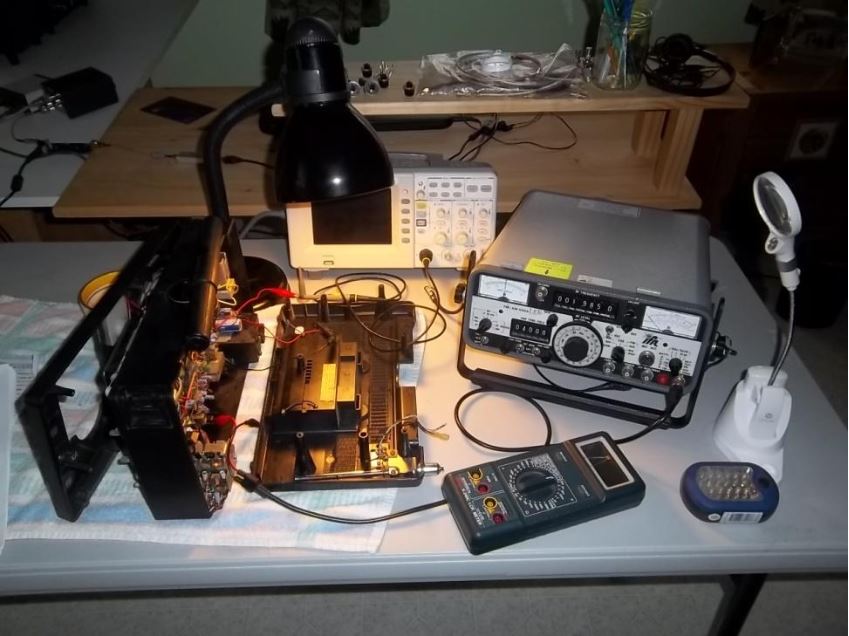
DR22 Undergoing Testing

After several weeks the radio was restored to specifications, all switches were cleaned and dusted and the radio reassembled.  This was done a few years ago and the radio continues performing well. Even the 125/500 KHz crystal markers are pretty much on the money when checked against WWV.  No scratchy pots either hi hi. So now the radio sits in my kitchen and is on at least a few hours a day and keeps company with its sister, my RF2200. Note that recently DR22s have sold on eBay for $150 – $300US. Tech specials/parts radio run considerably less.  Thanks and 73’s de N2HUN.


Thank you, Mario! It looks like you scored an excellent deal on the DR22 and it’s serving you quite well! I’m glad you spent time checking for leaky capacitors after opening the chassis. Using the DR22 so frequently will keep those caps “juicy!”

Post Readers: Please comment if you love the National Panasonic DR22!


Do you enjoy the SWLing Post?

Please consider supporting us via Patreon or our Coffee Fund!

Your support makes articles like this one possible. Thank you!