Category Archives: Radio History

Radio Waves: Radio Tirana’s Global Communist Voice, Sounds of Community Radio, Morse Code Phishing, and the Mission of Vatican Radio

Radio Waves:  Stories Making Waves in the World of Radio

Because I keep my ear to the waves, as well as receive many tips from others who do the same, I find myself privy to radio-related stories that might interest SWLing Post readers.  To that end: Welcome to the SWLing Post’s Radio Waves, a collection of links to interesting stories making waves in the world of radio. Enjoy!

Many thanks to SWLing Post contributors David Shannon, Dennis Dura, and David Iurescia for the following tips:


Sources on Cold War Radio, Paradoxes, Maoism, and Noise (Wilson Center)

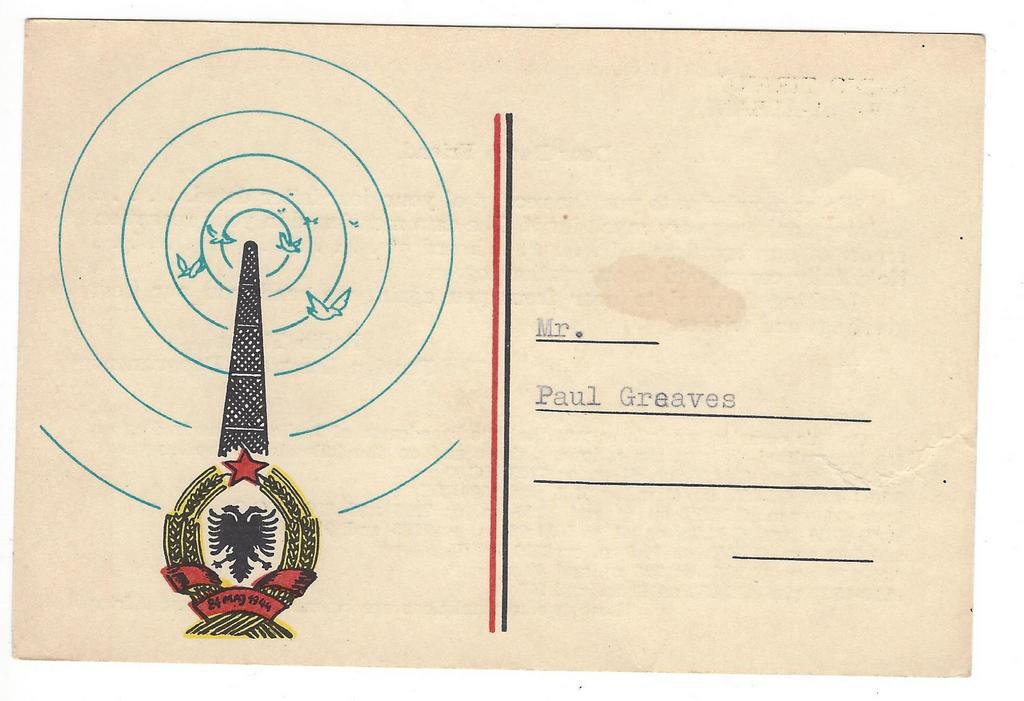
Radio Tirana emerged as a global Communist voice in the 1970s, reaching Brazilian guerillas in Araguaia, Maoist factions across Asia, Africa, and Latin America, and many other listeners around the world. Elidor Mëhilli explains how this came to be.

“Dear Radio Tirana,” the letter begins, “here in the Alps we can hear you well, and we are especially fond of your propaganda directed at the Italian Communist Party.” The letter is dated April 12, 1976 but its Italian authors are not named. After a final greeting “Viva Mao e Viva Stalin,” they have simply signed off “a group of true Communists.”[i]

Two months earlier, in Entroncamento, Portugal, someone has penned a letter to the same station. “Camaradas,” his note begins, “I am a worker (a porter) who listens regularly to your Portuguese-language broadcasts.” The letter then proceeds with complaints about the fate of Communism in Portugal, with questions about Albania’s foreign policy, about why Radio Tirana spoke so infrequently about Portugal, about sports, about whether a trip to the Balkans might be possible.[ii]

By March, in Arequipa, Peru, a thirty-year-old places the recipient’s address on a small envelope: Señor Director, Radio Tirana, Albania.

He is among early Peruvian intellectuals who have been drawn to Mao Zedong’s ideas. Having completed a thesis on the topic, he is on his way to becoming a professor within a few years. “Unfortunately, I have to tell you that it’s been over a year that I do not receive your broadcasts,” he writes, “I think that it might due to the interference of the imperialist Yankees or perhaps the Soviet social-imperialists.”[iii]

Once a modest station, Radio Tirana had become a global Communist voice by the 1970s, reaching Brazilian guerillas in Araguaia, teeny-tiny Maoist factions across Asia, Africa, and Latin America, far-flung dots scattered across oceans and seas. This turned the station into a kind “of superpower of its kind” as author Ardian Vehbiu has put it. Officials embraced this role, broadcasting in numerous languages—English, Arabic, French, Italian, Greek, Portuguese, German, Indonesian—and beaming anti-capitalist and anti-Soviet messages day after day.[]

World Wide Waves: The Sounds of Community Radio (BBC World Service)

We think we live in a digital age, but only half the world is currently online. Across the globe, small radio stations bind remote communities, play a dazzling array of music, educate, entertain and empower people to make change. Cameroon’s Radio Taboo, in a remote rainforest village 100 miles off the grid, relies on solar power; its journalists and engineers are all local men and women, and some of its audience listen on wind-up radios. In Tamil Nadu, Kadal Osai (“the sound of the ocean”) broadcasts to the local fishing community about weather, fishing techniques—and climate change. In Bolivia, Radio Nacional de Huanuni is one of the last remaining stations founded in the 1950s to organise mostly indigenous tin miners against successive dictatorships; its transmitters are still protected by fortified walls.

For World Radio Day, we visit community stations around the globe and celebrate the enduring power, possibilities and pleasures of the airwaves.

This program will be available shortly after broadcast on Feb 14, 2021. Click here for details.

New phishing attack uses Morse code to hide malicious URLs (Bleeping Computer)

A new targeted phishing campaign includes the novel obfuscation technique of using Morse code to hide malicious URLs in an email attachment.

Samuel Morse and Alfred Vail invented morse code as a way of transmitting messages across telegraph wire. When using Morse code, each letter and number is encoded as a series of dots (short sound) and dashes (long sound).

Starting last week, a threat actor began utilizing Morse code to hide malicious URLs in their phishing form to bypass secure mail gateways and mail filters.

BleepingComputer could not find any references to Morse code being used in phishing attacks in the past, making this a novel obfuscation technique

The novel Morse code phishing attack
After first learning of this attack from a post on Reddit, BleepingComputer was able to find numerous samples of the targeted attack uploaded to VirusTotal since February 2nd, 2021.

The phishing attack starts with an email pretending to be an invoice for the company with a mail subject like ‘Revenue_payment_invoice February_Wednesday 02/03/2021.'[]

Father Lombardi: Mission of Vatican Radio in service of the Pope (Vatican News)

We reproduce excerpts from an article written on the 90th anniversary by the former Director of Vatican Radio, which were published in the latest issue of La Civiltà Cattolica.

By Fr Federico Lombardi, SJ

On 12 February 2021 it will be exactly 90 years since Pope Pius XI inaugurated the new Vatican Radio Station – built at his request by Guglielmo Marconi and entrusted to the care of Jesuit Father Giuseppe Gianfranceschi as its first director. The “mission of Vatican Radio was clear from the beginning: to be an instrument at the service of the Pope for his ministry of proclaiming the Gospel in the world and guiding the universal community of the Catholic Church. This mission has been preserved over time and has been reaffirmed several times by the Popes, guaranteeing a strong identity of the institution. […]

The voice of the Pope
Vatican Radio […] was founded in 1931, in the context of the rapid establishment of the new Vatican City State […]. The radio station built by Marconi was at the forefront of the technology of the time, and was able to provide telegraphic and radio service completely independently from Italy. Thanks to short-wave technology, in an “ether” not yet overcrowded with countless transmissions, it was possible to be heard on other continents with a rather low power. At the beginning of its existence, Vatican Radio was the instrument thanks to which the Catholics of the world could hear the voice of the Pope directly for the first time. […]

The 1930s were years of the power of totalitarianism. Pius XI’s positions were courageous and, in the thickening of the storm, he looked to the Church with confidence. The demand for broadcasts in different languages to guide and support the faithful in European countries grew rapidly. Father Filippo Soccorsi, appointed to lead the Radio in 1934 (at 34 years old!), after the untimely death of Fr. Gianfranceschi, not only dedicated himself to improving the technical structures — such as the new antenna towering over the Vatican gardens, known as “The Pope’s Finger” — but promptly grasped the expectation to make the Radio grow also in the content of its programming. Thus, in 1936, the Vatican Broadcasting Corporation was accepted into the International Broadcasting Union with a recognition of its special nature, which authorised it to carry out radio activities without any geographical limitations. Because of the limited means available, Fr Soccorsi asked for the collaboration of Jesuit brethren from various countries for the editing and presentation of the texts. The German-language broadcasts were particularly important.

In the tragedy of war: for peace and solidarity with the suffering
[…] On the eve of the war, in 1939, there were regular broadcasts in Italian, French, English, German, Spanish, Portuguese, Polish, Ukrainian, and Lithuanian, and the station was able to be a point of reference for the Church in the immense tragedy, playing its role of denouncing violence, supporting victims and members of the resistance, and encouraging hope. The “Radio-messages” of Pius XII in wartime, eagerly awaited and listened to with great attention throughout Europe, remain famous. His was the loudest and most authoritative voice rising above the warring parties in those terrible years, calling for justice and peace.

During the war, however, Vatican Radio became famous for another service: it was in fact a fundamental instrument of the great commitment desired by Pius XII with the “Information Office of the Secretariat of State,” set up in 1939 to track down missing civilians and soldiers and prisoners; to provide information to their families and, if possible, to re-establish among them at least a link of greeting and remembrance. […]

Vatican Radio devoted specific broadcasts to requesting news about the missing and broadcasting short messages from the families to the prisoners, whose names were slowly spelled out by the “metallic” voice of the speakers. These broadcasts reached 70 hours per week, with peaks of 12-13 hours per day. Between 1940 and 1946, a total of 1,240,728 messages were broadcast in 12,105 hours of actual transmission time. In some cases, the transmissions were broadcast over loudspeakers in prison camps. The testimonies of gratitude for this service were numerous and moving. This is one of the most beautiful pages in the history of Vatican Radio.

A voice for the “Church of Silence”
With the end of the war, Vatican Radio accompanied with its broadcasts the climate of moral and spiritual reconstruction of the countries devastated by the conflict, while preparations were in full swing for the great Holy Year of 1950, a time of renewed vitality of the Church.

But in the meantime, most of Eastern Europe fell under the oppression of the communist regimes, and the Catholic Church became the object of harsh persecution in many countries. This was an historic challenge for Vatican Radio, which was practically the only way through which the faithful could nurture their bond with the Pope and the universal Church and receive support for their faith. Even with limited resources, programmes in the languages of Eastern European countries became more numerous and were given more airtime. At the end of the 1940s, the programme in Polish — which together with Italian, English, French, Spanish and German had always been one of the main languages of transmission — was joined by those in Czech, Slovak, Hungarian, Lithuanian, Latvian, Russian, Croatian, Slovenian, Ukrainian, Romanian, Bulgarian, Belarusian and, shortly afterwards, Albanian. For decades, throughout the time of oppression, the broadcasts of Vatican Radio offered a regular and sure appointment for the faithful, religious, priests and bishops deprived of the freedom to express and live their faith.

There would be countless stories to tell about those years. In certain countries and in certain periods of the harshest persecution, listening to Vatican Radio was absolutely forbidden and seriously dangerous: it could be the cause of serious penalties, up to imprisonment and even — in some cases — the death sentence. For some languages, such as Polish or Slovak, the audience was high, while for others, where Catholics were a minority, there were not many listeners. But the principle that guided the fathers of the Radio, according to the Pope’s intention, was not the vastness of the audience, but the situation of need of the listeners. That is why the languages of broadcasting to Eastern countries have always represented more than half of the languages used by Vatican Radio. When, after many years, the walls fell, the gratitude of the faithful and the people could finally express itself in moving forms, such as the more than 40,000 letters that arrived at the Ukrainian Section in the first year after the fall of the Soviet regime, or the bestowal of the award of the Albanian State for the work of Vatican Radio. […]

Communication for communion
In 1970 the editorial offices and studios of Vatican Radio moved to Palazzo Pio, in front of Castel Sant’Angelo, providing adequate space in what would become the main headquarters of the station for decades. In 1973 Father Roberto Tucci […] succeeded Father Martegani in the general direction. We were on the eve of the Holy Year 1975 and the Radio was completely mobilised. It was not only a matter of broadcasting live the great papal celebrations, audiences and events, and of giving adequate information in all languages so that the universal Church felt involved, but also of providing a service for pilgrims arriving in Rome from all over the world. […]

Pasquale Borgomeo, who would become a dynamic and creative director of programmes; and Father Félix Juan Cabasés, in charge of the “Central Editorial Office,” later the “Documentation Service”: The former would greatly cultivate the valuable international relations of the station, in particular with the European Broadcasting Union (EBU); the latter would leave a lasting mark in the organisation of documentation and editorial programming. […]

Vatican Radio thus reached maturity, with increasing professional and journalistic quality, which makes it not only the beating heart of daily communication in the universal Church — “communication for communion”, as the Council hoped — but also an active protagonist in the wider world of Catholic and lay communication in the life of the Church.[]


Do you enjoy the SWLing Post?

Please consider supporting us via Patreon or our Coffee Fund!

Your support makes articles like this one possible. Thank you!

Radio Waves: New Quantum Receiver, Virus and Distance Learning by Radio, BBC Woofferton Early Days, and Hello Morse

Radio Waves:  Stories Making Waves in the World of Radio

Because I keep my ear to the waves, as well as receive many tips from others who do the same, I find myself privy to radio-related stories that might interest SWLing Post readers.  To that end: Welcome to the SWLing Post’s Radio Waves, a collection of links to interesting stories making waves in the world of radio. Enjoy!

Many thanks to SWLing Post contributors Andrea, Kim Andrew Elliott, Dave Porter, and Phillip Novak for the following tips:


New quantum receiver the first to detect entire radio frequency spectrum (Phys.org)

A new quantum sensor can analyze the full spectrum of radio frequency and real-world signals, unleashing new potentials for soldier communications, spectrum awareness and electronic warfare.

Army researchers built the quantum sensor, which can sample the radio-frequency spectrum—from zero frequency up to 20 GHz—and detect AM and FM radio, Bluetooth, Wi-Fi and other communication signals.

The Rydberg sensor uses laser beams to create highly-excited Rydberg atoms directly above a microwave circuit, to boost and hone in on the portion of the spectrum being measured. The Rydberg atoms are sensitive to the circuit’s voltage, enabling the device to be used as a sensitive probe for the wide range of signals in the RF spectrum.

“All previous demonstrations of Rydberg atomic sensors have only been able to sense small and specific regions of the RF spectrum, but our sensor now operates continuously over a wide frequency range for the first time,” said Dr. Kevin Cox, a researcher at the U.S. Army Combat Capabilities Development Command, now known as DEVCOM, Army Research Laboratory. “This is a really important step toward proving that quantum sensors can provide a new, and dominant, set of capabilities for our Soldiers, who are operating in an increasingly complex electro-magnetic battlespace.”

The Rydberg spectrum analyzer has the potential to surpass fundamental limitations of traditional electronics in sensitivity, bandwidth and frequency range. Because of this, the lab’s Rydberg spectrum analyzer and other quantum sensors have the potential to unlock a new frontier of Army sensors for spectrum awareness, electronic warfare, sensing and communications—part of the Army’s modernization strategy.

“Devices that are based on quantum constituents are one of the Army’s top priorities to enable technical surprise in the competitive future battlespace,” said Army researcher Dr. David Meyer. “Quantum sensors in general, including the one demonstrated here, offer unparalleled sensitivity and accuracy to detect a wide range of mission-critical signals.”

The peer-reviewed journal Physical Review Applied published the researchers’ findings, Waveguide-coupled Rydberg spectrum analyzer from 0 to 20 GigaHerz, co-authored by Army researchers Drs. David Meyer, Paul Kunz, and Kevin Cox[]

Virus and distance learning by radio (1937, 1946) (AE5X Blog)

Six to eight decades ago polio was one of the most feared diseases in the US. In 1952 alone, 60,000 children were infected, 3000 died and many more were paralyzed.
The most severe outbreaks were in 1937 and 1946. My father was a victim of the 1946 epidemic, suffering minor paralysis in one leg as a child.

In 1937, many schools around the country closed, as did public pools, movie theaters and parks. But the Chicago public school system took an innovative approach.

During that period, 80% of US households contained a radio. This allowed 325,000 children in grades 3-8 to continue their education at home via radio lessons aired by six Chicago radio stations (WENR, WLS, WIND, WJJD, WCFL, WGN) that donated time for the purpose.

Program schedules for each day were printed in the morning paper. Home with more than one radio & more than one child often set up radios in different rooms so that each child could hear the appropriate grade’s lesson.

This continued for one month…until schools reopened in late September of that year.

Curriculum was developed by teachers and monitored over the air by school officials. After each episode, a limited number of teachers were available for phone calls. A large number of the calls were from parents distressed that they could not clearly receive the broadcasts.[Continue reading…]

BBC Woofferton Early Days (Ludlow Heritage News) [PDF]

Very few structures are left in the Ludlow area which can be traced back to the Second World War. However, look five miles south of the town towards the rise of the hills and a tracery of masts can be seen. Go closer, and a large building can be found by the road to Orleton, surrounded now by a flock of satellite dishes, pointing upwards. The dishes are a sign of the recent past, but the large low building was made for the war-time radio station aimed at Germany.

This little history attempts to tell the story of the British Broadcasting Corporation’s transmitting station at Woofferton near Ludlow in Shropshire during the first years of its existence. When and why did the BBC appear in the Welsh border landscape with a vast array of masts and wires strung up in the air? The story begins in 1932, when the BBC Empire Service opened from the first station at Daventry in Northamptonshire. Originally, the service, to link the Empire by wireless, was intended to be transmitted on long-wave or low frequency. But, following the discovery by radio amateurs that long distance communication was possible by using high frequency or short waves, the plan was changed. Later in the decade, the BBC expanded the service by also broadcasting in foreign languages. Although Daventry had a distinguished name in the broadcasting world, it was never technically the best place for a short-wave site, being on a hill and close to a growing town.

This article can be found in the Ludlow Heritage News: click here to download the full PDF.


Hello Morse: A collection of AI and Chrome experiments inspired by Morse code on Android Gboard (Google)

Developer Tania Finlayson found her voice through Morse code. Now she’s partnering with Google to bring Morse code to Gboard, so others can try it for accessible communication.

Morse code for Gboard includes settings that allow users to customize the keyboard to their unique usage needs. It works in tandem with Android Accessibility features like Switch Access and Point Scan.

This provides access to Gboard’s AI driven predictions and suggestions, as well as an entry point to AI-powered products, like the Google Assistant.[]


Do you enjoy the SWLing Post?

Please consider supporting us via Patreon or our Coffee Fund!

Your support makes articles like this one possible. Thank you!

Radio Waves: Michael Pack Resigns, FCC Enforcement Advisory, Upcoming ISS SSTV, and Prowling TV Detector Vans

Radio Waves:  Stories Making Waves in the World of Radio

Because I keep my ear to the waves, as well as receive many tips from others who do the same, I find myself privy to radio-related stories that might interest SWLing Post readers.  To that end: Welcome to the SWLing Post’s Radio Waves, a collection of links to interesting stories making waves in the world of radio. Enjoy!

Many thanks to SWLing Post contributors Eric McFadden, Ronald Kenyon,  for the following tips:


Defined By Scandal At Voice of America, CEO Resigns At Biden’s Request (NPR)

Michael Pack resigned Wednesday as the CEO of the federal agency over the Voice of America and other federally funded international broadcasters after a turbulent seven-month tenure. He leaves the U.S. Agency for Global Media with a Trumpian legacy of ideological strife, lawsuits and scandal, his departure effective just two hours after the swearing-in of President Biden, who requested him to leave.

Biden has named senior VOA news executive Kelu Chao as acting CEO.

Pack came to lead the U.S. Agency for Global Media with the support of former President Donald Trump; his appointment was delayed more than two years in the U.S. Senate by lawmakers who feared he was too ideological and also who questioned his finances. The soft-spoken conservative documentary maker proved to be an ideological warrior in the mold of his patron, taking to one conservative news outlet after another to denounce his own staff, all in the name of fairness.

In his resignation letter, Pack said he was “solely focused upon reorienting the agency toward its missions.” And he attacked the request for his resignation as “a partisan act,” saying the leadership of the agency and its networks “is meant to be non-partisan, untethered to alternations in the political regime.”

He added, “I had no political agenda coming into USAGM, and I still do not have one.”

NPR conducted scores of interviews over the controversies Pack’s actions engendered. And few at the agency or its broadcasters agreed with Pack’s characterization of his mission or performance, instead characterizing him as seeking political control over their coverage. Just last week, a VOA reporter’s insistent questions to then-Secretary of State Mike Pompeo and VOA Director Robert R. Reilly over the siege on Congress after a public event led to her demotion and an investigation.

Pack routinely accused journalists of anti-Trump bias, sought to fire top executives as part of a “deep state,” ominously accused the networks of being receptive to foreign spies and denied requests for visa extensions from his own staffers who are foreign nationals.[]

FCC Issues Enforcement Advisory: Radio Users Reminded Not to Use Radios in Crimes (ARRL News)

The FCC has released an Enforcement Advisory for licensees and operators across radio services.

[Complete text of FCC Enforcement Advisory follows.]

FCC ENFORCEMENT ADVISORY

DA 21-73

Released: January 17, 2021

WARNING: AMATEUR AND PERSONAL RADIO SERVICES LICENSEES AND OPERATORS MAY NOT USE RADIO EQUIPMENT TO COMMIT OR FACILITATE CRIMINAL ACTS

The Enforcement Bureau (Bureau) of the Federal Communications Commission issues this Enforcement Advisory to remind licensees in the Amateur Radio Service, as well as licensees and operators in the Personal Radio Services, that the Commission prohibits the use of radios in those services to commit or facilitate criminal acts.

The Bureau has become aware of discussions on social media platforms suggesting that certain radio services regulated by the Commission may be an alternative to social media platforms for groups to communicate and coordinate future activities. The Bureau recognizes that these services can be used for a wide range of permitted purposes, including speech that is protected under the First Amendment of the U.S. Constitution. Amateur and Personal Radio Services, however, may not be used to commit or facilitate crimes.

Specifically, the Bureau reminds amateur licensees that they are prohibited from transmitting “communications intended to facilitate a criminal act” or “messages encoded for the purpose of obscuring their meaning.” 47 CFR § 97.113(a)(4).

Likewise, individuals operating radios in the Personal Radio Services, a category that includes Citizens Band radios, Family Radio Service walkie-talkies, and General Mobile Radio Service, are prohibited from using those radios “in connection with any activity which is against Federal, State or local law.” 47 CFR § 95.333(a).

Individuals using radios in the Amateur or Personal Radio Services in this manner may be subject to severe penalties, including significant fines, seizure of the offending equipment, and, in some cases, criminal prosecution. 47 U.S.C. §§ 401, 501, 503, 510.

Media inquiries should be directed to 202-418-0500 or [email protected].

To file a complaint with the FCC, visit https://consumercomplaints.fcc.gov or call 1-888-CALL-FCC. To report a crime, contact your local law enforcement office or the FBI.

To request materials in accessible formats for people with disabilities (Braille, large print, electronic files, audio format), send an e-mail to [email protected] or call the Consumer & Governmental Affairs Bureau at (202) 418-0530 (voice), (202) 418-0432 (TTY).

Issued by: Chief, Enforcement Bureau[]

ISS SSTV 145.800 FM Jan 28-29 (Southgate ARC)

Russian cosmonauts on the International Space Station (ISS) are planning to transmit Slow Scan TV images on 145.800 MHz FM using the SSTV mode PD-120

The transmissions are part of the Moscow Aviation Institute SSTV experiment (MAI-75).

Jan 28 – Starts after 12:10 GMT and ends at 17:15 GMT*

Jan 29 – Start about 13:10 GMT and ends at 18:05 GMT*

*Dates and times subject to change.

ARISS SSTV Blog
https://ariss-sstv.blogspot.com/

Useful SSTV info and links
https://amsat-uk.org/beginners/iss-sstv/

TV Detector Vans Once Prowled The Streets Of England (Hackaday)

The United Kingdom is somewhat unique in the world for requiring those households which view broadcast television to purchase a licence for the privilege.

Initially coming into being with the Wireless Telegraphy Act in 1923, the licence was required for anyone receiving broadcast radio, before being expanded to cover television in 1946. The funds generated from this endeavour are used as the primary funding for the British Broadcasting Corporation.

A typical TV licence invoice. Separate licences for black and white and color sets still exist, with 6000 B&W licences issued in 2019.

Of course, it’s all well and good to require a licence, but without some manner of enforcement, the measure doesn’t have any teeth. Among other measures, the BBC have gone as far as employing special vans to hunt down illegally operating televisions and protect its precious income.

THE VAN IS COMING FOR YOU

To ensure a regular income, the BBC runs enforcement operations under the TV Licencing trade name, the entity which is responsible for administering the system. Records are kept of licences and their expiry dates, and investigations are made into households suspected of owning a television who have not paid the requisite fees. To encourage compliance, TV Licencing regularly sends sternly worded letters to those who have let their licence lapse or have not purchased one. In the event this fails, they may arrange a visit from enforcement officers. These officers aren’t empowered to forcibly enter homes, so in the event a homeowner declines to cooperate with an investigation, TV Licencing will apply for a search warrant. This may be on the basis of evidence such as a satellite dish or antenna spotted on the roof of a dwelling, or a remote spied on a couch cushion through a window.[]


Do you enjoy the SWLing Post?

Please consider supporting us via Patreon or our Coffee Fund!

Your support makes articles like this one possible. Thank you!
Radio Waves: Media Network Returns, Pack Seeks Lasting Control, Airtime on ex-DW relay station, and KCRW Berlin Signs Off

Radio Waves:  Stories Making Waves in the World of Radio

Because I keep my ear to the waves, as well as receive many tips from others who do the same, I find myself privy to radio-related stories that might interest SWLing Post readers.  To that end: Welcome to the SWLing Post’s Radio Waves, a collection of links to interesting stories making waves in the world of radio. Enjoy!

Many thanks to SWLing Post contributors Jonathan Marks, Kim Elliott, and Dennis Dura for the following tips:


Media Network Returns Jan 1st, 2021 (Critical Distance via Vimeo)

Media Network returns for a second series. Premieres here on Vimeo Friday January 1st 2021. In the meantime, how many faces do you recognise?

Trump Appointee Seeks Lasting Control Over Radio Free Europe, Radio Free Asia (NPR)

Michael Pack’s stormy tenure over the federal agency that oversees government-funded broadcasters abroad – including the Voice of America – appears to be coming to a close. Yet President Trump’s appointee has sparked an internal outcry by taking bold steps to try to cement his control over at least two of the networks and to shape the course of their journalism well into the Biden administration.

Pack, the CEO of the U.S. Agency for Global Media, also serves as chairman of the boards of Radio Free Europe/Radio Liberty and Radio Free Asia. Pack and the members of the boards have now added binding contractual agreements intended to ensure that they cannot be removed for the next two years. Pack stocked those boards with conservative activists and Trump administration officials, despite a tradition of bipartisanship.

In other words, although President-elect Joe Biden has already signaled he intends to replace Pack as CEO of the parent agency soon after taking office next month, Pack would maintain a significant degree of control over the networks. Pack and USAGM declined requests for comment.

NPR has reviewed the language of the contracts, which have yet to be signed by the new presidents of the two networks – both of whom were appointed by Pack this month. The Radio Free Europe/Radio Liberty contract was slated to be approved on Wednesday but appears to have been withdrawn from consideration after internal objections and inquiries from Congressional aides, NPR and other media. It is unclear what the future holds for the initiative from Pack.[]

Click here to download the RFE/RFA protest letter.

Sri Lanka to sell airtime on ex-DW relay station to Encompass Digital Media (Economynext)

ECONOMYNEXT – Sri Lanka has agreed to sell airtime on a former Deutsche Welle relay station in Trincomalee in the North East of the island to UK based Encompass Digital Media Services, London.

Germany’s DW built the relay station in Sri Lanka in 1980 for mainly for international shortwave (HF) broadcasting. It also has a medium wave transmitter for South Asia.

The station was given to state-run Sri Lanka Broadcasting Corporation in 2012.

The rise of television and the internet had made international broadcasts more accessible, though SW retains audiences in many countries.

London based Encompass Media has proposed to transmit shortwave and mediumwave programs from the station. It has offered to pay 49,000 dollars and 16,000 dollars a month for the airtime.

The Cabinet of Ministers had approved the proposal in November 2020. (Colombo/Dec29/2020)[]

America’s voice goes silent in Berlin as last US radio station closes (Politico)

BERLIN — American radio is a Berliner no more.

The postwar American presence on Berlin’s airways that began in the summer of 1945 when the city was still digging itself out of the rubble of World War II ended this month as the last U.S. radio station in the German capital ceased operation. For years, the station, known in its final iteration as KCRW Berlin, offered listeners a daily helping of local English-language news and eclectic music.

The idea behind the station was to deliver Berliners a dose of unfiltered Americana and to serve as a transatlantic bridge. Even in an era of podcasts, the offering found a loyal if small audience, from daily commuters to American expats.

“It’s a sad moment embodying the end of a tradition,” Anna Kuchenbecker, a member of KRCW Berlin’s board, said, blaming the shutdown on the pandemic. KCRW Berlin was operated in partnership with a California public radio affiliate with the same call sign. The economic fallout of the coronavirus forced the U.S. station to make steep cuts, including layoffs.

The closure comes at a time of deepening estrangement between the U.S. and Germany following years of Donald Trump’s attacks on Berlin. The longtime allies have recently been at odds across a range of issues, from climate policy and trade to foreign policy.

KCRW Berlin wasn’t eligible to receive any of the billions in broadcast fees the German government collects in order to finance domestic public television and radio. Former station officials say it would have been up to KCRW in California and NPR, which is partly funded by the U.S. government, to save the Berlin operation.

“The pain that we are feeling with KCRW Berlin going away is something that is not necessarily felt in the U.S.,” the station’s program director Soraya Sarhaddi Nelson said.

But even in its home city, the station’s death received little attention; Berlin media barely took notice of KCRW’s shuttering or what it signified, noting the move only in passing.[]


Do you enjoy the SWLing Post?

Please consider supporting us via Patreon or our Coffee Fund!

Your support makes articles like this one possible. Thank you!
SwissInfo shares a holiday recording from their archives

Kandersteg, Switzerland (Photo by Matt Foster)

Many thanks to SWLing Post contributor, David Iurescia (LW4DAF), who shares the following note from SwissInfo.ch:

Since you’re no doubt wondering what Christmas sounds like in Switzerland’s four national languages, we’ve dusted off an old radio interview, produced in 1975 by the Swiss Short-wave Service, later Swiss Radio International and ultimately SWI swissinfo.ch:

Thanks for sharing this bit of radio nostalgia, David!

Radio Waves: A Century of Radio in Germany, Magic of ARISS, and Second Lockdown Special Callsigns in Belgium

Radio Waves:  Stories Making Waves in the World of Radio

Because I keep my ear to the waves, as well as receive many tips from others who do the same, I find myself privy to radio-related stories that might interest SWLing Post readers.  To that end: Welcome to the SWLing Post’s Radio Waves, a collection of links to interesting stories making waves in the world of radio. Enjoy!

Many thanks to SWLing Post contributors Paul, Dennis Dura, Wilbur Forcier, and the Southgate ARC for the following tips:


How radio became a cult in its early years in Germany (DW)

A century ago, the age of radio began in Germany. Cultural broadcasts made radio popular before the Nazis appropriated it for their propaganda.

On December 22, 1920, the first radio broadcast in Germany hit the airwaves. “Attention, attention — this is Königs Wusterhausen on radio wave 2700.” This was how a Christmas concert by the employees of the German Reichspost was announced. Featuring a clarinet, reed organ, string instruments and piano, they played in the broadcasting building of the city of Königs Wusterhausen.

Modest sound quality

Transmission quality was poor: static and crackling accompanied the musical performance. Only official agents of the German Reichspost could listen to this transmission since in accordance with the Treaty of Versailles, private citizens in Germany were forbidden from listening to radio signals.

Society on the move

Nonetheless, radio in Germany was born. Society at the time of the Weimar Republic was in transition. Painters were no longer merely depicting the natural worlds — Cubism, Dadaism and abstract art were unearthing new dimensions of the imagination that had no direct reference to reality. Musicians and composers were creating hitherto unheard-of sounds with jazz and twelve-tone techniques joining familiar rhythms and keys. Writers and poets were creating parallel plots and stories. Consumer products were being mass-produced. Aviation was connecting people over thousands of kilometers — and radio was booming.

The first official radio entertainment program in Germany was broadcast on October 29, 1923. The Allies had by then lifted the ban on listening to radio waves. The fact that we even have an acoustic record of it today is due to a coincidence: a few months after it was broadcast, the program was re-enacted and preserved on disc.

Broadcasting with a mission

Meanwhile, inflation was soaring in Germany. Poverty and misery were rampant, especially in the big cities. “Radio was welcomed in Germany like a liberating miracle, especially at a time of intense emotional and economic hardship,” Hans Bredow, considered the “father” of German radio, said at the time.

Like many radio pioneers of the Weimar years, Bredow had lofty ambitions to widen national perspectives in his position as Radio Commissioner to the German Reich’s Postal Minister. This new technology was to signal an end to the age of ignorance and prejudice.

In December 1923, there were a total of 467 listeners. One year later, there were already one million listeners within the Reich’s entire territory. And in 1932, there were more than four million paying radio subscribers — and at least as many non-paying listeners. The daily broadcasting time also increased steadily. In 1923, it was 60 minutes; by 1932, there were already 15 hours of radio programs every day.

Entertainment for the masses

It was the new possibilities of simultaneous acoustic reporting that captivated the “Radioten, ” a derogatory term that was used for radio lovers at the time. An extraordinary media event at that time, the radio achieved its exciting effect through its immediacy and “live” character. And it gave birth to a genre unknown until then: the radio play.

Meanwhile, heated debates abounded about the negative effects of radio on listeners, culture and politics. Many intellectuals and artists distanced themselves from the new medium. Among them was the Austrian composer Arnold Schönberg. “Broadcast media caters to the majority. At any time of the day or night, people are served a feast for the ears without which they apparently can no longer live today. I assert the right of the minority against this delirium for entertainment: one must also be able to broadcast what is necessary, and not only the trivial.”[Continue reading full story at DW…]

Earthlings and astronauts chat away, via ham radio (Phys.org)

The International Space Station cost more than $100 billion. A ham radio set can be had for a few hundred bucks.

Perhaps that explains, in part, the appeal of having one of humankind’s greatest scientific inventions communicate with Earth via technology that’s more than 100 years old. But perhaps there’s a simpler explanation for why astronauts and ham radio operators have been talking, and talking, for years.

NASA astronaut Doug Wheelock was just a few weeks into his six-month mission at the space station when feelings of isolation began to set in.

Wheelock would be separated from loved ones, save for communication via an internet phone, email or social media. At times, the stress and tension of serving as the station’s commander could be intense.

One night, as he looked out a window at the Earth below, he remembered the space station’s ham radio. He figured he’d turn it on—see if anyone was listening.

“Any station, any station, this is the International Space Station,” Wheelock said.

A flood of voices jumbled out of the airwaves.

Astronauts aboard the space station often speak to students via ham radio, which can also be used in emergencies, but those are scheduled appearances. Some, like Wheelock, spend their limited free time making contact with amateur radio operators around the world.

“It allowed me to … just reach out to humanity down there,” said Wheelock, who interacted with many operators, known as “hams,” during that stay at the space station in 2010. “It became my emotional, and a really visceral, connection to the planet.”

The first amateur radio transmission from space dates to 1983, when astronaut Owen Garriott took to the airwaves from the Space Shuttle Columbia. Garriott was a licensed ham who, back on Earth, had used his home equipment in Houston to chat with his father in Oklahoma.

Garriott and fellow astronaut Tony England pushed NASA to allow amateur radio equipment aboard shuttle flights.

“We thought it would be a good encouragement for young people to get interested in science and engineering if they could experience this,” said England, who was the second astronaut to use ham radio in space.[]

Living in space can get lonely. What helps? Talking to random people over ham radio (LA Times)

The International Space Station cost more than $100 billion. A ham radio set can be had for a few hundred bucks.

Perhaps that explains, in part, the appeal of having one of humankind’s greatest scientific inventions communicate with Earth via technology that’s more than 100 years old. But perhaps there’s a simpler explanation for why astronauts and ham radio operators have been talking, and talking, for years.

NASA astronaut Doug Wheelock was just a few weeks into his six-month mission at the space station when feelings of isolation began to set in.

Wheelock would be separated from loved ones, save for communication via an internet phone, email or social media. At times, the stress and tension of serving as the station’s commander could be intense.

One night, as he looked out a window at the Earth below, he remembered the space station’s ham radio. He figured he’d turn it on — see if anyone was listening.

“Any station, any station, this is the International Space Station,” Wheelock said.

A flood of voices jumbled out of the airwaves.

Astronauts aboard the space station often speak to students via ham radio, which can also be used in emergencies, but those are scheduled appearances. Some, like Wheelock, spend their limited free time making contact with amateur radio operators around the world.[]

Special call signs in Belgium during the second lockdown period (Southgate ARC)

Belgian amateurs activate the following special event callsigns to remind everyone of Covid-19 restrictions and express gratefulness to medical personnel:
OS2HOPE, OT5ALIVE, OT4CARE, OR20STAYHOME, OT6SAFE, OP19MSF, OQ5BECLEVER, OR6LIFE, OO4UZLEUVEN and OT2CARE.

Due to the recent stricter COVID-19 measures, many radio amateurs will be forced to spend most of the following weeks at home again. Many are obliged to telework. Teleworking is definitely becoming the new standard for several employees. COVID-19 has accelerated teleworking for almost all companies.

At the request of the Royal Union of Belgian Radio Amateurs (UBA), the BIPT has decided to once again grant permission to apply for customised special call signs. The exceptional conditions apply to special call signs with an encouraging meaning.

These appropriate special call signs may be used at the home address of radio amateurs. The conditions are the same as during the first lockdown in spring.
Radio amateurs are allowed to re-request the special call sign obtained during the first lockdown.

Operation until January 31, 2021.

For QSL information see QRZ.com


Do you enjoy the SWLing Post?

Please consider supporting us via Patreon or our Coffee Fund!

Your support makes articles like this one possible. Thank you!

The Music Time in Africa Archive at the University of Michigan

(Source: Music Time in Africa Archive)

Many thanks to SWLing Post contributor, Zack Schindler (N8FNR), who writes:

If anyone wants to listen to archives of VOA’s Music Time in Africa many are now available. I received this email from the archivist at the University of Michigan

“At the present time we have roughly 600 shows online here: http://mtia.sites.uofmhosting.net/

Click on the “Listen” link to get to the streaming platform. The shows we have up now are those for which we also have printed scripts, so you can read the script and listen to the show. The dates of the shows are 1968 to 1998. There are five hosts represented in this group. Sometime in January 2021, we are planning to upload 109 more shows. These are the ones that are missing scripts so all that is there is the full show. Then, in February, we are planning to add about 400 more shows from the period between 2007 and 2017. These are programs where Matthew Lavoie or Heather Maxwell are hosts. The website contains some background information on the project.”

Here is more information about the archive project;
https://news.umich.edu/leo-sarkisians-music-time-in-africa-u-m-archivist-anthropologist-revive-popular-voice-of-america-show/

Wow! What a treasure trove of one of my favorite VOA programs! Thank you for sharing, Zack!

Click here to check out archived episodes of VOA’s Music Time in Africa.