I originally wrote this review for Monitoring Times Magazine, May 2013 issue (pages 56-57). The review that follows has been expanded and includes updates.
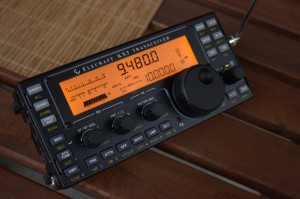
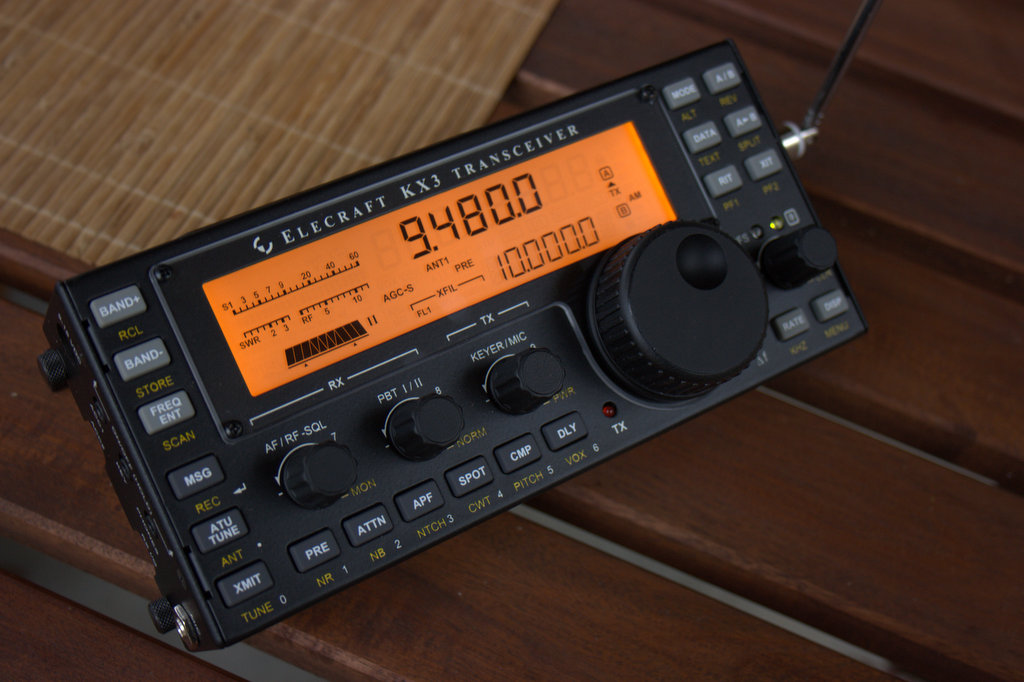
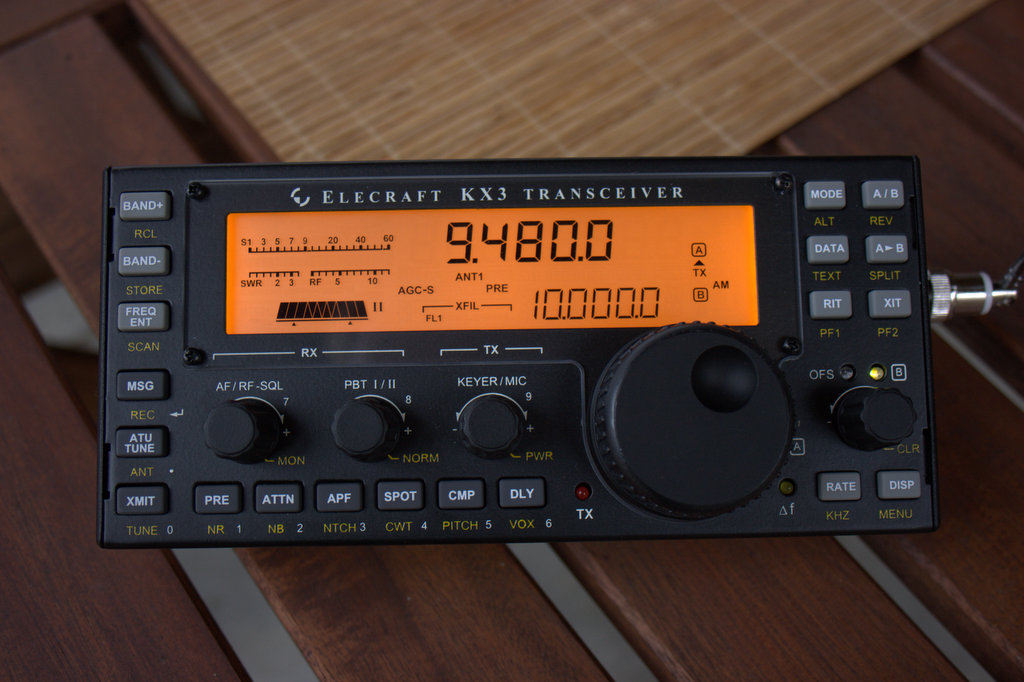
The Elecraft KX3 Transceiver (Click to enlarge)
You may have noticed that in the past few years, while more and more software defined radios (SDRs) are appearing on the market, fewer and fewer traditional tabletop shortwave receivers are being introduced. Most of the receivers in production, meanwhile, are quite mature, having been in production for years. For those of us who still have an appreciation for the traditional front panel, tuning knob, and portability of an all-in-one tabletop receiver, perhaps we should look to the active ham radio transceiver market.
Introducing the Elecraft KX3
Besides being an avid SWLer (ShortWave Listener, for the newbies out there), I’m also a ham radio operator (callsign: K4SWL). But if you’re not a ham, you may not be familiar with the innovative, US-based radio designer and manufacturer, Elecraft. First of all, note that “US-based” adjective: this is an increasingly rare phenomenon in the world of radio production, and it deserves a word of praise up front. Elecraft started life as a kit manufacturer, focusing on QRP ham-band-only radio transceivers that were effective, affordable, and maintained a very high level of performance. Their K1, KX1 and K2 transceivers are legendary, and I’ve had the good fortune to own them all at some point along the way. Their K3, introduced in 2008, became a benchmark transceiver and still tops the charts in performance; it’s truly a choice DXpeditioner’s radio.
In 2011, Elecraft introduced the KX3–a portable SDR transceiver with a full-featured knob-and-button user interface that doesn’t require connection to a computer to operate. At the Dayton Hamvention, the KX3 instantly drew crowds, as it was unlike any other transceiver on the market. I was there, and like others in the crowds around the Elecraft booth, I was eager to try out this full-featured transceiver, especially upon learning that even the basic, no-options model has a general coverage receiver. A ham transceiver with “general coverage,” incidentally, means that its receiver is not limited to the ham bands only; these receivers typically receive between 100 kHz and 30 MHz (i.e., the full shortwave radio spectrum). That morning at the Hamvention, I quickly made my way to one of Elecraft’s owners, Wayne Burdick, to ask him,“Would the KX3 make for a good shortwave radio receiver?” Wayne’s prompt response: “Yes.”
That was enough for me: more than ever, I simply couldn’t wait to get within reach of a KX3. Why? I love to travel and take radio along, but I’ve always had to haul separate transceivers and receivers for my separate-but-related hobbies: 1) ham radio and 2) SWLing. Perhaps the KX3 would suit both purposes? I was hopeful. If this was true, with a KX3, I could have a full-featured QRP transceiver and a shortwave receiver in one…and a portable one at that. Ideal!
I just had to get my hands on one to find out.
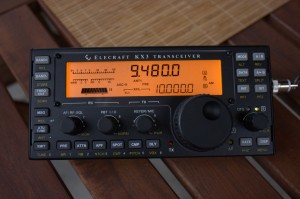
(Click to enlarge)
A closer look
Though the KX3 was introduced in the summer of 2011, it didn’t start shipping until a few months later, and there was a backlog of orders for it. Fortunately, my good buddy, Dave Anderson (K4SV), was among the first purchasers of the KX3, and he was generous enough (and trusted me enough!) to let me borrow it.
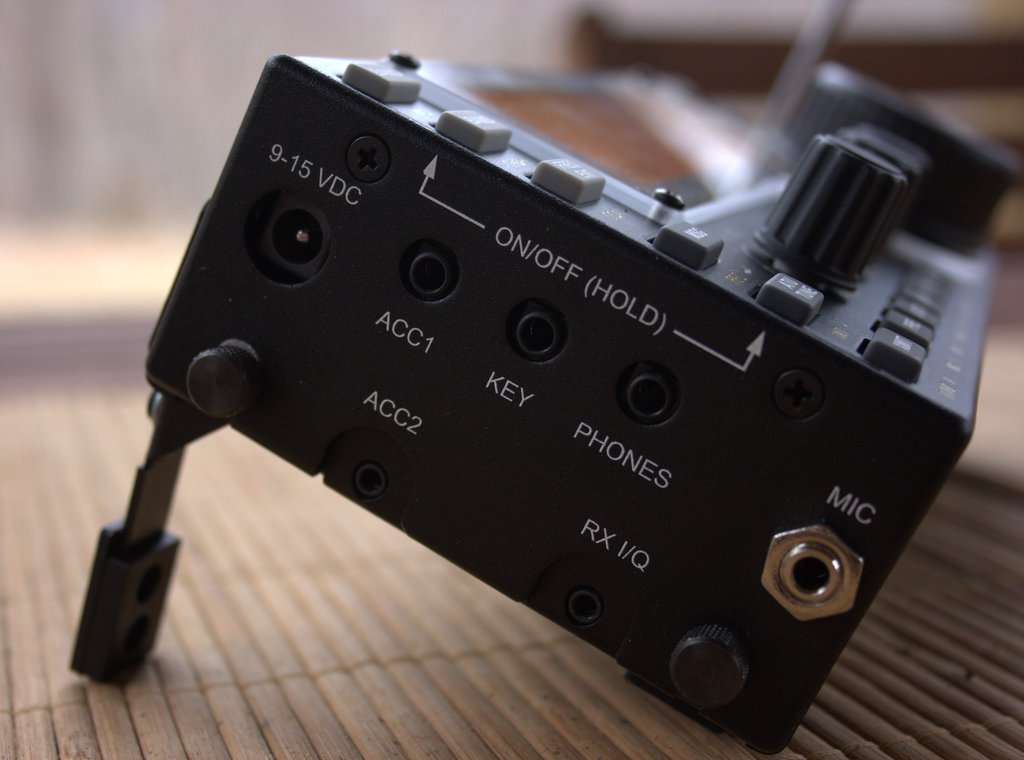
At first glance, the KX3 resembles just the faceplate of a tabletop radio: it has a large tuning knob, wide, clear amber backlit display, and a traditional set of function buttons and multi-function knobs…but not much else. Or so it appears, as there’s no bulky chassis. Connections for microphones, DC power, headphones, IQ out, key and PC interface are located on the left side panel of the radio, while the RF connection (a female BNC) is on the right side panel. The KX3 has built-in folding feet, quite sturdy, that allow the radio to be tilted at a comfortable angle for tabletop operation.
To best evaluate the KX3, I’ll first discuss some of the features that would interest a ham radio operator, then focus on those best suited to the SWLer.
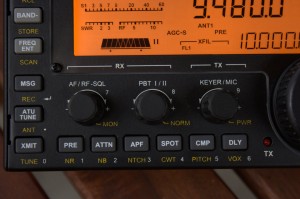
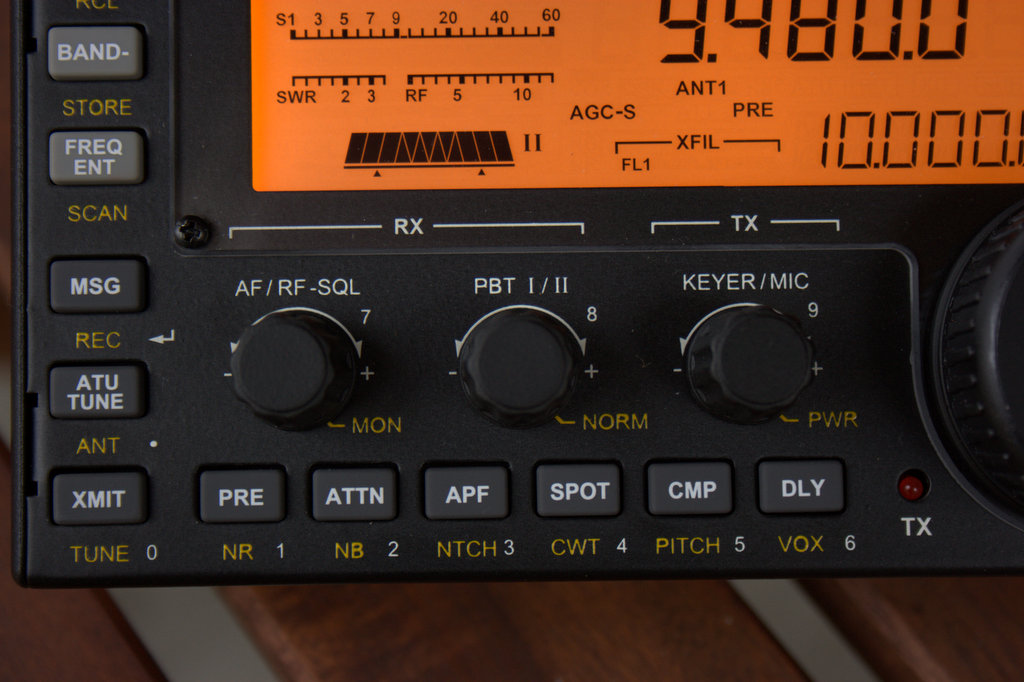
There is a hidden keypad for direct frequency entry (notice the numbers printed next to the multi-function knobs and buttons?)
Everything for the Ham
If you’re a ham, you’ll love the feature set on the KX3. It must be one of the most comprehensive set on any radio I’ve ever used. At a bare-bones level, meaning without adding any options, the basic KX3 is truly an all-in-one QRP transceiver.
Of course, it will function on any mode: USB, LSB, CW, data, AM and FM. The output power is adjustable from 0 to 10 Watts. You can easily adjust the DSP filters, AF, RF, passband, and notch all from dedicated buttons and knobs. It even has a memory keyers for both CW and voice.
You say you prefer digital modes? Not only will the KX3 natively decode RTTY and PSK31 and display the scrolling text on the display, but you can also send RTTY and PSK31 without a PC. How? Simply set the appropriate data mode and use your key to tap out your message in CW. Though you will hear the CW side tone, the KX3 will transform your code into RTTY or PSK-31, and send. Hypothetically, armed with only a KX3, you could run a RTTY contest from the field with no computer. Remarkable.
The variable DSP filtering is most impressive and the KX3’s ability to block adjacent signals is benchmarked. Indeed, if you look at Sherwood Engineering’s receiver test data rankings (http://www.sherweng.com/table.html), which are sorted by third-order dynamic range (narrow spacing), the KX3 is second only to the Hilberling PT-8000A, an $18,000 transceiver.
With the installation of the $170 optional internal automatic antenna tuner (the KXAT3), you will be able to tune most any wire antenna on the go, with no need to carry an external ATU.
In short, for the ham, the KX3 offers a cornucopia of features, too numerous to list here; but I can at least tell you that I discover something new on this radio almost every day and continue to be amazed by the features on this transceiver, especially considering that it costs only $1000 ($900 in no-solder modular kit form).
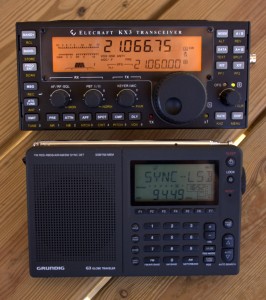
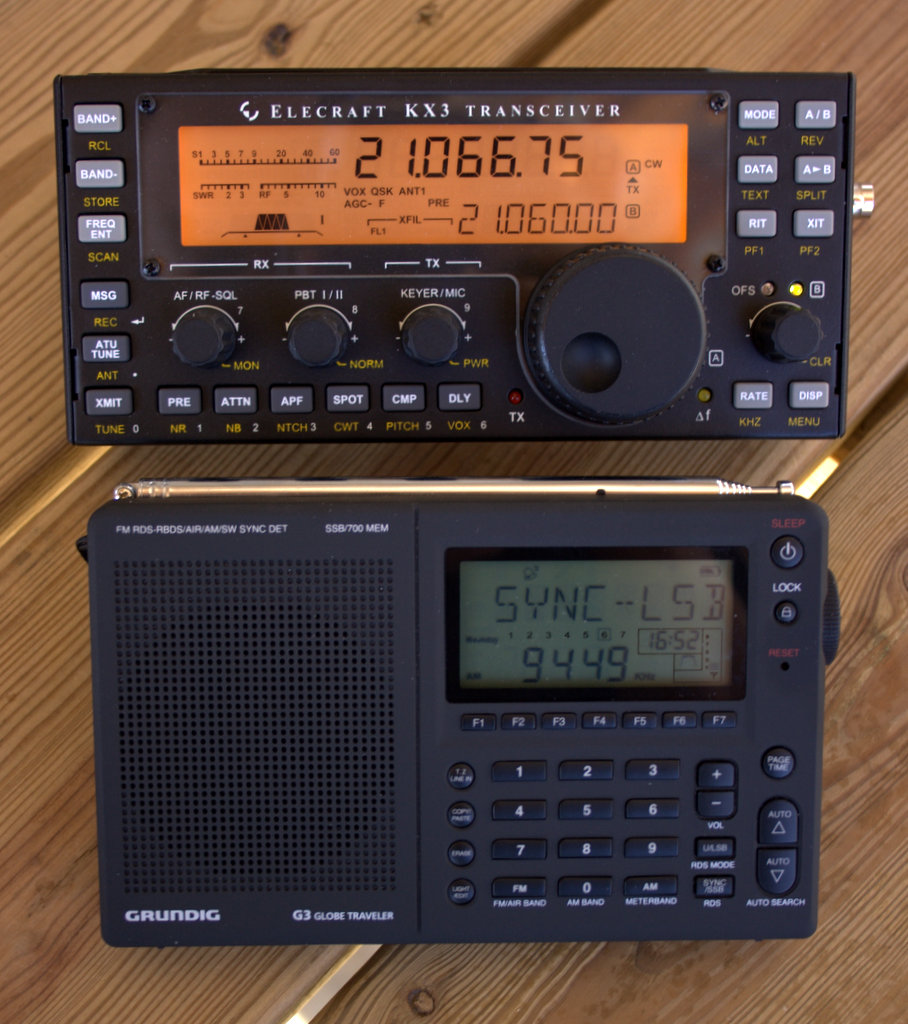
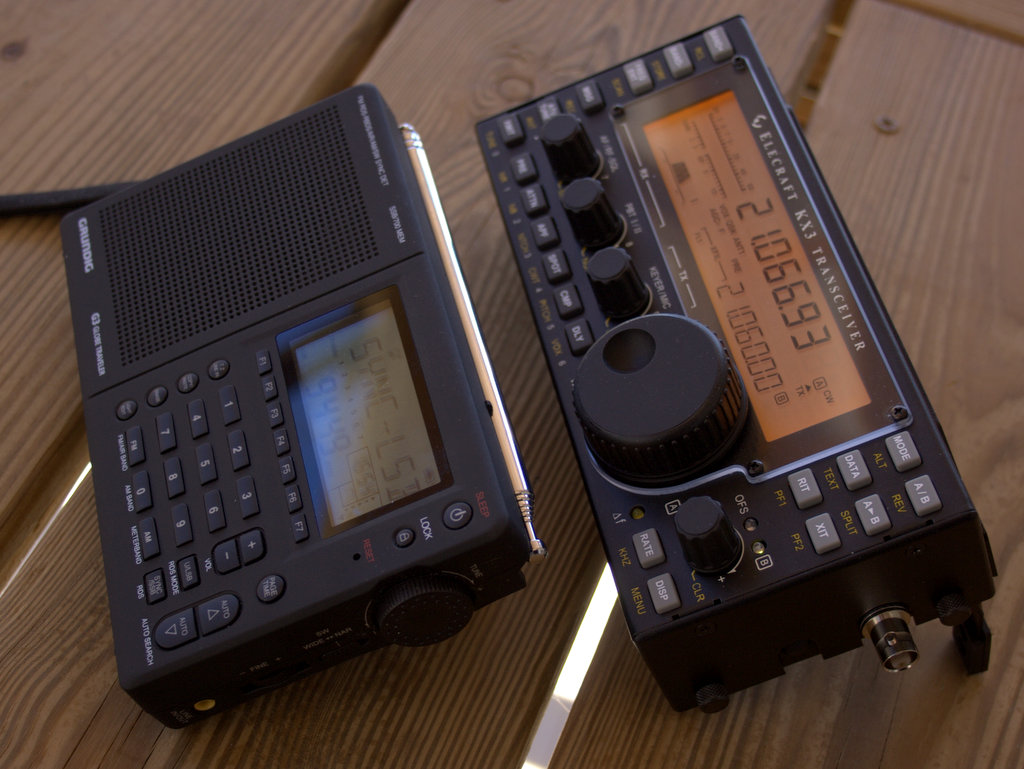
The Elecraft KX3 is built for travel and portability–here we compare its size with the Grundig G3
For the SWLer
We’ve talked about the KX3 as a ham radio transceiver, but how does it stack up if your primary interest is to just sit back and listen to broadcasts? Short answer: Very, very well.
The KX3 is loaded with features that would please even the most discriminating DXer.
First, on the faceplate, the KX3 has a multi-function knob that controls both the AF and RF gains. It’s very simple to use, even though I’m not a fan of switching between the AF/RF gain controls on the same knob. AF gain is what most of us refer to as a volume control and many dedicated shortwave receivers lack an RF gain control even though it’s a vital tool for broadcast listening in noisy conditions. By default, the KX3 RF gain is set to zero; turning the RF pot counter-clockwise will decrease RF gain.
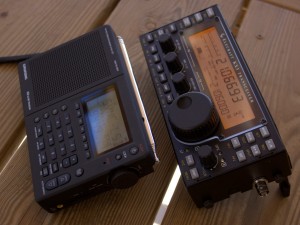
Grundig G3 (left), Elecraft KX3 (right)
The KX3 also has three different preamp settings, which are useful for amplifying weak stations, as well as an attenuator for local or strong broadcasters. The KX3 has passband and notch filtering, and an auto-notch function that effectively deals with heterodynes from nearby carriers. The KX3 also has DSP noise-reduction (NR) for noisy band conditions (or to help a signal “pop” out from the noise) and noise blanking (NB) for local RFI.
Many automatic gain control (AGC) parameters are adjustable, too, so they can be tweaked for AM fading and weak-signal DXing. The fact is, the KX3 has more built-in receiver controls than the dedicated tabletop shortwave receivers I’ve owned.
Audio
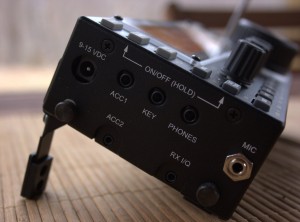
Left side panel of the Elecraft KX3 (click to enlarge)
To be clear, however, there is one negative in the architecture of the KX3 when viewed through the eyes of an SWLer. The KX3 is designed around the amateur radio operator and AM bandwidth is narrower than you will find on most dedicated tabletop shortwave receivers–indeed, a commonality on any general coverage ham transceiver. The KX3’s AM bandwidth can only be widened to 4.2 kHz–a figure that almost made me dismiss this radio’s SWLing abilities out of hand. I’m glad I didn’t let that spec stop me, though: I had read many a favorable comment from KX3 owners who used the radio to listen to the broadcast bands. Their comments on the audio were very positive, and for good reason.
What the KX3 lacks in wide bandwidth is made up for by the 32-bit floating point DSP architecture. I’m not sure how, but the KX3’s audio fidelity “sounds” much wider than 4.2 kHz. Indeed, I still have a difficult time believing that the filter is not closer to 7-8 kHz in width. When using headphones or amplified speakers, the bass response rivals some of my tube receivers. There are even adjustable 8-band equalizer settings for audio to improve this even further.
In addition, Elecraft has unique audio effects available in the audio effects menu. One I’ve found very valuable in broadcast listening is called “delay,” a stereo simulation effect that broadens the mono sound in such a way that the audio sounds even richer.
Memories, scanning and tuning
The KX3 has 100 general-purpose VFO A/B memories with optional alpha numeric labels. It also supports channel-hopping or scanning within any number of labeled memory groups. Auto scan is simple and works in both muted and (my favorite) non-muted, or continuous, modes.
The KX3 can also use the “K3 Memory” application from Elecraft’s K3 transceiver, which allows for longer labels and the instant selection of desired memories from a PC. The “K3 memory” application is a free software download on Elecraft’s website.
The tuning knob on the KX3 is substantial and of good quality. It’s only slightly smaller than the tuning knob on my Alinco DX-R8T, so it’s a substantial knob, which is helpful to big (or buttery) fingers. The drag can be easily adjusted with a supplied hex wrench. The tuning rate can be adjusted to .5 kHz increments, allowing you to quickly tune through the band. The small multi-function knob next to the main tuning knob can also be set for a 1 kHz rate.
At first glance, you might not realize that the KX3 has a direct frequency-entry keypad. Check out the photo, however [MAKE REFERENCE TO POSITION ON PAGE]. The buttons and multi-function knobs in the lower left quadrant of the KX3 double as number pad, decimal point, and an “enter” button for a keypad. I thought this a bit odd at first, but now find I use this all the time.
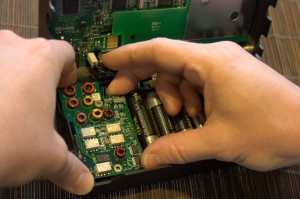
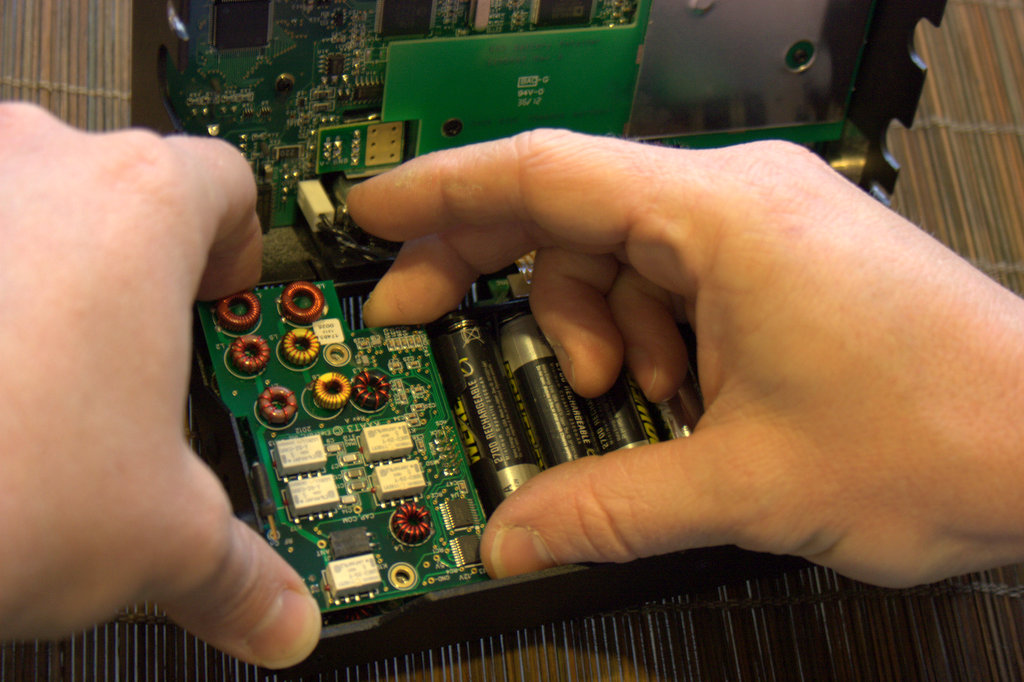
Installing the optional ATU is very simple and requires no special tools or soldering
Optional ATU: Worth the Cost
As I mentioned earlier, the optional automatic antenna tuner, the KXAT3, makes a lot of sense for the ham who operates portable. If you are a licensed amateur radio operator, the ATU can be a powerful tool for matching random length, or multi-band antennas to your desired broadcast band by tuning to a nearby ham band frequency. The L and C parameters of the tuner can be manually adjusted to optimize without transmitting. The user can select one of 8 L’s or one of 8 C’s parameters in the ATU MD menu entry. When an L is selected, C is set to 0, and vice-versa. However, it is not presently possible to select combinations of L and C to achieve a closer resonance. Still, selecting an L or C value in this way will provide a useful increase in gain.
In addition, if you like medium wave (MW) DXing, the ATU comes with MW (AM broadcast band) filtering that tracks the VFO, somewhat improving image rejection between 300-1,000 kHz. I have tested the KX3 on medium wave both with and without the ATU installed and find that it certainly improves rejection.
To be clear though, sensitivity decreases as you tune below 1,500 kHz. Elecraft informed me that it was necessary because the KX3 uses PIN diodes in its T/R switch, and the signal must be high-pass filtered to avoid IP2 problems with the diodes. When you tune through the 300-1200 kHz range (or so) you will certainly notice the loss of sensitivity. Elecraft also noted that selectivity in the AM broadcast band was not a major design criteria, so in this band the 160 meter low pass filter is used. This is not ideal from a harmonic rejection standpoint, and there will be some 3rd and 5th-harmonic images from strong stations. Adding the ATU helps with this. However, adding the ATU doesn’t generally improve sensitivity in this range.
The ATU is very easy to install–almost “plug and play” (see photo).
Oh, yes–and it’s an SDR, too!
As if the KX3 didn’t do just about everything, it also has a quadrature down-sampling mixer compatible with PC-based SDR (software-defined radio) applications. This means, via a shielded stereo audio patch cable and a supplied USB control cable, you can connect the KX3 to your PC and use a freeware SDR application like HDSDR to turn your KX3 into a proper software-defined receiver.
SDR functionality is limited to receiver functionality, and depending on the bandwidth and sampling rate, will be dependent on the quality of your sound card. The true benefit is the ability to see a wide–48 kHz or more–chunk of spectrum.
Summary
Every radio has its pros and cons. When I begin a review of a radio, I take notes from the very beginning so that I don’t forget some of my initial impressions. Here is the list I formed over the time I’ve spent evaluating the KX3. Note that I created this list with the shortwave listener in mind, not necessarily the ham radio operator.
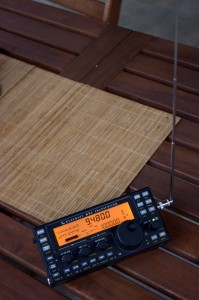
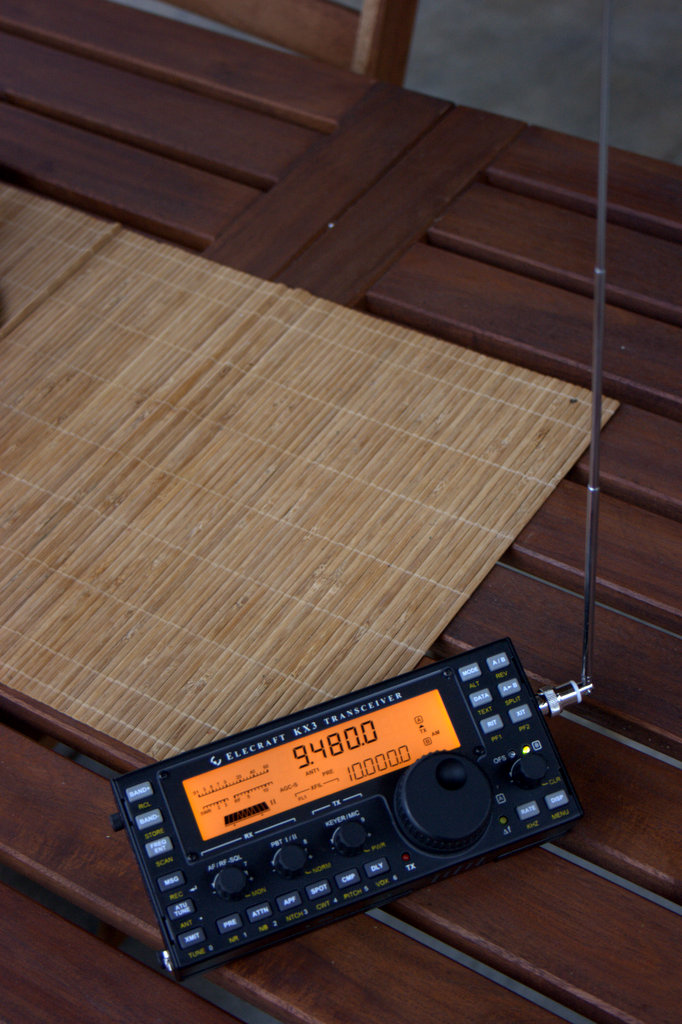
I even had some success SWLing using an inexpensive whip antenna (attached via BNC).
Pros:
- World class, benchmarked receiver performance powered by high-performance 32-bit floating-point DSP
- Rich, full audio fidelity on AM despite limited bandwidth (see con)
- AF and effective RF gain controls
- Adjustable filters (no optional roofing filters needed for SWLing)
- Superb sensitivity and selectivity; outperforming even my WinRadio Excalibur with weak signal DXing
- Very low noise floor
- Auto-notch, which helps eliminate annoying heterodynes, even in AM
- Internal ATU option brings improved MW image rejection (see MW con) and hams have the ability to tune a random length antenna
- Natively decode (170 Hz) 60-WPM RTTY and display it right on the KX3’s VFO B display, which is alphanumeric
- Battery operation via 8 AA batteries
- Lightweight
- Dedicated headphone jack
- For non-ham radio operators, the transceiver can be disabled and re-activated once you have a license with a simple hardware adjustment. No need to fear accidental transmission
- For hams, or those who plan to become one, the KX3 is a QRP transceiver in the top of its class
Cons:
- AM bandwidth limited to 4.2 kHz (see pro)
- Hand mic connector is the less standard 3.5 mm audio plug
- Built-in speaker is small with limited volume and fidelity–only intended as a back-up when headphones or external powered speakers are unavailable
- AA batteries fit a bit tightly in internal holder and can present a challenge to remove
- Medium wave reception is mediocre at best, but with the optional ATU, is improved though slightly better image rejection (see ATU pro)
- Very slight audio whine (similar to a faint heterodyne sound) heard in some zero beat AM stations; may be fixed in future firmware update
- No AM sync detector (AMS)
Did I buy one? Confession time
I must admit, I was appreciating my buddy Dave’s KX3 very much. Maybe too much…
I have three hobbies: shortwave radio listening, ham radio, and traveling. After using the KX3 for a few hours, I knew it would be my perfect companion. Not only is it a top-notch amateur radio transceiver, its also an excellent shortwave radio receiver. It’s portable, but also makes an excellent tabletop radio. It’s an all-in-one radio, but can also double as an SDR when connected to a PC.
So, is the KX3’s broadcast audio fidelity as good as a purpose-built broadcast receiver like the legendary Drake R8B? Not quite. But I would argue that its ability to receive weak signals would give even a Drake a run for its money. I have to admit, the KX3 receiver outperforms my Alinco DX-R8T in every respect. Even though the AM bandwidth is limited to 4.2 kHz, I think the audio also sounds better than my Alinco and any of my portable radios with wider bandwidth.
My Elecraft KX3 Transceiver (Click to enlarge)
Needless to say, I bought one. It was only fair to Dave, who needed to discover for himself what his loaned-out rig could do.
The KX3 is a game changer for me. Though I’ve always carried portable transceivers in my travels, I’ve also had to carry a separate tabletop receiver and an SDR or portable radio for my SWLing. No more. Moreover, I like the broadcast audio on the KX3 well enough to record and archive shortwave broadcasts, which I frequently do for my blog, The SWLing Post and The Shortwave Radio Audio Archive. In my shack, I’m even considering purchasing Elecraft’s 100 watt amplifier and doing away with my 100 watt tabletop transceiver.
As for support? No worries there. I’ve been an Elecraft customer for years and I can tell you that they believe in and stand behind their products. I purchased with confidence.
I encourage you to try on the KX3 as well. It may very well be all the radio you’ll ever need.


 Fortunately, however, I offer a full in-depth review in the August 2013 issue of Monitoring Times magazine (incidentally, their turn-around time from submission to print is simply amazing). If you subscribe to MT–or can get your hands on a copy–you will have my full review.