Shortwave listening and everything radio including reviews, broadcasting, ham radio, field operation, DXing, maker kits, travel, emergency gear, events, and more
I don’t know about you, but my goals when I switch on a radio are not always the same. Sometimes I want to communicate, to send and receive information, such as on the Commuter Assistance Network through ham radio. At other times, I want to gather information passively from first-hand sources, like the road condition reports that I can hear through the scanner from the highway crews on the New York State Thruway. And still other times, in the pre-dawn hours, my greatest desire is to hear the farthest possible station on the medium wave frequencies.
And sometimes, I simply want to hear something different . . . different from the usual fare that comes across medium wave, FM, or even shortwave. Hold that thought for just a moment.
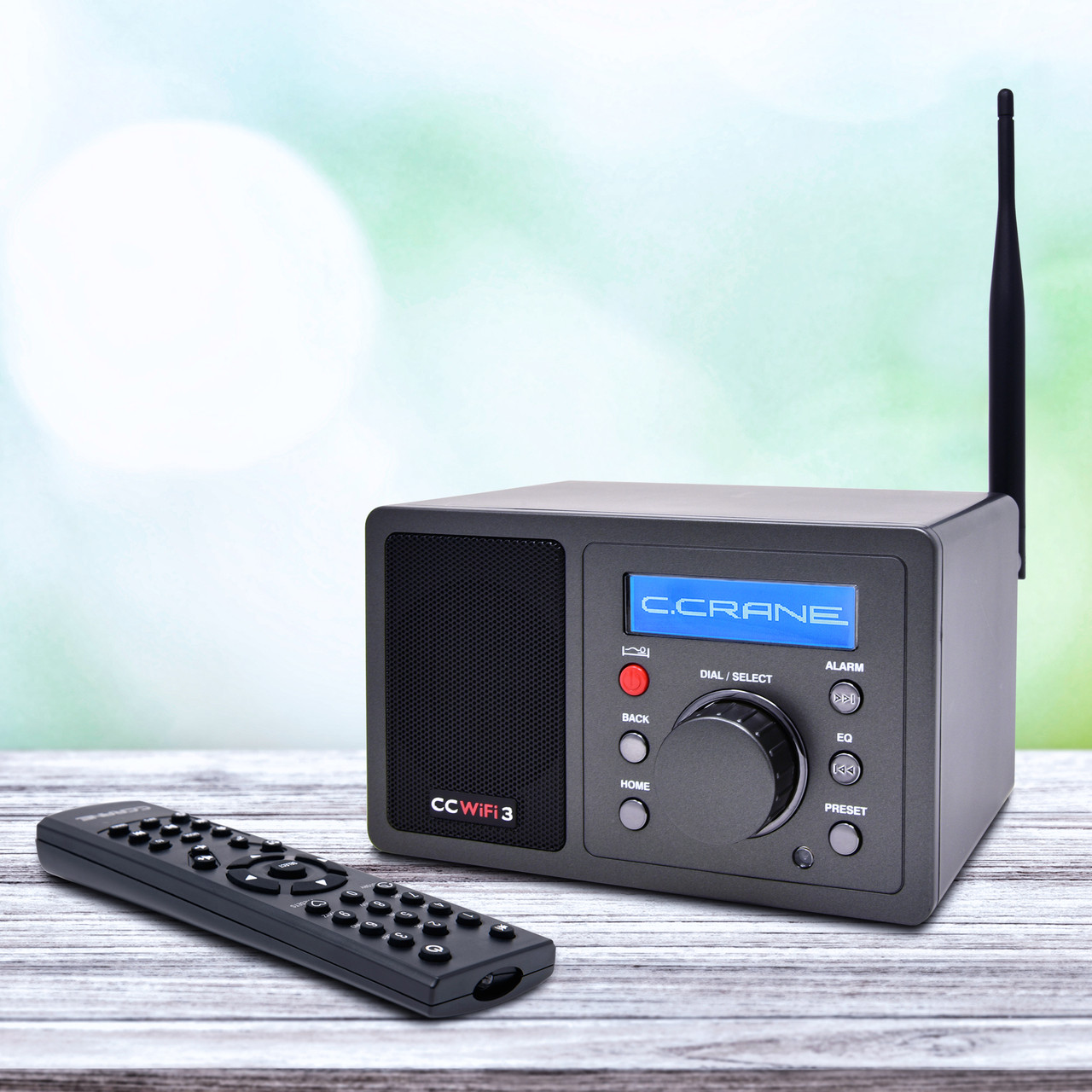
The other day, an email popped up in my inbox from the CCrane Company, inviting me to check out their CCrane CCWiFi3. “Listen to Thousands of Radio Stations from Around the World With Clear Reception – No Static, No Fade, No Apps,” it promised.
I was intrigued and sent an email to CCrane asking if they would like me to do a review, and they sent me a CCWiFi3 without charge.
To cut to the chase, the CCWiFi3 really does deliver what the marketing copy says: you can “Listen to Thousands of Radio Stations from Around the World With Clear Reception – No Static, No Fade, No Apps.” No kidding! And no frustration in setting it up either. It is easy and fun to use.
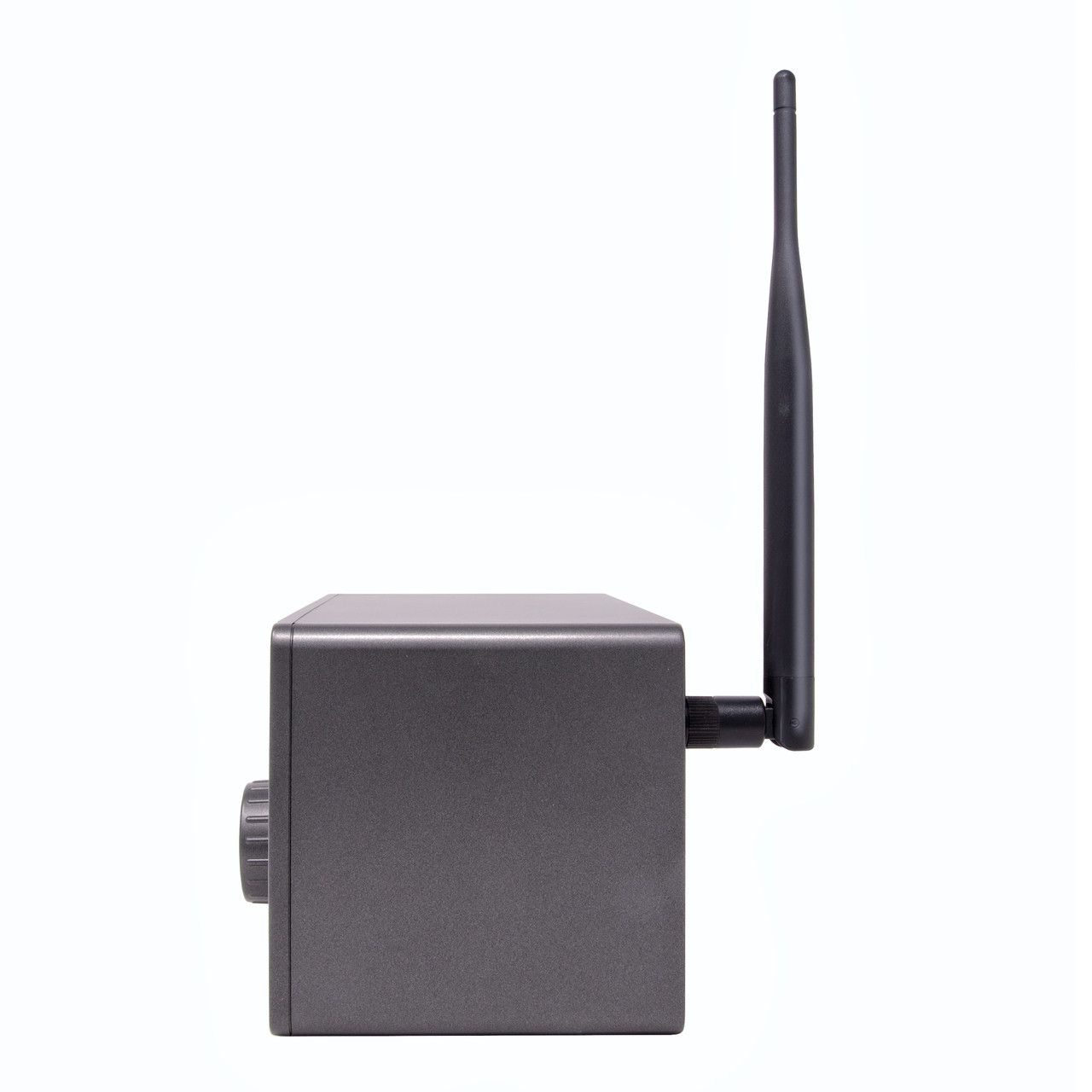
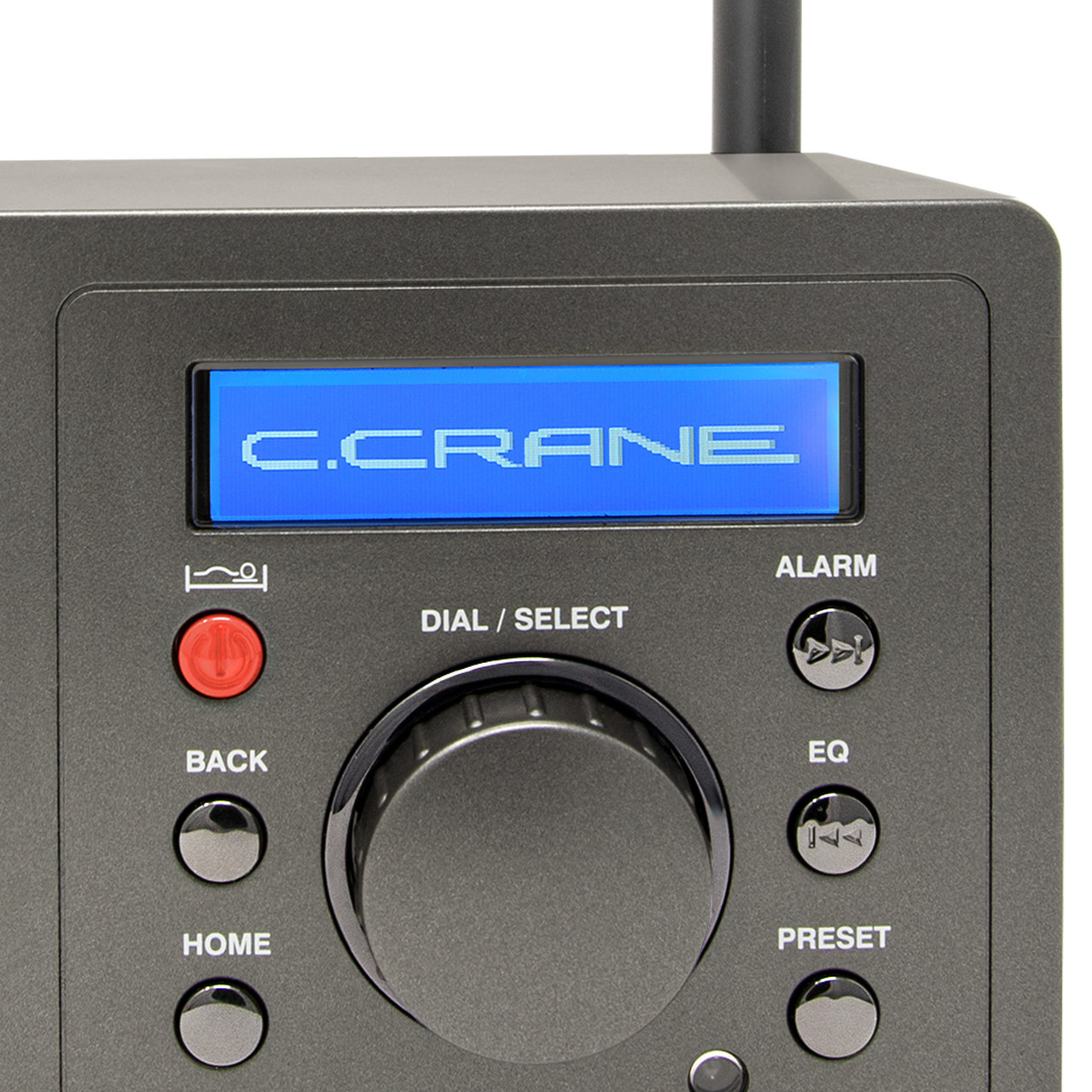
The CCWiFi3 measures roughly 6.5 inches by 4 inches by 4 inches. On the front are six buttons, a knob, a speaker grill, and a small digital display. On the bottom are four rubbery white feet to keep it from sliding around on tables. On the back panel is a connector for a WiFi antenna (included), a line out socket, a headphone socket, and a socket for plugging in an external power supply. The unit comes with a remote control that can select stations, boost and lower volume, mute the audio, and much more.
Setting up the CCWiFi3 is super easy: attach the antenna, plug in the external power supply. It will then warm up, and the display will ask for your preferred language. Make your selection, push in the central knob to confirm it, and the CCWiFi3 will then search for WiFi networks. Select the one you want, put in your password (using the central knob to select and confirm the letters and numbers), and you are good to go. (A tangential but important note: the unit is very light, so moving it from room to room, so long as you have a place to plug in the power supply, is no big deal.)
In a sense, the hardest thing about using the CCWiFi3 is choosing from the dizzying number of stations available. At the top of the menu for internet radio stations is: Most Popular (US), By Genre (World), and By Location. Click on any one of these, and you begin drilling down into the possibilities. For example, click on By Location, and your next set of choices includes Africa, Americas, Asia, Europe, Internet Only, the Middle East, and Oceania. Click on Oceania, and up pops a list beginning with Australia, Bermuda, and the Cook Islands. Want to hear news/talk in Finnish? You can. The possibilities seem endless.
I clicked on By Genre, then Talk-based, scrolled down to Old Time Radio and Suspense, and within minutes had Amazing Tales, Western Old Time Radio, and the Best of Art Bell saved to my station presets. You can access 10 easy presets using the remote and over 100 presets in the sequence list. As is typical of CCrane, the manual is clear, well-written, and easy to follow.
Even better, the audio coming through the speaker or headphones is pleasant.
Don’t get me wrong: I still love my antenna-to-antenna radios, but whenever you have the itch for something different from the radio, the CCWiFi3 delivers almost endless possibilities in a way that is enjoyable, easy to operate, and pleasing to the ears.
UPDATE: A couple of additional comments that I was unable to post until now.
1. Using the CCWiFi3, on St. Patrick’s day, I was able to hear Irish fiddle music, direct from Ireland on Radio Siamsa. The station’s website says: RadioSiamsa is the only Irish radio station specializing in traditional Irish music, with no ads and high-fidelity sound. Listen to Irish tunes and songs from Dublin, 24 hours a day, on your smartphone, tablet, or Amazon Echo device.
2. There is a function on the CCWiFi3 that allows searching by keyword. It’s a little clunky, since you have to select each letter separately using the main dial, but a search for “bluegrass” quickly turned up a couple of dedicated stations that had me happily enjoying banjo, guitar, fiddle and mandolin. That puts a smile on this old banjo picker’s face!
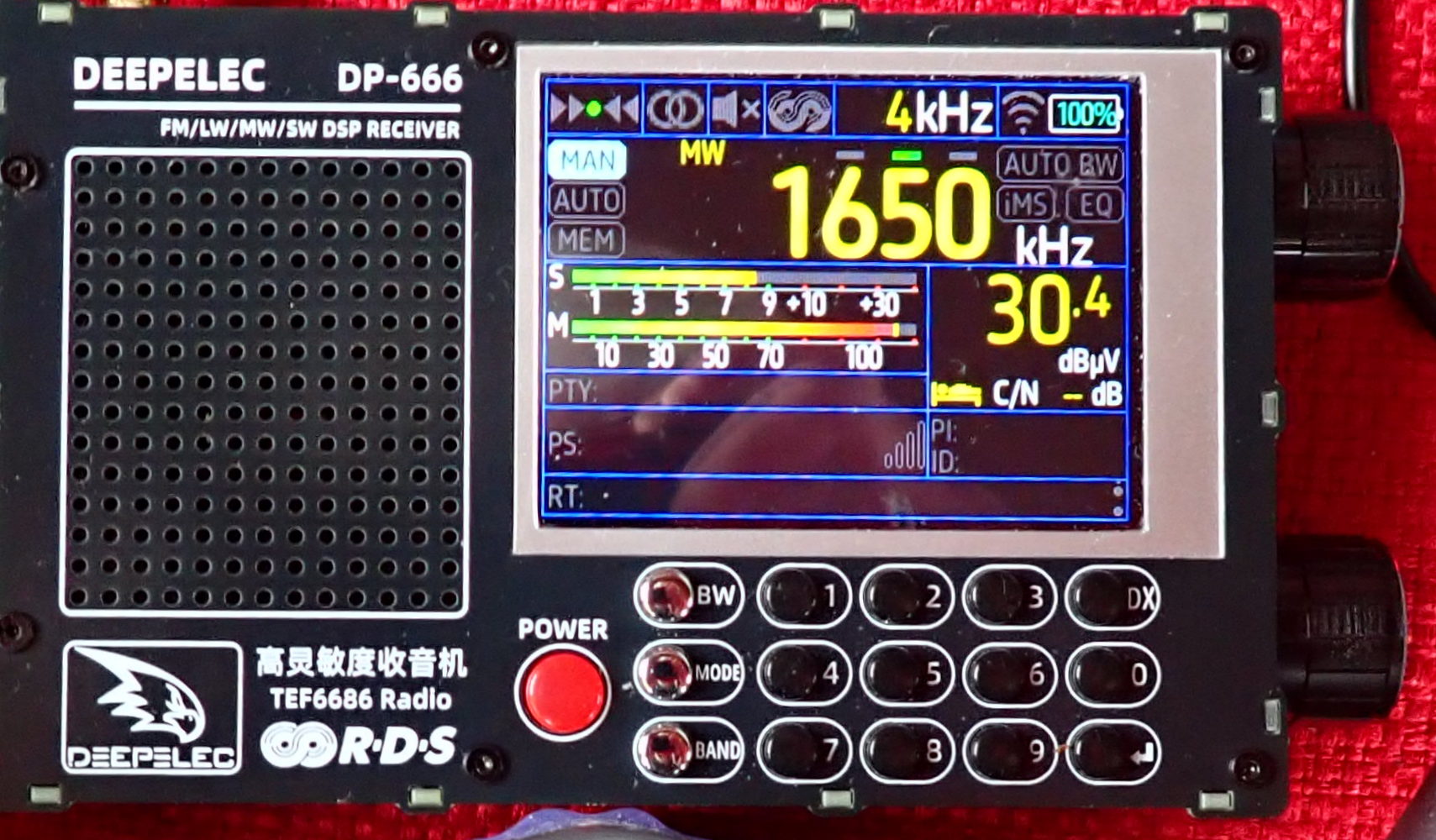
My friend Andy, who is an expert medium wave DXer, calls it his “weapon of choice” and a “DX machine.” In fact, just a night ago, using a YouLoop passive antenna hanging from a birdfeeder on his porch in upstate New York, he snagged a couple of tiny Mexican stations above 1600 kHz at a distance of over 2000 miles. He was surprised the stations were there, and it was a bit of a hunt on the internet to find their livestreams and ID them.
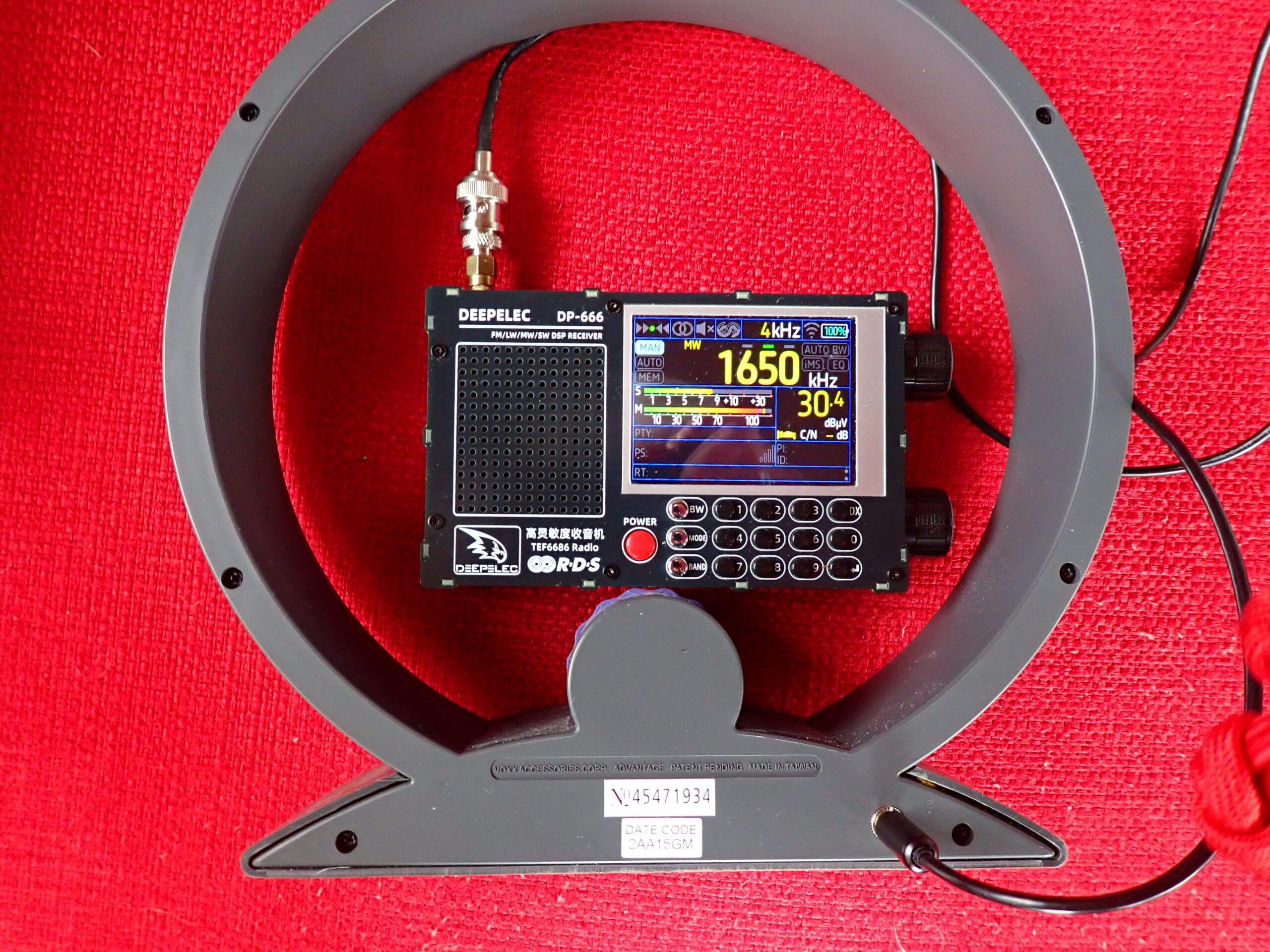
The radio that made hearing these diminutive stations possible is the Deepelec DP-666, a radio based on the high-sensitivity, high-selectivity TEF6686 chip which is used in automotive radios. The DP-666 measures 5 inches wide (excluding knobs) by 3 1/8 inches high by 1 1/8 inch deep. On the front panel are a speaker grill, a 2.8-inch color display, and 15 buttons for various radio functions (including a full numeric keypad for direct frequency entry) and a red power button. On the right side are tuning and volume knobs. On the bottom panel is a master switch for power. On the left panel are a 1/8-inch headphone socket and a USB-C port for a communication interface and for charging the 5000 mAh rechargeable battery, which is not user-accessible.
The DP-666 can receive FM (from 65-108 MHz with various frequency ranges selectable for different parts of the world and over a dozen different bandwidths), SW (from 1700-27000 kHz), MW (522-1791 kHz, 9 kHz steps; 520-1720 kHz, 10 kHz steps) and LW 144-513 kHz. In AM mode, 3/4/6/8 kHz bandwidths are available. The DP-666 does not offer single-sideband reception.
You won’t hear anything, however, unless you connect an antenna to the standard SMA female connector on the top panel of the radio, because the DP-666 has no internal antenna. The DP-666 comes with a 29 ½ inch whip antenna that does a yeoman job of receiving MW and FM. For MW DXing, Andy prefers the passive YouLoop, and he uses the DP-666/YouLoop combo frequently. “It’s quiet,” he says.
For MW reception, I like a direct cable connection between the DP-666 and a Terk AM Advantage, which is an un-amplified loop antenna with capacitive tuning. I can hold the Terk antenna in my left hand (which allows me to rotate it from side to side and even tilt it for improved reception), and with my thumb, I can rotate the antenna’s tuning wheel for peak reception. At the same time, I hold the DP-666 in my right hand and operate the tuning knob with my thumb and forefinger. It looks a little weird, but works really well.
For FM reception, I use a scanner antenna, a Comet W100RX extended to about 31 inches. The DP-666 display offers a full complement of RDS information if transmitted by the FM station. I am not, by any means, an expert FM DXer, but it seems to be a “hot” receiver.
For SW reception, the DP-666 also works pretty well with the whip antenna that comes with it. When connected to my 50-foot indoor horizontal room loop antenna, it detected a lot of shortwave stations on auto-scan. My guess is that dedicated shortwave DXers will be pleased with this pocket-sized radio.
In addition to its excellent electrical performance on MW, SW, and FM (I did not test LW), there are a couple of things about the DP-666 that I really love. The first is that, straight out of the box, the DP-666 is easy to use without consulting the manual. However, if you want tons, and tons, and TONS of customizability, press and hold the MODE button to access the MENU screens, where you can “fiddle the bits” to your heart’s delight. I have never used any of these settings, but they are there if you want them. (I think I consulted the manual just once to learn how to store stations in memory.) The well-written manual can be downloaded in PDF format here: https://deepelec.com/files/dp-666/DP-666_Product_Manual_EN.pdf .
The second thing that delights me about the DP-666 is that it is a quiet radio to operate. The clicks from the buttons are soft, and the tuning knob has detents that are felt, not heard. With headphones on, I can seek distant stations without disturbing others in the room.
Bottom line, the Deepelec DP-666 is a sensitive and easy to use radio that delivers pleasing results on MW, SW, and FM. I would be delighted to hear from others who have used it, particularly with high-performance antennas.
Many thanks to SWLing Post contributor Dan Robinson, who shares the following review:
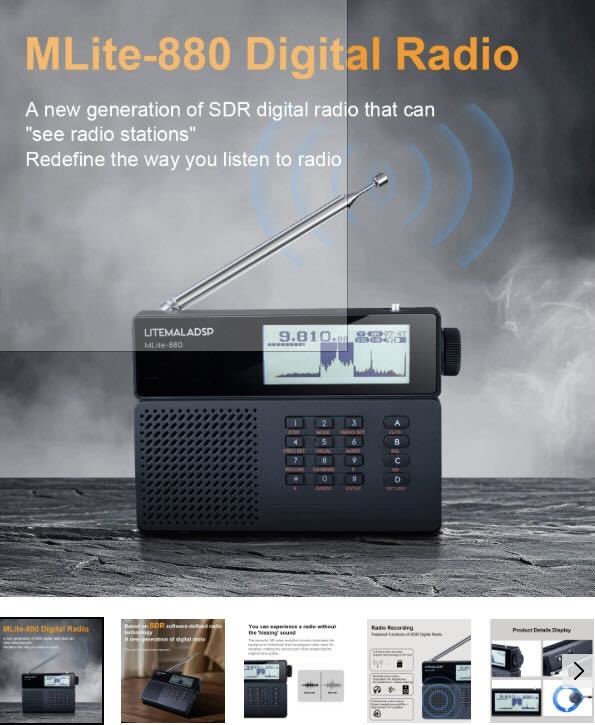
MLite-880 Spectrum Display Portable: Advanced SDR Performance in Traditional Portable Clothes
by Dan Robinson
For years, radio listening hobbyists (as many of us who are still around in 2026) have had numerous choices when it comes to portable receivers. Those of us who got our start as DX’ers/SWLs in the 1960’s (some earlier) or 1970’s have seen a lot of hardware come around the corner.
Some years ago, the Malahit/DSP receivers, firmware, and hardware designed and made in Russia appeared. There was the Belka, amazingly small but a superb receiver that many of us still use. Although shortwave broadcasting has generally been on the decline, we were lucky that companies such as Tecsun, Sangean (reported to have now stopped all production of SW portables), and other China/Taiwan-based companies continued to make impressive portables.
ICOM, Yaesu and Kenwood began putting spectrum scopes in displays a long time ago. ICOM’s IC-R9000 (produced 1989 to 1998) was the first to bring that feature. The more recent Icom 7300, 8600, and 9500 demonstrated far more advanced spectrum displays, as did Kenwood. Ten Tec in its original form put rudimentary spectrum display capability in its RX-350/Jupiter receiver/transceiver.
Today, we’re seeing a number of HT units with some kind of spectrum display. The Radtel 950Pro is one example of this. ICOM’s IC-R30, discontinued but a superb wide band unit, also has a spectrum option though quite limited. Various China-based companies started putting spectrum displays into the ATS series of receivers, and scope displays became standard on transceivers by Xiegu and others.
Malahiteam in Russia licensed firmware out to a range of China-based manufacturers. The China-made “ATS” portables available from AliExpress and Banggood have been through numerous versions, including the ATS25 Pro + AIR desktop, the ATS25 Ultra, ATS25 XF (see https://www.youtube.com/watch?v=LJC-pAu4nUk), and these are increasingly emphasizing the spectrum option on the display. There have been some very interesting front panel designs such as the DP-666 based on the TF6686 chip, and the AMNVOLT ESP138, the first with dual 4732/6686 architecture (see: https://www.youtube.com/watch?v=m1njJskDSUI&pp=ygUMZXNwMTM4IHJHzGlv)
What we had not seen until recently was anyone putting a spectrum display into a “traditional” portable cabinet (some years ago, I had suggested to County Comm/Maratac which has carried a re-badged Tecsun PL-368 that they consider doing so. At one point I received from them a photo of a prototype which looked like a PL-368 with a spectrum display at the top. But to my knowledge nothing was done to advance that to market).
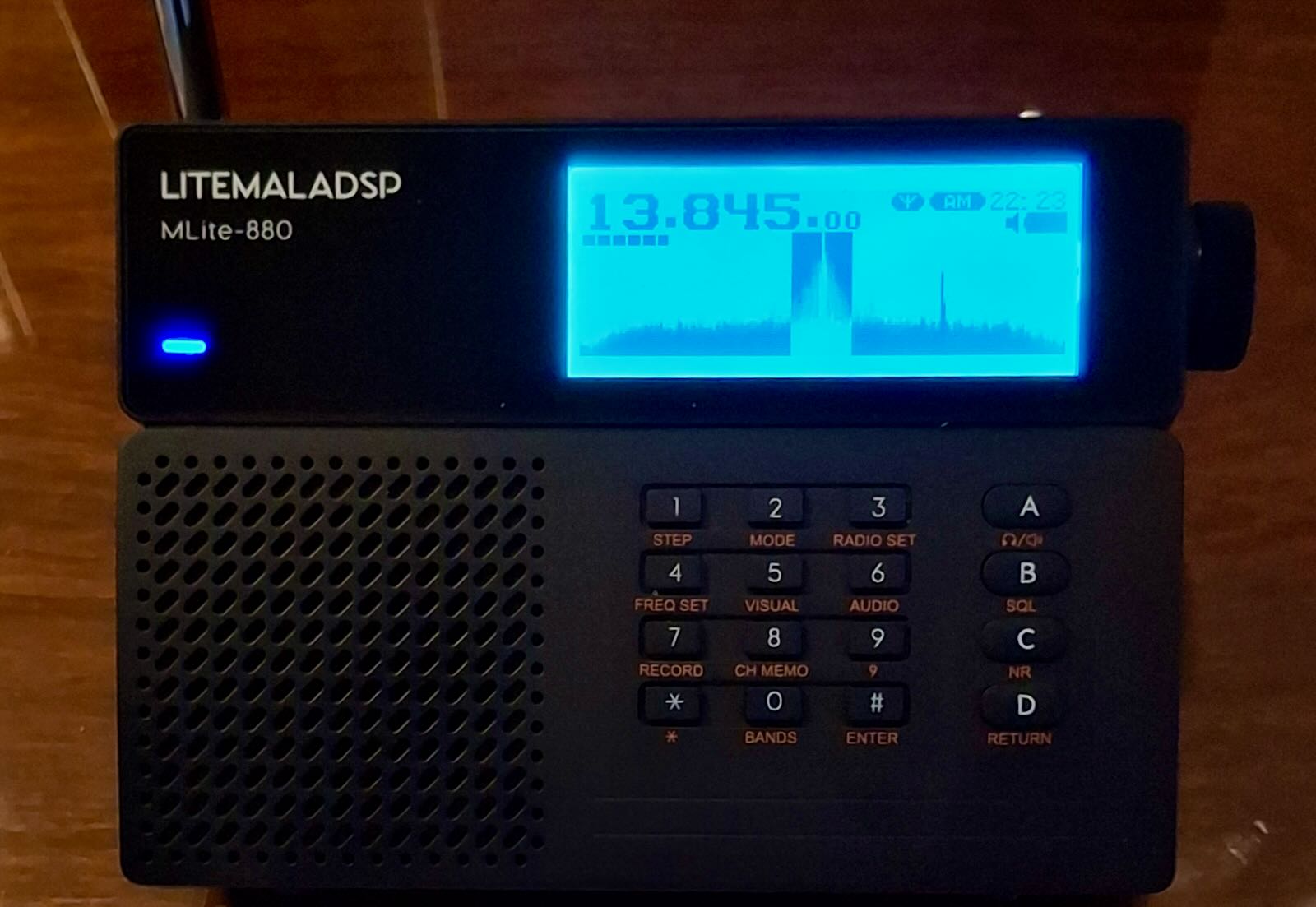
The major feature can be seen at power on. Instead of just a digital/numerical display of frequency we see the frequency AND below, a 40 kHz slice of spectrum. As the advertising description on the Elecevolve.com website states:
“A new generation of SDR digital radio that can “see” radio stations” . . . and “the radio in people’s impressions stays in the last century.”
The message that Malahiteam wants to convey is clear: this is a major step forward from portable design of the past.
The radio is very light, with a back-stand and a fairly robust whip antenna which stands at an angle when the receiver is being used with the back-stand (unfortunately, the antenna base does not allow it to go vertical).
Around the cabinet, there are a minimum of controls: on top, we have a simple power-on/off switch and a microSD slot (more about that later). USB-C and headphone jack are on the right, and an external antenna jack on the left. The frequency display module of the radio looks like just that — it’s on top above the multi-function keypad and ABCD keys. As for mode displays, there are battery and Bluetooth lights below and next to the LITEMALADSP letters. On the back, we find the 21700 battery compartment, and on the back-stand, we find information about the receiver, but no “Made in…” information whatsoever.
From the videos, and certainly from the name of the radio (LITEMALADSP) we have the impression that the MLite-880 is a cost-reduction version of the Russian DSP/2/3 receivers. Neither 4732 nor TEF 6686 chips are used. While one video review states that an MSI-SDR-M1 chip is inside, Georgiy at Malahiteam states that this is not so.
There was obviously a deliberate choice of the 21700 battery rather than 18650 used in Tecsun, Choyong, and other portables. First adopters say that so far, this battery keeps the receiver going for hours, something I can confirm. Anyone unfamiliar with professional type batteries like this should invest in a good standalone charger; if you already own a Tecsun PLxxx or D808 portable you will be familiar with 18650 and similar cells. [UPDATE]: Larger size 21700 battery does not fit — the battery provided with the radio is a EVE INR21700/50E
The inclusion of a backstand is very welcome, since Russian DSPs and China-made SDR portables often lack one. The whip antenna is not thin and flimsy like those found on some China-made small portables. There’s a mini to SMA adapter included in the box.
One reviewer notes that high-speed microSD cards are needed because files are recorded in WAV format. Georgiy at Malahiteam states that 16 and 32 GB cards have worked, BUT one user reports a 256GB card worked. Recording capability is a feature seen on other portables like the Raddy RF919. A good sized speaker is on the left. The tuning knob has a dual push-pull function for volume and frequency change.
And the radio has Bluetooth capability, which worked fine when I first tried it with a Bluetooth speaker.
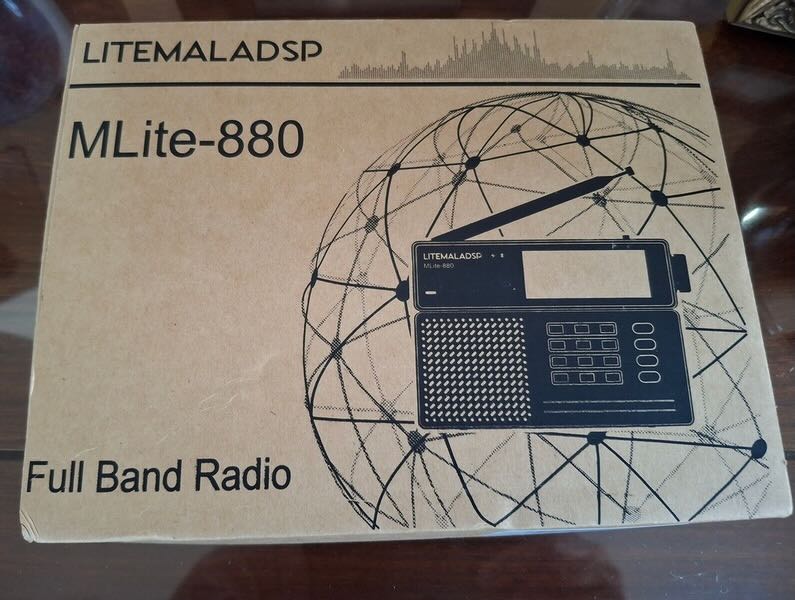
In menus under “About” we see “Designed in Russia/Made in China.” I recommend that readers view the various videos available online. While I was in the process of writing, I was surprised when the MLite-880 I had ordered from Banggood showed up on my doorstep. So, I’m able to provide initial impressions, and when a second unit arrives here, I’ll do some unit-to-unit comparisons. [NOTE: Testing done using only the onboard whip antenna]
If this is supposed to be a “Lite” version of the Malahit DSP receivers, whether the original Russian-made units or those from China, that would not be apparent to someone using this receiver for the first time. Numerous options are brought over from the Malahiteam DSP. We have synchronous reception (but see below) and the ability to correct calibration variations. Recalibration and BFO fine adjust is something we see on Tecsun portables, and China-made SDRs, and the AFEDRI SDR.
I won’t list everything, but we also see Hi-Z/50 Ohm, BiasT, Attenuation, and options for adjusting display brightness, spectrum average, spectrum fill, and RDS view. That is quite a lot of flexibility and reminds me of what we find on receivers costing thousands of dollars. Under Audio settings, we see Filter Type, Filter Low Freq, Filter High Freq, and variable Noise Reduction. One reviewer asserted that NR “works significantly better than on the Russian-made DSP-3, which costs near $500,” and based on my first tests, I agree. NR runs from 0 to 15 and, once set, can be quickly activated by pressing the C button on the right labeled NR. Overall filtering ranges: 0 to 8 Hz, 0 to 12 Hz, 0 to 15 Hz for the three designated filter positions.
AGC settings include AGC limit, AGC gain, and manual control, all settable in dB. On a third page of options, we find NB Mode, NB Threshold, Equalizer Type, Key Beep Level, and SQUELCH Threshold. Recording is accomplished with a direct access button (NOTE: I had some problems getting record working with a 1GB microSD but switched to a FAT32 8 GB and it worked). A quite nice printed manual shows the modes: USB, LSB, CW, DSB, AM, SAM, NFM, WFM. Steps are listed as: 100 Hz, 500 Hz, 1 kHz, 2.5 kHz, 5 kHz, 6.2 kHz, 8.3 kHz, 9 kHz, and 10 kHz.
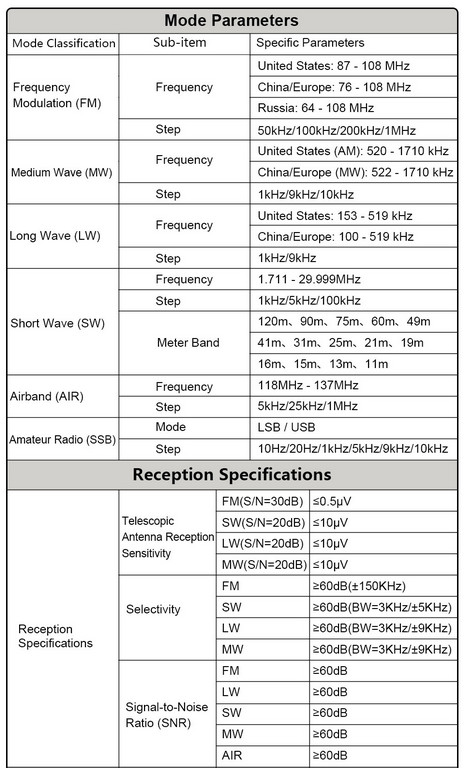
The MLite-880 contains band ranges selected by pressing the appropriate key and then A/B to scroll through those ranges. Coverage is from 100 kHz to 519 kHz, from 520 kHz to 1710 kHz, and up to 29,999khz. But one can directly enter any frequency in this entire range, regardless of the ranges. Under AMATEUR BANDS, we find 135.70 kHz to 137.80 kHz (2200m), 472 kHz to 479 kHz (630m), 1800 kHz to 2000 kHz, 3500 kHz to 3800 kHz, 5351.5 kHz to 5366.5 kHz, 7000 kHz to 7200 kHz, and on up to 29.700 kHz, with 70 mHz to 70.5, and 144 mHz to 148 mHz. Finally, FM/VHF bands include 65.9 mHz to 74 mHz (OIRT), 76 mHz to 108 mHz, and AIR band 118 to 137 mHz.
The spectrum display on the MLite-880 is 40 kHz. For most people, especially those coming from a portable with just a digital numerical readout, I don’t think this is going to be a problem. The 880 obviously has a smaller spectrum display than the full Russian DSP or Chinese-originated portables. Under VISUAL settings, we have choices of: BRIGHTNESS LEVEL, BRIGHTNESS OFF TIME, SPECTRUM AVERAGE, SPECTRUM FILL.
I have not opened my MLite-880, but RADIOCHIEF.RU on YouTube shows the cabinet back removed (around the 29-minute mark). We see extensive shielding with metal covers over key sections. Very impressive, and it finds me wishing that other manufacturers would have done this. How much better the short-lived “Elite Satellit” by Eton might have been with better internal shielding.
What remains to be seen is the extent to which the MLite-880 monochrome display throws off interference, a well-known issue with the original Russia-made Malahit units and China-made portables. See my interview with Georgiy of Malahiteam, who notes that not all noise is gone. “We weren’t able to completely eliminate the noise,” he says, adding that “it still occurs in places, mostly on the long and medium wavelengths. However, significant attention was paid to the screening, and turning off the display completely solves the issue.” The screen shutoff he mentions is accomplished as of now by pressing the “9” key.
We learn from the few available YouTube reviews that the main microcontroller in the MLite-880 is the STM32H743, which one reviewer says is “about the same as the older version in the Malahit DSP-3”. And he adds: “It’s a full-fledged SDR like the DSP-3 that is, unlike all sorts of superhet Tecsuns and DEGENs on chips with all sorts of soft mutes, the Malachite works just as well but significantly better. . .”
Unfortunately, so far we see that firmware updating is accomplished using the STMCube program used by the Russia and China units and the excellent AFEDRI. I find STMCube to be clunky and often frustrating, though it seems straightforward when explained in the ML-880 manual.
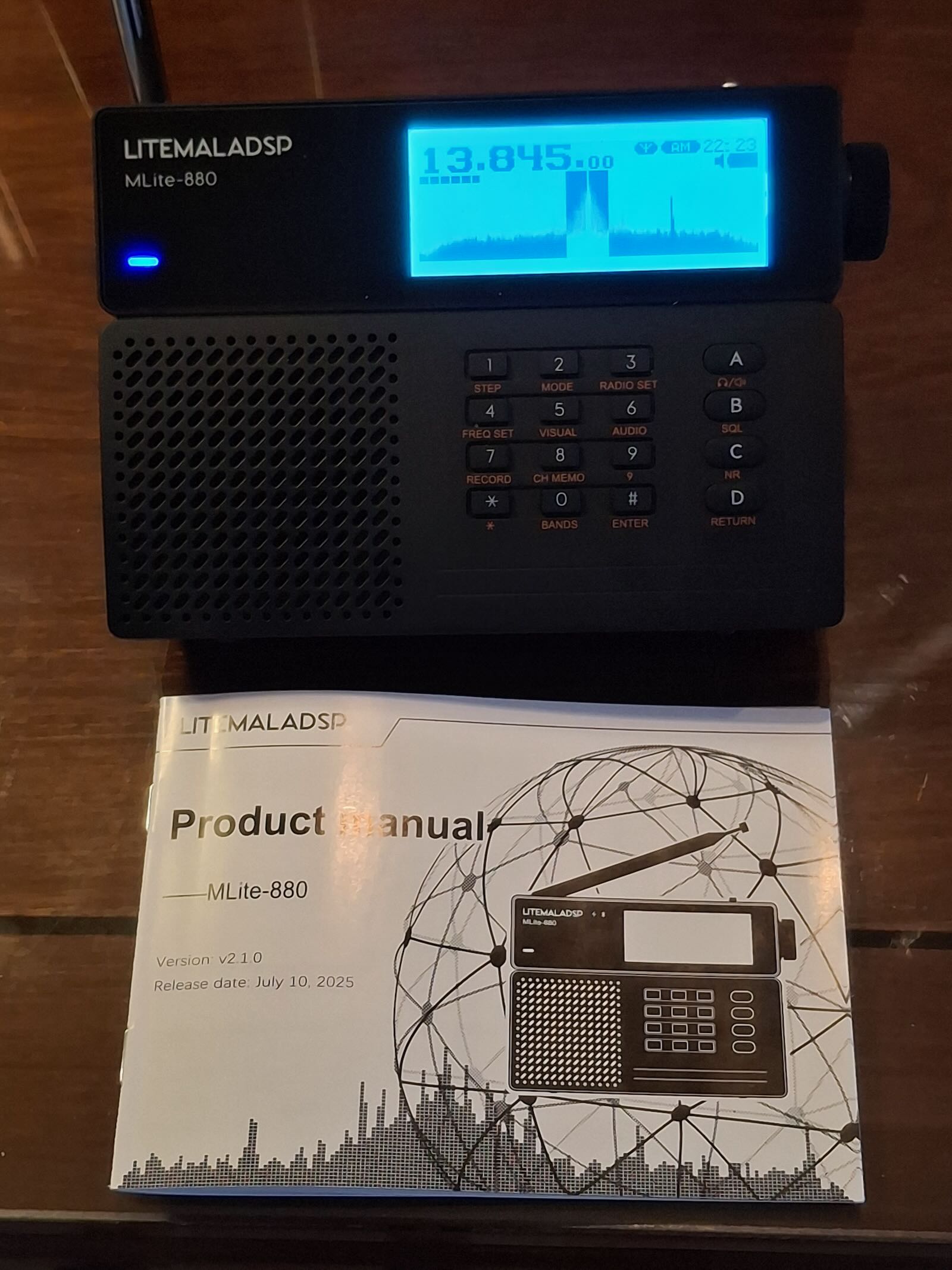
RADIOCHIEF.RU on YouTube provides a demonstration of the MLite-880, comparing it with an ICOM IC-R20 and a DSP-3. He notes that while there are flaws in the 880 they appear to be fixable via firmware upgrades. In the downloads section of the elecevolve website we see version 1.2 dated 6 February 2026. The unit delivered here has 1.1 The printed manual shows “v2.1.0 Release date July 10, 2025”. I’m not aware of videos or other online presence of the ML 880 before January 2026.
WHAT’S THE BIG DEAL?
SWLing Post readers, whether SWLs or amateur operators, may be asking what the big deal is with the MLite-880. That’s understandable, but let me explain the significance. Much as the Choyong LC-90 became the first receiver to provide HF and Internet radio in a traditional radio cabinet (though without any spectrum display), the 880 shows that placing such a display in a traditional portable cabinet has been quite possible for some time — it just took someone to go ahead and do it. Continue reading →
Many thanks to SWLing Post contributor Don Moore–noted author, traveler, and DXer–who shares the following post:
Two Portable Antennas for Remote DXing (Part Two)
By Don Moore
Don’s traveling DX stories can be found in his book Tales of a Vagabond DXer[SWLing Post affiliate link].If you’ve already read his book and enjoyed it, do Don a favor and leave a review on Amazon.
In my initial comparison of the PA0RDT mini-whip and the MLA-30+ MegaLoop, the mini-whip performed best on medium wave and the lower shortwave bands, while the loop worked better on the higher bands. But, I wondered, why should the MLA-30+ be restricted to that small steel loop? The wire loops I use with my Wellbrook ALA-100LN typically range from twenty to fifty meters in circumference.
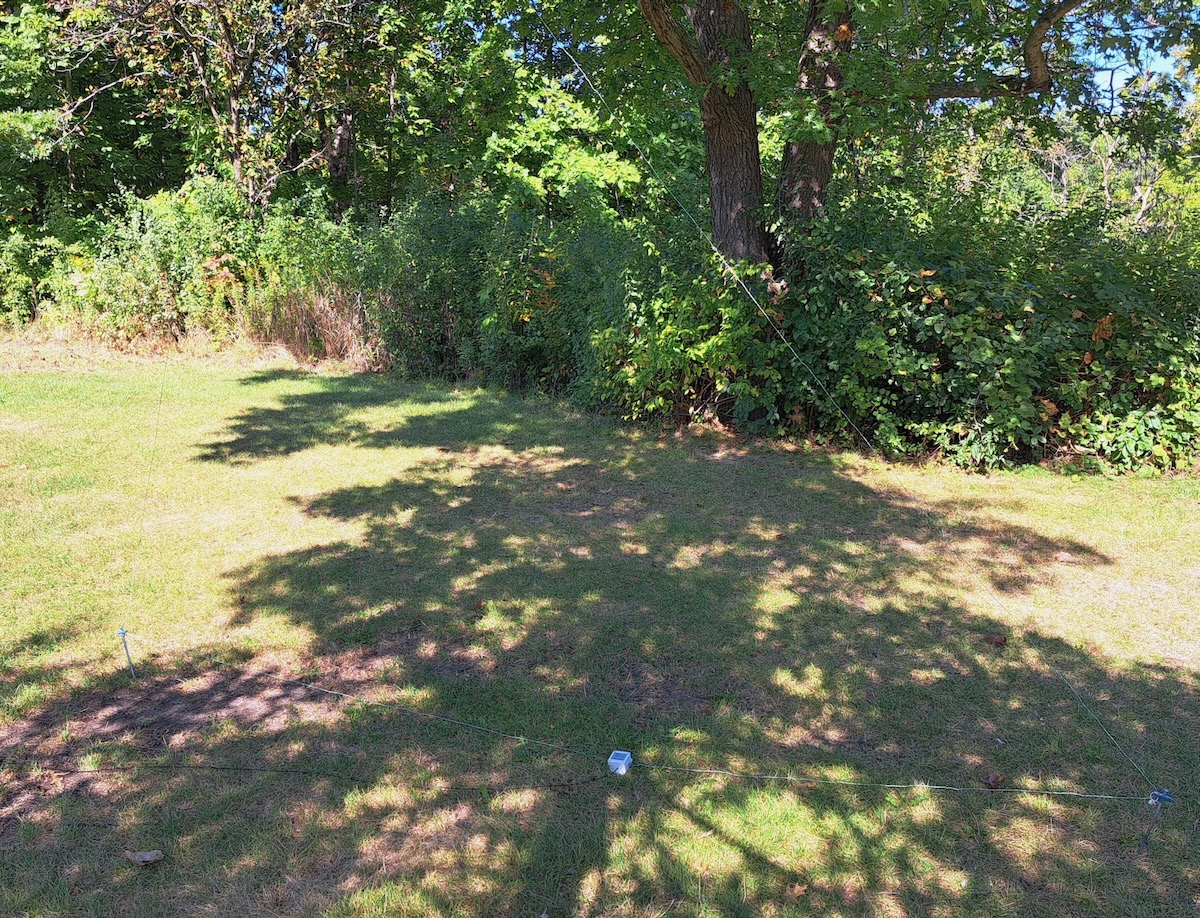
I threw a twenty-five-meter wire over a tree branch and formed it into a delta with the MLA-30+ in the bottom center. Remember, I was testing in the northern Chicago suburbs. My SDRs were completely overloaded. Medium wave was useless and I had strong MW stations all over the shortwave bands. The MLA-30+ doesn’t have the same strong-signal handling capabilities as the Wellbrook. And there are a lot of strong medium wave signals in the Chicago suburbs.
So I took that wire down and replaced it with a loop of twelve meters circumference.
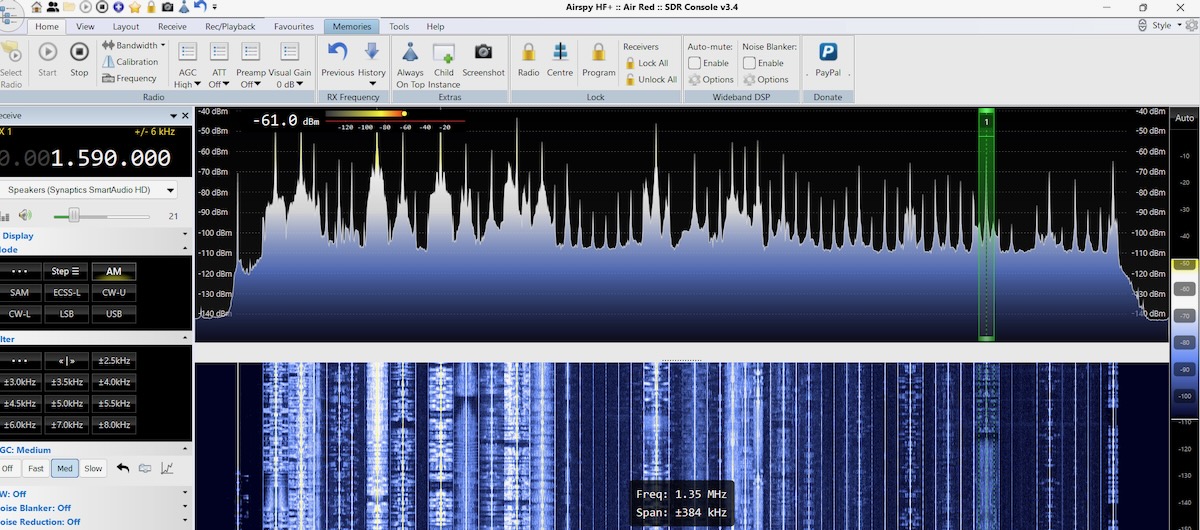
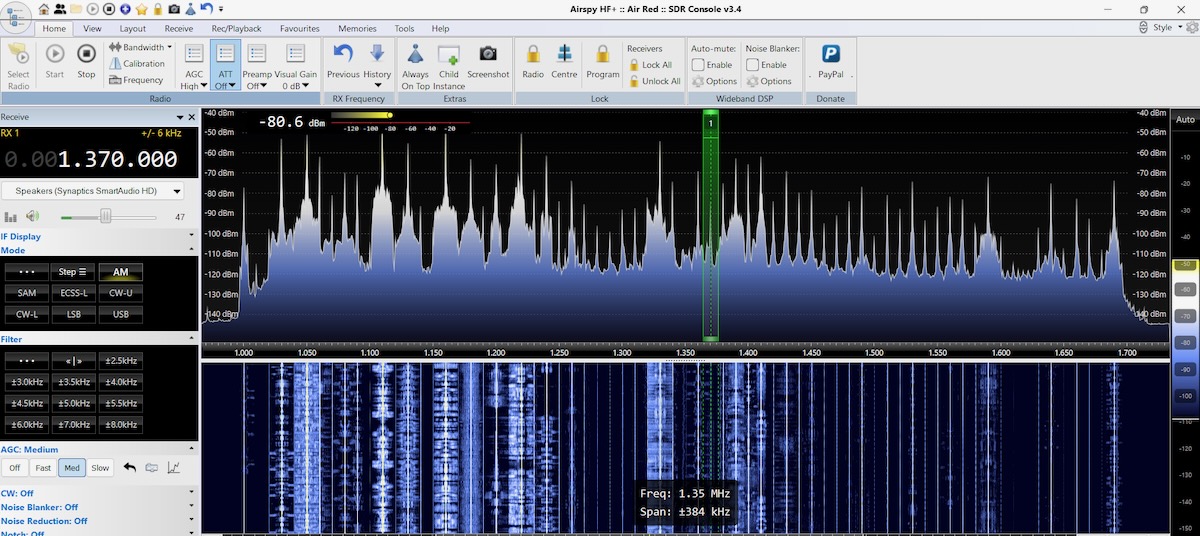
That did the trick. I had lots of signals on medium wave without the overloading. Here’s what the upper end of the MW band now looked like with the MLA-30+.
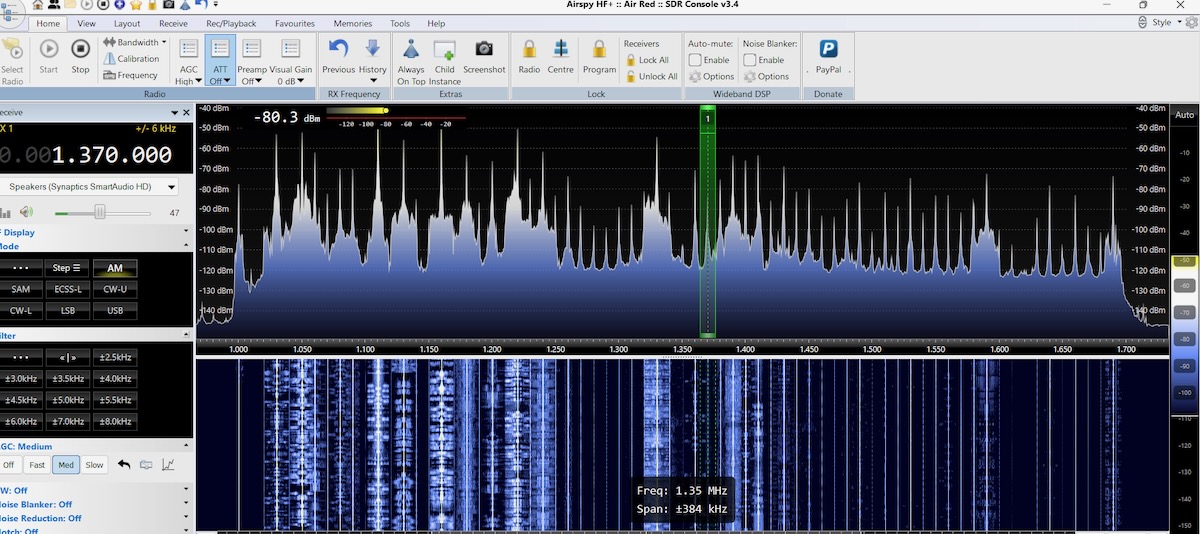
For comparison, here’s the same wire loop using the Wellbrook ALA-100LN. The Wellbrook has a slightly lower noise floor but otherwise the signals are about the same.
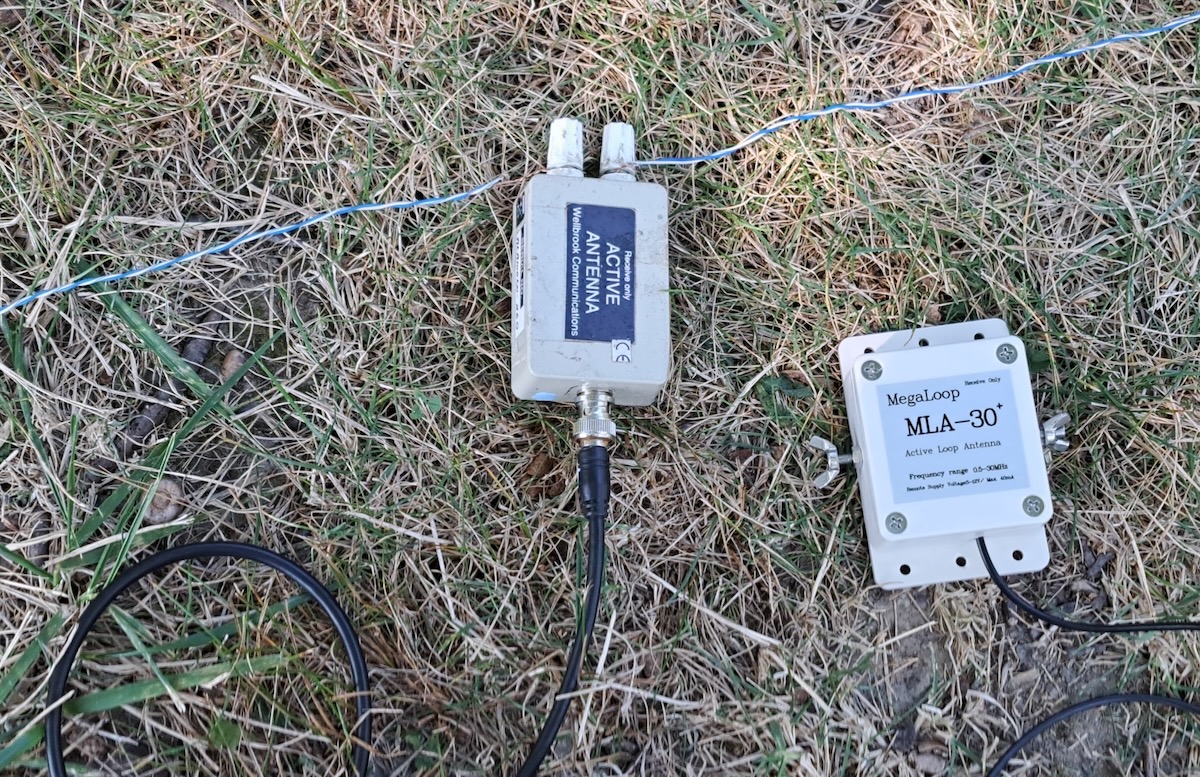
Out of curiosity, I replaced the Wellbrook power unit with the Bias-T from the MLA-30+ but left the Wellbrook antenna head unit in place. With this hybrid setup there’s no visible difference with the full Wellbrook.
I was satisfied with my findings but I still wondered how much wire the MLA-30+ could handle. A few weeks later I ran some more tests in Kansas, where I knew the dial wouldn’t be as crowded. The MLA-30+ easily handled a 25-meter delta loop without overloading.
Two weeks after doing the Kansas tests I was at a DXpedition in rural western Pennsylvania. The MLA-30+ worked fine with a 40-meter circumference loop, other than being a tad noisier than the Wellbrook with the same wire. So how much wire you can use with the MLA-30+ components depends on how strong your local medium wave stations are.
Findings
From the SDR images above it would be easy to conclude that with the right length of wire an MLA-30+ is just as good as a Wellbrook ALA-100LN even though it is significantly cheaper. But that’s not the full picture. Back in the 1990s my Drake R-8 cost about three times what my Sony ICF-2010 did. All other things being equal, I would say that 95% of the DX heard on the Drake could have been heard equally well on the Sony. I wanted the Drake for the other five percent.
I have no doubt that if I did a very careful head-to-head comparison of the two units under serious DX conditions on the same wire that the Wellbrook would get things the MLA-30+ couldn’t. But I suspect the difference would be around that five percent mark. I’m willing to accept that tradeoff for an effective cheap light-weight travel antenna. And the MLA-30+ is like having two antennas in one. I can use it with the steel loop in limited space situations or with a larger wire loop when I have access to some garden space with a tree. Together, the MLA-30+ and the PA0RDT make the perfect DX travel antennas.
The only thing I didn’t like about the MLA-30+ was that pre-attached coax cable. It’s not the best quality and I’d rather carry my own cable. I’m not very handy with a soldering iron in tight spaces but at our recent DXpedition my friend Bill Nollman replaced the coax with a BNC jack for me.
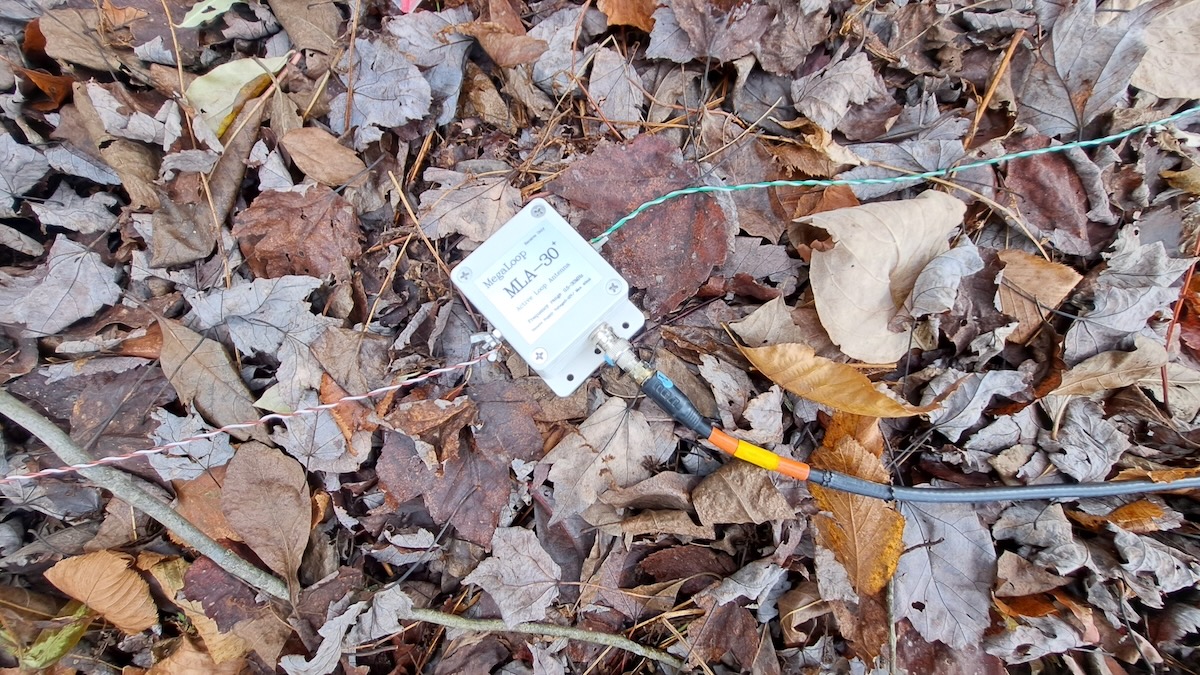
The MLA-30+ now looks like this when connected to a wire loop.
Finally, I should address powering the MLA-30+ via USB. While it can be connected to a spare USB port on your laptop, I found doing that sometimes introduced a tad more noise. Instead I’ve been using one of those battery packs used for recharging cellphones. Mine is rated at 6700 mAh and it can power the MLA-30+ for over 48 hours before needing a recharge. But be sure to test yours before doing any serious DXing. I’ve read that some power packs have a minimum required power draw and will automatically shut off if the draw is too low.
Another Option?
While I was finishing this article I heard about another option from my friend Guy Atkins. This antenna is a combination of the YouLoop with a low-priced Chinese made clone of the LZ1AQ amplifier. Some users say it’s better than the MLA-30+. Guy says it works well on shortwave up to 16 meters but he hasn’t tried it on medium wave. Guy says it’s a “low price, good value” antenna. I’m traveling in Southeast Asia for the winter but will definitely have to try this antenna when I get back to the USA. So maybe there will be a follow-up article next summer.
Links
[Note: Amazon links are affiliate and support the SWLing Post at no cost to you.]
Info on ordering a quality PA0RDT from Roelof Bakker. (Other cheaper versions have had issues with quality control.)
Many thanks to SWLing Post contributor Don Moore–noted author, traveler, and DXer–who shares the following post:
Two Portable Antennas for Remote DXing (Part One)
By Don Moore
Don’s traveling DX stories can be found in his book Tales of a Vagabond DXer[SWLing Post affiliate link].If you’ve already read his book and enjoyed it, do Don a favor and leave a review on Amazon.
Once upon a time, I had a traditional DX shack with an L-shaped desk and shelves of receivers, radio gadgets, and DX books. Everything I wanted or needed as a DXer was right at hand. Then I retired and was finally able to pursue my lifelong itch for serious travel. But there was no way to carry that DX shack along with me. Fortunately, modern technology was there to help. SDRs are significantly more travel-friendly than my old Sony ICF-2010 (let alone the Drake R-8). Instead of books and bulletins, my DX reference materials are websites and PDF files on my laptop.
I spend several months a year traveling internationally with just a suitcase and knapsack. That doesn’t leave much room for DX equipment. Several years ago I described my approach to vagabond DXing in an article here.
Since writing that article in 2019, I’ve continued to work on making my portable DX shack better and more compact. Recently, I replaced the Elad FDM-S2 with three Airspy HF+ Discovery SDRs. Not only are they smaller and lighter, but I can record three different band segments at once. Next up was rethinking my travel antennas. A wire loop with the Wellbrook ALA-100LN is still, in my opinion, the best travel antenna. But the components are heavy and are now irreplaceable since they are no longer made. So over the summer, I set about testing and comparing both old and new options. But you don’t have to wander the globe for my findings to be useful to you. This can be just as helpful for DXing from a nearby park. That’s how I did my testing.
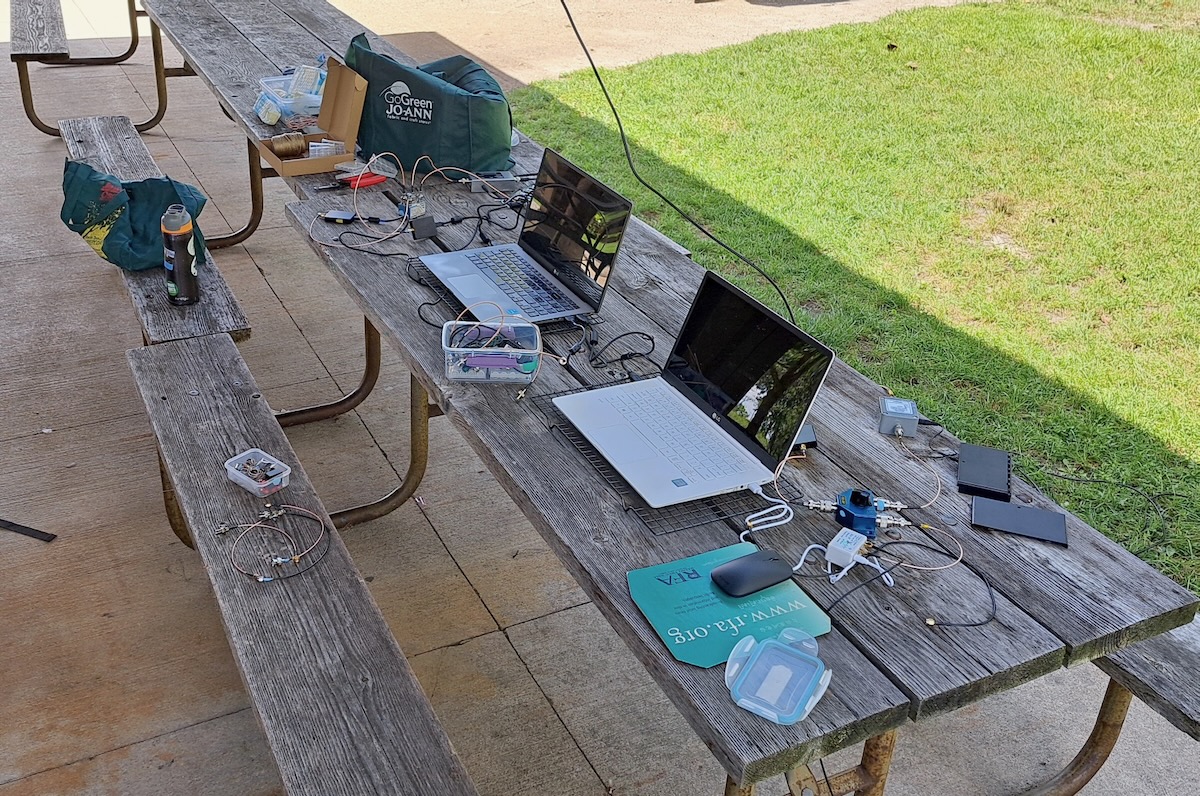
I spent the past summer staying at an AirBnB in the north Chicago suburbs. I wanted a better location for testing so I checked out parks in the area and finally settled on Preserve Shelter B (42.26797, -87.92208) at the Old School Forest Preserve, east of Libertyville in northern Illinois. The shelter was entirely wood, with standard asphalt shingles (rather than steel), and had no nearby power lines. I made four daytime DXpeditions there to do some utility DXing and to run my tests. Here’s a photo of my setup.
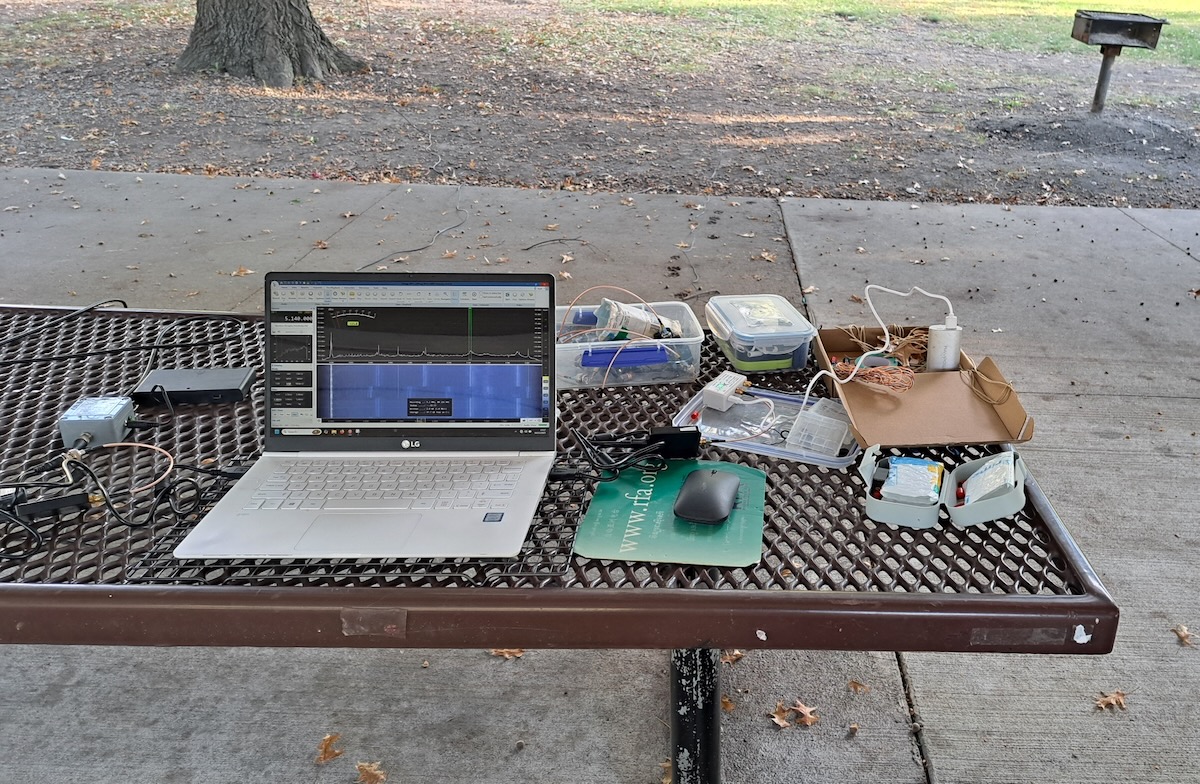
I decided I should rerun the tests at least one other location. So while driving across the US in mid-October, I stopped for a few hours one morning at Park Shelter A (39.11144, -94.86629) in Wyandotte County Park, just west of Kansas City, Kansas. There, I just had a minimum setup.
The Antennas
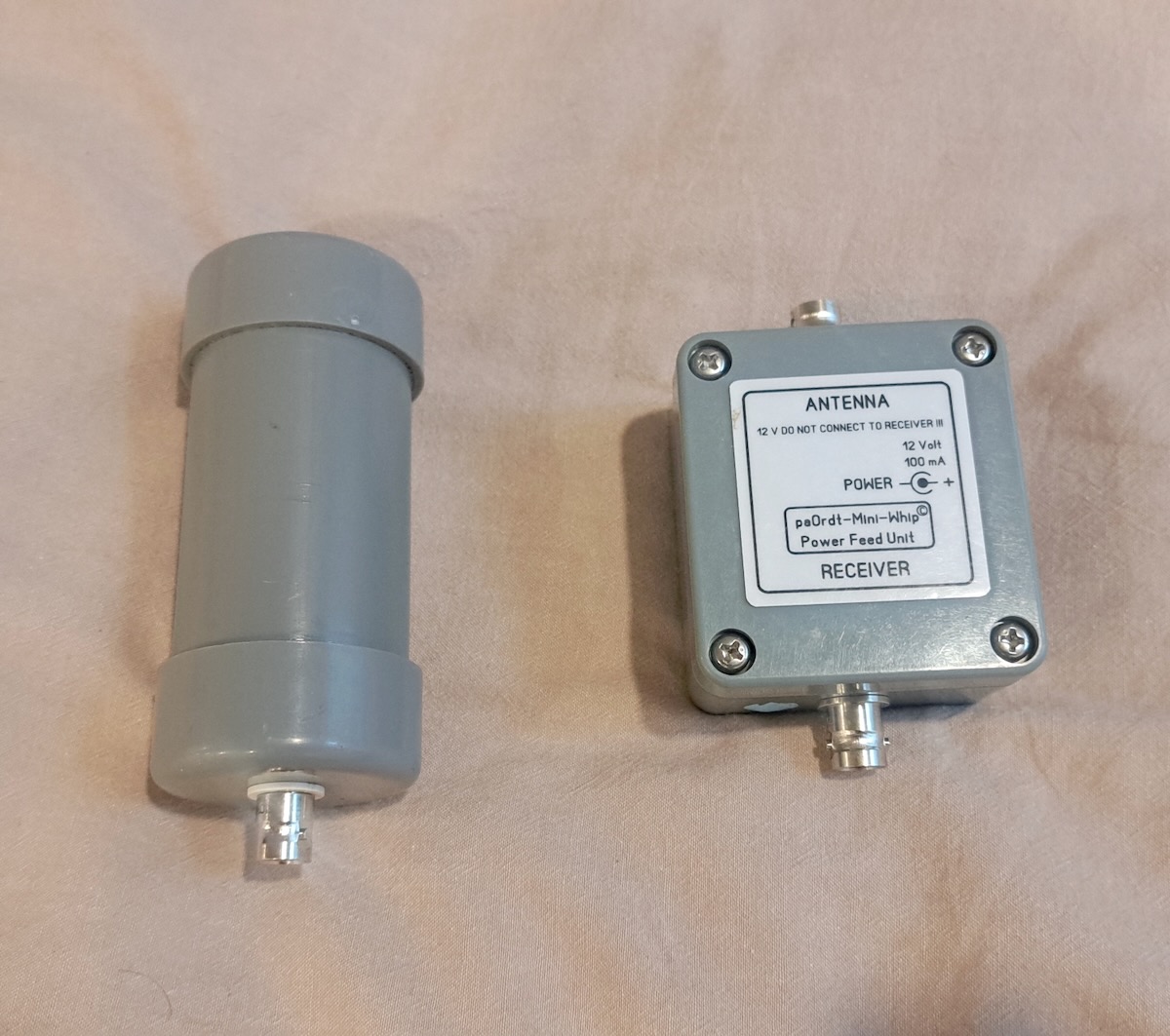
So, what were the antennas I was testing? The first was the tried-and-true PA0RDT mini-whip from Roelof Bakker. The PA0RDT is described in my 2019 article and is probably the most portable quality antenna you can get. To power it I use a battery box and eight rechargeable lithium-ion AA cells.
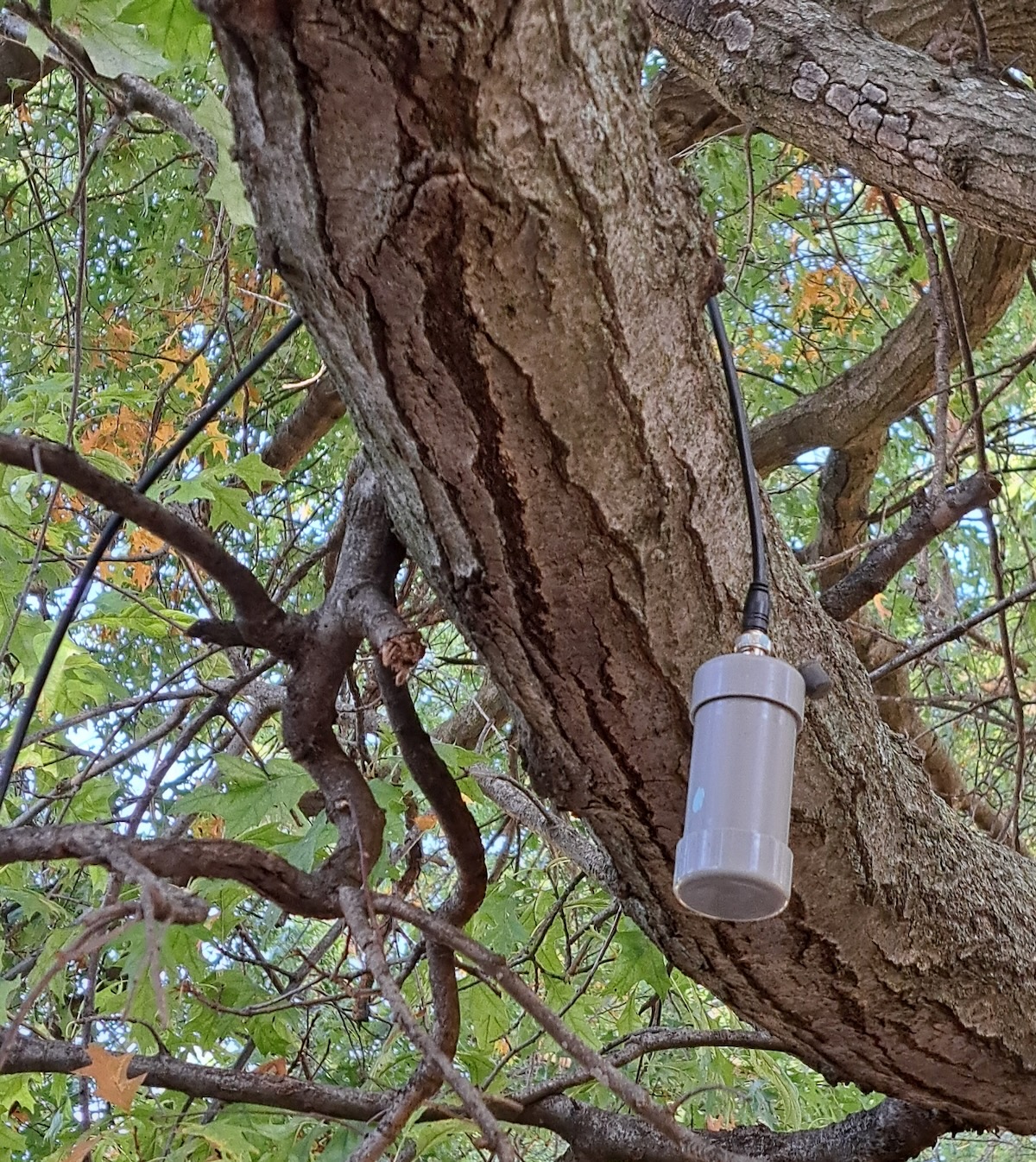
For the traveling DXer, setting up the PA0RDT is as easy as it comes. I just attach the coax cable and throw it over a support, such as a picnic shelter beam or a tree branch.
But I’ve always believed that the best antenna is another antenna. That is, every antenna works differently, and therefore the more options you have, the more likely you will have something that works well in any situation. So if I wanted to leave the Wellbrook at home, what might complement the PA0RDT? I contacted my friend Mark Taylor, who I knew had a large collection of the various inexpensive Chinese-made amplified loops. With his help, I settled on the MLA-30+ MegaLoop from DmgicPro.
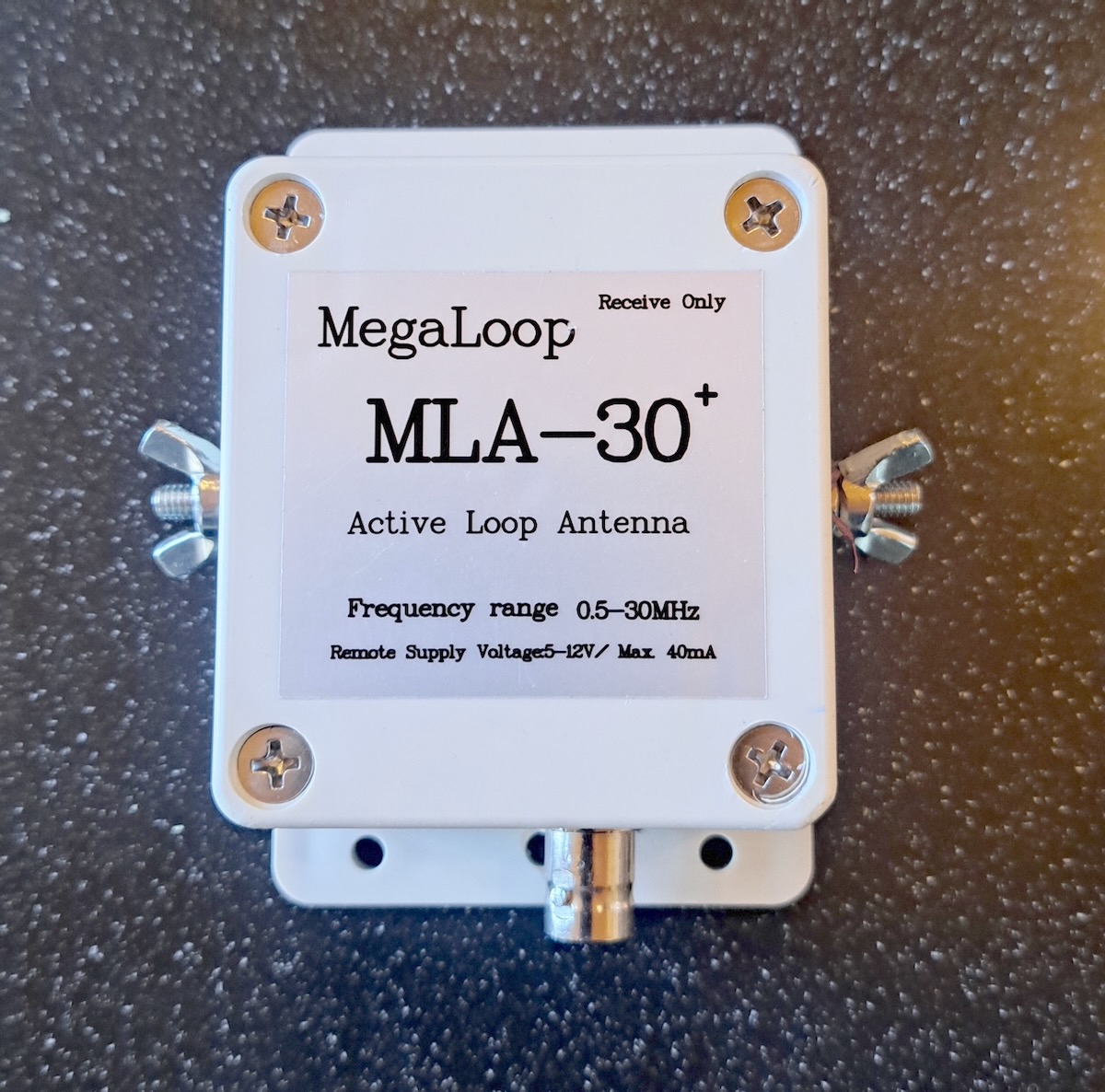
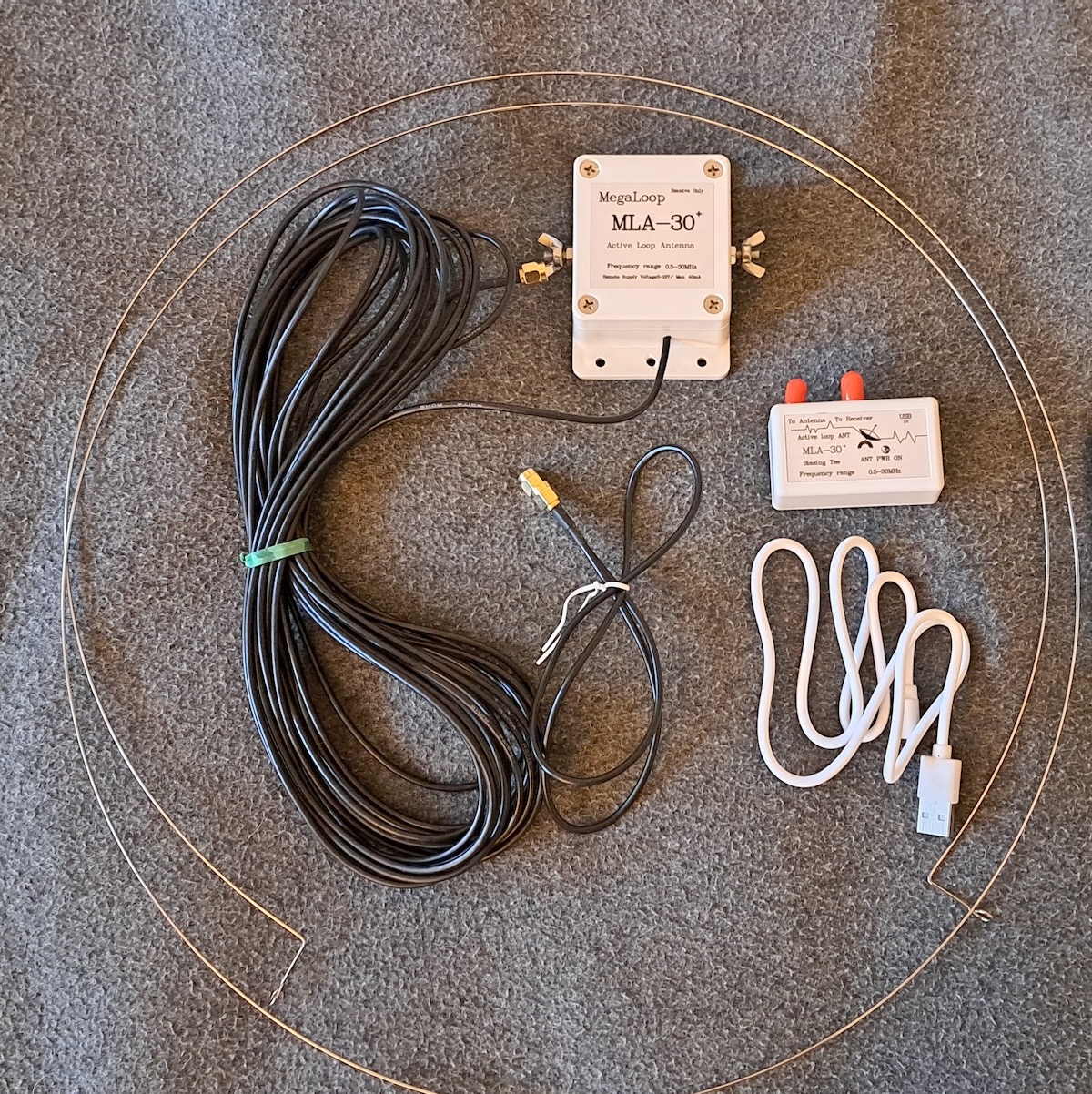
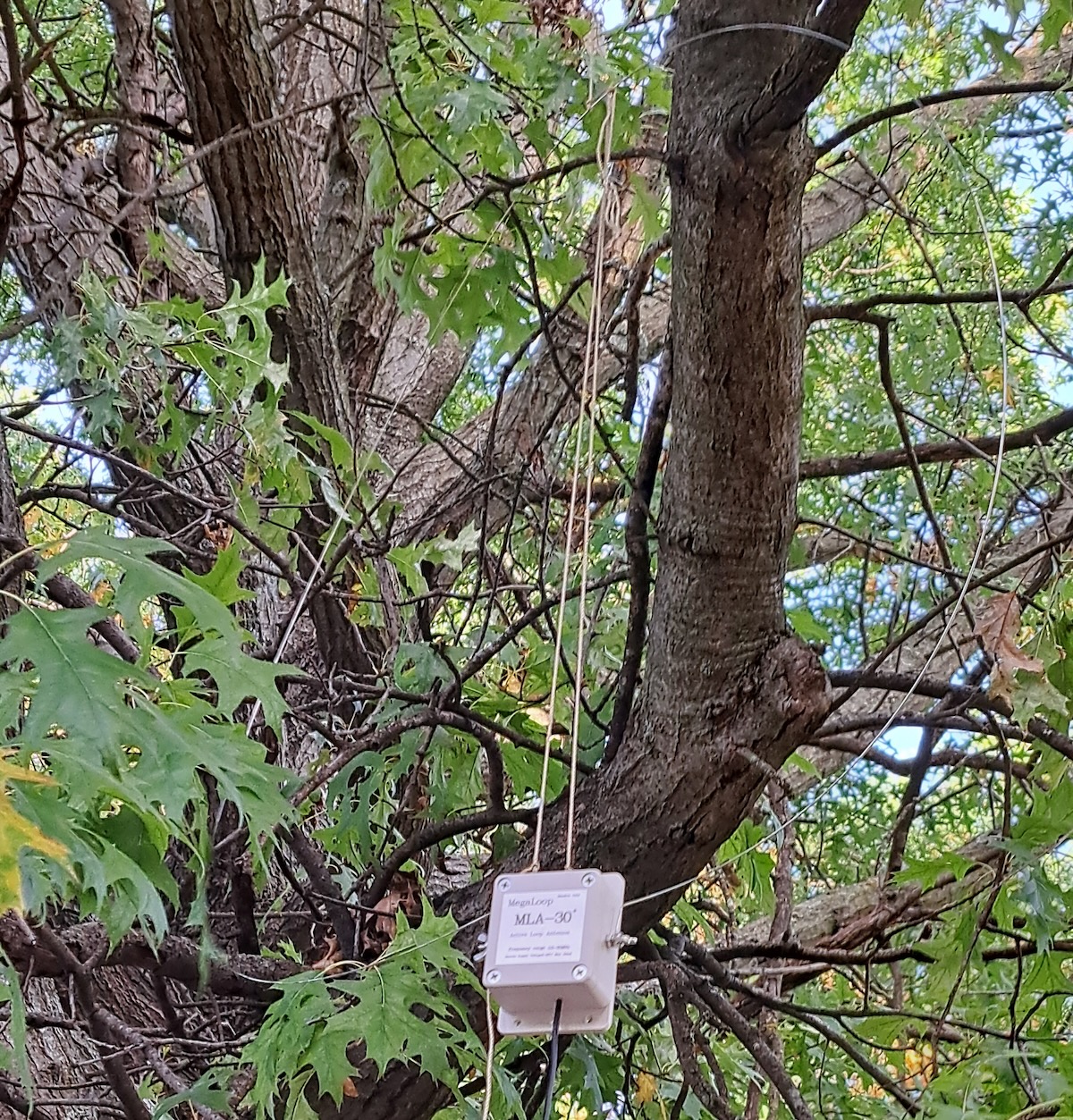
This antenna consists of a steel wire loop that connects to terminals on the amplifier box. The amplifier has a ten-meter coax cable, which in turn is connected to a small bias-T power supply, which gets its power via a USB connection. The MLA-30+ is designed to be used in a permanent installation with some sort of vertical support, such as a PVC pipe. Some users replace the wire loop with copper tubing.
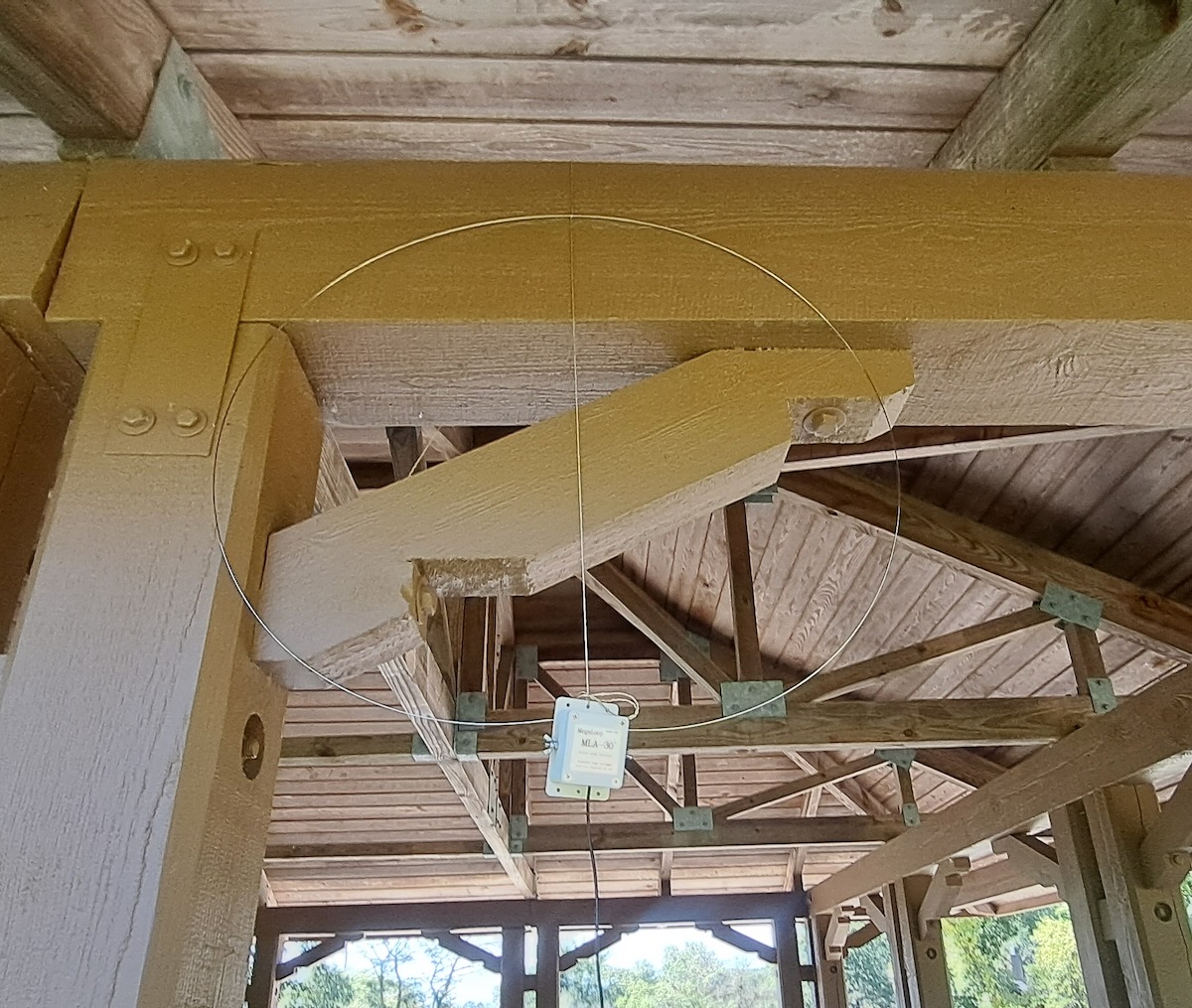
Those options aren’t practical for me, and simply hanging the antenna from the top would cause the steel loop to stretch and deform. So I came up with the idea of tying a strong cord from the top to the bottom of the loop so that the cord, and not the loop, bears the weight. To hang the antenna, I throw the cord over the support, attach the antenna, and then pull it up into place. That works well if you have rear support to hold it in place, such as the beams of a picnic shelter.
It’s a bit more difficult to mount the MLA-30+ in a tree.
Comparing the Antennas
I ran comparisons between the antennas several times at Old School Forest Preserve and then again at Wyandotte County Park. The results were practically the same every time. The images below were made at Old School unless otherwise stated.
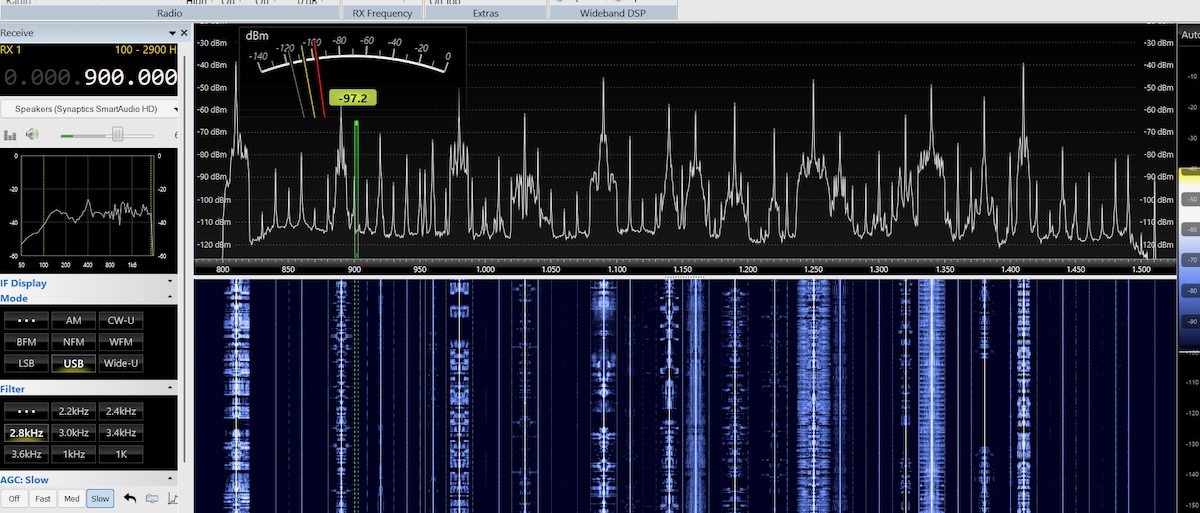
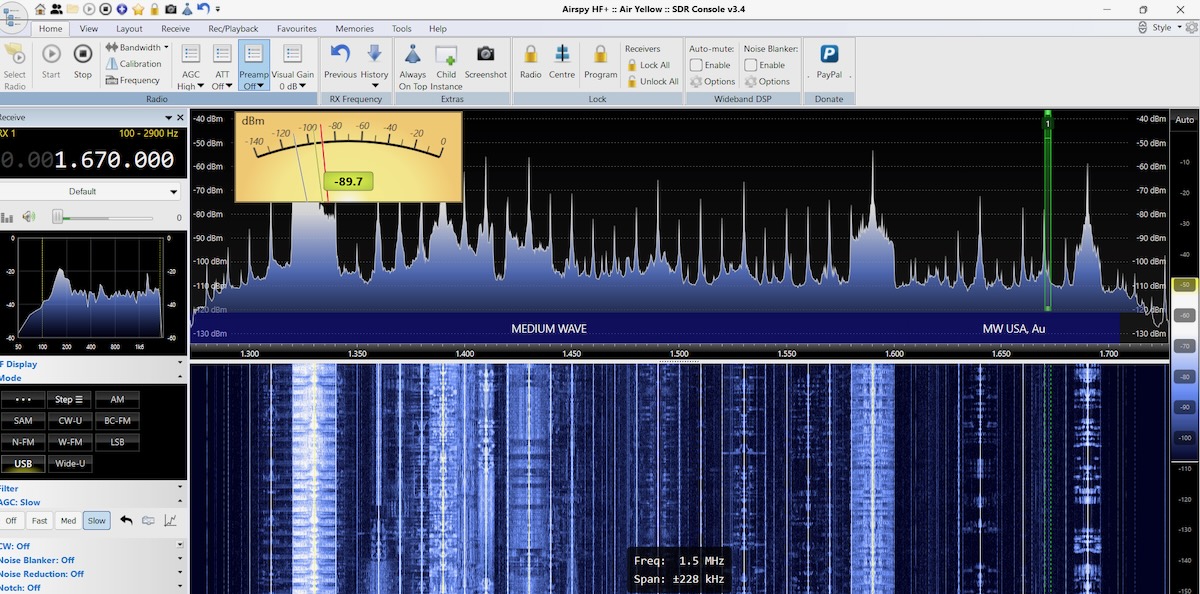
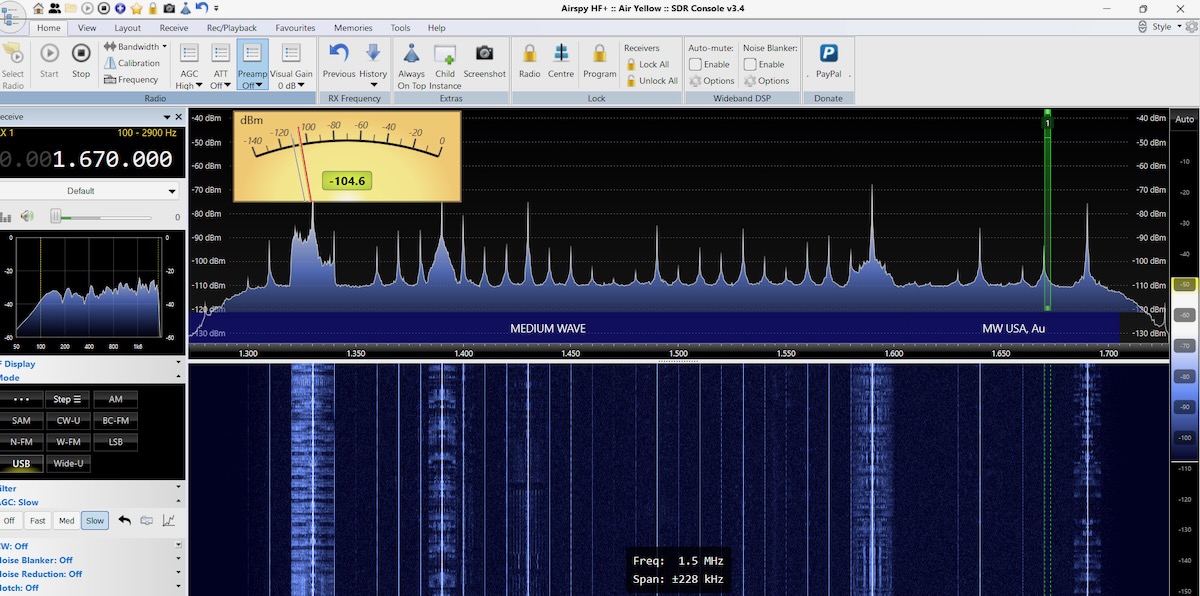
The PA0RDT was designed to be a good performer on longwave and medium wave. Unsurprisingly, it shows a lot of signals on the upper end of the medium wave band, even during the daytime. Except for being non-directional, the PA0RDT is an excellent MW antenna.
The MLA-30+, on the other hand, isn’t good for much beyond hearing the strongest local signals on medium wave.
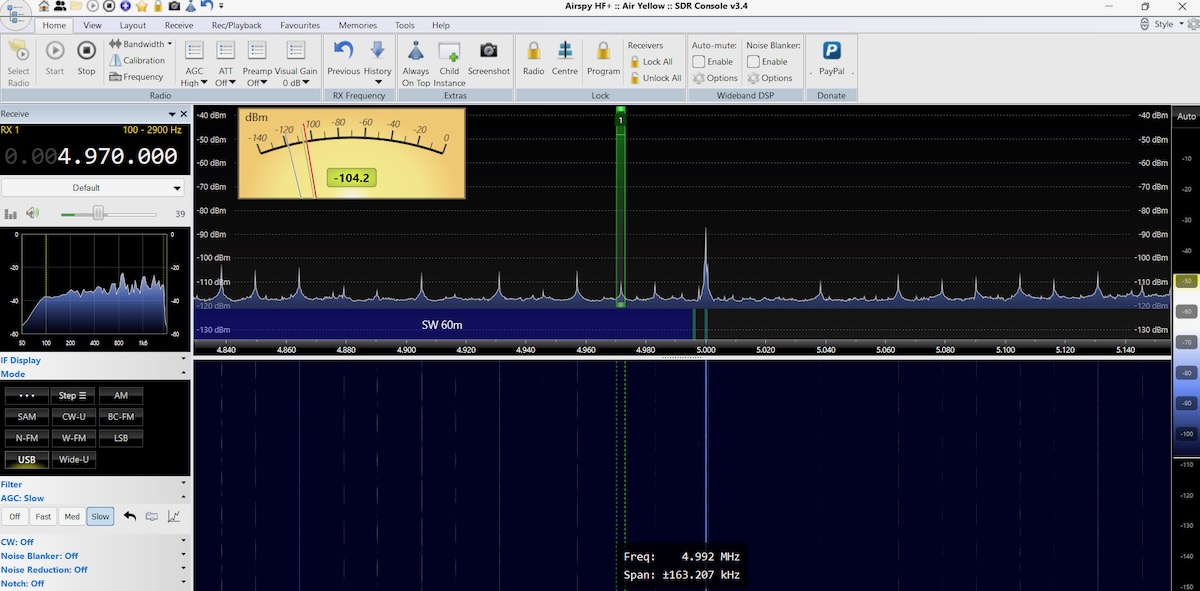
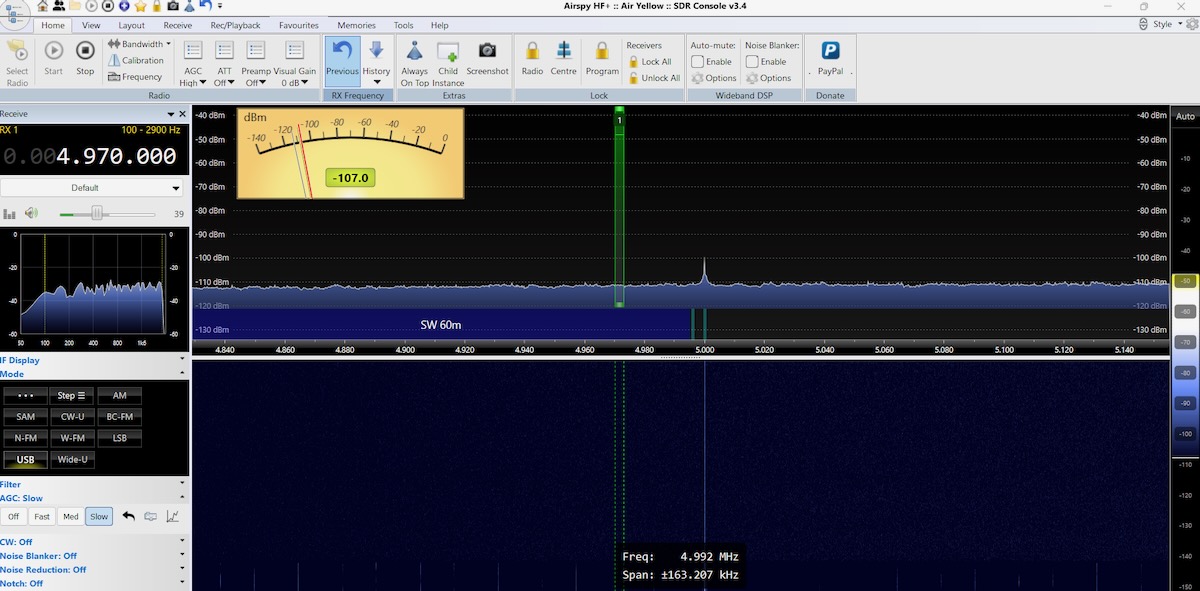
When I ran these tests in the late morning, WWV on 5 MHz was the only signal in the 60-meter band. It had a very listenable signal on the PA0RDT.
But on the MLA-30+, WWV was barely there.
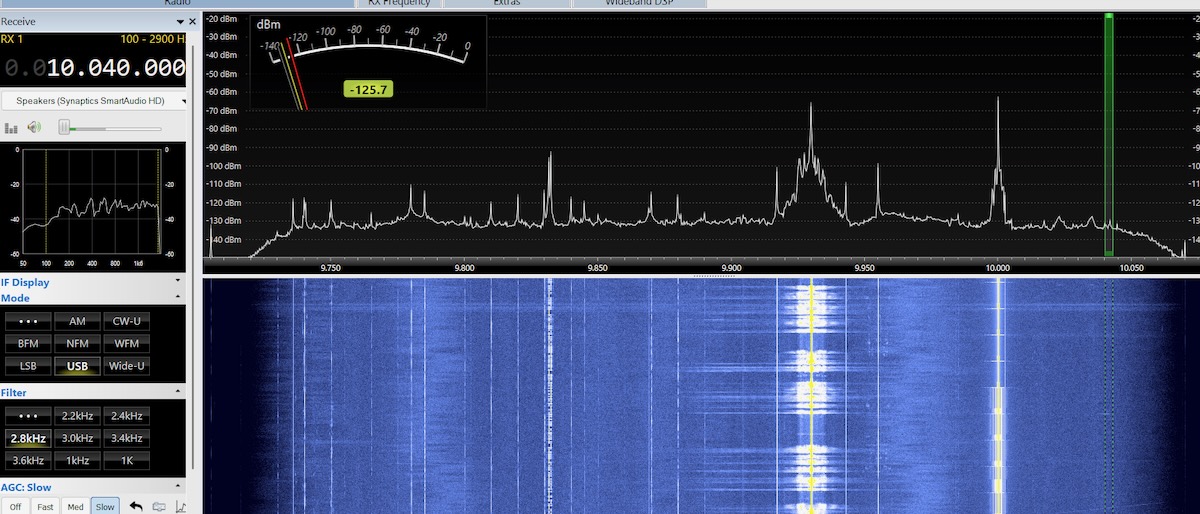
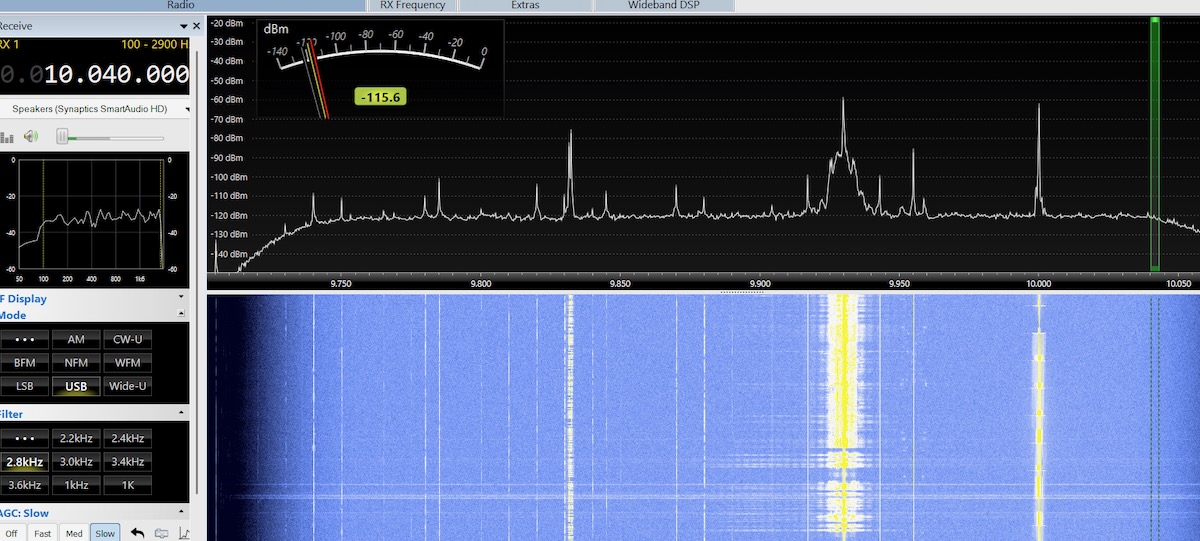
Likewise on 49 meters, CFRX on 6070 kHz was very clear on the PA0RDT but barely listenable on the MLA-30+. But when I moved up to 31 meters, the difference between the antennas mostly disappeared, as in these images made in Kansas. The PA0RDT is top and the MLA-30+ on the bottom.
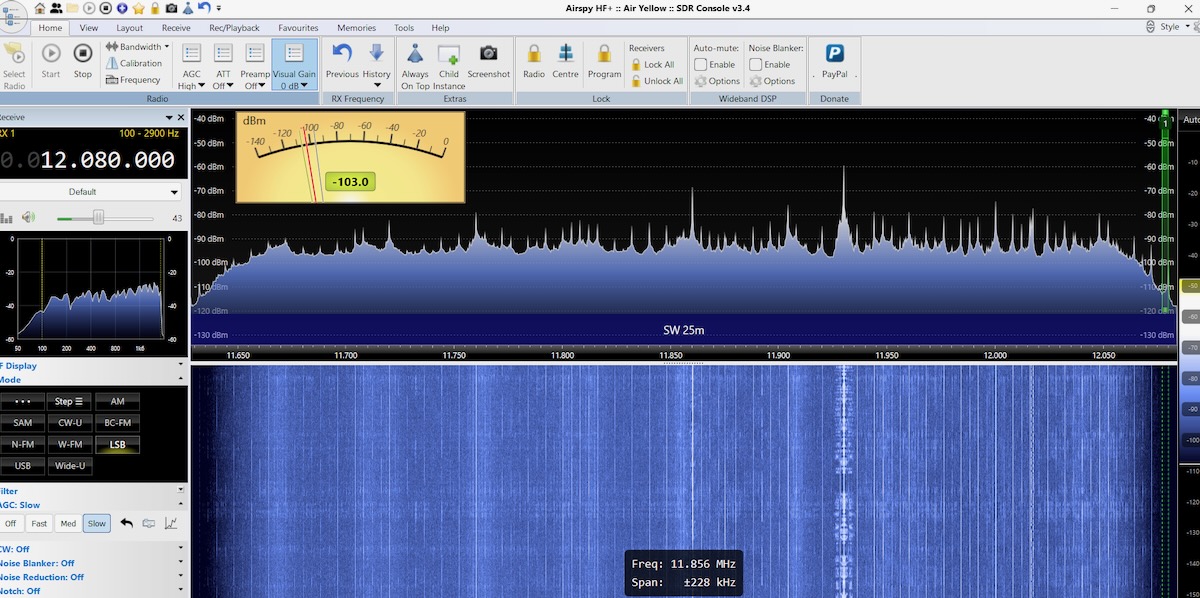
On 25 meters, the PA0RDT is picking up a lot of noise and the signals are not that strong. Nor were signals very strong on 19, 16, 0r 13 meters.
However, on 25 meters with the MLA-30+ there isn’t much noise and the signals are booming in. And 19, 16, and 13 meters likewise had strong signals.
So the PA0RDT is clearly the best antenna for MW and the lower shortwave bands, but it doesn’t do as well on the higher bands. This wasn’t a surprise to me as I’ve always felt that the PA0RDT underperformed above nine or ten Megahertz. The MLA-30+ was abysmal at the lower frequencies but worked better or just as well in the middle and higher shortwave bands. The best antenna is another antenna. Each one performs better in different situations. But I couldn’t help but wonder … was the problem with the MLA-30+ that small steel wire loop?
Look for Don’s Part 2 article next weekend on the SWLing Post!
It’s been a long while since I’ve written a receiver review. Years ago, I cranked them out several times a year and genuinely loved the process–evaluating performance, quirks, economics, and overall user experience. Writing reviews is, to this day, one of my favorite things to do.
But over the past four years, my reviewing work shifted more toward amateur radio and portable operations, especially as my QRP activities ramped up. And as many of you know, the SWLing Post now has an incredible group of contributors who regularly write thoughtful reviews, taking some of the pressure off of me.
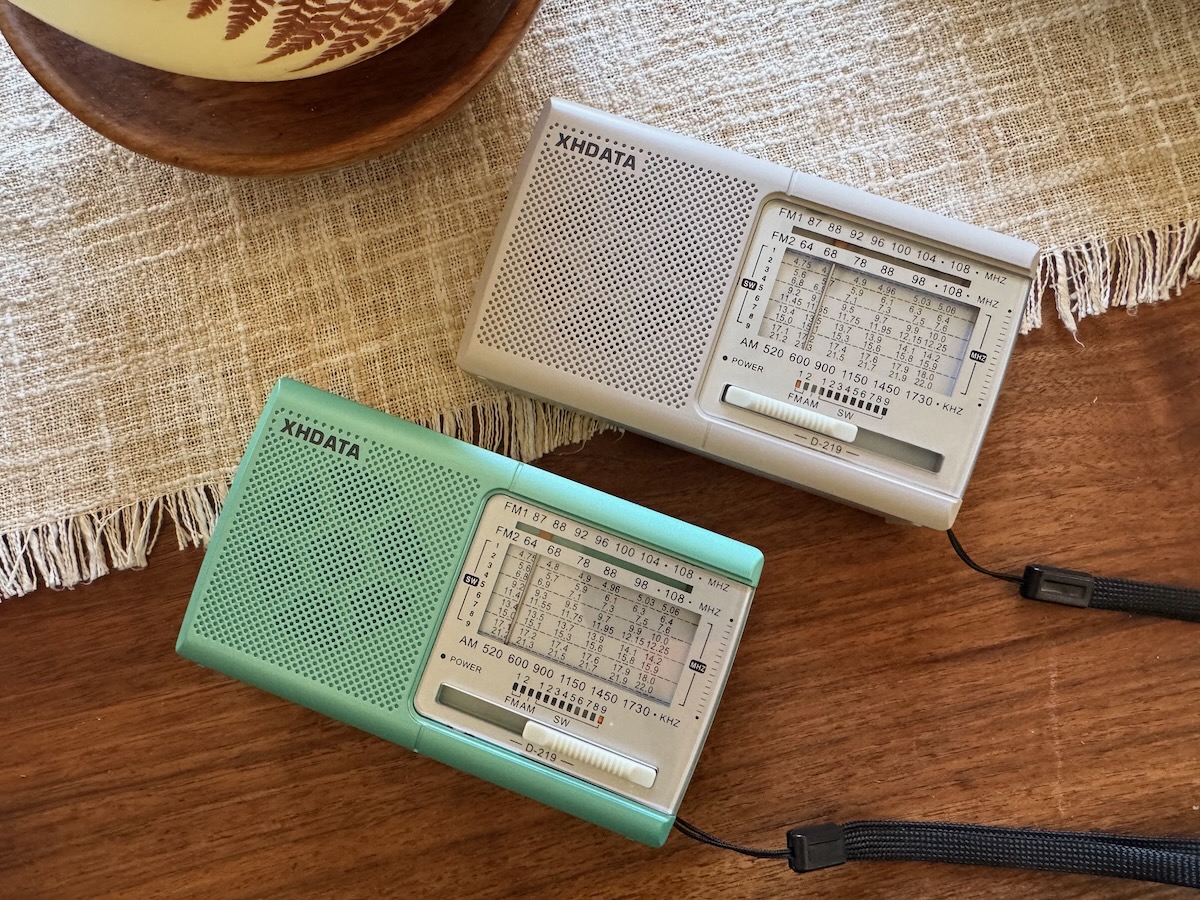
So when my contact at XHDATA reached out a few weeks ago asking if I wanted to try two new color variants of their ultra-affordable D-219, I surprised myself: instead of passing it along to one of our contributors, I decided I wanted the chance to revisit the world of simple, inexpensive portables firsthand.
Why? Because I’d been hearing surprisingly positive things about this little radio—and because it reminds me of the DX-397, a tiny analog portable I used for years after working at RadioShack right out of college.
This review, then, is less about testing a product and more about rediscovering the joy of having a simple, super-basic radio at hand.
Disclosure: XHDATA is a generous long-time sponsor of the SWLing Post. They sent both of these D-219 radios free of charge. Honestly, I don’t know many companies that would send out a sub-$20 product as a review loaner–it probably costs them more in shipping.
As always, I’ll be gifting these units back out once I’m finished. And in this case, I’ll also be buying three more myself for Christmas gifts… one of those, I’ll keep.
Design & First Impressions
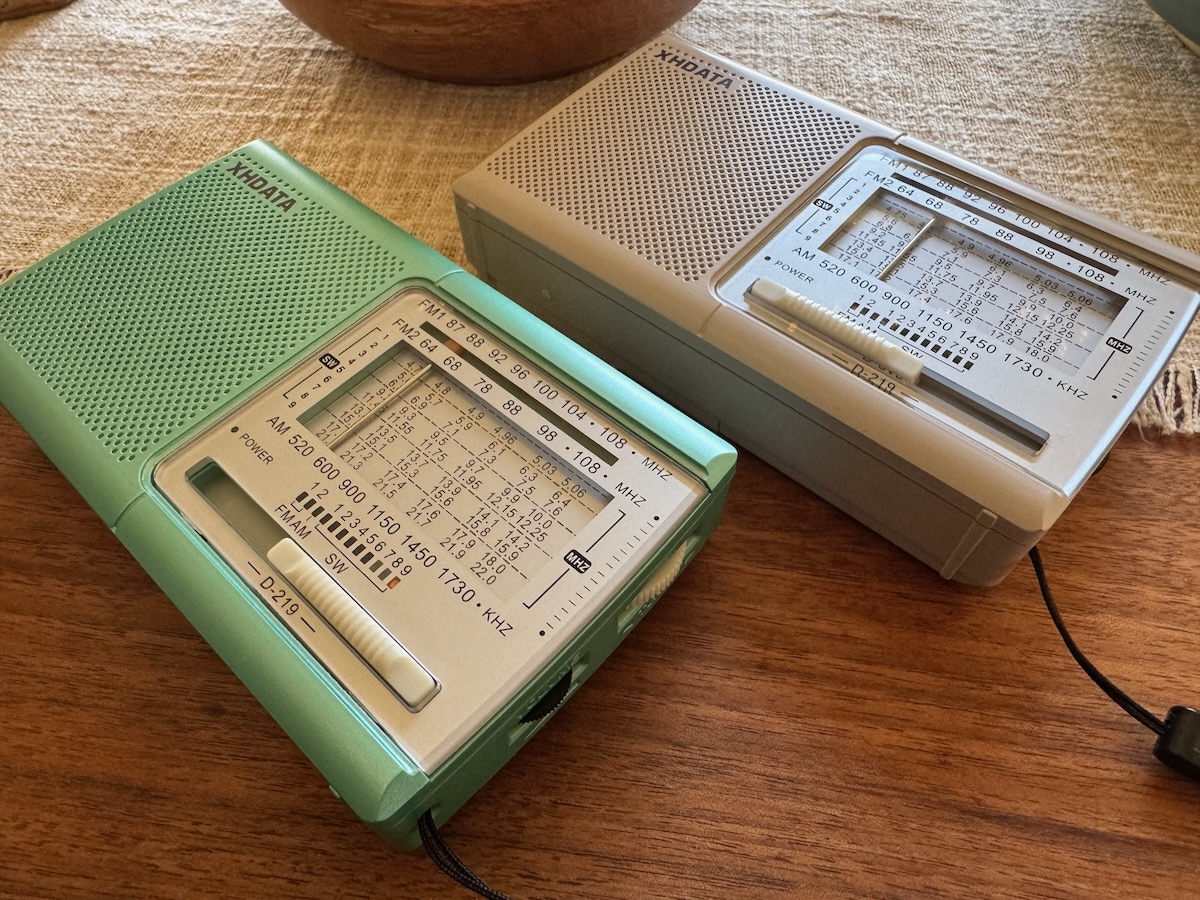
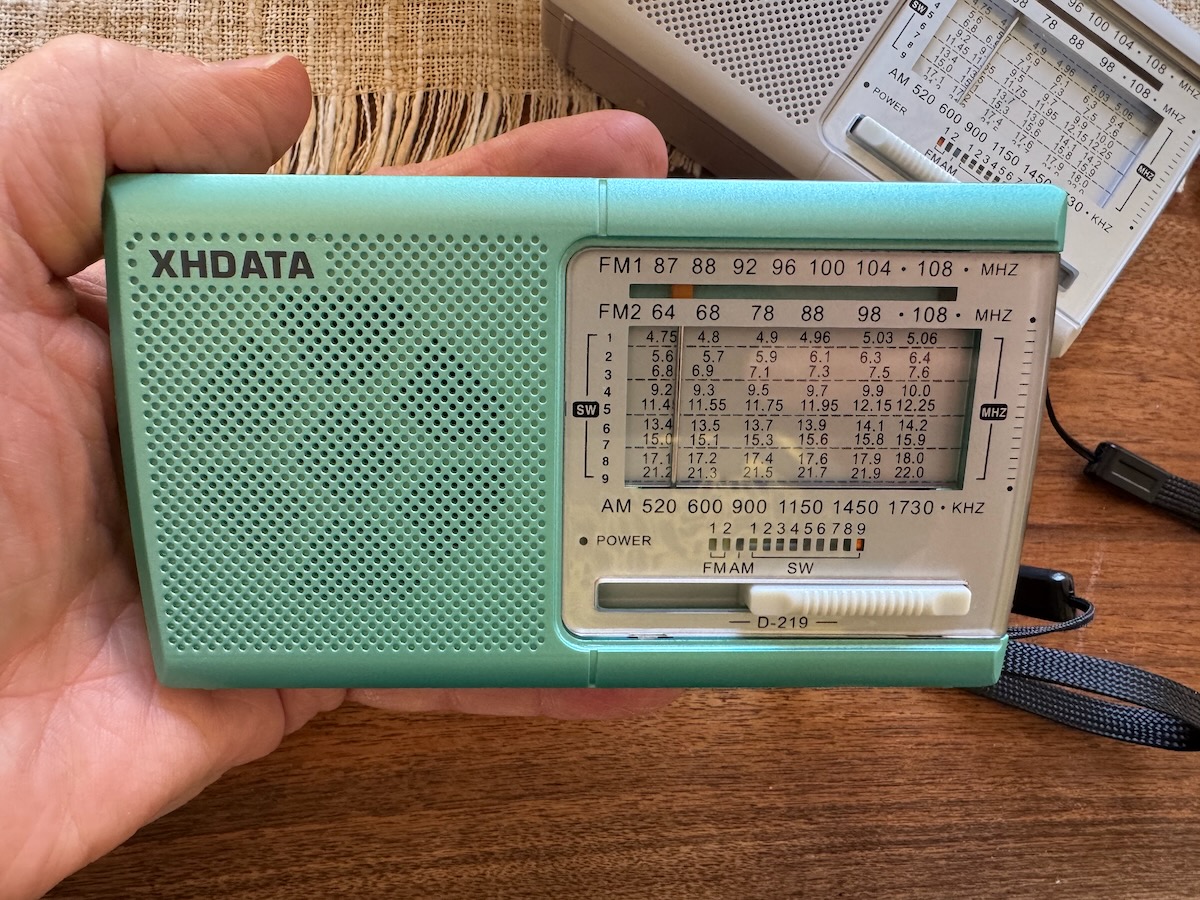
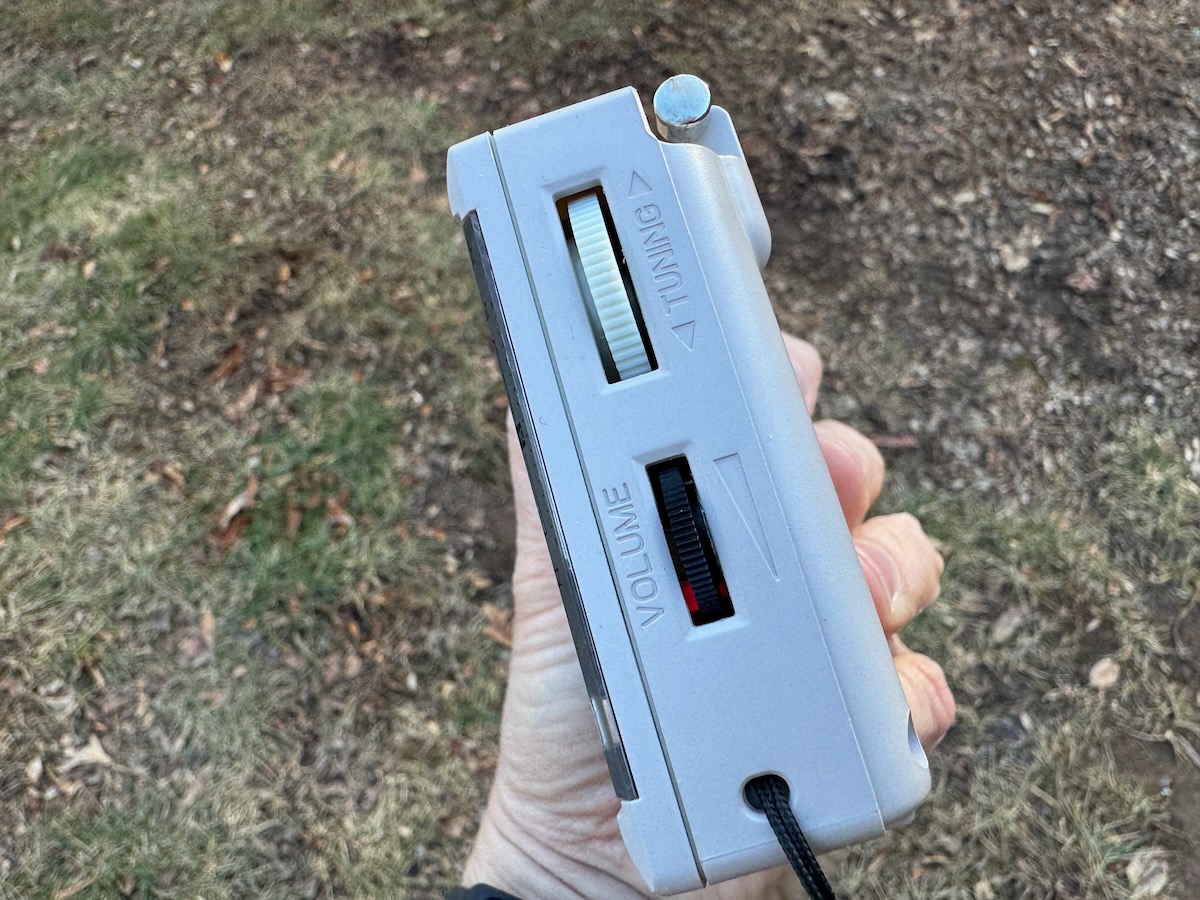
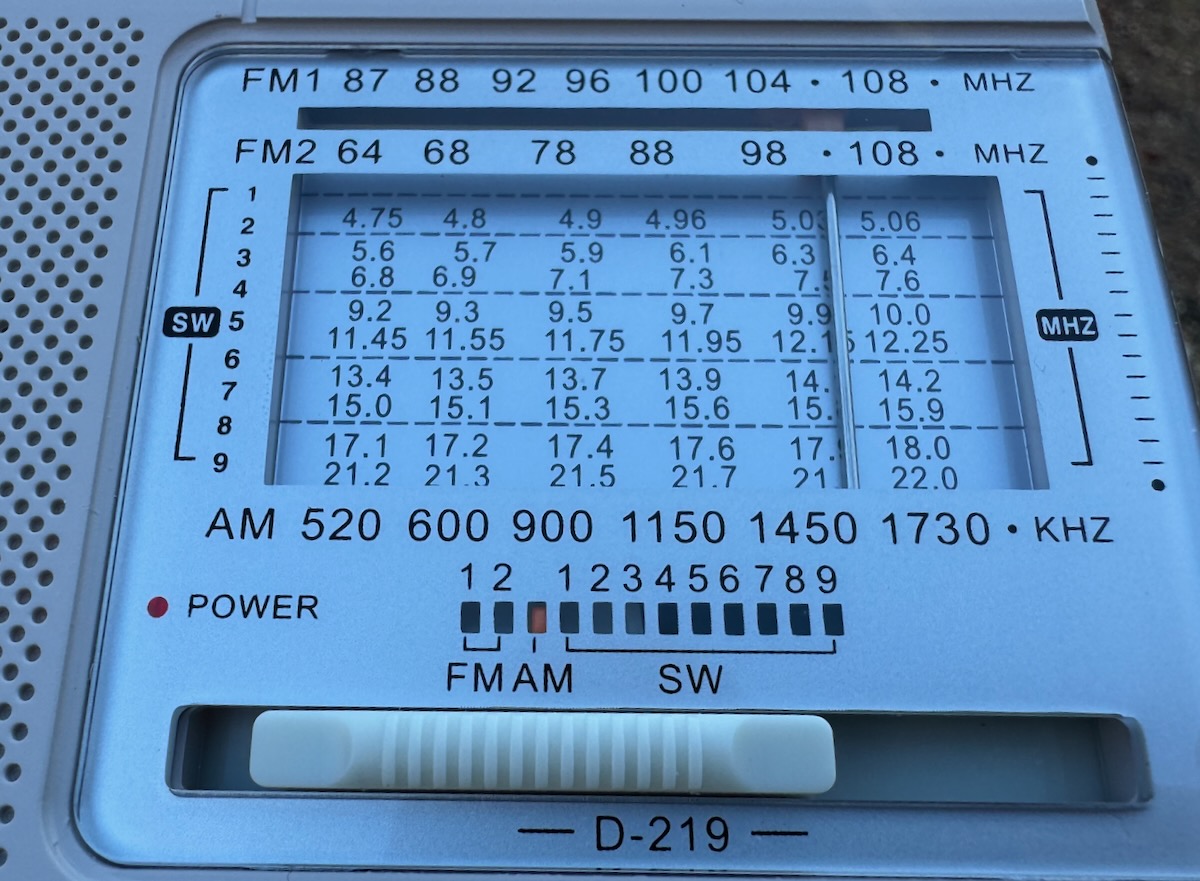
Let’s be clear: the D-219 is a simple radio. It looks like something straight out of the mid-1990s, with:
an analog tuning dial
band-switching sliders
a dedicated on/off switch on top
a small, lightweight plastic enclosure
But inside, it’s very much a modern radio. The D-219 is based on the Silicon Labs Si4825-A10 DSP chip, meaning that although tuning feels analog, you’re actually listening to a DSP-based receiver stepping through the band in predetermined increments.
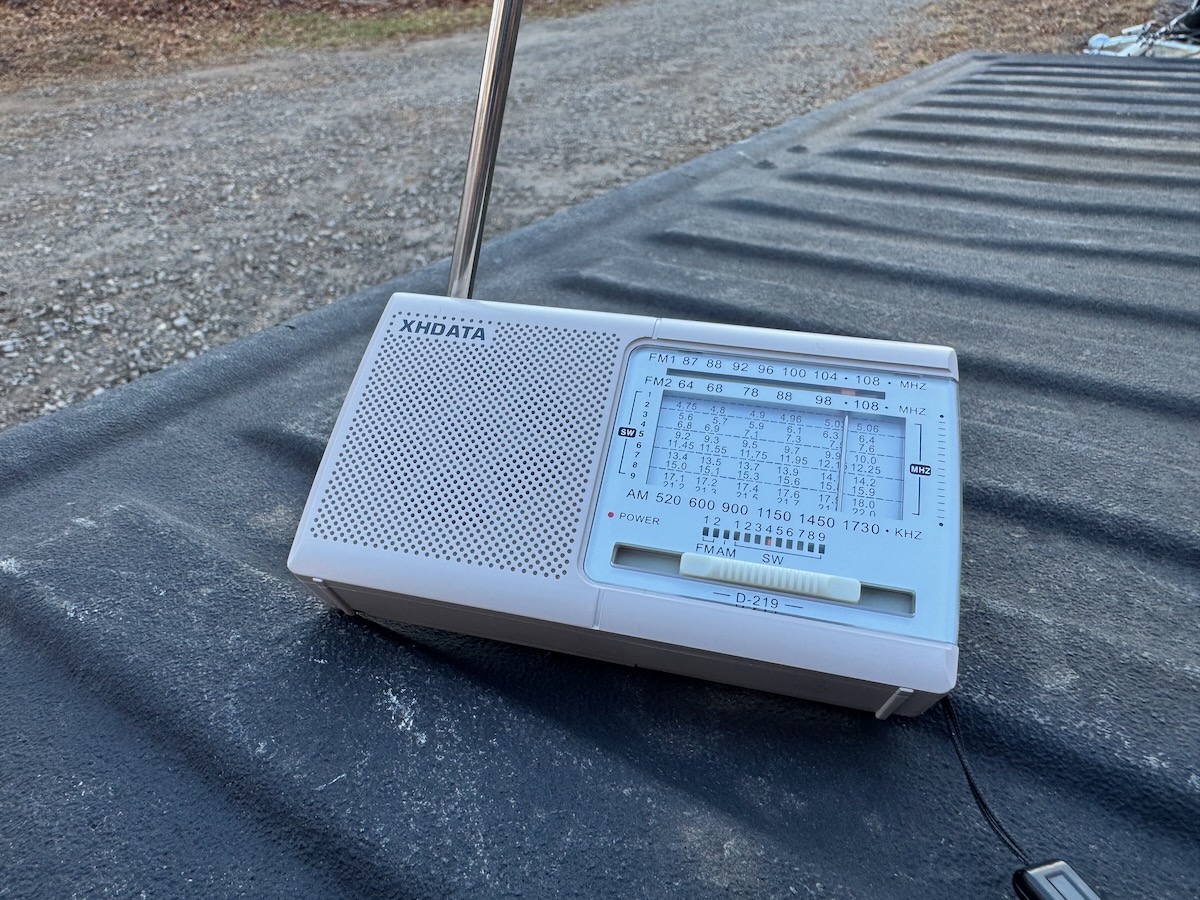
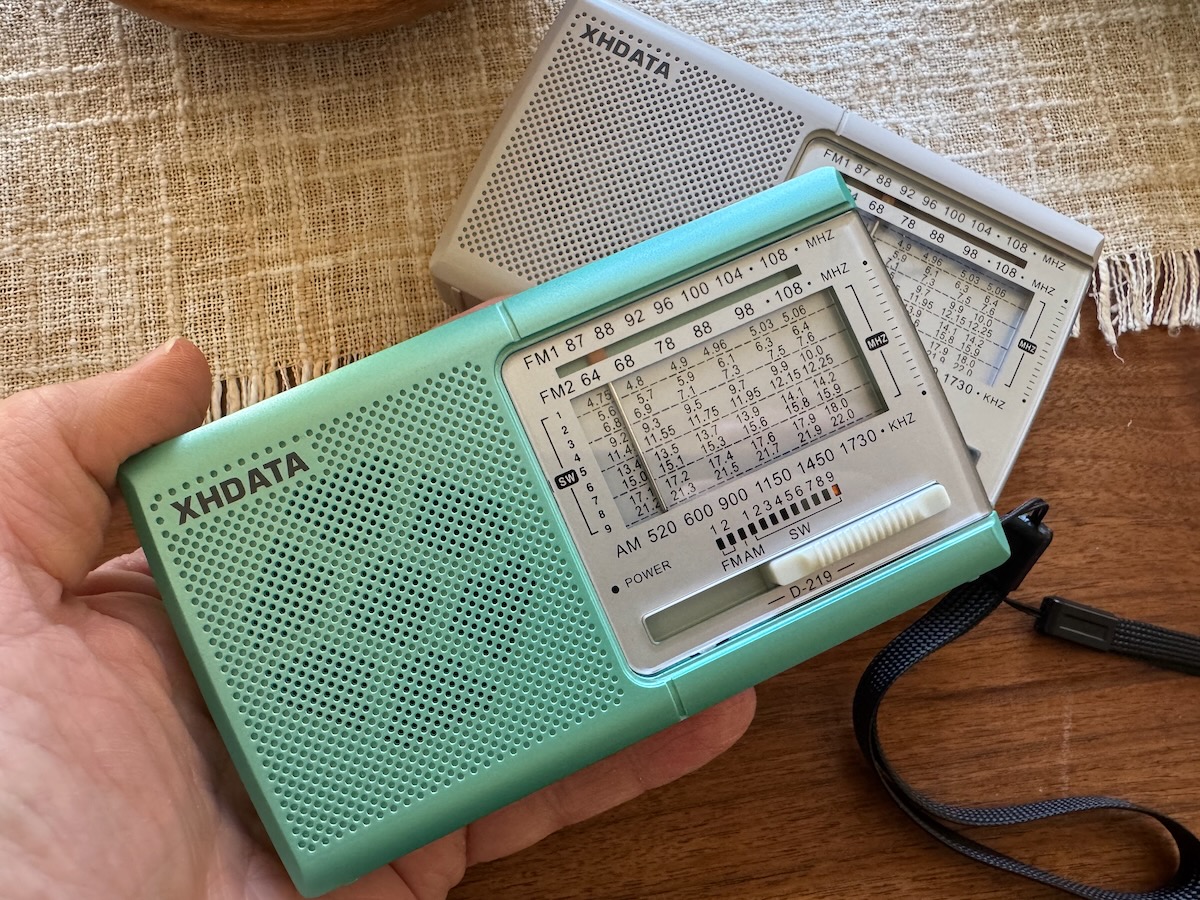
XHDATA sent me two new color options: off-white and light silver-green. Both look great in person.
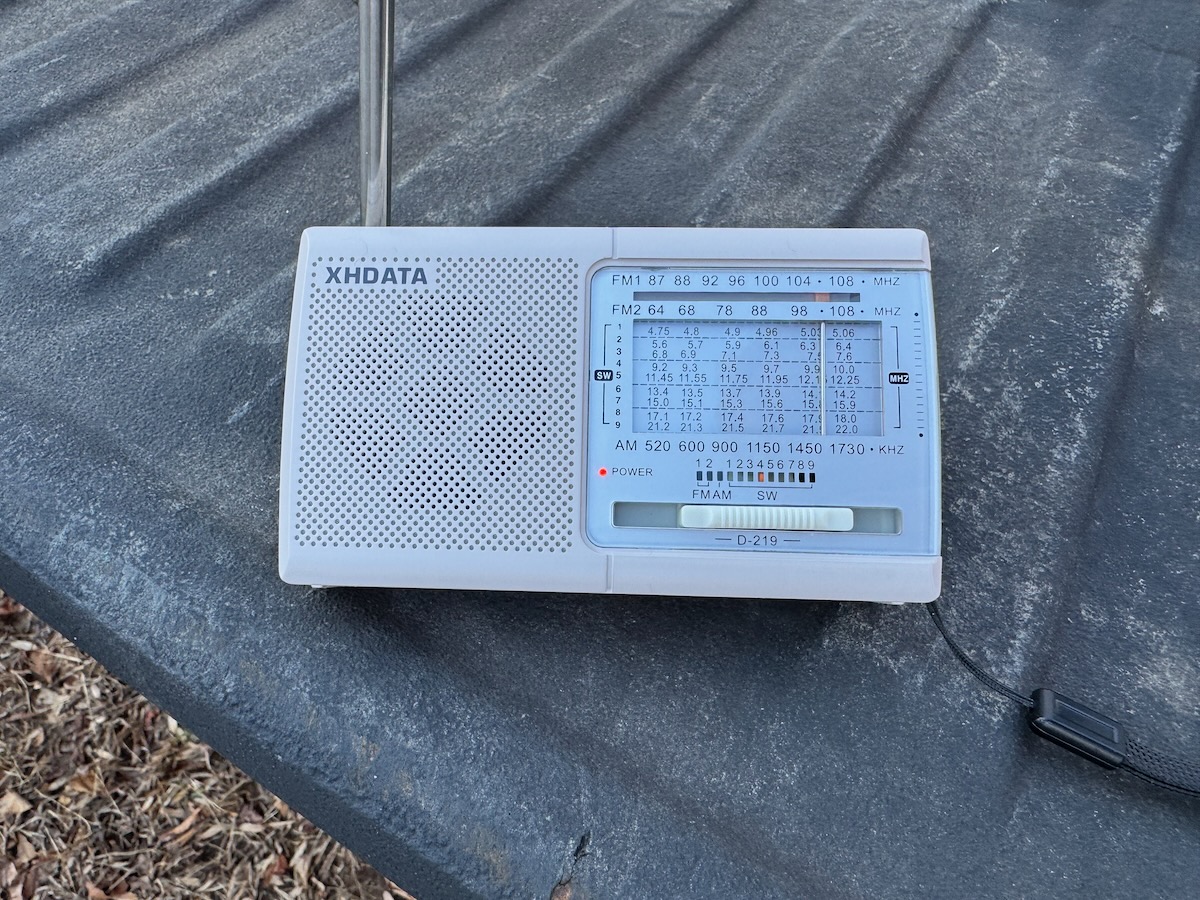
Using the D-219 Outdoors
I used my truck tailgate to hold the D-219 while stacking firewood.
Over the past couple of weeks, I’ve been doing a lot of work outside—stacking firewood, yard projects, general winter prep. The D-219 became my little companion radio during all of it.
I mostly listened to:
Mediumwave
A bit of shortwave
and FM radio
Audio Quality
The audio surprised me. It’s a tiny speaker, so don’t expect brilliant fidelity, but it’s perfectly listenable and cuts through outdoor noise when the volume is up.
Performance
FM performance is excellent—far better than I expected. I have a handful of “benchmark” distant FM stations that many small portables struggle to hold onto. The D-219 locked onto them easily. DSP chips often shine in FM, and this was no exception.
Mediumwave was the biggest surprise. I have a regional AM station–WTZQ 1600 kHz–that I enjoy during the day, especially around the holidays. Only about half of my small portables receive it well enough to be pleasant.
The D-219 locked it in better than most of my other inexpensive portables.
That alone impressed me.
Shortwave performance is quite good for the price. Sure, it lacks an adjustable filter, and tuning steps mean you don’t get that smooth, fluid band-scanning experience like a proper analog receiver. But overall, it works pretty well.
On 31 meters, for example, tuning felt natural and not cramped–something many ultra-cheap shortwave radios struggle with. It helps that the selected shortwave bands have enough tuning bandspread that you don’t have to use micro adjustments during tuning (I’m looking at you, XHDATA D-220!).
Back in the Cold War era, when the bands were jammed shoulder-to-shoulder, a radio like this would have been harder to use. But today, with fewer simultaneous signals, it’s totally workable.
Real-World Utility
In the aftermath of Hurricane Helene, I’ve become even more vocal about keeping at least one AM/FM/SW radio as part of your personal preparedness kit. The D-219 checks many boxes:
Runs on AA batteries
Very low power draw
Lightweight and pocketable
Small enough to disappear into a backpack or glove compartment
I’ve been using mine heavily for two weeks on a pair of Eneloop rechargeables and haven’t had to recharge yet.
Two of the D-219s I’m buying will be stocking stuffers for my daughters, just so they always have a reliable source of news and info while at university–even if the power or internet goes down.
Why This Radio Works
The band spread is generous compared to the D-220
I’m sure own more than three dozen portable radios here at SWLing Post HQ—from high-end benchmarks to tiny ultralights. Normally, I advocate for buying a good-quality receiver instead of “throwaway” electronics.
But I don’t think the D-219 is a “throwaway” radio; being based on the Silicon Labs DSP architecture, it doesn’t have an insane component density–inside, its board is almost roomy. Looking at it, I think I could make modest repairs myself as long as the chip still functions.
Sometimes simple designs translate into long life rather than an early landfill destiny. Of course, only time will tell, and I will post an update if my radio experiences any issues.
This is why I’m comfortable giving them to my daughters as everyday radios. And frankly, I’d much rather they lose or break a $13 D-219 than my old Panasonic RF-65B, PL-660, or ICF-SW7600GR–some of my most cherished (and irreplaceable) legacy portables.
The D-219 is also a perfect glove box radio. One to grab and listen to when you’re waiting on your spouse/partner to finish a yoga class, or waiting on your kids at schoool.
In Summary
If you’re looking for a true benchmark portable, obviously, this isn’t it.
But if you want:
a fun, capable, ultra-affordable little radio
something to give as a holiday stocking stuffer
a simple preparedness radio that uses AA batteries
a pocketable MW/FM/SW companion
a “leave-it-in-the-car” radio
…the XHDATA D-219 genuinely delivers for well under $20 each.
And as someone who hates e-waste and often avoids ultra-cheap electronics, I’m betting this radio will age better than most. Its internal design is refreshingly simple and built around the reliable Si4825-A10 DSP chip. There just isn’t much inside to fail.
For the price, performance, and sheer fun factor? The D-219 is a solid option.
Which radio listener hasn’t dreamed of owning a portable multi-band receiver allowing them to explore the widest possible radio spectrum?
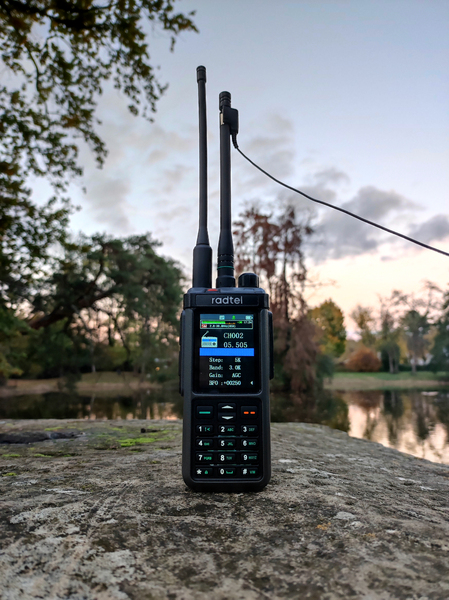
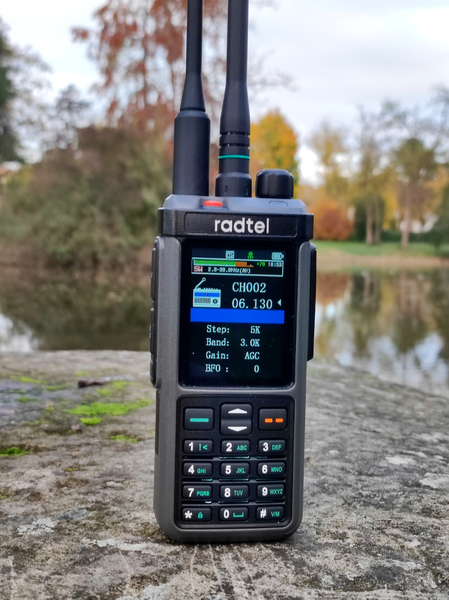
For nearly a year now, walkie-talkies have appeared on the market which, beyond the classic VHF–UHF functions, also allow listening and transmitting on CB (27 MHz) as well as listening to LW/MW/SW bands (LSB/USB/CW). The RADTEL RT-860 has won over those who have tested it.
The arrival of the Quansheng TK-11 — available in three versions — has caused quite a stir on social networks. Then, almost at the same time, the RADTEL RT-880 and RT-880G (G for GPS) appeared, also sold under other names such as iRadio UV98.
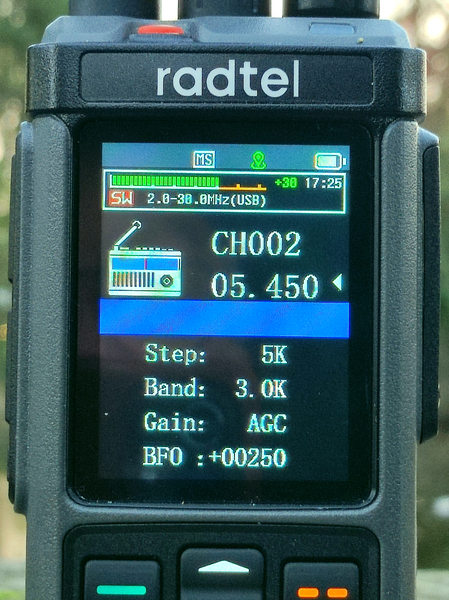
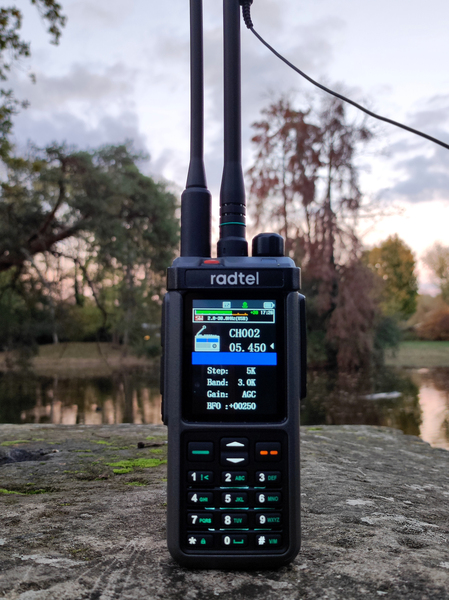
Among all these available models, I chose — as a radio listener, especially when I’m traveling — the RADTEL RT-880G. My choice is explained mainly by its antenna connectors (SMA-Female and SMA-Male), its large color display, its GPS module, its thousand memory channels, and the possibility of simultaneously monitoring three VHF/UHF frequencies. This device is highly customizable, but its user manual would deserve to be much more detailed and explicit.
The RT-880G comes with a “standard” 18 cm antenna for VHF-UHF bands, which is also used for FM station reception. I haven’t yet tested the device on the 27 MHz (CB) band, for which a dedicated antenna is preferable. No antenna is provided for LW/MW/SW listening.
For listening to LW/MW/SW bands, the device is often shown with small donut-type loop antennas (10 cm diameter).
However, for easier transport, I simply chose this small telescopic SMA-Male antenna, 48 cm long (weight: 20 g): to which it is possible to clip a wire antenna, such as the SONY AN-71, which can prove very useful.
I also used an antenna normally intended for CB, the ABBREE 27 MHz telescopic antenna (130 cm), admittedly heavier (weight: 78 g) and bulkier, but which gives very good results for the HF band.
The purpose of this contribution — which concerns only listening — is to arouse curiosity among mobile (or stationary) listeners, to invite those who own this walkie-talkie to come here and share their experience, and to collect your comments. It is therefore not a full review of the RT-880G, but simply an illustration of what it offers for listening to LW/MW/SW bands.
For LW/MW/SW bands, the RT-880G allows you to set the:
step to 1 – 5 – 10 – 50 – 100 – 500 – 1,000 – and 9 kHz],
bandwidth [0.5 – 1.0 – 1.2 – 2.2 – 3.0 – 4.0],
AGC (Automatic Gain Control)
BFO – (Beat Frequency Oscillator) – used for fine tuning SSB reception (the minimum step being 1 kHz).
Sample Recordings
Local park where some of the recordings were made.
Here are a few audio files that will help you form an opinion. The recordings were made with a smartphone placed near the receiver. The recordings were made using a smartphone placed near the receiver. The sound quality is quite good, even surprising. Continue reading →