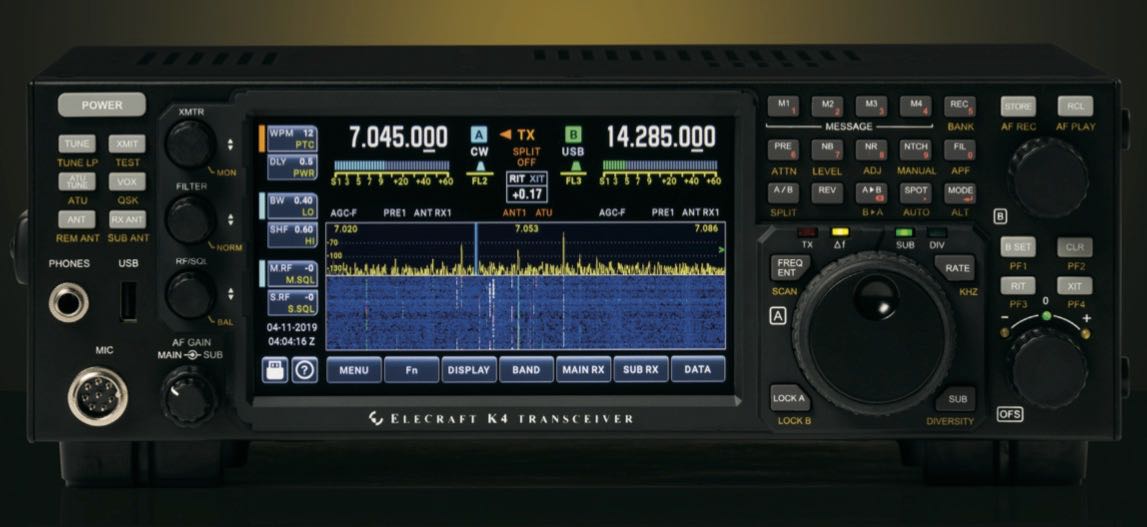
Click to enlarge (Source: K4 Product Brochure)
Today we learned about the latest addition to the Elecraft product line, the Elecraft K4.
This fills a niche in the Elecraft product line and is certain to directly compete with the likes of the Icom IC-7610 and a number of Flex Radio transceivers, among others.
Elecraft describes the K4 as having a “modular hybrid architecture”. Below, I’ve pulled the text and images from the Elecraft product brochure.
Wayne Burdick (N6KR) of Elecraft notes that tomorrow (Friday, May 17, 2019) the Elecraft site will (re)launch a K4 product page with pre-order/reservation page.
I plan to learn more about the K4 and report back during Hamvention this week. Stay tuned by bookmarking the tag Elecraft K4:
Elecraft K4 Product Information
(Source: Elecraft K4 Product Information Sheet via Lutz Electronics, Switzerland)
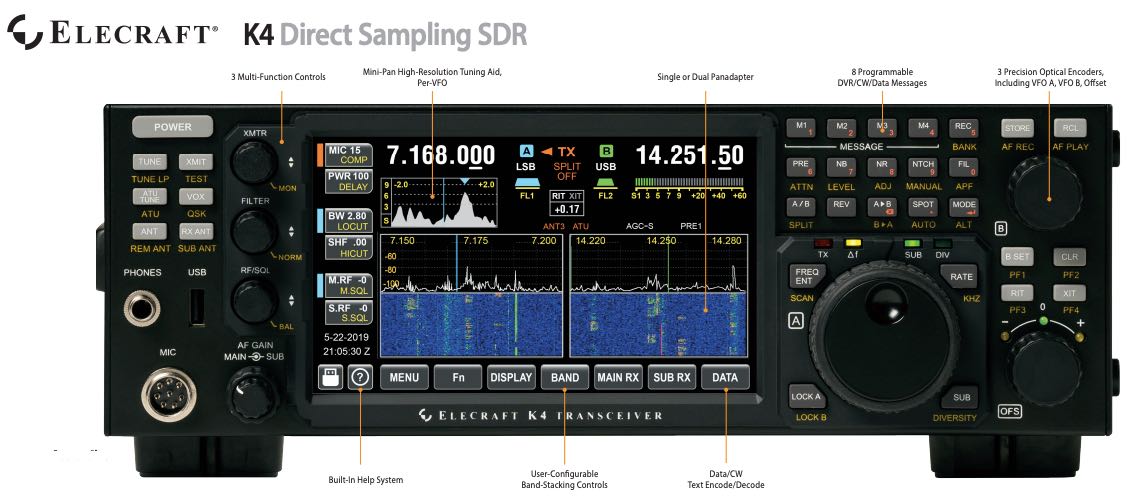
Click to enlarge (Source: K4 Product Brochure)
A direct-sampling SDR you’ll love to use
Our new K4 harnesses the latest in signal processing while retaining the best
aspects of the K3S and P3. The resulting user interface makes the technology
transparent, allowing you to focus on working the world.
160-6 meter, all-mode coverage & dual RX
The K4 includes dual receive over 100 kHz to 54 MHz. Since it utilizes direct
sampling, there’s no need for crystal filters in the K4 or K4D (see Models, back
page). For extreme-signal environments, we offer a dual superhet module
(standard in the K4HD). An internal VHF/UHF module is also planned.
High-resolution mini-pan for each receiver
Our advanced fine-tuning aid, with its resampled bandwidth as narrow as +/- 1
kHz, is displayed separately from the main panadapter. You can turn it on by
tapping either receiver’s S-meter or by tapping on a signal of interest.
Simple operation and setup
The K4 features a large, full-color touch display, combined with a rich set of real
controls. Per-VFO transmit metering makes split mode completely foolproof.
Band-stacking switches and per-receiver controls are both intuitive and versatile,
adapting to operating context. Usage information on these and other features
is just one tap away, thanks to our built-in help system.
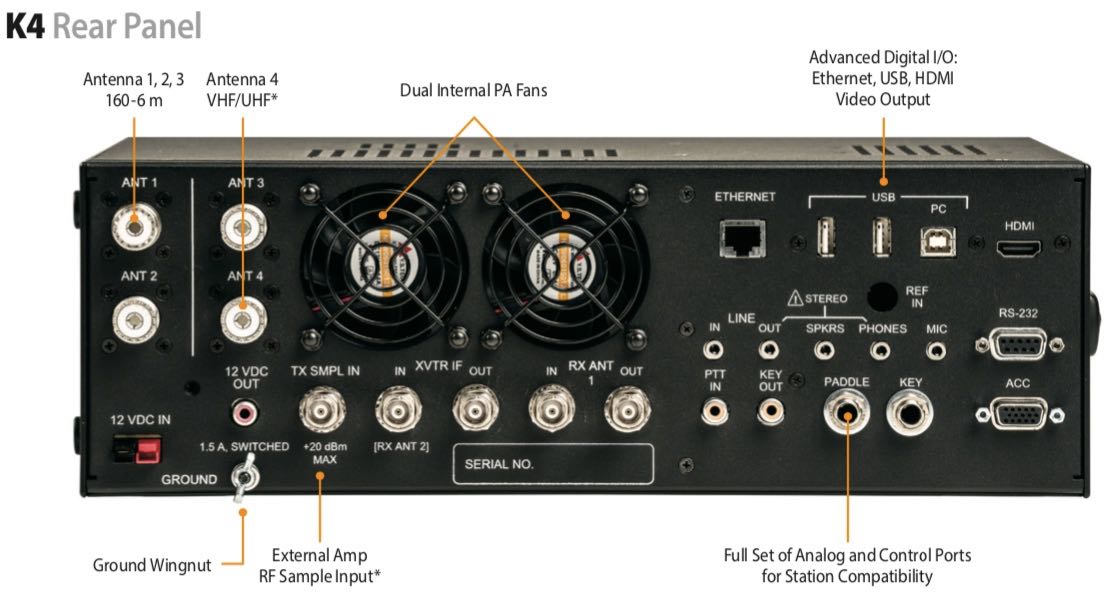
Click to enlarge (Source: K4 Product Brochure)
Rich I/O complement
The rear panel includes all the RF, analog and digital I/O you’ll need to complete
your station. All K-line accessories are supported, including amps, ATUs, and our
K-Pod station controller. The HDMI video output supports an external display
with its own user-specified format.
Full remote control from multiple devices
The K4 can be 100% remote controlled, via Ethernet, from a second K4 as well as
a PC, notebook, or tablet. Panadapter data is included on all remote displays.
Modular hybrid architecture
The K4 adapts to your needs, with three models to choose from:
- Basic K4 with wide-range dual receive
- K4D with diversity receive
- K4HD with a dual superhet module for exceptional dynamic range
You can upgrade or add options as desired, or as new technology becomes
available. This extensibility applies to software as well. The K4’s powerful, fast-starting CPU provides unlimited expansion opportunities.
Fast signal processing
The RF signal chain in the K4 incorporates parallel hardware processing of data
streams, including a dedicated DSP subsystem. This, combined with silent,
PIN-diode T/R switching, ensures fast CW break-in. Data and speech-processing
delays are also minimized.
Standard DSP features include easy-to-adjust, per-mode RX/TX EQ; clean,
punchy RF speech processing; full DVR capabilities; and several built-in data
decode/encode modes. Direct-sampling technology results in an ultra-flat
passband response for clean RX and TX audio. Since the signal chain is softwaredefined, the DSP can be field upgraded to add new algorithms and operating
modes.
KAT4 ATU
The KAT4 ATU has a nominally 10:1 matching range. It includes 3 antenna jacks,
any one of which can be selected as an input for one or both receivers.
Internal VHF/UHF module (future option)
An expansion slot is reserved for a high-performance VHF/UHF module, with
output of approximately 15 W. This module will support all modes.
Kit version
A no-soldering kit version of the K4 is planned for later release. Builders will learn
about advanced radio technology as they proceed. All modules are pre-aligned
and tested.
K4 Key Specs and Features
- Size: 4.5”Hx13.5”W,10”D
- Weight: Approx.10lbs
- SupplyVoltage: 12-15VDC
- Current: ~2ARX,~18-23ATX
- FrequencyRange: 100kHz-54MHz(VHF/UHFrangetobe determined*)
- Stablility: +/-0.25ppm(TCXO) Modes: CW, SSB, AM, FM, Data
- LCD: 7”color;touch&mousecontrol Text modes: CW, PSK31/63, RTTY KAT4ATU:
- 10:1+range;3ant.jacks RXantennasources: Upto5
- A-to-D Converter(s): 16 bits
- I/O: USB-Ax3,USB-B(twovirtualcomports+audio),RS232(DE9), Ethernet, HDMI. front/rear mic, front/rear phones, LINE in/out, speakers,PTTin,KEYout,paddle,key, ACC,12Vout.
- CWQSK: Silent,PIN-diodeswitched
- Other: RX/TX EQ, real-time clock,100% remote control including panadapter data, remote antenna switch control*, custom in-box software apps*
Models (K4 & K4D upgradeable by the user at any time)
- K4: Basic K4 transceiver provides 160-6 m, all-mode coverage; 100 W output; five receive RF sources; and wideband dual watch, allowing the main and sub receivers to be set for the same or different bands.
- K4D: Adds KDIV4 option, with a second set of band-pass filters and additional direct- sampling ADC module. This allows the two receivers to use different antennas – a requirement for diversity receive. Having two sets of band-pass filters also optimizes signal handling when the receivers are on different bands and/or antennas.
- K4HD: Includes all of the above, plus our dual superhet module, the KHDR4. Ideal for competitive field day, contesting, and DXpedition stations. Each superhet receive section includes two crystal filters: one SSB/data bandwidth, one CW bandwidth. The superhet’s 8 MHz IF has excellent dynamic range, so additional crystal filters are not required.