Category Archives: Shortwave Radio

What’s in the Box? Bob Colegrove Investigates the Forgotten Extras of Your Radio

What’s in the Box?

Itemized by Bob Colegrove

Not one to throw anything away, I tend to save ‘the box it came in’ for many new purchases.  The other day I decided to organize all my radio boxes.  Besides the radios themselves, they usually contain a selection of “goodies,” which can include, cases, power adapters, USB cables, batteries, earbuds, antennas, manuals, and so forth.

I generally do not use much that is included in the box.  Over time, however, some of the paraphernalia has gotten scattered around, and my recent effort was intended to corral and sort the accessories.  My experience is itemized below.

Cases

The cases are invariably the largest accessories in the box.  These are sometimes firm, faux-leather enclosures with a zipper around the edges.  I prefer the soft, pliable pouches which seem to function more easily and take up less space.

The Sony ICF-2010 and -2001D did not include cases.  To give the radio some protection during travel and storage, I fabricated a ‘sock’ out of an old bath towel and some hot glue.  The so-covered radio was then inserted into a travel bag along with earphones and anything else I needed.  This worked very well over the years; so well that I extended the concept for some of my smaller radios, which came with cases.

Homemade socks for a PL-880 and ICF-2010 could even be color-coordinated with the rest of your gear.

Power Adapters and Batteries

The following is not intended as the definitive treatise on power adapters and batteries.  Enough guidance has been provided by others.  The takeaway here is that, if you ever refer to the radio’s manual, this is the occasion to do so.  Ensure you know how your radio was designed and the proper way to power it.

In my collection of portable radios there are several combinations of power adapters and batteries.

  • Some radios came with power adapters and others didn’t.
  • Some radios came with batteries and others didn’t.
  • Some just came with USB charging cords.
  • Some were intended for both chargeable and nonchargeable batteries.  Others were intended only for alkaline, nonchargeable batteries, in which case the power adapter disconnects the battery from the circuit and is only used to power the radio.

An adapter might be used to power the radio, recharge batteries, or both.  It’s hard to believe in these days of switching power adapters that an adapter could ever be used to listen to AM radio, but that was the case with the Sony ICF-2010/2001D and Grundig Satellit 800.  These radios came with a more costly transformer adapter which produced very little discernable noise.  Manufactured in pre-rechargeable alkaline days; however, the adapter did not provide a battery charge function.  Over the years, I have mostly used these radios in-house.  They tend to be D-battery-hungry, and so they are usually powered via the adapters.

When Sony got around to producing the ICF-SW7600GR, they took a different approach.  They simply figured it was a small, portable radio, and would mainly be used with batteries.  So, there is a power port for an optional 6-volt adapter, but no included adapter.

The OEM batteries aren’t always the best, so I have an extra supply of rechargeable NiMH and lithium batteries which I cycle through my radios, and the originals are simply included in the rotation.  The NiMH batteries that came with the Tecsun PL-600, -660, and -680 only had 1000 ma capacity and tended to self-discharge quickly after a year or two of use.  However, they got you started.

I have always wondered about using NiMH batteries in radios intended only for alkaline batteries – mainly older ones.  There is a 20-percent reduction in voltage.  How does this affect the performance of the radio?  I suppose this can only be answered on a case-by-case basis.  As an example, I have used NiMH batteries in the Sony ICF-SW7600GR from the very beginning with no apparent degradation.  However, on the XHDATA D-219 and D-220, the difference is quite noticeable.  For some radios, the battery type is switchable, and one must be careful not to connect a power adapter to recharge alkaline batteries.

Earbuds

If you’re serious about radio, you have a good set of earbuds or headphones.  I would venture to say the supplied earbuds for each of my radios are still in the box in their original wrapping.  I don’t get along well with earbuds.  They are hard to install in what apparently are my constricted ear canals and are always falling out.  Several years ago I purchased a set of quality over-the-ear headphones.  Not the most convenient for travel perhaps, but great for reproducing sound and mitigating outside noise.  Grundig went so far as to include a set of over-the-ear headphones with the Satellit 800.

Antennas

Most new portables come with 20- to 25-ft long wire external antennas having 3.5-mm plugs for connection to the external antenna jack.  Sometimes a plastic ‘clothespin’ is attached to the remote end of the wire for mounting.  For convenience, some of these wires are contained in a tape-measure-style spool.  These antennas are quite useful for the non-tinker and traveler, as they provide a means to extend the range, particularly on shortwave.

The C. Crane wire terminal antenna adapter, included with the Skywave SSB 2, is a boon to anyone without a soldering iron or otherwise not inclined to use one.  Other manufacturers take note.  A #2 Phillips screwdriver, and knife to strip the wire insulation are all you need for extensive antenna experimentation.

Source:  C. Crane Skywave SSB 2 Instruction Manual, p. 30.

Sony packed not one, but two 3.5-mm external antenna plugs with each ICF-2010/2001D.  The concept was the same as the C. Crane wire terminal antenna adapter.  These had wire pigtails ending in screw terminals for an antenna and ground wire of your choice.

External antenna adapter (1 of 2) packed with the Sony ICF-2010 and -2001D

A caution here.  The RF amplifier for LW, MW, and SW on the 2010 is an unprotected FET (Q303), which is notorious for failing due to electrostatic discharge from an external antenna.  Early on, your author was twice bitten by this snake.  There may be other radios that suffer from this vulnerability.

Straps

The strap is arguably the least useful accessory included with any portable radio.  The Sony ICF-2010/2001D came with a very attractive blue over-the-shoulder web strap, which has become something of an “item” among collectors.  Mine have been bound up in their original wrapping and stored away for 40-plus years, and might yield the cost of a new portable radio should I ever decide to auction them on the Internet.  I have never used them on either of my 2010s simply because I can envision the priceless radio dangling pendulously at the end of the strap waiting to meet disaster through contact with an immovable door jam.

The same goes for smaller radios which almost always include an obligatory wrist strap.  Perhaps these should not be classified as accessories, as they are permanently attached to the radio.  I avoid using them for the same reason as sited for the 2010s.  Besides, they just get in the way.  These straps are usually anchored inside the case, but I can’t bear to cut them off; so, I have just lived with them.  In the few cases where I have opened the case, I have omitted reinstalling them.  Instead of having a strap, how about a collapsible “lunchbox” handle?  I can even envision one of these being developed into a dual-purpose handle/antenna.

Manuals

Don’t forget the manual.  We’ve gotten away from manuals.  People don’t use them, and they are a manufacturing expense.  Besides, you can find your answer on the Internet.

As a retired technical writer, however, I have a strong respect for a well-crafted technical manual.  Besides actually using them, I unconsciously evaluate them.  Unfortunately, most are written as an afterthought – an attempt to forestall customer enquiries.  “Read the manual.”  The problem is compounded by radios intended for a worldwide market, wherein the manuals are authored by writers who labor under the handicap of having English, French, Spanish, German, etc. as a second language.

There are also situations where the printing is too small or the fanfolds too inconvenient.  My standard practice is to download an electronic copy of each manual, print it out in 8 ½” × 11” format, and put it in a comb or 3-ring binder.  This is easier on aging eyes, and more suitable for adding my own notes.

…and so forth

Besides the common accessories described above, some unique items have been included over the years.  For example, Tecsun has packaged very nice 20-inch by 30-inch charts with some models.  One side contains a world map showing amateur call areas.  The other side is an enlargement of the radio with each button or control function described.

Going back a few years, Sony included a slick publication called the Wave Handbook with some of their radios.  These had convenient station vs. time charts for world band radio.  The charts were like those published in frequency vs. time format in Passport to Worldband Radio.  The booklets were published in several editions over the years, but obviously, these were time sensitive and became outdated rather quickly.  Still, they could pique the interest of folks new to SWLing.

Packaging

Finally, there is the box the radio came in and any accompanying wrapping.  The packrat DNA in me usually demands that I keep all this.  It can speed up the sale or otherwise increase the value of the radio, if you ever decide to sell it.

Which radio accessories do you use?

Would you like an option to buy the radio without any accessories?
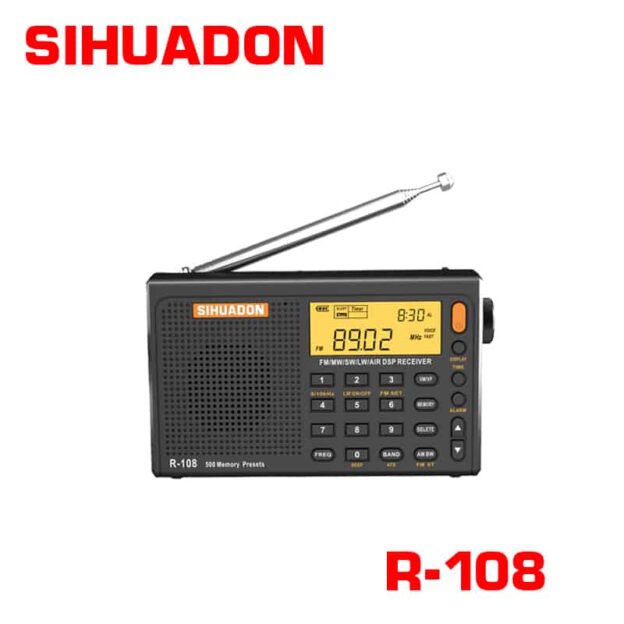
SIHUADON R-108

SIHUADON R-108 – A Truly Portable Radio

By Robert Gulley K4PKM

The SIHUADON R-108 is a compact, inexpensive and capable radio with many features radio hobbyists have come to expect. While I no longer have one of my earliest AM transistor radios, it is comparable in size, but not much else!! Being a radio “old-timer”, I never cease to be amazed at what can be fit into a jacket pocket these days!

For those who have seen, or own, a CCrane Skywave, the radios at first blush look very similar. Size and weight are almost identical. While they are indeed quite similar, they also have some significant differences, and so I will simply say even if you already own one or the other, having both in your radio arsenal can be easily justified given the prices involved.

With all of that as preface, the usual disclaimer applies – I was asked by XHDATA to review the SIHUADON R-108 with the complete understanding that I give fair and honest reviews, good or bad. Like all radios, the R-108 has a few nits I will pick at, but the short answer to the question of value and capabilities is: this is an excellent portable/travel radio which works great in the arm chair, as well as on the road or in far off locations.

We will start with the usual specifications according to the manufacturer:

Frequency Range:

  • FM: 64 ~ 108 MHz
    • Russia: 64 ~ 108 MHz
    • Japan: 76 ~ 108MHz
    • EU, USA:87.5 ~ 108MHz
  • SW: 1711 ~ 29999 kHz
  • MW: 522~ 1620 kHz
    • USA: 520-1710kHz
  • LW: 150 ~ 450kHz
  • AIR: 118-137MHz

Features

  • Speaker: 5W / 4Ohm
  • Earphone Jack: 35mm,Stereo type
  • 500 Memories
  • Power supply : USB 5V/250mA external adaptor (not included), BL-5C battery
  • External Antenna Connection

Unit Size:

  • 120(L)×70(W)×30(H)mm
  • Weight: ~190g (Battery not included)

Package includes:

  • 1 x SIHUADON R-108 Radio
  • 1 x USB charge cable
  • 1 x BL-5C lithium battery
  • External Wire Antenna
  • 1 x User Manual

Ergonomics

The R-108 has very good ergonomics for its size – even with rather large fingers the controls are easy to operate. There are a few multi-purpose buttons but these do not get in the way of typical operation, as most of them are designed to be used in the secondary function while the radio is off, such as setting the FM starting frequency for different parts of the world, or setting the MW bandwidth setting or clock function.

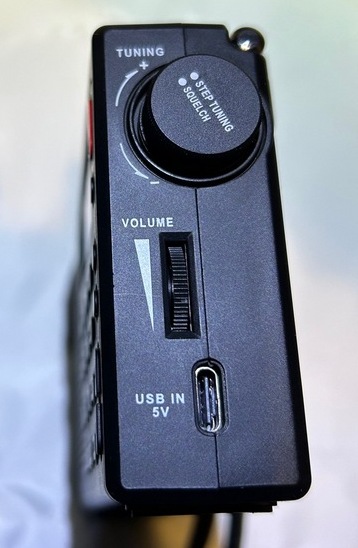
Tuning Dial, USB-C Connector, and Volume wheel

Tuning knob changes between Fast, Slow, and Stop with a press.

One feature I particularly like is the multifunction tuning knob. Rotating the knob does as one would expect in changing frequencies, and pushing the knob in switches between fast and slow tuning depending on the band. But a third option is “Stop”, which locks on to the frequency such that turning the knob will not change the current frequency. For a portable radio one is likely to be holding in the hands often, I find this a nice feature.

Direct keyboard entry is always a useful feature, one which I use quite regularly. With the R-108 you simply press the Frequency button and enter in the frequency based on the band – LW, MW, etc. There is no need to press a separate “enter” key when finished, as the frequency setting is complete with the last digit press.

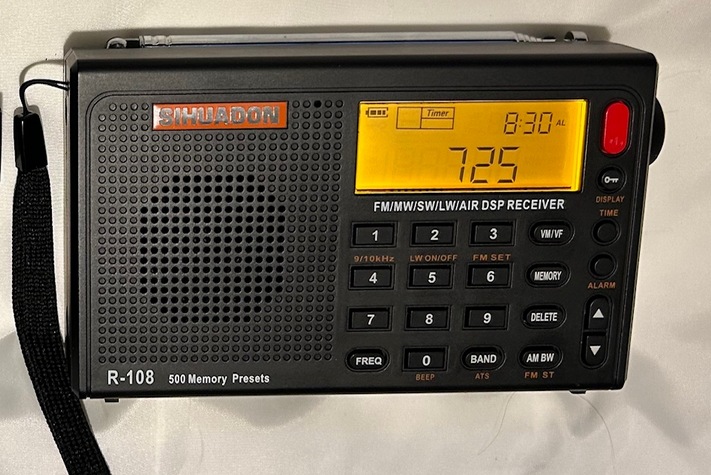
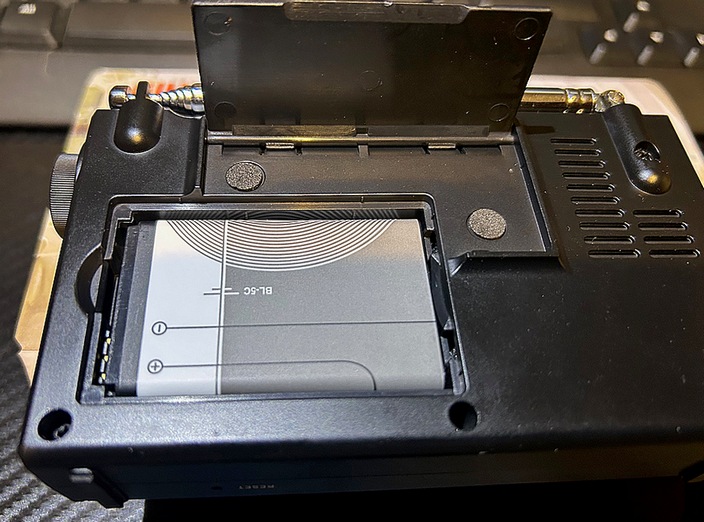
The radio features a robust 19-inch telescoping antenna, and while any antenna is able to be bent or broken if enough force is applied, this antenna should easily last the life of the radio if handled reasonably. The screen is bright and easy to read, and the radio features a flip out stand on the back and a replaceable battery.

Bright Screen and External Antenna Jack

Bright Screen and External Antenna Jack

There is also an external antenna jack for the included wire antenna, and one could certainly build a longer wire antenna or adapt an existing external antenna with the appropriate plug. I only tested the included wire antenna and did not find that it overloaded the front-end of the radio, but the performance of the wire antenna was less than desirable (see Cons below). However, your mileage may vary, as they say, whether due to location or by using a different external antenna.

One of the more obvious design intentions for this radio is an appeal to a world-wide audience, as evidenced both by the variable FM frequency range options and the inclusion of the LW band. Depending on your location, the time of year, and listening conditions, this can be a nice addition. I cannot speak to the effectiveness of this radio’s implementation of the band in that there are few longwave signals I have been able to receive on my desktop radios, even with external long-wire antennas at my current location.

Bandwidth tuning is variable for SW/LW/MW/AIR with options of 6, 4, 3, 2 and 1 kHz.

In testing the radio’s reception, I have compared it with the CCRANE SKYWAVE and it’s larger sibling, the XHDATA D-808, with some interesting results. On shortwave bands and FM I have found the three radios to be basically comparable in reception. Now, this deserves a bit of a deeper dive into performance. I say basically comparable because there are some differences in the SW reception.

The SIHUADON R-108 and the CCRANE are very similar, but the XHDATA D-808, even though it has a larger antenna (7-inches longer), did not receive signals as well as the R-108. There are likely two reasons for this. First, the most likely overall is a bit of a difference in design sensitivity. But what was more noticeable, and the secondary reason for the difference in reception, was the interference factor. The D-808 was simply more susceptible to electrical interference. There were several birdies present on portions of the SW bands which were not present on either of the two smaller radios.

This also brings up another interesting find: the audio out of the R-108 was noticeably better than the CCRANE or the D-808, even with the D-808’s larger speaker. This was a nice surprise as listening to MW and SW was much more pleasant to the ear. When connected to headphones the stereo audio quality was pretty much the same between the three units as one would expect.

This R-108, branded under “RADIWOW R-108”, was reviewed by Thomas a while back and exhibited some birdies on the MW band. This seems to have been corrected in my copy of the radio, but would be worth checking into to make sure if purchasing a new unit.

As a side note, the radio was also included in the excellent 2021 Ultralight Radio Shootout by Gary DeBock.

Replaceable Battery and Kick Stand

Replaceable Battery and Kick Stand

The radio has an ATS function which works quite well. The basic operation is like most radios with this feature in terms of scanning, but using the stored stations is not always easy with some radios, involving multiple button presses, “pages” or menu settings.

In the case of the R-108, once stations have been scanned on a particular band using the long press of the ATS key, selecting them becomes quite simple. For example, with the FM band selected, a press of the VM/VF key switches you from standard frequency tuning to your presets. This is indicated both by a change in the display to show the current preset selected, as well as a double beep, convenient for those who might be visually impaired. When in Preset mode you can tune the presets manually with the tuning knob, or make use of the U/D arrows to either fine tune or manually tune through the band. A long press on either the up or down arrows starts a scan of the preset stations, pausing for 5 seconds on each stored station for that band. Stopping the scan is done by pressing once again on the up or down arrows.

Below are a list of Pros and Cons, as well as my final thoughts on the radio.

Pros:

USB-C connector

Strong Antenna

External antenna jack

Bright backlit display

LW band inclusion

Superior Audio as compared to other portables of its size (and even larger)

Good battery life and convenient charging connection, replaceable battery

ATS function implemented well

Price

Cons:

Soft muting is present and the recovery time is a bit longer than most radios I have used

No WX band (For a travel radio in the U.S. this is a feature that will be missed)

External Antenna created more noise on SW signals with no boost in sensitivity for weak stations, and stronger stations were made less strong due to induced noise

Conclusion

As we so often say, no radio is perfect, and no radio will please everyone, or even fit everyone’s needs. I do not travel much, so a small portable radio that can be packed easily and not add a lot of weight to my luggage is not as important to me as it is to, say, our venerable leader Thomas, who travels a lot and loves a good compact radio.

I however do like to sit in my recliner and listen to AM DX, Shortwave, and the occasional classical music FM station or local AM station. I think Jock and I have a lot in common that way. For serious Amateur DX, Utility and serious DXing of almost any sort, I rely on my desktop radios and tie in my radios to my computer and external antennas. But I often like to just relax with a radio, and this is a great radio with which to do just that.

I have already mentioned the excellent audio which makes listening more enjoyable on all modes, and the ergonomics fit me quite well. The sensitivity of the radio is quite good, the range of reception band options is impressive, and the memory station tuning is a breeze.

What is most impressive in some ways is the price for which such excellent features may be found.

And speaking of price, XHDATA has offered a special coupon offer for a limited time for SWLing Blog readers:

From XHDATA: We’d like to provide you with a stackable 20% discount code.
Here are the exclusive discount codes:

R108 (Black & Gray):  20R108forSWL

Effective time: From 2025-2-6 To 2025-2-9 Pacific Standard Time

R108:
– Black: https://www.amazon.com/dp/B08XVVCP9L
– Gray: https://www.amazon.com/dp/B08HCYYW88

I have tested the codes and they are working for Amazon America purchases. Stackable means in addition to the 10% coupon offered on the Amazon site, you can add the above code during the checkout process to get an additional 20% off, making the price with tax ~$45! This code is for SWLing Blog readers only!

(Follow the tag Radiwow R-108 for additional posts.)

Revised: XSG Special World Radio Day Event and QSL Card

Many thanks to SWLing Post contributor Michael (BD4AAQ) and Xusheng Niu (BH4BFS), who share the following revised announcement:


120 Years of XSG: World Radio Day Commemoration

Revised Notice from Shanghai Coast Radio Station (XSG)

Dear SWLers and Amateur Radio Enthusiasts,

In celebration of World Radio Day and the 120th anniversary of Shanghai Coast Radio Station (XSG), XSG will transmit special commemorative messages on its dedicated frequencies from 12 to 13 February 2025.

Established in 1905, Shanghai Coast Radio Station has proudly served maritime communications for 120 years. Operating under the callsign XSG since its inception, the station continues to uphold its legacy by maintaining Morse code telegraph services, alongside its role in the Global Maritime Distress and Safety System (GMDSS).

Event Schedule:

Scheduled duration: 00:00 UTC on 12 February 2025 to 24:00 UTC on 13 February 2025.

XSG Transmission Frequencies and Modes:

  • 4105 kHz CW/A1A
  • 6780 kHz CW/A1A
  • 8502 kHz CW/A1A
  • 12871.5 kHz CW/A1A

QSL Confirmation:

For QSL card requests, please send your card or reception report to: Shanghai Coast Radio Station (XSG), No. 1 Diantai Road, Zhangjiang Town, Pudong New Area, Shanghai 201206, PR China. Email: [email protected].

We warmly invite SWLers and amateur radio enthusiasts worldwide to join us in celebrating this historic milestone.

Best regards,

Shanghai Coast Radio Station (XSG)
1 February 2025

Information provided by BD4AAQ (Michael Ye) and BH4BFS (Xusheng Niu)

Carlos’ Illustrated Radio Listening Report and Recording of Radio 2, Argentina (February 4, 2025)

Many thanks to SWLing Post contributor and noted political cartoonist, Carlos Latuff, who shares illustrated radio listening report of a recent Radio 2 broadcast.


Carlos notes:

Part of Argentina’s Radio 2 news bulletin (in Spanish), 1230 kHz AM, listened in Porto Alegre in a Sony ICR-N20 receiver:

“Gender violence in Argentina, according to a new report by the Observatory of Femicides in Argentina, Adriana Maricel Zambrano, 28 women were victims of gender violence in Argentina from January 1 to 31, 2025.

Trump received Netanyahu and stated that the Palestinians have no alternative but to leave Gaza. The President of the United States met with the Israeli Prime Minister and shared his vision of the situation in the enclave. They are there because they have no alternative…”

Click here to view on YouTube.

Beatles, Bigfoot and Skybird

Good day all SWLing Post community! FastRadioBurst 23 here with what Imaginary Stations will be bringing you this week for your listening pleasure.

On Saturday 8th February 2025 at 1200 hrs UTC on 6160 kHz and also on Sunday 9th February 2025 at 1000/1400 hrs UTC on 6160 kHz and at 2100 UTC on 3975 kHz via Shortwave Gold we’ll be bringing you Beatles to Bigfoot, a show with the songs of Lennon/McCartney covered in a way you’ve never heard before, beatles soundalikes, plus UFOs, flying saucers and if all goes well a Yeti Choir (*subject to availability and time constraints). It’s a odd mixture but a very nice odd mixture.

On Wednesday 12th February 2025 at 0300 UTC via WRMI we bring you a special archive edition of Free Radio Skybird. Fly Skybird fly!

Also we need your help again to cover our production and transmission costs like we did in 2024. Even if you can only spare a couple of dollars it still helps bring our shows to the shortwaves. Heartfelt thanks from all of the Imaginary Stations crew goes out all the folks who have sent us generous donations in the past!

For more information on all our shows, please write to [email protected] and check out our old shows at our Mixcloud page here.

Dan Reviews the Radel RT-860

Many thanks to SWLing Post contributor, Dan Van Hoy, who writes:

Because I [purchased a RT-470L last year], Radtel sent me news of their brand new RT-860. No need to mod the radio like a Quangsheng. It does LW/MW/SW with SSB/CW (rx only, of course) out of the box for less than $50! I just posted a short preliminary review of the RT-860 on YouTube:

Click here to view on YouTube.

Don Moore’s Photo Album: Guatemala (Part One) – The East

Many thanks to SWLing Post contributor Don Moore–noted author, traveler, and DXer–for the latest installment of his Photo Album guest post series:


Don Moore’s Photo Album: Guatemala (Part One) – The East

by Don Moore

More of Don’s traveling DX stories can be found in his book Tales of a Vagabond DXer [SWLing Post affiliate link]. If you’ve already read his book and enjoyed it, do Don a favor and leave a review on Amazon.

I’ve wanted to do a feature on Guatemala ever since starting this series a few years ago. From a cultural perspective it’s one of the most fascinating countries in Latin America. About half the population are indigenous, primarily Mayan, and most of them still speak their own languages. For several decades Guatemala’s religious broadcasters – Roman Catholic and Evangelical Protestant – used many of those languages on shortwave where we DXers were able to hear them.

I made five visits to Guatemala from 1982 to 1984 while in the Peace Corps in Honduras and returned in December 1987 while in graduate school. I spent enough time in Guatemala that there’s an entire section of my Vagabond DXer book filled with stories of my travels and station visits. In this seven-part series you get to see the pictures.

The map below shows the country, minus the sparsely populated northern department of Petén. We’re going to start in the least interesting part of Guatemala, the east. There’s very little indigenous culture left in that region nor much else of interest to the visitor. But you do have to pass through it to get from Honduras to the rest of Guatemala … and there were some radio stations to visit.

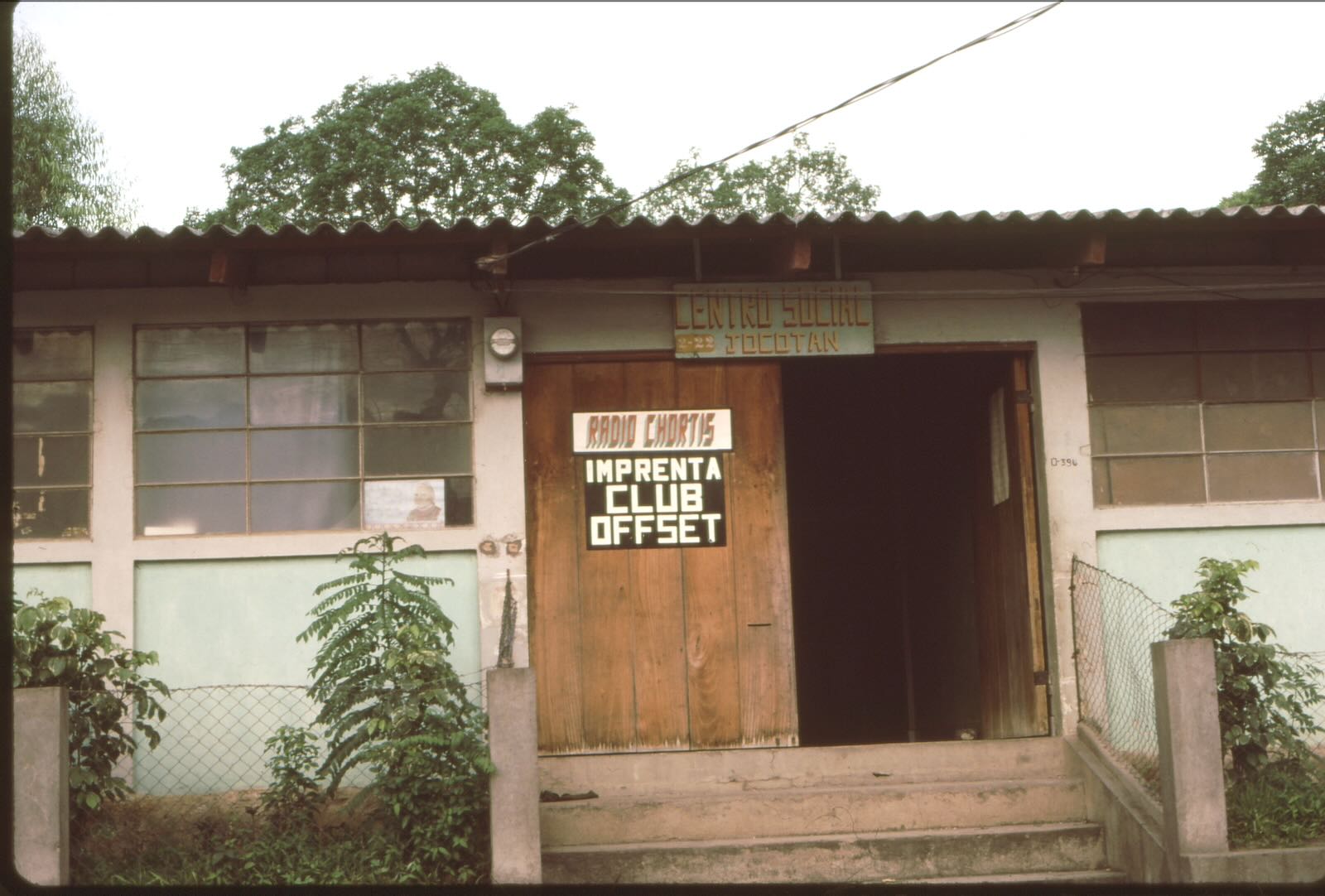
The main border crossing between Honduras and Guatemala has always been near Esquipulas in southern Chiquimula department. (That’s where the header photo comes from). But about 40 kilometers to the north is a secondary crossing near the town of Jocotán. In the 1980s, the road was rough and unpaved and the best mode of transportation was hitching a ride in the back of a passing pickup truck. The border consisted of just two wooden shacks, one on each side, minded by bored soldiers. That’s where I entered Guatemala on my second visit in June 1983. Jocotán had a radio station that I wanted to visit.

Eastern Guatemala may not have had much of interest, but the large Mayan ruins of Copán are just across the border in Honduras. The most direct route there from Guatemala City is via Jocotán so typically a few backpackers pass through town every day. I found a room at the Pension Ramirez. At $1.50 a night it was the perfect place for Peace Corps Volunteers, backpackers, and others at the very bottom end of the budget travel scale. I got a bed with sheets that may have been washed within the past week, a table, a chair, and a dim light bulb hanging from the ceiling. The shared bathroom was down the hall. Cold water only. But the Pension Ramirez had one thing that I never encountered at any other such lodging. The owner had a business card.

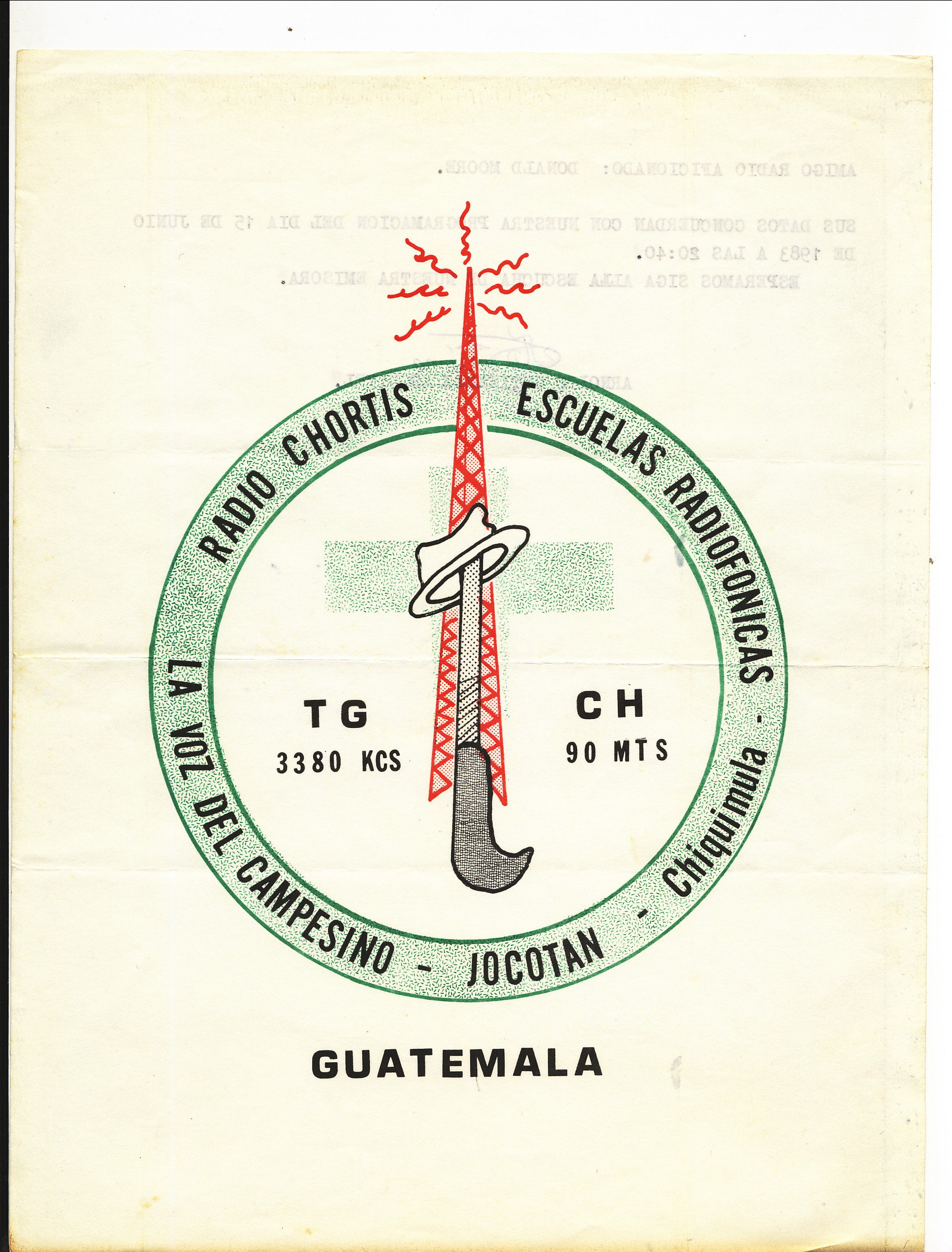
Jocotán was home to Radio Chortís, a Roman Catholic broadcaster that mostly ministered to the Chortí Indians who lives in the region. As most of the Chortí had assimilated into the dominant Spanish culture the station primarily broadcast in Spanish with just a few hours in the Chortí language each week. Radio Chortís used to put a strong signal into North America on 3380 kHz. The station was part of a mission funded by donations from Belgian and West German Catholics. The studios and offices were in a large complex that also included vocational training facilities and a print shop for the church. That explained why the back of their QSL letters always had a colorful station graphic.

Radio Chortís, 3380 kHz, as heard in Pennsylvania 30 December 1979 at 1152 UTC:

On to Cobán

Early the next morning, I took a bus to Chiquimula, the departmental capital. DXers may recognize the town as the location of Radio Verdad, the last active shortwave broadcast station in Central America. It came on the air long after my time there so I never got to visit the station. In Chiquimula I switched to a bus bound for Guatemala City, but that wasn’t my final destination. I got off at a little crossroads just before the town of El Progreso and then boarded the next bus heading north to Cobán, capital of Alta Verapaz.

In Cobán I planned to visit another Catholic broadcaster, but one with a rather unusual name for a religious station. In the 1520s, the Spanish conquistadores quickly overran most of Guatemala but the Kekchi Indians in their mountainous homeland proved impossible to defeat. The Spanish dubbed the region Tezulutlán from an archaic Spanish phrase that meant “Land of War.”

In the 1540s, the Spanish tried another method to subdue the region, this time allowing Dominican friars under Bartolomé de las Casas to attempt to convert the Kekchi to Catholicism. Where the soldiers had failed the padres succeeded and the newly pacified region was renamed Verapaz, or Land of True Peace. Bartolomé de las Casas was a good man who left a legacy of trying to protect the rights of the Indians in a time of brutal conquest. But he was just one man in a time of boundless greed. He left the region a few years later and the Kekchi were forced into peonage just as the Mayans elsewhere in Guatemala had been.

And so four centuries later when the Roman Catholic diocese in Verapaz, the land of true peace, set up a radio station they named it Radio Tezulutlán, after the land of war. Someone had a keen sense of irony. But maybe there is something symbolic there as well. The Kekchi, after all, have survived as a people with their own language intact. Today they number over half-a-million, or almost eight percent of the Guatemalan people. That Radio Tezulutlán broadcasts primarily in Kekchi, not Spanish, might just be a final victory for the Kekchi.

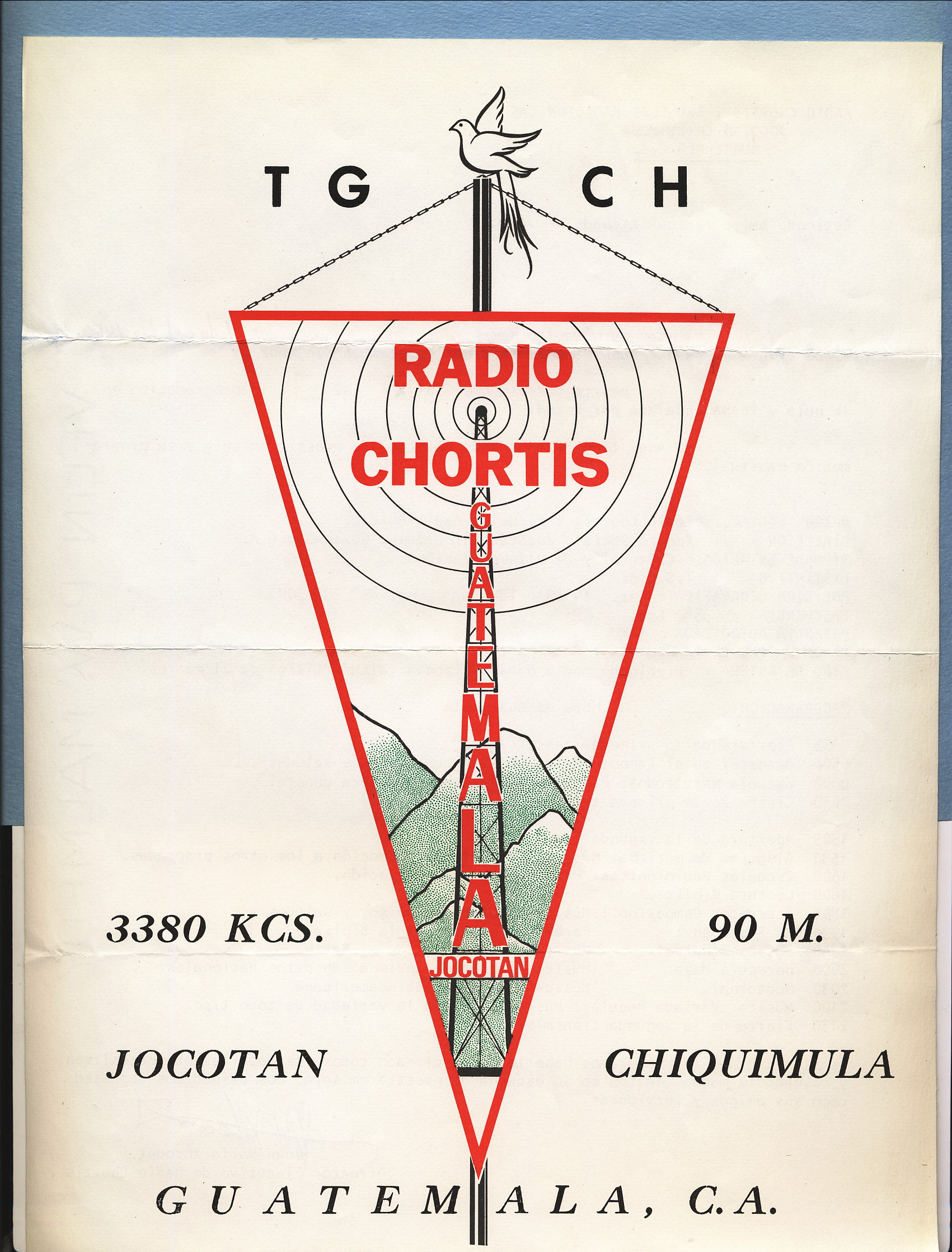
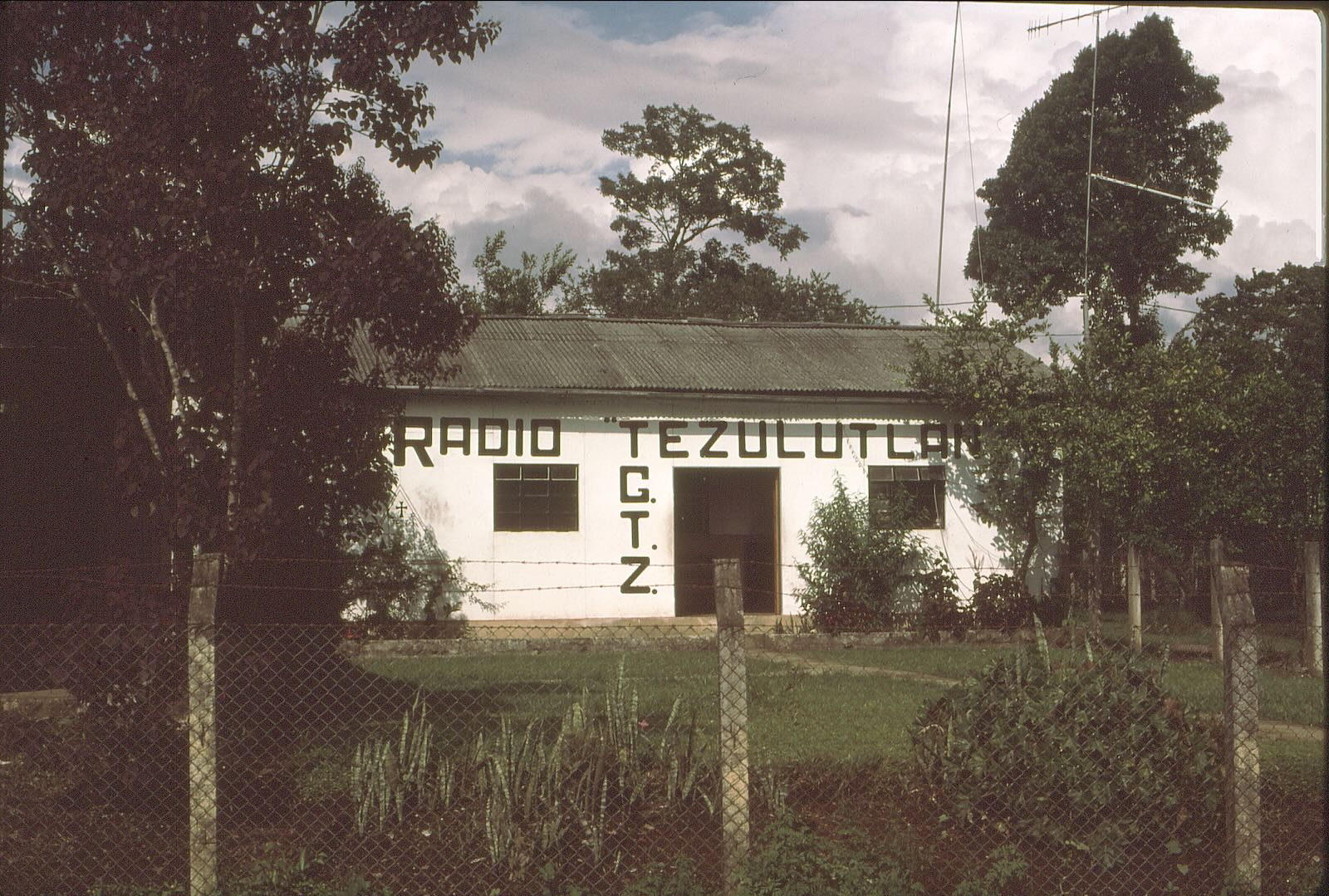
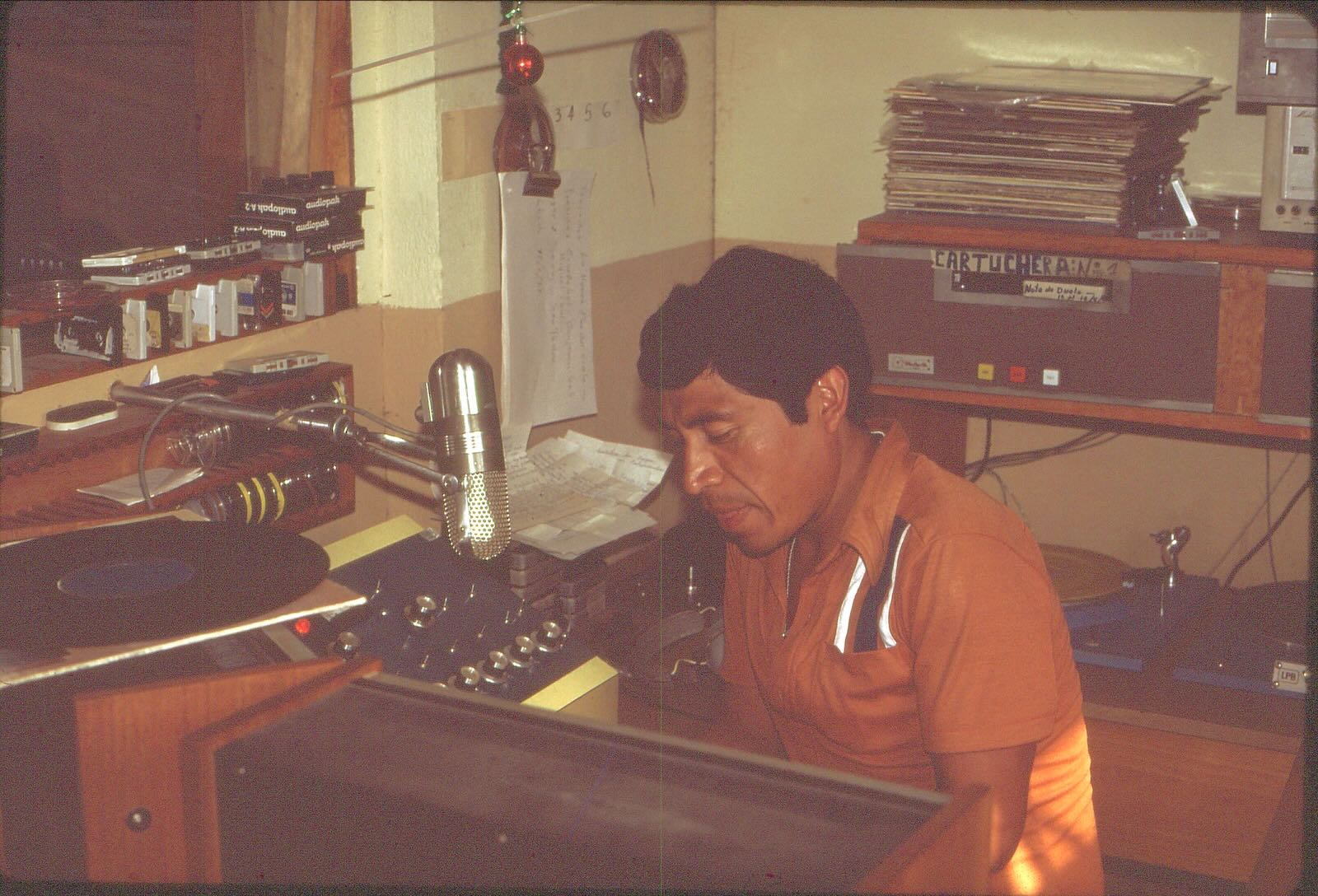
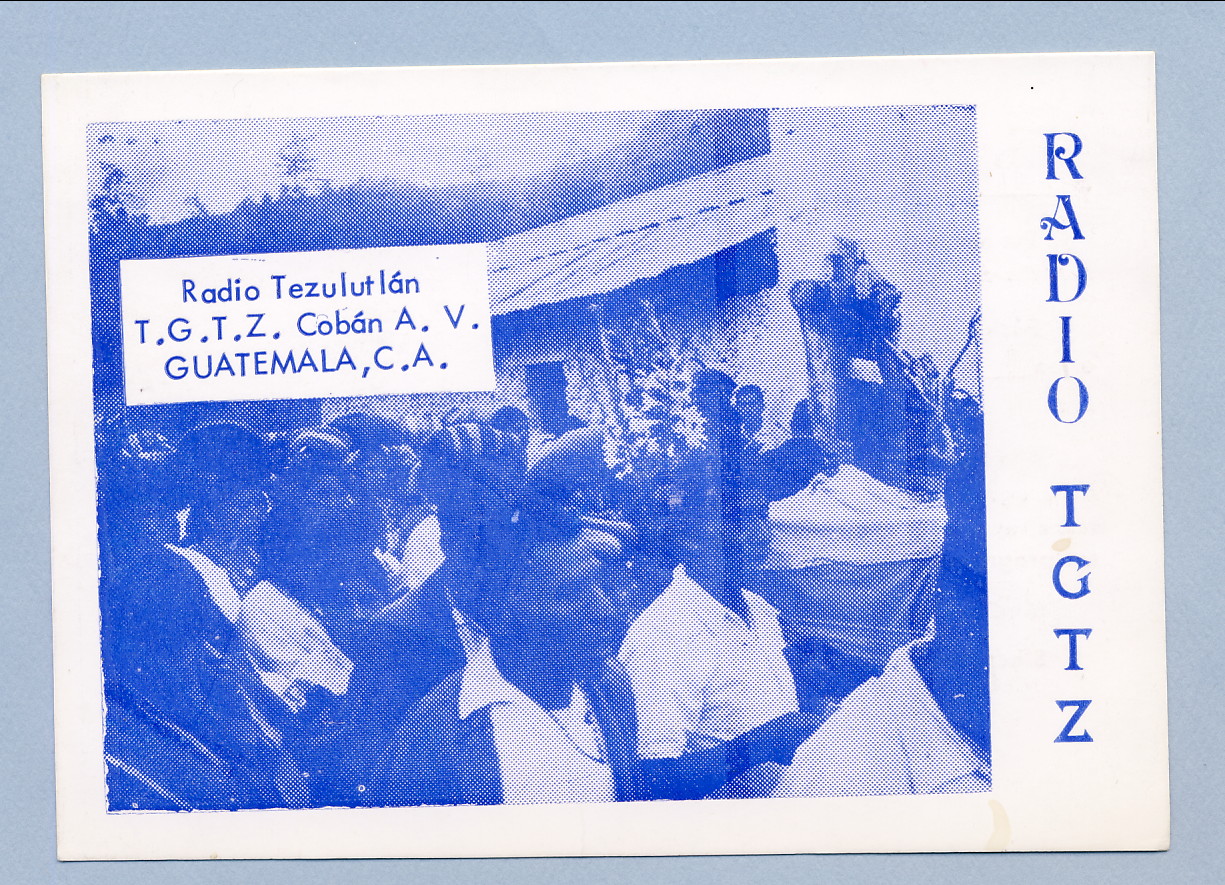
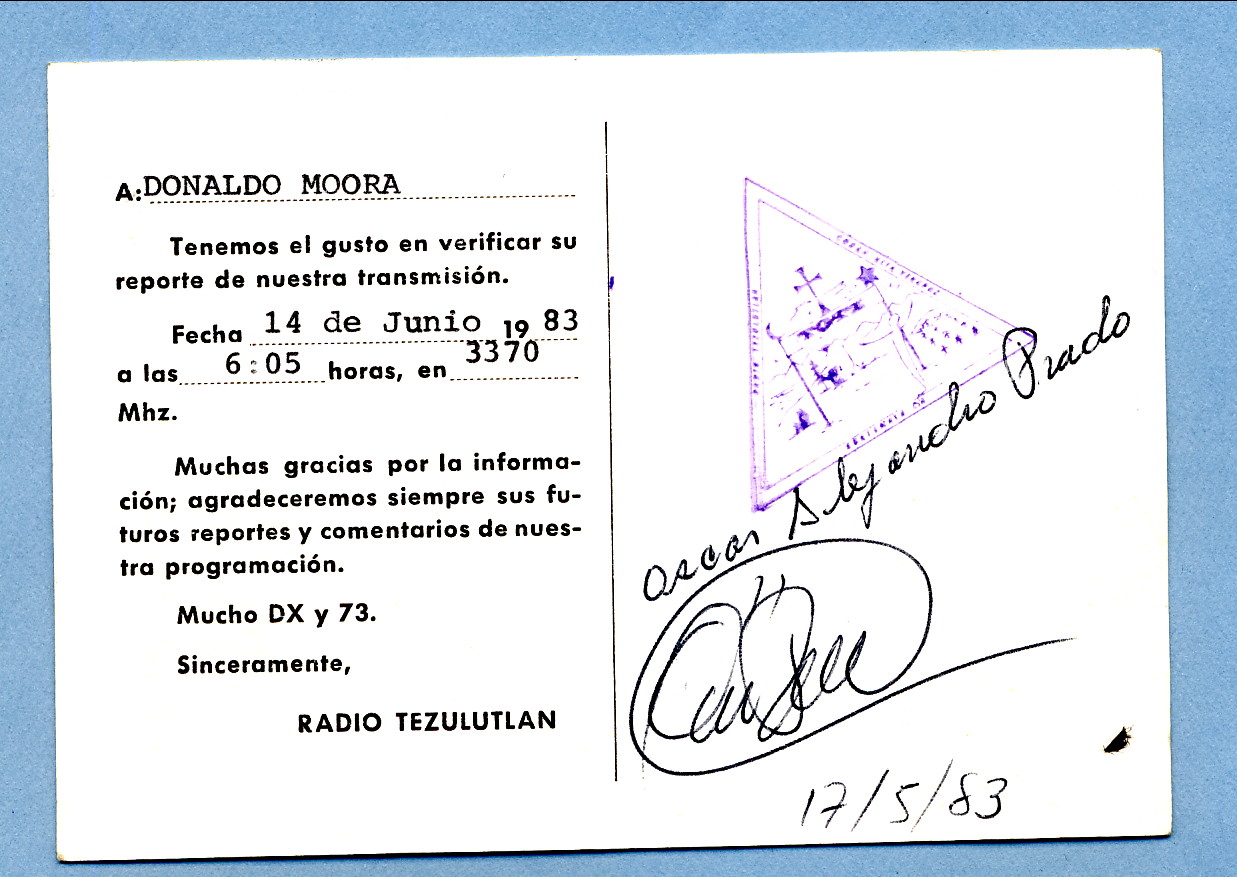
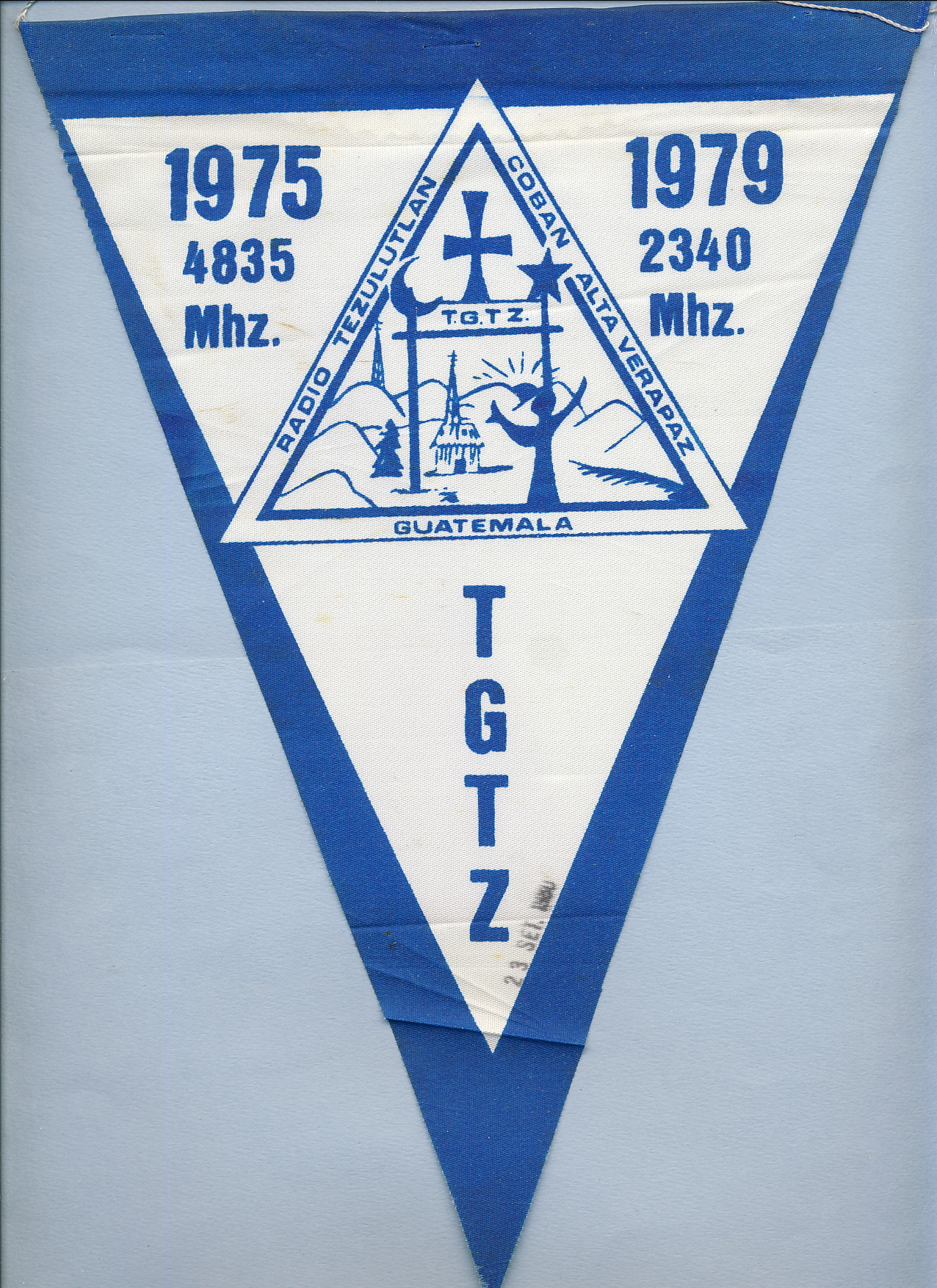
The next few pictures show the Radio Tezulutlán building and studio from 1983 and the QSL card and pennant that I picked up on my visit. The QSL was for their little-used frequency of 3370 kHz. They mostly used 4835 kHz.

Radio Tezulutlán, 4835 kHz, as heard in Pennsylvania on 24 December 1979 at 1153 UTC:

More Broadcasters in Verapaz

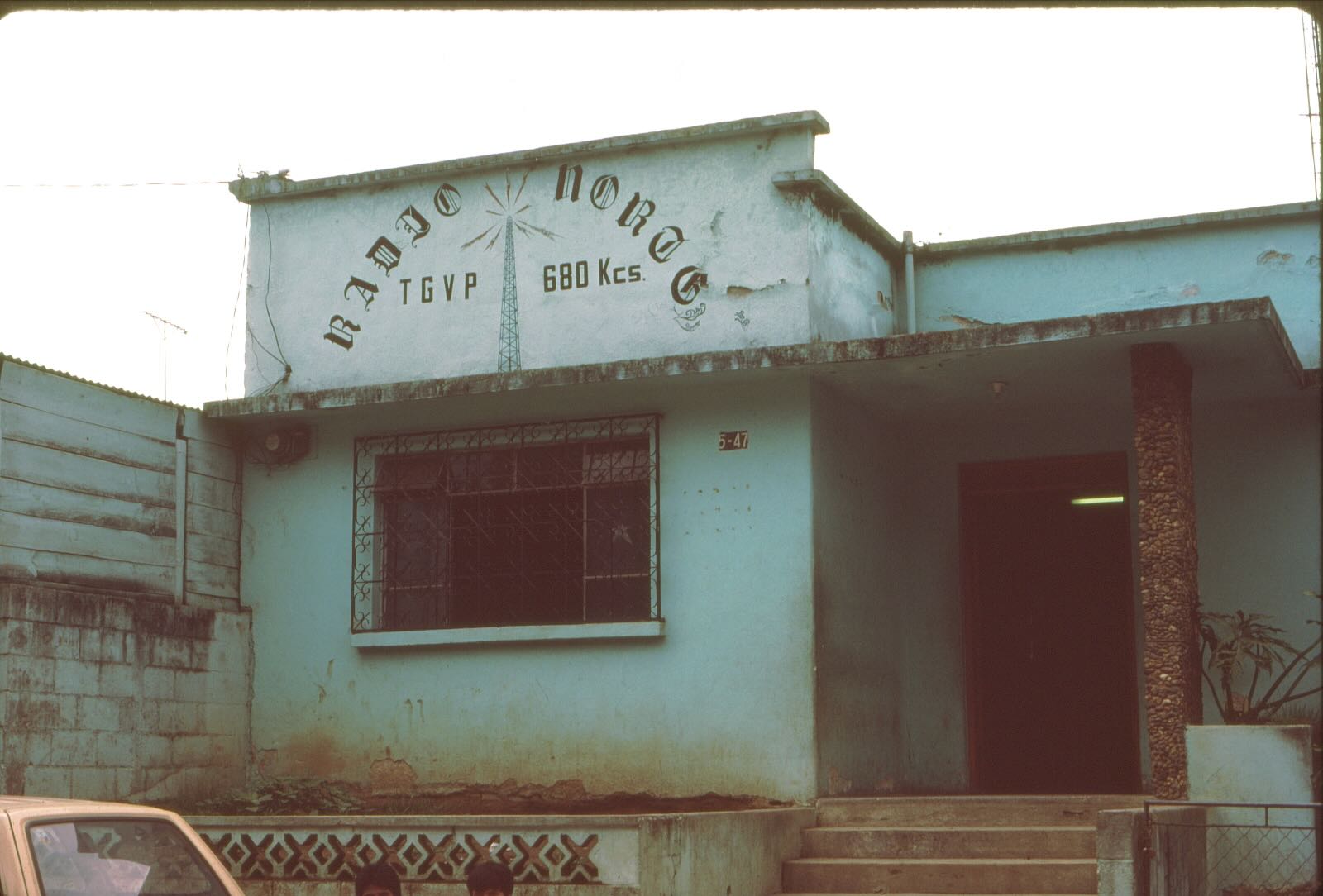
In Santa Bárbara, Honduras, where I was living in 1983, one of the best heard Guatemalan medium wave stations was Cobán’s Radio Norte on 680 kHz. I stopped by in the evening hoping to pick up a QSL but the only person there was a lone announcer who was too busy to help me. I may not have gotten the QSL but I did pick up something that I’ve since come to see as even more valuable.

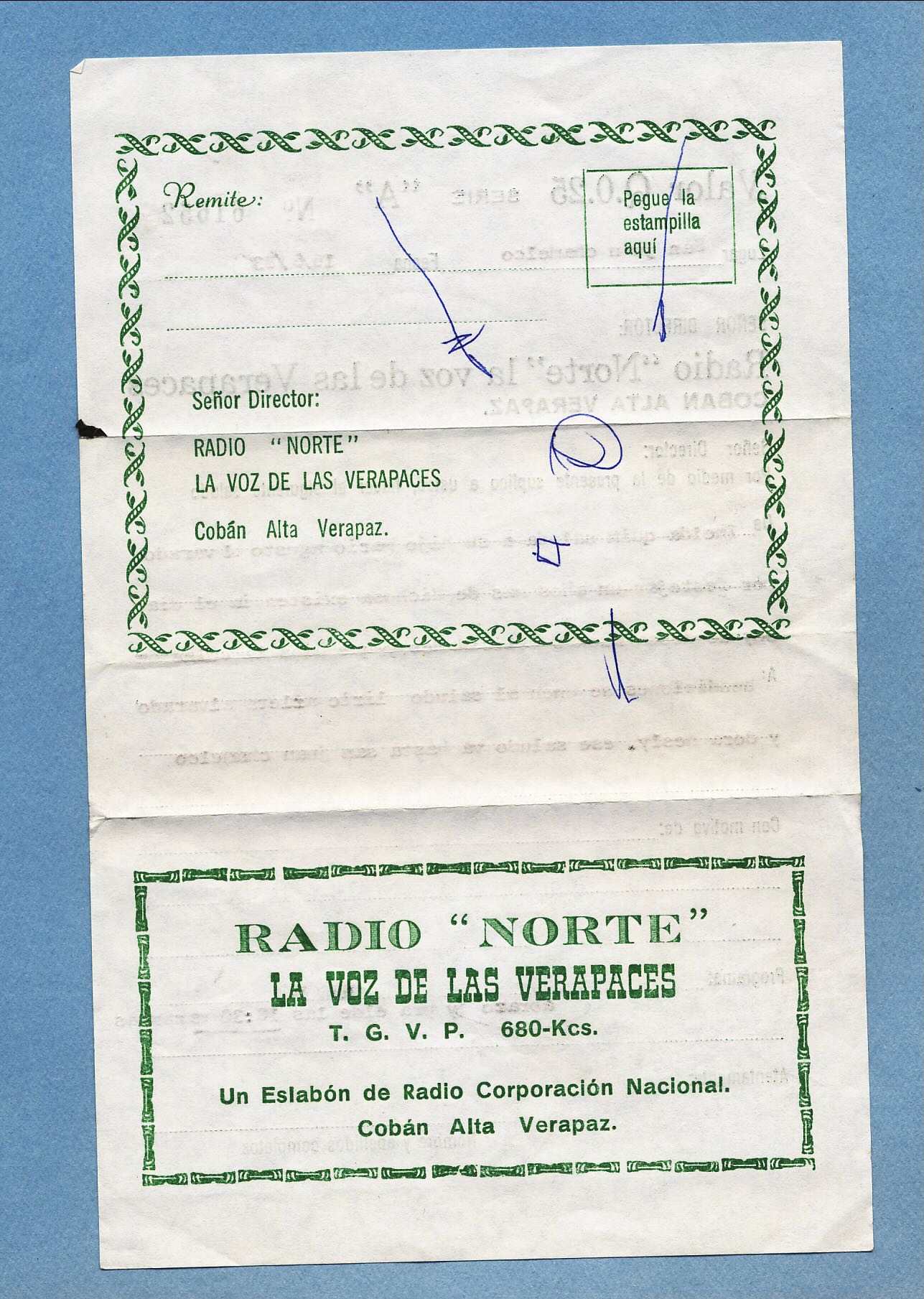
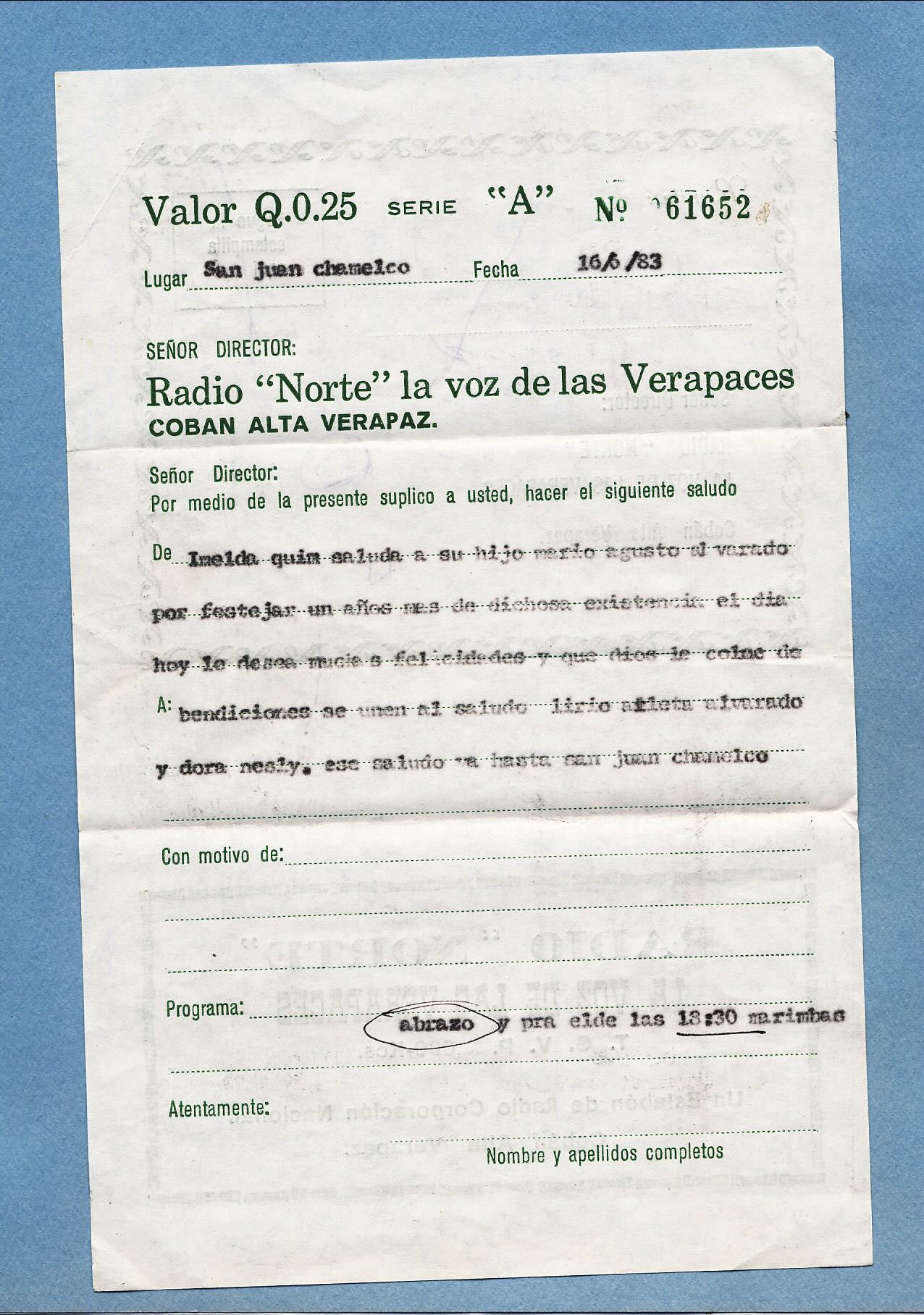
In my book, I explain how one of the primary sources of income for small town radio stations in that era was reading personal announcements and greetings on the air. The Radio Norte announcer had a stack of forms that listeners had filled out with messages to be read on the air. He was throwing away some that had already been read, so I took one.

The form could be either mailed to the station or hand-delivered, as this one apparently was. The message is a birthday greeting from Imelda to her son Mario Agusto. At the top, the date the message is to be read is listed and the place is listed as San Juan Chamelco. This is important as the announcer would first say something like “Atención! San Juan Chamelco!” to get the attention of listeners in that town. At the bottom are instructions as to when the announcement should be read – the 18:30 marimba music show. The form is a very unique radio station souvenir. I only wish I had taken the entire pile out of the trashcan.

Radio Norte, 680 kHz, recorded in Cobán during my June 1983 visit:

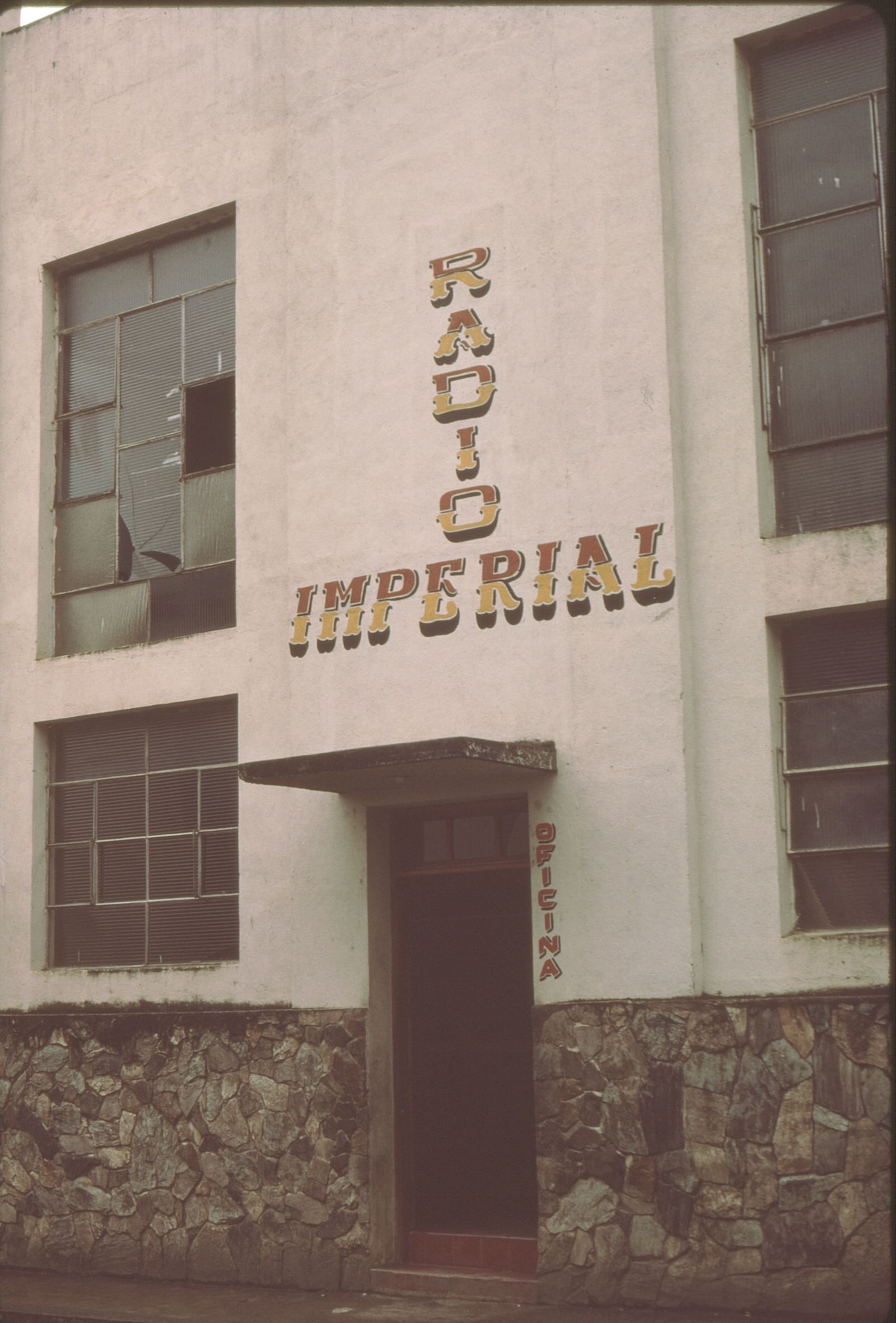
I also made a side trip to the neighboring town of San Pedro Carchá where I got a sort-of-QSL from Radio Imperial on 925 kHz. If you’ve read my book you know that a picture of the secretary would be a lot more interesting than this one of the front door.

A New Shortwave Station

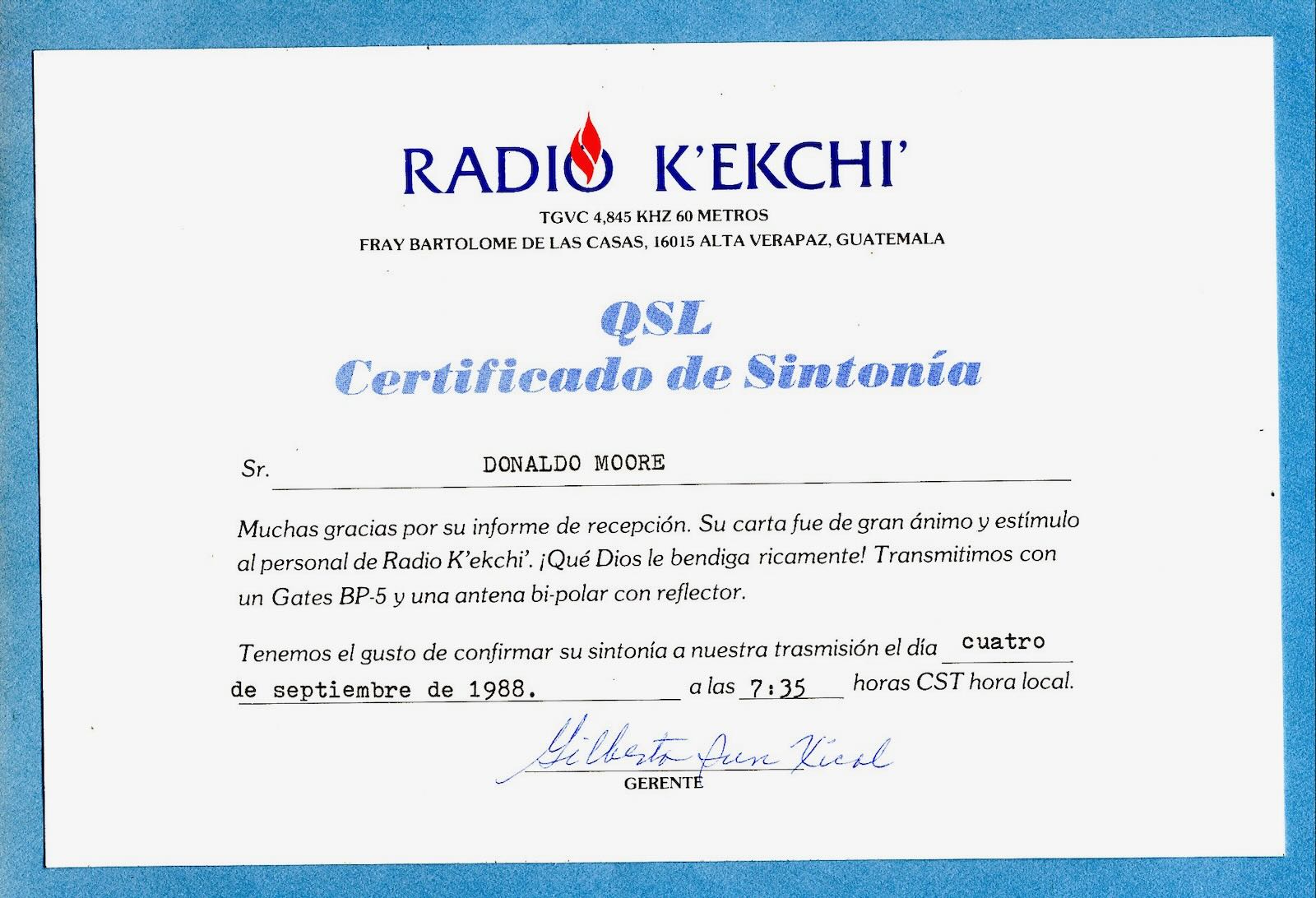
For thirteen years the Roman Catholic church and Radio Tezulutlán had the Kekchi language airwaves all to themselves. But Evangelical Protestantism had been gaining ground in Guatemala for several decades and in 1988 the Evangelical station Radio Kekchi began broadcasting on the shortwave frequency of 4845 kHz. Radio Kekchi must have had friends at the Ministry of Communication as that assigned frequency was just 10 kHz above Radio Tezulutlán’s 4835 kHz. That certainly made it easier to poach listeners from the competition.

In one more bit of strangeness, Radio Kekchi was located sixty-five kilometers northeast of Cobán in the town of Fray Bartolomé de las Casas. So the Evangelical radio station was put in a place named after the priest who originally converted the Kekchi to Catholicism. Maybe the region should be renamed The Land of Irony.

Radio Kekchí, 4845 kHz, as heard in Ohio on 5 September 1988:

Language or Dialect?

In much of the common literature about Guatemala it says that the indigenous people speak Mayan dialects. And back in the day when these stations were active on shortwave, DXers’ loggings often referred to hearing Mayan dialects. But I called Chortí and Kekchi languages, not dialects. What’s the difference?

Linguistically, a dialect is a regional variation of a language. The different dialects of a language are always mutually intelligible. American and Britons speak different dialects of English but have no trouble understanding one another except for the occasional confusion over a word or phrase. Speakers of Spanish and Portuguese can understand one another a little bit but not enough to have a real conversation. Those are distinct languages.

On the other hand, Danes, Norwegians, and Swedes have no trouble carrying on a conversation with each speaking their own language. That’s because linguistically they are speaking dialects of the same language. So why are Danish, Norwegian, and Swedish considered different languages? Linguist Max Weinrich once explained “a language is a dialect with an army and a navy.” He might have added an economy, a government, and international respect.

Languages spoken by people who are held in low prestige are often called dialects not for any linguistic reason but simply out of prejudice. It’s a subtle way of indicating these people and their culture are of less importance. This is true not only of Guatemala’s indigenous languages but of many others around the world. Chortí, Kekchi, Quiché, Cakchiquel, and all the other two dozen indigenous languages of Guatemala are just as distinct from one another as are Spanish, French, and Italian. So show them some respect. Call them languages, not dialects.

A DX Oddity

Let’s end part one of this series with an unusual bit of radio history. Aeronautical beacons are stations that broadcast a short morse code identifier over and over. Pilots use them for direction finding in lining up with the runway during bad weather. Today these are only found in the longwave band but there used to be a handful of Latin American beacons on frequencies just above the old top of the medium wave band. One of those was RAB on 1613 kHz at Rabinal, about 45 kilometers south of Cobán. It used to be an easy catch all over North America, but here’s a recording I made of it in nearby Honduras.

Beacon RAB, 1613 kHz, as heard in Santa Bárbara, Honduras, on 12 November 1982 at 0508 UTC:

Next: Part Two – Guatemala City

Links