Category Archives: Shortwave Radio

The Tecsun PL-680 now shipping

pl680-frontantenna-big

SWLing Post reader, Steve, writes:

Anna [at Anon-Co] has the PL-680 in stock according to a email I received from her this morning. Readers who are interested in ordering the radio should be aware of the Chinese New Year and the potential for delays.

Thanks, Steve. I received a similar email from Anna. They have listed the PL-680 on their website and, I’m sure, will post on eBay soon. The price is $95 US plus shipping; a reasonable price, if the PL-680 is an improvement over the PL-660.

I have already ordered a PL-680 from Anon-Co and it is on the way. I paid extra for FedEx shipping, so it should arrive before week end. I’ll post updates as I test this radio.

As Steve mentions in his note, Anon-Co will observe the Chinese New Year and will be unavailable from February 13th to the 26th.

I *should* have at least a preliminary review posted before the 26th so those of you who are tempted by the PL-680 will at least have some insight prior to purchase.

Michael Stevenson reviews the Wellbrook ALA1530S+

ALA1-2

I just noticed that my buddy Rob Wagner has posted Michael Stevenson’s review of the Wellbrook ALA1530S+ antenna.

Michael does an excellent job describing the Wellbrook, its performance, and even includes comparison audio clips. Click here to read the full review.

If you haven’t already, make sure you bookmark Rob’s excellent site!

Radio Australia antenna azimuth settings

RA-PropMap

SWLing Post reader, George, recently asked about the new Radio Australia antenna settings accompanying the modified (trimmed) broadcast schedule.

The following are the new azimuth settings for the antennas at the Shepparton transmitter site:

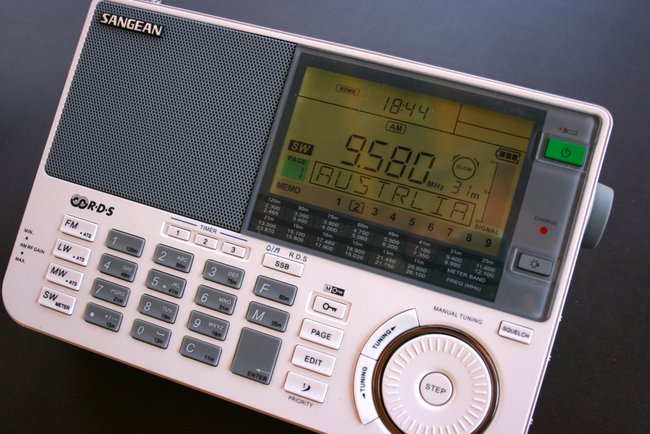
  • 9,580 kHz: 070 degrees 0900-2100 UTC
  • 12,065 kHz: 355 degrees 0900-2100 UTC
  • 12,085 kHz: 030 degrees  0900-2100 UTC
  • 15,240 kHz: 030 degrees 2100-0900 UTC
  • 15,415 kHz: 355 degrees 2100-0900 UTC
  • 17,840 kHz: 070 degrees 2100-0900 UTC

Pulling Radio Santa Cruz out of the interference

BoliviaI recorded Radio Santa Cruz early this morning around 05:00 UTC on 6,135 kHz using the TitanSDR I currently have under review.

Radio Santa Cruz‘s 10 kW signal from Santa Cruz, Bolivia, was very much audible here in North America, though RSC was competing with another station on-frequency at the time. Actually, Radio Santa Cruz was broadcasting slightly off-frequency–6134.8 kHz instead of 6,135 kHz. In this case, the fact that RSC was slightly below frequency helped me delineate the station’s audio from that of a competing station.

Fullscreen capture 272015 54241 PM

In the screen-grab of the narrowband channel from the Titan SDR (above–click to enlarge) you can see two distinct carriers spaced only .2 kHz apart (represented by the two peaks in the spectrum display and two parallel vertical lines in the waterfall display).

Here is what the audio sounds like in normal AM mode when we center on the Radio Santa Cruz frequency of 6,134.8 kHz:

You hear a hetrodyne and garbled noise from a competing station. Not pleasant audio.

If we change from the AM mode to eLSB mode (essentially, the TitanSDR’s version of synchronous detection on the lower sideband) we are ignoring all of the noise in the upper sideband, allowing the desired signal of RSC to pop out.

Fullscreen capture 272015 54317 PM

You can see in the screen-grab above that now only the lower sideband of the RSC signal is highlighted. Here’s a 21 minute recording:

Makes quite a difference!

It’s easy to see competing signals and interference on an SDR’s spectrum display, but if you hear something similar on your portable, try the techniques above to see if it clears up the signal.

If your receiver lacks a selectable synchronous detector, much of the same results can be gained by zero-beating (tuning in) the desired signal in lower sideband mode. Of course, if you have a receiver that lacks SSB mode, the best you can do is tune slightly below frequency in AM, in which case the results will not be as dramatic.

Conclusion? Listening in single-sideband or with a selectable sync detector might be all you need to dig a signal out of the interference.

Video: Dan compares the Sony ICF-6800W with several benchmark receivers

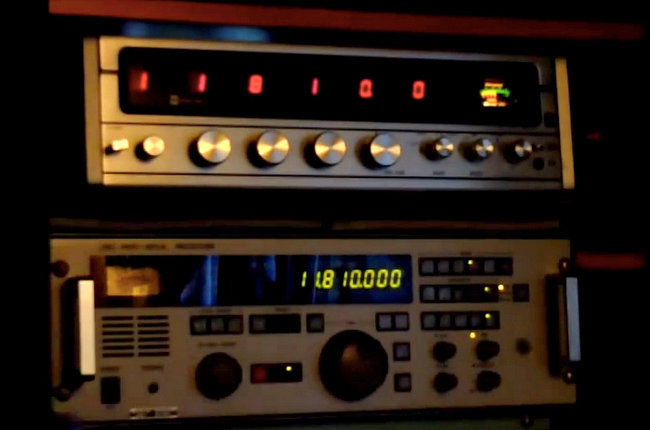
Fullscreen capture 272015 13405 PMCheck out this video of Dan Robinson comparing his Sony ICF-6800 with the JRC NRD-301A, Eddystone 1650/9, RFT EKD-515, Drake R7A, and the WJ8718A/MFP:

Thanks for sharing, Dan! Impressive lineup!

The story behind Landon’s Realistic DX-160

Landon's 15 year old son with his Realistic DX-160

Landon’s 15 year old son, Seth, with his Realistic DX-160

After posting Landon Reynold’s excellent listener post a few days ago, Landon added details about his Realistic DX-160. Landon writes:

Something I didn’t share in my original post, was that this DX-160 is a veteran of Operation Desert Storm!

Landon's shortwave listening post and coffee maker. All of the essentials.

Landon’s shortwave listening post and coffee maker inside the aircrew tent during Desert Storm.

I retired from the Tennessee Air Guard/USAF in 2004, having served 20 years as an Aeromedical Evacuation Specialist, flying Air Evac missions. In addition to having served in Desert Storm, I also flew air evac missions during Operation Enduring Freedom and Operation Iraqi Freedom.

My Shortwave Radio Setup

But … back in 1990-1991 when I deployed to Operation Desert Shield/Desert Storm, I took the DX-160 along with me. For an antenna, I used the pictured military surplus antenna, which I would string along our tent, or any other attachment I could find a place to attach it. The antenna was one I had purchased years before, and had used with the AN/GRR-5.

AT-984AG

When we were not flying missions, or filling sandbags, we’d often sit around the tent, tuning in shortwave stations, or listening aircraft such as the A-10s calling in their strike reports. They actually used HF radio and sent their reports in the clear on sideband.

I also realized after I had re-read my original post, that I may have led the impression that I purchased this particular DX-160 on eBay. In fact, I purchased it in a thrift shop in Erin, Tennessee back in 1989, before I went off to Desert Storm. I’ve purchased several other radios, such as Realistic Patrolman Scanners, Bearcat Scanners, etc. on eBay for my collection.

Monitor Station Registry KTN4CX (4 January 1989)

Another scan I thought you might be interested in, is the latter, which was from CRB Research Books, owned by the late Tom Kneitel, K2AES. Many DXers who have been around for awhile are most likely familiar with the works of Tom Kneitel, as he wrote many books on the hobby, especially those about monitoring the military and utilities. I have several of his books in my library.

http://www.hfunderground.com/wiki/Tom_Kneitel

Landon, many thanks for sharing this history and photos of your DX-160 throughout the years! It must give you great pride to see your son, Seth, taking an interest in the hobby with the DX-160.

Any other readers have a Monitoring Station Registry certificate from CRB Research? Though I knew about the certificates, for some reason I never obtained one back in the day. And Landon thanks for reminding me about Tom Kneitel; he was certainly one of the pillars of our hobby for many, many years.

The Sony CF-560s: a shortwave favorite in Spain

Sony-CF-560s-2Many thanks to SWLing Post reader, Jesus Leal, for contacting me and sharing photos of his Sony CF-560s shortwave receiver. I have never seen the CF-560s before. I believe the its a relatively rare receiver; indeed, I couldn’t even find one in the completed listings on eBay.

Sony-CF-560s-3
The CF-560s covers AM/FM/SW and has a built-in cassette player/recorder. Being a “boombox” style radio, I imagine the SW filter is wide and, when locked into a strong station, provides rich audio.
Sony-CF-560s

Mr. Leal, who lives in the La Mancha region of Spain, uses the Sony CF-560s for regular shortwave listening but also has a Grundig/Eton Satellit 750 in his radio arsenal.

GrundigSatellit750Any other SWLing Post readers have the Sony CF-560s? Looks like a gem of a radio.  The design certainly has strong 1980s nostalgic value.