Category Archives: Shortwave Radio

New Franzis shortwave radio kit

FranzisKitRadio

Many thanks to SWLing Post reader, Franz Miller, who writes:

“I’ve pasted a link below to the webpage at Conrad in Germany for yet another Franzis radio kit; no idea how good it is, but it looks neato-retro to me.  Covers longwave, medium, shortwave VHF, & UHF, allegedly.  Price on Conrad’s website is around 69 Euros.”

Click here to view the new Franzis Radio Kit on Conrad’s website.

I truly appreciate the reminder, too, that I have a previous model Franzis kit somewhere in storage that I need to unearth and build! I assume this new Franzis model also has a cardboard chassis.

Update–Tomas adds the following comment:

Here is a link to the Franzis site where there are several pictures and also a two minute video demonstrating the kit.

http://www.franzis.de/elektronik/lernpakete-elektronik/der-grosse-franzis-radiobaukasten#

Of course, for SW it only supports the 41-meter band.

Want to chat? Check out the new SWLing Post Chat Room!

ChatRoomSWLing Post reader, CJ, recently offered to host a chat room here on our site––quite a generous offering. I’d thought about implementing a radio-themed chat room in the past, but had to be realistic about it, as my schedule simply doesn’t allow for much chat room time. Still, I like the idea of real-time conversations.

With well over 2,000 daily unique visitors to the SWLing Post alone, there is certainly a strong community that may also appreciate the chance to chat with each other in real time. To that end, I have just published a new chat room page with CJ’s code. You’ll find the page in the tabs on the SWLing Post banner above, or by clicking here:

https://swling.com/blog/chat-room/

Let me know what you think, and if you enjoy having a chat room. In the beginning there may be very little activity, but if the chat room is truly engaging for our readers, we’ll continue to offer it!

Click here to visit our chat room

Can the VOA justify its funding?

voa logoJonathan Marks followed up his last post with two more pieces from the Media Network Vintage Vault, again, on the topic of US international broadcasting.

Jonathan writes:

Interesting to see there was opposition to RFE/RL expansion in 1992. http://jonathanmarks.libsyn.com/mn06081992radio-free-asia

And Bill Whitacre is good in this edition: http://jonathanmarks.libsyn.com/mn07051992voakorea

My question remains: can VOA still justify the funding it has? It has spent billions over the last few decades, but has little to show for it.

No doubt, with the recent loss of CEO Andy Lack and the announcement that VOA Director, David Ensor, is stepping down, the VOA is struggling to remain viable.  I don’t believe this is due to a lack of good reporters or internal innovators, rather, a lack of proper management.

Jonathan also found this recently published report titled, “Reassessing US International Broadcasting” by S. Enders Wimbush and Elizabeth M. Portale. Click here to download the full report as a PDF.

VOA director David Ensor steps down

(Source: NY Times)

David Ensor (Source: BBG)

David Ensor (Source: BBG)

David Ensor, who as director of the Voice of America has presided over significant growth in the news agency’s audience despite budget cuts, announced Tuesday that he was stepping down.

Mr. Ensor, who joined the Voice of America in June 2011, said he would leave the government-funded broadcaster at the end of next month. He did not explain his decision or discuss his plans.

The Broadcasting Board of Governors, which oversees the Voice of America, credited Mr. Ensor with creating new television programming in Russian, Ukrainian, Persian, Mandarin, Burmese and Creole, among other languages. It also said he had led a digital transformation of the agency’s newsroom and expanded media programs in Africa.

[…]His time at the news agency has not been without controversy. Dan Robinson, the former chief White House correspondent for the Voice of America, said its central news operation had been devastated by staffing cuts, and he and other former employees said a number of veteran correspondents had resigned or retired in frustration. [Continue reading…]

Media Network Vingate Vault: 1988 VOA Relay Stations Feature

SX-99-Dial

Jonathan Marks writes:

I published a few more old programmes which I think are relevant to the ongoing discussions in Washington about US International Broadcasting. One programme in particular from 1988 no less, shows me that not a lot has changed in over 25 years.

http://jonathanmarks.libsyn.com/mn04111998voafeature

Indeed, not much has changed in so many respects. Many thanks for sharing this recording, Jonathan!

Readers: I encourage you to bookmark Jonathan Mark’s Media Network Vintage Vault–a true treasure trove of international broadcasting history.

Portable antennas: a review of the Par Electronics EF-SWL

Last August and part of September, I traveled through the US with the CommRadio CR-1 and a couple of portable antennas: the Par Electronics EF-SWL and  NASA PA-30. I had the opportunity to try both in the field, and took notes as I used them. Following is a short review of the Par Electronics EF-SWL.
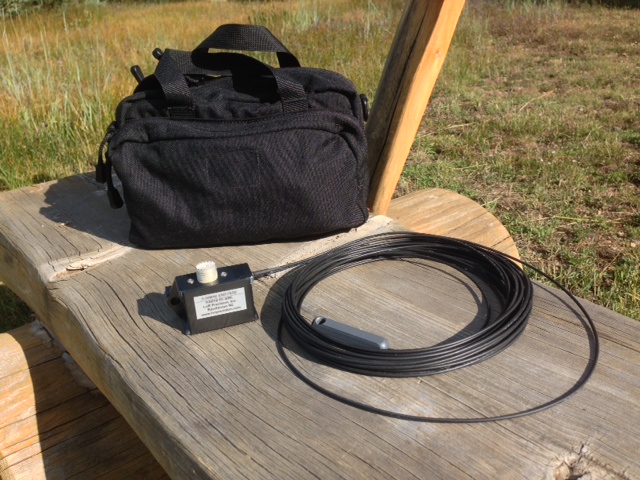
The EF-SWL ready to deploy.

The EF-SWL ready to deploy with my Spec.-Ops. Brand “All Purpose Bag.”

Par Electronics EF-SWL 

At the Dayton Hamvention last year, I had the pleasure of speaking with representatives of the North Carolina-based LNR Precision Inc. LNR is a mom-and-pop company with a focus on providing antennas, keys, and transceivers for the ham radio and shortwave listener markets.  Indeed I have several SWL friends who use on a daily basis an antenna this company manufactures and retails: the Par Electronics EF-SWL. LNR asked if I would consider reviewing their antenna, and since I was planning a road trip with radios in tow–the perfect opportunity to test such an antenna–I agreed.

The Par Electronics EF-SWL is an end-fed shortwave antenna designed for 1-30 MHz reception. It’s a receive only-antenna–perfect for the SWL. The radiator is 45 feet of #14 black polyethylene coated Flex-Weave wire. When I first used the EF-SWL, I noted the quality of its construction: no doubt it can withstand many deployments in all weather conditions–and it’s manufactured here in the US.

With a 45′ radiator, the EF-SWL needs a little space, but offers more gain than the other portable antenna I packed, the NASA PA-30 (look for its review in the near future). I put the EF-SWL to use in New Mexico where several large trees were readily available. I hooked the EF-SWL up to the CommRadio CR-1 and simply hung the end of the radiator as high as I could in a nearby tree. Though not a picture-perfect installation, it nonetheless certainly did the trick! I didn’t bother with a ground connection as I wasn’t in an area with much radio noise (RFI).

In the past, when setting up portable ham radio and shortwave listening, I’ve typically built my own antenna either for the specific meter band I hoped to use, or brought along a portable antenna tuner. It was quite nice having an antenna designed to be resonant on the broadcast bands.
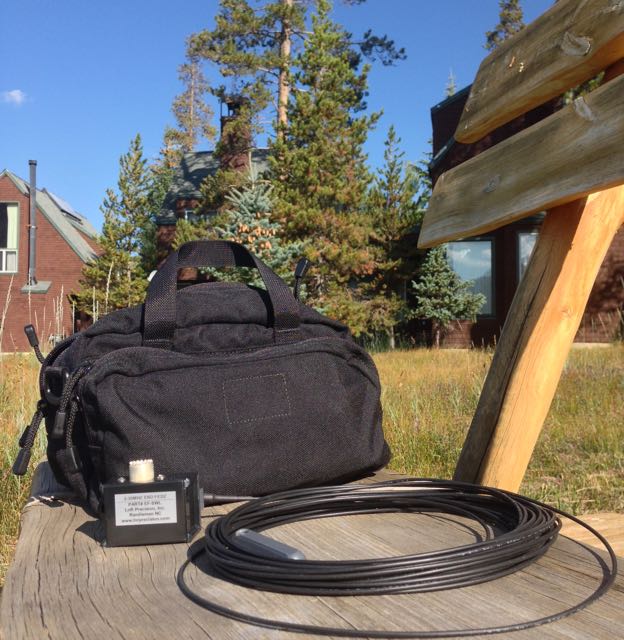
Par-EF-SWL

Though I didn’t do this, I did noticed that the EF-SWL’s radiator is attached via a stainless stud–Par Electronics did this so you can remove the radiator and replace it with a different wire length. With the stock 45′ radiator, I still find the EF-SWL quite portable, especially when compared with most of the portable amateur radio antennas I use, which tend to take a dipole or delta loop configuration.

After returning from my trip, I decided to hook up the EF-SWL at my home base for longer-term evaluation. These past months I’ve had it on the air as an auxiliary antenna, and I’ve been impressed with its performance. In truth, it’s not in an optimal location hanging off the corner of my house, but I think this may actually represent with some accuracy the installation most SWLs will likewise be able to provide–in other words, placement that must factor in antenna restrictions or limited space. Of course, for any permanent installation, you will need to ground the EF-SWL for lower noise reception.

And yet, even in these suboptimal conditions, the antenna performs remarkably well.

As with any exterior antenna, of course, take precautions against lightening if you live in an area with thunder storms. If nothing else, at least disconnect the antenna when not in use.

Moving forward, I will plan to relocate the EF-SWL to a more ideal permanent location and most likely purchase another to keep in my antenna bag. I hope to use this antenna in a DXpedition I’ve planned later this year.

The EF-SWL retails for $75 US directly from LNR Pecision or $72 US from Universal Radio.

Note that LNR also sells a number of QRP field-portable transceivers: the LD-5, FX-4a and Mountain TopperClick here for more details.