Category Archives: Shortwave Radio

The Ozark Patrol regenerative receiver kit

k0awb_ozarkpatrol 3small

Just learned that David Cripe (NM0S) has a new kit for sale: the Ozark Patrol regenerative receiver kit.

The Ozark Patrol is a simple, straightforward kit, designed with beginners in mind. The kit uses through-hole components, which is to say, mounted on pads etched on the opposite side.  All of the component values and reference numbers are silk-screened on the board to indicate each part’s location, making for truly quick and fool-proof assembly.

What’s more, Dave is a talented kit designer; he’s the brains behind the kit for our successful ETOW HumanaLight (originally conceived by engineer Greg Majewski). He’s not only clever like that, he’s also a great pal.

In the past, when Dave has announced new radio kits for sale, he’s sold out within a few days. That’s why I ordered mine the moment I saw the announcement.

And, hey…not only does just $40 plus shipping ($46 in the US) get you a superb regen receiver kit, but proceeds also support the Four State QRP Group. Win-win, in my book.

Here are a few specifications and design features listed on the Four State QRP Group’s website:

  • Frequency Range: 3.5-15 MHz in two bands
  • Sensitivity: Yes!
  • Power Supply: 6 x AA batteries
  • Audio Output: A 2.6” speaker is included, as well as a jack for 1/8” stereo headphones

Want one, too? Click here to order your own Ozark Patrol kit…and enjoy tinkering as well as listening!

WRTH 2015 to ship in December

WRTH-Cover

Sean Gilbert, WRTH International Editor, just posted the following information on the WRTH Facebook group:

“WRTH 2015 will be published, as usual, in early December. This will be the 69th Annual edition! Even though both International and Domestic SW is declining there is still a lot to be heard out there on those broadcast bands, so don’t consign the SW receiver to the attic (to gather dust) just yet.

There is a mix of over 200 languages and dialects to get stuck in to, plus the Clandestine broadcasters are always around from politically troubled areas.

Some of these are low powered or broadcasting to a different part of the world and can be a tough challenge to pick up.

All the details you need to stand the best chance of catching these, or any of the other broadcasters (be it LW, MW, SW or FM), can be found in WRTH.

You will soon be able to reserve your copy of the 2015 edition and be one of the first to receive it. Check the WRTH website for pre-ordering details. If the 2014 edition is still showing, try again in a few days time.”

BBC World Service launches Ebola radio network

Ebola Cases Map (Source: World Health Organization)

Ebola Cases Map (Source: World Health Organization)

(Source: BBC Media Centre)

The BBC World Service is launching special Ebola broadcasts for West Africa, starting today (Monday 22 September). Each evening shortwave transmissions to the region will be increased. There will be a round-up of news, concentrating on efforts to combat the virus – particularly to the three worst affected countries: Liberia, Sierra Leone and Guinea.

News About West Africa will be a nine minute daily programme (Monday to Friday) broadcast live at 19:50 GMT around the world and presented by BBC Africa’s Kim Chakanetsa. Through local stories, correspondents and interviews, the broadcast will include the latest information about local, regional and international effort to contain and combat the disease. There is a great deal of new information emerging about how best to respond to Ebola and the programme aims to share that with an African and global audience.

BBC Africa, in conjunction with the BBC’s international development charity Media Action, has since August been broadcasting two weekly Ebola bulletins on the BBC’s English, French and Hausa services.

BBC Media Action has also been helping to tackle dangerous misinformation about the disease in a new radio programme. Kick Ebola Nar Salone (Kick Ebola out of Sierra Leone), is a 30 minute show produced weekly and broadcast three times a week on 35 partner stations across the country.

Peter Horrocks, Director, BBC World Service Group says: “Lack of knowledge and myths about the disease are killing people as surely as Ebola is. Quality information from both within and outside the countries affected about how the risks of Ebola can be safely managed will save lives. The range of emergency activities on Ebola from the BBC World Service are in the finest traditions of the humanitarian instincts of our broadcasting.”

WRMI begins relay of Radio Ukraine International

Radio-Ukraine(Source: WRMI via Keith Perron)

NEWS RELEASE

September 23, 2014

WRMI to begin Relay of Radio Ukraine International

Shortwave station WRMI in Okeechobee, Florida will begin a daily relay transmission of the English-language program of Radio Ukraine International on Thursday, September 25, 2014 on the frequency of 11580 kHz from 2330-0000 UTC. This transmission will be directed primarily to eastern North America, although it will likely be audible in Europe as well.

“We are pleased to be able to provide this service to shortwave listeners at a time when much of the world’s focus is on the situation in the Ukraine,” said Jeff White, WRMI General Manager. The broadcasts will continue at least through the end of 2014.

Listener reports and comments are welcome at [email protected].

Shortwave Radio Recordings: Radio Argentina Exterior

800px-Rosario_y_el_Parana

Rosario y el Parana, Argentina

For your listening pleasure: the English language service of Radio Argentina Exterior–recorded on September 20, 2014 at 01:56 UTC on 11,711 kHz.

RAE is one of the more casual broadcasters on the air; I enjoy listening to their music selection and commentary as they’re not quite as formatted as other international stations. This recording begins with RAE’s interval signal–one of my favorites.

Click here to download the recording as an MP3, or simply listen via the embedded player below:

Hearing echoes on China Radio International

Earth

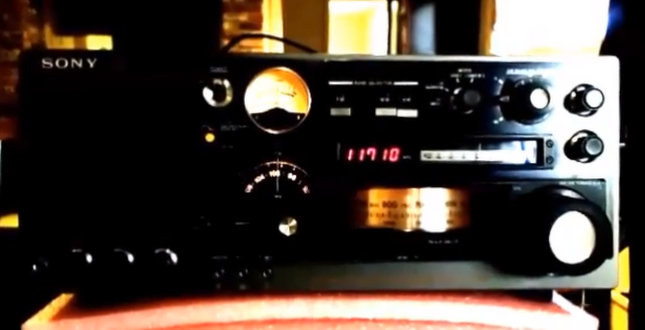
Bill Meara, producer of the popular SolderSmoke Podcast, recently recorded audio echoes on a couple of his home brew regenerative receivers.  Bill posted the following video, of his regen receiver tuned to China Radio International:

After Bill measured the echo delay at .133 seconds, he believes one possibility is that they originate from a propagation opening much like Lyle recorded on a 10 meter band opening last year (click here to listen to the audio and read the post).

A few days later, Bill recorded a similar echo effect while tuned to Brother Stair (Overcomer Ministries) on a different regenerative receiver. Click here to read the post and view the video.

The fact that Bill measured a .133 second delay (the amount of time it would take for a signal to circle the globe), makes me believe he’s hearing an echo similar to Lyle. But I must admit, I’m a bit amazed that a faint AM echo could penetrate blowtorch signals like CRI and Brother Stair’s relay generate State side.

Readers: What’s going on here? Is Bill catching rare propagation openings–or perhaps ducting in the Earth’s magnetosphere and ionosphere–or is there another explanation?

Christian’s reception of Radio Nacional Arcángel San Gabriel

RadioNacionalArcángelSanGabriel

On Wednesday, I received the following tweet from SWLing Post reader, Christian Diemoz, in Italy:


You can listen to Christian’s recording via Box.com.

If you’re not familiar, Radio Nacional Arcángel San Gabriel is located on Esperanza Base in Antarctica. Here’s a bit more info from Wikipedia (and translated from Spanish into English via Google Translate):

LRA36 Radio Nacional Arcángel San Gabriel (also known as Radio San Gabriel or San Gabriel Archangel Radio) is a radio station broadcasting on 15476 kHz on shortwave and 97.6 MHz for FM,  from Esperanza Base, Antarctica Argentina. Radio National Archangel Gabriel is the southernmost international radio station and the first to broadcast from the Antarctic.

The radio station was founded on October 20 of 1979 and is operated by the staff of the Argentine Army located on the base.

In its beginnings, Radio Nacional Arcángel San Gabriel broadcast on 6030 kHz shortwave and operated with a power of 1 kilowatt .”

Since conditions have been favorable out of South America recently, I’ll attempt to hear Radio Nacional Arcángel San Gabriel’s 10 Kw signal as well.  Thanks for the inspiration, Christian!

You can follow Christian on Twitter: @Chris_Diemoz