Category Archives: Vintage Radio

Radio Waves: Digital Audio via Vintage Radio, “10-Minute-ish” Transmitter, Why No Channel 37, and Inventor of the Audio Cassette Dies at Age 94

Image by Jon Tyson

Radio Waves:  Stories Making Waves in the World of Radio

Because I keep my ear to the waves, as well as receive many tips from others who do the same, I find myself privy to radio-related stories that might interest SWLing Post readers.  To that end: Welcome to the SWLing Post’s Radio Waves, a collection of links to interesting stories making waves in the world of radio. Enjoy!

Many thanks to SWLing Post contributors Ron, Valdo Karamitrov, Ronald Kenyon, and the Southgate ARC for the following tips:


‘I play digital music through my 1949 radio’ (BBC News)

When we think of technology our imagination usually takes us to images of the future. But for some, technology links us to the past – whether for nostalgia or for personal reasons

Following our recent feature on vintage technology, we asked you to share some of your collections with us – and people from around the world responded..

Rob Seaward, North Yorkshire, UK: 1949 Murphy A146 radio

I have a collection of older technology which I have collected throughout my life – including old cameras, calculators, hi-fis and radios. I had been interested in music from an early age, but it was really when my father purchased a Bang and Olufsen music centre that my interest in not only music, but style and function really took off.

To me, a lower middle-class grammar school kid living in Bradford, I suddenly had access to a world of real style and glamour.

My favourite piece must be the Murphy A146 console radio designed by Gordon Russell in 1949.

Its nickname is the “Batwing” because of the shape of the back panel. The sound is rich, slightly warm and typical of valve equipment. In its day, the radio cost the equivalent of an average monthly wage, it was built to last and the original valves are still working today.

However, as it pre-dates FM it is a little limited. I’ve had it restored and as part of the process we had a Bluetooth adapter installed which means I can now play my favourite digital music through this wonder from the 1940s – which really amazes people.[]

Getting on the Air With a 10-minute-ish Ham Transmitter (Hackaday)

Artificially constrained designs can be among the most challenging projects to build, and the most interesting to consider. The amateur radio world is no stranger to this, with homebrew radio designs that set some sort of line in the sand. Such designs usually end up being delightfully minimalist and deeply instructive of first principles, which is one reason we like them so much.

For a perfect example of this design philosophy, take a look at [VK3YE]’s twist on the classic “10-Minute Transmitter”. (Video, embedded below.)

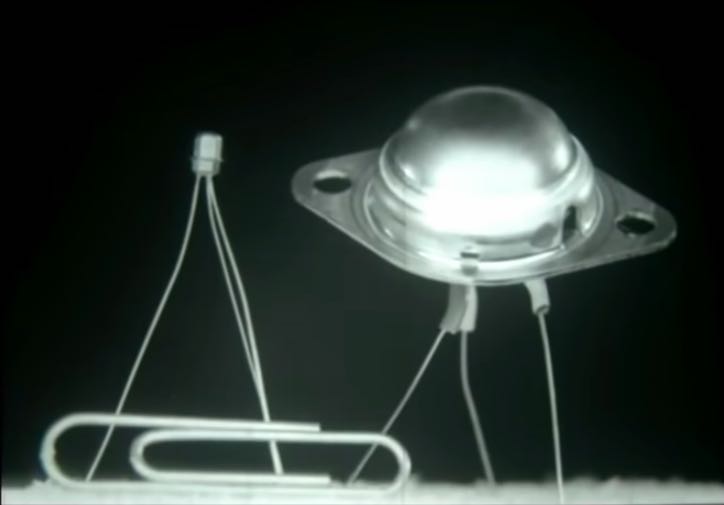
The design dates back to at least the 1980s, when [G4RAW] laid down the challenge to whip up a working transmitter from junk bin parts and make a contact within 15 minutes — ten for the build and five for working the bands. [VK3YE] used the “oner” — one-transistor — design for his 10-minute transmitter, but invested some additional time into adding a low-pass filter to keep his signal clean, and a power amplifier to boost the output a bit.[]

Why Channel 37 Doesn’t Exist (And What It Has to Do With Aliens) (Vice)

Since the advent of analog TVs, channel 37 has always been static. Here’s why.

A version of this post originally appeared on Tedium, a twice-weekly newsletter that hunts for the end of the long tail.

I’m endlessly fascinated by stories of the quirks that were built into the TV system where the well-laid plans of the system simply fell apart because it was asked to do too many things.

Nearly five years ago, I wrote about one of them, the tale of how radio broadcasters were able to shoehorn an additional FM station into the radio because of the proximity of TV’s channel 6 to the rest of the radio feed.

So when I was informed that there was another oddity kinda like this involving the TV lineups, I decided I had to take a dive in.

It’s a tale that centers around channel 37, which was a giant block of static in most parts of the world during the 20th century.

The reason for that was simple: it couldn’t fend off its scientific competition.

1952

The year that the U.S. Federal Communications Commission opened up the television system to use UHF, or ultra high frequency signals. The practical effect of this addition of bandwidth was that the total number of potential TV stations increased dramatically, from 108 to 2,051, overnight. The first UHF applications were granted on July 11, 1952, according to The History of UHF Television, a site dedicated to the higher-frequency television offerings.

The radio telescope that became a headache for the television industry

Within a 600-mile radius of the city of Danville, Illinois, population 31,246, are numerous major cities—among them Chicago, Detroit, Milwaukee, Atlanta, Minneapolis, Pittsburgh, St. Louis, Toronto, and Washington, DC.

Nearly the entire length of the Mississippi River fits into that radius. If Danville was located just a little farther to the east, the radius would also include Philadelphia and New York City. For all intents and purposes, a 600-mile radius from Eastern Illinois covers basically the entire East Coast except the state of Florida and the Northeast.[]

Dutch inventor of the audio cassette tape dies aged 94 (Southgate ARC)

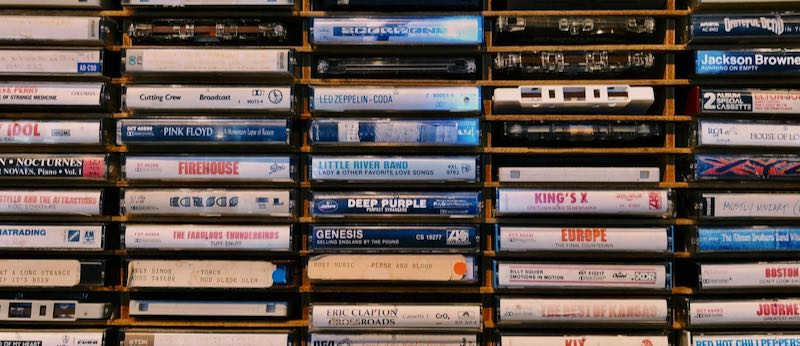
Lou Ottens, inventor of the cassette tape and a CD pioneer died aged 94 at his home in Duizel in Brabant on Saturday, Dutch media report.

Ottens, who studied to be an engineer, started working for Philips in 1952. Eight years later he became head of the firm’s recently introduced product development department. Within a year he and his team had developed the first portable tape recorder of which over a million were sold. Two years later he revolutionised the old reel-to-reel tape system by inventing the cassette tape.

‘I got annoyed with the clunky, user-unfriendly reel to reel system, it’s that simple’, Ottens said later. The new carrier had to be small enough to fit into his jacket pocket, Ottens decided, and he had a wooden model made to determine the ideal size. In 1963 the first plastic encased cassette tape was presented at an electronics fair carrying the slogan ‘smaller than a pack of cigarettes!’ The tapes were quickly copied by the Japanese but in different formats!

Ottens managed to make a deal with Sony to use the mechanism patented by Philips to introduce a standard cassette which was then rolled out globally. Over 100 billion were sold worldwide. Ottens went on to develop the CD, which again became a Sony-Philips standard and which sold over 200 billion.

In 1986 Ottens retired but he was often asked if he was proud of his inventions, which allowed millions to have access to music. ‘I have no ‘pride dial’’ Ottens said in an interview, stressing that both inventions were team efforts. His biggest regret was that that Sony, not Philips, invented what he considered to be the ideal application for the cassette tape, the Walkman. ‘That still hurts,’ he said. Dubious about the recent revival of the cassette tape Ottens said ‘nothing could beat the sound of a CD.’

Read more at DutchNews.nl
https://www.dutchnews.nl/news/2021/03/dutch-inventor-of-the-audio-cassette-tape-dies-aged-94/?


Do you enjoy the SWLing Post?

Please consider supporting us via Patreon or our Coffee Fund!

Your support makes articles like this one possible. Thank you!

Photos from an Antique Wireless Association meeting in 2000

Many thanks to SWLing Post contributor, David, who shares the following random photos he recently inherited and scanned. These were taken at an Antique Wireless Association meeting (AWA) from 2000. Click on images to enlarge:

Thank you for sharing these David!

Dan discovers a Squires Sanders SS-1R on eBay

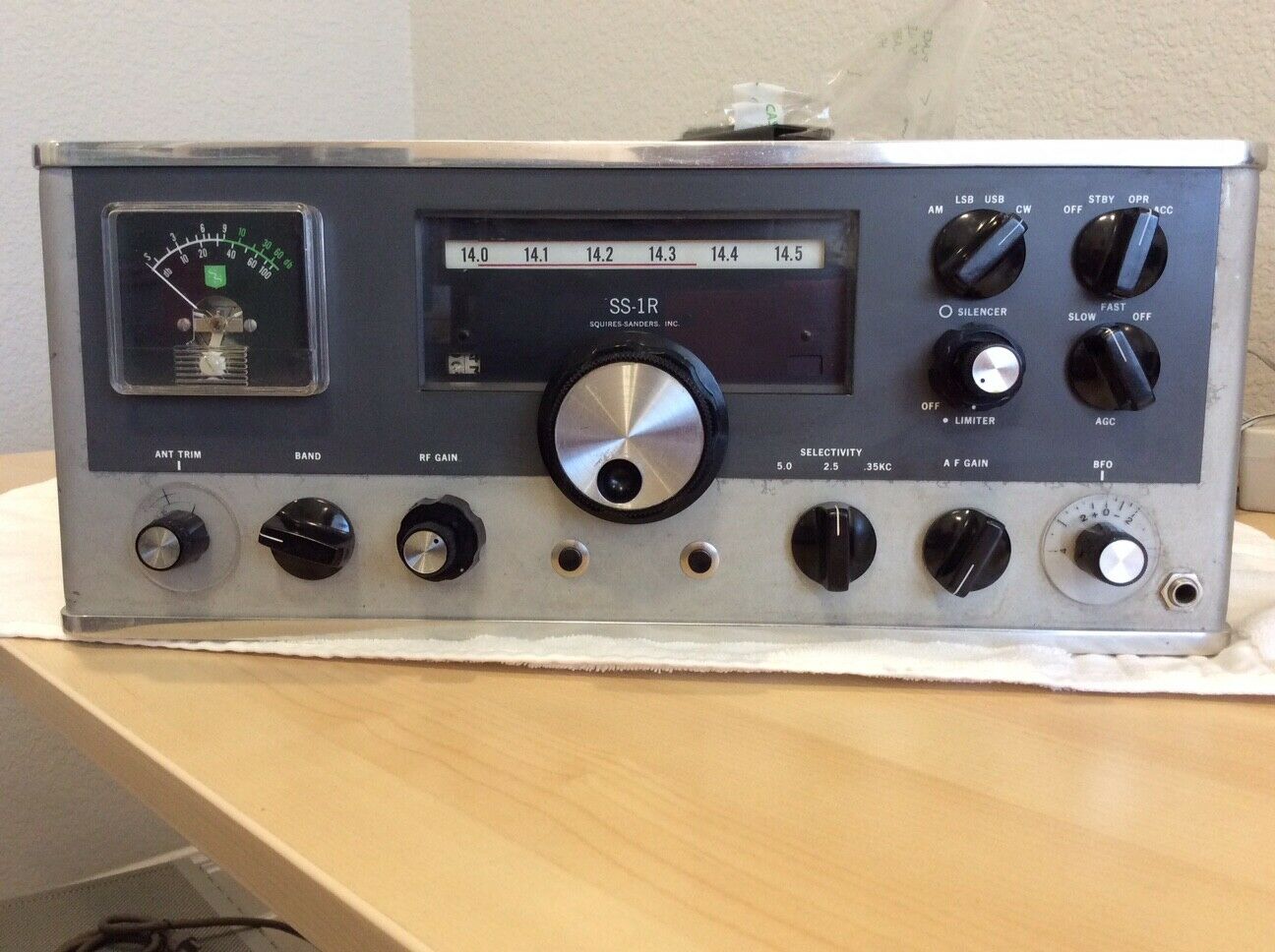
Many thanks to SWLing Post contributor, Dan Robinson who notes that there currently a Squires Sanders SS-1R on eBay. He notes:

Ultra rare amateur receiver. The only thing rarer is a SS-IBS, the SW bands version.

This is certainly a “fixer upper” in that it will need a re-stringing and likely at least a recapping. The chassis is super clean, though, and the internals look great.

Click here to check it out on eBay (partner link).

Radio life after death

A guest post by Troy Riedel:


This is a sad story.  Well, it’s sad for me.  But hopefully my sad story will yield “radio life” for somebody else and that life will bring them joy.

I’ve been an SWL’er since the early-90s.  Due to the decline of international broadcasters, “collecting” has become just as – if not more – important to me than listening.  I’ve always been fond of the Sony ICF-SW100 pocket radio.  I often read here on this blog about Thomas’ affection for it.  To make my dream a reality, on 19 November 2017 I found the perfect SW100 (with the leather case) and I purchased it.  It did not disappoint!  That radio has to be the most sensitive radio for its size out there.  No, correction – that little baby has held its own against any other portable shortwave radio (of any size) that I own (I have 17 or 18, incl. this SW100).  That’s quite amazing for a true pocket radio.

But please allow me go back to the beginning of my story.  Once I acquired the ICF-SW100, I assembled a “kit” … piece-by-piece (remember, I’m a collector).

I surmised that the SW100 would fit into the Sony ICF-SW1 case – and I was correct (sans the SW100’s leather case).  The SW1 case was one of my first purchases for my SW100 as I wanted something rugged to protect it.

The Sony AN-1 antenna works great with the SW100, and that was part of my kit.  Of course, I also wanted the OEM Sony Compact Reel Antenna.  “Check” – found one on eBay!  The OEM AC adapter? Yes, “check” that one off the list.  A photocopy of the OEM manual would not do – I found an original on eBay and “check”, that was added to the kit.

I already owned a Sony AN-LP1 (active) antenna.  That would not fit into the case, so I added a TG34 active antenna that I already owned (that’s a Degen 31MS clone).  Why?  I gotta have a ready passive antenna in my kit.

Wait, who wants a 30+ year old OEM set of earbuds?  Exactly, neither do I.  This is the only thing I did not want to be OEM!  I bought a new pair of Sony earbuds (off Amazon) to throw into the kit.  Other than the TG34, everything in the kit had to be Sony.  In the end, this handy little case was my Eutopia – it had everything I needed in its own “shortwave bugout kit”.

Of all of the radios in my shortwave arsenal, this was by far my favorite.  Hobbies should bring us joy.  So even if there weren’t many broadcasters to listen to, this little pocket radio never failed to bring me joy.

The last time I really used this radio was June-August 2020.  My newborn grandson was in the NICU far from my son’s home.  I “deployed” (with my SW100 bugout kit & 5th wheel camper) to my son’s very rural & very remote farm (275-miles from my home).  I was there to tend the farm, solo, for that period of time while my son and his family could be with my grandson at a specialty hospital some 350-miles away.  During this stressful & physically demanding time – tending to more farm animals than I care to mention and rustling bulls that escaped from the pasture – my SW100 was the only friend that I had.  It provided many, many hours of enjoyment.  Literally, other than a neighbor about ¾ of a mile up the road my ICF-SW100 and I were alone (not including the 50+ animals I tended to) from June through August.

Fast-forward to the present: last weekend I reached for my kit and I removed the my SW100.  I turned it on and there was no power.  Not surprising but actually very unusual as my NiMH Eneloop batteries typically last for a year or more inside my radios in “storage”.  I reached for the battery compartment, I felt an anomaly on the backside of the case and imagine my horror seeing this as I turned it over!

Surprisingly, there is zero damage to the Eneloop batteries (they did not leak).  I can no longer power the radio via ANY batteries, but amazingly the radio seems to operate at full capacity via AC Adapter.  Whatever happened inside the radio, it still seems to operate (though admittedly I haven’t taken it through all of its usual paces).

Unfortunately, a pocket radio that only operates via AC power does not suit me.  There is a better option: my loss may be someone else’s gain?  I am sending the radio and the necessary components to Thomas’s friend Vlado for a full autopsy (Vlado emailed that he has worked on these radios for years and has “never” seen this issue before).  After the autopsy, my radio will become an organ donor.  The remaining healthy components of this radio – and there are many – will be used for repairing other SW100s (singular or plural).

Strangely, I cannot detect any other “trauma” to the radio other than that one melted corner.  The battery compartment *seems* undamaged though I refuse to open the case as I do not want to accidentally damage the radio’s healthy components (I’ll let the professional “coroner” do that).  I am looking forward to the coroner’s report because I need to know what the heck happened to my baby?!

In closing, though we’ve only had a 3-year plus relationship I can honestly say this amazing little pocket radio had become a great friend.  I’m sure it’s grief, but I am considering liquidating the remainder of my radio & antenna collection – my heart just isn’t “in” to SWL at the moment.  And the timing of this is just awful for me: I’m having surgery Tuesday for an injury I incurred eight months ago while tending my son’s farm.  I had big plans that my SW100 and I would pass the time while I convalesce.  But alas, my buddy will be headed to radio heaven as an organ donor.  May others benefit from my loss.

Guest Post by Troy Riedel

Replacing the keypad on my Drake SW8

In 2019, I made an impulse purchase: a Drake SW8 tabletop receiver. As I mentioned previously, I’d always wanted an SW8. My buddy, David Goren, recommended this receiver ages ago, Each time I’ve stayed at his home in Flat Bush, he magically made an SW8 available as my bedside radio in the guest room. (That’s hospitality!)

After receiving my SW8 and putting it on the air, I realized it suffered from a common problem found in Drake receivers: a flaky keypad. Several of the buttons didn’t work reliably, or they made multiple contacts on each push, or they didn’t work at all.

What happens is, over time, the black carbon dot on the back of each pad on the rubber membrane simply wears out and no longer makes reliable contact. I believe a number of Drake receivers of the era used the same keypad style (though configured differently).

The seller didn’t realize this when he sold it to me and, frankly, I felt I got a pretty good deal regardless, so never bothered him about it.

A couple months later, I found out that Universal Radio uncovered a box of new old stock SW8 replacement keyboards, so I ordered one.

2020 got a little out of hand and I put off making the repair. I didn’t want to trouble my buddy, Vlado, who could have done this in his sleep. I knew I could handle a parts replacement as long as I didn’t need to de-solder the keypad from a circuit board (as one does with the SW2, I understand).

Tuesday, I cleaned off one of my radio shelves and found the replacement keypad. I looked at the SW8 and knew it was time to get’er done!

I first removed the encoder, volume, and tone knobs.

Next, I removed the top cover which is attached with five screws.

There are a number of multi-pin plugs that attach the front faceplate section to the main body of the radio.

I carefully removed all of them and noted their positions (taking photos at each stage really helps).

I quickly discovered that the keypad was under at least two more board layers.

I removed the main board which is held in place with three screws, then the board underneath which is also held in place with three screws.

To my surprise, the keypad, circuit board and two metal plates (in that order) are held in place with compression from the last board layer.

The keypad, circuit board and metal plates fell out quite easily.

While I had everything apart, I cleaned the inside. At some point, a wee bit of moisture must have accumulated near the bottom of the keypad. I’m guessing this was condensation, because it was so minimal and so localized.

I replaced out the old keypad with the new one. Should you ever do this procedure, take note that the keypad has holes that line up with dimples on the back of the SW8 face place–the keypad circuit board also has holes that line up with dimples on the back of the rubber keypad. Lining these up will insure a correct fit.

I then re-assembled the faceplate boards and reconnected it to the body of the radio. Unfortunately, one can’t really test to see if the replacement works until all of the boards have been re-connected and re-assembled–a good 10-15 minute process.

I tested the keypad and quickly discovered that number 9 and the bottom row of buttons were still a little flaky. After a little head scratching, it then dawned on me (after pulling the radio apart and reassembling it twice more!) that maybe part of the problem was left-over carbon/dust on the keypad circuit board.

I disassembled the radio again and carefully cleaned the keypad circuit board with some DeOxit (a radio enthusiast’s best friend).

Through a closer inspection of the board, I could see that some of the traces on the bottom of the board had corrosion. That really worried me because I’m not entirely sure how I could mend traces. I tested continuity, however, and they all passed.

I reassembled the SW8 for the fourth or fifth time, tested it, and the keypad performed perfectly!  Woo hoo!

Not only am I incredibly pleased that I was able to sort this out on my own, but now I can dissemblable and reassemble the SW8 with the speed of an Indy pit crew.

I’m still a little concerned about those traces on the keypad circuit board and the new keypad’s overall longevity, but at least I’ve got the SW8 back in tip-top shape and on the air for now. I’ll explore a work-around if these parts ever fail again.

I do love this receiver and now have it set up in the shack where I can do some proper armchair SWLing.

Do you have an SW8?

I’m curious if any SWLing Post readers have an SW8 and especially if you’ve had to replace your keypad.  Please comment!

Dan’s thoughts on a Panasonic RF-9000 up for auction

Many thanks to SWLing Post contributor, Dan Robinson, who writes:

Appearing on the Japanese Buyee website is this RF-9000, which was the “King of Radios” of the heavy multiband “portable” era.

In recent years, RF-9000s in excellent to LNIB condition have sold for $10,000 or more.

A tour d’force of technology in its day, the 9000 featured room-filling main speakers and PLL technology that was advanced for its time.

The shortwave receiver section of the 9000 was plagued by PLL artifacts which prevented the radio from achieving what it could have had this problem not been solved in advance by Panasonic engineers.

A LNIB RF-9000 that I purchased for near $5,000 sold to a Hong Kong collector for $10,000 a few years ago. While I do miss its amazing FM quality and looks, the receiver ultimately lagged behind others, such as the SONY CRF-330K and 320 in performance.

The asking price for this 9000, which appears to have cosmetic issues, is in my view high.

Click here to view the RF-9000 auction.

Thank you for your insights, Dan!