The “Shortwave Shindig” T: you know you want one

ShindigLogoWhite

[Update (04/10/14): Check out promotional pricing for SWLing Post readers below.]

Remember that incredible live Shortwave Shindig broadcast of a few weeks ago? If you missed it, check out one of these recordings.

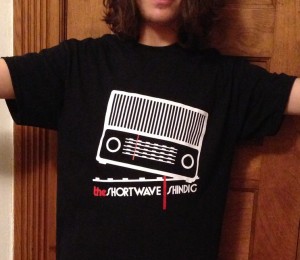
David Goren, radio producer and Shortwavelogist behind the broadcast, has printed up a series of terrific T-shirts to commemorate the event. Your purchase of a shirt will not only elevate your social standing (I mean, who has a T-shirt with the word “shortwave” on it?), but importantly, it will also help support more such broadcasts and radio productions out of the studios of Shortwaveology in future.

ShortwaveShindigTeeAnd did I mention that the funky retro logo design, above and right, is by the talented Jeff Murray, K1NSS? Gotta love it.

These shirts are 100% cotton and available in black (see right) or white.

I don’t want to over-promise here, but I understand that wearing the Shortwave Shindig shirt can increase your chances of hearing the elusive Bhutan Broadcasting Service and many other signals–perhaps even ones that have recently gone off the air. Moreover, this shirt is 100% QRM free.

What are you waiting for?

Hop over to this page on Shortwaveology.net and order yours today!

And, dear readers, thanks for hanging on to my hard sell: this one’s for a good cause.

UPDATE: Many thanks to David Goren who is offering a 10% discount to SWLing Post readers!  Simply enter the promotional coupon code “swling” at checkout. Total cost will then be $18 shipped! Click here to order your shirt. This promotion will only be available for two weeks, ending April 24, 2014.

WWV: experimental broadcasts on 25 MHz

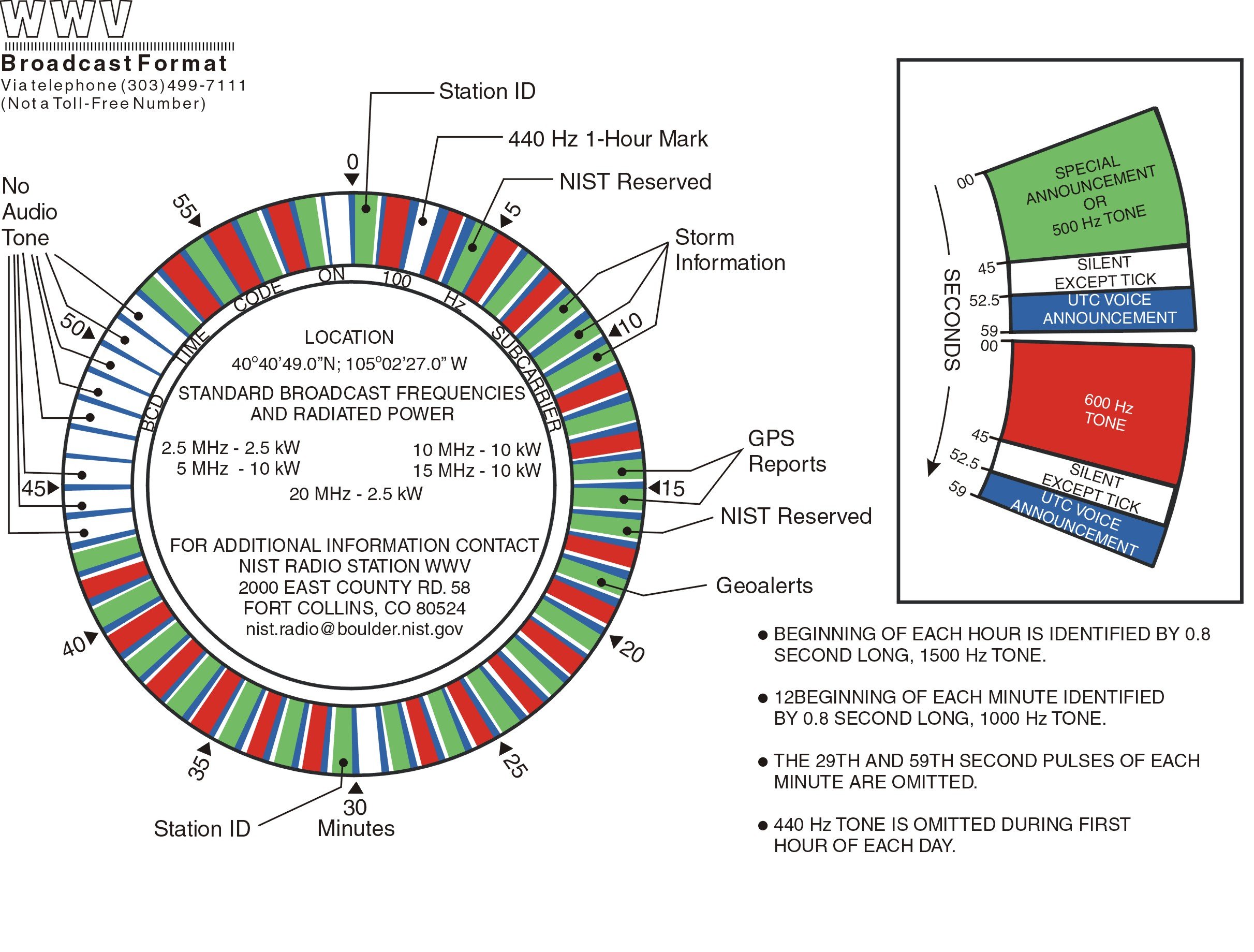
WWV format

WWV format (Click to enlarge)

Want to catch WWV–the Fort Collins-based time station–on a frequency they haven’t used since 1977?

The National Institute for Standards and Technology (NIST) has sent out a press release stating that, as of April 4, 2014, WWV will resume broadcasting on 25 Mhz for a limited time.

Full details follow in their press release:

NOTICE: Experimental 25 MHz WWV Broadcast

As of Friday, April 4, 2014 WWV has resumed broadcasting on 25 MHz on a limited, experimental basis. The broadcast consists of the normal WWV signal heard on all other WWV frequencies, at the same level of accuracy.

Current 25 MHz Broadcast Specifications (subject to change):
Schedule: variable; as an experimental broadcast, the 25 MHz signal is not continuous. It will typically be on the air from approximately 1500 – 2100 UTC Mondays through Fridays, but may operate outside these hours as well. The broadcast may be interrupted or suspended without notice.

Radiated Power: varies; no more than 2500 W

Antenna: broadband monopole, coordinates: 40 deg. 40′ 50.8″N, 105 deg. 02′ 32.6″ W

Listener comments and reception reports may be emailed to: [email protected], or sent via postal mail to:

National Institute of Standards and Technology
Radio Station WWV
2000 E. County Rd. 58
Fort Collins, CO 80524

Remembering Bill Bergadano

BillThe shortwave radio community lost a friend last week: Bill Bergadano (KA2EMZ).

I never got to know Bill personally, but I knew of him and we had many mutual friends.

Fred Waterer, my friend and fellow writer at The Spectrum Monitor magazine, worked with Bill at his online radio station, Radio Scooter International.

Fred writes:

“Bill Bergadano was the nicest guy you would ever want to know.. He “freinded” me on Facebook sometime in 2010 or 2011. He had been one of my readers, at Monitoring Times and the Ontario DX Association for years. Bill ran internet radio station Radio Scooter International. He said, “Hey, c’mon over to the chatroom during my show” (Bill’s show The Friday Night Party, was the flagship show on the station). I did. I got to know Jeri and Mary Anthony and Carrie Walden Merritt and of course Bill and the rest of the chatroom gang.

After a spell, he said “Why don’t you do a show on RSI?” At first I dismissed the idea as ludicrous. Me? Host a radio show?? Why me? Then I got to thinking “Why NOT me?” I have been a fan of radio since 1969, written about it in various forums since 1986. Why not try it? If nothing else it would be an interesting experience for a few weeks to try things from the other side of the mic. So I did. In August 2012, The Radio Time Capsule debuted to no acclaim. I told no one. I figured if I fell flat on my face no one would know but me and Bill and a small circle of friends.

Well I did fall flat on my face. I was terrible. Nervous. But Bill encouraged me. After a few weeks I started to get comfortable, relax and enjoy the show. I love it now. I owe Bill a huge debt of gratitude just for giving me the opportunity to do something this fun and creative.

Bill shared a love of radio as a broadcaster and a listener. He was an avid Ham, in fact one of our last conversations was about a Ham he had worked. He also had a fabulous sense of humour. I will never forget his silly jokes. He would give you the shirt off his back. He also attended many of the Winter SWL Fests over the years. His was a life well lived. A remarkable fellow I was proud to call my friend.

I have no idea what the future will hold. But my pal Bill will always be part of it. I will carry his memory and friendship with me as long as I live.”

Many thanks, Fred for sharing your memories of Bill.

BBC World Service to get more money, but less influence?

(Image source: BBC)

(Image source: BBC)

Jonathan Marks takes a look at the future of the BBC World Service under the umbrella of the BBC News group board.

His conclusion? Just doing the news may be “too narrow a remit.”

I tend to agree.

Read for yourself on Jonathan’s blog, Critical Distance.

Shortwave Radio Recordings: Radio New Zealand International

450px-New_Zealand_23_October_2002For your listening pleasure: three hours of Radio New Zealand International.

This broadcast was recorded on 9,700 kHz, starting at 07:59 UTC on April 5, 2014. This weekend RNZI broadcast includes Peter Fry’s Saturday Night music request show–always a treat to hear.

Click here to download this recording as an MP3, or simply listen via the embedded player below. Of course, you will automatically receive this recording if you are subscribed to the Shortwave Radio Audio Archive.

Shortwave Radio Recordings: Radio Romania International

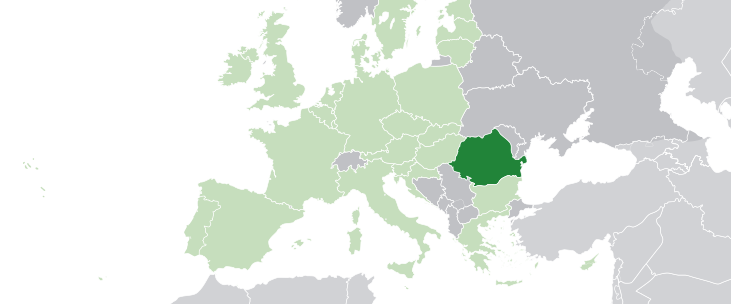
RomaniaOnMapFor your listening pleasure: Radio Romania International‘s English language service.

I recorded this broadcast with my WinRadio Excalibur on April 5, 2014, starting at 05:30 UTC on their new A14 frequency of 7,900 kHz.

This broadcast originates from RRI‘s Galbeni transmitter site.

Click here to download the recording as an MP3, or simply listen via the embedded player below:

Click here to view other posts mentioning Radio Romania International.

Russian “clamps down” on US media, US to increase funding for RFE/VOA

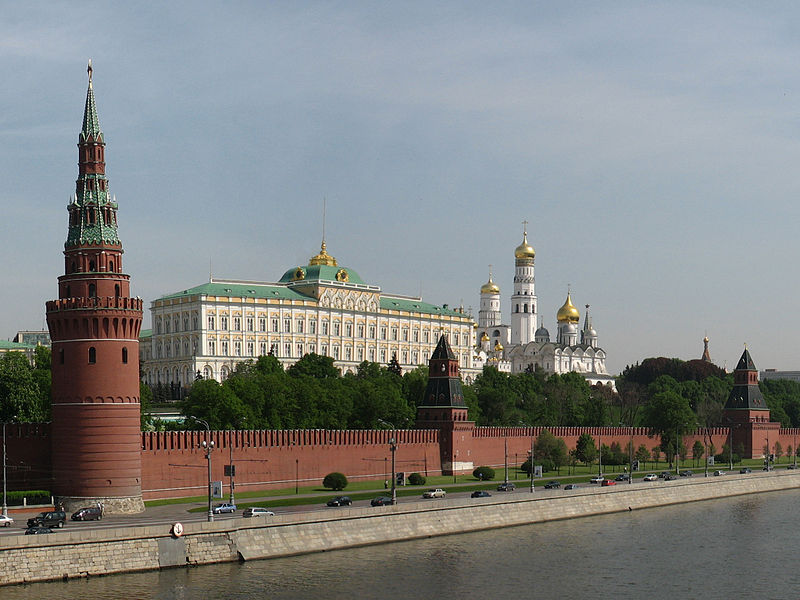
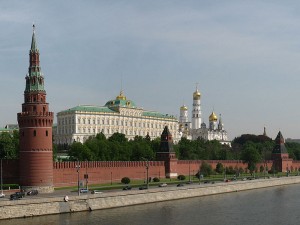
Photo of Kremlin: ??????? ?. (Julmin) (retouched by Surendil) via Wikimedia Commons

Photo of Kremlin: (Julmin) (retouched by Surendil) via Wikimedia Commons

This morning, I noticed the following press release from the US Broadcasting Board of Governors (BBG):

Russia Clamps Down Further On U.S. International Media

The Broadcasting Board of Governors has condemned a recent decision by Russian authorities to cut off all remaining radio transmissions by U.S. international media in Russia.

In a one-sentence letter dated March 21, Dmitry Kiselev, the director of the information agency Rossiya Segodnya (Russia Today), stated that “we are not going to cooperate” with the BBG’s request to continue a long-standing contract for broadcasting on Russian soil. Effective at the end of March, this decision removes the last vestige of Voice of America programming – including news in Russian and English-language lessons – from a local frequency in Moscow (810 AM).

“Moscow has chosen to do the wrong thing and restrict free speech,” said BBG Chairman Jeff Shell. “This is a fundamental value shared by many countries around the world. The BBG will continue to reach audiences in Russia through digital platforms and via satellite transmissions.”

Distribution of VOA and RFE/RL programming in Russia reached a high point in 2005, when VOA Russian programming was distributed on a nationwide television network and both VOA and RFE/RL had extensive partnerships with domestic Russian radio stations. But starting in that year, the Russian government turned greater attention to these stations and asked them all to re-apply for their licenses. And beginning in 2006, by denying the licenses of the stations that re-applied and intimidating the others, Russian authorities systematically eliminated domestic radio distribution of BBG-supported programs and almost all television distribution. In 2012, Russian authorities forced RFE/RL off its last remaining domestic radio outlet, an AM frequency in Moscow.

“We urge Mr. Kiselev and other Russian authorities to open Russian airwaves to more of our programs and those of other international broadcasters,” Shell added. “We’re asking for an even playing field: As Moscow’s media crackdown deepens, Russian media – including Russia Today television, which is under Mr. Kiselev’s authority – enjoy open access to the airwaves in the United States and around the world. The Russian people deserve the same freedom to access information.”

Kiselev, known for his strident anti-Western and homophobic views on Russian state television, was appointed in December 2013 to lead Russia Today. At the same time the Voice of Russia and the RIA Novosti news agency were merged into Russia Today.

The move also comes amid a fast-moving campaign to target opposition and independent media. Lists of “traitors” have been circulating in Moscow, and pro-Kremlin analyst Sergei Markov recently added RFE/RL’s Russian Service, Radio Liberty to his “list of traitors” on Facebook. In the same vein, politonline.ru, a part of the Pravda.ru media holding, has created Russia’s first top-20 list of the most “anti-Russian” news outlets. This list, which places Radio Liberty sixth, is being shared by influential Russian political advisors such as Alexander Dugin, who wrote on his Facebook page that “this is the order in which Russia’s most contemptible media outlets will be closed or blocked.”

Russians are increasingly turning to the Internet and social media for their news. VOA’s digital strategy incorporates content across platforms. In addition to live interactives with domestic television channels, such as Russian Business Channel, VOA’s web-TV show, Podelis, allows users to connect and engage with the content in real time using social media. Podelis, which means “share” in Russian, provides a unique opportunity to engage in discussions about current events, Russian politics and U.S.-Russia relations. VOA’s social media following in Russia has grown significantly and visits to VOA’s website have doubled every year since 2008.

Radio Free Europe/Radio Liberty’s Russian Service provides 24 hours of radio programming via the Internet and satellite, a website that was visited more than 6.5 million times in March, and a strong presence on social media such as Facebook and Twitter. RFE/RL has started a multi-hour, daily video stream for Russia consisting of coverage of the most important events with reactions from Russian citizens as well as opinions from the West. The stream also includes live roundtable ?discussions and expert interviews on Russia.

On Wednesday, BBG Watch posted an article with details about new legislation that would increase funding for Russian, Ukrainian and Tartar language services to “counter the propaganda that is supported by Russia.”

Here’s a quote from a press release in their article:

“S. 2183 is international broadcasting legislation originally authored by Chairman [Ed] Royce (and included as Section 103 of the Ukraine Support Act (H.R. 4278) that the House passed last week). The legislation authorizes increased funding for Radio Free Europe/Radio Liberty and the Voice of America to enable them to expand their broadcasting in Russian, Ukrainian, and Tatar. This legislation requires the Broadcasting Board of Governors (BBG) to counter the propaganda that is supported by Russia and increase the number of reporters in eastern Ukraine. In addition, this legislation recognizes the threat to free media that neighboring states are under and bolsters the Balkan and Moldovan language services.”

Is it me, or is this starting to feel like the Cold War again?

I think the BBG would be wise to take a close look at the VOA Radiogram. In this case, the target audience is highly computer literate and could easily decode VOA transmissions with a simple shortwave radio and free, open-source software.