Shortwave listening and everything radio including reviews, broadcasting, ham radio, field operation, DXing, maker kits, travel, emergency gear, events, and more
Radio Lavalamp “Your ethereal shortwave music station” returns to your radio receivers via the transmitters of Channel 292 this Saturday 26th November 2022 at 2300 UTC on 3955 kHz. The show will feature a mix of chilled out tunes and an eclectic selection for a Saturday night on shortwave. Tune in and enjoy! Fastradioburst23
Radio Waves: Stories Making Waves in the World of Radio
Welcome to the SWLing Post’sRadio Waves, a collection of links to interesting stories making waves in the world of radio. Enjoy!
AU2JCB Special Event Station (Nov 25 – Dec 13, 2022)
Many thanks to SWLing Post contributor, Datta, who shares the following announcement:
AU2JCB is a special event call-sign to commemorate the birth date (30 NOV) & to pay homage & to tell about the great INDIAN scientist Acharya JAGADISH CHANDRA BOSE who is recognized as the “Father of Wireless Communication” by the scientific community of our world &IEEE.
I, VU2DSI, have been operating with this call sign for the last 17 years since 2005 & operate AU2JCB from 25 NOV 2022 to 13 DEC 2022.
The Details of operation —-
Period: 25 NOV 2022 to 13 DEC 2022
Frequencies:
10 M: 28545, 28510,28490
21 M: 21235, 21310, 21350
20M: 4210, 14250, 14310
40 M: 7040, 7150
80 M: 3710
6M in FM mode 50800, 51500
10 M: 29700
Preferably the operation will be on higher bands according to propagation conditions.
QSL— Direct to VU2DSI, “SURABHI” MEHERABAD. AHMEDNAGAR.414006. INDIA.
FOR DX STATIONS PLEASE SEND 2IRC’s—–IF POSSIBLE— as many many DX stations are requesting QSL’s.
I will appreciate the GOOD number of used postal stamps instead of IRC as I love collecting stamps.
About
Aacharya J.C.Bose is well known as the “Father of Wireless Communication”.
Acharya Bose’s demonstration in 1895 & 1897 predates all.
Bose transmitted wireless signals to a distance of a mile. Popova in Russia was still trying remote signaling at this time & the first wireless experiment by Marconi was not successful until May 1897.
Bose is a pioneer in microwave optics technology.
Bose’s invention of 1-centimeter to 5 millimeters radio waves is being used in radars, satellite communication& remote sensing.
Bose’s concepts from his original 1897 papers are now incorporated into a new 1.3 mm multi-beam receiver on the NRAO (National Radio Observatory) 12 Meter Telescope.
Bose anticipated the use of P-type& N-type semiconductors & hence 60 years ahead of his time. Bose developed the use of GALENA crystals for making receivers.
In Bose’s presentation to the Royal Institution in London in January 1897, he speculated on the existence of electromagnetic radiation from the sun. This radiation from the sun was not detected until 1942.
My Dad and I took a road trip to tour the 1 MW FM community tower in Crestwood, MO, serving the entire St. Louis metro area combining 10 FM radio signals into two antenna systems.
Special thanks to the Audacy engineers who allowed us to take a peek at their (very clean!) transmitter rooms and equipment!
3ZZZ breaches community radio broadcast rules in its coverage on Ukraine (ACMA)
The Australian Communications and Media Authority (ACMA) has found Melbourne-based community broadcaster 3ZZZ in breach of community broadcasting rules in its coverage of the invasion of Ukraine by Russia. Continue reading →
Watching Shortwave Broadcast Stations on the TinySA Spectrum Analyser
by Bill Meara
November 18, 2022 1244 UTC. I was using a TinySA spectrum analyzer to look at noise levels on the 40 meter ham radio band. I also wanted to take a look slightly above the band (in frequency) to see Radio Marti at 7355 kHz. As I was doing this I remembered that Vatican Radio was on the air at 7305 kHz from 1230 UTC to 1245 UTC. So was just going to catch the last moments of that day’s transmissions. Sure enough, I caught it, and watched it disappear from the TinySA screen. See the video below:
Radio Marti continued on. In the morning we can hear the rooster recordings from that station. We are using it to test how well our homebrew Direct Conversion receivers avoid AM detection. In the video I mistakenly said these two transmitters were on the air with 250 megawatts. The correct power is 250 kilowatts. Both transmit from Greenville NC. I think the signal from Vatican Radio is stronger here because they are using a different antenna pattern — Radio Marti is aimed at Cuba.
This reminds me of a cool project I have not yet done: modifying the TinySA to allow the user to listen to the station: https://soldersmoke.blogspot.com/2021/10/how-to-listen-with-your-tinysa.html I notice that Dean KK4DAS (my colleague in DC receiver design) was the only commenter on the blog post describing the TinySA mod. TRGHS. We need to to do this.
Here are the reports showing when Vatican Radio and Radio Marti were on the air on November 18, 2022:
Thank you for sharing this, Bill. I love it! The TinySA is such an affordable and useful workbench tool.
Many thanks to SWLing Post contributor and noted political cartoonist, Carlos Latuff, who shares his radio log art of a recent Voice of Korea broadcast.
Carlos notes:
Announcement of the launch of an intercontinental ballistic missile (ICBM) by the DPRK, via KCBS Pyongyang, domestic radio service from DPRK, broadcasting in Korean, listened in Porto Alegre, Brazil, shortwave frequency of 11680 kHz.
Announcement of the launch of an intercontinental ballistic missile (ICBM) by the DPRK, via Voice of Korea, broadcasting in English from Kujang, North Korea, listened in Porto Alegre, Brazil, shortwave frequency of 12015 kHz.
Announcement of the launch of an intercontinental ballistic missile (ICBM) by the DPRK, via Voice of Korea, broadcasting in Spanish from Kujang, North Korea, listened in Porto Alegre, Brazil, shortwave frequency of 12015 kHz.
Get it while you still can: The Luxemburg-Gorky effect
by 13dka
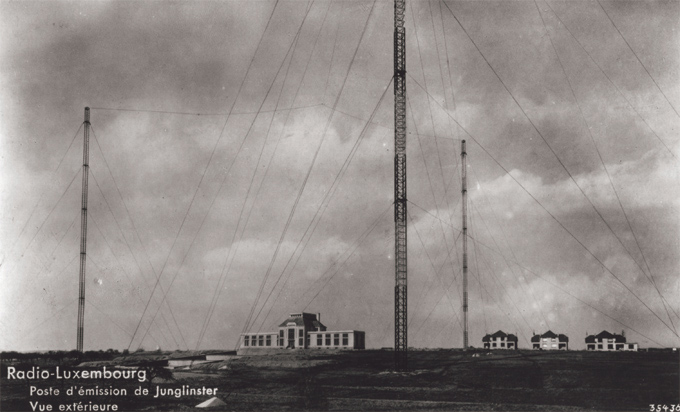
The Radio Luxembourg longwave transmitter Junglinster in the 1930s [RTL Group]
“In radiophysics, the Luxemburg-Gorky effect (named after Radio Luxemburg and the city of Gorky (Nizhny Novgorod)) is a phenomenon of cross modulation between two radio waves, one of which is strong, passing through the same part of a medium, especially a conductive region of atmosphere or a plasma.” (Wikipedia)
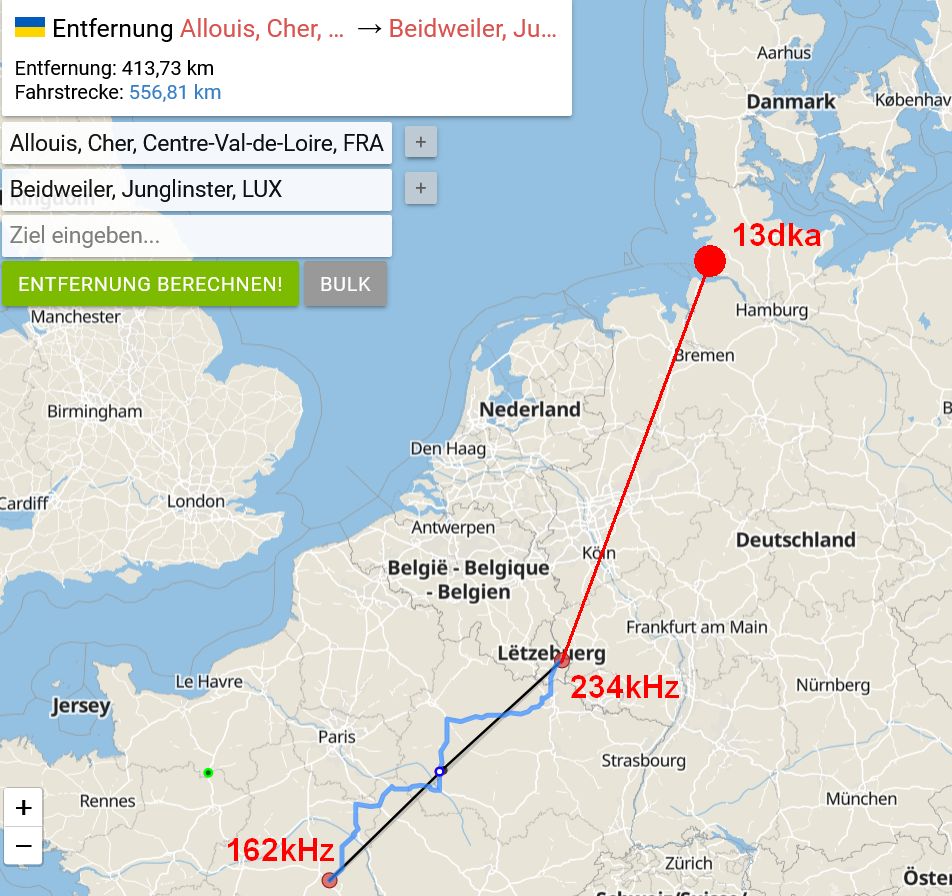
That sounds pretty abstract, right? In my own words, imagine your radio is tuned to a station on let’s say 162 kHz, 500 miles away. Somewhere in the middle between your receiver and the 162 kHz transmitter is a station transmitting on a different frequency, let’s say 234 kHz. The Luxemburg effect is that you can hear the modulation of the 234 kHz transmitter in the middle, on the 162kHz station you are receiving. The effect is not depending that much on the frequency/wavelength though, the longwave station could affect medium wave stations and it has been created using shortwave frequencies far apart.
It was observed first in 1932, when listeners of the Swiss Beromünster 60kW medium wave station built just one year prior also heard a bit of Radio Luxemburg’s longwave transmitter (250kHz) on the Beromünster frequency (653kHz until 1934). Of course this was assumed to be some kind of crosstalk within the receivers and probably drove radio engineers insane until 1933, when Bernhard D.H. Tellegen, a Dutch electrical engineer and inventor suggested the true origin of the effect: The new (1932) 150kW Radio Luxemburg longwave transmitter in Junglinster was directly modifying the ionosphere hundreds of kilometers above, it “heated” the ionosphere in a way that it made the plasma’s charge and reflectivity follow the amplitude modulation of Radio Luxemburg, thus modulating waves of other wavelengths crossing this part of the ionosphere.
Practical demonstration
Even if you’re living in Europe, you may never have witnessed that effect and according to this article by Paul Litwinovich, chances to observe this in the US are rather slim, due to the relatively low power of the stations. I’m in Europe but never noticed it either – until recently: Continue reading →
Many thanks to SWLing Post contributor, Alan Roe, who shares his B-22 (version 1) season guide to music on shortwave. Alan provides this amazing resource as a free PDF download:

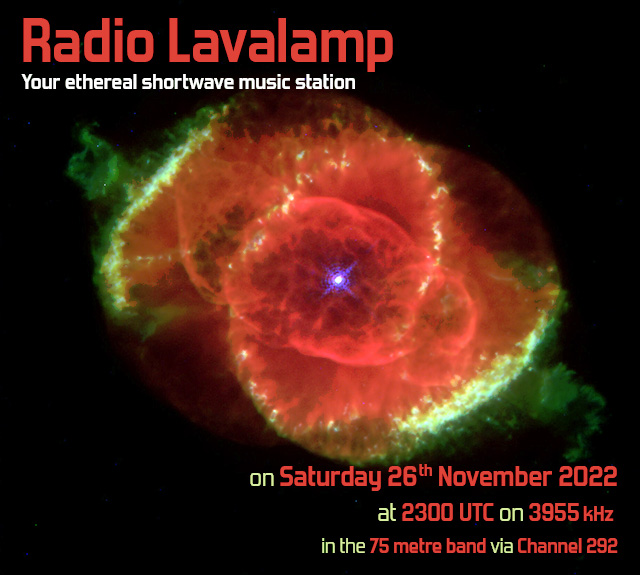 Radio Lavalamp “Your ethereal shortwave music station” returns to your radio receivers via the transmitters of Channel 292 this Saturday 26th November 2022 at 2300 UTC on 3955 kHz. The show will feature a mix of chilled out tunes and an eclectic selection for a Saturday night on shortwave. Tune in and enjoy! Fastradioburst23