Guest Post: Summer Daytime DXing 2019

Many thanks to SWLing Post contributor, TomL, who shares the following guest post:


Summer Daytime DXing 2019

by TomL

I took note of the mediocre band conditions this summer amongst amateur radio operators as they were making off the cuff comments about still being in a solar minimum.  Some had gone out and bought upgraded transmitters to solve the problem (MOAR WATTS!). And more power thrown at a weak ionosphere does seem to help get a signal farther.  I had not been out since the spring and decided to find out for myself. But instead of more watts, I wanted more height.
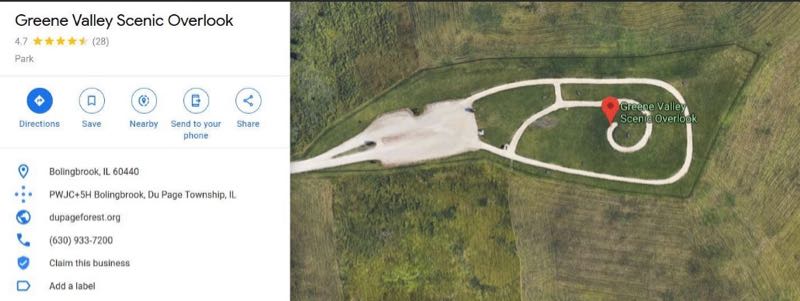
Greene Valley Scenic Overlook is open to the public from May through October on weekends only (and only from 11am-6pm).  It was the largest land fill (aka, garbage dump) in Illinois, now covered over and producing captured methane gas. On August 3 & 4, I ventured over there to see if its 190 feet above the surroundings might help my radio reception.

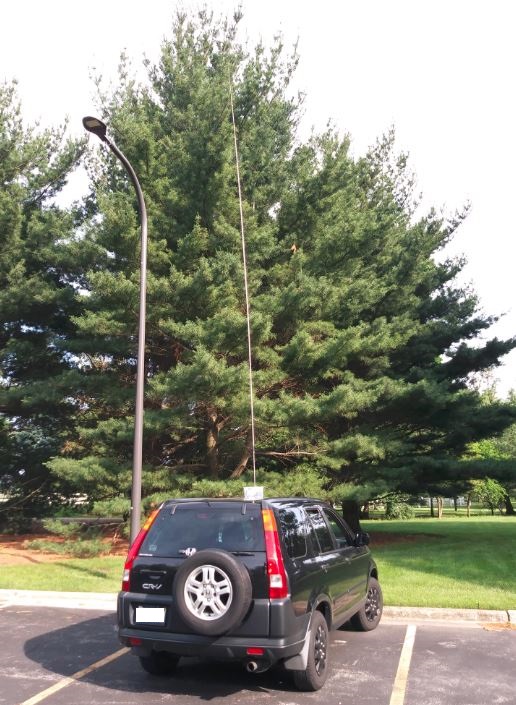
After trying my luck with a 12 foot vertical antenna on a tripod (and numerous children running around it chasing butterflies or looking at the view of Chicago), I went out the next day and parked away from anyone and put up my 19 foot vertical on the roof of the car.  This setup is still amazing to me and works much better than the tripod mounted antenna, probably because it has a proper ground plane as well as being 7 foot taller.

So, yes, the conditions were so-so, not too bad and not too good.  Lots of weak signals and some empty frequencies that I had expected to hear some South American stations around the 5 – 10 kw range.  Weak stations from Asia were more scratchy sounding than usual even with the extra 190 feet of height. Here are 5 broadcast recordings as a sample (times in UTC):

9920 kHz at 21.14 – Radio Thailand in Thai, just catching the end of the broadcast:

9685 kHz at 21.20 – Radio Free Asia in Chinese from Kuwait:

9650 kHz at 21.23 – Radio Guinea in French:

9445 kHz at 21.30 – All India Radio in English (fighting off computer generated noise on my SDR and cheap Dell laptop) and just getting a station identification:

11780 kHz at 21.44 – Radio Nacional de Amazonia booming in with the usual annoying host yelling enthusiastically over every tune he played:

Running out of things to listen to, I wandered over to the 20 meter amateur radio band and found a different situation.  Propagation was decent between the Western hemisphere and Europe. Lots of “pile ups” going on with people trying to make contact with their trans-Atlantic counterparts.  Some said they were running 500 watts or more, so more power does seem to help! Here are 5 recordings to show how active it was:

14171 kHz at 21.55 – Inaki (F5RAG) from southwestern France conversing with Carlos (YV3CRT) in Venezuela (surprised anyone is left in Venezuela with operating radio equipment and not sold off for food with the ongoing difficulties there).  Then Inaki makes contact with Alejandro (CE2ATS) from Chile with a good signal. All in Spanish:

14199.38 kHz at 22.04 – Ervin (VE3GAL) tries his QRP portable setup from Ontario to contact Ron (F4VSM) in Southwestern France who has a 500 watt setup and large Yagi antenna. Sometimes things do not go so well but that is the challenge of using low power, maybe around 10 watts (meaning that just because you can hear them, you cannot always transmit to them with the same effectiveness and vice-versa, for various reasons):

14228 kHz at 22.12 – “BAN” (IZ1PNT) from Italy makes contact with Norman (N3PVQ) in FL after asking everyone to be quiet. Good control over the frequency:

14238 kHz at 22.17 – Slavko (S57DX) booming in, making a contact (Rob, KK4HEQ) in Florida:

14245 kHz at 22.24 – Gabrielle from the Czech Republic, participating at a Youth event using station OL88YL contacting Ira (VP2EIH) in the British Virgin Islands and then another dude from Florida, Roy (AD4AN).  She handled it very well:

This outing was quite educational and I find it curious that people running 1000 watts or less are able to be heard well between continents but the large broadcasters were difficult to hear.  Antennas pointed in the right direction, at the right time of day and frequency, can certainly do amazing things, plucking those weak signals out of the air so easily. And I do think the extra height had something to do with hearing this magic, too!

Happy Listening,

TomL

NOTES:

  1. An easy way to lookup amateur radio operator “call signs” is to go to web site QRZCQ.com which does not need a login.  Some records may be out of date, but most of it is accurate.
  2. Setup used was a cheap Dell laptop, Windows 10, SDR Console 3.03,  connected to the AirSpy HF+, a Palstar amplified preselector, and an old Kiwa BCB filter, then going up to the car roof magnetic balun (a Palomar MLB2) which is then connected to the 4 magnet base and the MFJ 19 foot stainless steel antenna.  You can read about it here:

https://swling.com/blog/2018/07/guest-post-backpack-shack-3-0-part-3/


Brilliant report, Tom! It’s true: the bands are fickle, but like you I always find interesting things to hear on HF. I think your setup using your vehicle as the ground plane for the antenna is a fantastic idea. Plus, set up is easy, self-supporting, and you’ll never have to worry about a park ranger, for example, complaining because you have a wire suspended from a tree. And when there are no trees? You’re still golden. 

Thanks for sharing your experience and DX! Amazing that even with mediocre conditions, you still snagged some distant signals.


Do you enjoy the SWLing Post?

Please consider supporting us via Patreon or our Coffee Fund!

Your support makes articles like this one possible. Thank you!

QRPGuys Active Antenna Splitter Kit

Many thanks to SWLing Post contributor, Eric McFadden (WD8RIF), who shares the following announcement from Ken (WA4MNT) via the QRP-L forum:

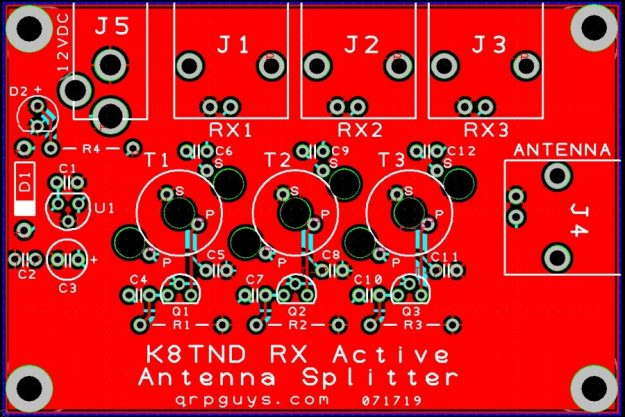
QRPGuys is open for orders after this year’s Summer shutdown. We have  added a product that may be of special interest to SWL listeners and some hams. It is an active antenna splitter that will enable connection to three receivers from a single antenna.

Product Deescription:

The KN8TND Active RX Antenna Splitter will allow you to use one antenna with mulitple HF receivers simultaneously. Many hams and SWLers like to monitor several bands and/or frequencies, i.e. 14.300, international nautical emergency freq, 14.100, world HF beacons, etc, etc. Having two or three HF receiving antennas is a luxury some Hams and SWLers can’t afford. With the active receiver antenna splitter you can use one antenna and three receivers at the same time. Keep abreast of what’s going on on the bands, put some of those dust collecting receivers back in action. On a difficulty scale of 1 to 5, this kit is a 2. Build time is about 2 hours, depending on your experience, with the normal kit tools. Bear in mind, this is for receiving only. For HF transceivers you would need a T/R switch to your tuned transmitting antenna.

Come by and see it at:
https://qrpguys.com/k8tnd-active-antenna-splitter

QRPGuys makes amazing QRP kits. Immediately after receiving Eric’s email, I purchased the active antenna splitter kit. Total cost with shipping was $25 US. A true bargain! Although I already have an ELAD Active antenna splitter, this one would be nice to take to the field as it’s much smaller and lighter weight.

Click here to check out the new Active Antenna Splitter at QRPGuys.

Fenu-Radio reviews an AirSpy HF+ Discovery prototype

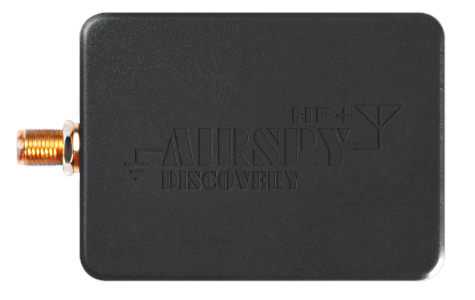
Fernando Duarte of Fenu-Radio has just posted his review of the AirSpy HF+ Discovery SDR prototype.  I trust Fenu’s reviews because they’re always thorough and based on actual listening sessions.

In short, he’s quite impressed with the prototype. In many instances the Discovery outperformed his benchmark Winradio G33DDC Excalibur Pro. Quite an accomplishment for a $169 SDR!

Click here to read Funu-Radio’s full review.

I will evaluate a first production run AirSpy HF+ Discovery. Since it’s incredibly lightweight and compact, I believe I’ll try to even build a small portable SDR station around it. Stay tuned.

Parker Solar Probe gathering data from our local star

(Source: NASA)

Many thanks to SWLing Post contributor, Paul Evans (W4/VP9KF), who writes:

Parker Solar Probe supposedly going to yield some interesting data [see below].

Hopefully it’ll bring forth some interesting new findings for Short Wave users!

(Source: Engaget)

Over the past months, NASA’s Parker Solar Probe flew closer to the sun than any other spacecraft before it — not once, but twice on two flybys. The probe obviously collected as much data as it could so that we can understand the sun better. Now its mission team at Johns Hopkins Applied Physics Laboratory in Maryland has just received the final transmission for the 22 gigabytes of science data collected during those two encounters. That’s 50 percent more than it expected to receive by now, all thanks to the spacecraft’s telecommunications system performing better than expected.

Parker’s ground team found out soon after launch that the probe is capable of a higher downlink rate. In fact, they’re taking advantage of that ability by instructing the probe to send back even more data from the second encounter in April. During that event, the spacecraft’s four suites of science instruments kept busy collecting information. That’s why the mission team is expecting to receive an additional 25GB of science data between July 24th and August 15th.

The mission team will release the data from the first two encounters to the public later this year. Before that happens, the spacecraft will conduct its third flyby, which will start on August 27th and reach closest approach on September 1st. Researchers are hoping that over the net few years the mission can gather the information we need to unravel some of the sun’s biggest mysteries, including why the sun’s corona (its aura of plasma) is far hotter than its visible surface.

Click here to read the full article at Engaget.

Radio World: History of Directional AM Broadcast Antennas

Many thanks to SWLing Post contributor, Marty, who shares the following article by John Schneider in Radio World:

In the early years of AM radio broadcasting, all stations utilized non-directional antennas. Most all of these were wire antennas suspended between towers or buildings. Interference, especially at night, was severe. An interfering signal of 5% or less in signal strength was enough to disrupt reception of the desired station, and if the frequencies of the two stations were slightly separated, there would be a heterodyne beat note. As a result, only a few widely-spaced stations could operate on each of the AM broadcast channels in the entire country at night. This limited the number of stations that could coexist to about 500 nationwide, with many of them sharing time on a single frequency.

As antenna technologies were developed and improved in the early 1930s, a few progressive stations began experimenting with multi-element directional arrays. This approach offered two attractive benefits: 1) It could reduce radiation towards other stations on the same or adjacent frequencies, permitting more stations to share a frequency; and 2) a broadcaster could direct more signal towards the desired coverage area, and away from wasted areas such as open water in the case of coastal stations.

WFLA-WSUN

The first known use of a directional antenna was by a pair of stations in Tampa/St. Petersburg, Fla. In 1927, the Clearwater Chamber of Commerce acquired station WGHB and changed the call sign to WFLA. A companion station, WSUN, was operated by the St. Petersburg Chamber of Commerce. The two stations shared the frequency of 900 kHz, broadcasting on alternate evenings to promote tourism and business opportunities in their respective communities. In reality, they operated with two station licenses, but there was only one transmitter and one antenna.[…]

Click here to to continue reading the full article in Radio World.

From the Isle of Music (Aug 11-17) and Uncle Bill’s Melting Pot (Aug 11 and 13)

From the Isle of Music, August 11-17:
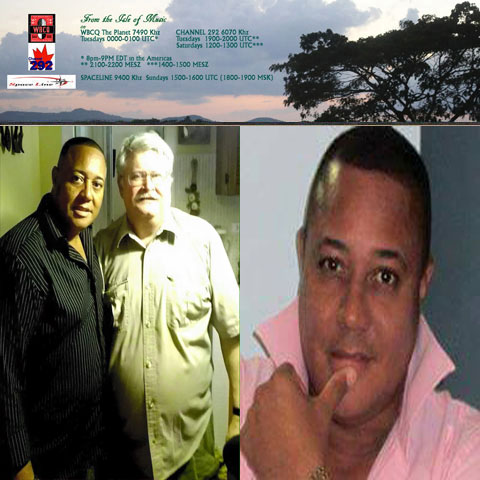
This week, our special guest is Denis Martínez, leader of the Timba band Denis y su Swing. Bring your dancing shoes.
The broadcasts take place:
1. For Eastern Europe but audible well beyond the target area in most of the Eastern Hemisphere (including parts of East Asia and Oceania) with 100Kw, Sunday 1500-1600 UTC on SpaceLine, 9400 KHz, from Sofia, Bulgaria (1800-1900 MSK)
If you don’t have a shortwave radio or are out of range, you can listen live to an uplink from a listening radio in the Netherlands during the broadcast at
http://websdr.ewi.utwente.nl:8901/?tune=9400am
2. For the Americas and parts of Europe, Tuesday 0000-0100 UTC (New UTC) on WBCQ, 7490 KHz from Monticello, ME, USA (Monday 8-9PM EST in the US).
If you don’t have a shortwave or are out of range, you can listen to a live stream from the WBCQ website here (choose 7490)
http://www.wbcq.com/?page_id=7
3 & 4. For Europe and sometimes beyond, Tuesday 1900-2000 UTC and Saturday 1200-1300 UTC on Channel 292, 6070 KHz from Rohrbach, Germany.
If you don’t have a shortwave radio or are out of range, you can listen live to an uplink from a listening radio in the Netherlands during the broadcast at
http://websdr.ewi.utwente.nl:8901/?tune=6070am

Uncle Bill’s Melting Pot, August 11 and 13, 2019:
Episode 125, Music for a Flat Earth, features music by groups with flat earth in their name.
The transmissions take place:
1.Sundays 2200-2230 UTC (6:00PM -6:30PM Eastern US) on WBCQ The Planet 7490 KHz from the US to the Americas and parts of Europe
If you don’t have a shortwave or are out of range, you can to a live stream from the WBCQ website here (choose 7490)
listen
http://www.wbcq.com/?page_id=7
2. Tuesdays 2000-2030 UTC on Channel 292, 6070 KHz from Rohrbach, Germany for Europe.
If you don’t have a shortwave radio or are out of range, you can listen live to an uplink from a listening radio in the Netherlands during the broadcast at
http://websdr.ewi.utwente.nl:8901/?tune=6070am

August 2019 Rockwork DXpedition

Many thanks to SWLing Post contributor, Gary DeBock, who shares the following guest post and update from the August 2019 Rockwork DXpedition:


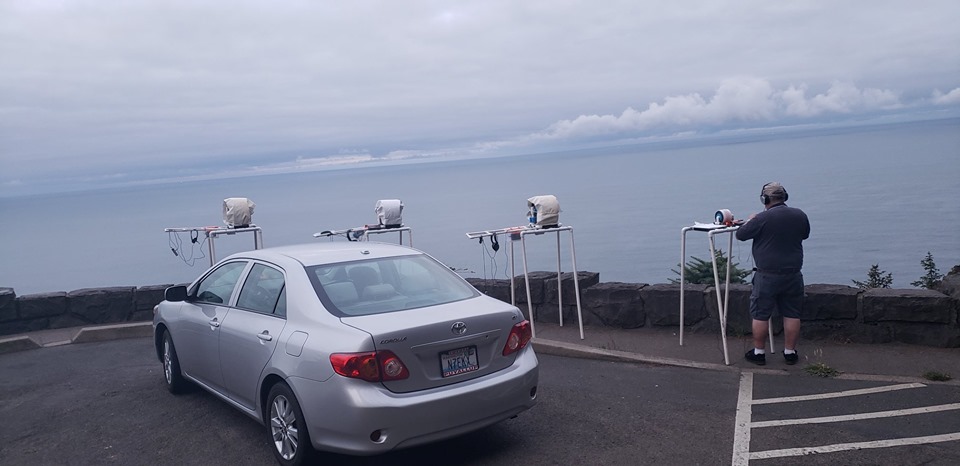
Gary DeBock DXing with Craig Barnes at the Rockwork 4 ocean cliff near Manzanita, Oregon, USA

Once again the largest FSL antenna collection on the planet made its way across the Columbia River bridge during an overnight trip to NW Oregon, finally being deployed at the original Highway 101 plunging cliff turnoff– Rockwork 4. There has been a drastic decrease in the squatter population, so that Craig Barnes and I were able to easily set up all four PVC bases for all-out DU-DXing at the dream site this morning (see photo). Unfortunately Chris Black came down with a health issue at the last minute, and needed to cancel out.

Craig and I had some excellent signals from the regulars (including 531-More FM, 558-Fiji and 1017-Tonga), although it wasn’t quite a stellar morning for rare DX. We were kind of spoiled last year with 1017-Tonga staying a S9 practically throughout the session, but this morning it was “only” at S9 for a few minutes at a time. This meant that as soon as I notified Craig of 1017’s potent status, the signal tended to nosedive. Maybe the cumulative effects of humidity and salt water exposure are beginning to take their toll on the Tongan big gun? 558-Fiji showed up with decent signals for a couple minutes at a time, which meant that Craig got the short end of the stick after I notified him of the potent signal. 531-More FM hit an awesome S9 peak around 1312 (including the usual split-second female ID), making it once again seem totally bizarre that no trace of the 2 kW modern rock station has ever been received at Grayland for the duration. The Rockwork Cliff is typically focused in like a laser on New Zealand, and this was a typical morning!

531 More FM Alexandra, NZ 2 kW Potent S9 modern rock signal from this Rockwork regular, with female “More FM” ID at 19 seconds:

Click here to download.

558 Radio Fiji One Suva, Fiji 10 kW Island music at temporary potent level at 1257; typically hit the skids after reaching this level:

Click here to download.

1017 A3Z Nuku’alofa, Tonga 20 kW Female Tongan speech at S9+ level at 1317:

Click here to download.

1017 Newstalk ZB Christchurch, NZ 10 kW Presumed the one under A3Z’s meltdown-level signal:

Click here to download.

73 and Good DX,
Gary DeBock (DXing with Craig Barnes at the Rockwork 4 ocean cliff near Manzanita, Oregon, USA)

DXpedition equipment:

7.5″ loopstick CC Skywave SSB and XHDATA D-808 Portables
15″, 15″ and 17″ Airport Unfriendly FSL antennas (see photos above)


Again, thank you so much for sharing your DX, Gary! I’m so amazed by the signals you snag each year with your homebrew loopstick antennas!

To read more of our posts by Gary DeBock, click here.