Many thanks to SWLing Post contributor, 13dka, for the following guest post:
A review of the XHDATA D-808
by 13dka
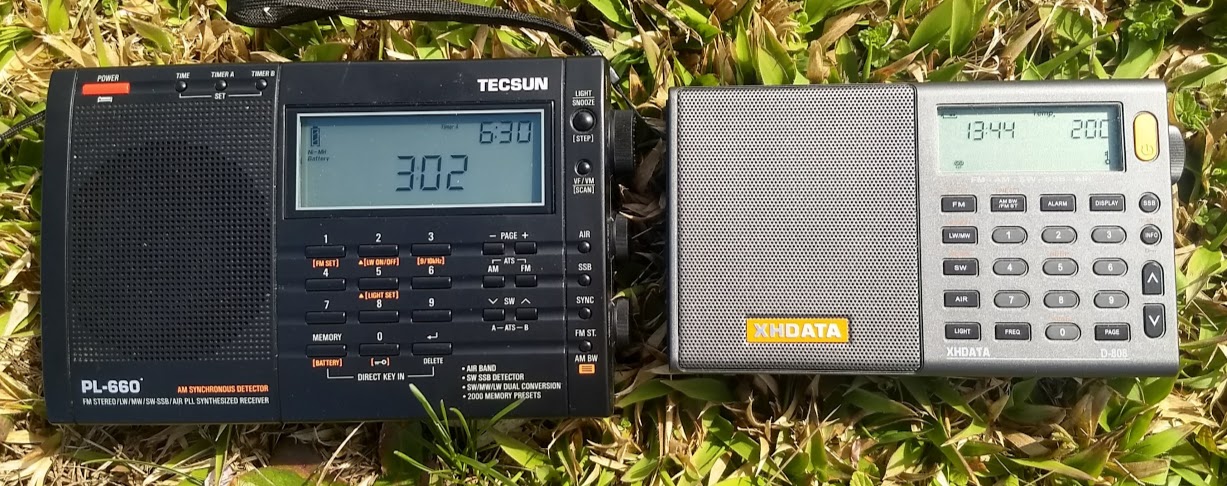
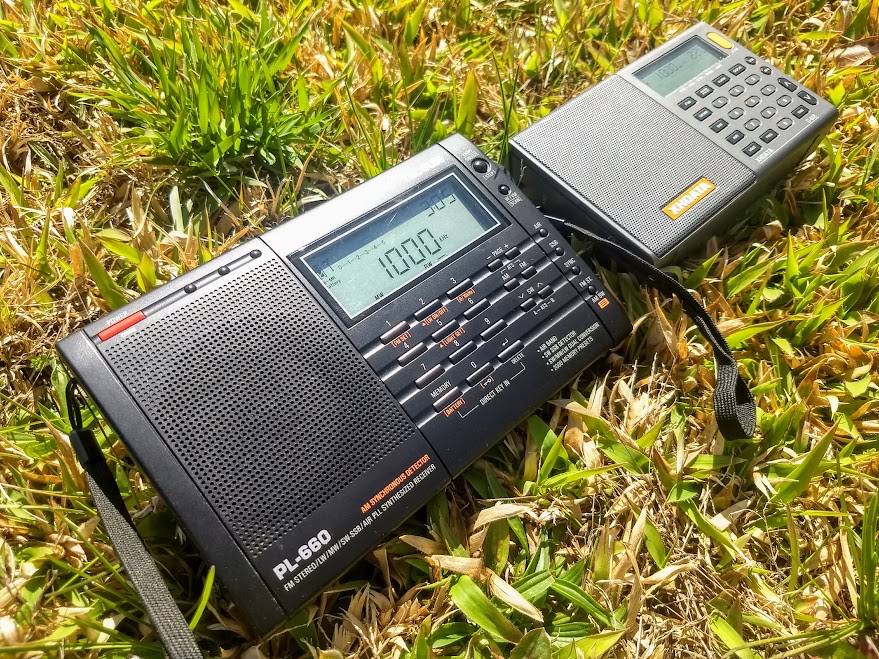
After all the recent buzz about the new XHDATA D-808 I had to get one. I got mine 3 weeks ago and I couldn’t help comparing it a lot with my PL-660. The PL-660 lends itself to such a comparison: it turned out to be the most sensitive shortwave portable with SSB in some comparison tests, so it became some kind of benchmark radio for this class of receivers and it has the same coverage as the D-808. Here are my findings, let’s start with the important stuff:
Performance

13dka’s “happy place” on the German North Sea shore.
I always try new receivers at my favourite listening post at the (German) North Sea shore, many of you know how beneficial such a location is for DXing. My favorite spot there is far away from any houses, power lines or other interference sources on the land side, so besides some sheep-made noise the man-made noise is as low as it gets, measured less than -130dBm (which is the receiver noise) on a 1/2 lambda dipole above 10 MHz.
At the same time the close proximity to the water results in somewhat boosted signals, so I can assess both reception quality at the lowest sensitivity threshold and behavior with strong signals. Sometimes it lets me find quirks that would go unnoticed anywhere else.
Here are my findings with the D-808:
Sensitivity
Longwave
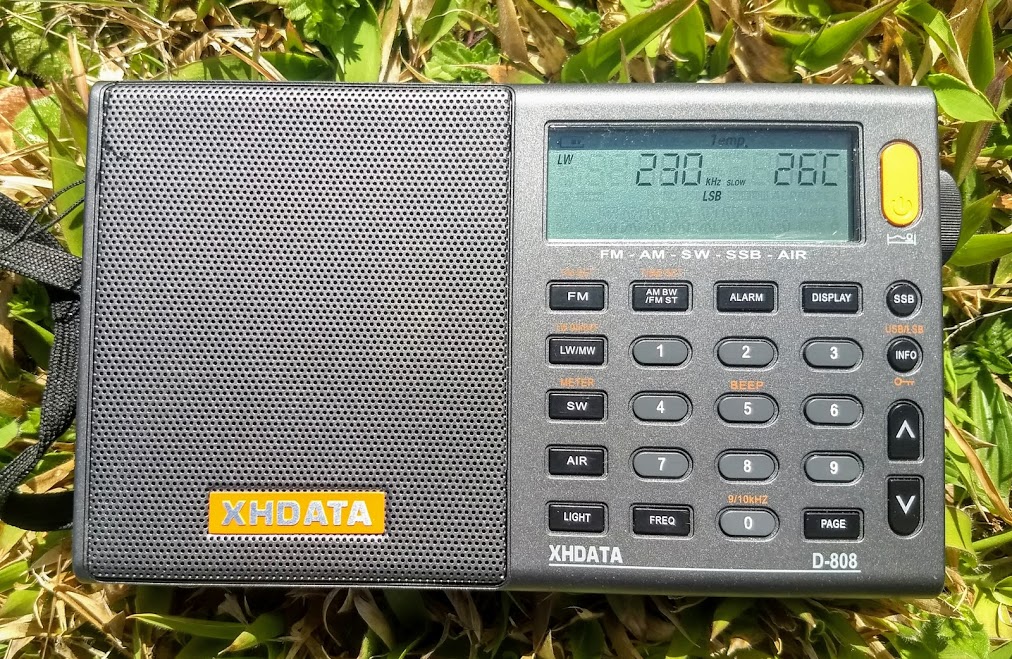
Since users in the US have little ways to test that, let me assure you that all rumors you may have heard about a deaf longwave are perfectly true: the European LW broadcast band is pretty much not existing on the D-808. All those reports (e.g. many to find in Amazon reviews) indicate that really all D-808 are affected. The PL-660 is known to be very deaf on LW as well but it picks up a few stations in the evening, only some of them leave a faint clue on the D-808 and it can’t pick up BBC 4 on 198kHz even at night.
The signal meter indicates that it gains some sensitivity only above 300kHz, but from there it quickly starts to beat the PL-660 – during the day I can hear all of the local NDBs, something I can’t say about the PL-660.
AM broadcast band
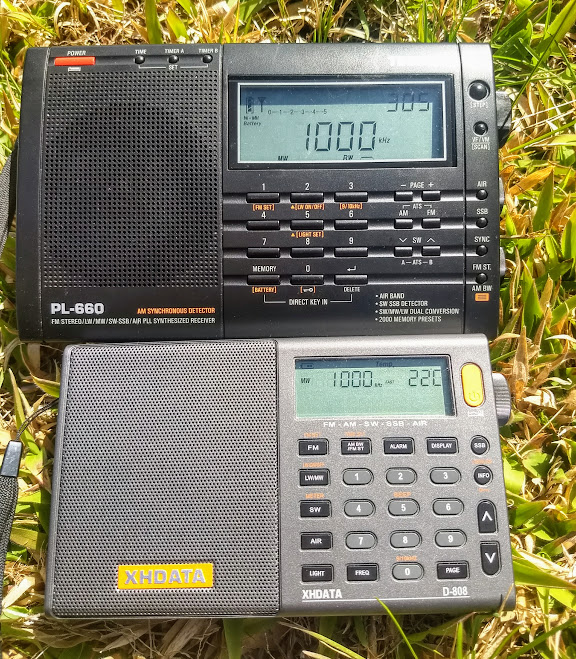
This continues throughout the AM broadcast range – best tested during the day and on early evenings, the D-808 lets me ID weak stations that are just not there (yet) on the PL-660. Being noticeably better than the Tecsun, I then compared it to my old Grundig Satellit 400 (which has an average sensitivity on MW) and the D-808 matches its performance perfectly. So perhaps it’s not exactly a MW DX machine with just its internal loopstick but it performs well enough to make the band enjoyable.
Trying that at night and indoors shows why the right time and a low-noise location (or alternatively proper test equipment) are so important for such comparisons: any weak station sticking out of the distant and local QRM there is not as weak as it sounds anymore, both QRM and wanted signal are now well above the sensitivity thresholds of both radios and so SNR is defined only by the QRM, not the receiver. That means both radios falsely appear to have exactly the same sensitivity.
Shortwave
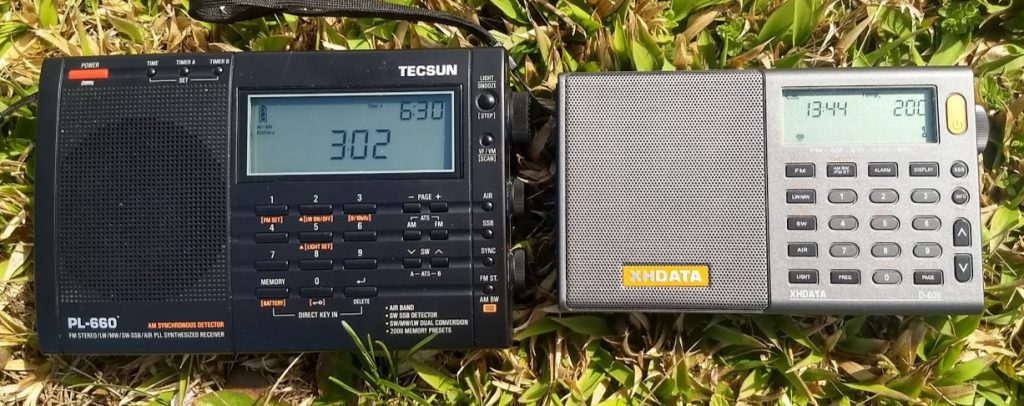
Notwithstanding some duds, the PL-660 is known to be a little sensitivity monster on shortwave. When I don’t feel like putting up wires etc. for my SDR, I just take the Tecsun to the beach and through the years I own it, I’ve logged plenty of true DX (JA, VK/ZL or WWVH on a regular basis) with it there, just using the telescopic whip.
Only below 3 MHz it’s not all that great on the whip, and that’s where the D-808 beats it – listening to top band (160m) hams works surprisingly well for a 25 inch whip. Between 3 and 30MHz the D-808’s sensitivity appears to be almost on par with the PL-660, the PL-660 often wins in terms of intelligibility at the “minimum discernible signal” (MDS) threshold. For example, on a day with bad conditions Gander Radio on 6604kHz USB had a barely audible signal on both radios. But I could occasionally decipher some words on the Tecsun that didn’t make it through the noise on the D-808. These photo finish victories for the PL-660 can be observed across most bands, but it needs ridiculously weak signals to spot the difference.
This difference is partly due to the fact that the D-808 seems to be a tad more noisy and partly owed to the better speaker of the PL-660. But the PL-660 also sports the often frowned upon “soft muting” feature, thus creating an impression (or should I say illusion?) of a pretty quiet receiver. I find it hard to tell whether the D-808 is really noisier than the PL-660, or just lacking this permanent noise reduction. I think this feature potentially even increases intelligibility on SSB a tiny bit, but on AM it’s just disturbing and makes the Tecsun lose its sensitivity advantage. Bottom line is that the D-808 is at least very close to the PL-660 in terms of sensitivity on shortwave and I find that quite remarkable.
FM

Both receivers are pretty identical in FM performance on their whip antennas. Sensitivity is good enough to pick up high-power stations more than 100km away in times without any elevated conditions. Both receivers don’t need much signal to make a station intelligible, so when conditions improve a tiny bit (“marginal” indications on the Hepburn Index map) the band already gets populated accordingly. One difference is the coverage: the PL-660 can be switched to cover the Japanese FM band (76-108MHz) only, the D-808 covers the old OIRT band (64-108MHz) on top. What makes the D-808 the winner is its RDS/RDBS capability and the size, it certainly has the sensitivity needed for some ad-hoc FM-DX when you find yourself bored on a hill or in sudden tropo conditions.
By the way: RDS gets decoded sufficiently fast and starts to show on signals with an SNR of at least 12dB (see the bit about the RSSI/SNR meter below). If the station transmits date information it will set the clock automatically, but when you go on a hunt for stations it may receive some garbage data that resets the clock to a wrong time. It may be best to turn on the automatic only occasionally to set the clock, then turning it off again.
Air Band
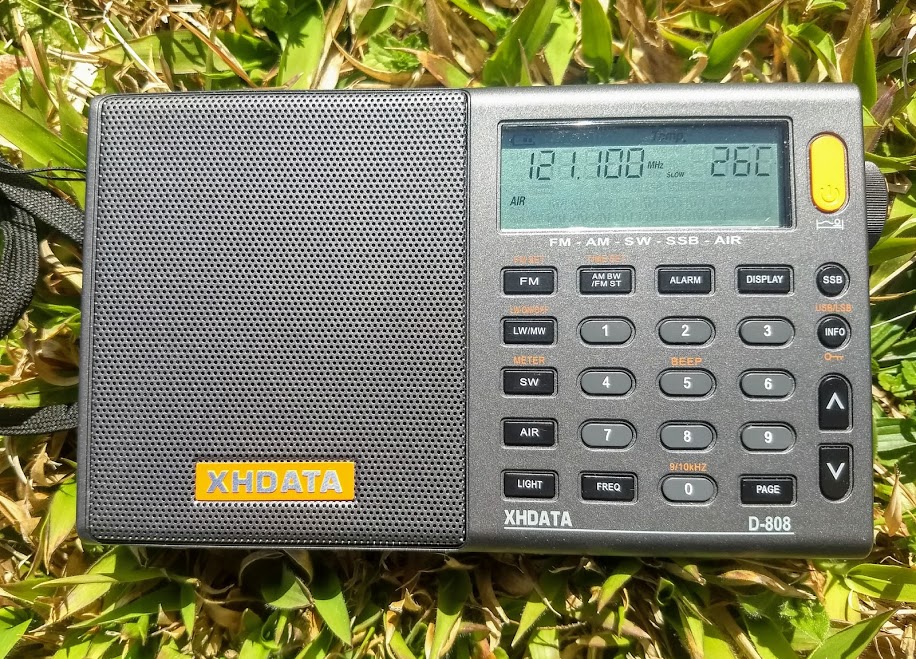
The D-808 is at least as sensitive as my Alinco DJ-X11 scanner and skunks the rather deaf Tecsun in this band. Unlike the PL-660 and most other small receivers covering that band it has a squelch, which is by the way active on all bands.
What it lacks is the new 8.33 kHz channel spacing, the “Fast” tuning step is still 25 kHz (“Slow” is 1 kHz) and the scan searches the band in 25 kHz steps as well, so I have to tune in the new channels manually. But while it lacks the new spacing, it absolutely has the selectivity for it – the AM filters are all available on the air band as well and even the widest one is still good enough to separate adjacent channels sufficiently. My 6 times more pricey Alinco has the new 8.33 kHz channels but it can’t separate them at all.
The D-808 is a great air band receiver!
Selectivity
The PL-660 has 2 (I think unspecified) ceramic IF filters for SW, which are doing a good job serving 90% of all typical purposes for such a radio. The D-808 on the other hand utlizes the DSP for IF filtering and offers whopping 11 different bandwidths (6 on AM and 6 for SSB), this is even more than the PL-880! This sold the D-808 to me the most, for example I like to improve my very poor CW listening skills every so often, and always having an even narrower filter up the sleeve can save otherwise hopeless DX reception in the ham and broadcast bands. But are they any good?
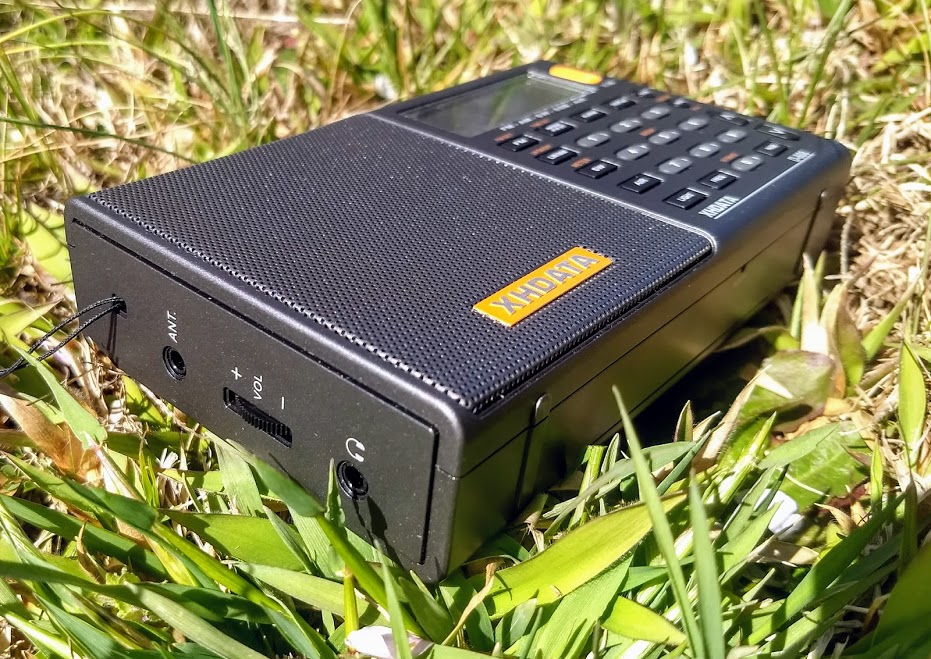
SSB: 500 Hz, 1 kHz, 1,2 kHz, 2,2 kHz, 3 kHz, 4 kHz
The 500 Hz “CW filter” seems to have a rather slow cutoff, unlike a true 500 Hz CW-filter it leaves voice communication almost intelligible. Still beats trying to hear CW through a regular SSB filter though! The 1 kHz filter seems to be the only one with an offset lower skirt (=less bassy sound), which can be useful in some cases. I’m not quite getting the purpose of the 1.2 kHz filter, I think I’d prefer a 1.8 kHz filter for a step between 1 and 2.2 kHz. The 1.2 through 4 kHz filters have the steeper cutoff you’d expect from DSP filtering and serve their purpose pretty well. In the “Gander Radio” example above, the narrow filter on the PL-660 couldn’t keep 4XZ’s CW signal on 6607kHz in check, while the D-808’s 2.2kHz filter eliminated the CW signal completely. I’d still take the bandwidth figures with a grain of salt though.
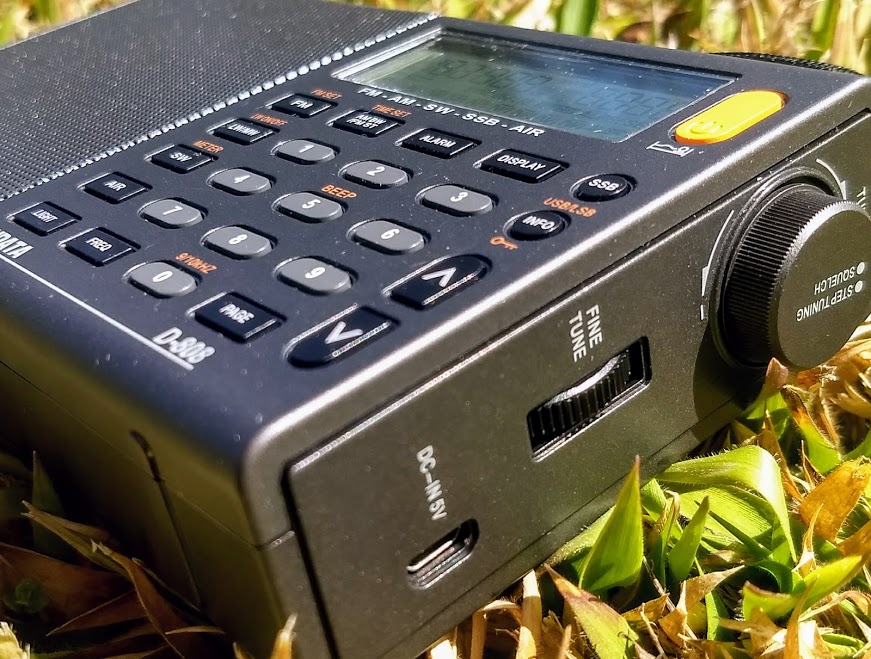
AM: 1 kHz, 1,8 kHz, 2 kHz, 2,5 kHz, 3 kHz, 4 kHz, 6 kHz
Oddly, the published bandwidth for the AM filters seem to be “audio bandwidth” (or “per sideband”) figures rather than IF-bandwidths, so they equate to classic IF filters with 2/3,6/4/5/6/8 and 12 kHz bandwidth. The only overlap is 4 kHz, hence I say it’s 11 different bandwidths, not 10. I think these AM bandwidths should cover all requirements that might come up, on top of those you can try ECSS reception with the SSB filters.
SSB Reception
On pretty much all of the tiny shortwave portables, SSB reception comes with some tradeoffs and the D-808 is no exception. When the PL-880 hit the market a few years ago, the amount of filters for SSB offered by the Si4735 DSP raised my hopes for improved SSB, but unfortunately the D-808 has the same problem that kept me from buying the PL-880 back then, and some on top:
AGC distortion
Like the PL-880 (at least some of them), the D-808’s AGC has a way too slow attack rate, the first portion of any strong SSB/CW signal is distorted before the AGC levels back, and it increases gain fast enough that even short talking (or keying) pauses make the next syllable distorted again. This seems to plague most (if not all) Si4735-equipped radios, so that might be actually a bug of the DSP.
Tuning
The chuffing noise is making tuning through the band quite bad in SSB mode, it’s even worse than the early digital “keypad”-style radios in the 1980s: every tuning step is causing first a short muting of the signal, then audio comes back with a loud “chuff” from the AGC kicking in with full gain – tuning sounds like a model railway steam engine sound chip gone mad. Luckily, fine tuning with the thumb wheel doesn’t have this issue.
Filter dropouts
Another issue is an occasional effect that sounds and feels like the filter drops out when you tune through the band. The chuffing sounds different and the background noise sounds wider with more hiss, then after a while (this can take several seconds) the filter pops back in with the regular puff from the AGC.
Slow mode switching
When switching to SSB a “loading bar” shows up first, the entire process between hitting the “SSB” button and getting reception again takes 5 seconds. Actually, these radios basically consist of a “radio-on-a-chip” and a microcontroller so it really might be a loading bar we see there. This controller seems to be not exactly fast in the D-808 anyway, so even using the tuning knob comes with occasional hesitations – I advance the main tuning encoder one indention and the frequency changes only 1-2 seconds later. Changing bands is not exactly fast either but at least toggling between USB and LSB works instantaneously.
In comparison, the PL-660 has none of these issues – tuning is smooth and fast, and the AGC is less borked. So tuning the D-808 isn’t elegant and it doesn’t sound exactly beautiful on SSB. On the other hand it has great frequency stability, great selectivity and sensitivity and I can hear what I want to hear anyway. At 1/3 of the price for a PL-880 and pocket-friendly 2/3 of its size I decided to avoid overrating the quirks.
AM Reception
… is fortunately less odd. The chuffing gets replaced by less annoying muting when tuning in AM mode, the ability to quickly scan a band with the main tuning knob seems to be less hindered by that. The PL-660 has a mediocre sync detector and the D-808 has not, but it can score with easier ECSS reception through its much less fiddly fine tuning in 10 Hz-steps (range +/- 990 Hz with the last digit omitted in the display) and the choice of filters is a clear advantage over the Tecsun’s 2 bandwidths in tricky DX situations. As mentioned above, the Tecsun is also losing its sensitivity advantage due to the soft muting on AM, so its remaining big plus is the more pleasant speaker sound.
Signal handling capabilities
As mentioned above, signals can increase quite a bit in very close proximity to the water. When conditions were good, I’ve witnessed occasional overloading even with just the whip antenna on the PL-660 there. But the Tecsun has a 3-position sensitivity switch that first turns off the input amplifier and then adds an attenuator, so it can manage these situations by turning off the preamp and it happily digests signals from full size dipoles, long wires and active antennas with the built-in attenuator in the signal path.
The D-808 has no such thing and that makes it at least as vulnerable to overloading from good conditions or big antennas as the PL-660 without attenuation. At the beach it exhibited very faint intermodulation even at propagation conditions that were just “not quite as crappy as the current record low” when the Tecsun did not. They were so soft that I think this can’t be heard when the noise level is a bit higher, still a bit strange. Intermodulation products seem to show up most prominently around 7MHz, 10MHz and in the 15m ham band first.
Other than that, it seems to abide <10m/30ft of wire just fine and it gets along with my ML-200 active loop, currently indoors with a rigid 80cm aluminum loop, unless the RRI transmitters populate 49 and/or 41m after midnight. That station occasionally hits the 9+60 mark on my SDR with a dipole and when they’re on, the D-808 has to be tuned far away from these bands or disconnected from the loop to stop the pumping, desensitizing and intermodulation products. Interestingly, strong signals often make the filter drop out (as described under “SSB reception”) as well. A theory could be that this happens when an off-band signal (and/or the AGC causing “clipping”) makes an AD-converter run out of bits.
That even regular good signals outside the filter passband can trigger unwanted AGC action might be more or less common with most of those DSP radios. The massive worldwide contest activity on March 24/25 was a nice opportunity to test that. Even though I fled to the less crowded upper region of the 20m-band and it was an hour after sunset so the band was closing, I noticed the AGC was pumping a lot while listening to a contester with a moderate signal. It could be the the ceramic filters (which are said to have better out-of-band rejection) or just the way my Tecsun’s AGC works (or malfunctions) differently, however this effect is much less pronounced on the PL-660.
Frequency stability, accuracy, birdies, quirks
Both receivers are generally very stable and don’t exhibit a noticeable warm-up drift. Just to see what happens, I took the D-808 from a very warm apartment into cold (-5°C/28F) and stormy weather outside. The internal (and very slow changing) thermometer of the D-808 indicated an internal temperature drop of 12°C within 10 minutes and if there was a drift at all, it drifted less than 10Hz.
Comparing the BFO frequency accuracy (using RWM on 4996 and 9996 kHz) brought up some slight offsets across the coverage range, with different curves for LSB and USB:
4996: USB=-160 Hz, LSB=+110 Hz
9996: USB=-190 Hz, LSB=-300 Hz
So particularly on LSB, the offset on my D-808 varies quite a bit over the entire coverage range but I think this is within the allowable tolerance for such a radio. The PL-660 has slightly better results but it also has a center-indented fine-tuning knob making small corrections quite difficult. In AM mode they are both spot on.
So far I couldn’t find birdies anywhere on the D-808. The PL-660 is pretty clean on shortwave too, but it has hefty birdies around 100, 200 and 970kHz, despite the efforts Tecsun has put into shielding and clean PCB design.
SWLing Post reader Mike reported a loud “pop” when changing bands. I can replicate that but it’s not that loud here. I’m getting a much louder pop (independent from the volume setting like Mike’s pop) when using the band scan function though. If I’m tuned to a station and another station (strong enough to stop the scan) is quite close (10-15 kHz) to the station where the scan was started, a loud pop will be heard when the scan stops at the other station.
Operation/Ergonomics
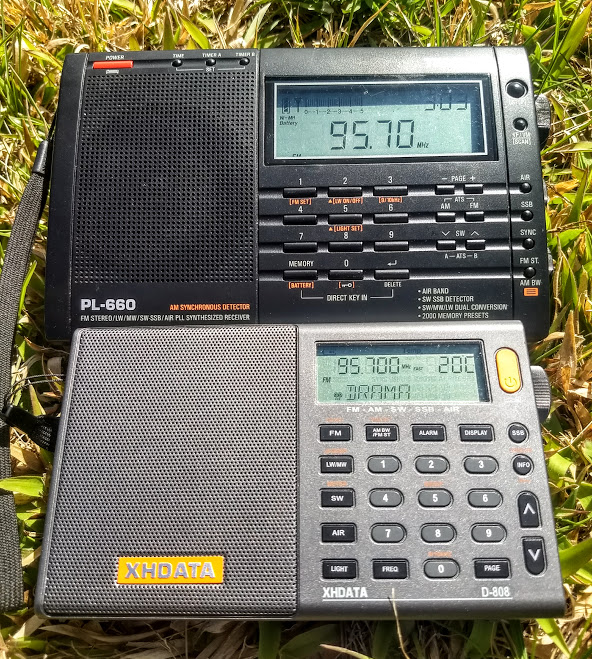
Both receivers have some “thin plastic” feel to me, but while my PL-660 has some slightly rattly and wiggly buttons and knobs rubbing against the casing, the D-808 has none of those and feels a tad more solid. The tuning knob and the fine-tuning thumbwheel have quite strong detents, so they are not very prone to unintentional detuning. The D-808 lacks the weight and the tiny rubber feet that keep the Tecsun fixed on the table.
Control
I’ve seen quite a few complaints/misunderstandings about the D-808’s operation and I think this is due to the fact that there is a fundamental difference between e.g. many Tecsuns and the D-808 in terms of keypad usage: the PL-660 is prioritizing direct frequency input and the D-808 makes memory operation easier. It couldn’t be any easier indeed – depressing a number button on the keypad for more than 3s stores a frequency, hitting it shortly loads that frequency. “Page” button, then number key loads the memory pages 0-9 on each band (so each band has 100 memories). Like the PL-660, the memories store frequencies only, not the mode and also not the bandwidth (despite the manual claims they do). Also differing from the manual, the selected bandwidth stays put per mode and doesn’t reset to a default setting.
Direct frequency input needs to be initated with the “Freq” button though, and in some cases (shortwave frequency <10,000kHz) you need to hit it again to enter the frequency. The D-808 has up/down buttons in addition to the main tuning knob, they are stepping through the bands in the “Fast” step width so you can pretty much always leave the tuning knob on “Slow” . Pressing these buttons longer than 3s starts the band scan. Holding each of the left side band buttons starts the “ATS” scan-and-save-to-memory automatic.
The D-808 shares the “power off” settings scheme with the Tecsuns – some functions like LW on/off, the FM band coverage and so on are set when the radio is off. These functions are labeled in orange above the corresponding buttons and I share the criticism about the color scheme, which is really hard to read in less than optimum lighting conditions. Also, some of the labels are actually “power on” functions marked in the same color, like the “METER” function on the SW band button (hit the SW button repeatedly to step through the broadcast bands) or the USB/LSB switching and key lock functions activated with the “Info” button.
Display/Backlight
Despite the size difference, readability of the display is fine on both receivers. Backlight control is fundamentally different tho: You can turn off the automatic backlight on the PL-660 but you can’t turn it permanently on, the D-808’s light button toggles between “permanently on” and off but you can’t turn off the automatic. The backlight is objectionably bright on the D-808, the upside is that it serves well as a reading light and the light reflected off your hand can illuminate the buttons sufficiently to substitute the missing button lighting.
Some random things I like:
RSSI/SNR meter
Like the PL-880 and some other Tecsun radios, it has a somewhat odd “dB over 1 microvolt”-like signal indicator. It lacks the negative figures needed to properly represent the ~S0-S3 range, it just goes from ’00’ to ’99’ and it’s strangely labeled as “dBu” but technicalities aside, it is a signal indication in 100 steps which is certainly more useful than a 5 bar indicator. According to reports, other receivers with this RSSI don’t seem to use the entire display range and end at ’75’ or less. However I can see the D-808 showing ’99’ when I’m at our airstrip and the tower transmits.
The second pair of digits is a crude calculation of receiver (not audio!) SNR, which can be useful in conjunction with the signal strength meter, e.g. for adjusting or comparing antennas and so on, and it works best with AM and FM signals.
Battery Endurance
“18650”-batteries have a very high energy density at a very low weight, and in the D-808 they meet a radio with a very moderate power consumption. As a result, the provided 2,000mAh battery powered the radio continuously for remarkable 32 hours, 14 of them with the display light on! For comparison, the heavier (and more expensive) 2,500mAh Ni-MH batteries in my PL-660 last for 24 hours only.
It seems the quality of the packaged battery is all over the place though, one user reports “have to charge every day”, another one “28 hours”. If in doubt, a Panasonic 3,400mAh battery (this is the current technical limit for 18650s, don’t fall for fake “10,000mAh” offers seen on Amazon and eBay!) should last for a long weekend even if you’re listening all day. Make sure you buy the “protected” type, the other flavor (used e.g. in electric cigarettes) doesn’t work. If you happen to be a high-performance flashlight fan, you may already have a bunch of batteries to keep the D-808 going forever.
The manual claims that the D-808 can’t be charged when it’s on but I found that’s not quite true–it sure takes much more time but I could top off a slightly discharged battery just fine.
Charging it from a USB charger or laptop USB port introduces some additional noise on AM/SW of course, trying a cheap power bank worked out much better in this regard.
A true “Walkman” for SWLs
The PL-660 fits in some big pockets only and weighs more than a pound. The D-808 has only 2/3 of the Tecsun’s size and I can stuff it conveniently into all of my jacket’s side pockets (tuning knob ahead) so the whip can stick out easily without getting into my way at all. It has at most half the weight of the Tecsun, it weighs less than my smartphone!
This is making an old dream come true for me – a full-featured “communication receiver” (well, almost) that’s “wearable”, one that allows me to enjoy hands-free and hassle-free full shortwave reception on all bands without compromises (particularly in sensitivity) when I do the boring walks the doctor prescribed!
Outsides where the noises of the digital world are gone, the D-808 presents all bands almost as filled as my dipole at home and so there’s always an interesting QSO or some overseas radio program to enjoy. To give you an idea on what I mean by “no compromises”: my companion on today’s walk was NY2PO from upstate NY (3,728mi/6,000km away) on 40m, constantly coming in with a signal allowing for convenient listening, despite the bad conditions (SFI=68 A=10).
I think this may be the first time a radio with so many features and such a high sensitivity comes in such a small package – all handheld scanners with SW and SSB were an expensive atrocity on shortwave, the late ICF-7600 was slightly bigger, less sensitive and SSB was not its strength. The only radio with even more features and similar dimensions would be the “Reuter Pocket” SDR but that might be less sensitive on a whip, it lacks the air band, it has a 1-digit battery runtime and a 4-digit price tag. The only other affordable radio that could fit that bill would be the even smaller Tecsun PL-365 SSB, but it lacks an SSB filter, it has no RDS and no air band and I’d be curious if it can match the sensitivity of the XHDATA.
Verdict
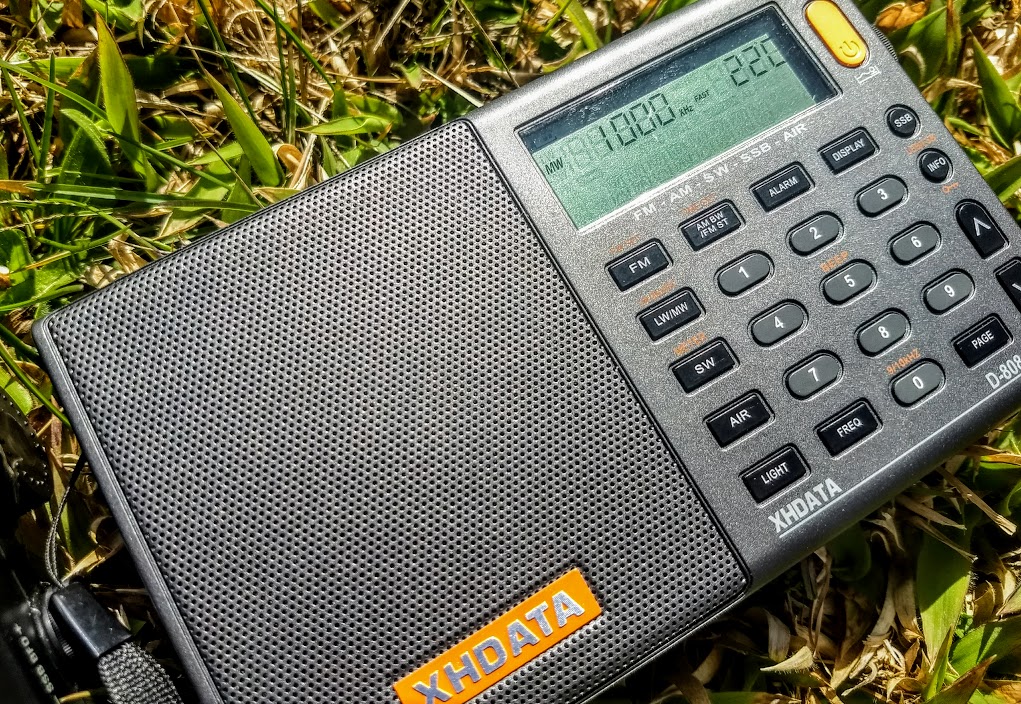
The D-808 can score in 3 bands (Air, FM (due to RDS) and AM) with its sensitivity, the PL-660 only on LW (due to the fact it actually receives something there) and by a narrow margin on shortwave. The Tecsun’s (perceived) lower noise floor, better speaker sound, better tuning and built-in attenuator is countered by a much wider choice of filters, better fine tuning control, better portability and the better battery endurance of the D-808. The latter also has a number of less important features the former lacks, on the other hand the Tecsun lacks the many quirks of the D-808. It’s up to you to weigh the advantages of each to find your personal favorite, the D-808 struggled a bit to become mine but at the end I couldn’t help enjoying this little radio a lot.
There is much room for improvement though – for example the slightly borked control of the DSP, the chuffing/tuning and AGC issues on SSB let the D-808 miss the title “most stunning cheap little radio ever” by a hair.
For me, the unique combination of size, sensitivity and selectivity is making up for the shortcomings, it certainly remains a very interesting radio and I can’t remember carrying one around that much, ever.
What a brilliant, detailed assessment of the D-808! Thank you so much for sharing this! I’m absolutely jealous of your North Sea listening location–looks to be idyllic!
Check out the XHDATA D-808 on Amazon.co.uk (affiliate link) and AliExpress.