Shortwave listening and everything radio including reviews, broadcasting, ham radio, field operation, DXing, maker kits, travel, emergency gear, events, and more
FROM THE ISLE OF MUSIC NEW WINTER SCHEDULE STARTS DECEMBER 12
This week, our special guest will be guitarist and composer Sergio Valdés Garcia, who in addition to doing much of the soundtrack for the film Juan de los Muertos also recorded some excellent music with his group Elévense. Also, we will have some authentic Rumba by Team Cuba de la Rumba in honor of the Rumba’s recent recognition by UNESCO.
NEW! Three options for listening on shortwave:
WBCQ, 7490 KHz, Tuesdays 0100-0200 UTC (8pm-9pm EDT Mondays in the Americas)
Channel 292, 6070 KHz, Fridays 1100-1200 UTC (1200-1300 CET) and Saturdays 1600-1700 UTC (1700-1800 CET)
See the From the Isle of Music Facebook page for more information.
Many thanks to SWLing Post contributor, TomL, for the following guest post:
“Car Shack” radio listening
by TomL
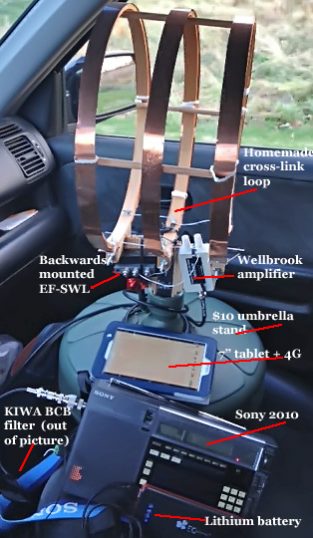
My car is an unusual place to listen to shortwave radio but has interesting possibilities. Due to the obscene noise at my home QTH, I decided that I must try something away from this unfortunate situation. So I took my homemade 14-inch loop antenna and outfitted the appropriate ancillary equipment with DC power packs. My trusty Sony ICF-2010 is the radio “vehicle” to “drive” this experiment (LOL). And, seriously, this is a way to show the public that it is not that hard to have a portable radio listening setup. Believe me, if I can do this, anyone can!
The basic ingredients are pictured here with some variations (see text):
Wellbrook amplifier powered by DC power pack of 10 eneloop AA batteries
KIWA Broadcast band (mediumwave) inline filter
Palstar preselector (active antenna) plugged into car cigarette lighter
Sony 2010 connected to a second DC power pack
Sony ICD PX333 digital recorder
Sennheiser earbuds
7 inch Samsung tablet and 4G MiFi device to do internet schedule lookups
Illustration SEQ “Illustration” 1: Car Shack in operation.
An important finding was that anything that has a cheap IC circuit to regulate and/or convert DC power can be extremely noisy! The pictured 16000 maH lithium brick would initially be quiet but after a while it would start spewing noise all over the bands. Power cycling it sometimes helped but I decided that it is too unpredictable. Also, converter cables that convert 5V to 12V for devices needing 12V also produce overwhelming amounts of noise. Even a small 5V USB converter plugged into the cigarette lighter makes a modest amount of ubiquitous noise. I am ditching the lithium power pack and converter cables and any cigarette lighter adapters!
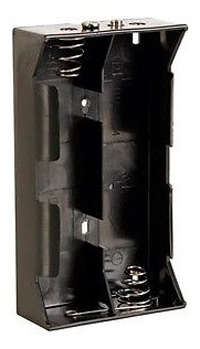
So, the main radio power pack will use the internal Sony battery comparment consisting of nine 2700 maH NiMH AA’s inside three D-cell battery holders that can each hold 3 AA batteries in parallel. This boosts the capacity to around 8100 maH for a modest cost (I already have NiMH chargers and the 4.5V requirement is not too high for the batteries in question). Pictured are examples of a single D-cell AA holder of which I bought 12 and the silver-top Powerex 2700 maH AA’s from fleaBay. The total voltage is slightly low (3.6V) but the Sony 2010 still works at a slightly lower performance (received signals are slightly weaker). I run the Sony on Local sensitivity and crank up the Palstar active antenna to compensate.
In a further quest for clean, portable DC power without noisy IC chips, I have been researching lithium batteries and it is quite a large amount of work to sift through all the variables. The Palstar active antenna and the Wellbrook amplifier both use external connections of 12V, 2.1mm (+ tip) plugs. NiMH is not going to cut it, too many needed and getting too heavy. Amongst the variables are things like:
Using a proper charger and not leaving it unattended or it could burn down your house
Chinese fakes being sold by the zillions that look exactly like the real thing
Initial cost being higher than current NiMH
Avoiding 1.5V step down batteries with noisy step down converter built-in
Learning the new terminology for sizes: AA = 14500 = 14mm diameter & 50mm length
Learning the differences between type of lithium: Lithium, Li-ion, LiFePo4, IMR, etc.
The difference between protected vs. non-protected batteries
How to avoid discharging the batteries too much which could render them completely useless (not just usage but also NON-usage as well)
How to physically handle Lithium batteries to avoid shock and temperature extremes
Learning how to compare maH’s of lithium to NiMH batteries
Finding out that most top rated 14500 Li-ion batteries are too long to fit into AA battery holders without risking damage to the protection PCB mounted at the bottom of the battery
and the list goes on and on…..
Here are some of the web pages I read to try to understand this technology:
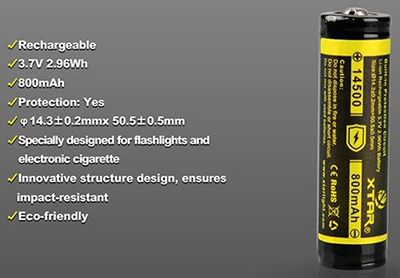
So, to cut to the chase, I have decided to order this one from XTARDirect because:
I can order from a USA distributor who orders from the factory in Shenzen China
The price is very reasonable for “protected” lithium ion batteries
They actually should fit into typical AA battery holders without damaging it
Illustration SEQ “Illustration” 2 XTAR 14500 800 maH Li-ion
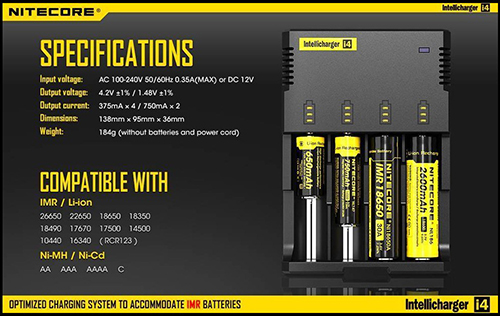
They are not the highest rated in terms of capacity, load drain, amp surge ability, etc., but they seem to have enough positive statements from users that indicate it gets the job done. Since I don’t have the lithiums yet, I am using some temporary 10-cell AA holders with good old Eneloops – good enough for now. And I am buying this discontinued charger at a discount to recharge lithiums:
Illustration SEQ “Illustration” 3: Nitecore i4 original version
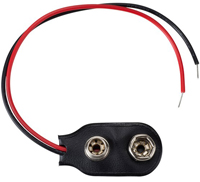
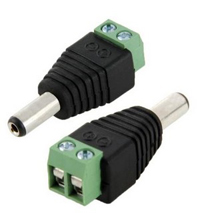
I will make two power packs made from these items pictured. The wire is fragile so I super glue the insulation directly to the DC power plug housing (avoiding getting any glue onto the bare wire inserted at the back). I will use three sets of lithiums (9 batteries) plus one set of Eneloop Pro’s (3 batteries) per power pack in the aforementioned parallel AA holders.
Illustration SEQ “Illustration” 6: 2.1mm x 5.5mm DC power plug.
Other items of note: The umbrella stand is optional since I found I like to move the antenna around and even tilt it to get slightly better directional signal. More importantly, I found that if I cut the Sony 2010 sensitivity from DX to Local, and then crank the Palstar preselector’s amplifier, I get a cleaner sound with less background noise. Also, the KIWA mediumwave filter is essential due to overloading.
One of my favorite stations is Radio Educacion (XEPPM) on 6185 kHz. A 1 kW station near the foot of Vulcan de Guadalupe in Mexico City, it is so weak that I almost never hear it and their wonderful selection of music representative of regional & cultural heritage. It is also 1675 miles distant according to Google Earth. Now, if I want to bother, I can go out and listen in my car at locations less noisy than home. So far, the safest places have been the parking deck at work (only two stories high) and the local grocery store parking lot. What I would really like is a very tall parking deck whose owners let me stay up on top long into the evening without harrassment (not sure I want to risk security personnel questioning me about the strange contraption and equipment – paranoia reigns these days)!
Sample of XEPPM, moderately good propagation from the work location:
Unexpected reception happens with this experiment. I mounted the antenna in the back, away from the engine and against the rear side window. Was traversing the local restaurant drive-through lane to get a hot dog, and turning the corner next to the long empty brick wall, the reception became dramatically stronger and clearer! Apparently, the brick wall blocked some interference as well as enhanced the signal coming from the Northeast. You can hear the effect starting at 25 seconds into the recording of RRI:
Also, not recorded from a previous evening at the grocery store location, 6135 kHz Radio Santa Cruz in central Bolivia, a 10 kW station playing Spanish rock music and a clear ID near the top of the hour.
More experiments to do, like
Mount the antenna as high I as dare with PVC pipe (too cold out now and I would rather not open any windows but I am itching to mount the umbrella stand and antenna on a 3 foot PVC pipe on the roof of the car, the increase in received signal strength is significant)
A bigger backpack to carry all this equipment away from the car
If Elon Musk has his way and builds the Gigafactory (and competitors follow suit), there could be many more experiments with lithium type batteries in the future
Perhaps get an SDR and cheap laptop computer to replace the Sony radio
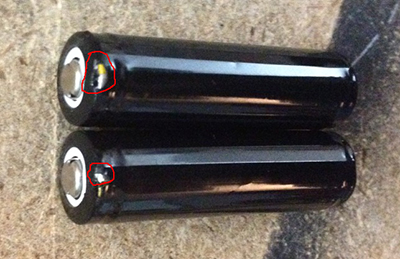
PS: I found out that the three-AA battery holders do not make contact at the (+) tip of the XTAR lithium batteries I purchased. I just gently lifted up the contact inside the battery holder to allow it to reach the battery tip, that’s all that is needed. Whatever you do, do not put an extra piece of metal inside the battery holders! I accidentally damaged the outside skin of two of the batteries with a common piece of copper metal and the batteries immediately started to get HOT. I took them out as soon as I could and the batteries cooled down. So, don’t use any extra metal surface inside the battery holders; lithium batteries do not tolerate any kind of short circuit!
Cheers from Noizey Illinoiz,
TomL
Thank so much, Tom, for sharing your experiences and your ongoing experiments! Lately, I’ve been doing NPOTA activations with a portable loop antenna on top of my vehicle. I completely understand what you mean about getting strange looks from passers-by! We look forward to hearing about your future experiments fighting RFI.
Many thanks to SWLing Post contributor, Mario Filippi (N2HUN) for the following guest post:
An Unusual Night for CB
by Mario Filippi (N2HUN)
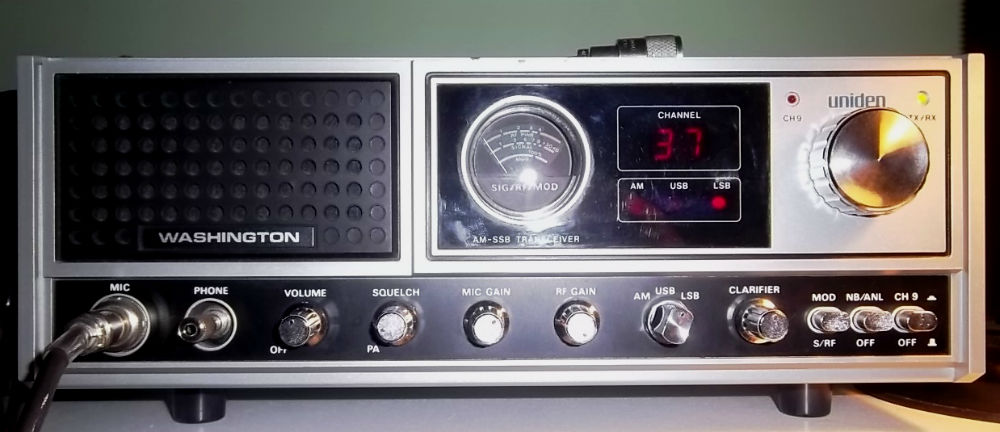
December 2nd was an unusual night for CB (Citizen’s Band) radio, as the band was open late (0030 GMT) when I turned on the President Washington CB radio just to see who was on. First stop was Channel 19 (27.185 MHz), the trucker’s channel, where the QRM was high, due to the skip from the many truckers on the channel. Earlier in the day this channel was very quiet as was the rest of the band. The fact that Channel 19 was pinning the S meter after dark was a big hint that the band might be open. And it certainly was!
Uniden President Washington AM/SSB Base Station
Being a CB’er from back in the 70’s (call sign KBN-8387), this band was my first serious introduction to two-way radio communication, and after 40+ years it’s still an enjoyable experience to listen in to the local, and sometimes DX chatter. For the most part the CB band mimics 10 meters, basically open during the day (except when sunspot numbers are low) and closed at night. That’s the usual drill, but Mother Nature doesn’t always go by the playbook and sometimes the band is opened at the darnedest times, sometimes even after midnight!
So this evening around 8:30 EST the President Washington CB base station was fired up and CB operators were heard in Maine, Illinois, and as far as Wisconsin, definitely what would be considered out of the ordinary range of CB, which is generally several miles. Now FCC rules still state that it’s illegal to communicate over 155 miles but it’s a non-issue when the band’s open. For the most part, AM is used on most of the channels but you’ll find LSB activity on Channel 36 (27.365 MHz). And when the band gets busy and crowded, you’ll hear LSB QSOs from Channels 36 – 39 (27.365 – 27.395 MHz) as sidebanders spread out among the channels so that they can work each other through the QRM.
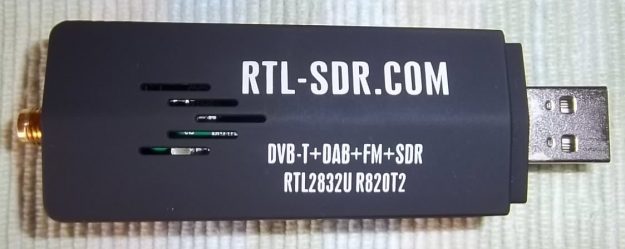
To get a better idea of what the CB band “looks” like during a band opening, a spectral scan of the band (26.965 – 27.405 MHz) would be useful. This can be achieved using an SDR dongle, such as the RTL-SDR.com version which is a diminutive broadband receiver with an analog to digital converter and covers from about 26 – 1670 MHz. Used in conjunction with an up-converter (from Nooelec), software such as SDR# (SDR Sharp) and a computer (Smartphone apps are available also) you’ll be able to put up a spectral scan of the band as well as hear what’s happening.
RTL-SDR.com dongle – a small broadband receiver covering all modes
Nooelec’s Ham It Up RF Upconverter expands dongle’s receiving range to the entire HF and MW band
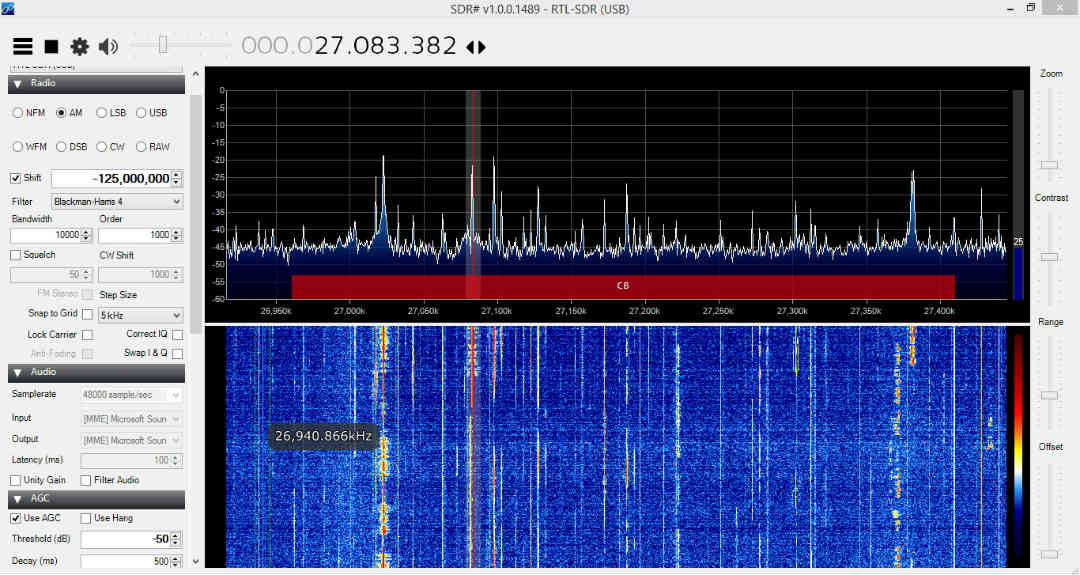
As the old adage goes, “a picture is worth a thousand words” so tonight the SDR dongle, along with SDR# software was fired up to get an idea of how many stations were on during the opening. The antenna used was an S9 43 foot vertical, the same one I use for HF. Using the dongle, it’s an easy feat to visualize the entire CB band on the spectral scan, which is a plot of frequency (X axis) versus signal strength (Y axis). The top half of the screen is the spectral scan and the lower half is the “waterfall” which is a time lapse recording of the spectral scan.
Screenshot of CB Band (wide red stripe) during tonight’s opening.
Normally at this time of night a spectral scan of the CB band would be flat-lining, but as you can see there are plenty of stations conducting QSOs, with the stronger stations having higher peaks and more intense tracings on the waterfall. Seeing the entire CB band visually gives one lots of information such as what channels are active, how many stations are on, what stations might be running higher power (limit is 4 W AM, 12W PEP SSB output), whether outbanders are active or whether DX stations outside the US are partaking of the opening.
Over the years I’ve heard the CB band open beyond midnight and on a winter’s night during a snowstorm. Some openings have lasted for hours. Last year, using the mobile CB, operators from Europe, the Caribbean, and as far away as Australia were heard during my commute to work. At the opposite extreme some days all you’ll hear is ignition noise, hihi. It’s a lot like 10 meters and even a bit like 6 meters; you never know what surprises Mother Nature has in store. Spin the tuning dial over to the CB band and take a listen one of these days.
Thank you so much, Mario!
Only a few weeks ago, I noticed on my SDR’s wideband spectrum display that the 11 meter band was very active. I started listening around and was absolutely amazed at how organized some of the nets were and how reliable skip was. Signals were blanketing all of the eastern US and even into the west. Sometimes I think there are openings on the 10 meter band, for example, but there are so few users there in comparison, no one notices. The CB frequencies are pretty much always active, when conditions are favorable for DX, everyone instantly notices!
More than two months ago, in the Mount Evelyn DX Report I posted a review of the Tecsun PL-680 portable receiver, entitled Tecsun PL-680 Beats Expectations. In that article, I pointed out many of the positives and a few of the flaws surrounding the unit. At the end of the review, I promised I would do some sensitivity tests on the radio.
Well, I finally got around to completing the tests, and the results are in. Below is a YouTube video showing a practical demonstration of the receiver’s capabilities in this area of performance.
The portable Tecsun PL-680 receiver is a hot little radio! As these tests show, it appears to be very sensitive to weak signals. Here, we put the little 680 up against one the best HF transceivers on the market today – the Yaesu FTDX3000 transceiver. The receiver in the 3000 is quite brilliant! And it has all the “bells-and-whistles” to make it even better at digging out weak signals and reducing adjacent channel interference.
However, in these tests we turn off all the fancy facilities on the FTDX3000 and just run the two receivers side by side to see how the 680 compares. We use the same antenna and we plug both radios into the same external speaker, adjusting as close as we can to equal volume and tone quality. We select a variety of shortwave broadcast stations over a range of frequencies from the 60 through to the 16 meter bands. I think you’ll discover that the Tecsun is really a very good performer when it comes to sensitivity!
[Additionally] I have started the prequels to Media Network’s return in 2017.
I found a great cassette sent to me by Africa media correspondent Richard Ginbey in 1989. Richard was a music presenter, first in South Africa, later moving to Windhoek. But I guess his passion was listening to his shortwave radio. And with nothing more than a cassette recorder he put together some fascinating portraits of broadcasting history as observed from a listeners’ perspective.
Richard also made features which traced the history of broadcasting in Africa, making some recordings which track the path to independence for many countries. I’m pretty sure many of these bandscans from the 1980’s and before have long since disappeared from official archives. So, here’s a chance to listen again to Richard Ginbey’s media view. I’ve put together several episodes back to back. Enjoy.
Thank you so much for sharing this, Jonathan. I might contact you soon about adding those cassette recordings to the shortwave archive. Absolutely priceless stuff! And the return of Media Networks? Please keep us informed!
Photograph taken from a Japanese plane during the torpedo attack on ships moored on both sides of Ford Island shortly after the beginning of the Pearl Harbor attack. (Source: WikiMedia Commons, Public Domain)
Many thanks to SWLing Post contributor, Michael Guerin, who writes:
Interesting article from the US Naval Institute on the role of radio intelligence before and during the December 7 attack.
“The key to the success of the Japanese attack on Pearl Harbor-specifically, what enabled the Pearl Harbor Striking Force to reach its launch point undetected (and totally unsuspected) by the Americans-was Tokyo’s radio denial-and-deception actions. Significantly, these activities simply were not just a “bag of tricks” meant to bemuse U.S. naval radio intelligence. Rather, they constituted a function of the change in Japanese strategy and were meant to convince the Americans that there had been no change from defensive to offensive intentions.”
We would like to ask you which person you think left their imprint on the world in a positive way in 2016. We are preparing to designate, based on your options, “The Personality of the Year 2016 on RRI”. Will this person be a politician, an opinion leader, a businessman, an athlete, an artist, a scientist, or even a regular person with a special story? It’s up to you! We would also want to ask you why you picked that particular person.
You can send your answers, as usual, by commenting on our website, at rri.ro, by e-mail at [email protected], on our Facebook, Google+, Twitter and LinkedIn profiles, by fax at 00.40.21.319.05.62, or by post, at 60-64, General Berthelot street, sector 1, Bucharest, area code 010165 (PO Box 111), Romania.
The “Personality of the year 2015 on RRI” was German Chancellor Angela Merkel.
The “Personality of the year 2016 on RRI” will be announced on January 1st 2017.