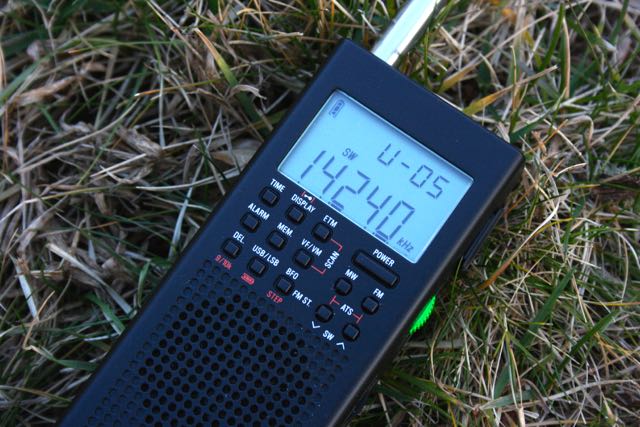
Steven is impressed with the CountyComm GP5/SSB and high-gain bar antenna

GP5SSB-Front

Many thanks to SWLing Post contributor, Steven Crawford, who sent the following message to me (several weeks ago) and has kindly allowed me to share it here. Steven writes:

I hope this finds you and yours well. I just wanted to take a few moments and express my sincere thanks to you for your posts of 12/20/2014 and 1/6/2016, and for sharing Larry Thompson’s post of 2/28/2016, and Ron’s post of 1/16/2016. If you are in regular contact with the other individuals please feel free to pass along my thanks as each of you and the respective post convinced me to purchase a CountyComm GP5/SSB and Ebay seller playloudfm’s high-gain ferrite bar antenna. I am so glad I did, so a hearty Thank You to each of you.

The afternoon of March 19th local was the first chance I had to use my GP-5/SSB. After popping in three fresh AA’s on AM using the internal ferrite bar antenna Beaumont, Texas’ own powerhouse 5,000 watt KLVI 560 was there as was 1,000 watt Orange’s KOGT 1600, 23 miles away and my AM daytime benchmark 50 kW KTRH 740 Houston 70 or so miles away on the back side of their pattern. KTRH surprisingly can be a little difficult during the day due to noise. The surprise was 50 kW WWL New Orleans 240 miles away was intelligible above the background noise. Extending the whip a quickie SW test showed WWV Fort Collins time signal was present at 15 MHz.

On the AM side the real money lay after dark once the sun had set in Beaumont and San Antonio. Using only the internal ferrite bar antenna all of the aforementioned AM stations were present. Continuing the internal antenna’s test 50 kW WBAP 820 Dallas 244 miles away and 50kW WOAI 1200 San Antonio 266 miles away were present. I started grinning when 50 kW WLAC 1510 Nashville 598 miles away and 50kW KMOX 1120 St. Louis 632 miles away were just intelligible above the background noise. Keep in mind these stations were received using only the internal antenna.
GP5SSB-MW-Antenna-1

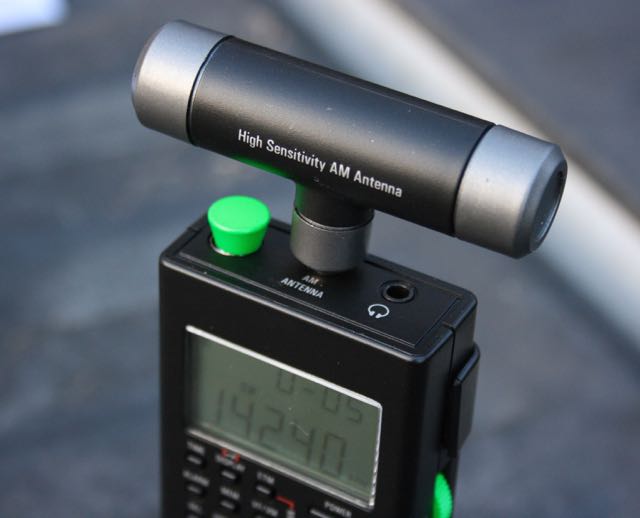
I popped the CountyComm included factory external ferrite bar on and used it 9 -10 PM Saturday local, 0200 – 0300 March 20 UTC. Using the external antenna rotated for best reception WLAC and KMOX improved to the point they were easily listenable. 50 kW WSB 750 Atlanta 625 miles away was listenable above the noise and most surprising 50kW WBBM 780 Chicago 892 miles away(!!!) was just intelligible above the background noise. Another quickie SW test was performed at 10 PM local, 0300 March 20 Sunday UTC by extending the built in whip and the WWV Fort Collins time signals were present at 5 and 10 MHz with 10MHz being particularly well received.
Ferrite-Bar-Antenna-PL-365-GP5SSB

Photo source: eBay

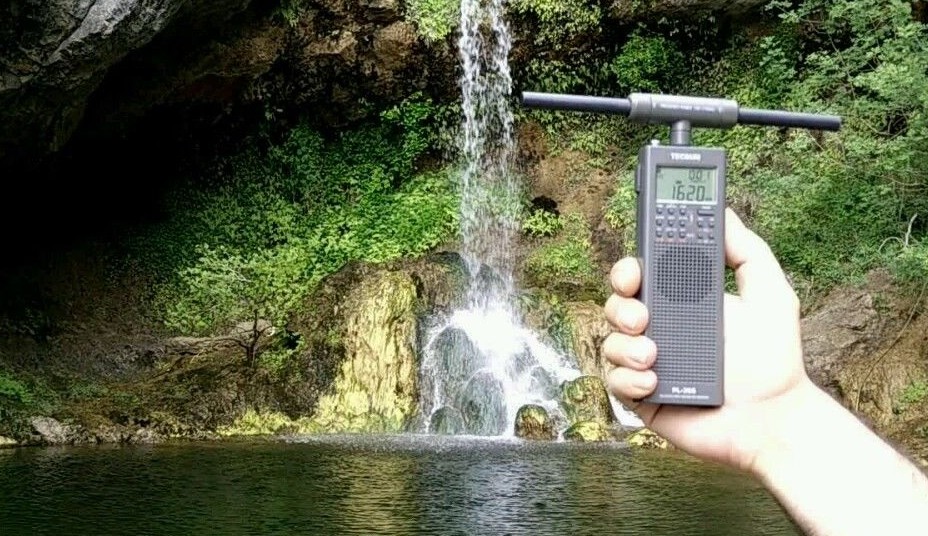
A real treat lay in store after receiving Ebay seller playloudfm’s aftermarket high-gain ferrite bar antenna, the subject of your 1/6/2016 and Ron’s 1/16/2016 post, yesterday. I am not experienced enough to judge what the space weather or propagation conditions were like from 0300 to 0400 March 27th UTC but I was extremely surprised and pleased with the reception results the new antenna afforded.

As I sat relaxing in my easy chair before bed I decided to try the combo out using the included earphones so as to not wake my wife. With the lights off and my iPad open to www.oldradio.com/archives/stations/ccs.htm to help identify clear channel stations I took the handheld combo for a spin. All of the stations found with the factory supplied external ferrite bar antenna were present. There was just so much more signal present using the aftermarket antenna each became easily listenable. For WOAI, WWL, WLAC and KMOX the effect was as if I was located within their local night coverage area. 50 kW WHAS Louisville Kentucky 740 miles away was newly found present. Chicago’s WBBM was there as before and I was surprised to find 50 kW WGN 720 Chicago as well. The reception quality was such that one could enjoy listening to a Cub’s game or breaking local news story should one be so inclined on WBBM or WGN. The listening experience was similar for newly found 50 kW XEROK 800 Ciudad Juarez 738 miles away.

The most surprising and gratifying, to me anyway, find of the night using playloudfm’s antenna was receiving 5,000 watt (nights!) KCMO 710 Kansas City Missouri 624 miles away. The ability to rotate the antenna to take advantage of it’s directional and nulling ability really aided in this reception. It really is a great benefit to be able to rotate the GP-5/SSB’s external AM antennas for peak signal strength while nulling interfering signals and noise. Indeed KCMO was missing in one antenna orientation but rotating the antenna 90 degrees and the station popped in. I really should have jotted signal strength to noise ratios down but I was just enjoying tuning through the spectrum too much. I have not fully tested SSB Exalted Carrier tuning on the GP5/SSB of difficult stations but have tried it 3 or 4 times and it does appear to work as does tuning 1 kHZ either side of the nominal frequency. The later technique did help clean up some signals by further reducing background noise without greatly affecting listenability.

As best I can tell I ordered and received either the last or next to last of playloudfm’s current batch of high-gain ferrite bar antennas as the Ebay add showed two available when I ordered and the ad was almost immediately replaced with an “accepting pre-orders” ad. Currently there are no ads by seller playloudfm.[Note: it appears more inventory has been added to eBay.] My transaction and shipping was quick and smooth. The bulk of the two week wait occurred after the package was received at the Athens airport where tracking stopped. It should be noted by buyers should more antennas become available the tracking number supplied does not work on the USPS tracking service but it will track the package to Athens through Greece’s Hellenic Post tracking service at http://www.elta.gr/en-us/personal/tracktrace.aspx

Note: all distances listed above are “as the crow flies”, straight line city center to city center and are not necessarily correct for the transmission tower location.

This little radio is fast becoming a hand holdable favorite with easy to learn button placement for use in the dark. I am all ready beginning to prefer it to my Sony SW7600GR / AN200 loop combo for MW broadcast AM reception but I really must do more work with SW before calling the CountyComm my favorite of the two.

Steven followed up a week or so later with this addendum to his review:

I finally got the opportunity to test the FM performance of the radio using only the extended whip on the afternoon of April 1st, April 1st 19:30 – 21:00 UTC. Using www.radio-locator.com and my zip code I found 51 FM stations listed as local, distant and possible fringe reception. I was very surprised and pleased when I was able to log all of the most distant fringe stations, KUHF, KKBQ, KTBZ, KKHH, KHMX, KBXX, KODA, KILT, KLOL, KMJQ, KRBE, KOVE, and KGLK, with ERP’s listed as 90 to 100 kW and distances in the given in the 80 to 90 mile range. In short I was able to log all 51 listed stations. The FM broadcast band is crowded indeed with this little rocket radio. It should be noted my little corner of Southeast Texas is dead flat with nothing between me and these stations broadcast towers but Houston skyscrapers, the typical urban / suburban sprawl, timber and marsh. Ground elevations range from 16 ft to 80 ft above sea level between me and many of the broadcast towers.

[…]My Sony SW7600GR / AN200 loop / Sony AN-LP1 loop combination sits in it’s go bag rapidly falling into disfavor, replaced by the easily used in the dark one handed CountyComm GP-5/SSB. Again thank you for your kind response and thanks again to all who motivated me to purchase this rig.

Steven, thank you so much for taking the time to share your experience with the GP5-SSB and the high-gain ferrite bar antenna.

I also have the high-gain ferrite bar antenna and have been meaning to post videos showing how it performs compared with the supplied GP5 antenna. I must say, it does do a pretty amazing job. I’ll get some videos posted in the coming weeks!
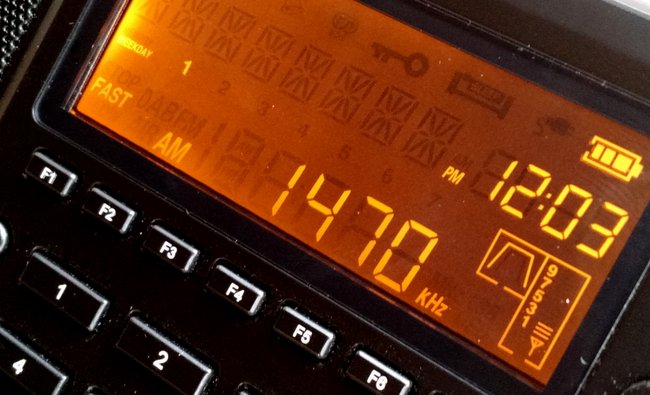
Netherlands clears way for licensed low power mediumwave/AM stations

AM-Dial-Digital-Grundig-Mediumwave-MW

SWLing Post readers might recall that the Netherlands was considering opening licensed mediumwave broadcasting to low-power stations–it appears the path is now clear. Yesterday, Minister Kamp gave the green light to low-power stations (those with a power output from 1 to 100 watts) who can now apply for a broadcasting license.

Stig Hartvig Nielsen posted the following on the WRTH Facebook page:

Today Dutch minister Kamp has made it public that the Medium Wave band now will be open for low power stations operating with a power of max. 100 Watt. Full story here (in Dutch): http://radio.nl/…/groen-licht-voor-laagvermogen-uitzendinge…

One of the first stations to go on the air under the new legislation may be the long time pirate – Atlantis Radio 1521 – in Friesland. They got a license (?) from Commissariaat voor de Media in March 2016, and they recently purchased a new 75 W AM transmitter (300 W PEP). The format is golden oldies – and the station can be heard online here:http://www.atlantisradio.eu/radio/ – and more details can be found here:https://www.facebook.com/RadioAtlantis1521KHz/

It will be interesting to see how this decision plays out and how many stations will apply for a license. I’ll certainly listen for new stations on the U Twente Web SDR as they pop up.

All India Radio adapting strategy

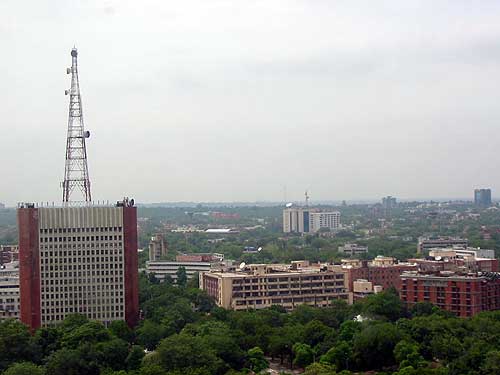
All India Radio (AIR) Headquarters in Dehli, India. Photo courtesy of Wikipedia.

All India Radio (AIR) Headquarters in Dehli, India. Photo source: Wikimedia.

Many thanks to SWLing Post reader, Mike R, for sharing this article from Asia Radio Today:

During a session on Public Service Broadcasting (PSB) at Radio Asia,  Fayyaz Sheheryar the Director General of All India Radio said all PSB [Public Service] broadcasters are facing the question of how to make revenue within the public service model.

As governments are reducing funding for public service broadcasters, “there is competition between hedonism and altruism,” he said.

“If we want to earn money would it be at the expense of ethics? This is a question that requires everyone’s attention.”

The expansion of tv channels in India overshadowed radio for a while, but radio has come back to life “thanks to the deregulation of radio, new licences and new frequencies on FM and [DRM]” according to Sheheryar.

All India Radio has introduced new channels to compete with the new private commercial channels.

But, like other public broadcasters else where in the world, All India Radio is “facing questioning from commercial broadcasters about our role.”

[…]In India, All India Radio is allowed to take advertising, but advertising is not allowed to affect decisions on program content. It is heavily used by advertisers to reach both educated and mass rural populations, but the new private channels have taken a share of the pubic service broadcaster’s significant ad revenue.

“Public service broadcasting is a keystone of democracy,” said Sheheryar.

“Should we leave it to the market to decide the content of PSB? PSB gently leads the masses to more mature values and services all sectors of the population regardless of whether the have money to spend or not. Ratings cannot be the sole yardstick to measure the success of PSB.

[…]“The proliferation of private broadcasters has also contributed to the questioning of PSB’s role.”

[…]The question of how to fund AIR now that it is autonomous is constantly being discussed. All India Radio uses a “hybrid model of funding” with some government funding and some commercial revenue funding. Other sources of revenue are program sales, news media sales, facilities hire and transmission rental.

Despite the philosophical and revenue challenges Sheheryar is optimistic: “Public Service Broadcasting is on a revival course despite all the challenges. The [Indian] Prime Minister’s choice to broadcast regularly on AIR has helped us… For PBS to survive it must be recognised as a creative art and treated accordingly.”

Click here to read the full article.

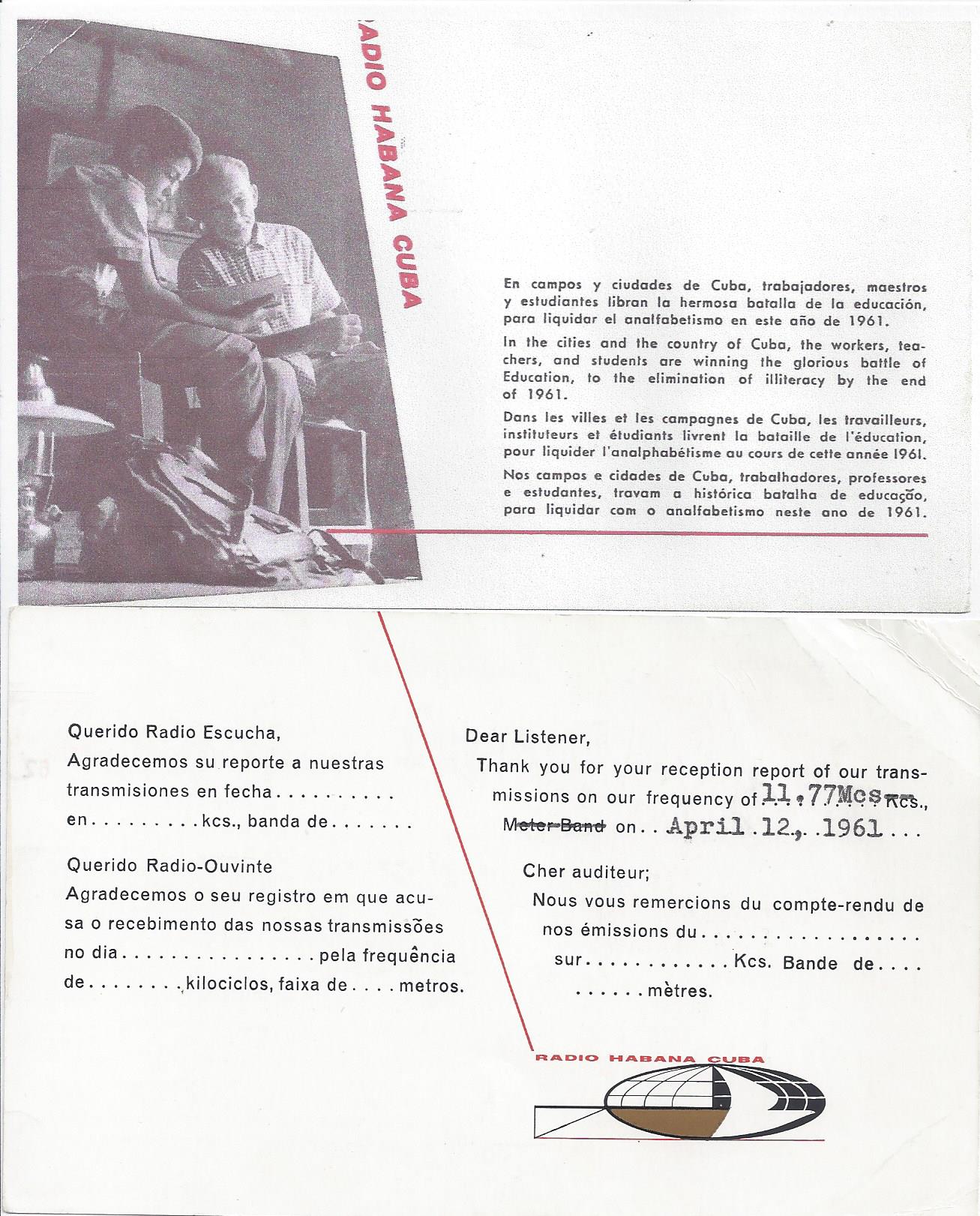
Bob’s 1961 Radio Havana Cuba QSL Card and full text from DXers Unlimited on 55th anniversary

RHC QSL

Many thanks to SWLing Post reader, Bob La Rose, who shares a QSL he received (see above and below) from Radio Havana Cuba after they had only been on the air a few days back in 1961.

RHC Letter 16May61

Amazing, Bob!  Thanks for taking the time to scan and share this report!

Also, many thanks to Arnie Coro, Host of Dxers Unlimited at Radio Havana Cuba, for sharing the full text/script from his May 1st 2016 anniversary edition of DXers Unlimited:

Radio Havana Cuba
Dxers Unlimited
Dxers Unlimited’s weekend edition for 1 May 2016
By Arnie Coro
Radio amateur CO2KK

Hi amigos radioaficionados, welcome to the weekend edition of Dxers  Unlimited,  today l am happy to celebrate with you all the 55th Anniversary of Radio Havana Cuba… Yes amigos, it was on the first day of May of 1961, during the May Day celebrations when Cuba had just won the battle against the mercenary invasion that we went on the air using our present name Radio Havana Cuba… Two announcers, Orlando Castellanos and Fernando Alcorta announced to the world that Radio Havana Cuba, was on the air… Previously we had used the name Cuban Experimental Short Wave, but from May one of 1961, we are known worldwide as Radio Havana Cuba…

So today is a very special day… remembering those who have passed away after many years of valuable services to our station, like Pedro Costa the General Administration Manager, Carlos Estrada our Chief Engineer, and former Director Generals Marcos Behamaras. Orlando Fundora, Jose Antonio Caiñas and Alfredo Viñas. I also keep very nice memories of Angel Hernandez our bilingual announcer with the most effective voice for short wave radio that I can recall, and also I remember Manolo Ortega, reading our Spanish language editorials so that they could be heard clearly through his powerful voice…

Si amigos, I was there at the station 55 years ago as a young radio technician in charge of supervising the operations of our studios and transmitters that at that time included four Brown Boveri Swiss made short wave transmitters connected to a still under construction antennas farm, and the two studios borrowed from Radio Progreso until we could finish building our first studios .

The history of Radio Havana Cuba is full of very relevant moments, like the day that our Experimental Station announced to the world that the mercenary invasion that entered the Bay of Pigs had been defeated after sixty six hours of fierce combats .

With a lot of enthusiast and the impacting presence of a new generation of announcers, journalists , technicians, engineers and support personnel we are moving ahead to provide the best possible programming keeping our short wave transmitting facilities because we do believe on the use of international short wave broadcasting, while not disregarding the feeding of streaming audio to the Internet-

I am Arnie Coro, your host here at this special 55th Anniversary edition of Dxers Unlimited, that will continue in just a few seconds after a station ID..

Musical short cut

Yes amigos this is Radio Havana Cuba, using short wave frequencies at different times of the day on the 16, 19, 22, 25 ,31, 49 and 60 meters bands… and now our next radio hobby related item, a very popular section of this show under the name   Antenna Topics , that is dedicated today , at the request of several listeners to a very effective Dxing antenna, low take off angle radiator, known as the HENTENNA, A great number of listeners  from all around the world  have written to me recently, asking to learn more about  this Japanese  antenna design , known as the HENTENNA, that seems to continue to be making headlines in radio publications around the  world once again… But before telling you more about the mysterious HENTENNA…. A solar activity update… believe it or not, we are seen the solar flux moving up to very near 100 units for the first time in many weeks… following the typical ups and downs of the tail end of solar cycle 24… so  propagation conditions have improved on the short wave bands …. Now back to the HENTENNA…

By the way, the first original report about the HENTENNA that went on the air  here at Dxers Unlimited, dates back to  1999,more precisely, it went on the air the 12th of October of 1999, and  according to my records, it  then generated a lot of interest from our listeners, who were at that time, 1999, getting ready to enjoy the peak  years of solar dream solar cycle 23 !!! >Never as powerful as super cycle 19, but nevertheless much better than the present very poor cycle 24.

So amigos here is  at the request of Dxers Unlimited’s fans , a special Dxers Unlimited’s report on the HENTENNA, the Japanese elongated  rectangular loop antenna with an easy  match to coaxial cable feedlines of any impedance, be it 50, 60 ,75 or  93 ohms…or even 150 ohms !!! Of course that you can feed it with parallel transmission line of 300 to 450 ohms too, it is just a matter of minutes to find the perfect match for the feedline in use.

Let me start by saying that  I recently built yet another HENTENNA for the FM broadcast band, and it  is working nicely, having already picked up some Sporadic E skip DX stations from Mexico, the US and Puerto Rico during first few days of this year’s spring and summer  E skip season.

Now you will have to learn something very unusual about the HENTENNA…  the HENTENNA produces or receives VERTICALLY  polarized waves when the antenna is placed horizontally; that is, with  the long sides of the rectangular loop parallel to the ground. AND, if you want horizontal polarization, just flip the HENTENNA so that the long sides  of the loop are vertical, and the short sides are parallel to the  ground, something that is puzzling, but that’s the way it is amigos…

By the way, one of the world’s foremost antenna experts, Dr. L. B.  Cebik, amateur radio operator W4RNL, did during his fruitful life an extensive analysis of  elongated loops, and his findings are really fascinating. Dr. Cebik , now sorrily a silent key specialized in computer modeling of complex antenna systems, and his work with the HENTENNA and other similar elongated loops shows that the  HENTENNA is a very good performer indeed.

In a few seconds, be ready to write down, the formulas for calculating HENTENNAS  in the frequency range from 14 megaHertz all the way up to 220 megaHertz.

And now, as promised  more about the japanese wonder antenna… the  HENTENNA. Dr. Cebik’s computer modeling shows that the elongated loop HENTENNA has an edge over a regular square one  wavelength loop and the regular elongated loop.

HENTENNAS for receiving FM broadcast signals are very easy to build,  using a wooden or PVC pipe frame and copper wire. I built the one just
mentioned cut for 100 megaHertz, using PVC insulated no. 12 wire, the  one that is typically used for home wiring.

The loop was closed by soldering with a butane torch, and using regular  solder with rosin core… The reason for using the butane torch is that no soldering iron at hand here could handle the heavy wire PLUS the high  speed heat transfer of the copper wire.

The loop for the 100 megaHertz antenna is 1.5 meters on the long sides of the rectangle and 50 centimeters on the short sides. The feed point  for the 50 ohm cable is was found to be  located about 55 centimeters from one of the  short sides of the loop.

The antenna is installed with the long sides in a vertical position; for receiving horizontally polarized FM broadcasts. I tried both 50 ohms and  75 ohms coaxial cables, and could not detect any difference on the  weakest station that I am picking up here regularly with the FM band HENTENNA.

Again, now please pay extra attention …if you want to make of these elongated loops for receiving, here  are the measurements to use: for the long sides of the rectangle 1/2 of  a wavelength at the operating frequency, for the short side, the length  is 1/6 of a wavelength… and the connection point for the coaxial cable  of 50 ohms impedance is a little more than 1/6 of wavelength from one of the short sides of the rectangle, and it must be found experimentally by locating the point that provides the minimum standing wave ratio.

HENTENNAS can be built for any frequency between 10 megaHertz and 300
megaHertz by using heavy WIRE, and for the frequency range from about 50  megaHertz to 500 megaHertz you may try building HENTENNAS with copper or  aluminum tubing.

Hope to have you all listening to my middle of the week edition of Dxers Unlimited amigos and do enjoy the improved short wave propagation conditions now in progress, especially after your local sunset. 

More on the 55th anniversary of Radio Havana Cuba

Radio-Havana-Cuba-QSL-Front

Many thanks to SWLing Post contributor, David Iurescia (LW4DAF), for sharing the following feedback yesterday:

Today, the 1st of May, is the 55th anniversary of Radio Havana Cuba. Here is the link about this on their website:

http://www.radiohc.cu/en/especiales/comentarios/91190-radio-havana-cuba-55-years-broadcasting-the-truth-to-the-world

I haven’t heard if RHC has any special programs or contests going on this month. If you know of any commemorative RHC programming, please comment.

Beta release of SDRplay ADS-B for Windows

SDPlay-RSP

Many thanks to Jon Hudson with SDRplay who noted that, yesterday, the beta Windows version of ADS-B for SDRplay was released:

“We now have an updated beta version of ADS-B for Windows. This is based upon the 16bit Mutability version of dump1090 developed by Oliver Jowett and unlocks the full 12 bit performance of the RSP1. People should see a significant performance improvement over the dump1090_sdrplus version, which was based upon 8 bit code. Go to http://www.sdrplay.com/windows.html – as with the recent update on Raspberry Pi, it supports both 2MHz and 8MHz demodulator modes. We recommend you uninstall the previous version (if you had it) before installing this one. Performance should be better than before. This is still in beta so any feedback or comments to [email protected] is welcomed.”

Thanks for the info, Jon!

The new LNR Precision LD-11 transceiver is essentially general coverage

LNR-Precision-LD-11

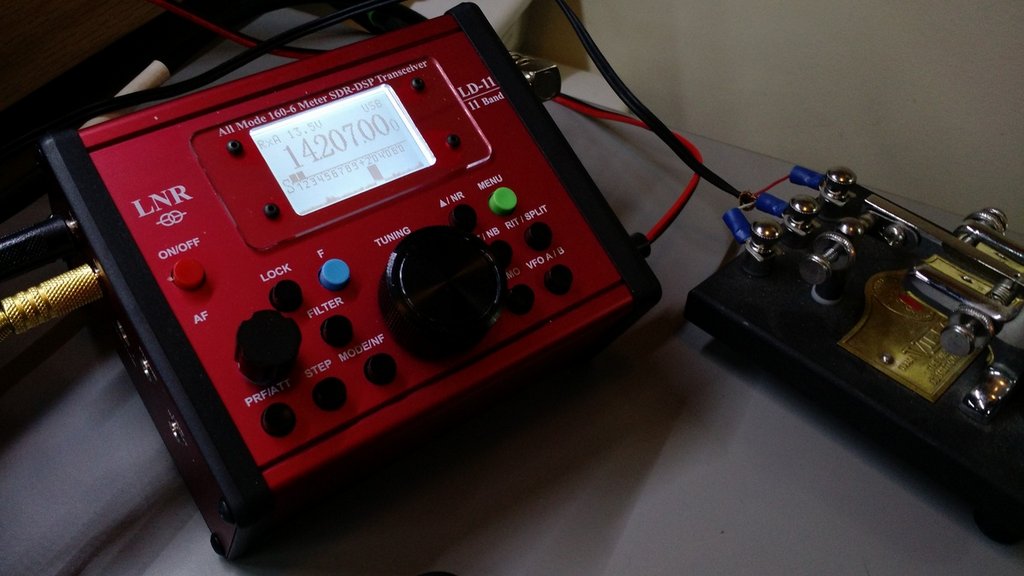
A couple weeks ago, LNR Precision sent me their new LD-11 Digital Direct Conversion QRP transceiver on loan for review.

The LD-11 is basically a small, tabletop SDR transceiver. It’s like a miniature, simplified version of the Icom IC-7300 I’ve also been evaluating.

The LD-11 is an all-mode and all-band transceiver–meaning, it includes SSB, CW, CW-R, Digi, AM and FM modes on all amateur radio bands (160 – 10 meters).

Though the LD-11 isn’t advertised as having a general coverage receiver, it will indeed tune the entire HF band.

You do this by entering the LD-11’s administration mode. LNR describes this in the LD-11 product manual, but suggests you contact them for help the first time you do this. In the admin panel, you’ll find functions that allow you to set the band edges on each amateur radio band.

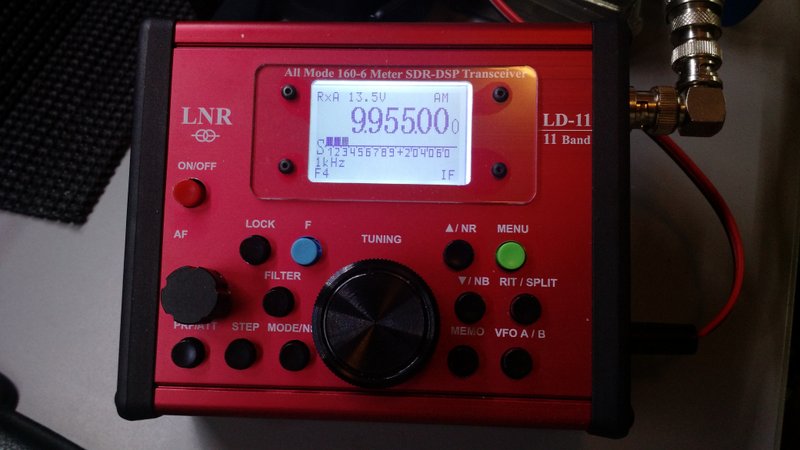
For a preliminary test of broadcast reception, I moved the lower band edge of the 30 meter ham radio band to 8.2 MHz.

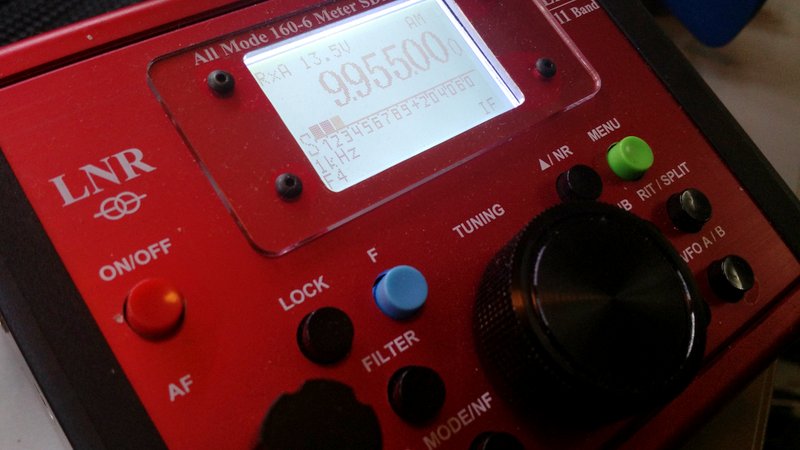
LNR-Precision-LD-11-front panel

After saving the settings and re-starting the LD-11 in normal operation mode, I could then tune the entire 31 meter broadcast band on the LD-11.

Hypothetically, you could either widen each amateur radio band to include adjacent broadcast bands, or you could simply set one of the ham bands to include the entire HF spectrum. To make it easier to navigate and tune through the bands, I’m choosing the former method over the latter.

Since the LD-11 has a proper AM mode, broadcasts sound great–especially via headphones!

Proper AM filters for broadcast reception!

Better yet?  The AM filter width can be widened to an impressive 9.6 kHz! Woo hoo!

LNR-LD-11-Shortwave-AM

The LD-11 has four filter slots: F1, F2, F3 and F4.

The F1-F3 slots can be set to a fixed user-defined widths (common widths are default).

F4 can be altered to any available filter width without having to enter the admin mode of the transceiver. Simply press the “F” (blue function button) and the FILTER button simultaneously and use the encoder/tuning knob to specify the filter width in .1 kHz steps. Pressing the F and FILTER button simultaneously again, will save your filter width for the F4 position.

I’ve been using the F4 filter position for widths between about 8.2 and 9.6 kHz in AM.

It’s still early days with the LD-11, but I’m enjoying this little transceiver immensely. It reminds me of one of my favorite QRP transceivers of yesteryear: the Index Labs QRP Plus (though the LD-11 is much smaller, more versatile and has a much better front end than the QRP Plus!).

LNR Precision sold out all of their first run LD-11 units within moments of having announced availability. I’m willing to bet they’ll bring a few LD-11s to the upcoming Dayton Hamvention, though.

Check inventory status and view LD-11 details on LNR Precision’s website.