Tag Archives: AM Radio

Radio Waves: DRM Demo in Australia, Decoding the JWST, the ARDC, and EV Makers Dropping AM Radio

Radio Waves:  Stories Making Waves in the World of Radio

Welcome to the SWLing Post’s Radio Waves, a collection of links to interesting stories making waves in the world of radio. Enjoy!


Australia Demonstrates DRM on AM, FM (Radio World)

Since September 2020, ABC Radio has been quietly trialing DRM technology in Victoria

The public-service Australian Broadcasting Corp. and its transmission contractor BAI Communications Transmission Network hosted a public demonstration of Digital Radio Mondiale broadcasts on June 29, 2022. ABC highlighted the use of DRM on both AM and FM in Wagaratta, Victoria.

According to the DRM Consortium, the demonstration was the culmination of almost two years of COVID-impacted work to assess the performance of DRM services in Australia’s VHF and medium-wave bands.

Previously, the Australian Amateur Radio Experimenters Group reported that AREG member Steve Adler (VK5SFA) had been monitoring “a very un-publicized Digital Radio Mondiale (DRM) trial” on 747 kHz from Wangaratta in August 2021.

The Australian Communications and Media Authority provided ABC with a license variation to conduct the DRM 30 trials from September 1, 2020, to August 31, 2022.

At the public demonstration, senior representatives from the public, commercial and community radio sectors, along with regulators and other interested parties, were able to hear and see the capabilities of DRM broadcasting on AM from Dockers Plains and on FM from Mount Baranduda. They were also able to review the transmission equipment at Wagaratta.[Continue reading…]

Also check out the DRM Consortium’s article on this same topic.

Decoding James Webb Space Telescope (Daniel Estévez)

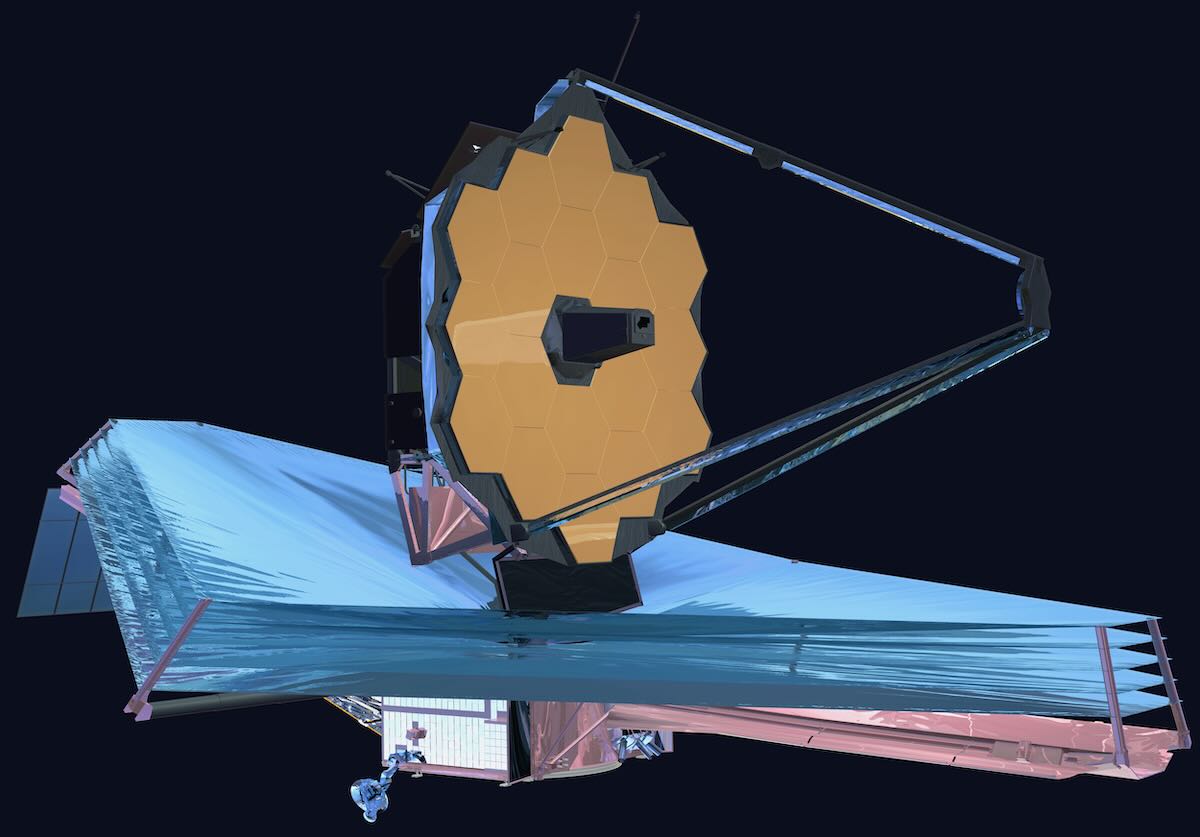
The James Webb Space Telescope probably needs no introduction, since it is perhaps the most important and well-known mission of the last years. It was launched on Christmas day from Kourou, French Guiana, into a direct transfer orbit to the Sun-Earth L2 Lagrange point. JWST uses S-band at 2270.5 MHz to transmit telemetry. The science data will be transmitted in K-band at 25.9 GHz, with a rate of up to 28 Mbps.

After launch, the first groundstation to pick the S-band signal from JWST was the 10 m antenna from the Italian Space Agency in Malindi, Kenya. This groundstation commanded the telemetry rate to increase from 1 kbps to 4 kbps. After this, the spacecraft’s footprint continued moving to the east, and it was tracked for a few hours by the DSN in Canberra. One of the things that Canberra did was to increase the telemetry rate to 40 kbps, which apparently is the maximum to be used in the mission.

As JWST moved away from Earth, its footprint started moving west. After Canberra, the spacecraft was tracked by Madrid. Edgar Kaiser DF2MZ, Iban Cardona EB3FRN and other amateur observers in Europe received the S-band telemetry signal. When Iban started receiving the signal, it was again using 4 kbps, but some time after, Madrid switched it to 40 kbps.

At 00:50 UTC on December 26, the spacecraft made its first correction burn, which lasted an impressive 65 minutes. Edgar caught this manoeuvre in the Doppler track.

Later on, between 7:30 and 11:30 UTC, I have been receiving the signal with one of the 6.1 metre dishes at Allen Telescope Array. The telemetry rate was 40 kbps and the spacecraft was presumably in lock with Goldstone, though it didn’t appear in DSN now. I will publish the recording in Zenodo as usual, but since the files are rather large I will probably reduce the sample rate, so publishing the files will take some time.

In the rest of this post I give a description of the telemetry of JWST and do a first look at the telemetry data. [Continue reading…]

Helping Secure Amateur Radio’s Digital Future (Hackaday)

The average person’s perception of a ham radio operator, assuming they even know what that means, is more than likely some graybeard huddled over the knobs of a war-surplus transmitter in the wee small hours of the morning. It’s a mental image that, admittedly, isn’t entirely off the mark in some cases. But it’s also a gross over-simplification, and a generalization that isn’t doing the hobby any favors when it comes to bringing in new blood.

In reality, a modern ham’s toolkit includes a wide array of technologies that are about as far away from your grandfather’s kit-built rig as could be — and there’s exciting new protocols and tools on the horizon. To ensure a bright future for amateur radio, these technologies need to be nurtured the word needs to be spread about what they can do. Along the way, we’ll also need to push back against stereotypes that can hinder younger operators from signing on.

On the forefront of these efforts is Amateur Radio Digital Communications (ARDC), a private foundation dedicated to supporting amateur radio and digital communication by providing grants to scholarships, educational programs, and promising open source technical projects. For this week’s Hack Chat, ARDC Executive Director Rosy Schechter (KJ7RYV) and Staff Lead John Hays (K7VE) dropped by to talk about the future of radio and digital communications. [Continue reading…]

Interference causes EV makers to drop AM radio (Radio World via the Southgate ARC)

Radio World reports the Electromagnetic Interference generated by Electric Vehicles is causing some EV automakers to drop AM (medium wave) radio

The article says:

Some EV automakers are dropping AM altogether due to audio quality concerns, but that’s just one piece of the puzzle as radio continues to fight for space on the dash.

“As carmakers increase electric vehicle offerings throughout their lineups, the availability of AM radio to consumers is declining,” said Pooja Nair, communications systems engineer with Xperi Corp., in a Radio World guest commentary. “This is because the effects of electromagnetic interference are more pronounced in EVs than in vehicles with internal-combustion engines.”

In other words, electromagnetic frequencies generated by EV motors occupy the same wavelength as AM radio signals. The competing signals clash, effectively cancelling each other out. As EV motors grow more powerful, AM static tends to increase.

Read the full story at
https://www.radioworld.com/news-and-business/headlines/why-are-some-automakers-ditching-am-radio


Do you enjoy the SWLing Post?

Please consider supporting us via Patreon or our Coffee Fund!

Your support makes articles like this one possible. Thank you!

Radio Waves: Triple J is Shedding Young Listeners, Audio is the new Radio, Benefits of OTA, and RX Radio

Radio Waves:  Stories Making Waves in the World of Radio

Welcome to the SWLing Post’s Radio Waves, a collection of links to interesting stories making waves in the world of radio. Enjoy!


Triple J is shedding young listeners, but radio isn’t a dead medium yet (The Age)

I’ll never forget the excitement I felt as I bought my first transistor radio with a hard-saved pile of silver coins. I was 9, and I wasn’t just getting a piece of shiny kit, I was gaining access to a whole world of music and chat and cool that might somehow magically bind me to the other kids in my neighbourhood and at my school.

That thrill was only topped when, in my teens, I discovered the seditious sounds of student radio on the FM band, and realised there really were other people like me in the world. Like Jenny in the Velvet Underground song, I turned on a radio station and my life was saved by rock and roll.

It’s doubtful, though, that young listeners feel the same way about the medium today. While they consume vast quantities of music, much of it is via streaming platforms like Spotify, YouTube and TikTok. The radio isn’t the principal conduit to a world and identity – it’s just one channel among many. And when they do listen to radio, young people are increasingly shunning the stations targeting them in favour of golden oldies.

The latest Australian radio survey results saw Smooth FM pick up considerable market share in the younger demographics – 10-17, 18-24 and 25-39 – and much of it came at the expense of the ABC’s youth-focused network Triple J.

In the survey, which covered the period of February 27 to May 21, Triple J clocked an average audience of just 78,000 listeners in the five mainland capital cities across the full listening week (from a total of 1.56 million average radio listeners). In Sydney, it held a 3.9 per cent share of the listening audience, in Melbourne 4.5 per cent. It did better in Brisbane, where it has a 6.7 per cent share of listening, Perth (6.8 per cent) and Adelaide (5.1 per cent). [Continue reading at The Age…]

Audio – it’s Radio, but not as we know it. (Radio Today)

Comment from Dean Buchanan.

Much is made of Radio’s digital future in Australia. The publicly listed broadcasters and the industry body CRA are obsessed with digital. And so they should be as the content equation continues to fragment and the battle for your attention increases. The buzzword is AUDIO.

However, this appears to me at the significant risk of over-looking the goose that lays the golden eggs – FM and AM radio. The audience numbers and revenue this “traditional” medium continues to generate are staggering and dwarf many “digital audio” businesses.

This from radiotoday.com.au: “Commercial radio ad revenue in May was up 11.2% compared to May 2021, continuing months of sustained growth in the sector. (April was up 8.8%) That’s according to data released today by industry body Commercial Radio Australia. Ad revenue for the five major Australian capital city markets totalled $66.273 million during the month compared to $59.605 million a year ago. Commercial Radio is currently flying on all fronts with record audience listening levels in the most recent GFK survey and now an 11.2% year on year increase in commercial revenue for May.”

I would have thought that’s something for Radio to be very proud of, especially in the light of declining television viewership and publishing readership trends? But the word Radio is in danger of extinction.

This from SCA’s Annual report: “The four pillars of our refreshed corporate strategy are to entertain, inform and inspire our audiences; to establish LiSTNR as Australia’s ultimate audio destination; to use our assets to help our clients succeed; and drive and embed a digital audio first operating model.” Where’s Radio? [Continue reading at Radio Today…]

Don’t Overlook the Benefits of OTA (Radio World)

The author is a retired broadcast engineer who has been involved with advancing radio and television throughout his career, including for Qualcomm/MediaFLO, Harris, Nautel and ONEMedia LLC/Sinclair.

There are days when I feel like Ira Wilner, who wrote a piece here in reply to my commentary about NextGen TV.

Why bother with OTA broadcast? That is the question, isn’t it? But then, several explanations come to mind.

OTA is free. It’s hard to beat free. Streaming delivery requires an ISP or wireless data payment. Subscription satellite is needed when one drives through nowhere. Admittedly, many of us have connectivity in all the places we want it for other reasons; thus, sometimes it is a “sunk cost” for listeners, but always an additional, buy-it-by-the-bit, per-listener CDN cost for broadcasters.

OTA is low-friction. It’s hard to be smoother than navigating on-off/volume/tune.

OTA doesn’t buffer. It does not (and should not on NextGen) require searching with a browser. Done well, there isn’t even a “channel change” delay.

Try surfing through the dial on IP. Try scanning for local stations when travelling. I like local. On Sunday nights, I could stream “The Big Broadcast,” WAMU’s longest-running program, which I became addicted to when I commuted east; but I dial up KCFR or KUNC here in Denver instead. I am that lazy. I hate friction.

And if we don’t have an FCC license, just exactly what are we? Pause and contemplate what we’d be without a signal and those magic call letters. [Continue reading at Radio World…]

Groundbreaking children’s hospital radio station RX Radio appeals to public for support (IOL)

Cape Town – This Youth Month, award-winning RX Radio, run by and for children and based at the Red Cross War Memorial Children’s Hospital, are appealing to the public for help to keep the groundbreaking initiative going.

RX Radio celebrate their fifth birthday this year, with a studio based at Red Cross Hospital and their broadcast feed reaching the paediatric wards at Brooklyn Chest and Paarl Hospital.

With a vision of reaching every hospital with a paediatric ward in South Africa, RX Radio has trained over 135 young reporters from ages 4 and up.

A team of five staff, one intern, one mentor, volunteers and former reporters work behind the scenes to train, co-ordinate, and support the reporters – but the children are always behind the microphones and are active participants in the production; they design their own shows, choose the music, invite guests, write interviews, questions, and even plan fundraising events.

RX Radio founder, Dr Gabriel Urgoiti said: “Children make up 34% of people in South Africa; you see them everywhere, but at the same time you don’t see them, children are quite invisible. What RX radio continues trying to do is provide a platform where children can be heard and children can be engaged on things that are important to them. We provide them with an opportunity to talk, and working at hospitals has helped children with chronic conditions tell their stories and improve healthcare delivery.” [Continue reading at IOL…]


Do you enjoy the SWLing Post?

Please consider supporting us via Patreon or our Coffee Fund!

Your support makes articles like this one possible. Thank you!
Radio Waves: Future of AM in UK, BBC and Nuclear War, SAQ Unable to Air on Alexanderson Day 2022, ITU Ham Station Celebrates 60 years, and RRI International Quiz

Radio dial

Radio Waves:  Stories Making Waves in the World of Radio

Welcome to the SWLing Post’s Radio Waves, a collection of links to interesting stories making waves in the world of radio. Enjoy!


Opinion: The Future of AM Radio
England, Scotland, Wales and Northern Ireland (FrequencyFinder.co.uk)

Summary

AM radio in the British Isles is now in terminal decline with audiences dropping and many transmitters closed already. The majority of the remaining transmitters will likely close by the end of 2027. Over the next few years, the BBC and major commercial broadcasters will be looking to minimise their AM transmission costs by reducing transmission powers at the high-power sites and closing some of the low-power transmitters serving small audiences.

A coordinated AM shutdown may then follow at some point, most likely in 2027, though some independent broadcasters may continue using AM beyond this. This article explores these issues in more detail.

Click here to download the full PDF of this article.

The Last Word – The BBC and Nuclear War (Atomic Hobo Podcast)

This episode of the Atomic Hobo podcast focuses on the role of the BBC before and after nuclear attack:

https://soundcloud.com/user-494087291/the-last-word-the-bbc-and-nuclear-war

Click here to listen via Soundcloud.

SAQ unable to air on Alexanderson Day (The Alexander Association)

Note: the The Alexander Association has announced that they will be unable to put SAQ on the air this year on Alexanderson Day. There are no more details other than the title of their post (the content still reads as if the transmission will happen as planned).

Check the Alexander Association website for more details.

ITU’s ham radio station celebrates 60 years on air (ITU)

By Nick Sinanis, callsign SV3SJ, President of the International Amateur Radio Club (IARC), and Attila Matas, callsign OM1AM, Vice-president and Station Manager, IARC

Did you know that the United Nations specialized agency for information and communication technologies owns and operates its very own radio station?

Residing at the headquarters of the International Telecommunications Union (ITU), the 60-year-old amateur station operates under the callsign 4U1ITU.

It started broadcasting on 10 June 1962 and was officially inaugurated the following month by then UN Secretary-General U Thant and ITU Secretary-General Gerald Gross – himself a ‘’ham” radio enthusiast known by the personal callsign W3GG.

Recognized as a unique “country” in the ham radio community, 4U1ITU operates in accordance with privileges extended by ITU and the Government of Switzerland. It has also earned the DXCC (or ham radio “century club”) award from the American Radio Relay League (ARRL), confirming air contacts with 100 or more countries.

From its long-time home on the 5th floor of the Varembé Building in Geneva’s international district, this unique broadcasting outlet still today serves as a model for the highest standards of amateur radio station operation everywhere.

From one to a million

4U1ITU’s first contact, or “QSO” in ham radio parlance, was made with a German station called DL4VK. Further QSOs followed, amounting to over 1,300 contacts worldwide in the first 24 hours.

In the six decades since, ITU’s radio station has made over a million contacts using Morse code carrier wave (CW), voice (SSB), and digital operational modes, based on more than 20,000 two-way QSOs with radio amateurs around the world.

4U1ITU can operate on most of the frequency bands allocated to amateur and amateur-satellite services as identified in Article 5 of the Radio Regulations.

Aside from letting licensed radio amateurs in ITU, its Member State representatives, and its conference and meeting delegates contact fellow radio hams, the station promotes international goodwill and cooperation across the community. It also allows hands-on demonstrations of amateur radio communications for delegates and meeting participants. [Continue reading…]

RRI Voice of Indonesia: International Quiz 2022


Do you enjoy the SWLing Post?

Please consider supporting us via Patreon or our Coffee Fund!

Your support makes articles like this one possible. Thank you!
Radio Waves: Trend in Tropical Bands, AM Drive Time and EDT, RTI Russian Service, and Feedback from RW Guest Commentary

Radio Waves:  Stories Making Waves in the World of Radio

Welcome to the SWLing Post’s Radio Waves, a collection of links to interesting stories making waves in the world of radio. Enjoy!


Trends in Tropical Bands Broadcasting (EDXC)

EDXC co-founder Anker Petersen has published the latest Trends in tropical bands broadcasting and Domestic Broadcasting Survey.

Anker writes: “Since the Danish Short Wave Club International published the first annual Tropical Bands Survey in 1973, I have registered which stations are active, based upon loggings from our members and other DXers around the world. Here is an updated status outside Europe and North America, where Clandestine and Pirate stations are not included.”

Both of the documents are available at the DSWCI website, to study and enjoy. Click on the two blue boxes on the left side of the website for the current versions, and also to look back over previous versions. Hopefully, these will also encourage more DXers to listen regularly to the Tropical Bands. [Click here to read the original post…]

Universal Power-Up Time For AMs Seen As One Potential Fix For Proposed Clock Change. (Inside Radio)

Talk in Washington about making Daylight Saving Time permanent may bring cheers from people who hate the “spring forward” and “fall back” disruption to their body clocks. But it has the potential to upend radio stations, especially during the darkest winter months. New Jersey Broadcasters Association President Paul Rotella is urging the bill’s sponsor to consider adding some protections for AM radio into the bill.

“If this legislation is adopted, many if not most, AM stations will lose an hour of morning drive with no or reduced power and no one seems to be addressing the issue,” said Rotella in a letter to Rep. Frank Pallone (D-NJ), the chair of the House Energy and Commerce Committee. Permanent daylight-saving time would mean that AM daytime-only stations and AMs with directional signals would not be at full power until after 9am in some parts of the country.

Rotella says such a move would mean that these stations would lose most of their critical morning drive daypart when a lot of ad revenue is made. The upside is the change would give AMs more time during their afternoon drive, when some stations need to power down before 5pm during the winter months. But many AM owners have said that the amount of money they would make from an extra hour of broadcast time during the afternoon would not make up for the losses they would suffer in the morning. [Continue reading…]

Letters from Ukraine – Taiwan Insider (RTI English via YouTube)

[What RTI’s Ukrainian listeners are saying]

RTI’s Russian broadcasts are reaching Ukraine, and the Ukrainian people are talking back. The head of RTI Russian tells Insider what listeners are saying and how RTI is supporting Ukraine from Taiwan. Continue reading

Guest Post: Control of Electromagnetic Radiation (CONELRAD)

Many thanks to SWLing Post contributor, Bob Colegrove, who shares the following guest post:


Control of Electromagnetic Radiation (CONELRAD)

As recalled by Bob Colegrove

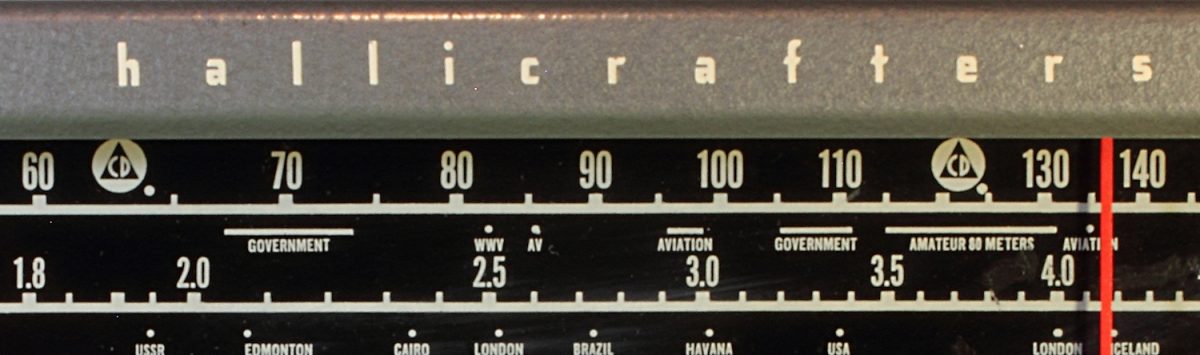
In his comment on my recent posting, Tinkering with History, Mario noted the dial on the featured radio, the General Electric P755A, sported two small triangles, one between 6 and 7, and the other between 11 and 14.  He noted that these were civil defense markers intended to show the frequencies of 640 kHz and 1240 kHz, respectively, and that these were characteristic of AM radios produce in the US roughly between 1953 and 1963.  Since two full generations have been born and raised to adulthood since that time, and I can’t find any related posting here, I thought it might be useful to bring this subject to light.

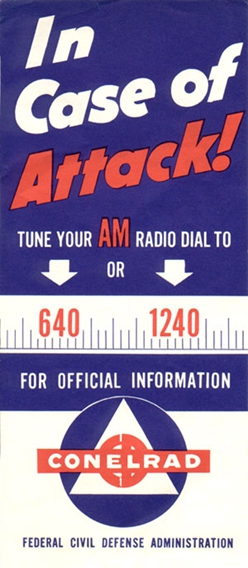
In spite of otherwise economic prosperity and general wellbeing, these years were nevertheless filled with anxiety about the prospects of all-out war.  Children of the time (myself included) were being shown how to hide under their school desks, and some of their parents were going so far as to construct air-raid shelters in their basements, and stock them with enough provisions to supposedly outlast any catastrophe.  So it was that CONELRAD came into being in 1951.  The idea was, that in case of a National emergency, all radio and TV stations would go off the air, and only certain medium wave radio stations would stay on either 640 kHz or 1240 kHz.  They would remain on for a few minutes and then other stations would take over in a round robin arrangement – this to deter homing by hostile bombers.  Needless to say, quickly changing over transmitters and antennas to one of these two frequencies did not bode well for the equipment and there were many failures in subsequent tests.  Note that, as originally conceived, the system did not provide for local weather emergencies or other situations.

The banner photo at the top of this posting shows a portion of the Hallicrafters S-38E receiver which conformed to Government law of the time required for marking all AM dials.  An S-38E just like it was my first genuine multi-band radio in 1959.  Assuming good alignment, the dots next to the CD triangles indicated the 640 kHz and 1240 kHz frequencies.  When a test came on, you didn’t have to fish for it, since CONELRAD was the only service transmitting.

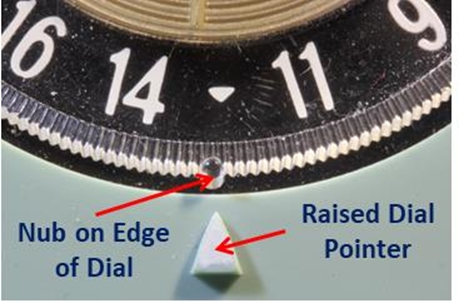
Going back to the radios described in Tinkering with History, GE took this one step further.  The figure below shows a portion of the dial on a GE P806A.  Note the nub on the outer edge of the dial under the triangle at 1240 kHz.  There is another nub on the edge at 640 kHz.  Together with the raised triangular dial pointer molded on the cabinet, they provided a braille system, so that someone visually impaired could easily tune to a CONELRAD frequency.

As technology improved, CONELRAD transitioned to the Emergency Broadcast System (EBS) in 1963, and subsequently the Emergency Alert System in 1997.  A more thorough description of CONELRAD can be found on Wikipedia https://en.wikipedia.org/wiki/CONELRAD.  Reprint of an April 1955 Radio & Television News article describing the construction of a transistor CONELRAD receiver is at https://www.rfcafe.com/references/radio-news/conelrad-radio-television-news-april-1955.htm.

Guest Post: Remembering the Radio Shack TRFs

Many thanks to SWLing Post contributor, Bob Colegrove, for the following guest post:


Remembering the Radio Shack TRFs

As recalled by Bob Colegrove

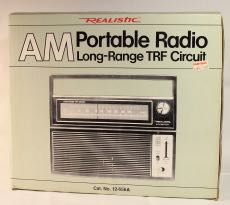
There has always been an interest in DXing on the cheap.  At the same time, most of us don’t want to sacrifice any more capability than necessary.  In the late 1970s and the early 1980s, Radio Shack provided an attractive answer to this conundrum for medium wave DXers.  These were identified respectively by their Radio Shack stock numbers 12-655 and subsequently the 12-656A.  I remember them being very popular among National Radio Club members of the time.

These radios were commonly known by their sobriquet “TRF.”  Initially applied by Radio Shack itself, the term stuck.  TRF stands for tuned radio frequency receiver.  In the early days of radio, the term referred to the necessity for the operator to manually put an RF amplifier stage on frequency by adjusting the value of a variable capacitor or inductor.  As amplifier stages became cascaded in two or three stages, this became a real problem, as each stage had to produce the correct frequency before anything could be heard.  Eventually, designers hit on the idea of mechanically connecting all the RF stages together so tuning could be accomplished with a single knob.

Fast forward to the standard AM radios of a later generation.  Entry level (read cheap) radios were limited to two stages consisting of a converter and an oscillator.  This was standard design practice during the vacuum tube and transistor eras.  Better, more sensitive radios added a third stage, an RF amplifier operating ahead of the converter stage.  Obviously, this required more circuitry and, consequently, more expense.

Enter the Radio Shack TRFs.  The term TRF was a throwback to the days of the tuned radio frequency radios and referred specifically to Radio Shack’s addition of an extra RF amplifier ahead of the converter stage.  The TRFs were by no means the first radios to have this feature, but they were obviously marketed to folks who wanted longer than normal distance reception.  Further, the radios were AM only uncompromised by FM circuitry, which would have to be integrated into the design and provide a distraction at best and a performance compromise at worst.

I didn’t discover these treasures until late in their production cycle.  Consequently, my comments are mostly focused on the 12-656A.  In later times, the -656A retailed for $34.95.  On final clearance this dropped to $25, and I snapped up several for my friends and my own tinkering.  The internal layout was not especially good for repair or modification, but at least was well within this enthusiast’s capability.

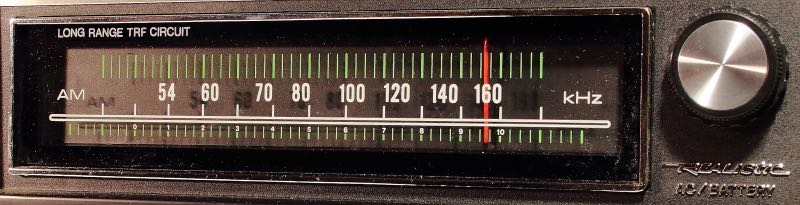
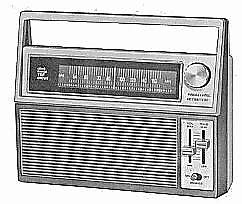
The picture below shows the dial of the -656A.  The radio was designed prior to the expansion of the AM broadcast band to 1700 kHz; thus, it is only specified to cover 520 kHz through 1620 kHz.  Although I don’t recall ever having tried it, the circuitry could possibly be coaxed to 1700 kHz.  On one of my “hot rod” units, I replaced the silk-screened dial with a plain piece of Plexiglas backed with a hand-calibrated dial, which permitted accurate calibrations for 10-kHz channel identification.  The tuning knob and dial cord mechanism work very well right out of the box.

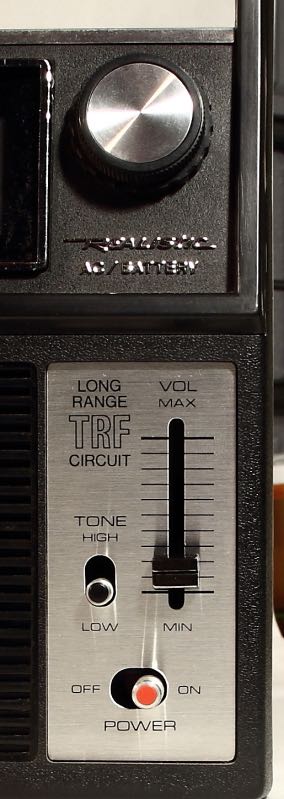
The controls are aligned along the right front side of the radio.  Below the tuning knob are tone and volume controls followed by an off/on switch.  The 655 is similar, except the tone switch is replaced by a slider potentiometer like the volume control.  In retrospect, the off/on switch should have been recessed into the front panel, as it is easy to accidentally turn on the radio with the protrusion of the switch.

The back of the cabinet (below) features standard 1/8” phone jacks for earphones (left) and an external antenna (right).  The TRFs may be powered by either four C cells or from 115-Vac mains.  Rather than having a separate 6-Vdc wall wart, the ac power supply components, cord and all, are contained inside the radio.  For storage, the power cord is simply wrapped up in its own compartment next to the battery compartment.

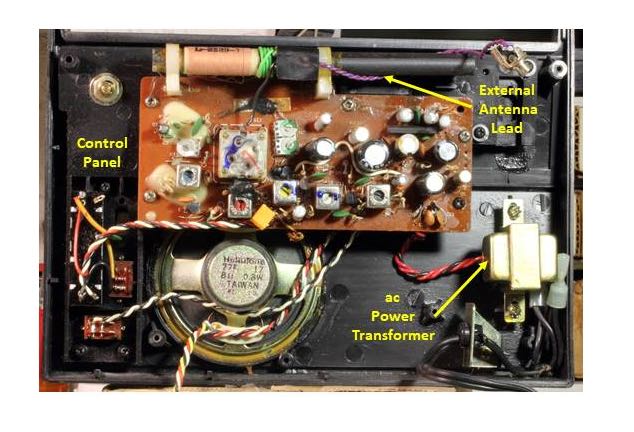
Below is a tinker’s view of the innards of a -656A.  Could the box have been made smaller?  Obviously, one could replace the internal ac power components with a wall wart.  Perhaps the C batteries could be replaced with AAs.  Problem is with the speaker.  The PC board hides a large drum for the tuning mechanism.  Given the smooth tuning and large dial, the tuning arrangement is not something I would compromise.  So, stacking the speaker with the PC board would require a much thicker box.

The external antenna uses the standard approach of a small transfer coil wrapped around the ferrite bar for signal transfer.  Just as an aside, keep in mind for any long- or medium-wave radio having an external antenna coupled to the internal ferrite bar, the ferrite bar will remain active with the external antenna attached.  The external antenna is effective only to the extent that the phase and amplitude of its signal compliment or reduce that produced by the ferrite loop.

In addition to two intermediate frequency (IF) stages, the circuitry includes a 455 kHz ceramic filter in the base circuit of the first IF stage.  This provides very good selectivity.  Never satisfied the way things are, when I first got these radios, I duplicated a third IF stage in one of the units.  The result was a nice tight bandwidth still providing good audio.

The “improvements” in the -656A seem to be focused on the reduction of production costs.  I’ve already mentioned the tone switch for one.  Another example is the replacement of discrete components in the -655’s audio amplifier with a whopping 0.5-watt integrated circuit in the 656A.  Having no way to make a performance comparison, I will say my experience with the -656A is that it is still a very hot radio.

The TRFs filled a relatively minor marketing niche, namely DXing enthusiasts and perhaps a small number of expatriates who wanted to listen to broadcasts from their old hometowns.  The format evolution of medium wave broadcasting was already well on the way toward news-talk-ethnic broadcasting, and the appeal to rock ‘n rollers or virtually any music lovers just wasn’t there.  A sensitive radio had to include an FM band.  So, the TRFs faded into history sometime in the early ‘80s.

Enter the long-distance “superadios,” notably General Electric’s Superadios I, II, and III in the 1990s.  Radio Shack itself produced a clone-like Optimus 12-603.  The “super” by that time referred more to the audio quality than the sensitivity.  This later generation featured two higher-quality speakers packaged in a cabinet with somewhat better acoustics, separate base and treble controls, all driven by a higher-powered audio amplifier.

Having worked in the industry for a couple years as an assembler, I have never been convinced that inclusion of multiple band coverage does not result in some performance compromise.  Radios such as the TRFs have a special appeal to me.  The General Electric P780 is another well-regarded example of an AM-only, high-sensitivity, radio.  Maybe you have a favorite of your own.  If you’re into tinkering, and even if you’re not, a functional TRF or such radio can provide a lot of cheap entertainment.

Radio Waves: Dirty Transmitters, World Amateur Radio Day, Electronic Echoes, DRM via Android, and 10 More BBC AM Services Close

Radio Waves:  Stories Making Waves in the World of Radio

Because I keep my ear to the waves, as well as receive many tips from others who do the same, I find myself privy to radio-related stories that might interest SWLing Post readers.  To that end: Welcome to the SWLing Post’s Radio Waves, a collection of links to interesting stories making waves in the world of radio. Enjoy!

Many thanks to SWLing Post contributors Grayhat, David Iurescia, Bill Hemphill, Harald Kuhl, and Troy Riedel for the following tips:


Transmitter Noise / Dirty Transmitters: Receiver Performance has hit a Brick Wall (DJ0IP)

For the past 15 years, Ham Radio’s Mega-Focus on Receiver Dynamic Range (DR3) has resulted in the community ignoring other factors that are just as important to receiver performance.

Even though our receivers have made a quantum leap in performance in important parameters such as DR3, RMDR, etc., On-The-Air Reception has gotten worse.

Unless used at a multi-transmitter site, today’s typical user won’t detect a difference in the receiver performance between a radio with 90 dB DR3 and a radio with 110 dB DR3. That’s because Receiver Performance is not the limiting factor.[]

World Amateur Radio Day 18 April 2021 (IARU REGION 2 Newsletter)

World Amateur Radio Day (WARD) is an opportunity to celebrate the many accomplishments and contributions of amateur radio to the communications technology revolution which has dramatically impacted the daily life of virtually everyone on the planet. Many of these technologies and techniques started as experiments, not by governments or commercial enterprises, but by radio amateurs.

WARD 2021 commemorates the 96th anniversary of the International Amateur Radio Union’s founding in 1925, where amateurs first met in Paris to band together to give voice to these early experimenters to national governments and international bodies representing all radio amateurs.

The almost universal adoption of mobile technology created ever increasing demand on a finite resource, the radio spectrum. Access to useable spectrum is the fundamental base on which amateur radio was built and continues to be developed. As a result, amateur radio is very different than decades ago. Embracing new technologies and techniques has greatly expanded what amateur radio is and opened further possibilities as to what it could be. The proliferation of technology also means that the ongoing experimentation and innovation in electronics, radio frequency technique and radio wave propagation is no longer only the traditional realm of the radio amateur but also includes university research satellites, the “maker” community, and other non-commercial experimenters: citizen scientists.

Looking ahead, this ongoing evolution of the telecommunications ecosystem makes it clear that the national Member Societies of the IARU and IARU itself must also continuously change and adapt. A century later, the future possibilities are as exciting as ever.

Celebrate World Amateur Radio Day. The pandemic and more localized natural disasters continue to demonstrate the value of ordinary citizens as technically skilled contributors to society. The original social network is robust. Expose someone new to amateur radio (properly distanced), get on the air and contact the many special event stations, on HF, VHF, or satellite.

Electronic Echoes (KPC Radio)

From SWLing Post contributor Bill Hemphill:

“I have run across an interesting set of audio interviews that were done by Aaron Castillo of kpcradio.com. This is an internet based radio station of Pierce College in California.

Aaron did a series of audio interviews in the fall of 2020 called Electronic Echoes. See following link:

https://kpcradio.com/author/aaron-castillo/


STARWAVES DRM SoftRadio App upgrades mobile devices to receive undistorted DRM Digital Radio anytime and anywhere (Fraunhofer Press Release)

Horgen/Switzerland, Erlangen/Germany: Starwaves, a developer and distributor of receiver technologies centered around the digital broadcast standard DRM (Digital Radio Mondiale), joined forces with Fraunhofer IIS, a leading supplier in the field of broadcast encoder and receiver components for DRM, to develop an Android app that allows DRM reception on mobile devices. Starwaves enables Android phones and tablets to receive entertainment, text information, and emergency warnings via DRM Digital Radio – without costly data plans, independent from cell phone network availability, and based on innovative Fraunhofer technology.

Digital Radio Mondiale (DRM) is the digital successor standard to the classic AM and FM radio services. In many parts of the world, terrestrial digital radio broadcasts are already an important and trusted source of entertainment and information. They do not require monthly payments and work reliably even if there are no cell networks available. Radio reception with mobile phones and tablets combines the mobility and flexibility of these devices with the benefits of free-to-air radio services.

Starwaves has been active in the field of DRM radio receivers for many years. The “STARWAVES DRM SoftRadio” app was developed in close cooperation with Fraunhofer IIS. Its goal is to ensure easy access to innovative DRM radio services for everybody. It is available from now in the Google and Amazon Android app stores. The app provides listeners with access to all the essential features of the DRM digital radio standard, across all transmission bands from DRM on long wave to FM band and VHF band-III.

Fraunhofer IIS is a significant co-developer of core digital radio technologies. This includes the innovative xHE-AAC audio codec, which provides high audio quality at lowest data rates, as well as the Journaline application, which gives radio listeners access to news, the latest sports updates, local weather forecasts, travel tips, and even radio schooling services without requiring internet access.

The app also supports many more DRM features such as the Emergency Warning Functionality (EWF), image slideshows, station logos, and service descriptions including Unicode support for worldwide application. To provide all these services, the app only requires a standard off-the-shelf SDR RF dongle that is attached to the device’s USB port.

“We are proud to launch the world’s first low-cost full-featured DRM digital radio reception solution for mobile devices, developed in close partnership with Fraunhofer IIS. Now everybody can easily upgrade their existing mobile phone and tablet to enjoy DRM digital radio with its undistorted audio quality and advanced features including Journaline,” says Johannes von Weyssenhoff, founder of Starwaves.

I order to meet the needs of everyday radio listeners and to clearly separate this app from the engineering-driven approaches of the past, usability was a primary development objective from day one. With only a few clicks on the clutter-free interface, users select their preferred radio service, navigate through the clearly structured menus, and gain instant access to the various advanced information services that DRM provides. By supporting multiple user interface languages, the app ensures optimized usability in many countries around the globe.

About STARWAVES

Found in 2005 in Bad Münder, Lower Saxony/Germany, Starwaves had set its focus on the development and distribution of receiver technologies around the digital broadcast standard DRM (Digital Radio Mondiale). As far back as 2003 after both organizations, the DRM Consortium and the WorldDAB Forum, had expressed their appeal to the industry at IFA in Berlin to develop and produce multi-standard receivers compatible with both their systems, Starwaves developed its model ”STARWAVES Prelude”, the world’s first DRM-DAB receiver and presented it at CeBIT 2004 in Hanover. In 2006 Starwaves was again in the headlines with the ”Carbox”: It was the world’s first automotive DRM-DAB receiver which then was produced in volumes and enjoyed by lots of listeners worldwide – including many DXers thanks to its excellent analogue Short-Wave capabilities as well.

Since 2008 Starwaves moved its focus to Africa where it developed and tested an innovative approach of broadcasting community television in the L-Band with DVB-T2 in cooperation with ICASA – another world premiere. After DRM was chosen the national standard in India in 2012 Starwaves relocated its headquarters to Switzerland and started developing a new generation of DRM receivers.

Starwaves also initiated Africa’s first DRM trial in the FM Band in Johannesburg/South Africa and completed it with local and international partners. The trial report contains valuable discoveries regarding the feasibility of DRM for community radio which guided the South African government to adopt DRM in the FM Band for community radio and secured the report becoming an internationally recognized piece of standard literature, recently endorsed by ITU. Today, Starwaves offers various DRM receivers and broadcast solutions for consumers and the professional broadcasting industry.

For more information, contact [email protected] or visit www.starwaves.com/de/starwaves-drm-softradio

Ten more stations turn off Medium Wave services (Radio Today)

Ten more local BBC radio stations are turning off their Medium Wave transmitters for good this year.

BBC Essex, BBC Radio Cambridgeshire, BBC Radio Devon, BBC Radio Leeds, BBC Radio Sheffield, BBC Hereford & Worcester, BBC Radio Stoke, BBC Radio Lancashire, BBC Radio Ulster and BBC Radio Foyle will be FM and digital only in May and June 2021.

In addition, BBC Radio Wales and BBC Radio Gloucestershire will reduce AM coverage.

The BBC’s intention to close MW transmitters was first announced ten years ago in 2011.[]


Do you enjoy the SWLing Post?

Please consider supporting us via Patreon or our Coffee Fund!

Your support makes articles like this one possible. Thank you!