Tag Archives: Amateur Radio

Icom IC-7300: Field Day reports?

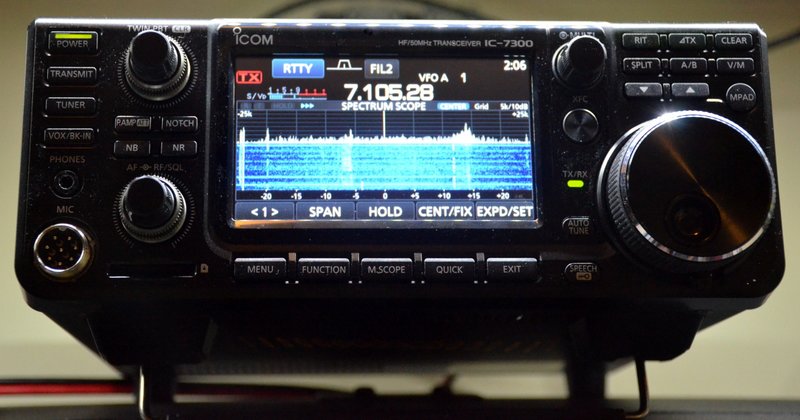
Icom-IC-7300-Front

I’m curious: any Post readers use the new Icom IC-7300 on Field Day?

While I gave Icom’s new transceiver a very positive review, it was based on operation at my home QTH. There were no significant contests in progress during my review window.

Field Day has, arguably, some of the toughest receiver conditions out there.  If a transceiver/receiver performs well during Field Day’s dense signal environment, without overloading or distorting, it’s a good receiver.

I’m very curious if anyone tested the IC-7300. I assume someone took it out to play on Field Day!

Please consider commenting with your report!

13 Colonies Special Event

13-colonies

13 Colonies operating event runs from 1300Z July 1 – 0400Z July 7

Once again, the 13 Colonies Special Event will take place between 1300z, July 1st and 0400z July 7th. The certificate is printed on heavy card stock. Stations working one state or, as many as all 15, will be eligible for the certificate. A “Clean Sweep” indicator will be affixed, for those lucky enough to “Q” all 15.

A special endorsement will be attached for stations contacting their sister operation, WM3PEN, in Philadelphia, PA, where independence was declared. New since 2015, the 13 Colonies have added a second sister event station GB13COL will operate from Durham, England. The 13 Colonies certificate will have a Liberty Bell added for a contact with WM3PEN. They will also offer a special QSL card printed just for this event.

There should be at least two stations from each on the 13 colonies on the air, as well as Super contest stations, multi-operator Club stations and OM and XYL teams. The thirteen orginal U.S. colonies are CT-DE- GA-MA-MD-NC-NH-NJ-NY-PA-RI-SC-VA. Special events stations mentioned are: K2A (NY), K2B (VA), K2C (RI), K2D (CT), K2E (DE), K2F (MD), K2G (GA), K2H (MA), K2I (NJ), K2J (NC), K2K (NH), K2L (SC), and K2M (PA).

All HF bands will be in play, including the WARC bands, with the exception of 60 meters. 2 meters and 6 meter simplex are encouraged. All modes of operation should be represented – SSB, CW, RTTY, Digital, and the Satellites. The mode of operation is up to the individual colony state station. For more details on the stations, suggested frequencies, QSL info and on how to obtain the special certificate, see: http://www.13colonies.info

Thanks to the Southgate Amateur radio News for this information


This is one of my favorite events each year – and it also represents some of the best of the traditions of amateur operation. I have always found the operators to be kind and helpful and patient, and they really seem to enjoy the event. Why not give it a go  this year?!

Robert Gulley, AK3Q, is the author of this post and a regular contributor to the SWLing Post. Robert also blogs at All Things Radio.

It’s Field Day weekend 2016: find a local event, have fun

2016 Field Day Logo

If you live in North America and have an interest in becoming a ham radio operator, this is the weekend to check out what amateur radio is all about, and meet local radio enthusiasts.  

It’s Field Day!

What is Field Day?  I’ll quote from the ARRL, who sponsors the event:

“ARRL Field Day is the single most popular on-the-air event held annually in the US and Canada. On the fourth weekend of June of each year, more than 35,000 radio amateurs gather with their clubs, groups or simply with friends to operate from remote locations.

Field Day is a picnic, a camp out, practice for emergencies, an informal contest and, most of all, FUN!

It is a time where many aspects of Amateur Radio come together to highlight our many roles. While some will treat it as a contest, other groups use the opportunity to practice their emergency response capabilities. It is an excellent opportunity to demonstrate Amateur Radio to the organizations that Amateur Radio might serve in an emergency, as well as the general public. For many clubs, ARRL Field Day is one of the highlights of their annual calendar.

The contest part is simply to contact as many other stations as possible and to learn to operate our radio gear in abnormal situations and less than optimal conditions.”

GOTAMany Field Day sites have a GOTA (Get On The Air) station where non-licensed individuals are welcome to play radio. It’s a fantastic way to try your hand at transmitting with a little guidance and encouragement from the more experienced. Indeed, even if there is no GOTA station, you will often be invited to try out the mic.

You’ll find that ham radio operators are very welcoming on Field Day–after all, spreading the word about the fun of amateur radio is what it’s all about. Indeed, I’ve shown up unannounced to a number of Field Days over the years; once I even got some serious radio time with the Charlotteville Amateur Radio Club while on vacation in Prince Edward Island, Canada.

This year, I’m joining the Québec Amateur Radio Club (Club Radio Amateur de Québec) and I’m looking forward to it very much!

Keep in mind that there are many shortwave listeners among the amateur radio community; indeed, many hams became interested in the hobby through SWLing.

The ARRL has made it quite easy to find registered Field Day locations in your region. Click here to find a local Field Day event near you–and have a great Field Day!

“When everything else fails, amateur radio will still be there—and thriving”

IMG_6686

(Source: ARS Technica)

by Rupert Goodwins

It’s a good time to be technical. Maker communities are thriving around the world, tools and materials to create and adapt are cheaper and more powerful now than ever, and open source hardware, software, and information mean that if you can think it, you can learn how to do it and then make it happen.

For one group of technological explorers, this is more than just a golden age of opportunity: it’s providing the means to save one of the oldest traditions in electronic invention and self-education, one that helped shape the modern world: amateur radio. That matters.

Radio amateurs get a sweet deal, with effectively free access to many gigahertz of the same radio spectrum that companies pay billions for. They’ve earned it. Throughout the history of electronics, they’ve been at the borders of the possible, trying out ideas that commerce or government deem impossible or pointless—and making them work. One example of hundreds: Allied military comms in World War II needed a way to reliably control the radios used by front-line forces, replacing tuning knobs with channel switches. Hams had the answer ready and waiting: quartz crystal oscillators. (That’s part of computing history too—you’re probably using about ten of them right now.).

[…]Then, there’s backup. Take the European HAMNET, for example. That’s a four-thousand-node high speed data network covering a large part of continental Europe and providing full IP connectivity at megabit speeds. It connects to the Internet—ham radio owns 16 million IPV4 addresses, believe it or not—but is independent of it, doing its own robust and flexible routing. If the Internet was to go away, HAMNET would still be running. The same’s true of nearly all ham radio infrastructure: when everything else fails—power, comms, roads—ham radio is still there, and these days it can be a full-fat digital medium.[…]

Continue reading at ARS Technica…

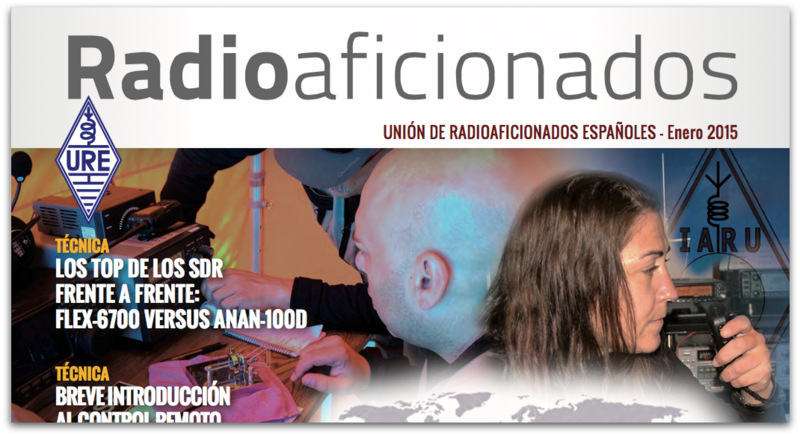
URE: Radioaficionados available as free download

RUE-Spain-HamRadio

(Source: Southgate ARC)

Spain’s national amateur radio society the URE has made annual compilations of its magazine Radioaficionados available for free download

PDFs of the magazine are available from 2001 to the end of 2015.

To download each year click on the Descargar buttons at
http://www.ure.es/component/docman/cat_view/110-revistas/156-.html?orderby=dmdate_published

URE website in Google English
http://tinyurl.com/SpainURE

ARRL reaches agreement with national association of homeowners associations

ARRL

Many thanks to SWLing Post contributor, Marty, who writes:

Hi Thomas,

I just came across this interesting new item about ARRL reaching agreement with Homeowners national association on antenna restrictions:

http://www.arrl.org/news/arrl-community-associations-institute-find-common-ground-on-parity-act-language

Regards,

Marty

[Excerpt from ARRL new item]

[The] ARRL did not have the final language for the substitute amendment until late last week, and the amended bill has not been introduced in the House as of yet. ARRL planned no announcement about the text of the amended House bill until it was introduced. However, because the text became available from the House Office of Legislative Counsel, and as CAI released the text to its members, it was decided to release the amended text now.

“The bottom line,” Imlay said, “is that if the bill is enacted, it would allow every amateur living in a deed-restricted community — for the first time in the history of Amateur Radio in the U.S. — the ability to install an effective outdoor antenna.”

“That would benefit thousands of current and future hams living in deed-restricted communities,” Lisenco added.

Thank you for the tip, Marty! Though I have never lived in a deed-restricted community, I imagine this will be welcome news to those amateur radio operators and radio enthusiasts who do.

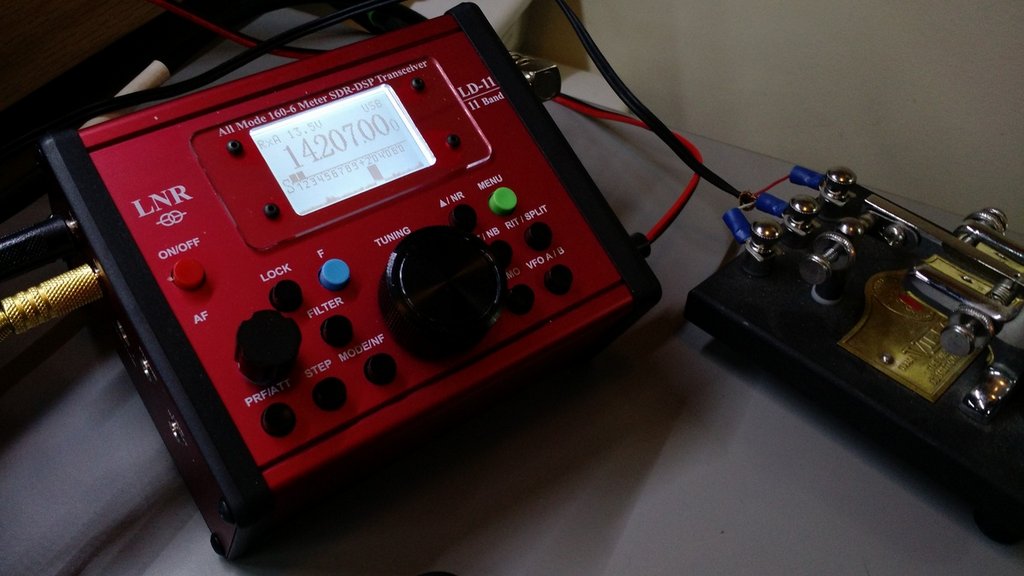
The new LNR Precision LD-11 transceiver is essentially general coverage

LNR-Precision-LD-11

A couple weeks ago, LNR Precision sent me their new LD-11 Digital Direct Conversion QRP transceiver on loan for review.

The LD-11 is basically a small, tabletop SDR transceiver. It’s like a miniature, simplified version of the Icom IC-7300 I’ve also been evaluating.

The LD-11 is an all-mode and all-band transceiver–meaning, it includes SSB, CW, CW-R, Digi, AM and FM modes on all amateur radio bands (160 – 10 meters).

Though the LD-11 isn’t advertised as having a general coverage receiver, it will indeed tune the entire HF band.

You do this by entering the LD-11’s administration mode. LNR describes this in the LD-11 product manual, but suggests you contact them for help the first time you do this. In the admin panel, you’ll find functions that allow you to set the band edges on each amateur radio band.

For a preliminary test of broadcast reception, I moved the lower band edge of the 30 meter ham radio band to 8.2 MHz.
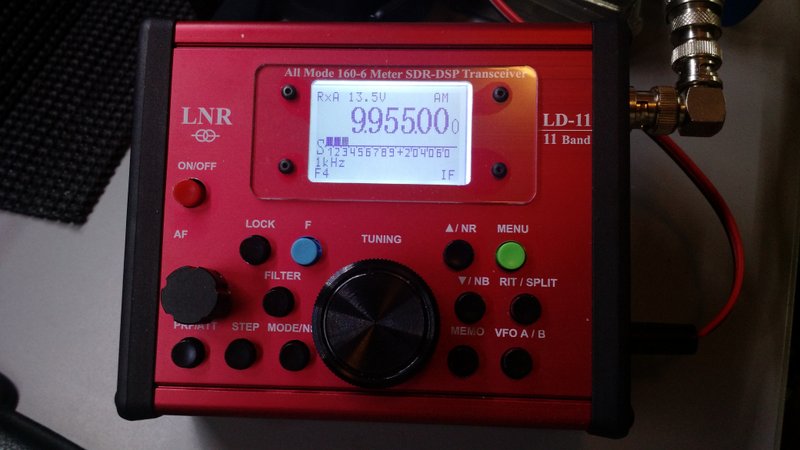
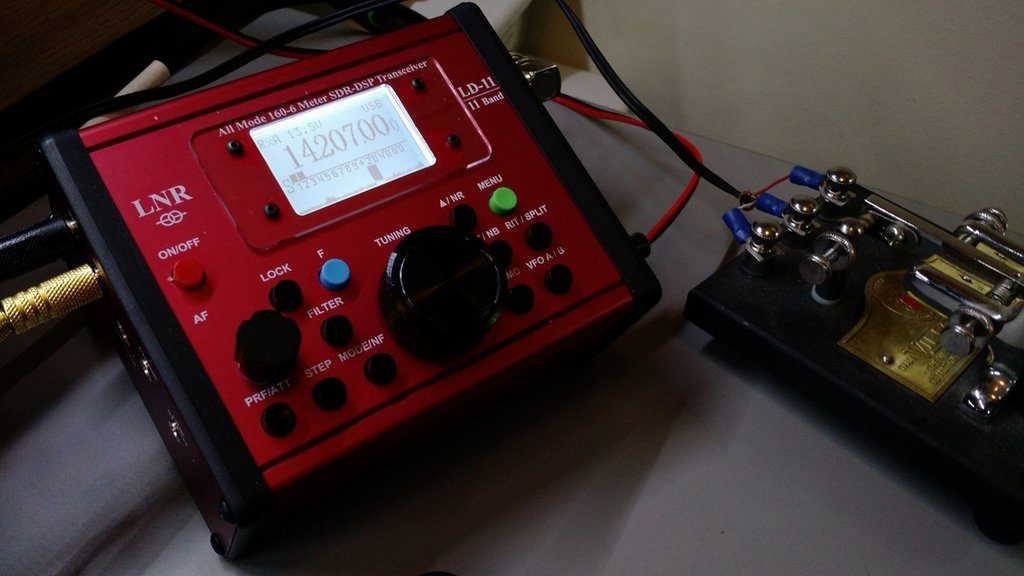
LNR-Precision-LD-11-front panel

After saving the settings and re-starting the LD-11 in normal operation mode, I could then tune the entire 31 meter broadcast band on the LD-11.

Hypothetically, you could either widen each amateur radio band to include adjacent broadcast bands, or you could simply set one of the ham bands to include the entire HF spectrum. To make it easier to navigate and tune through the bands, I’m choosing the former method over the latter.

Since the LD-11 has a proper AM mode, broadcasts sound great–especially via headphones!

Proper AM filters for broadcast reception!

Better yet?  The AM filter width can be widened to an impressive 9.6 kHz! Woo hoo!
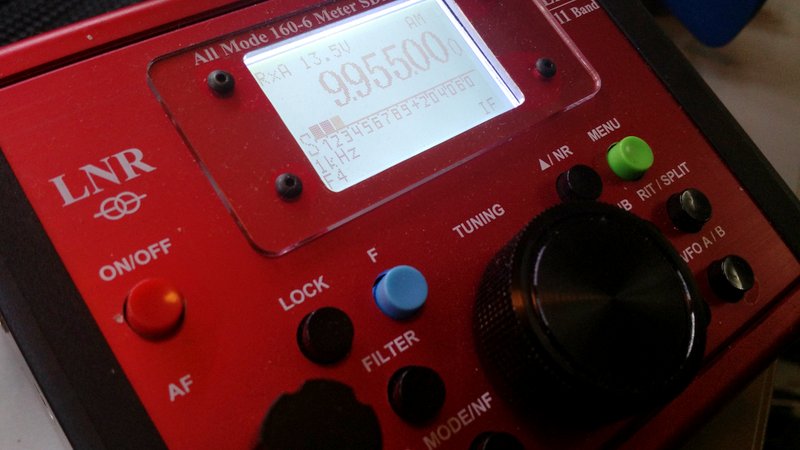
LNR-LD-11-Shortwave-AM

The LD-11 has four filter slots: F1, F2, F3 and F4.

The F1-F3 slots can be set to a fixed user-defined widths (common widths are default).

F4 can be altered to any available filter width without having to enter the admin mode of the transceiver. Simply press the “F” (blue function button) and the FILTER button simultaneously and use the encoder/tuning knob to specify the filter width in .1 kHz steps. Pressing the F and FILTER button simultaneously again, will save your filter width for the F4 position.

I’ve been using the F4 filter position for widths between about 8.2 and 9.6 kHz in AM.

It’s still early days with the LD-11, but I’m enjoying this little transceiver immensely. It reminds me of one of my favorite QRP transceivers of yesteryear: the Index Labs QRP Plus (though the LD-11 is much smaller, more versatile and has a much better front end than the QRP Plus!).

LNR Precision sold out all of their first run LD-11 units within moments of having announced availability. I’m willing to bet they’ll bring a few LD-11s to the upcoming Dayton Hamvention, though.

Check inventory status and view LD-11 details on LNR Precision’s website.