Tag Archives: Shortwave Radio

Video of Marc Montgomery’s farewell speech to The Link listeners

(Source: YouTube)

Radio Canada International journalist Marc Montgomery broke down in tears during his farewell speech to listeners as RCI ended its 67-year history of shortwave broadcasts yesterday. June 22, 2012, was the last day of The Link, RCI’s flagship English language daily radio show, which Marc hosted from its very inception in October 2006.

Cabinet silences Canada’s international voice, RCI Action responds

Yesterday, as I toured Radio Canada International’s Sackville, New Brunswick transmission site, the Canadian press discovered that the Cabinet approved an order that paves the way for RCI to be dismantled. The Metro News reported:

Heritage Minister James Moore recommended an order in council, approved on June 7, that deleted a requirement for RCI to maintain a shortwave service.

That change removed an obstacle to the steep cuts the CBC had announced for RCI in April — $10 million of $12.3 million budget will disappear along with at least three-quarters of its work force.

RCI had planned to file an injunction this past week to prevent CBC from shutting down its shortwave broadcasting facilities, but the new order thwarted their lawyers.

“I don’t know how this happened. I’m just shocked that it did happen. I’m shocked that the minister would make this decision two months after CBC announced the budget cut, two months after the CBC announced they were cutting shortwave,” said Wojtek Gwiazda, spokesman for the RCI Action Committee, a union-supported lobby trying to save the international service.

The Ottawa Citizen quoted RCI Action spokesman, Wojtek Gwiazda, extensively:

“As of June 25, most of the original content will disappear,” he said, “because we won’t have the people to do it.”

Thirty of 45 permanent employees are being laid off, along with a dozen or more contract workers and other regular freelancers.

Gwiazda, spokesman for a group inside RCI attempting to salvage the short wave service and its original programming, said a proposed injunction on behalf of RCI employees was thwarted last week when the Conservative cabinet quietly and quickly changed two key rules under which RCI operates.

Under previous rules, RCI was legally obliged to provide a shortwave service and to consult regularly with the Department of Foreign Affairs.

The government, in its June 7 rule change, has dropped both those requirements.

A spokesman for the Department of Canadian Heritage confirmed the change had been made, but refused to say why.

The Department of Foreign Affairs did not respond to questions about the issue.

[…]NDP Foreign Affairs critic Paul Dewar accused the CBC and the Conservative government of “taking Canada’s voice off the world stage.

“It is sneaky,” he said in an interview with the Citizen. “They are pretending they aren’t killing it, but they are. Our Commonwealth cousins and others in the G8 have made a commitment that the world should hear their voices. Why not Canada’s?

“How will we keep people in other countries informed about Canada and how will Canada’s voice be heard by the international community.”

Dewar says he’s hearing negative reaction to the RCI cuts from MPs in all parties, and the NDP has written to both Foreign Affairs Minister John Baird and Heritage Minister James Moore urging a reversal of the decision.

“We are appealing to them to find the money and put this essential service back where it belongs,’ added Dewar. “Canada needs its voice heard and we have to figure out a way to do it. It’s not a lot of money. Let’s find it. Let’s not leave RCI orphaned.”

The Metro News also quoted me:

Thomas Witherspoon, founder of an American non-profit organization called Ears to Our World, said it is shortsighted to cut RCI’s shortwave service because it represents a cost-effective way of showing Canada to the world.

Witherspoon, whose organization distributes shortwave radios to communities in the developing world, recently wrote an impassioned opinion piece defending RCI.

“Here on the overly-lit, information-saturated North American continent, it’s easy to forget that an estimated 1.6 billion human beings — a full one quarter of us — still lack access to reliable power and to the Internet,” he wrote.

“In remote, impoverished, often war-torn regions, radio has become a familiar voice in the darkness. Without radio broadcasters such as RCI — and the light of information they can relay — the night can become very dark, indeed.”

RCI Action formed a response to the Cabinet’s decision:

Hon. James Moore,

A little more than 24 hours ago we at the RCI Action Committee found out that on June 7, 2012, you changed the Order in Council that directs CBC/Radio-Canada in its obligations under the Broadcasting Act in dealing with Radio Canada International.

You have eliminated CBC’s obligation to provide programming on shortwave, depriving almost all Chinese listeners of uncensored news from Canada, since the website of RCI is blocked by the Chinese authorities. And you have made it impossible for most listeners in the world to stay abreast of what’s going on in Canada via radio, because most people do not have easy access to the Internet.

You have also abolished CBC’s obligation to consult with Foreign Affairs about the geographic target areas and languages we broadcast in. Letting it continue in the slashing of services to the Ukraine, Russia and Brazil.

And you have done this after two months of CBC being in contempt of the 2003 Order in Council. Just as we were preparing an injunction to stop the shutting down of shortwave transmissions.

You have cleared the way for the CBC’s destruction of a 67 year old institution. An institution that CBC/Radio-Canada has never understood. It does not understand international broadcasting, the importance of it, and the impact of the 80% cut you are letting them get away with.

It is ironic.

Chinese authorities block RCI’s website. They have not jammed the shortwave frequencies of Radio Canada International. So you’ve done it for them, by shutting down RCI’s Chinese radio programming.

Why have you done this?

Yours truly,

Wojtek Gwiazda

Spokesperson, RCI Action Committee

[email protected]
rciaction.org/blog

Follow our tag, RCI Cuts to follow these developments.

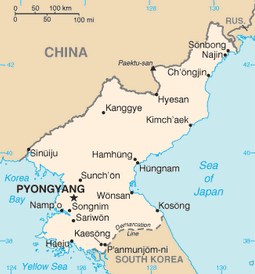
North Korea is testing digital shortwave broadcasting via DRM

As Vatican Radio pulls out of DRM, North Korea moves in. What a strange and shifting international broadcasting landscape:

(Source: North Korea Tech)

North Korea appears to be testing digital radio broadcasting.

Hiroshi Inoue, a radio monitor in Japan, received on Wednesday the country’s international radio service, Voice of Korea, broadcasting on shortwave using DRM (Digital Radio Mondiale). DRM is a digital broadcasting technology developed for use on AM and shortwave services.

[…]The broadcasts are taking place on 3,560MHz, a frequency used by the Voice of Korea in the past for conventional analog shortwave broadcasts.

[…]North Korea’s testing of DRM comes at a time when the country appears to be upgrading its international radio broadcasting system.

In mid-June 2011 the country’s Ministry of Posts and Telecommunications signed a deal with Beijing-based BBEF Tech for several new radio and television transmitters. The Chinese company trained North Korean engineers in how to install them.

At least one of those transmitters now appears to be on the air. North Korea’s transmissions on 11,680kHz shortwave are now broadcast spot-on that frequency. In the past they drifted a little either side of the correct channel. (Thanks to DX Aktuell for the tip!)

DRMNAinfo comments:

Here are some cool videos of the English language June 7th broadcast and the June 8th broadcast in Korean. As you will hear, the high production values, overly aggressive compression and sibilant laden distortion present in VOK analogue broadcasts translate well to the digital medium of DRM. Now all we have to do is convince Kim Jong-un to aim the antennas our way for some NA reception opportunities!

Additional info here.

I would like to thank Kim Elliott for the news tip on North Korea.

Note that this will be a difficult broadcast to hear and decode in North America, but many regions within Asia will be within the broadcast footprint.

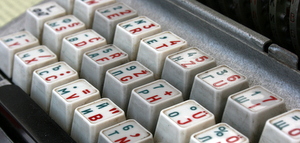
Numbers Stations: The English Man came back

Two weeks ago this Friday, I caught and recorded the numbers station often referred to as the English Man. He was found in the pirate radio watering hole (of 6,925-6,990 kHz) on 6,949 kHz.

After sifting through more spectrum recordings taken the following evening by the Microtelecom Perseus, I realized that I caught him once again at the exact same time and frequency. I have his full transmission in the recording below.

Note: The English Man was broadcast in AM, but I had to dig the signal out of the noise. I used a tuning technique I referred to last year in a post–click here for more info.

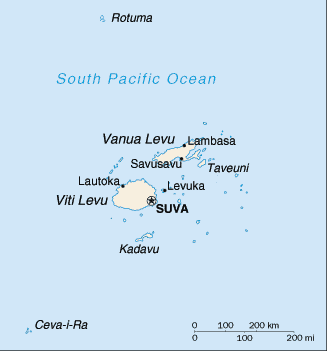
Domo I Viti: New Fiji clandestine station

I just received this message from Glenn Hauser via the Hard-Core DX group:

** FIJI [non]. As first reported exclusively on WORLD OF RADIO 1617 and DXLD 12-20:

HOT NEWS: A station for Fiji named Domo I Viti should start on 4 June at 0830-0900 on 11565 via WRN from Palau. Not sure what its agenda is, clandestine or at least political? Seems there are at least two programs/stations by same name, in Auckland and Sydney by expatriates. Related to either of them, originating where? E.g.:
http://www.aucklandfiji.org.nz/community_features_view.asp?newsid=408
(Glenn Hauser, OK, May 9, WORLD OF RADIO 1617, DX LISTENING DIGEST)

WRN confirms that this new clandestine starts June 4 at 0830-0900 on 11565 via PALAU, and will be weekly on Mondays only. It`s sponsored by the Fiji Freedom and Democracy Movement, based in Adelaide, South Australia.

If anyone can hear it, please note how much, if any, is in English, any contact info, and if possible record an ID. I haven`t found any Adelaide office, altho searching on ABC News stories gets some hits which aren`t very productive.

Note that HFCC has WHRI rather than T8WH registered on 11565 at 08-09. WHR schedules show Angel 4, the most likely transmitter, on 17650 at that time, and Angel 3 on 9930. 11565 was probably just a place-holder in HFCC. Searching WHR program schedules is fruitless (Glenn Hauser, June 3, DX LISTENING DIGEST)

Click here to check out Glenn Hauser’s DX program, World of Radio.

Note that we’ve covered Fiji in the past as their ruling party routinely blocks free press. Click here to read past articles referencing Fiji.

Voice of Greece plays music format during strike

On Monday, May 28, I recorded over 2 hours of popular Greek music programming from the Voice of Greece on 9,420 kHz with a Microtelecom Perseus. Propagation was excellent.

UPDATE: Once again, SWLing Post reader, Christos, provided more info on the strike and recording below:

This time only the journalists had gone on strike. So, no news were broadcasted, no newspapers, no news in internet portals. Announcements between songs concerned the artists and cultural events of the same day, such as theatre, movies, concerts etc. The programme recorded from 42nd minute till 99th was from ERT’s archive introducing contemporary songs. The announcements of this part were about the songs, the singers and the composers. The programme recorded from 100thminute and on contained songs of 60ties, 50ties and older. Music programmes’ producers made no comments about the strike of their colleagues.

Thanks, Christos!!!


You can listen via the player below, or simply download the MP3 by clicking here.

Click here to check out previous Voice of Greece recordings.

RFE: Radio Farda Families A Target In Iran

One of the points I often make is that repressive regimes can track and take action against citizens who read online content from banned/blocked media sources. Here is a case in point:

(Source: Radio Free Europe)

In an escalation of ongoing efforts to thwart Radio Farda, RFE/RL’s Persian-language Service, Iranian authorities are interrogating journalists’ family members in Iran.

Employees of Radio Farda believe that their journalism, which attracts over 10 million page views monthly on Radio Farda’s website, is the motive behind at least 20 incidents this year involving the interrogation and intimidation of their family members in Iran by officials of the country’s Intelligence Ministry.

In sessions that sometimes lasted for several hours, agents denounced the work of Radio Farda journalists and warned family members against having further contact with them. In several cases they instructed family members to tell their relatives to resign from their jobs and return to Iran; in one instance they demanded that a specific series of reports be discontinued. During questioning, family members were also asked about their foreign contacts and trips abroad.

The interrogations have targeted family members, who in some cases have been repeatedly summoned, in Tehran and at least six other Iranian towns and cities.

“This is a proxy war against Radio Farda. It shows the extremes to which the regime will go to prevent the exchange of information it doesn’t control,” said Steven W. Korn, RFE/RL president. “Our journalists make enormous sacrifices for the work they do and will not submit to this pressure on them and their families.”

Radio Farda, produced in and broadcast from Prague, is a leading source of uncensored information in Iran. Each month 1.5 million users inside the country defy the government by employing proxies to access Radio Farda’s website, which is blocked. Radio Farda and “Pasfarda,” its signature satire program, are active on social media, with a combined 300,000 Facebook fans. Iranians actively participate in Radio Farda’s weekly call-in shows, connect with it daily through hundreds of email and SMS messages, and despite government jamming, tune in to satellite radio and shortwave to hear its programs.

In media freedom surveys this year, Freedom House ranked Iran 192 among 197 countries surveyed and Reporters Without Borders ranked it 175 of 179.

Yet one more reason why shortwave radio is safer than the internet as a reliable source of news and information and one more reason why countries like Canada should not abandon this vital resource.