Tag Archives: Shortwave Radio

Nick acquires a Harris RF 505A receiver

Many thanks to SWLing Post contributor, Nick Booras, who writes:

I just picked up a Harris 505A and I made a couple videos your viewers might like.

This radio is extremely sensitive as you can see in the comparison videos. I am very lucky to have picked it up. I will add that in the comparison to the Kenwood TS890 I didn’t try the 15 kHz filter on video. I did try it afterwards and I was surprised to receive the weak 6.085 signal with similar results to the 505. I thought for sure that that huge width would only let in more noise but I was wrong. I learned something new! But the 505A is still a super sweet machine.

Thank you for sharing this, Nick! What a wonderful addition to your radio collection. I’ve always loved the incredibly simple design of the 505A and have assumed it would have a very low noise floor.

Thanks again!

Social DXing: Looking back at one very radio-active year

One year ago, I posted an article about making the most of social distancing as the world started locking down due to the rapid spread of Covid-19. Here in March 2021, the news is looking much better: vaccines are being distributed at a record pace across the globe and number of cases and deaths are mostly on the decline.

Looking back

As I look back at the Social DX Bucket List I made last year, I’m happy to see that I actually accomplished about 64% of the goals I listed. I knew some of those goals would take well over a year to achieve (the QRP EME one especially).

In particular, I’m chuffed that I braved up and started doing Parks On the Air (POTA) and Summits On The Air (SOTA) activations in CW (Morse Code). That was a huge step for me and I’ll freely admit: I was nervous about it. But in July 2020, I managed to do my first CW activation and since then it has become my choice mode of operating in the field. CW is such a simple mode and so efficient–plus it gives me a sense of connection with the roots of radio communications.

I also accomplished a few things I never set out to do:

Not a typical radio year for me

In a “normal” year, I do way more SWLing than I do ham radio activity.

Last year, I started doing caregiving for my parents in my hometown–I’m typically there 2-3 days a week. While I’ve done shortwave listening and even a little MW DXing in my hometown, I typically don’t have a lot of time, especially in the evening hours. I just want to hit the sack early. QRM is also debilitating there and while I’d like to install a permanent Loop On Ground antenna to mitigate the noise (you heard that right, Andrea!) I’m not entirely sure I’d even have the dedicated listening time to justify it. When I’m there, I like to spend quality time with my folks.

In general, I’ve had much less free time. Indeed, if you’ve written to me via email, you’ll know this based on how long it’s taken me to reply. It can take several weeks especially if the reply requires a detailed response (which many do).

En route to, and on the way back from my hometown, I’ve found that doing park and summit activations has been very rewarding. Last year, I believe I completed a total of 82 park activations.

POTA has given me an excuse to explore public lands I’ve never visited before. Plus, I love nothing more than taking radios to the field–both receivers and transceivers.

Hamming and SWLing

At the end of the day, I’m an SWL and a ham radio operator. I find the two activities complimentary.

Side note: As I mentioned in my Winter SWL Fest presentation this year, it saddens me when I receive angry emails from readers after I post items that are ham radio related. We’ve upwards of 7,000-10,000 daily readers on the SWLing Post and the number of complaints are a teeny, tiny fraction of our readership. I only receive messages like this about once a month and they typically say something akin to “I don’t like the ham radio stuff, so if you don’t stop posting it, I’m leaving!” (FYI: That’s a real quote taken from the last one I received in January). I can only assume that at some point in the past, a ham radio operator has been a jerk to this and other radio enthusiasts. It’s a shame, too. I hate seeing the negative impact of one loud troll compared with the encouragement and support of much better people. All of my ham radio friends are not only supportive of SWLing, but almost all got their start in radio via the shortwaves. I’m certainly a case in point.

I love all things radio and I believe the SWLing Post is a reflection of that. If it offends you, then it might make sense to surf somewhere else.

Now where was I? Oh yeah…

POTA and SOTA outings have helped to satisfy some of my travel cravings as well. I miss going to radio conventions, hamfests, and especially traveling internationally with my family. We are a family who love national parks, forests, and other wildlife areas. Having an excuse to explore public lands we haven’t visited before has been amazing fun.

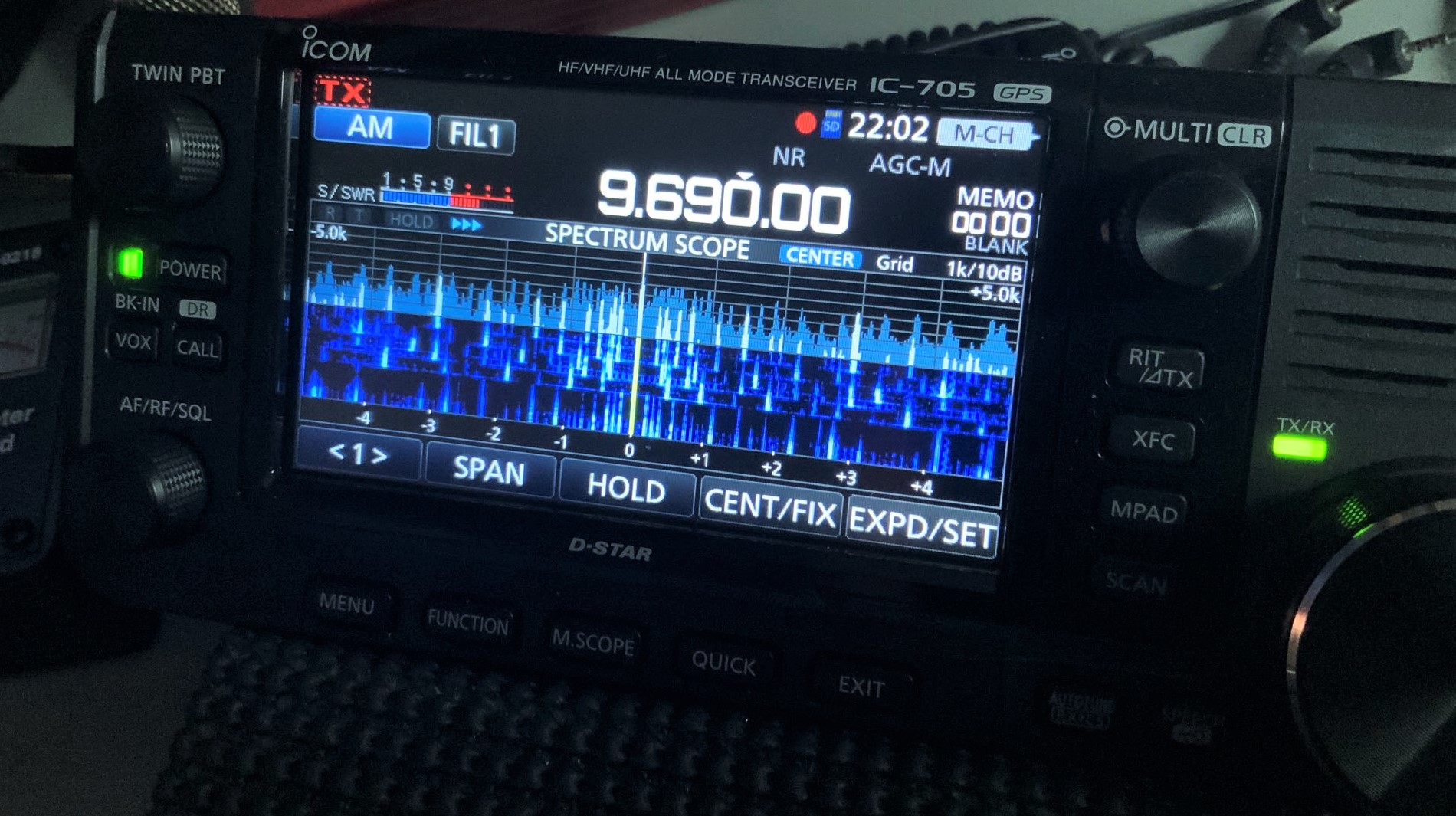
After POTA activations, I’ll often do a little SWLing since I already have an external antenna up and it’s typically connected to a good general coverage transceiver in a spot with zero RFI or QRM. I’ve especially enjoyed my DXing sessions with the superb Icom IC-705.

Listening habits

One indicator that I did less radio listening last year was the low number of recordings I made. I checked my audio folder recently and saw that I only made a couple dozen recordings–most were staple broadcasters, not rare or special DX.

At the end of the day, I realize that when I do SWLing sessions I like to have dedicated time–at least an hour or two–with headphones on, losing myself on the radio dial.  I simply haven’t had many opportunities this past year to make that a reality.

That’s okay, though. The great thing about the shortwaves is that they’re always there, patiently waiting for us to dive back in!

Looking forward

I’m really not sure what’s in store for me this year, but I know it’ll involve a lot of radio time and that pleases me to no end. I’ve made a few fun goals, but my hope is that, by the end of the year, I may even be able to do some proper travel–maybe even take a flight!

I do know this: I have an even more profound appreciation for my radio enthusiasm as I realize it’s the perfect space to travel and explore the world no matter how “locked down” things are. Based on feedback from readers and contributors to this site, I know I’m not the only one who feels this way.

How about you?

Did your radio activity change or pivot this past year? Did you have more or less time to hit the airwaves? Please comment!

KSKO’s “Virtual Dance Party Request Party Thingy” via WRMI

Many thanks to SWLing Post contributor, Paul Walker, who shares the following announcement:

Tune into WRMI for “The LIVE Friday Night Virtual Dance Party Request Party Thingy” from community station 89.5 KSKO McGrath, Alaska.

The broadcast will take place on Saturday, March 20th 2021 from 0300 to 0500 UTC on 7570 kHz for the west coast and 7780 kHz for the east coast. KSKO Program Director Paul Walker is going to be hosting the show and WILL take requests by phone at (907) 524-3001 DURING the show!

It’ll be all kinds of music from the 60s to today from all genres, so there’s probably going to be something for everyone. Paul says, “I’m funding the WRMI airtime costs from my own personal pocket, not the stations bank account. I’m doing it just because, for fun.. because I can.. because why not?”

Thanks, Paul! I’ll certainly tune in and perhaps even call in!

Radio Tirana memories: Who was the voice of “goodnight dear listeners”–?

I just received the following comment from Richard Levenson posted with this off-air recording of Radio Tirana on the Shortwave Radio Audio Archive:

Lots of fond memories listening to Radio Tirana, Albania going back to the late 1950’s. Their broadcasts back then were loaded with anti-West propaganda and more. Their interval signal is a classic to SWL people. Always remember the female announcer on the station. Her sign-off phrase was “and goodnight dear listeners.” This came after much in the way of negative propaganda. When she would say her sign off you got the idea she was tucking you into bed for the night. It had that quality and sincerity to it. Love to know who this person was or if she is still alive. Give you an idea how much SWL I did since around 1953 to present day.

Thank you for your comment, Richard! If you can identify this announcer with Radio Tirana, please comment with details!

Guest Post: Mark’s review of the Yaesu FT-891 as shortwave broadcast receiver

Many thanks to SWLing Post contributor, Mark Hirst, who shares the following guest post:


Using the Yaesu FT-891 for SWLing

by Mark Hirst

Woodland Operation in North Hampshire

Introduction

While I have a small collection of portable shortwave radios for outdoor listening, I’ve been looking to fill a gap in my amateur radio lineup for a while. Outdoor operation has become important in recent years as solar cycle conditions deteriorated along with rising levels of QRM in urban neighbourhoods. The ICOM IC–7200 with Wellbrook loop stays at home fighting a losing battle with PLA noise, while the very portable FT–817ND does occasional data modes contacts and outdoor listening. Somewhere in the middle, the FT–891 promised to provide a modern and more powerful data modes station, a radio to take on holidays, needing external batteries, but portable enough for walks into the country side. Earlier this year, I bought one new from my local ham radio store, and what follows are my findings and observations so far on shortwave listening.

Audio Characteristics

I’ve accumulated hundreds of recordings of VOA Radiogram and Shortwave Radiogram since 2013, so a recent woodland expedition with the FT–891 was an opportunity to compare a recording made with it against those of other radios I’ve used.

The most striking difference is the lack of frequencies in the lower part of the audio spectrum along with a distinct cut off at around 5kHz.

This is easily visualised in the following comparison between the FT–891 and the Tecsun PL–680. Note the conspicuous pillar associated with MFSK32 from these Shortwave Radiogram broadcasts, and interfering RTTY on the FT–891 recording:

Audio Frequency Analysis

While this audio profile may not be to everyone’s taste, the extra sparkle yields voice audio that is clear and distinct. I find those low frequencies make the audio muddy and tiring to listen over long periods, so I’m quite happy with this.

When listening to speech based broadcasts through the top mounted speaker, the audio is also precise and intelligible, and provides more than enough volume.

You can judge for yourself from this 2 minute video I made recently:

Headphones, External Speakers and Recording

You also have the option of connecting an external speaker or headphones to a socket on the side of the radio. Be aware that the audio level is different for headphones, and is controlled by a small switch hidden behind the front panel. I expect people may go for one option such as headphones and then stick with it, rather than continually detaching the front of the radio and moving the delicate switch back and forth.

If you turn the volume right down you will hear a hiss, although its really only noticeable if you face the speaker directly and get close. Listening outdoors with the sounds of nature around you? It’ll be fine. There’s no way to avoid it with headphones of course, with forums suggesting inline resistors or high impedance headphones as solutions.

Audio recordings can of course be taken from the headphone socket, but you will get better results from the data port on the back. I use a UD04YA cable which provides 3.5mm audio in and audio out jacks, plus a USB cable to provide PTT functionality. It’s meant for data modes operation with the FT–817, but I have used it successfully with the FT–891 for PSK contacts using fldigi, eliminating the need for CAT control through a second cable to the radio’s USB port.

Customising for SWL

The advanced manual for the FT–891 helpfully provides a section called ‘Tools for Comfortable and Effective Reception’, so I began configuring the radio using the guidance there.

First up was re-configuring the front panel RF/Squelch knob to only control RF gain (Menu 05–05). I use the same configuration on my FT–817ND to dial back RF gain, allowing the AGC to pick up the slack.

Next was enabling the awkwardly named Insertion Point Optimisation (IPO) which switches out the pre-amplifier. It’s interesting to note that this setting can be associated with a stored memory channel, which became relevant later when I used CAT control to program some favourite frequencies.

The radio has an attenuator, although I’ve not found a need for it so far.

The AGC can be configured as Auto, Fast, Mid, and Slow. Since it is not a ‘set and forget’ setting like the RF control or IPO options, it might be a good candidate for assigning to one of the three user definable buttons below the LCD screen.

Audio can be fine tuned using four menu options (06–01 to 06–04) to control high and low frequency cutoff, but after some experimentation I have turned these options off.

As an aside, I found the LCD backlight, button illumination and TX/Busy lights too bright for indoor use, so dialed them back to their minimum values.

Listening Tools

The radio provides some additional tools as part of its IF DSP. The features of particular interest are Digital Noise Reduction (DNR), Noise Blanker, IF Notch Filter, Digital Notch Filter, and Narrow IF filter. Contour, IF Bandwidth, and IF Shift are not available in AM mode, and you must resort to SSB to get them. More about SSB in a moment.

Out of this wide array of options, I’ve only explored Digital Noise Reduction and the Narrow IF filter so far, as they offer fairly immediate gains without too much configuration.

Narrow filter simply reduces the total IF bandwidth from 9kHz to 6kHz, which gives some immediate relief to higher frequency noise. In tougher conditions at home tackling QRM, the harsher sound it causes has sometimes been counter productive.

At the outset, it’s obvious that the DNR capability of the FT–891 is a powerful feature. Rather than providing a level of processing that varies from a little to a lot, the radio provides 15 different ‘algorithms’ which can be selected for best results. This means you will tweak the DNR setting to address signals on a case by case basis.

Comparing it with the IF noise reduction of my ICOM IC–7200, the ICOM has a scale of diminishing returns as the DSP level is turned up, whereas the FT–891 seems to start strong and it’s more about picking the algorithm that sounds best.

After testing the DNR on AM broadcast stations away from the noise at home, voice audio sounds distant and words can be clipped, which is fine for SSB amateur radio contacts, but makes me think it’s not a feature of first resort when trying to improve broadcast reception. In those circumstances, the narrow filter might be a better option.

The Trials of Single Side Band

On the matter of SSB and using it to combat adjacent or co-channel signals, the radio offers a single SSB option in the mode menu, picking USB or LSB for you automatically based on the current band. When tackling broadcast band interference however, you want the option to go in either direction. The radio also changes the current frequency by 700Hz when SSB is selected, which then has to be corrected with the main dial.

You would begin by switching to SSB mode by pressing and holding the band button. If you’re lucky, the default setting is the one you want.

If it isn’t, activate the settings menu with a long press of the F key, go to the menu option SSB BFO (11–07), select it and use the multi-function knob to change the mode away from Auto to LSB or USB.

As you are doing this, the VFO will change to LSB or USB too. Leave the setting on the option that suits your needs.

If you exit the menu option without saving (pressing F), the mode will remain changed, but the override is not saved. This can be a useful quirk because next time you turn the radio on, it will be back in auto mode.

If you commit the override by pushing the multi-function knob instead, the radio will stay in manual mode until you remember to return to the menu and restore automatic behaviour again.

It’s a needlessly complicated system, as I discovered recently while recording another Shortwave Radiogram broadcast. Even after testing the procedure previously for this article, the radio was determined to stay in LSB no matter what.

Memory Programming

Since the radio has no keyboard for direct frequency input, an early priority for shortwave listening was to program some of the 99 memories available. My plan was to have some favourite broadcast stations, along with WX, Volmet, GMDSS, and some data mode frequencies. To handle ad-hoc stations however, I wanted a way of moving quickly across the main shortwave bands without excessive use of the main tuning dial or multi-function knob.

Taking the official definitions of the broadcast bands between 60m and 16m, and combining those with frequency schedules, I came up with a series of frequencies 150kHz apart across each of those bands, guaranteeing that no broadcast was more than 150kHz away.

The combined list of favourites and the 150kHz stepping stone frequencies resulted in 70 memory channels in total. As I wanted to apply alphanumeric tags to those channels, and didn’t relish the prospect of entering them manually, my next port of call was the CAT control manual to see how those memories could be set programmatically.

While there is commercial software available for the FT–891, I only needed to set up the memory channels, so decided to adapt some PowerShell I’d written for another radio, sending the necessary serial port commands to configure my list.

Now that is done, I can fast travel using the stepping stone memories to the closest point in a band, then use the fast mode of the main tuning dial to move quickly to my final destination.

The following table lists my current stepping stone channels in kHz:

60m 49m 41m 31m 25m 22m 19m 16m
4750 5900 7200 9400 11600 13570 15100 17480
4900 6050 7350 9550 11750 13720 15250 17630
5050 6200 7500 9700 11900 13870 15400 17780
7650 9850 12050 15550 17930
7800 15700

Memory Access

An obvious way to access the memories is to toggle memory channel mode with the V/M button, then cycle through the memories using the multi-function knob. Depending on your memory choices, you will hear relays clicking as the radio jumps back and forth between widely spaced frequencies and bands. You will also need a good memory of your memories, so you know which way to turn the multi-function knob.

An alternative and perhaps faster method is to press the M>V button. This brings up a multi-line listing of memories that can be scrolled through using the multi-function knob. Pressing the M>V button again copies the selected memory to the VFO and leaves you in VFO mode. This avoids the radio flipping across bands and the associated relay activity.

Although it is not documented, if you push the multi-function knob on a selected memory channel in the multi-line listing rather than using the M>V button, the selected memory is activated and the radio is left in memory channel mode displaying the memory tag.

Disabling Transmit

At the time of writing, I haven’t discovered a way of formally disabling transmit, and the minimum transmit power goes no lower than 5W. Since my main interests are around shortwave listening, utility stations and an occasional data mode QSO, I have not fitted the microphone to the radio. In that configuration at least, there is no danger of me manually transmitting into a receive antenna by accident.

Outdoor Power

Reports vary on the power consumption of the FT–891. It certainly isn’t as high as the 2.0A documented in the user guide.

While some sources claim values in the region of 1.0A, my power supply shows around 0.4A at 13.8V when receiving a typical HF broadcast. You will notice where some of that power goes quite quickly, as part of the radio gets warmer.

To save weight, my preferred power supply in the field is usually a lithium battery designed to jump start smaller engined cars. This versatile 12V battery also supplies 5V USB power to phones and tablets, and can even charge laptops.

In Conclusion

Control ergonomics and screen size are factors that can detract from shortwave listening on these kinds of radios, with smaller speakers and menu options for features normally at your fingertips.

Despite this, I’m happy with the audio, and I like the emphasis on mid-range frequencies in its audio spectrum. The digital noise reduction is impressive and can tackle significant QRM environments, but for outdoor listening may not be your first port of call.

Memory presets can make tuning less laborious, while assigning key listening tools to the customisable front panel buttons should reduce the need to access menus. I may consider defining some stations with known co-channel issues to memory with preset LSB and USB variations, to allow rapid responses to interference in future.

In good conditions, I suspect there is little difference between the FT–891 and FT–817ND for general listening. The FT–817ND has produced some of my best recordings of Shortwave Radiogram. The newer radio however brings many advanced tools to bear on more difficult signals, while its band scope and full sized VFO tuning dial enable desktop style shortwave exploration.

The ICOM IC–7200 is constrained by interference at home, biding its time for when the solar cycle swings back. When it’s been out on field days, it has always been a strong performer for broadcast listening. All the important controls are upfront, but is not a trivial thing to transport on foot. While the FT–891 has impressive DNR chops, I think I prefer the ability of the IC–7200 to apply noise reduction in incremental steps. Perhaps the algorithm approach will grow on me in time.

Any amateur radio operator using the FT–891 should have no trouble using it for shortwave listening. It attracts a lot of positive reviews for its ham radio capabilities, and it looks like those features carry across for listening to the world too.


An excellent review, Mark! Thank you for sharing. 

The Yaesu FT-891 must be the most popular HF transceivers Yaesu sells today. So many of its users rave about its performance and audio characteristics. Mark, thank you for sharing your experience with the FT-891 as an SWL!

Click here to check out the affordable IP67 rated case Mark uses to house his FT-891.

What’s your favorite general coverage transceiver for shortwave listening?

The Elecraft KX2 doing a little coastal SWLing.

Yesterday, at the (Virtual) 2021 Winter SWL Fest, I gave a presentation about QRP general coverage transceivers that I regularly use for shortwave broadcast listening (SWLing).

My discussion was limited to QRP–or low-power–transceivers designed for portable use, but they only represent a small fraction of the new and used transceivers on the market.

So what is “general coverage”––?

A ham transceiver with “general coverage” means that the receiver portion of the radio is not limited to the ham bands only; these receivers typically receive between 100 kHz and 30 MHz (i.e., the full medium and shortwave radio spectrum). Many transceivers, starting in the 1980s, employed a general coverage design as a feature of the radio. Some radios implemented general coverage receiving better than others. In most cases, there was a compromise to performance when the receiver was opened to general coverage reception, so many manufactures held to a ham-band-only platform to optimize performance where hams sought it most. Today, receiver architecture can better accommodate general coverage without compromising sensitivity and selectivity on the ham bands. This is especially true with new SDR-based transceivers that employ direct conversion or a hybrid architecture.

My favorite?

My current favorite is the new Icom IC-705. I purchased this rig last year and have done a tremendous amount of SWLing and MW DXing with it. I love its overall performance, portability and recording/playback features.

What’s your favorite?


I’m betting a lot of us use transceivers for shortwave broadcast listening.

What’s your favorite general coverage rig and why? I’m also curious how many of you almost exclusively use a transceiver for SWLing. Please comment!

Dan’s first impressions of the new Sangean ATS-909X2

Many thanks to SWLing Post contributor, DanH, who shares the following guest post:


Sangean ATS-909X2 First Impressions

by DanH

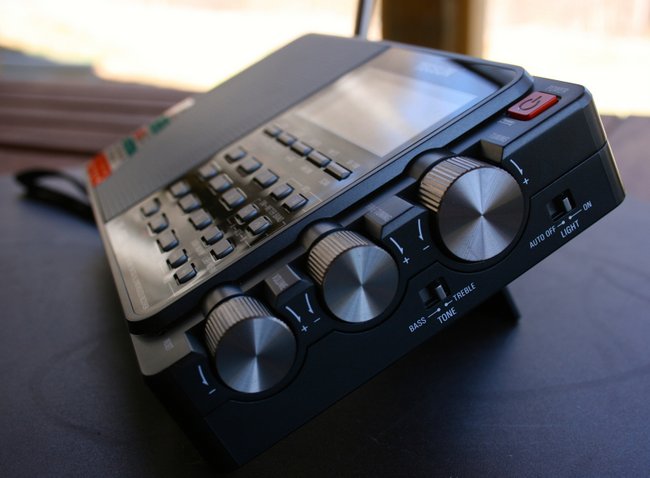
A few hours spent tuning a new radio are enough to make me feel confident that I know most of the new features and how to use them. Then several days, weeks or months later I discover overlooked features and I figure out new ways to operate the radio. Sometimes I actually read the operating instructions again. Understand that I received my new Sangean ATS-909X2 only three days ago so this early report is hardly a comprehensive review nor was it intended as such. At this point I’m looking mostly at shortwave and medium wave performance.

My first experience with the new Sangean ATS-909X2 was online at the Amazon shopping site. On December 16, 2020 I pre-ordered the radio for US $459.99 (list price). The radio didn’t ship and the prices dropped a couple of times. Each time I cancelled the order before it shipped and ordered it again at the lower price. In the end I ordered my 909X2 for $297.95 and paid for it with credit card bonus points and a little more that I had on my Amazon gift card.

The 909X2 arrived on Friday afternoon, February 19. I devoted the first 24 hours to tuning around on SW and a little MW only. I deliberately made no videos at this time and devoted my radio time to exploring the bands. The latest addition to the ATS-909 series is a well thought out evolution of the radio and much more than a 909X with a cosmetic facelift. The 909X2 retains the excellent speaker sound of its predecessor, the tuning knob is unchanged from late production 909X, the solid build quality remains the same as does the general layout, performance, size and weight. SSB audio for the 909X2 remains at a lower level than for AM, like 909X. I don’t like having to turn the radio volume up for ECSS or SSB. Like 909X, the new radio excels with external antennas and is not easily overloaded by a lot of wire antenna.

Like 909X, 909X2 occupies an interesting niche in the portable multiband world. It is a little too large and heavy for a travel radio but over the years I have packed it many times in my carry-on bag. Sometimes I am willing to sacrifice extra clothes if it means bringing the best radio. These radios excel on a desk or radio room work station. The radio is big and powerful enough to provide top notch sound for all modes. Late at night I run mine with Sennheiser HD 280 Pro headphones. With 909X2 you get top performance in a small package. It is an over-used metaphor but think of a 1950 – 60’s communications receiver in a small package, plus VHF air band and FM. The speaker audio sounds better for broadcasts than many Amateur rigs.

There are many new features with the 909X2. Instead of charging NiMH batteries like Eneloop in series the 909X2 monitors each cell individually and identifies failing cells for you. SSB resolution is now selectable 10 – 20 Hz, auto-bandwidth control may be used on all bands except SSB on HF. There are many more memory slots available in three separate banks. The LCD has dimmer settings, soft muting is switchable for FM and the keyboard beeper may be shut off! Instead of hidden features the 909X2 has an INFO/MENU button for customizing your operating options.

The new bandwidth choices make a real improvement in LW, MW, SW, FM and VHF airband signal quality especially when adjusted in tandem with the audio tone control. Automatic bandwidth control selects the bandwidth that offers the best signal-to-noise ratio. Now I understand why the 9090X2 shortwave bandwidths are relatively closely-spaced: auto control shifts quickly between multiple bandwidths. Too much space between bandwidths would sound jarring. The auto bandwidth control is most useful during heavy fading and has improved my ability to copy words on poor AM broadcast signals. This feature does add an odd effect to fading signals: the audio tone quality will shift as different bandwidths are selected. This feature is not something that I would leave ON as a default for shortwave listening but it is definitely a welcome tool when needed.

MW performance is as good as the 909X but with improvements made possible with more bandwidth and memory slot availability. I found that 909X2 LW is generally better than 909X with fewer MW images. I am hearing substantially more LW beacons on 909X2. LW activity is very limited here on the US West Coast.

10 Hz SSB resolution means that ECSS is excellent on the 909X. I can tune a shortwave music broadcast on the 909X2 without warble. This was impossible with the 909X 40 Hz resolution.

The 909X sold near US $220 for most of the last five years with a few rare Amazon holiday sales at the $190 level. Then the prices jumped another $30 post-Covid 19, as did prices for other radios in this range.

Is 909X2 worth the additional money right now? I say yes! Mine is a keeper.

I do not believe that there will be significant improvements coming along any time soon. Sangean is a private Taiwanese company with its own factory located in PRC. 20 pre-production units delivered to Europe in January are not the same batch as the retail production units released by Sangean USA this month. Sangean USA has two of the pre-production units. They did not offer these for sale. The first retail production units arrived at Sangean USA in mid-February before the Lunar New Year. If there are significant changes for 909X2 we won’t see those radios for at least another 6 – 8 weeks. I can’t see much need for significant changes anyway.

Believe it or not I have been very busy with the Sangean ATS-909X2 and haven’t tried FM or VHF air band on it yet!

This video is a companion to my first impressions written here. Hearing and seeing video is hard to beat. SW and MW features are shown in real-life reception conditions. I test for the dreaded LCD/hand capacitance internal noise and have a look, listen and comparison for telescopic whip performance. And you will hear DX too, not just Brother Stair. You need to see and watch auto bandwidth control to believe it.

Wow! Thank you so much for sharing this, Dan. Very encouraging. We look forward to publishing your updates as you get to know the 909X2 even better! 

Sangean ATS-909X2 Retailers:

All prices are current at time of posting (22 Feb 2021).