Shortwave listening and everything radio including reviews, broadcasting, ham radio, field operation, DXing, maker kits, travel, emergency gear, events, and more
Many thanks to SWLing Post contributor, Harald Kuhl (DL1AX), who shares the following announcement from the NDR regarding the annual Gruss an Bord Christmas Eve broadcast. Harald notes:
Norddeutscher Rundfunk (NDR) published frequencies for this year’s shortwave transmission on 24 December:
Many thanks to SWLing Post contributor, Kostas (SV3ORA), for sharing the following guest post which originally appeared on his radio website:
How to build an automatic rig/antenna switching system
by Kostas (SV3ORA)
When I started collecting vintage rigs, I ended up in a line of rigs on my bench, that were sitting there, disconnected from any mains cables or the antenna. I wanted these rigs to be ready to fire at any time I wanted to, without having to connect/disconnect cables all the time. I also wanted to be able to compare different rigs performances at the flip of a switch, which is the only way this can be done on the HF quick fading conditions. For power cables, the solution was to leave them connected in the mains plugs all the time. My rigs that have an internal PSU, have mechanical switches, so they are isolated from the mains when they are switched off. The rigs that are powered by an external PSU, depend on the external PSU main switch for isolation (in case they haven’t mechanical switches on them), which in my case is mechanical and switches off the mains power, when the PSU is switched off.
However, for the RF cables, this was a different story. Having only one antenna and multiple rigs, means that you have to connect each rig to the antenna every time you want to operate each rig. This is not only boring and time consuming (you have to reach the back of the transceivers to connect/disconnect the connectors), but eventually causes the connectors of the coaxial cable and the rigs to wear out. I decided to make things better and make an RF rig selector for my rigs. This RF rig selector has been described in this link.
The current antenna I use is fine for transmitting, but in the noisy neighbourhood where I live, it picks up a lot of noise. I have tried many solutions, without significant effect in the noise level. This is why I decided to use a separate antenna for receiving, from that used for transmitting. This antenna will be some kind of loop probably, so as to be immune to noise or insensitive to the direction of the noise. It will be placed in a different location than the transmitting antenna, a location which will be less noisy. Unfortunately, the space I have for the TX antenna lies in a very noisy location in my property. So a separate RX antenna, in another physical location is a must. This means that a separate coaxial for the RX antenna must be used. Thankfully, the RX coaxial can be very small in diameter, passing easily through the sides of the windows, without extra holes.
To satisfy all of my requirements, I developed the circuit shown above. The circuit is able to switch a common antenna to four different rigs. Why four? Because this was the capacity of my switch and the number of connectors I had available. If you have a greater capacity switch and more connectors, expand the circuit to your needs.
The circuit of the shack switch, allows for 4 separate rigs to be selected, and two antennas, one for RX and one for TX. TX/RX antenna selection is being done automatically (split antenna operation) and controlled by the PTT of any of the rigs connected. This feature can be bypassed by the switch, so that the TX antenna can be used for both RX and TX. The same switch allows also RX operation with passive RX antennas of active ones. When in the active RX antenna position, power is passed to the remote RX preamplifier through the RX coaxial cable, using a bias-T circuit. The values of the bias-T circuit have been chosen very large, so as active RX antennas that operate at LF and lower could still be used. The RF relay defaults in the TX antenna, so that if there is a power failure, or if the circuit is not supplied with power, you can still receive (and transmit) with the TX antenna. The other way around, would be fatal for both the transceiver and the RX antenna (If you transmitted accidentally into it).
The PTT circuits are based on my transceivers. Unfortunately, there is no “standard” for the PTT circuits, each rig has its own way, so the PTT circuits must be thought for each of them. I followed an “inhibit” approach for the PTTs. That is, all the PTT switches are connected in series and DC is passed through them. If any of the rigs transmits, the PTT switch is opened and the circuit switches to the TX antenna. For the rigs that do not have an internal relay but output DC on TX instead, an additional small relay is used (for greater isolation and lossless switching). The only drawback of this “inhibit” topology is that the PTTs of all the rigs must be connected to the circuit simultaneously. If you want to exclude a rig of course, you may short circuit it’s PTT connector in the circuit. The PTT circuits as I said, are non-standard, so you might want to change the circuit to your needs, but anyway you got the idea.
Notice the connections in the circuit. One section of the RF switch (on the left) is used for the positive wire (central conductor of the coaxial) and another for the negative (braid of the coaxial). Why is that? This is because I canted to add a special feature to the switch. That is, the ability to disconnect the antenna from any rig when the rigs are not used. Previously, I used to disconnect the antenna coaxial from the transceiver when I was away, so as to protect the transceiver from antenna static discharges and possibly destroy it’s front end circuits. Now, with a single flip of the switch, I am able to do so. Because I wanted the switch to operate on different types of antennas (balanced or not) I decided to short circuit both poles of the antenna at this position, to equalize their charges.
But equalizing their charges was not enough. I had to find a way to let these charges go to the ground, so that the antenna is discharged. Directly grounding the short circuit, did not seem a good thing to do, because the whole TX wire antenna on the roof would be grounded. Whether this is a good idea to avoid lightings or not, I do not know. So I decided to keep the short circuited antenna floating and instantly discharge it only when adequate static charge is built upon it. For this purpose, I used a neon tube, permanently connected to the switch NC (not-connected) position. When the switch is in the non-connected position, the tube lights up and discharges the antenna (both poles) if an appropriate amount of static charges has been built upon it. When the switch is in any of the selected rigs connections, the tube is disconnected, preventing it from lighting up when you transmit into the antenna. Note that this configuration, requires that the output (antennas) coaxial connectors must be isolated from the metal chassis of the RF switch!
Isolation of the output antenna connectors has been done with a PVC sheet and isolated screw rings. Also note the usage of BNC connectors on TX and SMA on RX. I used BNC connectors for various reasons. They are excellent connectors with quick lock/unlock features. You do not need to screw them (and wear them out) and once fit in place they are not unscrewed. Once fitted in place, they allow for rotating the connection without unscrewing the cable or bending it. They can handle 100W easily. Despite all these features, they are much smaller in size and lighter. Their reduced size fits easily to reduced diameter cables like the RG-58 and similar. In an RF switch where there are lots of cables connected, this does make a difference. They are also very common and very cheap. There are even types that do not require soldering at all to fit a coaxial to them. I use BNC connectors even at my antenna side, as they have been proven to be quite waterproof. The types of BNC connectors I choose are not silver plated. Despite silver plated connectors are better, in the long term they are corroded by humidity and become much worst than the nickel plated connectors. The connectors I used are nickel plated with gold plated central conductors. I have found these types to be much more durable over the years, despite being cheaper. The same goes for the RX SMA connector, but I used an SMA connector there so as to accommodate thinner coaxial cables for RX.
The BNC connectors used, are the square flange types. I used this type of connectors because when they are fitted onto the chassis, they cannot be unscrewed, unlike the single-hole types. For the RX though, I used an SMA connector because it is even smaller and it can accommodate smaller diameter cables. The coaxial cable used for the internal switch connections on TX, is the RG-223. This cable is silver-plated (both the central conductor and the braid), it has double braid for increased shielding, it is of the same diameter as the RG-58 and it has a bit lower loss. The cable loss is negligible though for such small pieces of cable. The same type of cable has been used for the internal switch-relay connections as well as for the connections of the selector to the rigs. Appropriate lengths of RG-223 cables were cut and fitted with BNC connectors at one side and the appropriate rig connectors at their other side. For the RX antenna, you may use the thinner diameter cable you can find. I used a small piece of very thin coaxial (taken out of the WiFi card of an old laptop) and passed this piece through the side of the windows of the shack and through the mosquito net of the windows. No extra holes are required that way! For the rest of the RX cable, you can use whatever cable diameter you want, but I tried to use the smallest diameter I could find, so that the cable is as much phantom as possible.
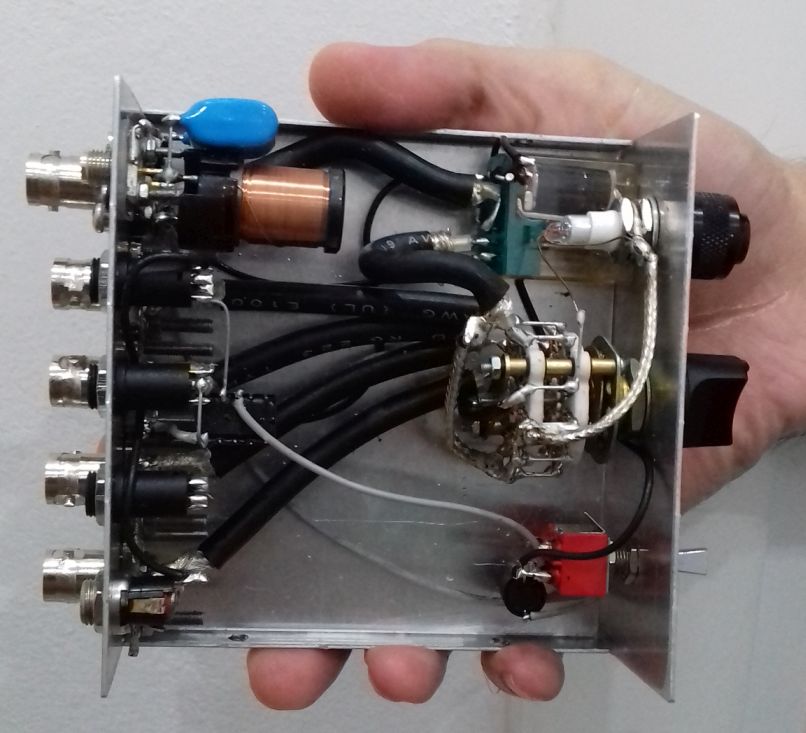
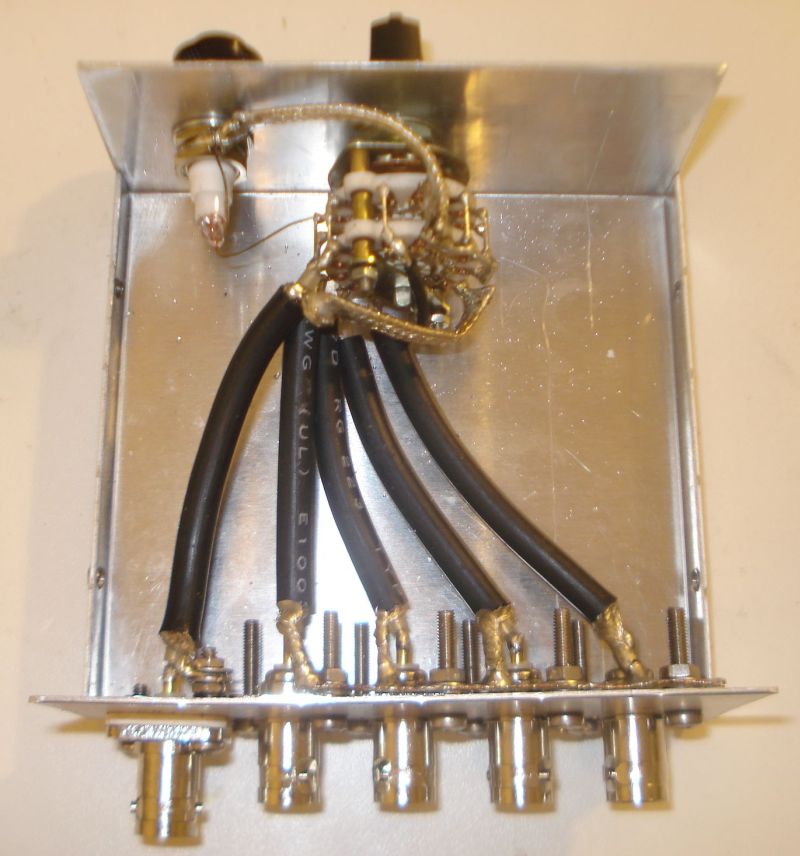
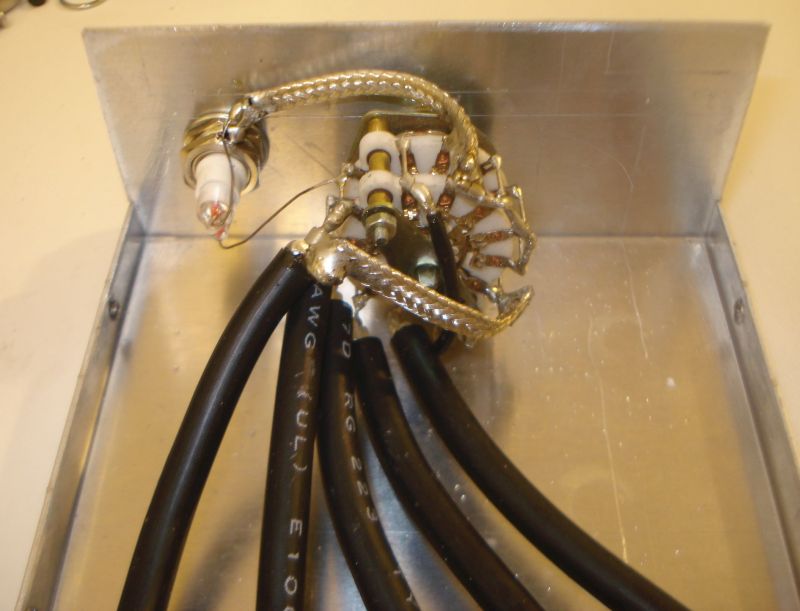
All the coaxial rig cables are grounded at the connectors side. I used a piece of coaxial braid and fitted it to the connectors screws. Then I soldered the braids of the coaxial cables onto this piece. Notice the black ring screw isolators at the antenna connector, to isolate it from the chassis. Speaking about the chassis, do not use a plastic chassis for the RF switch, use only a metal one! The picture below, as well as all the next pictures, show the RF cables arrangement, but note that the circuit in these pictures is not complete yet.
The coaxial cables are soldered onto the switch contacts. Where a ground connection is required, a piece of braid accomplishes this. Do not use thin wires, the device has to allow for at least 100W of HF RF power to pass through it. I have tested the switch with 200W of power and there were no problems at all. The neon tube directly connects to the appropriate switch contact and to the chassis.
The most important part of an RF switch is of course the switch itself. For 100W of HF RF power, I would suggest you to use a porcelain switch. I had a 5-positions 4-sections small porcelain switch, which I used. I connected two sections at each side in parallel (adjacent pins connected together). That is, two sections in parallel for the positive wire and two sections in parallel for the braid. I did that for various reasons. First, by using two contacts for each connection instead of one, you increase the power handling capability of the switch. Then, you ensure a sure-contact throughout the years. Any corrosion or wearing on the switch contacts would cause contact problems eventually. By using two contacts for each connection instead of one, you double the probability for a good contact. After all, I had a switch with more sections, so why not make a good use of them?
The completed selector is shown above. The relay was been taken out of an old CB radio. Use the best quality relay you can afford, as this will be switched quite often and it must handle at least 100W of RF power.
The results from the RF switch operation are quite satisfying. The overall construction is kept small and low profile. The switch makes a good contact despite being small. The automatic discharger seems to work well. On receive, there is some RF leakage, as I expected, in the near by cables, which is noticed in the higher HF bands or in very strong signals. The very sensitive receivers we use, are able to detect that. This RF leakage occurs even when the switch is in the NC position, where the antenna is disconnected and floating. So, to be honest I have not figured out if the leakage is from the switch or from the external cables in the shack. On TX, there is of course severe leakage from the transmitting coaxial to the rest of the ports. This IS expected. There is leakage even without using any selector at all, in the nearby receivers, when a transmitter operates at such high powers. There is nothing you can do about it really, unless your receiver has a mute capability, which I did not bother to take care of.
The TX/RX switching is taken care automatically and this is very useful and relaxing for the operator as he does not have to worry about anything. The active or passive RX antenna selector and the feature to disable the auxiliary RX antenna are really useful and you can do many antenna and rigs comparisons on-the-fly with it, by the flip of a switch. Depended on the noise level and the sensitivity you want to achieve, the switch will provide you the most optimal RX conditions instantly!
The most important thing though, is that the goal of this project was achieved. I am able to switch the antenna to whatever rig I want at the flip of a switch. And before I go away, at the flip of a switch I can isolate and automatically discharge the antenna when needed. This is so much more convenient than having to connect and disconnect cables all the time. I can also now use a separate antenna for RX, which greatly improves reception in my case. This antenna is automatically switched by any rig I have and I do not have to worry about anything. I can also do comparisons between different antennas on RX, which is crucial in deciding which antenna is better for receiving. All these features make this little simple to build circuit, so useful and an integral part of the shack.
Thank you for sharing this practical and affordable project with us, Kostas!
Many thanks to SWLing Post contributor, 13DKA, who shares the following guest post:
From Belarus with love: The Belka DSP
by 13DKA (international man of mystery)
I do have a thing with tiny radios. However, the Belka DSP is so very, very tiny and disguised in understatement that it squirreled itself out of my sight for a while. There wasn’t a lot of information when I took notice of its existence last year, having to order it from a Cyrillic script website prevented an impulse purchase and to be honest, I didn’t think that a shortwave receiver so small could do anything as good or even better than the radios I already own. Then, when this fine blog spread the news about the Mobimax.bg shop in Bulgaria offering this radio, I started another research and I learned that I’m not the only one who had some serious misconceptions about the little squirrel. (“Belka” = “squirrel” in Russian).
The outside: Spy radio reloaded
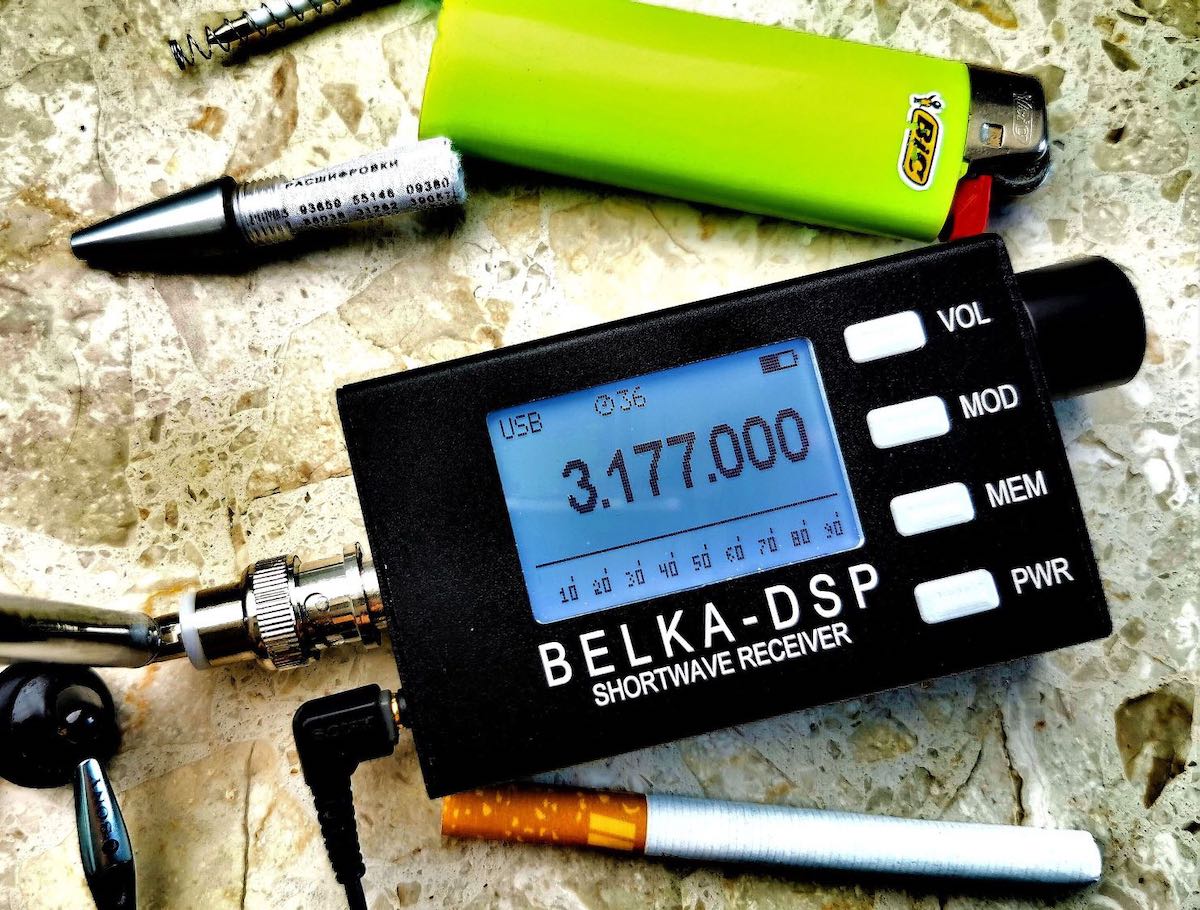
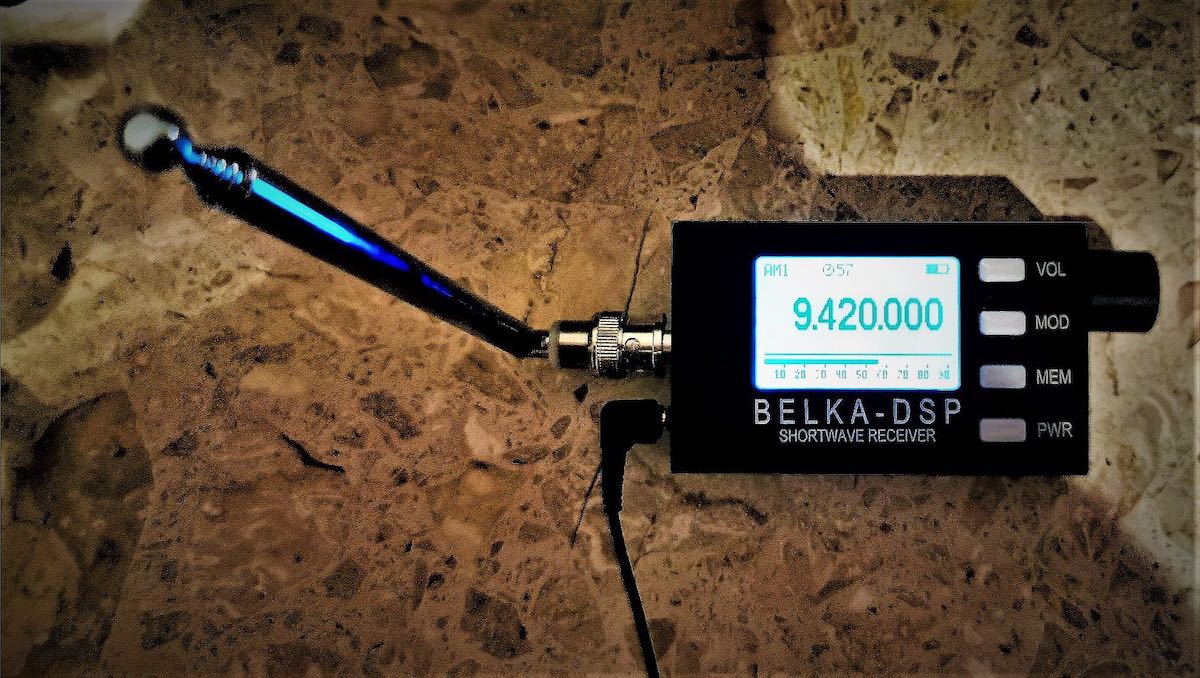
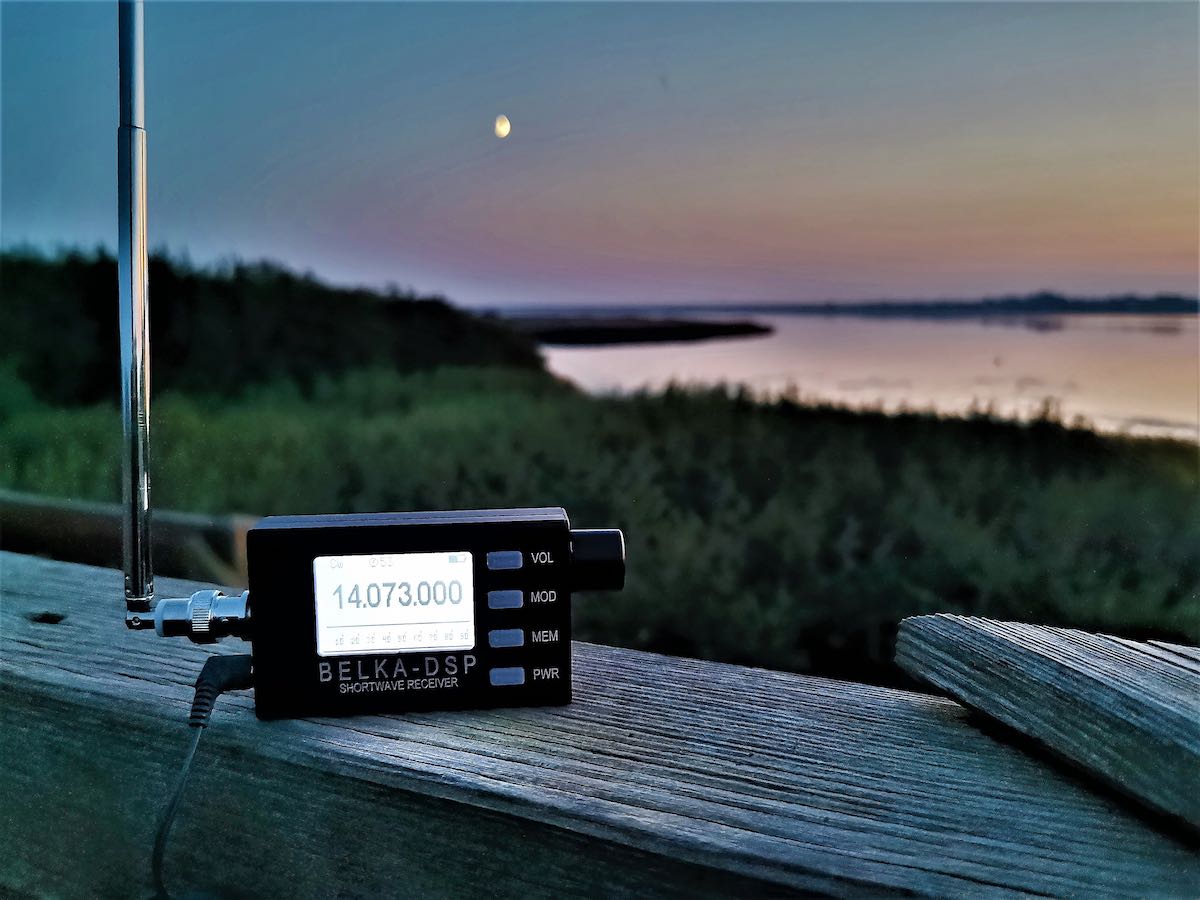
Admittedly, the tiny metal box with 4 buttons and a (metal) knob, antenna, headphone and a micro USB jack on the side, bringing less than 100 grams onto the scale, in a size that could make this radio as hard to find as your car keys may look like something that must have traded functionality for size. This is no doubt a solid little piece of gear though, one that doesn’t try to be anything but functional.
The form factor could be described as “bigger than a box of matches but smaller than a pack of cigarettes” to the ex- and still-smokers, and the elderly people among us who watched all the classic spy flicks out there may inevitably associate it with “spy radio”. It’s not quite 007’s clothes brush communicator or the U.N.C.L.E. pen radio but it would sure beat classic spy radio equipment which could be anything from a suitcase full of electronics to small boxes with comparatively few transistors in it, and they all wouldn’t have lasted much longer than it takes to be killed by 007 before the batteries would run out of juice.
The Belka DSP is very different from those, while it could possibly be smuggled into the country in a shoe heel, it boasts an endurance of 18h and it consists of 100,000s of transistors due to its highly integrated and low-power consuming electronics. These innards deserve some examination, because there seems to be some confusion about the nature of this radio out there on the interwebz:
Much bigger inside – technicalities:
It seems that some people read “DSP”, see the price and automatically dismiss it as yet another SiLabs 473x radio like many of the bargain Chinese shortwave portables, and the Belka’s miniscule size may suggest that it might not be the best of them either. Some presumed it’s based on an RTL chip… but that’s all as far from the truth as it gets. For starters, said Chinese radios, albeit digitally controlled, are actually still “conventional” analog radios which employ digital signal processing only at some varying later stage in the circuit and use only parts of the many features provided by the SiLabs chip (of which DSP is only a part), some even still rely on analog ceramic IF filters and use the chip only to provide AM/FM (e.g. PL-6xx). If they do use the DSP features, that’s how some end up as “triple conversion” receivers – 2 conventional IF stages with a 3rd, DSP IF stage – and some common quirks.
The Belka DSP, on the other, hand is not exactly a conventional radio to begin with but a basic (“direct conversion”) SDR. If I interpret the information on this site correctly, the only Silicon Labs chip used is a Si5351A multi-clock generator to provide high-precision oscillators to be fed into some TI chips serving as the quadrature detector/mixer, their output is then processed in a pretty decent ADAU1761 audio DSP (24-bit AD/DA), a PIC is controlling all that, and a 1W audio amplifier IC (TS4890) is providing the needed power to drive headphones or a passive external speaker directly. One comment somewhere was putting it in the same category as the Commradio CR-1 and while there’s some truth to it in some way, that’s not quite right either because the Belka DSP doesn’t use some pre-fabricated and re-dedicated TV tuner chip. While the functional principle may be similar, the Belka is made out of “discrete” components.
The different architecture also explains why it has so little in common with the Chinese DSP radios, there’s no muting, chuffing or hissing, no “softmute” or similar slightly malfunctioning attempts at making the radio appear quieter than it actually is, no distortion due to a seemingly uncurable lazy AGC… Instead, everything is predictable, precise (frequency!) and quiet and it behaves and sounds like a classic communications receiver or any reasonable piece of modern ham radio gear.
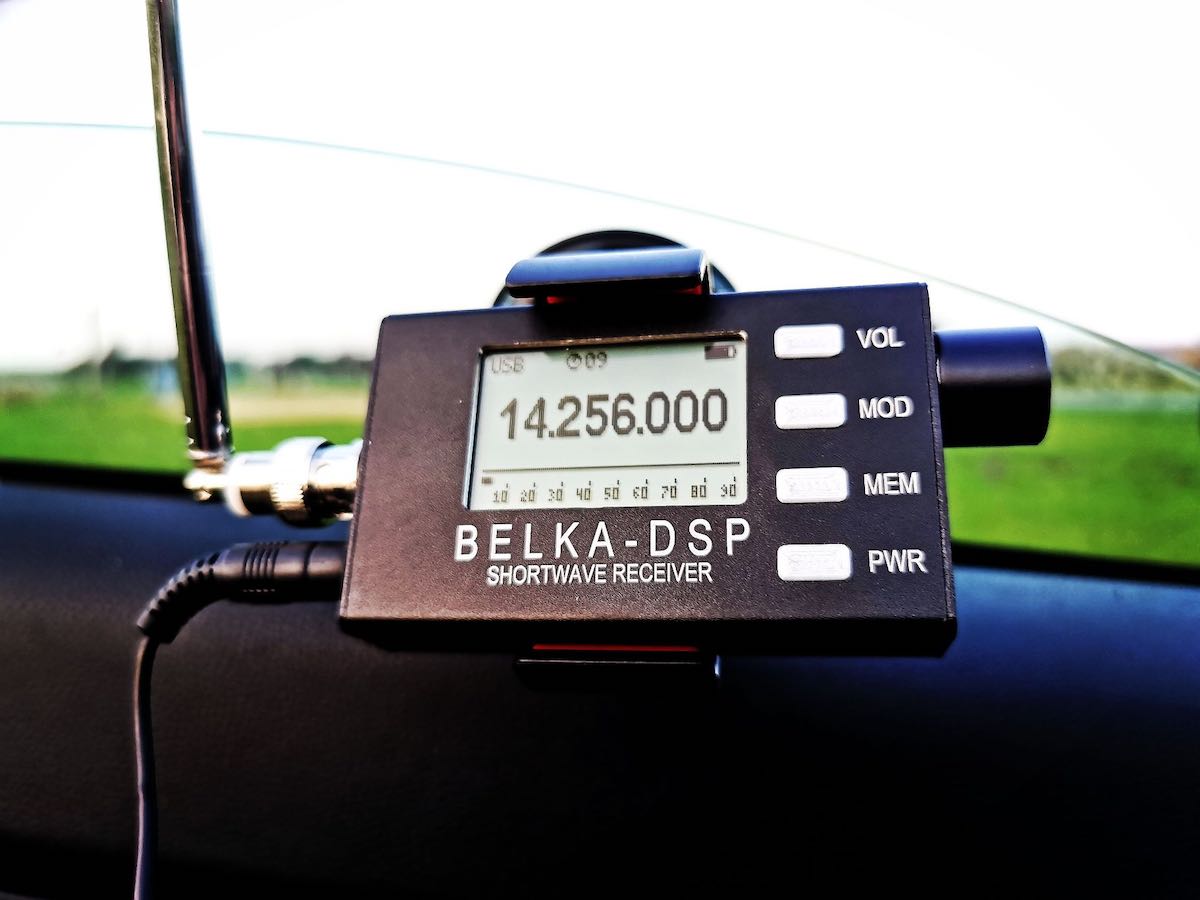
The Belka DSP ships with a detachable (BNC) 74cm/29″ short telescopic whip, and the receiver is said to be designed to develop full sensitivity with that whip. This may be raising some apprehension about how it would perform on full-sized antennas, but most of the YouTube videos about this radio demonstrate it with all kinds of passive and active antennas and (almost) surprisingly the Belka DSP appears to cope just fine with them, which in turn made me concerned about how good it could be on its whip – I mean it can’t be super-sensitive on a whip and have a decent dynamic range and be cheap all at the same time, right? How does it compare to the typical Chinese portables it’s being confused with? Do I need this radio anyway?
Q would be jealous – performance
Meaningful technical data beyond what’s provided on the purchase pages is hard to find. For example, Fenu Radio has listed the MDS (= minimum detectable signal) threshold as “-135 dBm” (without stating a source), whereas MDS was possibly taken synonymous for noise floor. A Russian YouTube radio channel seems to have actually measured an excellent sensitivity of 0.16µV on 40m in SSB. These would be rather typical figures for such a design and that would make it a quiet and sensitive radio indeed.
My other portables, on the other hand, don’t come with any specs beyond frequency range and features and the proof is in the pudding anyway. Let’s go north by northwest (the correct compass point name would be “northwest by north” BTW) to the secret 13DKA proving ground at the dike to find out if it shows!
Practical results
Actually I took it to the dike on several days/evenings/nights during the past 4 weeks to test it under varying conditions, to compare it with different radios and to serve as a nutrition source for the local lady mosquitos. The first one I took to the dike was my XHDATA D-808, it seemed like a natural candidate to compare with the Belka because I would use both in the same role – as a very sensitive “wearable” shortwave receiver to carry around on walks. To summarize that quickly – while the D-808 is already a sensitive radio, the difference between the two is represented pretty well by this short audio clip I picked out of many – this is Radio New Zealand International on 13840 kHz, 2 hours before midnight local time (UTC +2):
[No time indications needed here. The portions with mostly noise: D-808, When you hear someone talking: Belka]
So the Belka won the competition for the intended purpose already and it wasn’t exactly a “photo finish” either…mission accomplished, case closed, end of the review, thank you for reading. But… how would it compare to the S-8800, the most sensitive and quiet of my Chinese DSP radios? I felt like this would be an unfair comparison, I mean c’mon, the Tecsun’s whip is almost twice as long as the Belka’s…
So to level the field, I compared them with my favorite lazy makeshift antenna: A few meters of litz wire coupled (inductively) to an old 24ft steel flagpole on my “proving ground”, connected to the radios with a short stretch of coax to shield the “hot” wire inside the car. Not exactly a proper antenna but it would do to compare the radios better and I used this contraption to boost signals (a lot!) in the past years with great success. Indeed, the radios performed very similar on this contraption in terms of sensitivity, so there was no clear winner in this regard. Then on a hot, sunny day I decided to spend the afternoon at the beach with the Belka and the other radios, this time letting the Belka and the S-8800 run against each other on their whips only. To my surprise, the beneficiary of the external antenna the other day was the Tecsun, not the Belka! But let’s break this up into the different modes:
SSB
On the Belka DSP, “15,000 kHz” means 15,000.000 kHz, not 15,000.030 or 14,999.790 or worse, no matter how you shake it or where you touch it, it’s dead-on on WWV or many well-maintained broadcast transmitters and calibration or regular retuning is not necessary. Of course it doesn’t have trouble suppressing the other sideband, LSB and USB sound and behave absolutely identical/symmetrical and demodulation, even of strong stations is free of artifacts. This is SSB (or ECSS) reception how it’s supposed to be.
Of all my Chinese portables, only the S-8800 could come close to that “analog” feeling when turning the VFO knob, or particularly its fine-tuning knob with 10-50Hz steps …if that fine-tuning knob wouldn’t cause a terrible frequency jitter while tuning and if the AGC wouldn’t cause clipping and if the BFO had even remotely the stability of the Belka. In the following audio clips you may notice that the Tecsun is slightly off frequency most of the time – after retuning the radio for the 10th time because the sun sets and the air temperature is dropping slowly, I usually stop caring about that.
These clips were all recorded with the S-8800 @2.3 kHz and the Belka @2.4kHz bandwidth. Please, if you really want to hear the differences do yourself a favor and use some headphones or external speakers with some decent bass response, otherwise the important bits may get lost (like on my laptop speakers):
– This is the Gander/NY VOLMET on 10051 kHz the night I used the external antenna:
[0:00: Tecsun, 0:15: Belka]
– Here’s Argentina (LU6FOV) in QSO with Scotland (GM1DSK) on 20m around midnight:
[0:00: Tecsun, 0:18: Belka]
– Same band, a ham in Louisiana later that night:
[0:00: Tecsun, 0:15: Belka]
– 75m after midnight, ragchewing guy from NC on 3927 kHz (alas a noisy band at this time of the year):
[0:00: Belka, 0:15: Tecsun, 0:30: Belka]
Here are a few clips with the radios only using the whip, both recorded on 20m around sunset, when the atmospheric noise was finally going down and the band was slowly closing, at least for north-south propagation paths. Like I mentioned above, the Tecsun with its long whip and great independency from a counterpoise etc., clearly won the comparison with my other portables a few years ago and I was really expecting it to beat the Belka.
– ZS1OPB near Cape Town, South Africa in QSO with an unknown OM, possibly in Scandinavia or Germany. The latter has a pretty borderline intelligible signal, and it shows when switching to the Tecsun:
– Here’s KB3RHR calling CQ even later on 20m, which had just dropped into the quiet period between daytime and the South America route greyline enhancement:
[Again, no time indication needed!]
CW
CW is another mode where the Belka shows how it’s different in that it has a dedicated CW mode to begin with. Most of the portables based on a SiLabs 4735 come with typical CW filter bandwidths like 500Hz, but to receive CW you may have to switch to USB, then to the proper bandwidth first. The Belka DSP has a dedicated CW mode doing these settings for you and a way, way superior 300Hz filter. The passband of that filter can be shifted in 100 Hz-steps between 500 Hz and 1 kHz to match your favorite tone pitch. CW reception is like you’d expect it from a regular ham RX/TRX, proper AGC action, proper filter, no artifacts, clean tone. Tuning through the band with 10, 50 or 100 Hz steps is smooth, quick, easy and fun. While there are of course tiny QRP transceivers particularly for CW, I’m almost sure that this level of CW goodness in such a small general coverage all-mode receiver hasn’t been seen before.
Here’s all 3 radios in one go. I deliberately picked a frequency with someone producing terrible clicks to the left and another pretty loud station to the right:
I think it’s awesome that the multi-banders kind of cover CW now but as you can likely hear, CW is also where the inherent (chip-related) and newly acquired (wanderlusty BFO on the S-8800) shortcomings of the Chinese radios are most obvious. Both distort on the onset of AGC action of course and turn a pure-ish sine CW signal waveform into some more square-ish shape thereafter and their “500 Hz” filters are letting a lot of signals through from beyond the filter slopes, which makes me think that setting is maybe not really meant to be used for CW. In the Tecsun example at 0:21 I had to use the fine-tuning knob and you’ll also hear the S-8800’s strange quirk with trying to mute the audio, despite soft-/automute is being turned off in the “hidden” settings. The D-808 is less quirky and very stable but using the fine-tuning knob to scan the CW segments on the bands is rather tedious with it, because it doesn’t tune the radio continuously and just jumps back to -99 on the same frequency once you reached +99.
NFM
When I saw this on the specs list, I thought this must be some error. On second thought it was pretty obvious: A proper shortwave receiver designed by a ham (Alex, EU1ME) for hams (among others of course) must be capable of receiving the local 10m-band FM repeater and of course you could also enjoy European 40-channel CB radio with that. Many ambitious tabletop receivers of the past had that option too. While this is nice, a squelch is more or less mandatory for FM or the listening pleasure will have its limits, and the Belka DSP does not have one. Unfortunately the next FM repeater is too far away, so is the next proper 10m-band opening and to receive any CB (apart from freebanders worldwide around 27,555 kHz USB) in my neck of the woods I have to be very, very lucky and I never managed to hear anything local with any of the portables. By coincidence, on the 2nd test evening on the dike I did pick up some CB stations in FM with the Belka and it did a great job, given the faint (but domestic) signals I got out there. So, the FM function was unsurprisingly tested OK and much more surprisingly, the FM noise is rather untypically unobtrusive.
Noteworthy: NFM has the same filter options as the other modes, so unlike aforementioned receivers with FM option or a dedicated CB radio, you can try a narrower filter setting which can improve SNR on FM (at the cost of some more distortion) in order to dig a weak station a bit more out of the mud.
AM reception
Receiving international SW broadcasters is what almost all, even some particularly cheap SW portables do quite well. Of course, like any decent receiver aiming for demanding hobbyists, spies and other commercial users alike, the little squirrel is even apt for more elusive DX, due to its versatile filters, stability and sensitivity. On top of that it sports what the manual calls “pseudo-synchronous detection”. I can foresee people misunderstanding this, so I think this could use a bit of an explanation:
“Pseudo”-Sync
Alex likely didn’t use this somewhat unwieldy term for no reason, instead of just putting a slightly misleading “sync detection” on the feature list: To put my limited understanding in simple words, regular sync detection is extracting the modulation content from the carrier, then replacing the original carrier that was battered by the ionosphere with a phase-locked, fresh and stable one from an oscillator, and finally bringing that back together with the modulation content.
“Pseudo sync” does the same except it doesn’t use an oscillator and a phase-lock-loop to recreate the carrier, instead it regenerates the original carrier by squashing it in some limiting amplifier to stabilize it and remove the modulation content. This is a quite smart and parts-saving arrangement and it’s inherently in phase with the signal. But that also means the original carrier must be somewhat intact, the less damage it has taken the better, while the “true” sync detector doesn’t rely on the original carrier and the signal can be reconstructed as long as modulation could be extracted.
That explains why recovering ultra-weak and downright broken signals from clandestine stations at the other end of the globe may not be the strength of a “pseudo-sync” detector, on the Belka it may even desensitize the radio and you will hear less than without…unless the opposite happens. Like with any sync detector I’ve tried so far, sometimes it works, sometimes it won’t. What always works is improving reception of stations that still have some headroom, mitigating phasing effects and making it generally a little more comfy to listen to and I think the Belka’s sync detector does that very well but unobtrusively. It’s usually hard to asses whether or not a sync detector helped with a particular dip in the signal or not, unless you have 2 specimen of the same radio to record their output simultaneously and compare.
ECSS (Exalted Carrier Single Sideband)
Besides the “pseudo-sync” detector, the Belka’s excellent frequency precision and stability also makes the technically similar sideband-reception of AM broadcasts a no-brainer: Just switch to USB or LSB and if the transmitter itself isn’t badly off frequency, that’s all you need to do because the radio is dead-on on the frequency, LSB or USB.* Since the available filter settings are the same for all modes (other than CW), you can also use the widest filter setting for maximum fidelity in ECSS. In comparison, all of the Chinese portables I have (and most if not all of the Chinese, Korean or Japanese portables I owned in the past) need some fine tuning to zero in on the station, each meter-band and each sideband their own setting and some just lacked the stability to stay zeroed in.
*With a tuning resolution of 10Hz, it’s technically impossible to entirely “zero-beat” a station with an offset other than exactly 10 Hz or multiples thereof. However, a small residue beat of a few Hz isn’t that bad and the ability to select the sideband suffering the least interference, the recovered modulation content and the decreased noise through narrower bandwidth still make ECSS a great way to improve reception.
AM reception examples
…beginning with some clips captured using the external antenna:
– This is RHC 5040 kHz, shortly after fading in after midnight local time, followed by some music from Radio Rebelde on 5025 kHz. The Belka’s 2.4 kHz filter setting has not only 100 Hz more bandwidth but also a much more presence-friendly shape than the Tecsun’s rather muffled sounding 2.3 kHz filter. The other notable difference is some high frequency hiss the Tecsun likes to emit, it becomes more evident when the channel noise doesn’t play such a significant role anymore, like on AM:
– Next is CHU 7850 kHz. While CHU is technically transmitting AM with one sideband suppressed (H3E) I threw those in this category, even though at the end I switched the radios to USB to demonstrate the SNR gain this means for both radios:
– CHU again, but now on a late afternoon on 14 MHz with really bad condx and with the radios [b]using their whips[/b]. Unfortunately I lost the clip with the Tecsun in USB but if you consider how little CHU you hear from it in AM, you can probably imagine that it wasn’t that much better in USB:
– Finally 2 clips (again using the whips only) taken from a German station with the imaginative moniker “Shortwave Radio” (www.shortwaveradio.de) transmitting from a site little more than 100 miles from here on 3975 kHz, in the afternoon. Despite the station being so close to my QTH, there’s some pronounced fading on it that makes the Tecsun suffer a bit more than the Belka:
[Left channel: Belka, right channel: Tecsun]
– Same station, but now with both radios switched to wide filters (4.7 on the Belka and 4.0 on the Tecsun):
[Left channel: Belka, right channel: Tecsun]
It’s very subtle but I find the Belka presents AM signals with less harshness and distortion and a more “solid” feel to it. Please note that these clips were recorded with a cellphone (with some decent built-in stereo mic though) and I used my CC Radio 2E as a powered speaker for the speakerless Belka, which is admittedly a great combination.
Selectivity
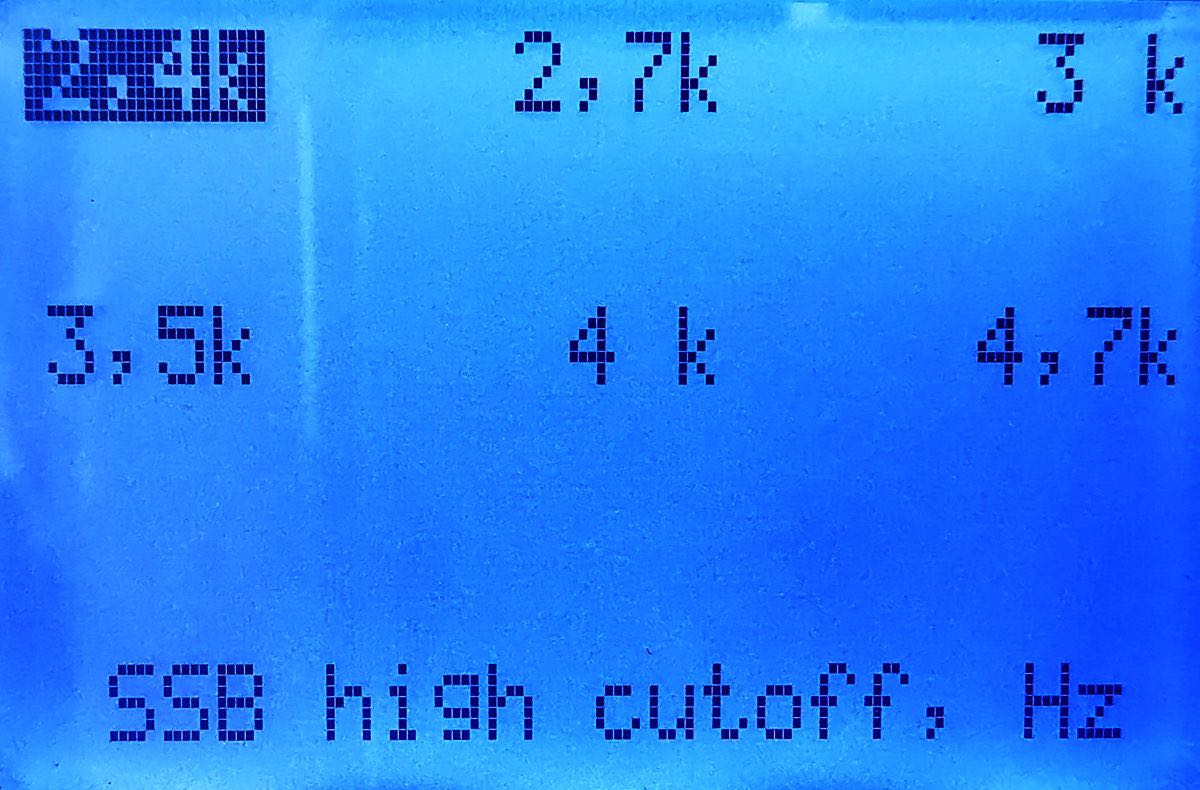
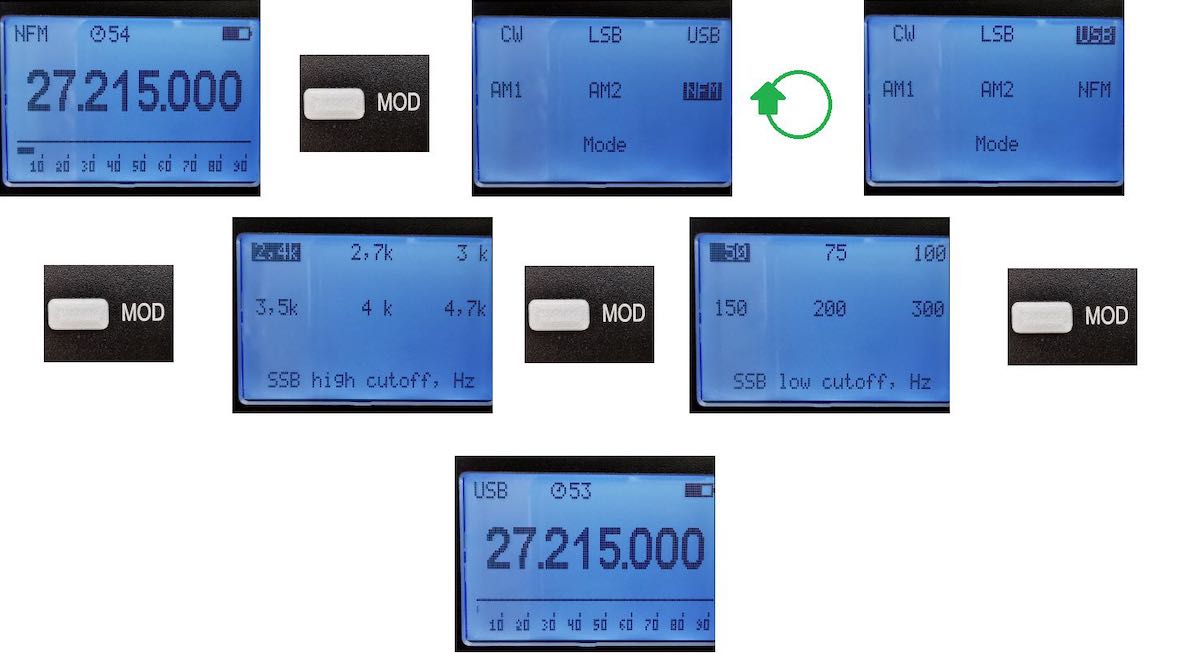
The Belka has one variable IF filter, whereas both low and high cutoff frequencies can be adjusted for each mode individually and will be memorized for SSB, CW, AM and NFM individually. If you ever played with a more recent SDR, you’ll know what to expect from the filter.
While this perceived superiority over conventional filters may be subject to heated discussions among radio connoisseurs, it will beat whatever cheap ceramic filters usually ended up in consumer-level portables and low-end to mid-range tabletop shortwave receivers and it also beats what the aforementioned Chinese DSP radios have to offer in filter quality and flexibility. For example, those come with pre-defined settings, with arbitrary, varying and not always great sounding filter shapes and lower filter skirts tending to roll off the signal a bit too high for my taste, which can be both an advantage and a disadvantage depending on the signal: Some ham operators put considerable amounts of energy into a fat sounding bass. With a filter roll-off around 200 Hz and a weak signal, only a small remainder of modulation will make it to the speaker and you may not even notice that there’s a station while you tune the band*. With the filter reaching down to 100 Hz or even lower, that station’s existence will be immediately obvious and the now more complete modulation content could even be somewhat more intelligible. On the other hand, when splatter from a neighbor channel is creating a lot of rumble you’re happy if the lower edge of the passband can be shifted upwards.
What the Belka’s filter doesn’t quite match is the variety – some the latest China-portables have many presets including 1.7, 1.2 and 1 kHz while the lowest upper filter frequency you can get on the Belka DSP is 2.4 kHz. While this is consistent with common ham radio rigs, I find a filter <2 kHz quite useful on crowded SSB bands. Given the great presence and intelligibility the 2.4 kHz setting provides and the filter not entirely (95%) passing my “4XZ” test, where the filter has to suppress 4XZ’s CW signal on 6407 kHz while the radio is tuned to 6604 USB (Gander/NY VOLMET), maybe 2.3 kHz would have been better for optimum (but in the ham bands very theoretical) channel separation. This is some high level nitpicking for a radio that costs less than one plug-in filter for a Japanese transceiver though.
In AM, the shown filter bandwidths are per-sideband like on some other DSP radios, which equals “audio bandwidth”. That means you have to multiply the number by 2 to get an AM IF filter bandwidth figure comparable to conventional radios with “tangible” filters, the 2.4 kHz setting would be a 4.8 kHz filter and 4.7 means 9.4 kHz.
AGC
The Belka has a properly working AGC, but it seems to reflect the radio’s emphasis on SSB: It has a fixed, slow release constant for SSB reception and that appears to be in effect also on AM. Actually, the AGC release time is quite slow (2+ seconds?), just as slow as I would have preferred it if I’ve had a choice, however, this can turn out less than optimal in rare cases of fast fading intervals on an AM station. But that’s still way better than having to live with a fast AM AGC setting on SSB, and it doesn’t really diminish the general AM listening experience with the Belka for me, which I find quite a joy. Being able to listen to SSB stations without compromises for a change and not having to cut the radios some extra slack when they do not quite behave like normal radios is actually a relief.
This may reach into the “signal handling” category, but the Belka does also not exhibit any AGC pumping effects when a loud station is on a neighbor channel. For comparison, this is one of the issues that make the D-808 a little more uncomfortable, particularly on SSB – the constant change and modulation of noise and signals, often triggered by strong signals quite far away at the other end of a band or even worse in another band not exactly nice. Even the S-8800 tends to emit soft modulations or sudden faint hisses in response to stations booming in outside of the IF passband. It’s the sum of all those little behavioral bits that make the Belka play in a different league.
Signal handling capabilities:
Despite being so small, the Belka appears to have 3 bandpass filters for preselection of its coverage range, which is one more than for example the SDRPlay RSP SDRs have in the shortwave part of their coverage. However, all you need is 2 hefty signals within a frontend passband to put a radio’s dynamic range to a practical test. I don’t have any test equipment to quantify this robustness precisely, but I happen to have some big guns transmitting (often simultaneously) on several frequencies in the 41 and 31m bands at night over here, producing signals that none of my portables can swallow without hopelessly overloading when those signals (from sizeable dipoles/loops etc.) peak. In most nights at least one of these stations makes the virtual meter needle hit the stop pin (see screenshot above) and then my RSP SDRs start acting up as well.
Being too lazy Lacking the time to put up a proper “big” antenna at the dike, I simply tried a loop-on-ground with pretty substantial 60ft/20m circumference and a MegaLoop preamp deliberately left at its high gain setting, which was coincidentally just the right amount of trouble for the Belka. Here’s a video showing what was piling up on 41 and 31m in the hours before midnight local time (UTC+2) during the test:
I could’ve missed that if I hadn’t explicitly checked the broadcast bands neighborhood for it, but the Belka did show some mild signs of overloading: there were faint intermodulation products on some out-of-band frequencies and there was some very subtle onset of cross-modulation on e.g. Gander Radio 10,051 kHz, manifesting itself in some “rough” modulation:
[0:00: Tecsun cross-modulation, 0:22: Belka (slightly roughened up modulation)]
In the video, you can see that it was worse in the broadcast bands containing the offending signals (9635 kHz is an example and alas I didn’t check if the OTH radar signal on interfering on 9700 kHz was really there or not). This was however nothing compared to the S-8800, which really started acting up despite its improved frontend. This could be mitigated by using the “Local” switch (which I presume only turns off the input RF amp) on the Tecsun and given that the Belka doesn’t have any means of keeping overloads in check it’s a particularly good thing that it wasn’t anywhere near this level of misbehavior. I should also mention that I was scanning particularly the 40 and 20m ham bands the entire evening, and I didn’t notice any signs of overloading there while RRI, CRI, Vo Turkey and company were blasting the broadcast bands at the same time.
While the Belka doesn’t have a switchable preamp or even an attenuator like some multi-banders, it has a fully adjustable “sensitivity” control, a.k.a. “RF gain”. It’s useful even when using the whip only, because turning it down is effectively putting the radio in “manual” gain control mode and listening to a couple of strong stations with the noise turned way down and without the AGC pulling the schmutz back up is so much more relaxing. Unfortunately, RF gain controls never really help with an overloading frontend.
However, the Belka apparently takes a lot of a beating for a portable but maybe it should be duly noted that none of these radios are really meant to (fully) replace tabletop radios and that the little Belka is so good that it can be used in that role shouldn’t be leading to unrealistic expectations. If need be, there are affordable (<$20) attenuators built into male-female BNC adapters available and I think a -10dB type should suffice in most cases, -20dB if you can’t resist alligator-clipping the Eiffel tower to the Belka.
For your eyes only: Signal indicator and a display that speaks to me
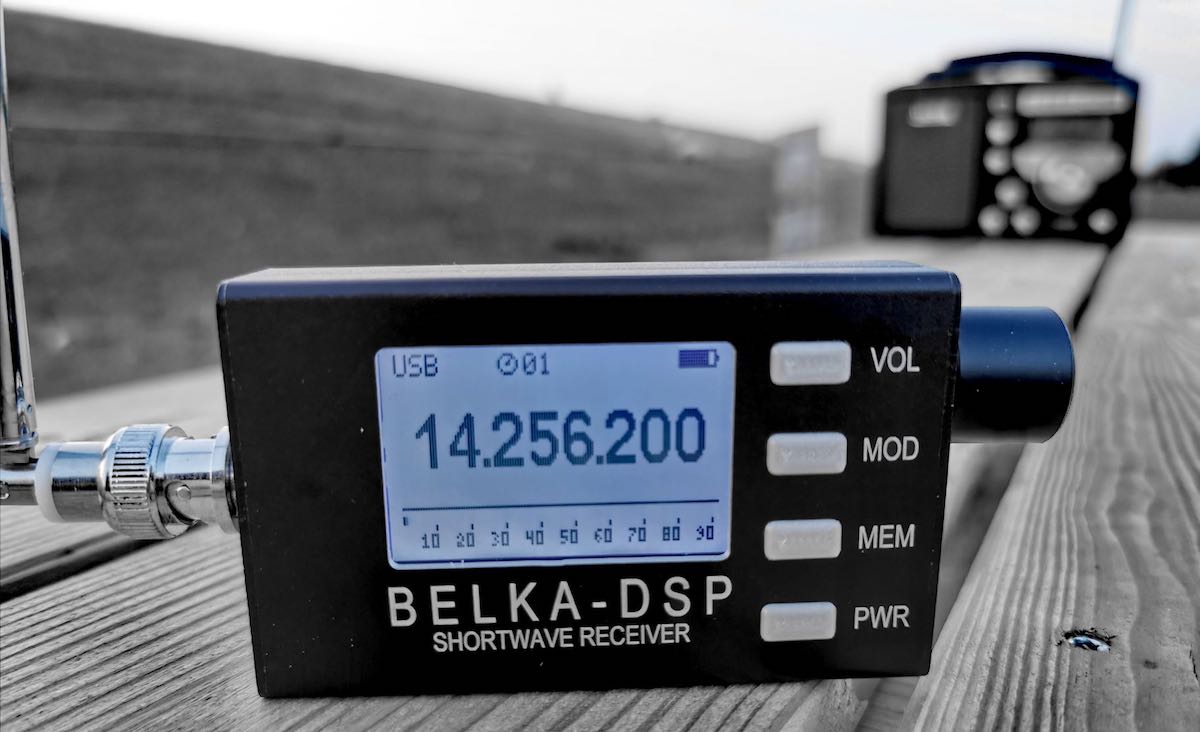
The display is very readable from most angles and the bright backlight can be switched permanently on, off or to the usual automatic mode. The signal meter deserves some extra praise:
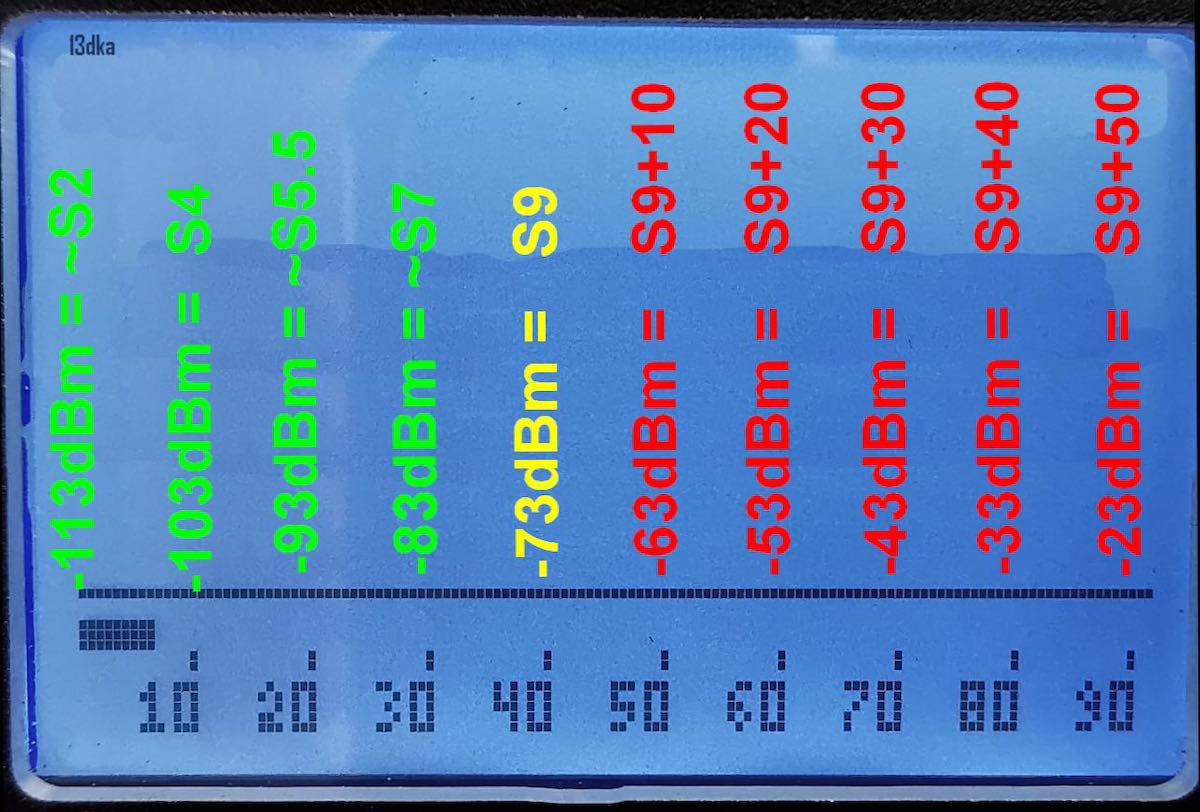
Similar to the numerical displays on the PL-880/990 or my D-808, it comes with a signal indicator in the unit of “dBµv/EMF”, indicating 0-90 (or 100? 95?) dBµv/EMF with marks every 10 units from 10 to 90. But this is a bar stretching over the entire width of the display and it has a really fine resolution (13 pixels per division, together at least 120 positions!) and that makes it not only quite a joy to watch but also quite useful for a change!
I find it refreshing to see some “analog-ish” meter on a small portable radio, giving me a very fine and immediate indication of the signal and – particularly valuable for me – the noise floor in a satisfyingly high resolution, albeit with the limitation of not showing anything below 0 dBµv/EMF, which is -113dBm or roughly S2. However, also owed to the radio’s high sensitivity with just the whip, I can not only see the atmospheric noise on 20m during daytime on the beach, I can also tell intuitively if it’s bad or not so bad and notice the drop when the band is about to close, because I have already 13 different positions between “no indication” and “10” where other portables have 5 positions for the entire level range or aforementioned numerical displays, which are abstract and slow due to the needed long averaging/integration time to provide readable numbers.
Converting dBµv/EMF into more customary units is way beyond my math skills but thanks to multiple converter pages I can hopefully help:
The thin line above the meter indicates the “sensitivity” (RF gain) setting and it works in reverse from right to left. This looks like a meaningful arrangement in that the signal meter indication doesn’t change with the gain setting (it still indicates the input signal even when sensitivity is turned all the way down!), so the meter may roughly indicate the ballpark for a sensitivity setting that keeps the AGC from riding the signal for most quiet and pleasant listening to some strong stations in SSB.
Operation, ergonomics
Despite only having 6 controls and several sub-menus for settings, I think even for less experienced users the operational concept should sink in pretty quickly because it’s quite intuitive or at least not hard to figure out even without the manual. The English manual is short but well-written and a separate download, the radio comes only with a small slip explaining the different power-on modes because it is set to “safe mode” for shipping and doesn’t initially turn on by just hitting the PWR-button.
Basically, the push function of the rotary knob confirms a selection you made with it in one of the menus and gets you back to the frequency display, each of the 4 buttons can be pressed once to reach the first menu level, twice or more to get to the next levels etc. and a new setting becomes effective when you reach the end of the menu chain, if you don’t just push the big knob.
That being said, while the radio is pretty simple to use, having the only rotary knob controlling any variable parameter on the radio comes with a few ergonomical drawbacks and since that knob also dubs as pushbutton, there’s some opportunity to end up on a slightly different frequency than before after adjustments in the menus – the encoder is quite sensitive with many (100?) pulses per revolution and no indents.
There are 32 memories that store frequency, mode and sensitivity (!), but not bandwidth (which is saved per mode) or step width (which is memorized globally for all modes). Selecting, saving and loading memories is as straightforward as it gets but I quite often save a memory by accident instead of loading it, because the “Mem” button that calls up the memory page is also the “Save” button, while the “Vol” button recalls a memory, which is consistent with the operational concept of the radio’s menus but for some reason my internal logic for the memories is wired the other way around. If you pressed the ‘Mem’-button by accident, hitting the ‘Mod’-button gets you out of that menu to return to your currently set frequency.
BTW, the “spy radio” theme of this review wasn’t only inspired by the size and origin of this radio but also the memory slots, which came pre-loaded with band centers etc, and a few pretty odd frequencies (USB), of which some were showing up in logs of number station monitoring sites only. Using memory slots to jump to bands is not the only way to quickly reach another band though: keeping the knob pushed while turning is putting this into a “fast” mode. If you have selected a step width of 1 kHz or more it’s quite easy to jump to a band several MHz away with very few turns of the knob. With 100Hz step width, each encoder pulse is 10 kHz and it’s often only one quick push-and-twist to go from one segment of a band to another.
Doing the first evening walk with it, I immediately appreciated its particular aptitude for that job: It’s not only more sensitive and has better audio (which belongs into the “ergonomics” category because it’s less dreadful to listen to), it also fits in way more pockets than the D-808. Just hold the ‘Vol’-knob for 2 seconds to lock the frequency, then put it knob ahead e.g. into your breast pocket and there may still be room for some other items in it. The radio is so quiet and sensitive that you can even leave the whip partially or even fully collapsed when you’re just listening to strong stations.
Codename Tinnitus: Downsides and quirks
As per usual, this is the place for the reminder that the perfect radio does not exist, no matter how much money you are willing to throw at it, and the cute little squirrel is no exception.
– The radio is showing a considerable number of birdies across the entire coverage range, something between 1 and 4 noticeable ones per MHz, sometimes very faint ones in between. This is usually a huge showstopper for some people, including me. But then again, birdies are a fairly common thing among all the hyper-sensitive portables and entry-level SDRs and of course they are only an issue if they happen to be on a frequency you want to listen to, in a mode that makes the birdie obvious and it all depends on how likely that is in your personal usage pattern. Even more, some disappear if I connect an external antenna, some only exist if I disconnect any antenna (so that turned out to be a wrong way of assessing how many birdies it really has) and only few of the birdies are having a considerable signal, most of them can only be heard quite faintly in SSB and some are spurs apparently coming out of the mixer so their “relative bandwidth” is only a few Hz, they wander off when you tune the radio a few Hz up or down. Being more of a ham band than a broadcast program SWL, the only (for me) really disrupting birdie I found so far is on 14,175 kHz. Weighing in the considerable strengths and qualities of this radio I concluded that I’m willing to live with that where I have to. Believe me, nobody is more surprised about that last sentence than me!
– In a somewhat related matter, the manual states that the display can cause some noise (unfortunately none of the birdies are created by the display), so the display can be turned off by holding the ‘Mod’-key for a while. However I never noticed any noise that would disappear by turning off the display (and I did that a lot) until I tried to operate the radio in the car with the doors closed and the whip not stuck out of the window. Apparently, within that closed Faraday cage the display noise was reflected back onto the antenna and some hash was audible until the display was turned off. Then on my first walk with the Belka I heard it again – it turned out that putting the radio in one of my jacket’s breast pockets with the display pointing towards my body caused that reflection again – I just turned the radio by 180° so the display faced away from me and that solved the problem. Not really an issue, but something to keep in mind.
– Another observation is some slight loss of sensitivity on 17m. I’m not entirely sure that this is common to all Belka DSP but a Russian Youtube video comparing it with an FT-817 (on some wire antenna in the woods) seems to indicate the same – 18 MHz was the only band where the Belka couldn’t fully keep up with the 817 in that video, and in my tests the 17m ham and 16m broadcast bands were the ranges where it was only as sensitive as the other radios, which admittedly is a pretty subtle difference.
– I know that the soldered-in battery will likely be perceived as a downside by anyone who’s not fond of opening the radio and soldering in a replacement in an unknown and very variable number of years. But such a small radio with that kind of battery capacity just wouldn’t be possible with AA or AAA batteries. If you want to maximize the (easily obtainable cellphone type) LiPo battery lifetime, try to avoid charging it to more than 80%, particularly if you want to stow it away. Only charge it fully when you really need the full capacity and also avoid discharging it below 20% without need. The remaining 60% capacity should amount to ~10-14 hours endurance, which is still a lot of SWLing. The Belka can be recharged on any USB port and even the cheapest powerbank from the $1-store will recharge it at least once.
– Another thing I don’t mind personally but that has triggered criticism about other radios was their bright display backlight and the Belka is such a little reading lamp too, which also serves me well as a safety light when I do my walks in the dark so I won’t be run over by a cyclist.
– The volume control doesn’t turn the audio down to zero, only the sensitivity control can reduce the volume further but that’s just an observation, you don’t turn this radio on to hear nothing. 🙂 There is also a little hiss on the output (not half as bad as on the D-808 though) but that can be easily mitigated by simply using some phones with at least 32 ohms upwards. Most cheap earphones fit that bill, but my old-as-dirt Sony earphones have only 16 ohms and made that hiss obvious enough for me to notice. Without FM band on this radio, you’ll not be running into a listening scenario (classical music, jazz ballads or drama on a really strong FM station) where low impedance headphones or hiss could become a problem though.
– Lastly neither a quirk nor a complaint, but a reminder that this radio is specified to work from 3.5 through 30 MHz: Even with the short whip, most things you will receive below 3 MHz are images of stations above 3 MHz. Of course receiving Shannon VOLMET on 3413 kHz USB is not a problem yet but the lower you go, the more odd things start to show up, for example the Shannon and RAF VOLMETs around ~1.8 MHz in LSB (images from 5.5 MHz). Maybe with sufficient external preselection it will “have” 160m but otherwise take it as if it just doesn’t and it was never advertised as such. I did manage to hear my favorite funny British oldtimer ragchewing net on 1933 kHz though.
Now after all the boring stuff, here’s the radio in action – a compilation of some highlights received the evening I tried the Belka with the pre-amplified 60ft loop-on-ground. I could log some pretty interesting (particularly from a European perspective) stations again, despite the poor condx (SFI=69-70, A+Kpi=normal) we had on all the days/nights during the test, even though the ionosphere was slightly more excited that night, just like me when I picked up some rather unexpected callsigns:
BTW, a LOG is a great outdoor DX companion for the Belka: The antenna can be packed small and put down quickly with the least imaginable amount of hassle (dropping stuff on the ground in an educated way), the receiver is just another tiny box and all can still be brought to a place in your coat pockets. Due to its bidirectional pattern and reduced susceptibility to QRN it likely beats any wire you’d have to hurl up a tree, particularly when there’s no tree around.
The spy who…uh…spy radio I love…umm… summary and verdict:
I’m aware that this review may make the radios I compared the Belka with look bad, which they aren’t. So please don’t get that all wrong, I love my Chinese DSP portables, they’re doing a great job, some of them are very versatile and beat the Belka hands down on any other band than shortwave. But they also come with some common quirks and idiosyncrasies particularly on SSB, sometimes showing their low price…or a conflict with their not so low price here and there.
The Belka DSP on the other hand is a completely different animal (in this case, a squirrel) in terms of ingenuity, architecture, dimensions and likely also target audience – yes, it’s a portable and it’s not perfect either but that’s already the end of the similarities: It’s not a multi-band radio, it won’t wake you up in the morning so it’s not a travel radio by common (OK, by Thomas’ definition), it doesn’t even have a speaker and all it does is shortwave… but that’s what it’s really doing like a big one! It behaves and sounds refined like a regular modern ham radio receiver and generally matches that kind of performance. Its big strength is SSB and CW, but the great stability and precision making these modes so good is beneficial for broadcast listeners as well.
It had no trouble to best my D-808 in the “SWL walkman” role by several orders of magnitude in terms of both size and sensitivity and to my surprise it had no trouble beating my S-8800’s great sensitivity on the whip either, while not showing any of the weaknesses of said radios, except for the birdies. Also, its frontend can take bigger antennas. Underestimating what such a little radio could do, the Belka DSP exceeded my expectations in all aspects by far.
That’s why I never cared less about the quirks of a radio, including the birdies, which are the only really noteworthy issue to me. The overall sensation of a well-conceived radio with outstanding performance paired with irresistible cuteness is clearly dominating my feelings about this, and that it comes from what seems to be a little mom-and-pop business in Belarus at a very competitive price compared to the Chinese offers is explicitly not part of my technical assessment, but it sure is another plus for the Belka. It can be bought directly from Alex’ shop here for currently ~$120 plus shipping, I bought it for ~160€ including shipping via the Mobimax.bg shop in Bulgaria, which certainly included a markup for the middleman and the convenience of PayPal payment.
If you have a craving for communication receiver performance particularly on SSB/CW but lack the funds or just the space in your pockets for a communication receiver, if you want to have a stunning shortwave performer with you all the time even when your carrying capacity is limited to whatever kind of pants you’re wearing, if you’re doing mini-DXpeditions to escape the QRM and want to keep it light-weight but performant – this might be a radio you shouldn’t let pass. Its size-vs-performance ratio is mind-boggling and even though spy radios may be a bit out of fashion nowadays, it would still excel in covert radio operations, like when your XYL frowns at you packing more radios than pants for a vacation.
Please don’t forget to eat or burn this document after reading.
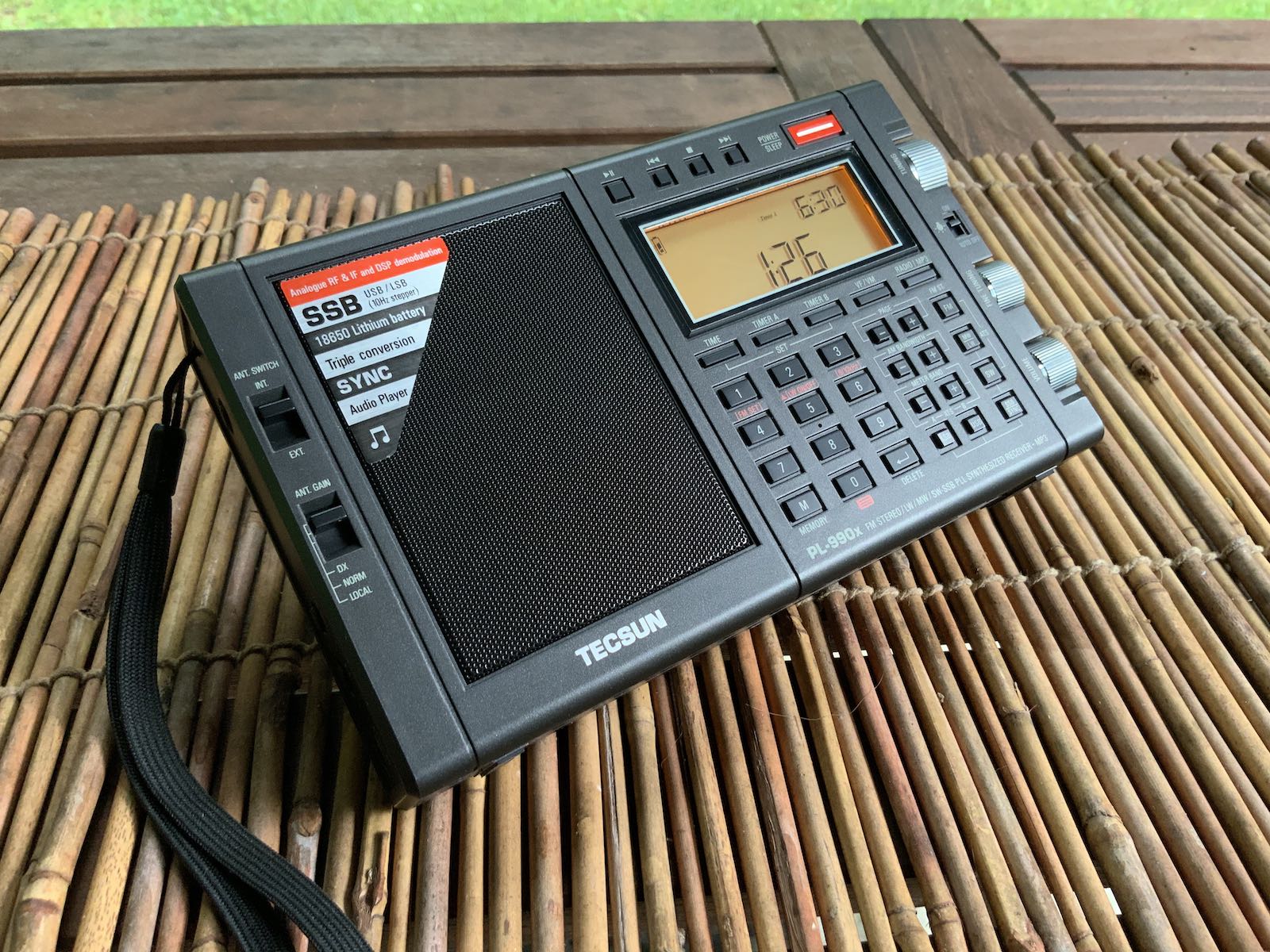
A number of SWLing Post readers have been asking about SSB audio characteristics on the new Tecsun PL-990.
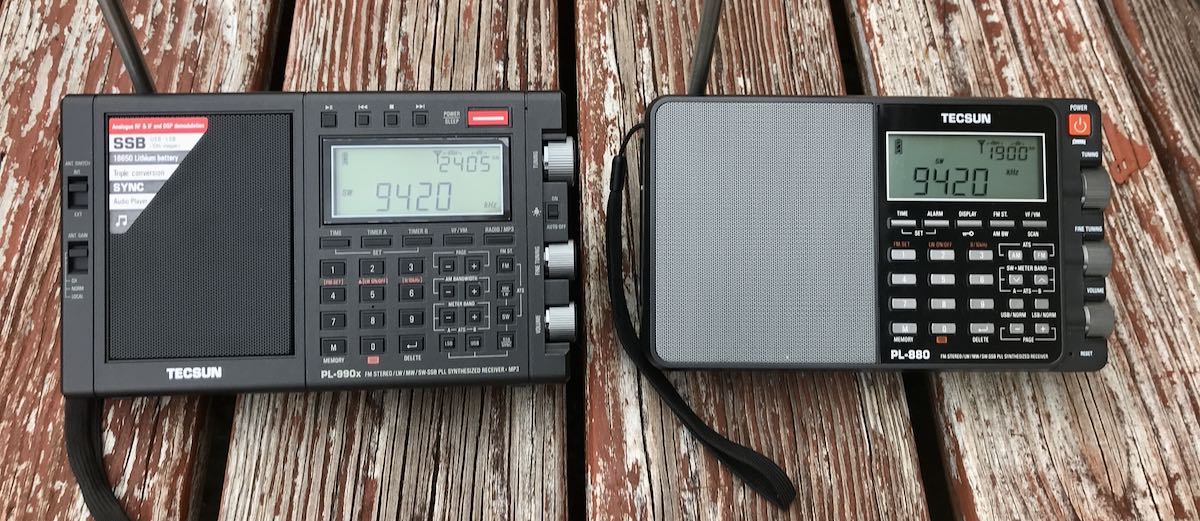
Earlier this week, I took a moment while visiting family to make a few quick comparison videos with the PL-880 outdoors and away from RFI.
As I mention in the videos, there are a lot of cicadas singing in the background and you can also hear a bit of road noise–not ideal for audio, but I had to take advantage of a break in the weather!
You should also note that this isn’t a sensitivity comparison. The radios were pretty close together–if measuring sensitivity, I would have spaced them much further apart. Rather, I hope these videos give you an idea of the audio characteristics in SSB (both CW narrow and voice) and one comparison in AM. If you’re curious about sensitivity and how the PL-990x compares, check out Dan Robinsons initial evaluation.
CW Audio: .5 kHz filter on the 80 meter band
CW Audio: .5 kHz filter on the 30 meter band
SSB audio: 75 meter band
AM Audio: 5 kHz filter WWV 10 MHz
My thoughts
While these videos are far from ideal, they should give you a real-word impression of audio characteristics.
Personally, I think the PL-990x is a much better performer in single sideband. The noise floor is lower, but I think that may have more to do with better filter implementation. I’ve always felt that the PL-880 audio sounds “wider” than the selected filter in the more narrow SSB selections.
In addition, the PL-990x exhibits better SSB stability that’s especially noticeable in CW. The PL-880, at times, almost sounds garbled in comparison.
I also mentioned in the last video that the audio sounds better on the PL-880. I should have qualified that statement a bit better.
In general, yes, the PL-880 audio sounds better because its built-in speaker has slightly better audio fidelity that’s most noticeable when listening to music on the FM band, or a strong local AM station. On shortwave, I feel like I actually prefer the PL-990 audio for all but the strongest stations although I do wish the PL-990 filter could be widened to 9 kHz like the PL-880.
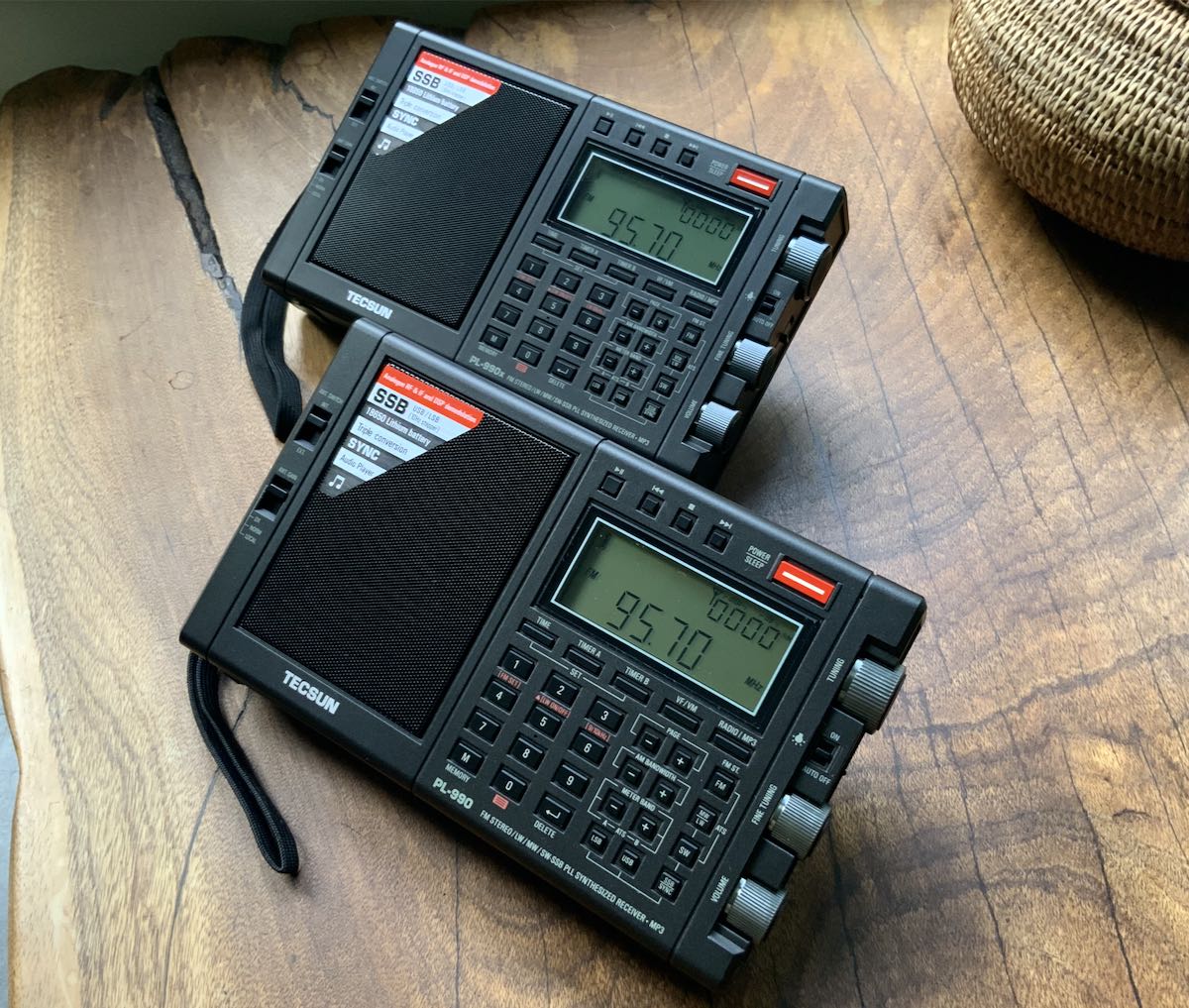
PL-990x (pre-production) vs. PL-990 (production model)
Tecsun Radios Australia reached out and kindly sent me one of their PL-990 production model radios to compare with the PL-990x pre-production model from Anon-Co we’ve been testing up to this point. This has been incredibly helpful as I put together my PL-990 review for the 2021 World Radio TV Handbook.
As I’ve mentioned in previous posts, I feel it can be problematic using a pre-production model radio for review only because there can be differences in quality control when a small number of pre-production units are manufactured compared with a proper first production run (remember this case?).
I’ve only had the production model PL-990 for a few days and most of that time we’ve been dealing with the remnants of hurricane Sally moving through our area dumping torrential rains.
Last night, however, a massive tree fell across our road knocking out power for the better part of 5 hours. This gave me a perfect excuse to start my comparison indoors while rain continued outside.
Based on my comparisons last night, it appears performance is nearly identical between the production and pre-production models. I’ve still more testing to do, but my initial impressions are most positive. Very happy quality appears to be consistent.