Shortwave listening and everything radio including reviews, broadcasting, ham radio, field operation, DXing, maker kits, travel, emergency gear, events, and more
Many thanks to SWLing Post contributor, Alan Roe, who notes:
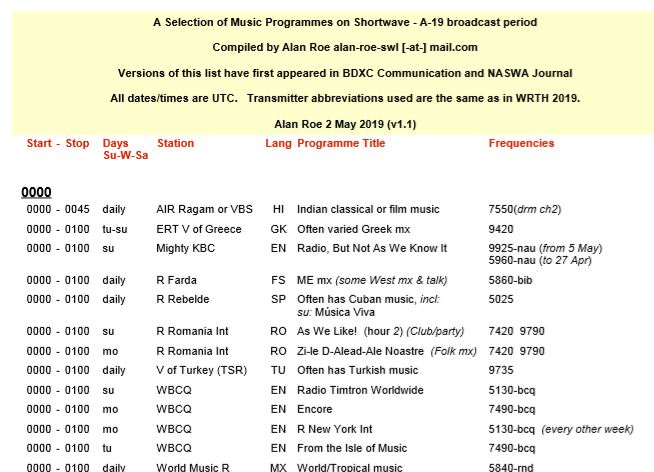
I attach a copy of my “Music Programmes on Shortwave” PDF list for the
new A-19 broadcast season for you to consider adding to your SWLing Post
pages.
Alan, thanks so much for keeping this brilliant music guide updated each broadcast season and for sharing it here with the community! I always print and keep a copy of your guide at my listening post!
As always, the 3 most recent broadcast recordings are available here, processed for artificial stereo, using recordings from different SDRs. (Big thanks to Daz Man for processing these recordings, and improving the show’s broadcast fidelity!)
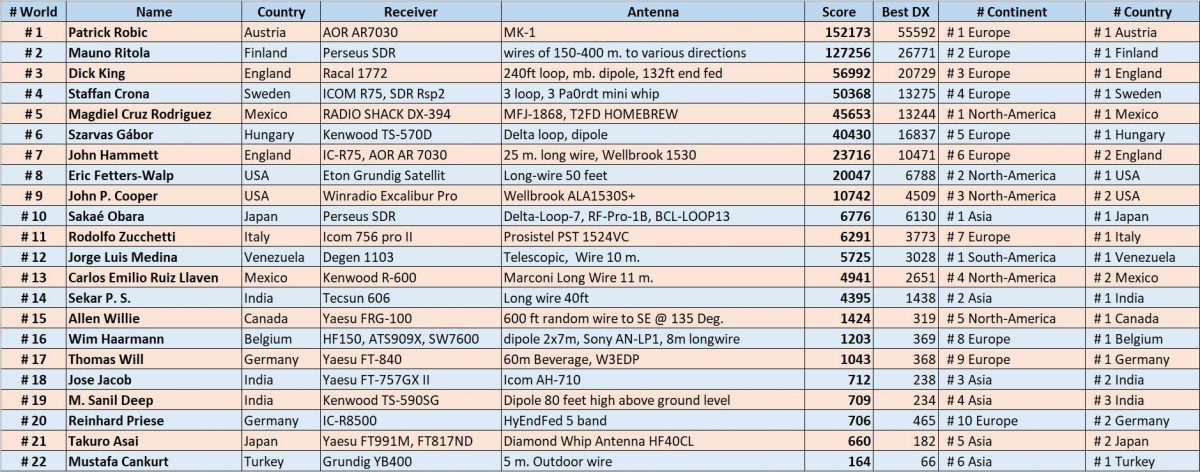
Many thanks to Istvan Biliczky, from the Top 10 DX Of The Year Contest who shares the following results from the December 2018 contest:
Click to enlarge results sheet.
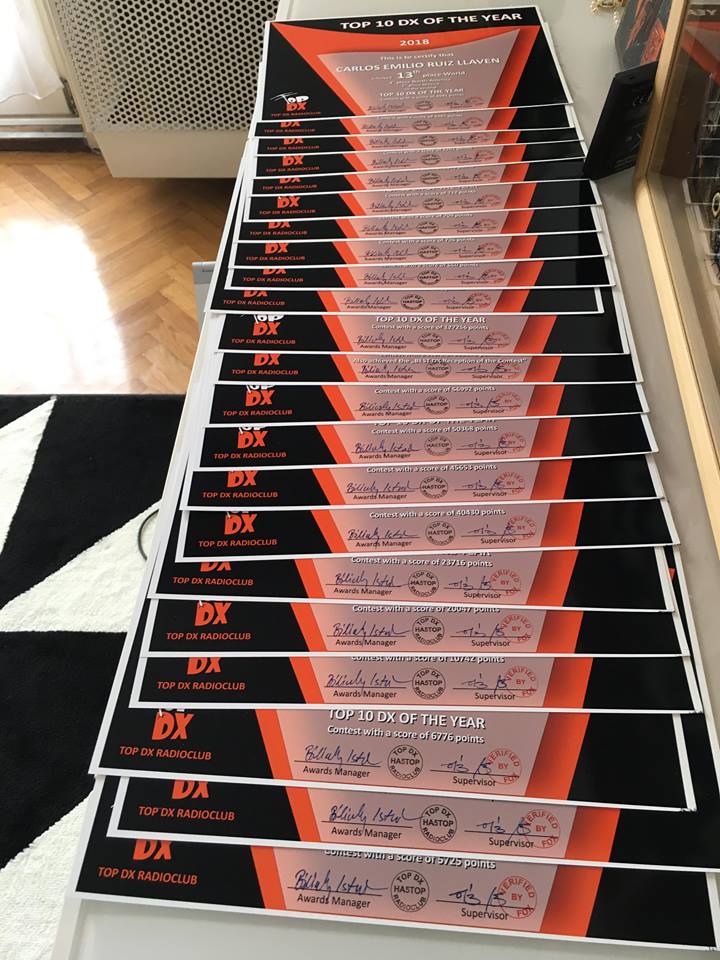
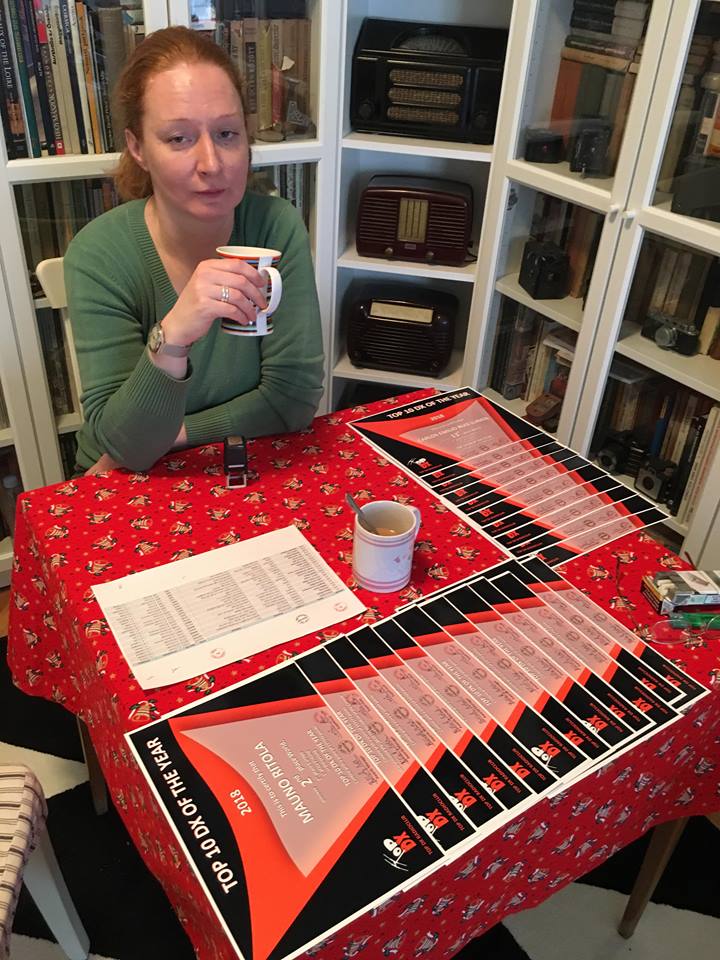
Istvan tells me that the “certificates are printed, verified, t-shirts are done, and all packed, will be sent this week.”
Check these photos:
Brilliant news and congratulations to the many friends and SWLing Post readers I see in the winners circle! Thank you for sharing, Istvan and thanks for hosting this impressive DX contest!
Many thanks to SWLing Post contributor, Nad, who writes:
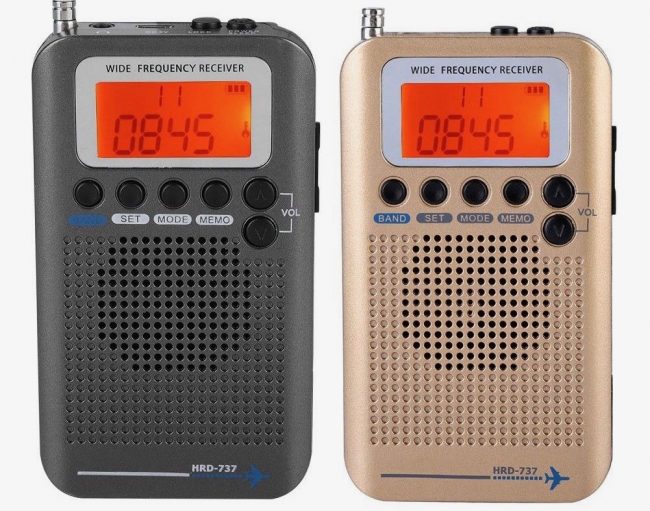
I bought an HRD-737 a few weeks ago off AliExpress. Was going to write a review but now feel there is no point because it has so many major and minor problems beyond those already reported.
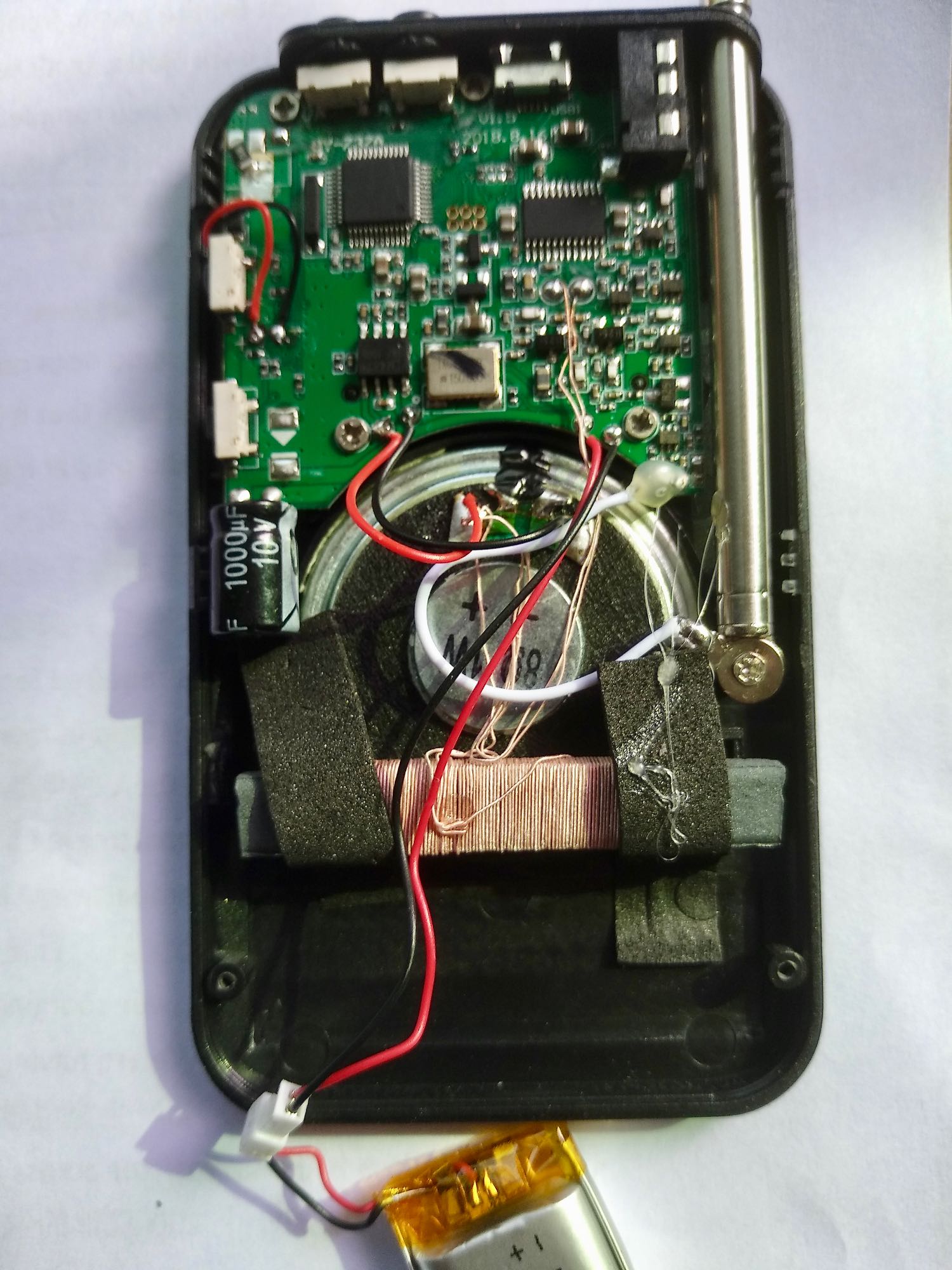
Decided to take mine apart. The photo is attached.
Click to enlarge.
It appears to me that the HRD-737 could be the first attempt at an SDR-based pocket sized receiver. Wondering if you or someone the experts at SWLing Post can offer any insight in this regard. Identifying marks on the ICs have been removed. The metal can in the middle could be a wideband programable oscillator of some kind?
Thank you for sharing, Nad!
Readers: can you shed some light on the HDR-737 receiver design based on this internal photo? Please comment!
Many thanks to SWLing Post contributor, Jamie Anderson (KM4WYO), who writes:
I have been browsing around eBay too much and was trying to put together a do-it-all radio for camping/backpacking that is small.
It is hard to find SW/broadcast/weather/air band together (for good reason, of course). I did run across this radio that is interesting: the HRD-737 which retails around $40.
Internal 700mah 3.7v lithium, with 5v usb charge
Air 118-138 MHz
FM 87.5 – 108 MHz
AM 520-1720 kHz
CB 25-28 MHz
SW 2-30 MHz in 5 kHz steps
VHF narrow/wide FM – 30-223 MHz (10,6,2,220)
I’m not sure if it would pick up NOAA stations as I think they have a slightly different FM bandwidth.
It seems interesting for a do it all point of view, you could possibly monitor ham repeaters on 2 meters, just a little too short of frequency coverage for 220.
Have you seen one of these or something similar in your reviews?
I have never used the HDR-737, but thanks for bringing it to our attention, Jamie!
I should think, assuming the stated VHF frequency coverage is correct, that you should be able to hear weather radio on this receiver. NOAA weather frequencies are on 162.400, 162.425, 162.450, 162.475, 162.500, 162.525, and 162.550 MHz.
The manufacturer isn’t clear about the frequency steps on VHF however–it’s possible tuning increments could be too coarse to get a good lock on the station. That specification is omitted altogether even though every other band has stated frequency steps.
I should mention that the original C. Crane CC Skywave meets all of your specifications save the ability to potentially tune in the 2M ham radio band.
Post readers: Is anyone familiar with the HanRongDa HRD-737? Please comment!
Many thanks to SWLing Post contributor, Dan Robinson, who shares the following guest post:
In these days of declining activity on the shortwave bands, we don’t often enjoy the experience of hearing what we might still call “rare” stations. The new year brought an exception.
On January 1st, 2019 I was tuning around the 48 meter band, which is largely populated by European pirate stations, utilities, and weather stations, when I heard a station on 6,210.20 khz. It was very distinct in that it sounded like an African station — music, with a male DJ/MC and religious songs.
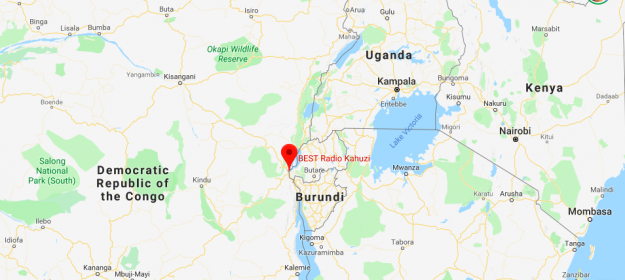
What immediately came to mind was the religious station calling itself Radio Kahuzi, which is in Bukavu, Democratic Republic of Congo.
The station has been heard by DX’ers in a number of countries since the mid-2000’s and because it’s management is based in the U.S. it is possible to obtain a QSL verification.
On January 1st, RK was heard from about 1730 to 1747 UTC when it shut down, playing what Richard McDonald, one of the station’s founders, says were musical pieces that are specific to RK.
On January 2nd, 2019 the station was heard again via Europe-based SDRs, signing off at approximately 1811 UTC.
Here is McDonald’s response to my report (which included an mp3) from January 1st, in which he notes that he even went so far as to give the main station announcer, Gregoire, my name and asked him to mention me in the station’s broadcast:
“I just shared with Gregoire that you had sent a recording of the last minutes of his closing musical sign-off if Radio Kahuzi and he agreed to greet you by name this evening and several days in several languages including English.
You got him saying his name at 5:54 into your recording yesterday,and the ID sign off Mountain Blue-Grass Music was unique to Best Radio Kahuzi in Bukavu!
Barbara Smith will be happy to send the QSL Card and info about us and our National Director and his family situation in case you have any suggestions
Powering off here! Our power cuts off with SNEL often — I just lost a longer reply to you !
But Keep Looking UP ! And Keep On Keeping ON !
Richard & Kathy McDonald”
By the way, according to Wikipedia, SNEL stands for Société nationale d’électricité “the national electricity company of the Democratic Republic of the Congo. Its head office building is located in the district of La Gombe in the capital city, Kinshasa. SNEL operates the Inga Dam facility on the Congo River, and also operates thermal power plants.”
A very interesting page containing the history of Radio Kahuzi, with information about the McDonalds, is at: http://www.besi.org/
As of the time of this writing, it’s unclear to me whether the extended broadcast times of Radio Kahuzi will be continued or if this was a one shot deal linked to the new year — we may have some clarification on this in coming days.
Here’s a video of my January 1st, 2019 reception of Radio Kahuzi:
For now, I am quite pleased to join the group of about 63 DX’ers around the world (that number comes from a link on the RK website called “Shortwave Listeners” that lists SWLs who have heard and contacted the station).
Though it is highly unlikely that Radio Kahuzi will be heard anytime soon in the United States (the station’s schedules shows it being active from 8 AM to 8 PM Bukavu time) at least using U.S.-based radios, whether SDR or traditional receivers, it’s nice to know that there is still a station out there (with 800 watts!) that is a real DX target!
Wow! What a fantastic catch, Dan! Thank you for sharing your catch and, especially, shedding light on this rare DX.
Post Readers: Please comment if you’ve logged and/or confirmed Radio Kahuzi.
Many thanks to SWLing Post contributor, Al Holt, who writes:
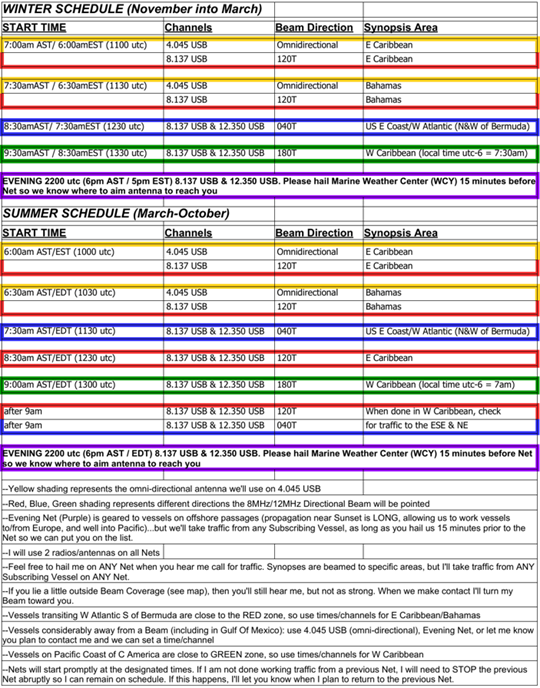
Your readers may be interested in tuning in the daily (except Sunday) broadcasts of Marine Weather Center on 4045 and possibly 8173, 12,350 kHz. These broadcasts use upper sideband mode. https://www.mwxc.com/index.php
It’s described as, “custom weather and routing information for small vessels in the Caribbean Sea, Bahamas and United States East Coast,” and is based near Lakeland, FL.
As a subscription weather service for pleasure craft, but they provide an interesting roundup and forecast of weather in this area of the world. They do take questions and traffic from subscribing vessels at the conclusion of their broadcast.
I am usually am able to receive the omnidirectional broadcast on 4045 kHz here in northern Florida. But, their coverage at greater distances is pretty good I think.
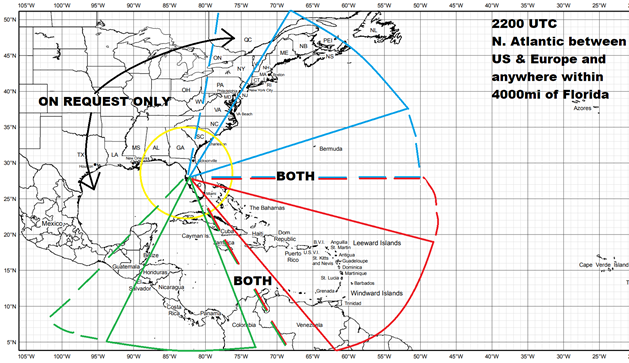
The chart below (taken from their ‘Services’ page https://www.mwxc.com/marine_weather_services.php ) shows this broadcast starting at 1100z, but I usually hear them closer to 1200z and that may be due to atmospheric conditions. I haven’t had much success catching their later transmissions. I’m not sure how often their webpage gets updated and schedule changes are probably relayed privately to their subscribers.
Wow! Thank you so much for sharing this information, Al.
Post Readers: I know there are a number of SWLing Post readers who sail and cruise (some on very long voyages)—I’m curious if any use the Marine Weather Service regularity. Please comment!
Please support this website by adding us to your whitelist in your ad blocker. Ads are what helps us bring you premium content! Thank you!