Tag Archives: Vintage Radio

New Zealand auction includes collection of 400 vintage radios

Many thanks to SWLing Post contributor, Jason Walker, who writes:

Dear Thomas,

I noticed a New Zealand news article that may be of interest to SWLing Post readers.

Approximately 400 vintage radios are to be auctioned in Nelson, New Zealand. Whilst I use more modern Tecsun radios, the article will be of interest for vintage collectors. Many of the Radios are New Zealand made and rare.

Links below include a video and news article.

https://www.stuff.co.nz/national/124587912/collectors-go-gaga-over-vintage-radio-auction

Radio and Collectables Auction
17 Hereford Street (off Songer St)
Stoke, Nelson
Saturday 10 April, 2021

AUCTION STARTS AT 11am
Viewing from 9am day of auction
and, Friday 11am – 3pm

More information: https://jwauctions.co.nz/upcomingauctions.html

Thank you, Jason. Even though this auction has been widely publicized in New Zealand, the collection is so massive, I imagine bidders will be walking away with some excellent bargains. If I lived in NZ, I would certainly be a part of the bidding. I’d love to have an NZ-made receiver.

I really like the following quote from the Stuff.co.nz article:

The widower of the man who stockpiled the radios told Walker her husband had collected the stash from all over the country.

“His wife was a wee bit disappointed she didn’t know he had half the radios because he used to keep hiding them.[“]

How many of us can relate to that last statement? Let’s face it: par for course, right!? 🙂

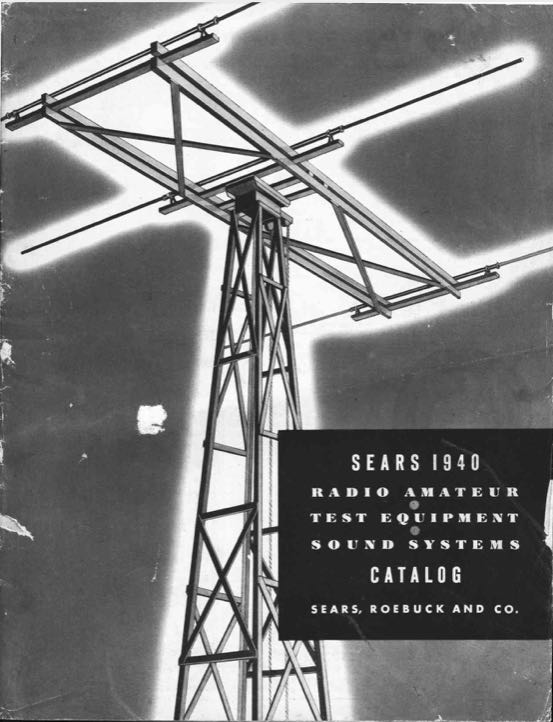
1940: When Sears Roebuck sold a wide array of radio gear

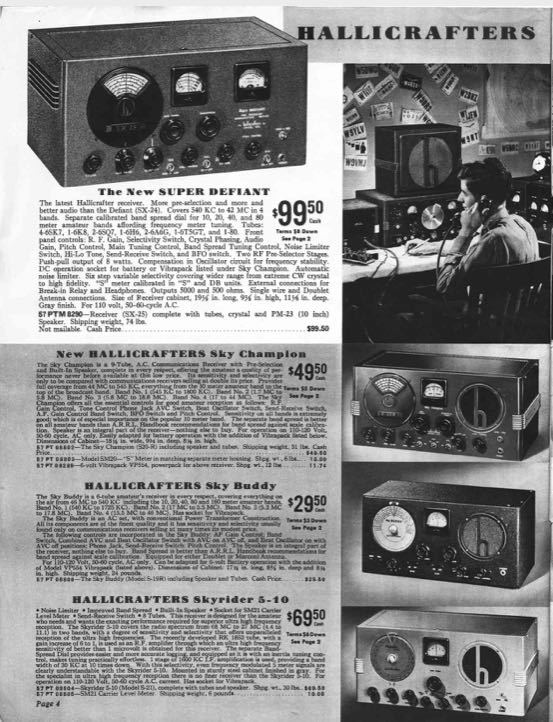
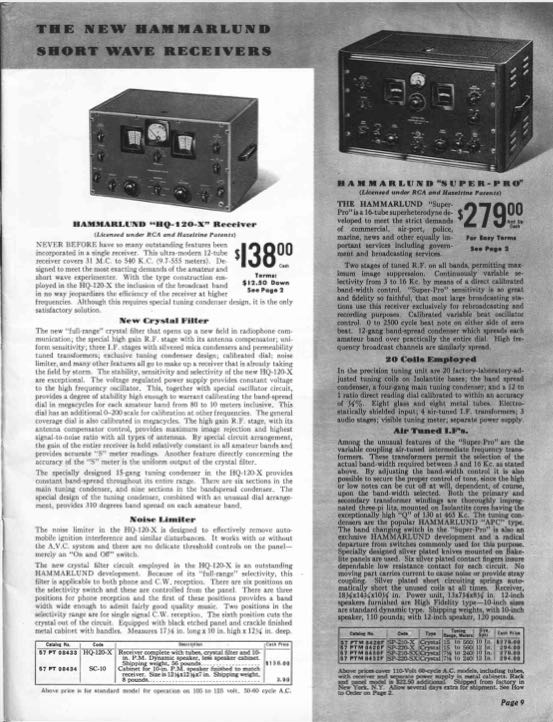
Many thanks to SWLing Post contributor, Charlie (W4MEC), who shares a PDF of the 1940 Sears Roebuck Co. catalog section featuring a wide array of radio gear and test equipment.

This file is hosted on the Pro Audio Design forum and can be downloaded as a PDF (15.8 MB) by clicking here.

It’s a real nostalgia trip reading through the fine Hallicrafters, Hammarlund and National HRO descriptions. Thanks so much for sharing this, Charlie!

Radio Waves: Digital Audio via Vintage Radio, “10-Minute-ish” Transmitter, Why No Channel 37, and Inventor of the Audio Cassette Dies at Age 94

Image by Jon Tyson

Radio Waves:  Stories Making Waves in the World of Radio

Because I keep my ear to the waves, as well as receive many tips from others who do the same, I find myself privy to radio-related stories that might interest SWLing Post readers.  To that end: Welcome to the SWLing Post’s Radio Waves, a collection of links to interesting stories making waves in the world of radio. Enjoy!

Many thanks to SWLing Post contributors Ron, Valdo Karamitrov, Ronald Kenyon, and the Southgate ARC for the following tips:


‘I play digital music through my 1949 radio’ (BBC News)

When we think of technology our imagination usually takes us to images of the future. But for some, technology links us to the past – whether for nostalgia or for personal reasons

Following our recent feature on vintage technology, we asked you to share some of your collections with us – and people from around the world responded..

Rob Seaward, North Yorkshire, UK: 1949 Murphy A146 radio

I have a collection of older technology which I have collected throughout my life – including old cameras, calculators, hi-fis and radios. I had been interested in music from an early age, but it was really when my father purchased a Bang and Olufsen music centre that my interest in not only music, but style and function really took off.

To me, a lower middle-class grammar school kid living in Bradford, I suddenly had access to a world of real style and glamour.

My favourite piece must be the Murphy A146 console radio designed by Gordon Russell in 1949.

Its nickname is the “Batwing” because of the shape of the back panel. The sound is rich, slightly warm and typical of valve equipment. In its day, the radio cost the equivalent of an average monthly wage, it was built to last and the original valves are still working today.

However, as it pre-dates FM it is a little limited. I’ve had it restored and as part of the process we had a Bluetooth adapter installed which means I can now play my favourite digital music through this wonder from the 1940s – which really amazes people.[]

Getting on the Air With a 10-minute-ish Ham Transmitter (Hackaday)

Artificially constrained designs can be among the most challenging projects to build, and the most interesting to consider. The amateur radio world is no stranger to this, with homebrew radio designs that set some sort of line in the sand. Such designs usually end up being delightfully minimalist and deeply instructive of first principles, which is one reason we like them so much.

For a perfect example of this design philosophy, take a look at [VK3YE]’s twist on the classic “10-Minute Transmitter”. (Video, embedded below.)

The design dates back to at least the 1980s, when [G4RAW] laid down the challenge to whip up a working transmitter from junk bin parts and make a contact within 15 minutes — ten for the build and five for working the bands. [VK3YE] used the “oner” — one-transistor — design for his 10-minute transmitter, but invested some additional time into adding a low-pass filter to keep his signal clean, and a power amplifier to boost the output a bit.[]

Why Channel 37 Doesn’t Exist (And What It Has to Do With Aliens) (Vice)

Since the advent of analog TVs, channel 37 has always been static. Here’s why.

A version of this post originally appeared on Tedium, a twice-weekly newsletter that hunts for the end of the long tail.

I’m endlessly fascinated by stories of the quirks that were built into the TV system where the well-laid plans of the system simply fell apart because it was asked to do too many things.

Nearly five years ago, I wrote about one of them, the tale of how radio broadcasters were able to shoehorn an additional FM station into the radio because of the proximity of TV’s channel 6 to the rest of the radio feed.

So when I was informed that there was another oddity kinda like this involving the TV lineups, I decided I had to take a dive in.

It’s a tale that centers around channel 37, which was a giant block of static in most parts of the world during the 20th century.

The reason for that was simple: it couldn’t fend off its scientific competition.

1952

The year that the U.S. Federal Communications Commission opened up the television system to use UHF, or ultra high frequency signals. The practical effect of this addition of bandwidth was that the total number of potential TV stations increased dramatically, from 108 to 2,051, overnight. The first UHF applications were granted on July 11, 1952, according to The History of UHF Television, a site dedicated to the higher-frequency television offerings.

The radio telescope that became a headache for the television industry

Within a 600-mile radius of the city of Danville, Illinois, population 31,246, are numerous major cities—among them Chicago, Detroit, Milwaukee, Atlanta, Minneapolis, Pittsburgh, St. Louis, Toronto, and Washington, DC.

Nearly the entire length of the Mississippi River fits into that radius. If Danville was located just a little farther to the east, the radius would also include Philadelphia and New York City. For all intents and purposes, a 600-mile radius from Eastern Illinois covers basically the entire East Coast except the state of Florida and the Northeast.[]

Dutch inventor of the audio cassette tape dies aged 94 (Southgate ARC)

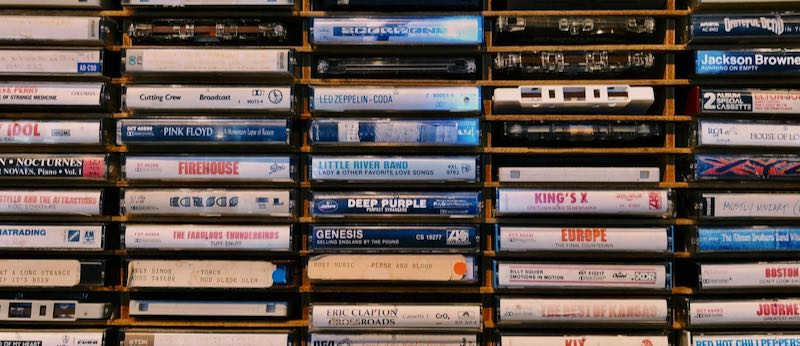
Lou Ottens, inventor of the cassette tape and a CD pioneer died aged 94 at his home in Duizel in Brabant on Saturday, Dutch media report.

Ottens, who studied to be an engineer, started working for Philips in 1952. Eight years later he became head of the firm’s recently introduced product development department. Within a year he and his team had developed the first portable tape recorder of which over a million were sold. Two years later he revolutionised the old reel-to-reel tape system by inventing the cassette tape.

‘I got annoyed with the clunky, user-unfriendly reel to reel system, it’s that simple’, Ottens said later. The new carrier had to be small enough to fit into his jacket pocket, Ottens decided, and he had a wooden model made to determine the ideal size. In 1963 the first plastic encased cassette tape was presented at an electronics fair carrying the slogan ‘smaller than a pack of cigarettes!’ The tapes were quickly copied by the Japanese but in different formats!

Ottens managed to make a deal with Sony to use the mechanism patented by Philips to introduce a standard cassette which was then rolled out globally. Over 100 billion were sold worldwide. Ottens went on to develop the CD, which again became a Sony-Philips standard and which sold over 200 billion.

In 1986 Ottens retired but he was often asked if he was proud of his inventions, which allowed millions to have access to music. ‘I have no ‘pride dial’’ Ottens said in an interview, stressing that both inventions were team efforts. His biggest regret was that that Sony, not Philips, invented what he considered to be the ideal application for the cassette tape, the Walkman. ‘That still hurts,’ he said. Dubious about the recent revival of the cassette tape Ottens said ‘nothing could beat the sound of a CD.’

Read more at DutchNews.nl
https://www.dutchnews.nl/news/2021/03/dutch-inventor-of-the-audio-cassette-tape-dies-aged-94/?


Do you enjoy the SWLing Post?

Please consider supporting us via Patreon or our Coffee Fund!

Your support makes articles like this one possible. Thank you!

Photos from an Antique Wireless Association meeting in 2000

Many thanks to SWLing Post contributor, David, who shares the following random photos he recently inherited and scanned. These were taken at an Antique Wireless Association meeting (AWA) from 2000. Click on images to enlarge:

Thank you for sharing these David!
Dan notes that premium receiver scammers are back on eBay

Many thanks to SWLing Post contributor, Dan Robinson, for the following guest post:


Premium Receiver Scammer(s) Back

by Dan Robinson

From time to time here on SWLing Post, we have alerted readers to scammers using multiple eBay addresses to attempt to rip off unsuspecting potential buyers and using old photographs of usually premium receivers to do so.

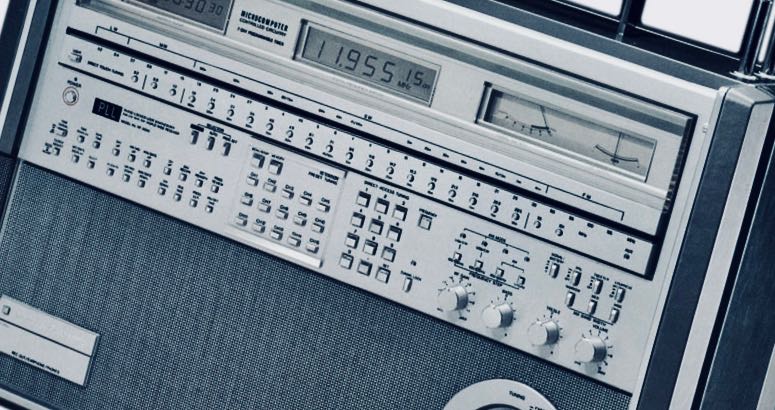
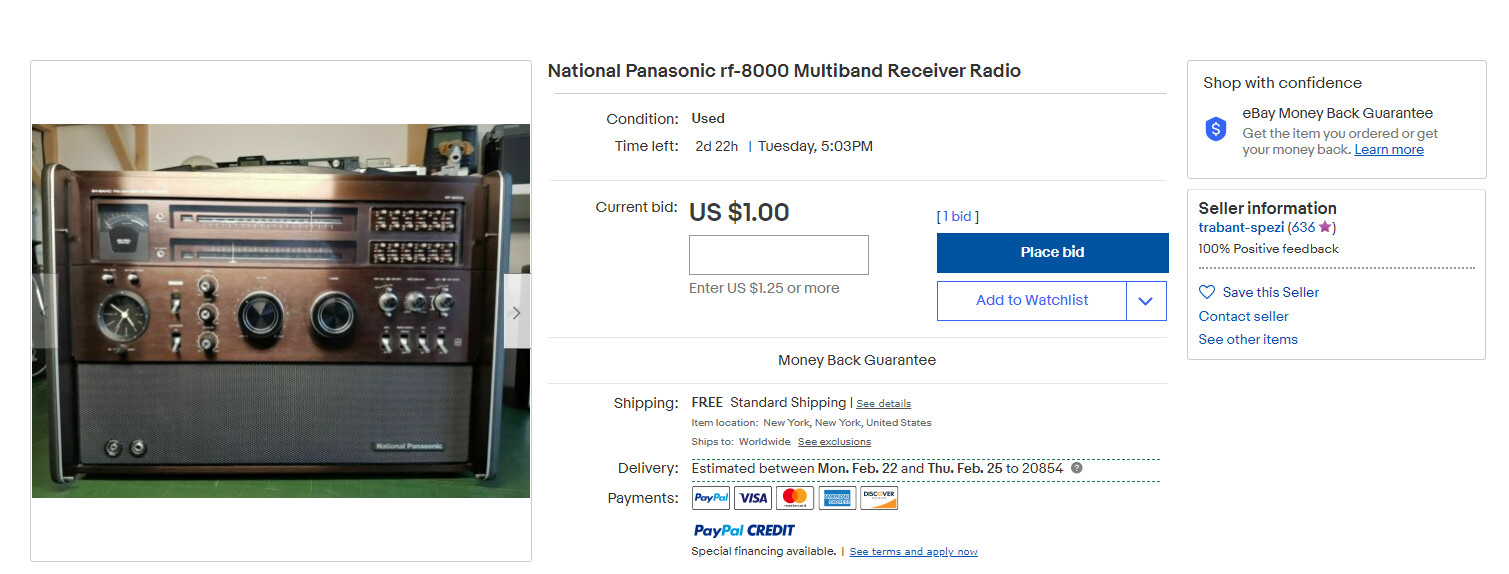
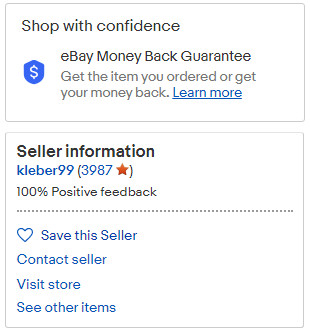
Well, whether this is one scammer or many, he is back. See the photos attached here, which show what is surely a fictitious eBay ID and what appear to be legitimate photos of a Panasonic RF-8000, one of the most sought after of the large portables from decades ago.

It’s not until the 4th photograph that this person provides that you see what’s involved in the scam, which is the scammer noting that he is “selling this on behalf of my company” and that the radio can be purchased “at the buy it now price only” The scammer then provides an email address to get around the standard eBay auction process, adding that he does not respond via Ebay messaging.

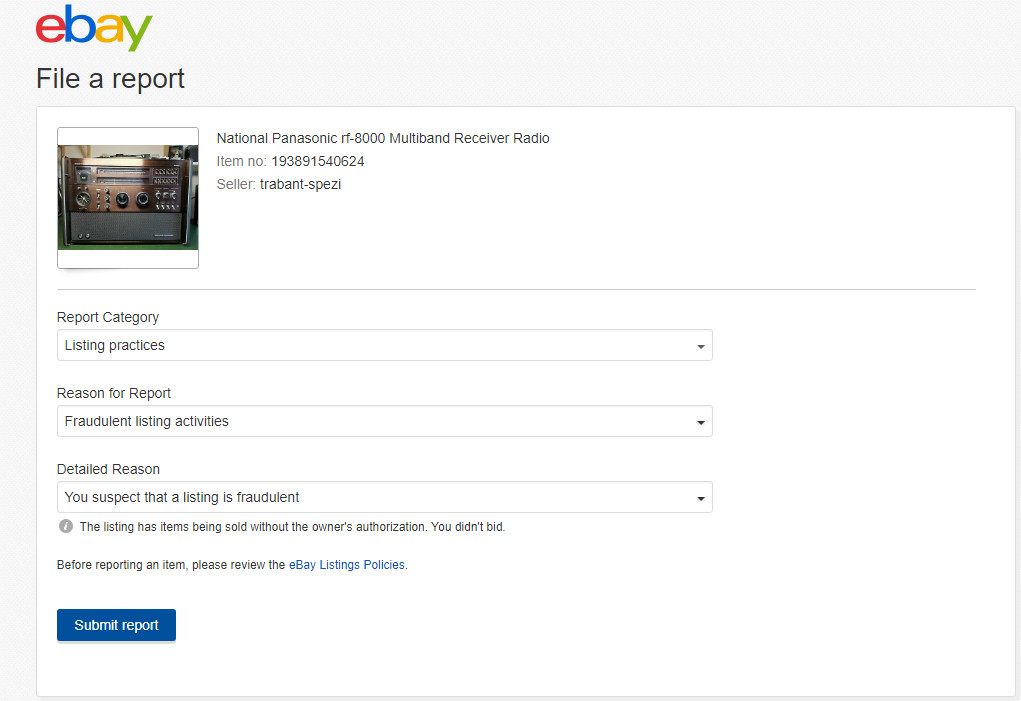
I have continued to alert eBay to these scams, and to their credit eBay has taken down many of these items in recent weeks and months, though occasionally eBay does miss these. eBay also does not make it immediately clear as to how to report items like this (HINT: you have to scroll down the page until you see a tiny REPORT link on the right side which takes you to multiple categories. These scam items fall under “LISTING PRACTICES” “FRAUDULENT LISTING ACTIVITIES” and “YOU SUSPECT THAT A LISTING IS FRAUDULENT”

If eBay has successfully already taken a scam item down, you will then see a confirmation page saying the item could not be found after refreshing the page. Very often, even after reporting an item, the identical item will show up within seconds or minutes under a completely different eBay ID (see the 2nd photo here on the Panasonic RF-8000 which shows a changed eBay ID)

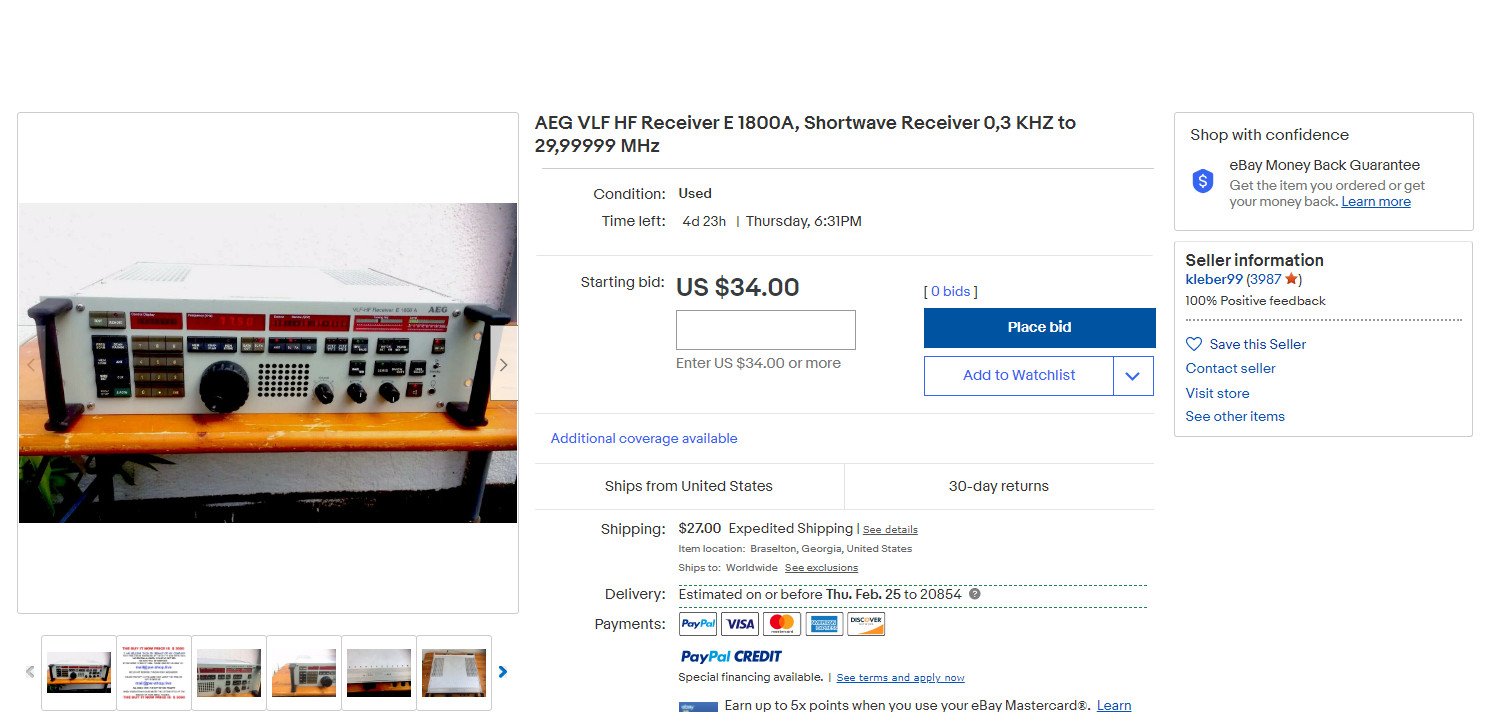
Receivers most often seen on these scams include: AEG 1800A, Panasonic RF-8000, and usually other premium sets, and the tip off to the scam is that the seller/scammer usually always starts the price at $1.00 or $34.00 or similar level. In the case of the AEG 1800A, the scammer consistently uses the exact same photo of this rare receiver, from a sale that completed years ago.

I would encourage eBay users to join me in reporting scams like this — eBay certainly appreciates it and if you have eBay “Concierge” level service, which I do, it’s sometimes a help to them to get online and chat with eBay about the item and your report, especially if the eBay algorithms have failed to spot and take down a particular scam.


Thank you for sharing this, Dan. We appreciate insight from radio enthusiasts like you and Paolo.  As Dan suggested, I encourage you to report listings that are obviously fraudulent to eBay. They will investigate the case and take action if it is a scam.

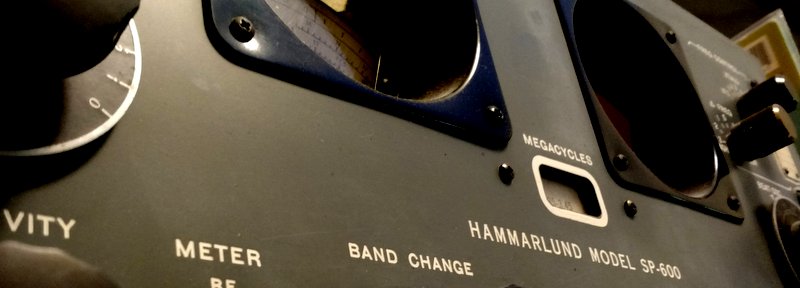
Dan’s respect for Hammarlund and the SP-600 series

Many thanks to SWLing Post contributor, DanH, who shares the following comment in response to this news article from the Citizen Times featured in Radio Waves yesterday:

Here are my thanks to members of the Amateur Radio community and The News-Record & Sentinel for remembering the legacy of Hammarlund Manufacturing Company Incorporated. It is good to know that this part of our radio history is valued and preserved. I loved the newspaper article!

I have a few vintage Hammarlund radios including two Super-Pro models. The SP-600-JX-21 is one of my daily drivers. This relatively late production SP-600 is in stock condition with the exception of a half dozen electrolytic capacitors that I replaced mostly in the power supply. By the time this SP-600 was built in 1957 Hammarlund had replaced the short-lived black beauty electrolytes with ceramic disc capacitors. Like military and industrial users I upgraded the original nickel plated tube shields with IERC heat dissipating tube shields where possible. I also installed vintage GE No. 1847 long-life incandescent bulbs as direct replacements for the brighter (too bright, for me) No. 47 dial lamps.

Here are my two most recent reception videos of the SP-600. The first features reception of Radio National da Amazonia and the second is a brief operating demo of the SP-600. The loudspeaker used in both videos is a full-range vintage Jensen 10? with matching transformer from the 1950’s instead of a communications range speaker typically used with these radios. This makes a big difference when listening to broadcasts.

This old Hammarlund is still working pretty well.

RN da Amazonia

SP-600 operating demo

Wow! Thank you for sharing this, Dan!

I used to own an SP-600 myself and I do miss it. The only reason I sold it is I was struggling to find a spot in my very compact shack where I could keep it on the air as a daily driver, yet still have enough room to bring new radios and accessories into the shack for evaluation. Moving it around all of the time (especially higher on my radio shelves) was incredibly difficult as she’s a hefty girl indeed! I ended up selling the ‘600 to a good friend for a song. That’s okay because like you, I know he’ll keep her in prime operating condition and I can even pop by to visit when I wish! I do miss having the ‘600 in the shack, though. It was truly a champion MW receiver as well!

The best radio you have is the one in front of you

This autumn, I’ve received a number of emails from new readers who’ve dusted off the radio in their closet and decided to get back into shortwave radio listening and/or ham radio.

I can’t recall another time I’ve gotten so many similar messages and I can only attribute it to the fact so many people across the globe are still having to social distance due to the C-19 pandemic.

There’s.a common theme in the messages I’ve been receiving from readers. Here’s an excerpt from the latest message (note that I removed the model name from this question because, frankly, it’s irrelevant):

“[My radio] seems to be in great working order. It’s been stored in a climate controlled environment and besides needing a little DeOxit on some of the pots, it works like new. I couldn’t be happier! My question to you is, this model is from the 1990s when I used to be hot and heavy into radio. I know technology has advanced by leaps and bounds since then, so as I get back into radio maybe I should invest in a newer model? What do you think or suggest?”

It’s true that radio technology has gone through a massive number of innovations since the 1990s. We’ve seen the advent of Software Defined Radios and portable receivers/transceivers sporting DSP technology.  Far be it from me to dissuade anyone from acquiring new gear!

With that said, I also believe that the best radio you have is the one in front of you. Period.

Listening is a skill

You can’t buy it. Whether you’re an SWL or ham radio operator, most of the time you’re on the air, you’re listening. And the best filter you have is the one in your head. I’ll quote from an article I posted many moons ago:

My good friend Vlado (N3CZ) is a case in point: he is one of the most capable ham radio DXers I know. His extraordinary ability to pull intelligible conversations and CW (Morse code) out of the static, even in crowded radio conditions, is simply astounding. Vlado’s main transceiver is nearly two decades old, and by no means a benchmark technically. If you ask Vlad if he uses filters and digital signal processing, he will wisely tell you, in his Macedonian accent: “Your best filter is between your ears.”

The same goes for SWLing. I have spent enough time listening to shortwave and weak DX that I can now pull conversations out of the noise that my (non-radio) friends can barely detect. I’m convinced this is healthy exercise for the old grey matter.

A seasoned radio enthusiast can grab any radio and make the most of it.

Imagine what Joe Walsh could do with a toy guitar…

Do you think the guitar makes him one of the greatest guitarists of all time?


Many of the advances in technology over the past two or three decades has, of course, given us better tools for working weak signals. But more importantly, it’s brought down the price of performance. I can invest $200 in an SDR that will perform as well as or better than multi thousand dollar benchmark receivers from the 1990s. So yes, in terms of equipment, it’s a brilliant time to be an SWL or ham radio operator.

But at the end of the day, your skills are more important your gear.

My advice?

Make the most of the radio you have.

Challenge yourself to log a certain amount of DX with your radio–try to work states, counties, provinces, regions, territories, or countries. Make your own goals!

Take your radio to the field.

Experiment with antennas.

Get to know your radio so well you can use it blindfolded!

If you still feel you want to invest more in your gear, go for it and don’t look back!

That will be all.

-Thomas