
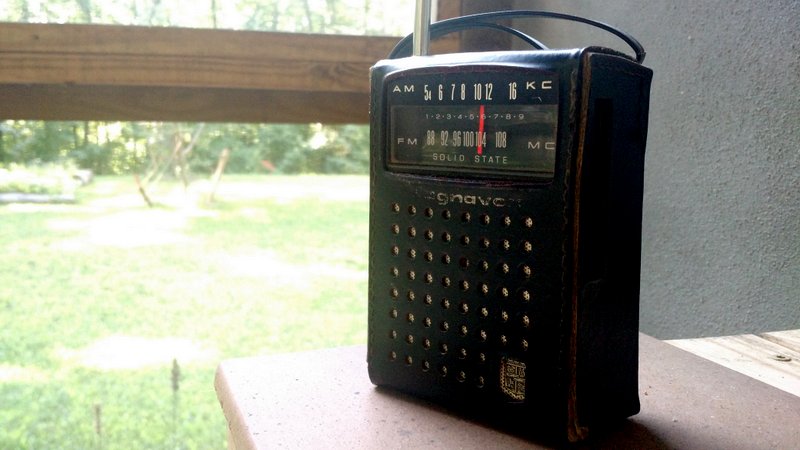
 I’ve always had an affinity for pocket transistor radios.
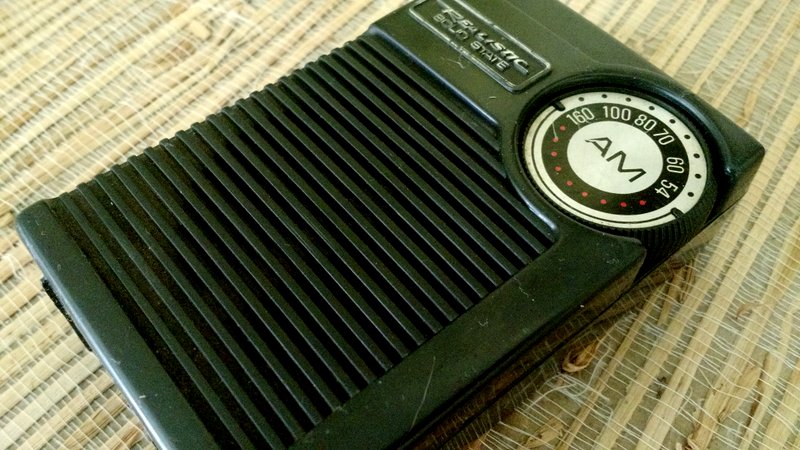
The Realistic Model 23-464.
My first one was an AM-only model: a Realistic Model 23-464. It was about the only new pocket radio I could afford–and purchase locally–when I was a kid.
It was surprisingly sensitive on the AM broadcast band, but the dial was a far cry from accurate. At some point, I either gave this radio to someone or lost it. Last year, I happened upon one on eBay and purchased it for $9 shipped. Its plastic body shows signs of wear, but it works and reminds me of my childhood.
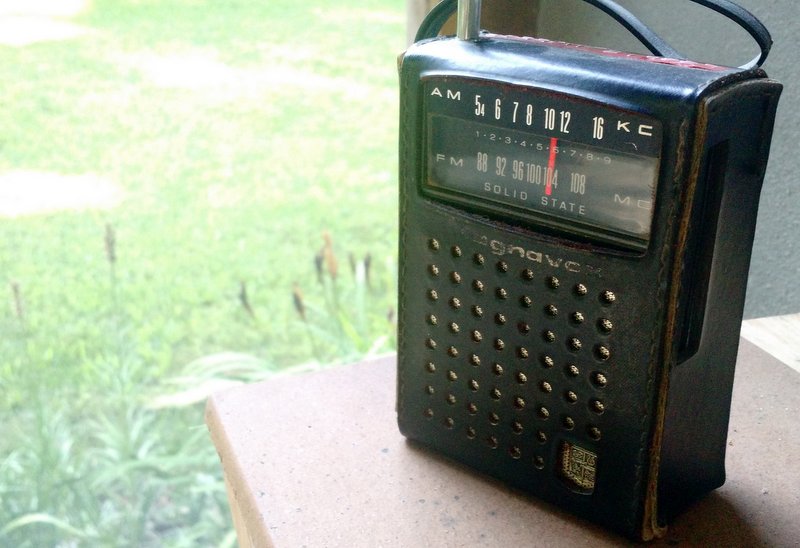
My grandpa’s Magnovox 1R 1203
Another pocket AM/FM radio that brings back a flood of memories is the Magnovox 1R 1203. It belonged to my dear grandpa, who also shared and conveyed a love of radio. When I was a kid, we would sit around on his front porch on hot summer days and listen to local AM stations on this little radio, cicadas whirring in the background.
I still have his Magnavox–it sits here in my radio room and brings back memories every time I look at or listen to it.
Am I a nostalgic fellow? You bet!
Anyone else have memories associated with pocket radios? Please feel free to comment and share!
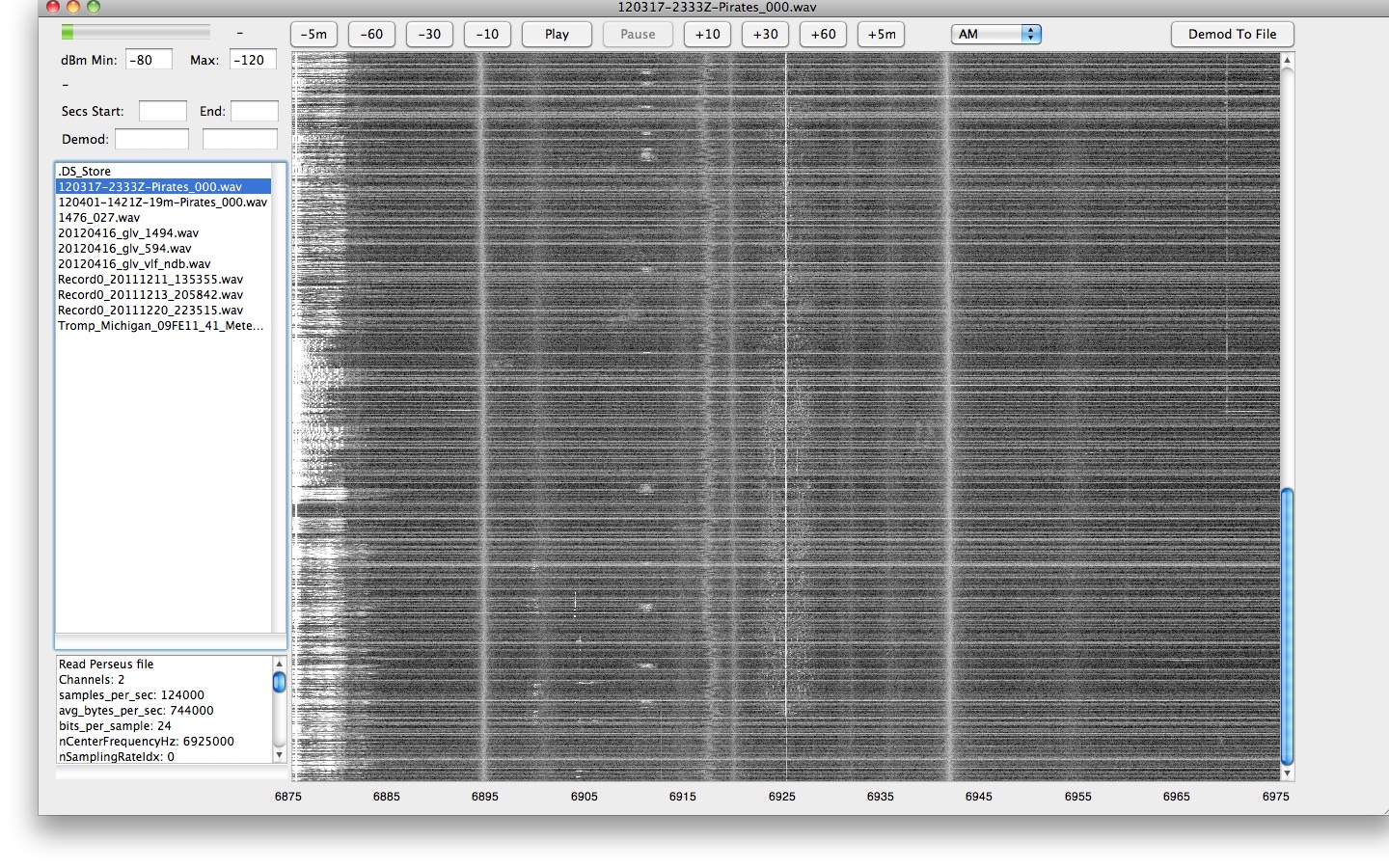
 Hi there, I thought I would share some Brazilian shortwave catches with you, obtained using my Sony ICF-2001D receiver and 200 metre experimental longwire. The first is Radio Bandeirantes, Sao Paolo on 9645.4 kHz. This is a station that I’ve only heard once or twice previously, but was received with excellent signal clarity and strength recently, using my deployable longwire antenna. I would rate this station as moderately difficult to receive with reasonable discernibility. The second is Radio Novo Tempo from Campo Grande, on 4894.9 kHz. This station I would rate as difficult to hear with discernible audio. The key is always signal-to-noise, thus moving yourself out of the ubiquitous blanket of QRM most modern environments endure will usually achieve this and of course coupled with sufficient space outdoors to erect a larger antenna will hopefully also improve signal strength. My final video on this post is Radio Nacional Brazilia on 6180 kHz. I would regard this station as quite easy to hear well; their effective TX power towards Europe is around 2 MW, however, outdoors, this station can literally boom in, with what might be perceived as local-AM signal strength. I hope you enjoy watching the videos and seeing/ hearing what’s possible with a modest set-up. As for the Sony ICF-2001D? Well the design is more than 30 years old, but in my opinion at least, still one of the very best portable shortwave receivers ever manufactured. Thanks and 73.
 (Source: Christian Milling via
 (Source:
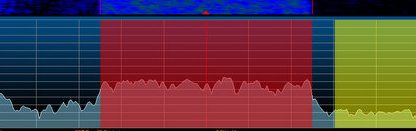
 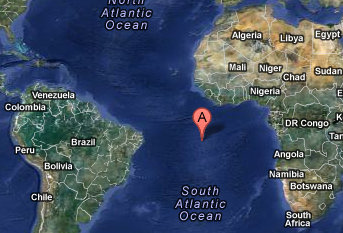 The two hour-transmission on 21715 kHz will start with the old, special sound of Bow Church Bell in east London, the sound of which, even if in DRM this time, will remind older listeners of the BBC broadcasts of many decades ago. The 21-hour transmission will be the regular BBC programmes for West and South Africa and will end at 1400.