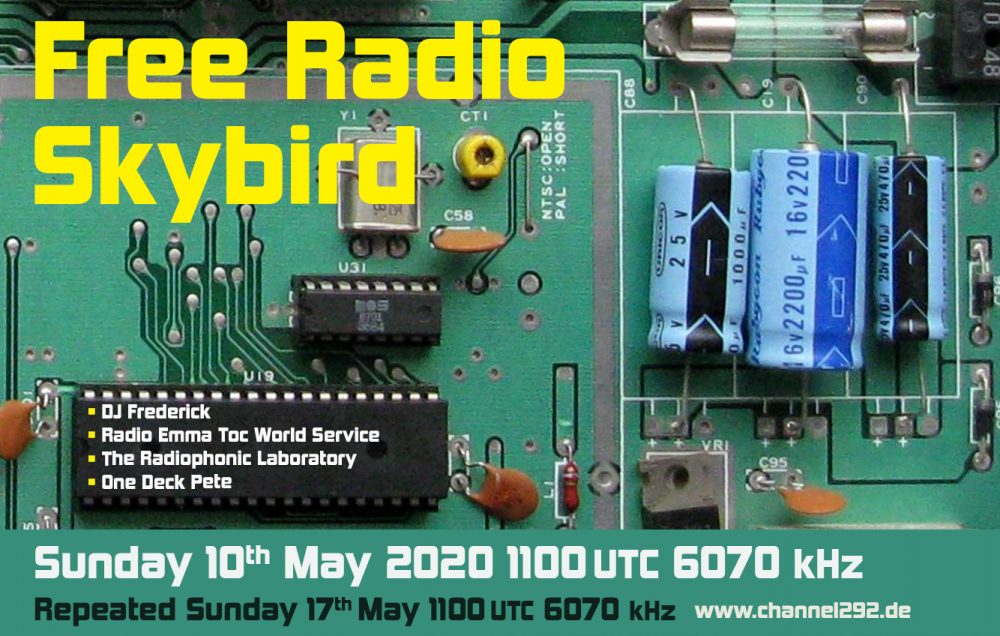
As you can see on Pete Madtone’s graphic above, Free Radio Skybird will be on the air Sunday, May 10th, and repeated on Sunday, May 17th, 2020 at 1100 UTC on 6070 kHz (Channel292).
Thanks for the tip, Pete! Love those FRS graphics!

As you can see on Pete Madtone’s graphic above, Free Radio Skybird will be on the air Sunday, May 10th, and repeated on Sunday, May 17th, 2020 at 1100 UTC on 6070 kHz (Channel292).
Thanks for the tip, Pete! Love those FRS graphics!
 Radio Waves: Stories Making Waves in the World of Radio
Because I keep my ear to the waves, as well as receive many tips from others who do the same, I find myself privy to radio-related stories that might interest SWLing Post readers. To that end: Welcome to the SWLing Post’s Radio Waves, a collection of links to interesting stories making waves in the world of radio. Enjoy!
Many thanks to SWLing Post contributors Ron, Andrea Borgnino, and Tracy Wood for the following tips:
Non-official radio stations always attracted shortwave listeners who call them “clandestines”, follwing a mixture of mis-understanding and romanticism. The range of this class of stations is remarkably wide. Nowadays, the majority of them is renting time from major transmission centres like Nauen/Germany, Issoudun/France or Toshkent/Uzbekistan.
As all media, they are put into service to influence people and to sell something by propaganda. The difference between an official broadcaster, like Voice of America, and a “clandestine” like North Korea Reform Radio is not palpable – both are financed by the U.S. Congress.
With most broadcasters transmitting on a scale between facts (“white” – nearly only the BBC) and sheer disinformation (“black”), clandestines are placed on the darker third of this range. The separation between “clandestine” and “official” is rather artificial. There simply is no difference between e.g. the official World Harvest Radio and the clandestine Voice of Wilderness, both religious brodcasters, funded by Cornerstone Ministries International/USA – to take just two religious stations.
Today’s activity of clandestines is concentrated on Africa and Asia with especially taking countries like North Korea, China, Eritrea and Sudan into focus.[…]
In anticipation of its upcoming move, the FCC has adopted a new FCC seal. The redesigned seal is the product of an agency-wide contest that solicited proposals from employees and contractors. The winning design, submitted by Umasankar Arumugam, was selected by a vote of the agency’s employees and contractors.
The revised design incorporates several elements: communications technologies currently transforming our world; four stars on the outer seal border, drawing from the legacy of the predecessor Federal Radio Commission seal; 18 stars on the shield, recognizing the current number of bureaus and offices; and the eagle and shield, identifying the FCC as a federal government agency.[…]
The notion of WNYC becoming the flagship station of a non-commercial network of cultural stations was first publicly articulated by Mayor La Guardia at the launching of the station’s new WPA-built transmitter facility in Greenpoint, Brooklyn on October 31, 1937. La Guardia envisioned a non-commercial/educational radio network connected via shortwave rather than expensive landlines leased by AT&T, but the FCC prohibited interstation communication by means other than wire when wire is available. At the ceremony La Guardia sharply criticized the FCC prohibition: “That is just as nonsensical and as unreasonable as to say that one isn’t permitted to fly from here to Chicago because there are railroads going from here to Chicago. Of course, all this is very good for the New York Telephone Company, but it is not so hot for us.”[…]
On behalf of Radio Amateurs of Canada, I would like to thank you for your continued support of Amateur Radio in Canada and internationally.
Your membership has helped RAC in its two primary objectives: to support and promote Amateur Radio in Canada and internationally; and to provide valuable programs and services to RAC members (see below).
As a result of the COVID-19 global pandemic, the RAC Head Office in Ottawa has been closed temporarily and we are no longer able to send out membership renewal notices by mail and we will be sending out email notices instead.
We would appreciate it if you would please watch for these messages in your inbox and also in your junk folders – this is especially true if you have Outlook or Hotmail email addresses.
In addition, you can assist us by checking to see when your membership will expire by logging on to the RAC website and going to the “My Membership” webpage (https://www.rac.ca/my-membership/). You can also find it on the mailing label of the paper version of The Canadian Amateur magazine or by calling the RAC office as described below.If you need to renew your membership you can do so by using one of the following options:
- Online: by completing the online renewal form (or by clicking on the “Join Radio Amateurs of Canada” logo on the top right of the RAC website). Payments must be made by credit card or by PayPal.
- By phone: by calling 877-273-8304 from 10 am to 4 pm EST/EDT, Monday through Friday (except statutory holidays). You may pay by credit card or you may send a cheque for the appropriate amount to the RAC head office.
- By mail: if you prefer to have your renewal form processed via standard mail, you can download an application for your region from the Membership Renewals webpage and mail it to the RAC Office.
73, Glenn MacDonell, VE3XRA
RAC President
Please consider supporting us via Patreon or our Coffee Fund!
Your support makes articles like this one possible. Thank you!

 Many thanks to SWLing Post contributor, Patrizio Cardelli, who writes:
I’m Patrizio (SWL I – 5184 /AN) from Riva del Garda, Italy.
A few days ago, I built a Noise-Cancelling Passive Loop (NCPL) antenna. I built the 1:1 balun with a couple of ferrite 175 – 285.
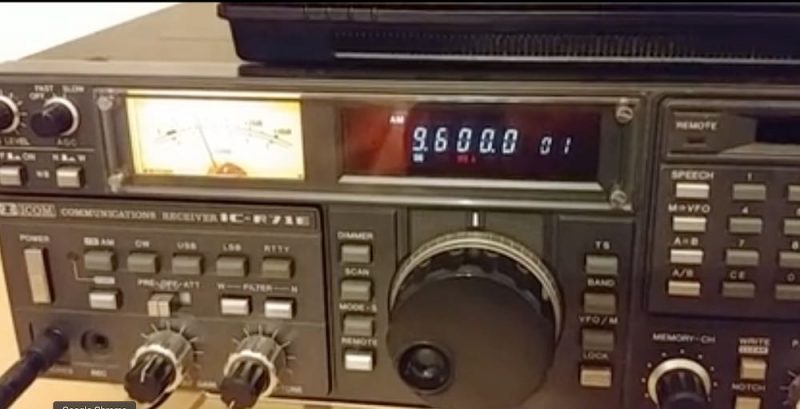
I got a good result on medium wave on my ICOM IC R 71 E with the antenna inside my house installed behind the desk just to avoid any problems with my wife.
On shortwave, the signal was low in comparison with the Bonito mini whip but in my QTH I have a lot of QRM and with this antenna I solved my problem.
Yesterday I tried the balun with my random wire (15,2 meter long) also with good results.
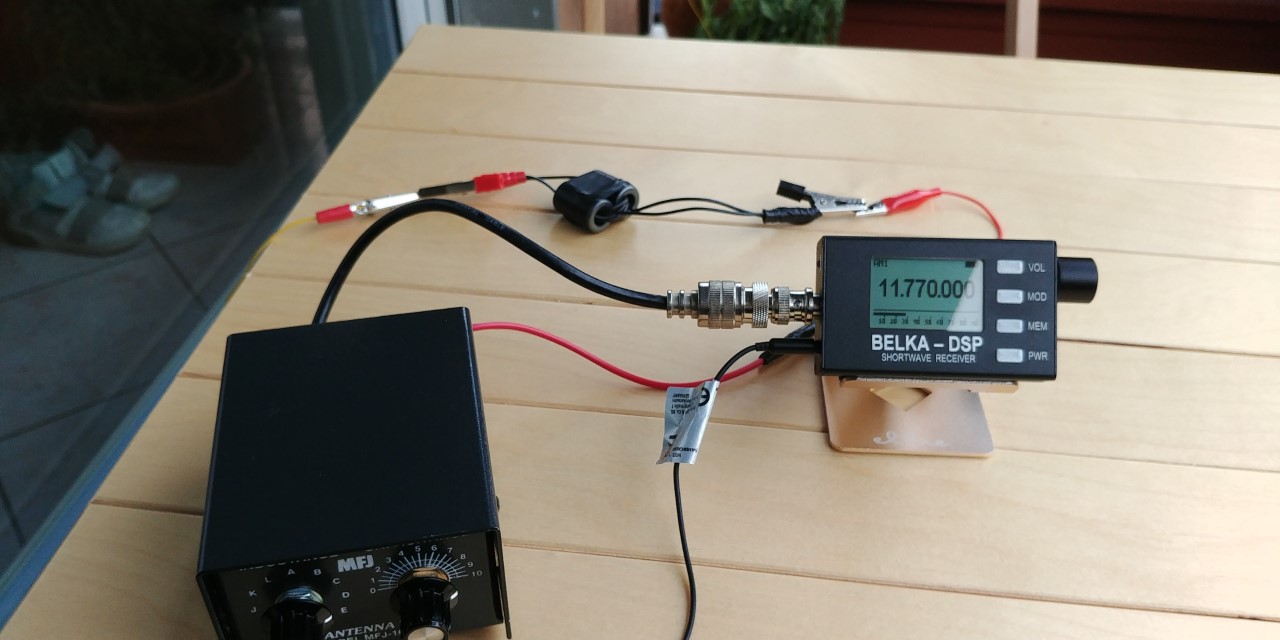
About my NCPL antenna: I made mine with RG-58 coaxial cable just to have easy portability in SOTA (please see photo) and also the feed line is made by the same coaxial cable. OK, you are right…it’s ugly:
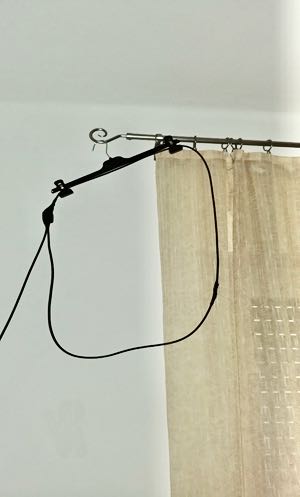
Electrical connections are not soldered, still I don’t see any mechanical issues and this antenna since it is made for SWL / BCL purposes (meaning, RX only, no TX).
Concerning the binocular ferrite core, I didn’t have one, so I used two ferrite core type 175 – 285 (28,5 mm length, external diameter 17,5 mm and internal diameter 9,5 mm) normally used to reduce HF interference:
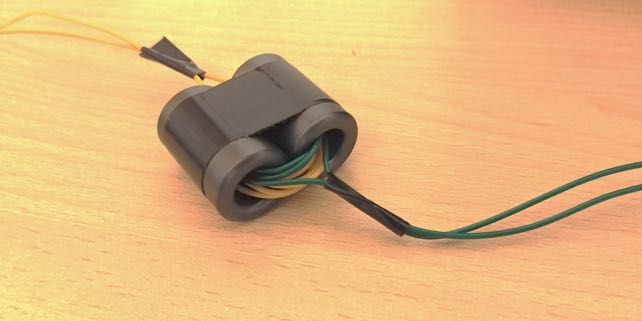
For the winding I used PVC insulated cable cat no: 7/0,2 type 2 (def61 – 12) conductor 7/0,2mm TSCu X 0,3mm R/T type single (4 turns primary and 4 turns secondary). It’s the same cable with which I built my random wire antenna (also portable for SOTA but now installed on my balcony until the COVID – 19 emergency is over).
The attached videos show the situation in comparison with my BONITO MINI WHIP active antenna (also installed inside my house). Recently I changed my QTH and unfortunately here I have a lot of interference both on MW and SW. The better results that you can hear are achieved with my NCPL antenna.
I have made this test with my ICOM IC R 71 E + BHI noise cancellation speaker…..you can assess yourself, the better results that you can hear are achieved with the NCPL antenna and in the case of Tecsun PL-660 without any noise cancelling filter (BHI speaker off).
Thanks for sharing this, Patrizio! As you say, the NCPL loop seems to do a fine job helping to eliminate local RFI/QRM. The Bonito Mini Whip is a fine antenna, but not optimal for environments with a lot of radio noise–that’s where the NCPL antenna really shines.
You also make a good point that if you’re simply experimenting and only using an antenna for receiving, you can be more relaxed about the build because you’re not sending RF through it. In the end, however, properly soldered and protected connections will last much longer and provide better, more reliable performance.
Thank you, again, for sharing your build, Patriio! Those reception results speak for themselves!

Many thanks to SWLing Post contributor, Bill Hemphill, who writes:
I was very happy to see your post about The Spectrum Monitor magazine. Like you, I am a big fan of it and have subscribed for several years and have purchased the archived years.
Usually, I am not a fan of digital magazines. They either are in special formats requiring special programs or even special versions of Acrobat. Like you, I was happy to see that it is in standard PDF format.
But that still brought up a problem. With my eyesight, I need to zoom in on the page to read it, even when using a 10” tablet and definitely if using a smaller screen such as my phone. Normally it means panning around the page, reading column one down and then going back to the top of the page to read the second or third column.
But there is some good news that many people may not be aware of. The Acrobat Reader app on the Android system allows for a mode called “Reading Mode”. What reading mode does is stack the columns up into a single column thus allowing for reading straight down – no more scrolling back to the top of the next column. And you can tap on the screen to enlarge the text and the text will reformat in a larger font to fit the margins of the screen.
I took some screen shots of TSM using Adobe Reader on my Android phone.
On the left is the complete page, on the right I have tapped on the page and while it enlarged it, I now need to scroll around to read it:


Following screen shot shows the “View Setting” Settings and “Page-by-Page” is the default setting.
What you want do is change this to “Reading Mode”:
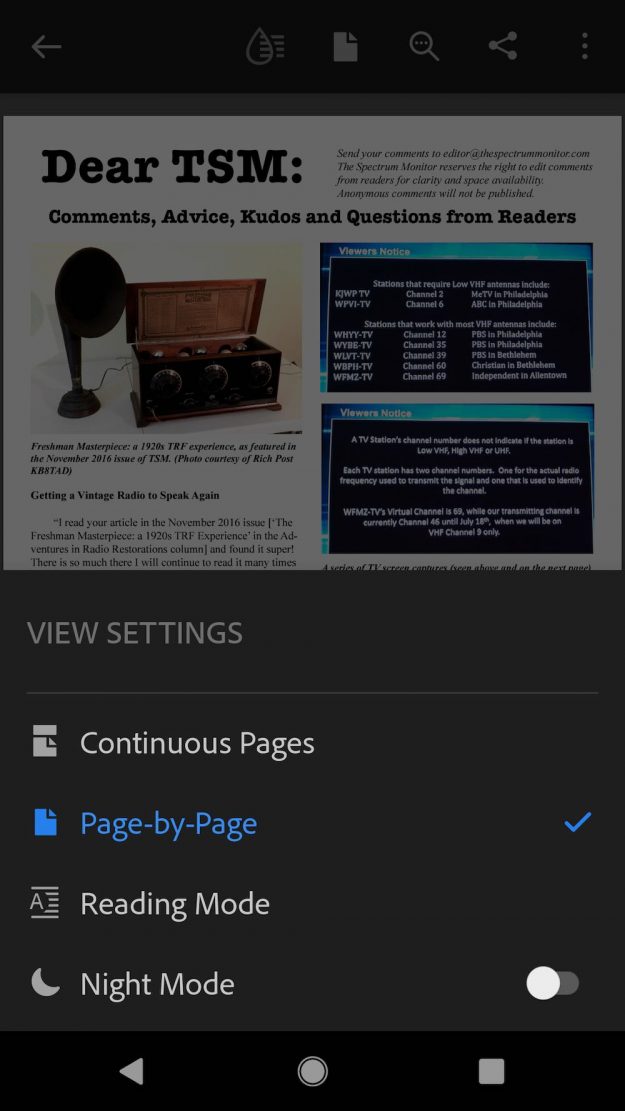
Once you have selected “Reading Mode” you will find that the columns are now stacked vertically and you can read my just scrolling down. No more going back to the top for the next column. Also, taping on the text will enlarge it and reflow it to fit the device screen.
Left screen shot is after selecting “Reading Mode” and right is after tapping the screen to enlarge the text:


With Reading Mode, I find I can even read TSM on my Cell Phone Screen as well as my tablets.
Note: Reading Mode only works with PDF’s that have been created with this is mind. It obviously won’t work with PDF’s created from scans.
Unfortunately, while there is a “Read Mode” in Acrobat Reader DC for Windows, it does not stack the columns like the Android version does. I’m not sure if the Acrobat Reader for iPhone works the same way as Android.
Hope this is of help to others.
73
Bill Hemphill
WD9EQD
Smithville, NJ
Thank you so much, Bill, for sharing your tip! You make a really good point, too, that PDF publications give you the flexibility to change text size and adjust layout through Adobe Reader so that it’s quite easy to read even on a small device. I’m also a huge fan of PDF documents and wish other radio publications would consider adopting the PDF format instead of replying on proprietary readers and apps.

IMPORTANT UPDATE – Amanda Dawn Christie notes:
“Unfortunately [this video] was never supposed to be public – it was an accident on my part. The film will be viewable soon though, for seven days. May 26 to June 1. It is being hosted by a gallery in Montreal. That upload was only a test for them, and should never have been public. I was in a hurry, trying to get it uploaded before I packed my hard drives before I moved and I guess I didn’t check all the settings. Sorry about that. I appreciate the enthusiasm though.”
SWLing Post friend and filmmaker, Amanda Dawn Christie, has just uploaded a version of her film Spectres of Shortwave to Vimeo where it can be viewed free of charge:
Many thanks to SWLing Post contributor, Mario Filippi (N2HUN), who shares the following guest post:
by Mario Filippi
During the pandemic a source of local information for residents in certain areas of the country can be found on Emergency Advisory Radio stations that dot the country and provide 24/7 information pertinent to a community. Not all communities have these stations, which can be found from 1610 – 1710 kHz and operate at varying power outputs.

Author’s Yaesu FRG-100 tuned to EAS station
For example, a station I regularly hear is WRBX655 about 12 miles away in Franklin Township, NJ operating on 1630 kHz : https://www.franklintwpnj.org/Home/Components/News/News/6384/1130?cftype=News
At the moment it is broadcasting information on COVID-19 from the Center for Disease Control. Every EAS station has a call sign and wattage generally is from about 10 – 50 watts. However some stations do not necessarily announce their call signs so you can check theradiosource at: http://www.theradiosource.com/resources/stations-alert.htm
Now some of these stations are part of the HAR (Highway Advisory System) that broadcast on major roadways and usually have prominent road signs announcing where to tune your car’s AM radio for latest traffic conditions. These stations were also termed TIS (Traveler’s Information Stations) at one time and were the precursors of HAR. However, over the years the FCC allowed more leeway on what information could be broadcast and as a result these EAS stations appeared in communities and even state parks.
You can look up the locations of these stations to ascertain if one serves your community but the best way is to tune regularly from 1610 – 1710 kHz. The optimal time to listen is during daylight hours as propagation changes greatly after dark and you’ll hear commercial AM radio stations coming in and overpowering most EAS. As for range, I’ve heard HAR stations as far away as 40 miles depending on ground wave conditions which can vary greatly. QSB is common. Many of these stations will rebroadcast NWS weather information when no pertinent emergencies exist and that is another way to spot them. Some highway stations I’ve heard will begin each broadcast loop with a tone, they’re all different in their approach.
Attached [at the top of the page] is a picture of the author’s Yaesu FRG-100 tuned to WRBX655 from Franklin Township, New Jersey. For an antenna I’ve used a 31 foot vertical and a loop and success will depend on using an outdoor antenna but when away from the home QTH, I’ve heard many of these stations while traveling on the roadways of America, They’re a good break casual AM radio listening. Give it a try.
Thank you, Mario! I must admit that when I travel, I often hunt down EAS transmitters via my car’s AM radio. Besides being a good source of local information, I do know some DXers who’ve identified and logged an impressive number of distant stations when conditions were ideal.
If you live outside the US, do you have similar networks for local information? Please comment!
Many thanks to SWLing Post contributors, Kris Partridge and Mark Hirst, who share the following article from the BBC:
Coronavirus: How amateur radio is connecting people during lockdown
By Vanessa Pearce
BBC NewsAmateur radio use in the UK has seen a “significant” rise during the coronavirus lockdown as people seek new ways of staying connected. The national body that represents users – the Radio Society of Great Britain (RSGB) – has said many people who formerly enjoyed the hobby are also returning to it.
Mark Rider’s social life before the coronavirus lockdown consisted of the occasional trip to the pub, rehearsing with musician friends and visiting his wife in her care home.
“But when I knew that wasn’t going to happen any time soon I decided to dust off my amateur radio equipment to seek out some other social interaction,” he says.
Mr Rider, a retired engineer from North Warwickshire, said “ragchewing” – or chatting to people on the airwaves – “has become one of the highlights of my day”.
“Because I live on my own, and because of lockdown, I knew I couldn’t do what I used to do, which wasn’t going to be very good for me or my mental health.”
The 67-year-old says keeping in touch with others has been more important since his wife was taken into care after a stroke.
“Just speaking to somebody else in the same situation is very rewarding,” he says.
The RSGB defines amateur radio as a “technical hobby for people who want to learn about, use and experiment with wireless communications”, like Mr Rider, who uses his radio kit to speak to others using designated radio frequencies.
Steve Thomas, RSGB general manager, says the organisation has experienced a threefold increase in the number of people asking to sit licensing exams since social distancing rules came into place. There are currently about 75,000 licensed users in the UK.
“Across the country, clubs and individual radio amateurs are supporting one another by setting up ‘nets’, or online meetings,” Mr Thomas says.[…]
Continue reading the full article at the BBC.
Thank you for sharing this excellent article! A number of readers have been commenting about how much more activity there is on the ham radio bands these days. I concur! With everyone at home, ham radio certainly does provide a way to reach out and be a part of a larger community.