Author Archives: Thomas

Tecsun PL-990: How to distinguish pilot run and final export versions

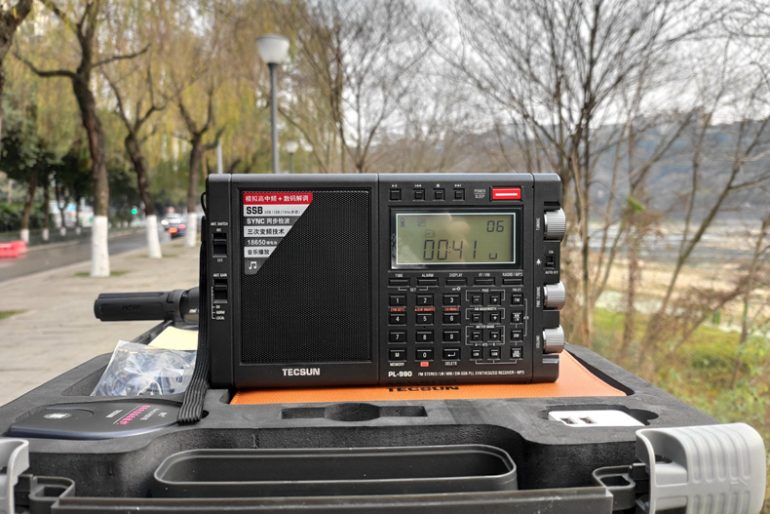
The Tecsun PL-990

As I suspected, it appears the Tecsun PL-990 batch that showed up recently on AliExpress for $399 each are the preliminary pilot run units that Tecsun offered in China last year. The final export version of the PL-990 is not ready for production yet and has been severely delayed by Covid-19 quarantines.

Anna at Anon-Co reports that Tecsun factories have been closed since mid-January 2020 and have only recently recommenced production, “but at a very slow pace.”

Since there will eventually be two different versions of the Tecsun PL-990 in the wild–the pilot run for China, and the finalized export version–I thought I’d share a trick Anna has described to tell the difference between the two.

Anna notes:

One way to easily see this is from the labels for the buttons above the keypad, these should be

[ TIME ], [ TIMER A ], and [ TIMER B ] (see picture below)

Tecsun PL-990 Final Export Version:
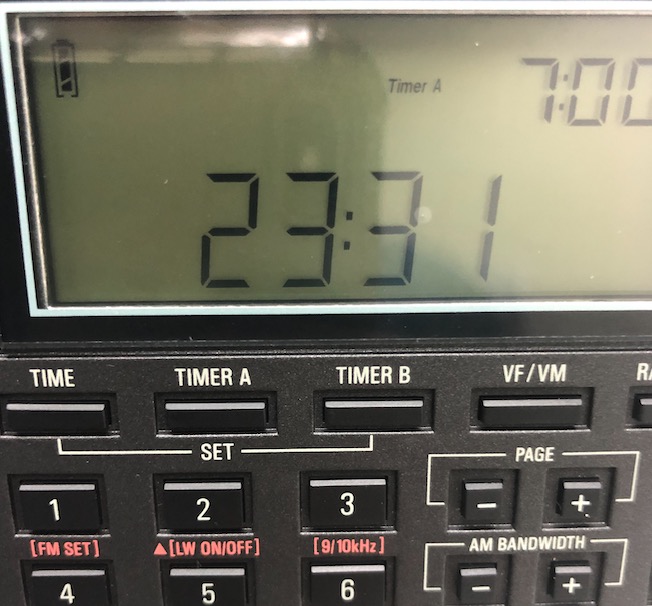
Tecsun PL-990 Final Export version

Tecsun PL-990 Final Export Version

Pilot Tecsun PL-990 (preliminary China domestic version):
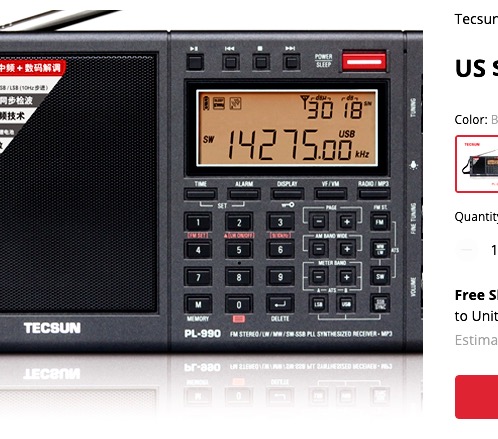
Preliminary Pilot Tecsun PL-990 distributed in China — image from AliExpress.

Anna adds:

I highly recommend [no one] buy these pilot versions, because the software on those devices is also not developed.

There still isn’t a final version or any price indication available yet, but it will definitely not be US$399.99.

So in case it’s not clear: don’t purchase a PL-990 until you can confirm you’re receiving a final export version which has the TIME, TIMER A, and TIMER B labels.

Again, at time of posting, the final PL-990 export version is not yet in production.

When the final export PL-990 is available, I will announce it here on the SWLing Post with links to authorized retailers like Anon-Co.

Patreon Code


Do you enjoy the SWLing Post?

Please consider supporting us via Patreon or our Coffee Fund!

Your support makes articles like this one possible. Thank you!

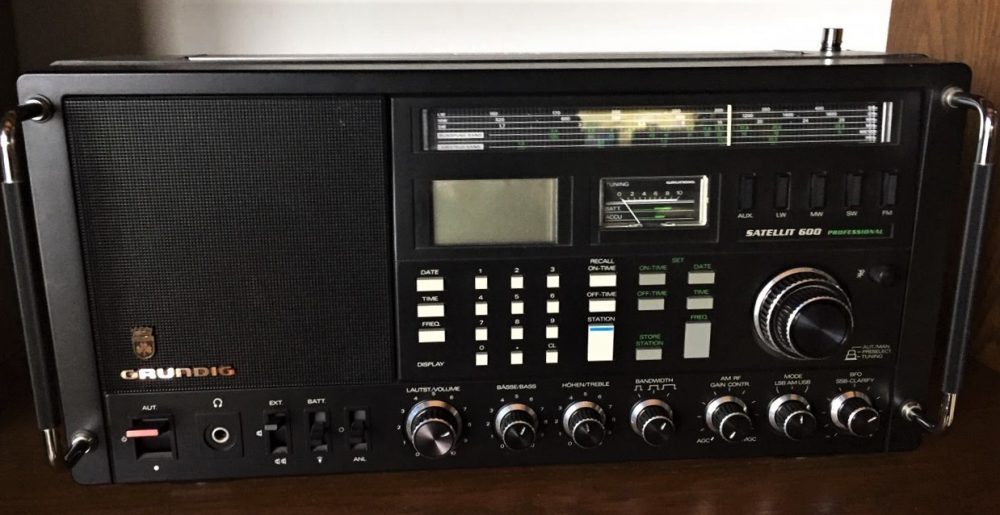
Free to a good home: A Vintage Grundig Satellit 600 Professional

I was recently contacted by Allan Rosenbluth, a particularly generous SWLing Post reader.

Allan contacted me because he would like to give away his cosmetically excellent Grundig Satellit 600 Professional (see photo above) with all the original paperwork. He said that the radio turns on, but does not work or produce sound.  Allan purchased this radio for his father who has sadly passed away.

I would assume the 600 might need to be re-capped, or it might only need a little DeOxit on some of the contacts.

We’re not looking for someone to fix the 600 and flip it on eBay, we would simply like his dad’s Satellit 600 Pro to find a good home.

Allan is not interested in the hassle of shipping this radio–he only want to arrange a local pickup.

If you live near Encino, CA (91436) and are interested, simply contact Allan via his email address.

Thanks again, Allan!


Do you enjoy the SWLing Post?

Please consider supporting us via Patreon or our Coffee Fund!

Your support makes articles like this one possible. Thank you!
SiriusXM offers channel and free stream devoted to Covid-19 awareness

(Source: SiriusXM via Radio Survivor)

Doctor Radio & NYU Langone Health launch 24/7 coronavirus-focused channel & hotline

SiriusXM, in conjunction with NYU Langone Health, launched a special 24/7 channel dedicated to providing the public with the latest information on the coronavirus outbreak. The channel launched on Friday, March 6 at 6pm ET and features programming from SiriusXM’s Doctor Radio (Ch. 110). It is available on both active and inactive SiriusXM radios on Channel 121 and will also be available on the SiriusXM app and via SiriusXM.com.

Click the link below to hear an exclusive, free livestream of the channel.

Click here to listen now.

Click here to read the full announcement.

Airspy Youloop and Homebrew Passive Loop Antenna designs

Almost two weeks ago, at the 2020 Winter SWL Fest, I gave a presentation called “A New Era in Portable SDR DXing.

The presentation was essentially an in-depth version of an article I published in the January 2020 issue of The Spectrum Monitor magazine (see cover above).

I devoted a good portion of the presentation describing how to build a passive loop antenna design by Airspy’s engineer and president, Youssef Touil. This passive mag loop takes advantage of the Airspy HF+ Discovery‘s exceptionally high dynamic range and is an impressive performer.

The homebrew loop on the balcony of a hotel.

You may recall, I posted a short article about this loop in November after enjoying a little coastal DXing.

In short? This passive loop antenna pairs beautifully with the Airspy HF+ Discovery. I’ve also been very pleased with results using the new SDRplay RSPdx on the mediumwave band where the receiver now sports a high dynamic range mode.

Overdue corrections…

After returning from the Winter SWL Fest last week, I was hit with an upper respiratory bug. No doubt, a souvenir of my travels!  It wasn’t the flu (I was tested), nor COVID-19, but it did knock me off my feet for a few days with fever, coughing, and headaches. You might have noticed a lot less posts last week and almost no replies from me via email. I’m only now feeling totally human again and trying to catch up with my backlog.

Shortly after my SWL Fest presentation, I realized I made (at least!) two mistakes. I had planned to post corrections here on the SWLing Post last week, but the bug delayed all of that, so here you go:

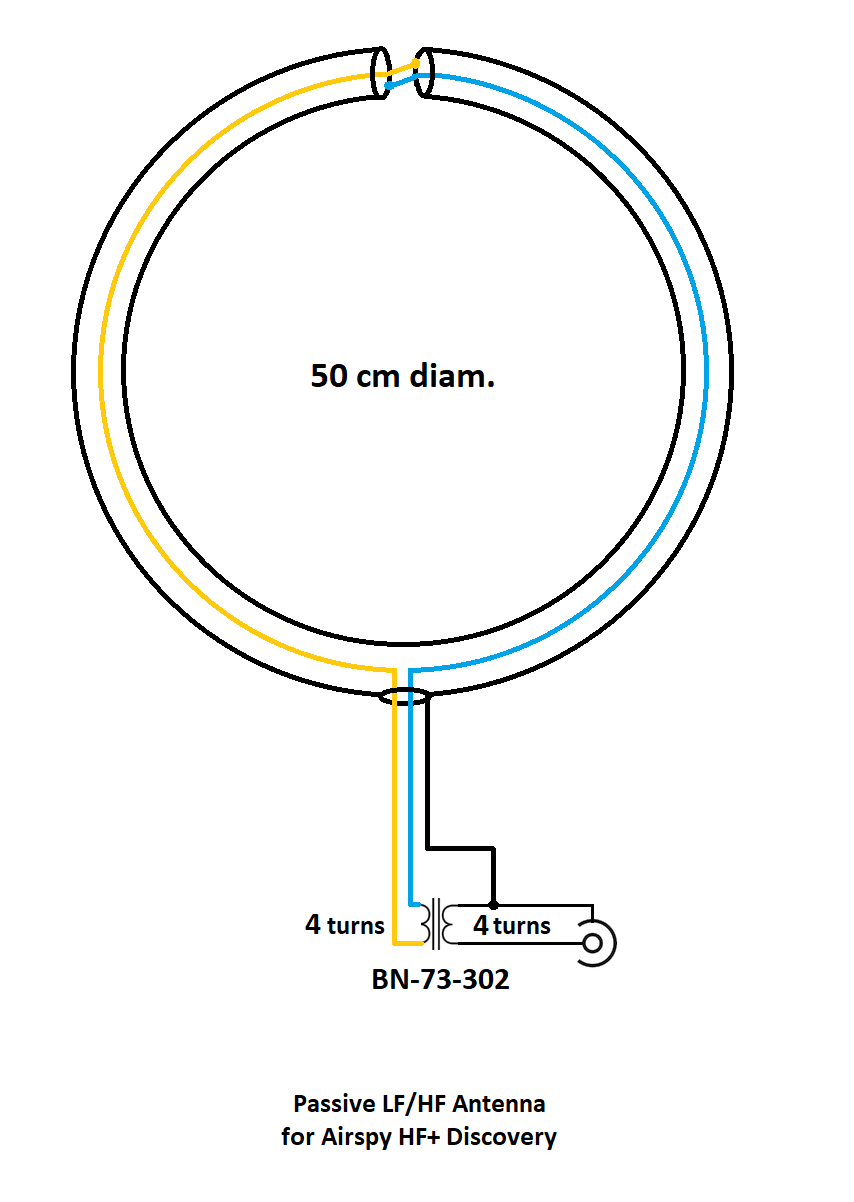
#1 Schematic of my homebrew passive loop antenna

When Youssef started experimenting with passive loop antenna designs, he posted a few schematics of at least three build options.

Although I described how to build my passive loop antenna, I grabbed the wrong schematic for my presentation slides. Many thanks to those attendees who noticed this.

Here is the schematic I should have shared:

Note that the transformer has four turns on both sides (the one in the presentation had 4:2).

Again, apologies for any confusion.

#2 The Airspy Youloop passive loop antenna

If you’re not inclined to build your own passive loop antenna per the diagram above, Airspy is planning to manufacture and sell a lightweight, high-performance loop of a similar design.

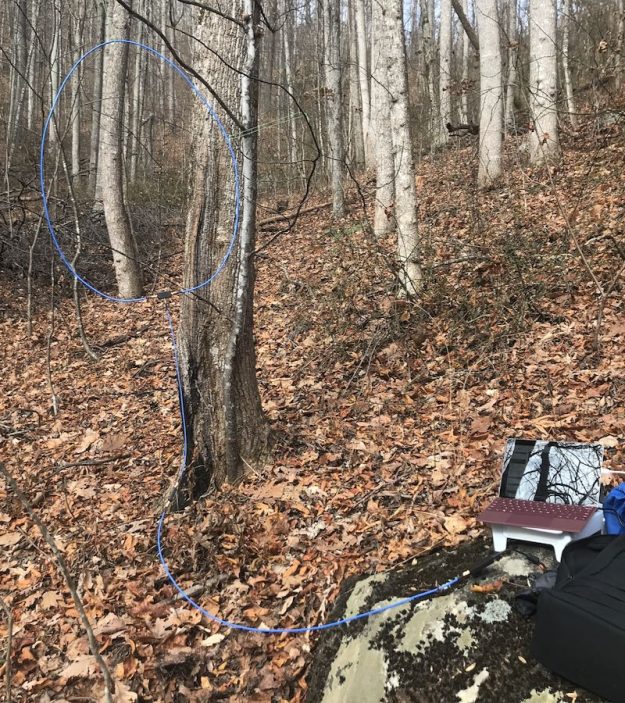
Prototype of the Airspy Youloop in the field (note bright blue cable jacket)

During the presentation, I called the future AirSpy antenna, the “Spytenna.” I was incorrect. (Turns out, I got this name from an early antenna schematic and somehow it stuck in my head!)

Airspy is calling their passive loop antenna the Youloop. Youssef posted the following note in the Airspy email discussion group:

We are currently arranging the shipping of the affordable passive version to Airspy.us and RTLSDR Blog.

Btw, It’s called “Youloop”

Many thanks to Richard Langley and a number of other readers who pointed this out last week.

I’ve had a prototype of the Youloop since November and brought it to the SWL Fest and presentation. It’s a quality antenna and incredibly compact when disassembled and rolled up.

When the Youloop is available to order, we’ll post links here on the SWLing Post.

More to come!

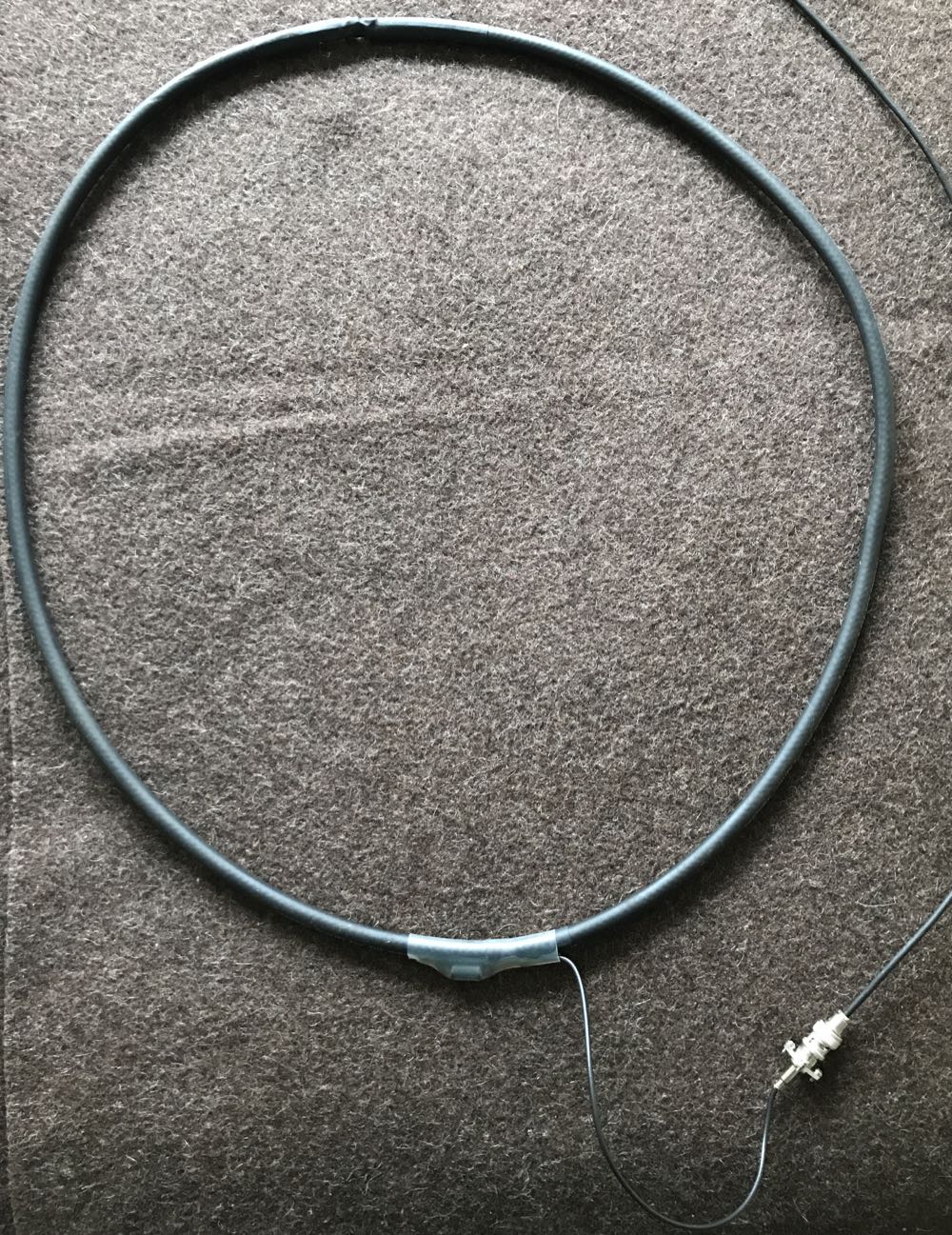
Once I catch up here at SWLing Post HQ, I plan to publish detailed construction photos of the homebrew loop antenna.

Many of you have questions about how to tap into the center conductor at the mid-point of the loop. These photos should help guide you.

Stay tuned!


Do you enjoy the SWLing Post?

Please consider supporting us via Patreon or our Coffee Fund!

Your support makes articles like this one possible. Thank you!

Steve’s crusade to obtain KGAF license plate


Many thanks to SWLing Post contributor, Dan Van Hoy, who shares the following item from WFAA:

GAINESVILLE, Texas — A North Texas radio station that the Texas Department of Motor Vehicles determined had call letters that were too “vulgar” to put on a personalized license plate finally has those formerly vulgar letters proudly affixed to its one station vehicle.

It’s a victory thanks to a Gainesville-area lawmaker who decided a bit of common sense was in order.

Late last year KGAF station manager Steve Eberhart started the process, applying to have KGAF on a personalized license plate for their company van. The station has been a fixture in Gainesville since 1947. But in a modern world that sometimes communicates in OMGs, LOLs, IDKs and IMHOs, the state told him that KGAF might mean something, too.

“Well, I’ve been told that it’s an acronym or a slang for social media for ‘can’t give a (expletive),” Eberhart said. “But certainly we never intended that,” he told me several weeks ago. “I can assure you the people in 1947 did not intend for it to mean that!”[…]

Click here for the full story at WFAA.

That is a riot, Dan!  Thank you for sharing. I’m glad someone finally came to their senses and gave Steve his plate!

Dean solves second interval signal mystery

(Image source: Madrid.org)

In response to our second mystery interval signal challenge, SWLing Post contributor, Dean Bianco replies:

Mystery solved!

This is the “interval signal” (more accurately, a placeholder with a musical station identifier) for the Compañía Telefónica Nacional de España (CTNW) from Madrid, Spain.

They were a point-to-point HF radiotelephone terminal that provided overseas telephone and telegraph services in the days before satellites became common.

As a young SWL, I would receive all manner of strange musical identifiers for these utility stations. Most of these HF telecommunication services had gone to satellite by the early 1980’s. The HF bands were chock-a-block with signals, whether they be broadcast or utility services.

Glad to help!

To verify his claim, Dean shares the following embedded audio file made by Willi Passmann in the mid 1970s (via the excellent UtilityRadio.com website):

Well done, Dean! Thank you once again for coming to the rescue!

In case you didn’t know, dear readers, Dean Bianco is a force to be reckoned with in the shortwave radio world. 🙂 This year, he won the 3rd Annual Fest Trivia Quiz at the 2020 Winter SWL Fest! An impressive accomplishment, indeed. Not only that, but Dean’s an incredibly nice guy, great friend, and always willing to help out those new to the hobby!

Thank you, Dean!

Radio Northern Europe International and This is a Music Show broadcasts

Many thanks to SWLing Post contributor, Roseanna, who shares the following announcement posted on her blog [with apologies for the late plug!]:

Radio Northern Europe International has worked with This is a Music Show to make a broadcast consisting of 30 minutes of RNEI and 30 minutes of TIAMS, that’s 1 hour of great music!

We really love what TIAMS has made for us and we can’t wait to share it with you!!

Radio Northern Europe International show #2 will have music from Iceland, Norway, Ireland, Sweden, Denmark and Finland this month, I really love the music we are playing and we hope to introduce you to some new music this month!
Songs 4,5 and 6 are my favourites this show!

Broadcast Times:
We have good news to those of you not in Europe and those of you nearer the transmitter, multiple times throughout the month! RNEI #2 will broadcast 5 times on 6070 kHz at the following times:

Saturday the 7th of March 2020, 10-11UTC
Saturday the 7th of March 2020, 19-20UTC
Friday the 13th of March 2020, 11-12UTC
Saturday the 21st of March 2020, 19-20UTC
Sunday the 29th of March 2020, 01-02UTC (this time is very experimental!)

Digital modes:
In RNEI Show #2 the final song will have the MFSK32 embedded into it. This time: text, Emoji and some Icelandic art! (Note, an app like TIVAR shows the emoji!)
TIAMS’ contribution will contain some MFSK64 text and an MFSK64 image!
Many thanks to one of our listeners for suggesting our final MFSK song!

Audio Processing:
This show Daz has been working hard making an audio processor to try and expand the audio range of RNEI! We have decided on trying to broadcast a flat signal to combat the noise floor. This means that the highs might come across a bit too bright and the bass might feel bit lacking.
Don’t worry, a little bit of EQ on the receiver should reverse it ending up with a better frequency range than before! Most standalone radios should already apply a high frequency reduction however SDRs can omit this!

You can send your reception reports, feedback and suggestions for RNEI to [email protected]!
Wishing you good reception conditions and all the best,
-Roseanna

For more info, check out Roseanna’s blog.