Author Archives: Thomas

Paul Litwinovich’s Vintage Radio series

SX-99-Dial

Many thanks to SWLing Post reader, Richard Cuff, for pointing out a brilliant series of articles called Vintage Radio by WSHU Chief Engineer, Paul Litwinovich.

Here are links to each article written thus far in the Vintage Radio series. If you would like to start at the beginning of the series, go to the bottom of the list first, then work your way up:
1-RadioListening

Paul Litwinovich is a shortwave listener, amateur radio operator and holds a commercial FCC license as well; here’s his bio, taken from the WSHU website:

“Paul caught the radio bug as a child. By age 12, he had taught himself the basics of vacuum tube theory.  He began repairing old, discarded radio sets, the kind that we now call vintage sets.  He loved listening, too, to local programs, DJs who picked their own music, talk shows designed to inform, not shock the listener.  But his favorite listening was to short wave radio, with its magic of music and programming from all around the world.

Hobby led to career.  Paul was a design engineer and engineering manager in the broadcast industry  for 14 years before coming to WSHU in 1990.  He holds an FCC commercial radio license, and an extra class Amateur radio license. And, oh yes, he’s still restoring and collecting vintage radio sets, for more than 45 years now, and counting.”

I’ve been in touch with Paul who tells me that an upcoming article will focus on one of my favorite WWII era receivers, the BC-348.

I can’t wait to read it!

Brooklyn pirates “hijacking” the airwaves

pirateThanks to many of you who sent me a link  to this article in the New York Post. Here’s an excerpt:

Brooklyn radio fans are fighting a pirate invasion — demanding a crackdown on illicit Caribbean, Hebrew and shock-jock stations hijacking the airwaves.

Dozens of unlicensed shows operate in New York City on an average evening and the state is home to 25 percent of the nation’s pirate transmissions, according to the FCC.

But many radio amateurs aren’t forced to walk the plank. Instead, they find new hideaways for their equipment as FCC budget cuts decrease enforcement.

There were 46 FCC field actions in New York City in 2013, compared to just 20 through July 31 of this year, government data show.

Ike, a Sunset Park resident, launched Brooklyn Pirate Watch, a Twitter feed — @BkPirateWatch — to track rogue radio transmissions.

“I’m fascinated by the pirates,” he said. “Especially .?.?. their ability to get support from advertisers who .?.?. don’t care that they’re advertising on illegal stations.”

“Brooklyn Pirate Watch” has clocked one pirate at 94.3 FM, where a host shouted for female listeners to tune in while wearing lingerie. There’s also Radyo Independans, a

Haitian Creole station squatting on 90.9 FM, according to Jersey City indie station WFMU — which claims its legal broadcasts at 91.1 FM are often interrupted by its illicit rival.

[…] Pirates are going strong because the radio tools are cheap and their audiences are often “way less wired,” WFMU general manager Ken Freedman said.

Continue reading at the NY Post website…

I love that last quote by WFMU general manager, Ken Freedman. If listeners in Brooklyn, New York are “way less wired” imagine how shortwave listeners are in, say, South Sudan?

Incredible band openings tonight

X1.6 Solar Flare, sunspot 2158 (source: Solar Ham)

X1.6 Solar Flare, sunspot 2158 (source: Solar Ham)

After an X class solar flare that caused a serious HF radio black-out earlier today, we’ve been rewarded with superb radio conditions this evening in North America.

This is, perhaps, one of the best temporary band openings I’ve experienced this year.  Unfortunately, there’s a good chance an incoming CME could wipe out the bands again in the next 12-24 hours. Check out the forecast here: http://www.solarham.net/

But who cares? The following are just some of the stations I logged on 25 and 31 meters this evening.  Note that I didn’t include all of the weak stations I could hear and I also omitted many CRI, RHC, and religious broadcasts:

Starting 22:00 UTC on 25 meters

  • 11780 RN da Amazonia
  • 11810 KBS World Radio
  • 11820 Radio Riyadh
  • 11855 Radio Aparecida
  • 11880 RHC French
  • 11915 Radio Riyadh
  • 11930 Radio Marti
  • 11940 Radio Romania International
  • 11965 RHC? (French)
  • 12050 EWTN (WEWN)

Starting 23:00 UTC on 31 meters

  • 9420 Voice of Iran
  • 9535 Radio Exterior de Espana
  • 9575 Radio Mediterranee International
  • 9620 Radio Exterior de Espana
  • 9645 Radio Bandeirantes
  • 9665 Radio Voz Missionaria (with WRM from other broadcasters)
  • 9740 Radio Romania International (Spanish)
  • 9765 Radio Romania International
  • 9795 FEBC Radio (under heavy QRM)
  • 9850 Radio Tirana
  • 9855 Radio Australia
  • 9875 Radio Free Asia (Tibetan)
  • 9900 (RA?) English
  • 9965 Radio Cairo
  • 10000 WWV

Staring 00:00 UTC on 31 meters

  • 9420 Voice of Iran, then ERT Open (VOG)
  • 9500 Radio Sultanate of Oman
  • 9520 Radio Romania International (Romanian)
  • 9535 Radio Exterior de Espana
  • 9550 Radio Boa Ventade
  • 9570 China Radio International English
  • 9530 Radio Transmundial
  • 9620 Radio Exterior de Espana
  • 9630 China National Radio 1
  • 9645 Radio Bandeirantes
  • 9665 Radio Voz Missionaria
  • 9690 All India Radio
  • 9700 Radio Romania International
  • 9710 China Radio International (Portuguese)
  • 9730 Adventist World Radio (Burmese)
  • 9800 China Radio International (Spanish)
  • 9810 Radio Havana Cuba
  • 9820 Radio 9 de Julho
  • 9880 Voice of America (Chinese)
  • 9930 The Overcomer Ministry
  • 9955 Radio Marti ?
  • 9965 Radio Cairo
  • 10000 WWV

Staring at 01:00 UTC on 25 meters

  • 11580 The Overcomer Ministry
  • 11590 NHK Radio Japan (Hindi)
  • 11620 All India Radio (Urdu)
  • 11640 Radio Free Asia (Uyghur)
  • 11650 China Radio International (Chinese)
  • 11670 Radio Havana Cuba (Spanish)
  • 11695 Radio Free Asia (Tibetan) ? QRM from another station
  • 11711 Radio Argentina Exterior
  • 11730 Vatican Radio (Tamil)
  • 11740 All India Radio (Sinhala)
  • 11760 Radio Havana Cuba (Spanish)
  • 11765 Radio Tupi – Super Radio Deus e Amor
  • 11780 RN da Brasilia
  • 11815 Radio Brasil Central
  • 11825 The Overcomer Ministry
  • 11840 Radio Havana Cuba (Spanish)
  • 11855 Radio Aparecida
  • 11870 EWTN – WEWN (Spanish)
  • 11905 Sri Lanka BC (English/Hindi)
  • 11925 Radio Bandeirantes
  • 11945 Radio Free Asia (Uyghur) & jamming noise
  • 11955 Radio Romania International (French)
  • 11980 China Radio International (Amoy) – vy faint
  • 11995 BBC (Hindi) vy faint
  • 12005 Voice of Vietnam (English)
  • 12020 Voice of America – Deewa Radio (Pashto)
  • 12025 UNID (Spanish / religious)
  • 12070 POssible Radio Cairo behind strong jamming or transmitter noise
  • 12105 WTWW (English)
  • 12115 Radio Free Asia (Burmese)?

Enjoy this opening while it lasts! As my buddy Mike (K8RAT) suggested earlier today, we may be rewarded with further openings if the incoming CME only glances Earth–not probable, but possible.

I’m curious how conditions have been in other parts of the world? If you’ve been enjoying this band opening, please comment with stations you’ve logged.

Wavescan contest: “rare, unusual, unique QSLs”

WavescanContest

Many thanks to SWLing Post reader, Tom Ally, who shares a link to Wavescan‘s 2014 Annual DX Contest where you are invited to share your rare, unique and unusual verifications.

(Source: AWR Wavescan)

Shortwave listeners, international radio monitors and DXers around the world are invited to search their collection of QSL cards and letters for rare, unusual and unique verifications. You are invited to make up a list (up to 5 in number) of your QSLs in this collective category, and to write a short paragraph about each. Partial entries for this year’s contest are considered to be valid.

Prize: At the conclusion of the contest, we at Wavescan are planning to write up and publish a detailed compilation of interesting information on a world wide basis about the rare, unusual and unique QSLs that come to light in this way. This will be the first occasion in the history of international radio broadcasting for the compilation of such a QSL list, and you all are invited to submit entries.

Submission period: Through September 2014.

Click here for full details…

From Moscow With Love via WRMI

FromMoscowWithLove

Many thanks to SWLing Post reader, Tom Ally, who informed me that WRMI is now relaying From Moscow With Love on 9,955 kHz, Mondays at 11:00 PM EDT (Tuesdays, 3:00 UTC).

Many thanks to Jeff White at WRMI for keeping one of my favorite VOR shows on the air.

You can view WRMI’s full schedule for 9,955 kHz by clicking here.

Numbers stations featured in Highbrow Magazine

towersMany thanks to SWLing Post reader, Richard Cuff, who shares this link to a numbers station piece in Highbrow Magazine; one of the more comprehensive numbers station articles I’ve read in a while.
Here’s an excerpt:

“Many nights, Spooks turn on their shortwave radios and drift through the frequencies. On any given night, one can hear amateur radio stations broadcasting church sermons, utility traffic for aircrafts – with the right equipment, you can hear/contact the International Space Station. Yet one of the most eerie, mysterious uses of shortwave is that of the numbers stations: stations that feature ominous – sometimes robotic – voices saying seemingly random number patterns.

Shortwave radio boomed in the 1920s: For decades, it was the only way to receive transmissions from far way. Numbers stations, as they are called now, have been around since World War I, though many of the most famous transmissions took place during the Cold War. These mysterious stations are all, to date, unlicensed. Some feature automated voices, others have what sound like children’s voices, another with a sultry woman announcing numbers. One station – a Moscow-based broadcast during a Communist party coup – featured only the number five repeated for hours.

Numbers stations and use of shortwave have declined after the Cold War, but there are still transmissions heard every day – the shortwave decline has not been as pronounced as one would expect. Part of the reason for this is that it is a secure means of one-way communication. Since the airwaves are being released out into the ether – the intended recipient is completely untrackable. Presumably, spies would carry a one-time pad, which would have the encryption code to be used (ideally) for just one broadcast (hence one-time). This makes decryption from pedestrians and enemies nearly impossible unless that one-time pad is misused or corrupted.

Almost all of the information we have on these numbers stations is due to hobbyists listening, sourcing, and sometimes attempting to decode the stations with their own radios. The communities of hobbyists are vast – and their logging can be prolific. There is the Spooks Spy Numbers Station Mailing List, the Conet Project (which compiles recordings of shortwave), the Spy Numbers Station Database, and many others. They keep track of the frequency, the time, the numbers, and sometimes record audio each time spooks hear a Numbers broadcast. These shortwave enthusiasts sometimes spend hours trying to locate the source of these broadcasts – sometimes, to no avail.”

Continue reading “Numbers Stations, Shortwave Radio, and Their Role in the Intelligence Community”…

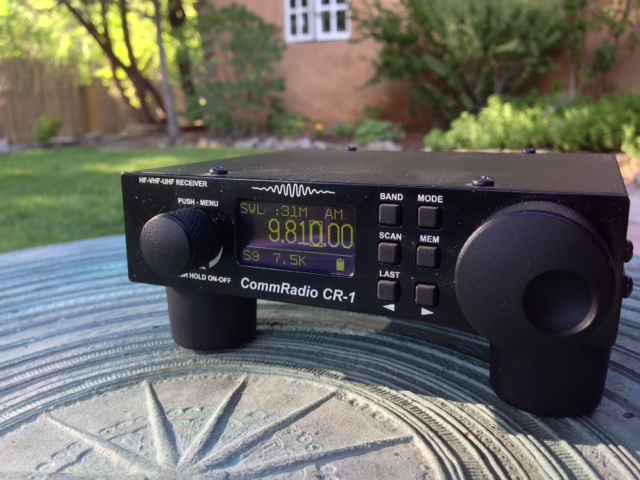
CommRadio CR-1: a superb travel radio

The CommRadio CR-1 in Taos, New Mexico

The CommRadio CR-1 in Taos, New Mexico

If you’re a regular reader, you’ll know that I’ve been on the road for the past three weeks, and have enjoyed some quality radio time in New Mexico and Colorado. While I brought four portables along (the CommRadio CR-1, the Sony ICF-SW7600GR, the Tecsun PL-380, and the Tecsun R1212A), when conditions were favorable and I wanted to chase a little DX, I chose the CommRadio CR-1.

I’ve sung the praises of the CR-1 as a great travel radio in the past, when it accompanied me on several shorter trips, but this particular road trip afforded me some quality time with this little rig.

What makes the CR-1 such a great radio for travel?

  • Excellent sensitivity and selectivity
  • Wide frequency coverage (150 kHz – 30.000 MHz, 64.0 – 260.0 MHz, 437.0 – 512.0 MHz)
  • Internal battery powers the CR-1 for hours at a time (meets FAA regulations, too; you can pack it and fly with confidence)
  • Charge or power the radio from a generic phone USB charger or 12 V power supply (indeed, the CR-1 can be powered from a variety of sources–anything from 6-18 Volts)
  • Mil Spec tested and tough
  • Compact footprint; this one is as small as most shortwave portables
  • Lightweight
  • OLED display that works from a variety of viewing angles
  • Resin feet can even be removed if packing space is severely limited
  • Very quick to deploy
CommRadio_CR1_Keysone2

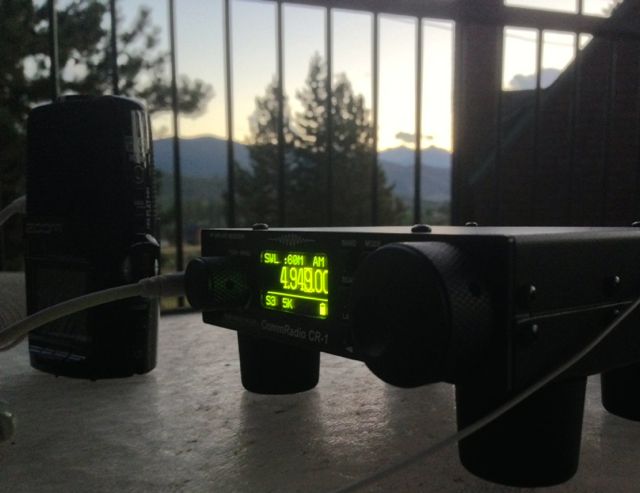
The CR-1, hooked up to my Zoom H2N digital recorder,  on the balcony of our Keystone, Colorado condo

One con of the CR-1 is that its front panel function buttons are not backlit. Fortunately, there are only six buttons, so it was easy to commit them to memory: I did so much outdoor nighttime listening, I can now operate the CR-1 in the dark.

Although the CR-1 is basically a tabletop SDR, it reminds me very much of the Palstar R30C I once owned and Lowe receivers I’ve used in the past–simple and effective.

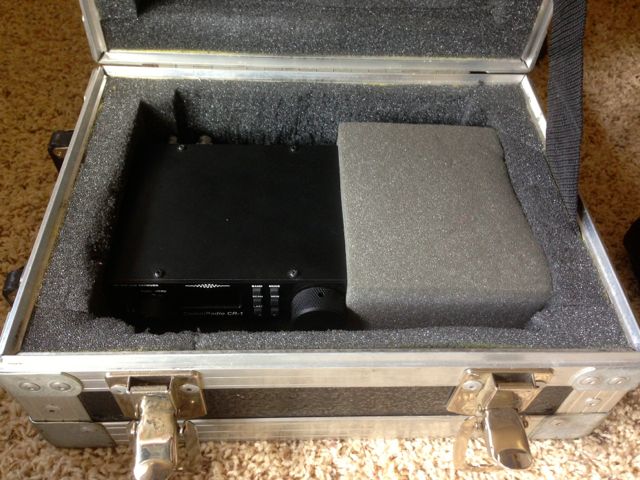
The photo at the top of the post was taken in the back garden of a friends’ home in Taos, NM. Though you can’t see this in the photo, it was hooked up to a Par Electronics EF-SWL wire antenna at the time. It took five or so minutes to hang the EF-SWL in a tree, but took me only a few seconds to pull the CR-1 from a small flight case, plug in the antenna, and have it on the air. I charged the CR-1 prior to the trip so I didn’t even need a power supply. In fact, the internal battery powers the CR-1 long enough, I only charged it perhaps twice on the whole trip.

A flight case I purchased for $3 at a charity store holds the CR-1, the Sony ICF-SW7600GR and the Tecsun PL-380. The case is pretty much bullet proof and protects its contents even if dropped or heavy items placed on top.

A flight case I purchased for $3 at a charity store holds the CR-1, the Sony ICF-SW7600GR and the Tecsun PL-380. This  case is fairly bullet-proof, protecting the contents even if dropped or heavy items are placed on it.

 The CommRadio CR-1a

CommRadio recently introduced the CR-1a, identical to the CR-1 in every respect but with the addition of a USB I/Q output, making it a very capable SDR when connected to a PC–and simplifying the update process to one step (the CR-1 requires two steps).

In conclusion? My appreciation for this rig has grown.  If you’re searching for a capable travel receiver, certainly consider adding the CommRadio CR-1 or the CR-1a to your list of considerations.