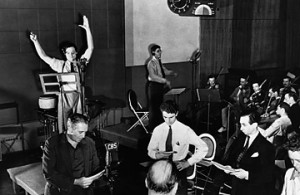
 Without a doubt, one of the most famous broadcasts in radio history––indeed, in American history––was Orson Welles’ radio production of the H. G. Wells’ classic sci-fi novel, The War of the Worlds. A Halloween radio drama from the The Mercury Theatre on the Air series from the Columbia Broadcasting System (CBS), The War of the Worlds aired on October 30, 1938–exactly 75 years ago, today. And it’s still creating a stir…
Memorable legend?
The Welles’ production of The War of the Worlds invariably receives a side note or breakout in US history texts because of the unprecedented panic it incited in unsuspecting radio listeners during the tense period just prior to World War II, when radio was truly king of mass media and information. Listeners reportedly took to the streets upon hearing the Mercury Theatre’s seemingly credible “accounts” of monsters from Mars invading New Jersey.
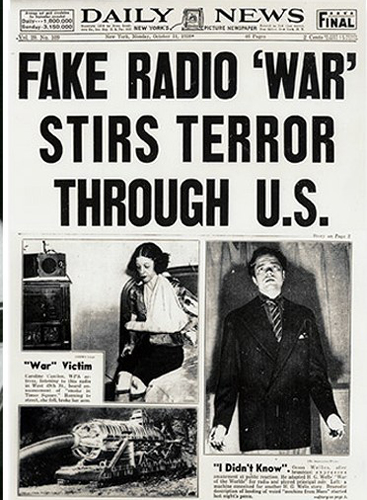 Because many listeners tuned in the production without hearing the Welles’ introduction to the drama, they heard what sounded like a live news report of Martians attacking our planet. While it seems dubious today, what made Welles’ production so convincing was his innovative use of mock news breaks, and what listeners described as a “deafening” silence after a supposed “eyewitness report.” It sounded, in short, terribly authentic, and therefore convincing.
Few believe Welles was intentionally trying to trick his audience; rather, sources suggest he was attempting to treat his listening audience by infusing what would have otherwise been a fairly staid radio drama with imagination, creating a captivating thriller.
The result? By most accounts, Welles’ succeeded. Without doubt, The War of the Worlds propelled this young theatrical director into the public spotlight, onto the big screen, and made his name known the world over.
Last night I had the pleasure of viewing a brilliant documentary about The War of the Worlds on PBS’s American Experience. It told, in detail, of the events leading up to the production, the very convincing reasons why it had the impact it did, and offered entertaining listener accounts from letters sent to CBS. If you missed it, you can watch it, too, by clicking here.
NPR’s RadioLab also devoted their most recent show to Welles’ production of The War of the Worlds. You can listen to their broadcast on their website, or via the embedded player below:
…Or forgettable myth?
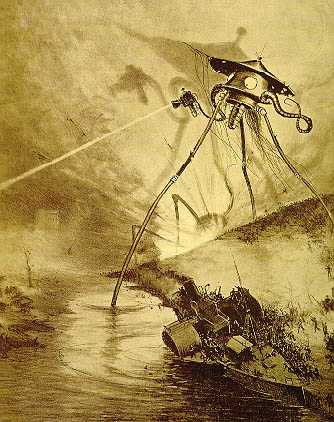 Then this morning, I read a rather provocative article by Jefferson Pooley and Michael Socolow in Slate; their mutinous view of the impact of Welles’ The War of the Worlds broadcast flies in the face of the American Experience and RadioLab documentaries and, indeed, every history textbook which devotes space to Welles. These authors claim:
“The supposed [War of the Worlds] panic was so tiny as to be practically immeasurable on the night of the broadcast. Despite repeated assertions to the contrary in the PBS and NPR programs, almost nobody was fooled by Welles’ broadcast.”
The authors go on to explain that the myth of Welles’ mass hysteria was fabricated:
“How did the story of panicked listeners begin? Blame America’s newspapers. Radio had siphoned off advertising revenue from print during the Depression, badly damaging the newspaper industry. So the papers seized the opportunity presented by Welles’ program to discredit radio as a source of news. The newspaper industry sensationalized the panic to prove to advertisers, and regulators, that radio management was irresponsible and not to be trusted.”
I encourage you to read the full Slate article, however, as it goes into much greater detail supporting the author’s assertions, which I find both logical and compelling.
But that’s not all. This afternoon, while writing this post, NPR published a new article about The War of the Worlds, highlighting the Slate piece and the American Experience and RadioLab productions, but drawing no conclusions of their own. Click here to read the full NPR post.
Strangely, nothing I’ve read so far about The War of the Worlds mentions what I feel to be most obvious.
So, what came of it?
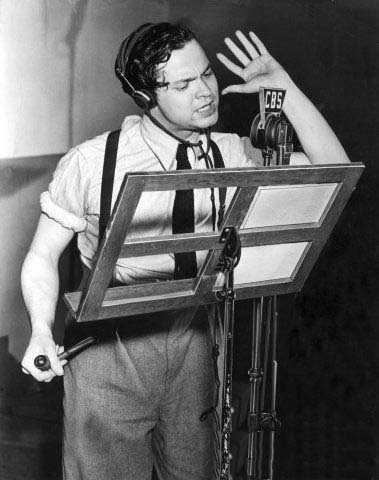 I believe Welles’ controversial radio production did something for radio listeners regardless of the level of panic it may––or may not––have engendered. Welles’ Halloween production left them (and us) with a gift. How so?
Prior to the dense radio propaganda surrounding World War II, The War of the Worlds undoubtedly made radio listeners, from that point forward, seriously question what they were hearing over the air. It forced them to listen with a skeptical ear, to realize that no matter how “real” a report might sound, not to assume its authenticity just because it was broadcast on the radio––or, for that matter, printed on the page of a newspaper. This was to become an invaluable tool in the coming days of American involvement in the war, especially for GIs desperate for news from the home front while propaganda seized the media. Whether during Welles’ thrilling production or in the news frenzy that followed, radio’s power had been publicly highlighted, and that power was sure to have an enormous impact on the coming world war.
In conclusion, perhaps we need another such event in this age of television and Internet. All too many people no longer question what they see, read, or hear from either source; these readers/viewers accept reporting of any stripe with blind faith, swallowing news bites and opinion pieces like digital candy. Then they tweet…and re-tweet.
Indeed, this is a common complaint I hear from many shortwave radio listeners. I suspect this is because we, in contrast, tend to be motivated by hearing the many differing voices on the air and allowing our grey matter––our brains––to discern fact from fiction.
We owe Welles a debt of gratitude.
But don’t take my word for it…
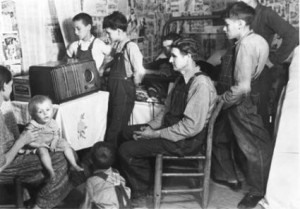 Regardless: whether Welles created widespread or merely local panic, or whether you even buy my theory that this production taught us to question what we hear, it’s difficult to deny that the Orson Welles’ production of The War of The Worlds was a brilliant, ground-breaking radio drama. And, I would add, great seasonal entertainment. Fortunately for us, almost 75 years later (nearly to the minute!), we can listen to archived recordings of the original CBS production.
If you would like to hear the original, simply click here to download the broadcast as an MP3, or listen via the embedded player below.
Happy Halloween! Enjoy (and keep your hat on, folks):

 Many thanks to David Ricquish of the