Category Archives: Guest Posts

Hand Made Vacuum Tubes by Claude Paillard

This is an amazing video – hand-made vacuum tubes! About 17 minutes long – well worth the watching if you have any interest at all in old equipment!

https://vimeo.com/47812871

You can find the video here

Enjoy!

Robert Gulley, AK3Q, is the author of this post and a regular contributor to the SWLing Post. Robert also blogs at All Things Radio.

House Passes Digital Music Licensing Package

This was posted today in Radio World:

Bills head to Senate accompanied by applause from stakeholders

The House has unanimously passed the Music Modernization Act, a compromise bill that creates a framework for better compensating artists for digital plays of their music and making it easier for music rights organizations to collect those fees from distributors of streamed music like Pandora and Spotify, as they do from traditional plays on TV and radio.

The bill has been billed as the most significant change in music licensing laws in decades, and drew praise from a chorus of stakeholders. It now heads to the Senate, where it is also expected to pass.

It actually incorporates a trio of bills. The base Modernization Act creates a single licensing entity for reproduction rights for digital uses, like those of Spotify, Pandora, Google, Apple and Amazon. It also randomly assigns judges to preside over ASCAP and BMI rate-setting cases, according to the Recording Industry Association of America (RIAA).

The package also includes The CLASSICS (Compensating Legacy Artists for their Songs, Service, and Important Contributions to Society) Act which compensates artists for pre-1972 recordings, which had previously not been eligible for digital royalties.

You can read the entire article here

It should be interesting to see the impact this has on availability of songs and costs of streaming services over time.

Robert Gulley, AK3Q, is the author of this post and a regular contributor to the SWLing Post. Robert also blogs at All Things Radio.

Guest Post: The Prof finds a Nova Tech Pilot II RDF receiver

Many thanks to SWLing Post contributor, The Professor, who shares the following guest post:


A 1960s Signal Sniffer

by The Professor

I just recently purchased a radio that on eBay that looks very intriguing, especially if you happen to DX AM Radio. It’s a mid-60s portable made in Japan – a Nova Tech Pilot II . However, wasn’t just a grab ën go to the beach kind of transistor set. This radio has a serious side. It’s actually an RDF – a “radio direction finder.”

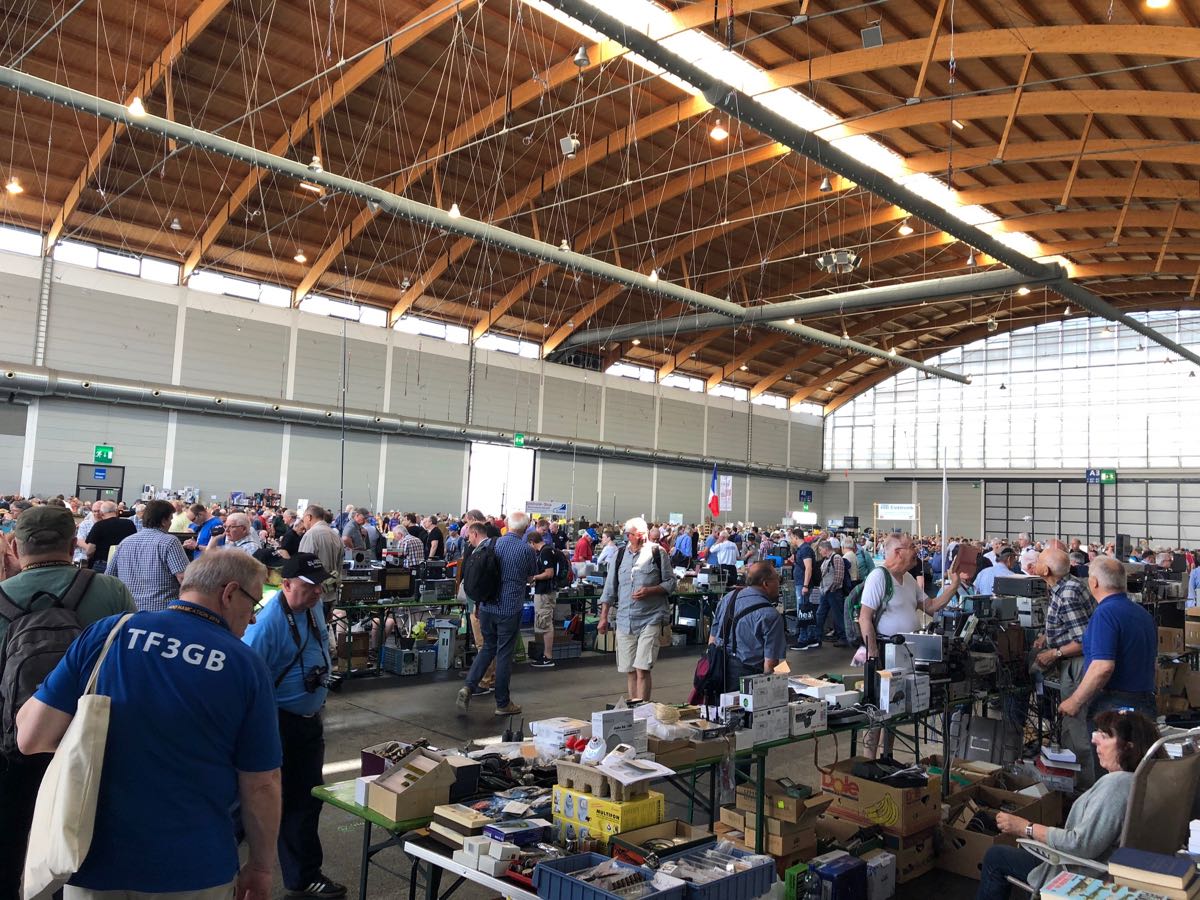
I have seen these kinds of radios before, somewhere. Only the ones I’ve noticed were older and had more of a military look. Although I’ve never actually attended a hamfest, I’m sure these types of receivers might be found at a gathering like that.

But this is a smaller and frankly more stylish version of RDF. Not to go into too much detail about something I know little about, but before GPS became ubiquitous, devices like this would commonly assist in the navigation of ships and aircraft by pinpointing “beacon” transmitters at specific known locations.

As you might imagine, this type of technology was (and probably still is) a strategic tool for military purposes. In fact, one of more “infamous” incidents of using radio direction finders was when they were utilized by the Japanese in the bombing of Pearl Harbor. Their bombers just honed in on the signal of a Honolulu AM station (KGU at 760kHz) as their beacon.

So, this radio has three bands which were traditionally used by beacon transmitters. Besides the medium wave band, it also has a section of the longwave spectrum, and the VHF airband. Other models included the old marine band (around 3 to 5MHz). A later model also included the CB frequencies, and another included a VHF police band (called the Nova Tech Action!!).

So, no shortwave on this one. No FM either, but I have plenty of radios with those bands (like almost all of them). Of course, there’s not much to find on this side of the world on longwave these days, and listening to aircraft communications has its fans but it’s not something I’ve done much. But this thing has a unique toolset for medium wave DXing. And after doing a little research online I’ve discovered that the big rotating double ferrite on top is only one of the attributes it offers for AM DXing purposes.

For one, it has an RF amplifier in the front end to help pull those weak signals up out of the noise floor. For another, it has a pure RF gain function called “DF” (direction finder), which when turned on shuts down the AGC (automatic gain control) and allows you to tweak the RF gain any way you like. And it also has a very accurate tuning meter. That all sounds good to me.

So, I haven’t actually seen my Nova Tech in the flesh yet, and it will be probably a couple of weeks before I get a chance to give it a test drive. But I’m pretty confident in my purchase at this point. More than a few people have spoken glowingly of the AM DXing capabilities of this set. But one of the reasons I decided to go ahead and bid on this device was that not only did the dealer have an excellent eBay rating, but he says he also fully serviced the radio electronically and physically restored most of its original beauty. Apparently, it was cleaned up, recapped, and even a transistor was replaced. And he also aligned the AM band IF and re-peaked the antenna trim for AM and the airband.

Although this radio is still a twinkle in my eye at this point, I thought I’d mention it here in hopes some of the fine readers of this blog might have something to say about DXing with direction finding radios. And I was especially hoping that a few people might have personal experience with these 60s era Nova Tech receivers. I also noticed online that there are U.K. versions of these RDFs that were branded as “Bendix” radios.

All insights offered as comments are appreciated, and once I spend some time with this radio I’ll be sure to offer some of my own.

I always find it so much fun to await the arrival of an interesting old radio I’ve purchased on eBay, especially one that I’d never heard of before.


Thanks for sharing your find, Professor! I was not at all familiar with the Nova Tech Pilot II. I love the Transoceanicesque design! No doubt, it’ll be a handsome addition to your collection, and I’m willing to bet a MW DX machine as well! 

Tudor demos his portable Raspberry Pi-powered AirSpy HF+

Many thanks to SWLing Post contributor, Tudor Vedeanu, who has kindly shared details about his portable Raspberry Pi system which now can run the AirSpy HF+ SDR.

Tudor writes:

I bought the RPi to use it as a Spyserver for my Airspy HF+ SDR.

My main radio listening location is a small house located on a hill outside the city and there is no power grid there (it’s a radio heaven!), so everything has to run on batteries and consume as little power as possible.

My first tests showed that the Raspberry Pi works very well as a Spyserver: the CPU usage stays below 40% and the power consumption is low enough to allow it to run for several hours on a regular USB power bank. If I add a 4G internet connection there I could leave the Spyserver running and connect to it remotely from home.

Then I wondered if the Raspberry Pi would be powerful enough to run a SDR client app. All I needed was a portable screen so I bought the official 7” touchscreen for the RPi.

I installed Gqrx, which offers support for the Airspy HF+. I’m happy to say it works better than I expected, even though Gqrx wasn’t designed to work on such a small screen. The CPU usage is higher than in Spyserver mode (70-80%) but the performance is good. Using a 13000 mAh power bank I get about 3.5 hours of radio listening.

I made a video showing how it works:

Click here to view on YouTube.

This is fantastic, Tudor. Thanks for taking the time to put together a video for us. I’ve just ordered the latest Raspberry Pi 3 (Model B+). It has slightly more horsepower than the previous Pi3. Tudor, you’ve inspired me to grab the 7″ touch display as well and try my hand at running the AirSpy HF+ portable.

I’m not sure if the Raspberry Pi 3 will be able to record spectrum without hiccups, but it’s certainly worth a try.

As you tweak your system, please keep us in the loop!

Backpack Shack 2.0: an update from the field

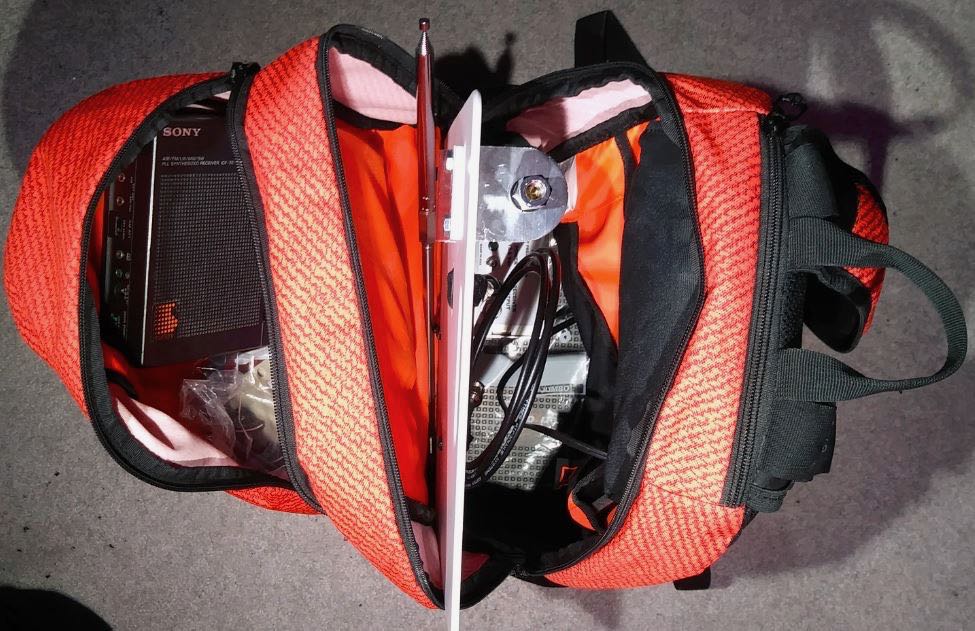
Finished Backpack Loop 2.0 and accessories assembled together

Many thanks to SWLing Post contributor, TomL, who shares the following update about his homebrew Backpack Shack 2.0 portable loop antenna:


Quick Field update

by TomL

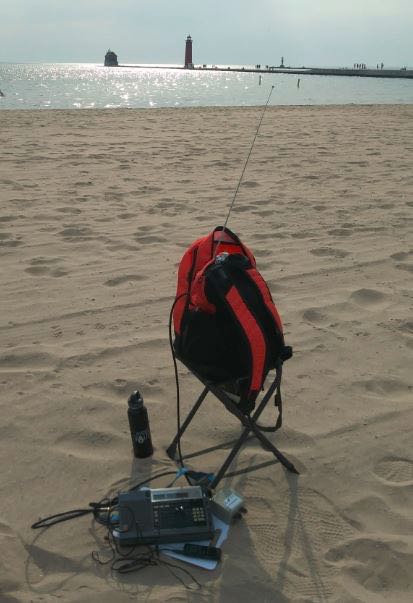
This is just a quick Field Update for my Backpack Shack 2.0 antenna. It is not the most powerful antenna but in the right location it can be useful, especially with using an SDR. It was used during February in two Forest Preserve (County Park) locations outdoors and once from my usual Grocery Store parking lot!

Field Recordings

Please excuse some of the computer generated noises (caused by a slow CPU) as well as some audio connector problems on a couple of recordings.

Each Time is in UTC and Frequency in kHz. Where can you hear unique programming like these samples except Shortwave Radio??? Enjoy!

VOA, @03:00 on 6080 kHz in English from Sao Tome towards Africa (backside of their antenna, opposite of my location)

China Radio Int’l, @23:00 on 9415 kHz in Vietnamese from Beijing (not sure if this traveled around Antarctica to get to me or a backside of their antenna over the North Pole?)

WHR, @15:59 on 9965 kHz in Korean from T8WH Palau

Mighty KBC, @01:48 on 6150 kHz in English from Nauen Germany (announcer sound effects included!)

Voice of Greece, @20:34 on 9420 kHz in Greek from Avlis (unique stylized Greek music, INTERESTING artistic expression)

Vatican Radio, @20:27 on 9660 kHz in English from Vatican City to Africa

WINB, @21:30 on 9610 kHz in English from Red Lion, PA USA (a FUN song about promoting Radio listening!)

And my favorite Government-run authentic folk music station of Mexico, tiny 1KW XEPPM @04:17 on 6185 kHz with clear station ID

I will be working on a larger version of this antenna to transport in my car as well as a small VHF loop antenna for the outside deck for Air/Police/Weather scanning.

Hope to report sometime this Spring.


Thank you so much for the update, Tom! It looks to me like you’re having an amazing time with you homebrew loop in the field! 

As always, keep us in the loop! (Yeah…bad pun, I know!)

Guest Post: Radios I Have Known #2

Many thanks to SWLing Post contributor, Neil Goldstein, who shares the following guest post which originally appeared on his blog, Fofio:


Radios I Have Known #2 The old, the new, and the Select-A-Tenna

by Neil Goldstein

L-R: Select-A-Tenna, Tivdio V-115, Sony ICF-5500W

After promising this series a year and a half ago, I finally have started digging through the collection, and will start posting about once a week.  The radios, and accessories may not have anything in common (as seen in this post), but were all acquired because they were in some way interesting, or sentimental to me.  Here’s the first three:

Select-A-Tenna
One of the original air-core tunable AM antennas.  You just put this near the radio and peak it for reception.  I was watching for one of these in good shape, and not overpriced, and they have been in and out of production over the years.  This one is from a later production run as can be seen by the extended AM range (1700).  Jay Allen reviewed the S.A.T by comparing the the TERK Air Core antenna not long ago here:  https://radiojayallen.com/select-a-tenna-vs-terk-am-advantage/  The TERK reviewed well, and looks more modern, but I wanted the classic cheesy art-deco looking S.A.T.

Tivdio V-115
I won’t post a long, boring review here.  Many have already reviewed this radio.  All I can say is that if you like small, decent-sounding transistor radios, you will not be disappointed.  If you are expecting top-shelf performance, and perfect ergonomics, then you you may not be happy, but for around $19 you really should be happy with this little gem.  A great little radio at a great price and the most impressive thing here is the sound.  The radio has a small passive radiator like the Meloson M8, and M7, and really surprises me.  It can also be used as an amplified speaker, and has a micro SD slot for using it as a standalone MP3 player.  Grab one!

Sony ICF-5500W
Most transistor radio collectors know this radio.  It’s a classic for sure, but I have to give a little background on why I wanted one.  When I was about 12 years old, I had a few analog SW portables, but nothing with direct frequency readout.  Panasonic had introduced it’s series of direct-readout radios, the RF-2200, 2800, and 4800, and Sony was competing with the ICF-5900W.  Dad acknowledged the quality and technology of these radios, and told me that if I saved most of the money by working for him, he may help me get one.  The 2800, and 4800 were way out of reach, but one Sunday in the local paper, a department store in Kingston (Britt’s, which was Newberry’s answer to Macy’s) had the 2200 advertised for $138.88.  I had been flip-flopping between the Sony and the Panasonic for weeks, but that was the clincher.

The radio is still in use.  My sister in law has it.  I had given it to my late brother Paul at some point and she still uses it as her main radio.

Why this Sony though?  I still want a 5900W.  When I saw this one come up at an auction, I recognized the shape it was in.  The ICF-5500W was the companion radio to the 5900W.  AM/FM and VHF Hi (with a basic, but functional squelch control).  The 5500 and 5900 are a monument to Sony design at the time.  The pop-up antenna (which still works flawlessly), The separate Bass, Treble, and Loudness controls, The overall quality of sound and function, all of this is an example of what Sony was producing at the time.  I think their modern small electronics are a shadow of what they were capable of years ago.  This thing still sounds great and performs well next to my modern DSP radios.  I still would love to get a pristine 5900W but they usually fetch premium dollars.  Maybe someday.

Bravo Sony, but where did you go?

More to come!!


Thanks for sharing, Neil!  I, too, have the Tivdio V-115 and the Sony ICF-5900W.

The ‘5900W is a gem of a solid state receiver. It has brilliant AM broadcast band reception and rich audio. I need to open my ‘5900W and clean all of the contacts since some of the sliders are scratchy. It’ll make for a nice rainy day project!

We look forward to your next installment! Post Readers: be sure to check out Neil’s blog, Fofio!

Vintage Radio: How to read a logging scale

Many thanks to SWLing Post contributor, Charlie Liberto (W4MEC) for the following guest post:


Vintage receiver frequency counter…sort of

by Charlie Liberto (W4MEC)

You probably know what a log book is, and maybe a logarithm, but do you know what a ‘Logging Scale’ was meant for? If you are a modern SWL’er, and have a receiver built in the last 40 years or so, you probably don’t have that mysterious 0 to 100 range on your dial, as shown at the top of the picture of the Hallicrafters S20-R main dial, and you may not have a dial at all, peering without question at a digital display of your received frequency.

The Logging Scale on older and vintage receivers had two functions: to let you find a station you might be looking for, when you knew the frequency it would be on, and to determine the frequency of a station, but you had to have known references. How to do that on those old scales that may have had 50 kHz or even 500 kHz hash marks between whole Megahertz numbers, or in that era, KC or MC numbers? The process is fairly straight forward, but did require you to know the operating frequency of at least 2 stations on the band of interest, and the closer they were to the mystery frequency, the better.

Let’s say you are looking for WLMN that is supposed to begin its operation day on 6025 kHz. and your receiver has a mark every 250 kHz between 5 and 7 MHz, that’s pretty iffy as to setting the dial. Now, you know that station WABC is on 5500 kHz, and station GXYZ is on 6525 kHz, so, tuning in WABC you note what number the pointer on the dial is over on the logging scale, maybe it is 40. Then you tune to GXYZ and you find it on 70 on the logging scale. The known difference in frequency between WABC at 5500 kHz and GXYZ at 6525 is 1025 kHz, and the logging scale number difference is 40 to 70 or 30 divisions. Take the 1025 kHz separating your two known stations, divided by the 30 logging scale divisions and you get 34.167 kHz per division. Some more math, the station you are looking for, WLMN is on 6025 kHz, which is 525 kHz away from WABC at 5500 kHz., divide 525 kHz by the logging scale frequency versus division number of 34.167 kHz which equals approximately 16. Take that 16, add it to WABC logging scale number of 40, and you should expect to hear WLMN on logging scale 56 on the dial.

Of course you can flip this process around. If you heard WLMN, but did not know it’s frequency, the same procedure worked backwards to interpolate the logging scale 56 into kHz, added to the WABC frequency/log number, or subtracted from GXYZ numbers, and you would figure out WLMN was on 6025 kHz.

What did this process do? It ‘calibrated’ your receiver dial to known checkpoints by using known frequencies of stations, such that you had a better idea of where you were frequency wise, but it did have it’s limitations. Older receiver dials usually had the lower frequencies divisions of a band close together, and as you tuned to higher frequencies on the same band, hash marks for frequencies got farther apart, while the logging scale stayed linear. This was because builders used the simpler straight line capacitance variable capacitor for tuning, instead of the straightline wavelength or straight line frequency style which would have made the dial more linear. If you used two stations on the low end to set a logging scale reference, chances are it will be quite a bit off in the frequency versus logging scale number on the high end of the dial. So, if you could find two stations that bracketed the one you were examining, that would assure the most accuracy.

After all that, you are probably saying thank God and a lot of engineers for a digital readout.


Thank you, Charlie, for an excellent tutorial and example of using dial logging. I’ve had a number of vintage radios over the years with logging scales and it took some digging to discover how they worked. While digital radios make the process as easy as pie, vintage radios are worth the extra effort!