Category Archives: Guest Posts

Guest Post: Building a magnetic loop antenna & broadband amplifier for your SDR

Many thanks to SWLing Post contributor, Dave Gahimer (K9ZCE) for the following guest post:


Loop-Antenna

Small Magnetic Loop Antenna with Broadband Amplifier for SDR Reception

by Dave Gahimer (K9ZCE)

Those with limited space, or antenna restrictions, might find a small 1 meter loop antenna a solution.

My son lives in an apartment. One Loop leaning against a wall gives him acceptable reception with the SDRPlay RSP on the ground floor–2nd or 3rd level flats should have very good reception.

Ten meters off the ground outside should give reception equal to any SWL antenna. We all with SDRs fight the image problem. Normal resonate ham band antennas show too strong reception of unwanted bands/stations. Did I mention noise? Loops are well known for –6 db noise reduction.

Then there is the possibility of SDR chip damage from your 1.5 KW station! In researching Loops we came across LZ1AQ. A Brilliant design /engineer (http://www.lz1aq.signacor.com/). Deep reading sometimes, but a great understanding of what makes a good receiving loop antenna.

Those who chase DX know that sometimes fading is caused by the signals’ polarization changing in the Ionosphere. Having both vertical and horizontal loops, and the ability to combine both signals diminishes this fading problem. Being able to filter the powerful, commercial FM transmitters diminishes image problems. Clipping strong signals at the antenna from very near powerful antennas/transmitters could save the SDR receiver from damage.

The LZ1AQ broad band Amp solves all these problems. http://active-antenna.eu/amplifier-kit/.

My son Ted and I built three, one meter loops from soft ½ inch copper plumbing tubing. One for his apartment, two for my crossed loops antenna. We weather proofed the Copper from corrosion by coating with outdoor clear spar varnish. We shaped the circle by drawing the tubing around a round glass top patio table.

The soft copper loop in held by white PCV plastic plumbing pipe. 1” or 1.25 inch schedule 40. Be careful to check that the PVC is schedule 40, thick wall. The thin wall pipe is not strong in the wind and will crack when you try to drill it.

Drill up to a 3/8 hole for the ½” copper tube to go through, then file out to fit. Here are some photos (click to enlarge):

crossed loops up 3 crossed loops up 4

Check out these links (all courtesy of LZ1AQ) to acquaint yourself with the loop construction and amplifier installation:

http://active-antenna.eu/tech-docs/2_ActiveAA_Mount_20.pdf

http://active-antenna.eu/tech-docs/1_ActiveAA_DandS_20.pdf

http://active-antenna.eu/tech-docs/3_ActiveAA_Antena_11.pdf

Many SDR receiver owners have seen improved noise and Image reduction by placing the plastic cased SDR unit on a small shielded/ grounded case.

crossed loops up 5

The Amp needs 12VDC from in the shack. The Amp has two relays that you can switch, from in the shack, to select Vertical or Horizontal loops, or a dipole. The loop amp connects back to the shack via a shielded Cat 5 cable, Make sure you get shielded CAT 5 to reduce noise pickup. Make sure you provide an adequate good Ground below the antenna, less noise pickup and lightening protection.

crossed loops up

Have fun!
Dave, K9ZCE
Retired from EE Dept @ Rose-Hulman Institute of Technology
Terre Haute, Indiana


Thank you so much, Dave!

Readers: yesterday I saw Dave’s loop antenna photos on the SDRplay RSP Facebook page. I was fascinated by his horizontally/vertically oriented loops and asked if he would write up a short guest post.  He kindly obliged in a matter of hours!

If you have an antenna project you’d like to share, please contact me. So many SWLs and ham radio operators live in areas with restrictions and pervasive RFI–projects like Dave’s can revive one’s radio life!

Guest Post: Jerry’s Mediumwave DXing Powerhouse Mini FSL Antenna

Many thanks to SWLing Post contributor, Jerry Popiel, for the following guest post:


PowerhouseFSLAntenna-1

A MW DXing Powerhouse Mini FSL Antenna

by Jerry Popiel

In late February 2016 I completed construction of a modified version of Gary DeBock’s excellent 3 inch Mini FSL design (click here to view).

This new antenna is nothing short of a AM DXing powerhouse with unbelievable sensitivity for receiving stations across the entire AM Bandwidth both day and night. The tuning of stations is razor sharp and it has stunning nulling qualities. Consultation assistance was provided from DXing experts Steve Ratzlaff and Gary DeBock on the project.

Construction Details:

The Antenna was constructed using 9 – 100 mm Ferrite Bars wound on a 2.75 inch diameter x 4 inch styrofoam cake dummy form custom made by in Vancouver, B.C. Canada – ([email protected]) for $3.50 plus shipping.

The Coil wire consisted of 38 turns of high gain 660/46 Litz Wire. (Note: As can be seen 38 turns of the thicker Litz Wire left only 5/8” of room on each side of the Styrofoam Form to wire wrap the coil to the ruler frame. A longer Form ie 5” long would work much better for this build).

The insulation spacer used was 2 layers of 1/8 inch Aerotape self adhesive tape which also helped hold the 100 mm Ferrite Bars onto the Styrofoam Coil Form. Inductance measured 356 uH using a DM 4070 Meter which is well within the requirement of over 300 uH for AM Band Reception.

Side View Of 9-Bar FSL Antenna with 2.75” Diameter Styrofoam Cake Dummy.

Side View Of 9-Bar FSL Antenna with 2.75” Diameter Styrofoam Cake Dummy.

Because of the extra thickness of high gain 660/46 Litz Wire which is a bit too big to solder to the inside terminals of the Tecsun PL-380 Radio, a 2 Position Terminal Block was superglued to the outside of the Ruler Frame to act as an interface connection point.

Position Terminal Block Superglued To Back Of Antenna Frame

2 Position Terminal Block Superglued To Back Of Antenna Frame

Testing Results:

Both daytime and evening AM station captures have been spectacular. Stations as far away as KKOB / 770 kHz Alberquerque, New Mexico 1130 Miles from here in Winnipeg, Manitoba, Canada have been received. Country music station WSM / 650 kHz in Nashville, Tennessee 1082 miles distant is a daily evening pickup.

Station KKOB / 770 kHz Alberquerque, New Mexico 1130 Miles distance.

Station KKOB / 770 kHz Alberquerque, New Mexico 1130 Miles distance.

Station WSM / 650 kHz in Nashville, Tennessee 1082 miles distance.

Station WSM / 650 kHz in Nashville, Tennessee 1082 miles distance.

Two Stations Received At 600 kHz 90 Degrees apart at the same time:

The amazing Nulling and Razor Sharp Tuning quality of this FSL was demonstrated when 2 stations at 600 kHz were received at the same time by rotating the Radio with attached FSL 90 degrees. In the North / South direction Station KSJB / Jamestown, North Dakota (219 miles distant) was received with a strong signal strength of 50 / 23. Then by rotating the Radio 90 degrees to the East / West direction Saskatoon, Saskatchewan station CJWW (442 miles distance) was captured with a similar strong signal strength of 44 / 24.

600 kHz Station KSJB / Jamestown, North Dakota.

600 kHz Station KSJB / Jamestown, North Dakota.

600 kHz Station CJWW / Saskatoon, Saskatchewan.

600 kHz Station CJWW / Saskatoon, Saskatchewan.

Daytime Reception of 600 Watt Station 137 Miles Distant:

A major daily AM reception capture during the afternoon illustrating the amazing sensitivity of this antenna is 600 Watt station KKXL Sports Radio 1440 kHz (137 miles).

PowerhouseFSLAntenna-8

All Indoor Reception – For Now!

Due to winter conditions here in Winnipeg, all of the amazing station reception captures in this report were done inside the House facing towards the South window. Fortunately the red ruler platform sides can he used as handles when pointing the radio in the direction of best reception. Exciting times are ahead to see how well this mini 3” FSL will perform outdoors for likely even better AM DXing.

Summarizing:

The design of this new FSL Antenna attached to the Tecsun PL-380 Ultralite radio by Gary DeBock is a major breakthrough in AM DXing since the Radio is attached to the FSL. This new FSL Antenna needs to be constructed to be really appreciated. The application described here requires a bit more skill to construct and is also heavier than the original construction – but at least it is portable. For beginners Gary’s original 3” FSL Heathkit Design is highly recommended and can be reviewed in his You Tube Video posted at: https://www.youtube.com/watch?v=VY9u8MReGjk

Thanks,
Jerry Popiel
Winnipeg, Manitoba, Canada


Thank you, Jerry! It’s amazing what performance you and Gary DeBock have gotten out of these homebrew FSL antennas! Thank you so much for taking the time to share your construction details and performance notes!

Paul’s shortwave logs, commentary and audio from Alaska

KIRA in Galena, Alaska

KIYU in Galena, Alaska

SWLing Post contributor, Paul Walker, is a radio host for KIYU in remote village of Galena, Alaska–we recently posted a few photos of Paul on site.

Many thanks to Paul for sharing the following notes about SWLing at his location. Paul writes:

Right now, all I have to DX with is a Tecsun PL-880 and PK’s loop 6-18 MHz tuneable SW Loop antenna. I am investigating a location to put up a long wire or massive box loop antenna somewhere away from home.

It has to be away from home as I have 2 FM and 1 TV transmitter above my head plus an ungodly amount of electrical noise and RF overload. The banks of the Yukon River are 500 feet from my office and apartment, so that’s a good location.. just need a way to secure a long wire or box loop. I am also in the process of finding an FM Low pass filter to filter out the FM stations real nearby that overload certain parts of the SW dial.

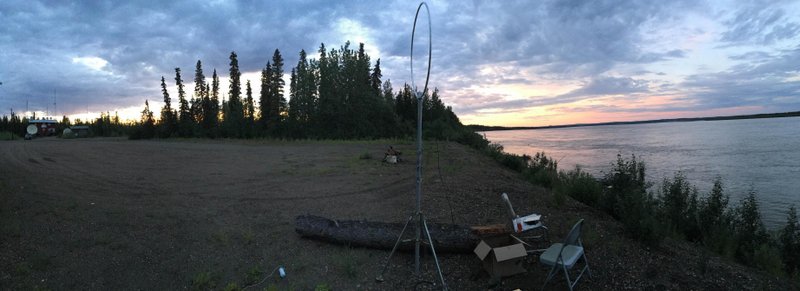
I am in Galena, Alaska. It is a village of about 500 people in the central part of Alaska, we are 300 miles west of Fairbanks and 300 miles east of Nome. Off the road system, everything is flown in 8 months or so out of the year and when the river is flowing, it’s barged in.

Radio Australia and Radio New Zealand are weak here, some days barely listenable, other days passable, but not very strong here. I’ve not heard anything from Radio Taiwan International here, yet I could get them weakly in California and in Arkansas.

I can hear CRI daily, the stuff that comes from their Beijing area SW transmitters is quite listenable.

What I can hear with regularity and strangely, a very good signal depending on the frequency, is The Voice Of North Korea. I’ve logged The Voice Of Korea on about A DOZEN different frequencies! What I can’t figure out is why? Some of the Voice of Korea broadcasts are near local AM radio station like strength many nights. I could hear them fairly well in northern California, but not always so strong.

Why I can’t figure out is the Voice Of Korea broadcasts that I’m hearing, what is their target area? It would sure seem I am not in the direct beam for any of their target areas, being so far north.

The strongest Voice Of Korea broadcasts for me are generally, not always, 15180 kHz and 11735 kHz. I’ve heard them on several 6 and 7 MHz frequencies which are listenable, but never very strong. I’ve also heard them in a few places in the 9mhz band and those are generally pretty listenable.

https://www.youtube.com/watch?v=lGhjfshf87Y

https://www.youtube.com/watch?v=Vkn7dgnk2m4

I did hear Voice Of Korea on 3250 kHz about a week ago. The signal was weak but steady and it was very clearly them.

I’ve heard them in the 13 MHz band one night and that signal was pretty strong. I did get them a few days ago smack in the middle of the day at 11910 kHz which was a bit surprising.

I expect when I construct a massive(and very directional box loop) or put up a longwire, My DX will greatly improve beyond the average stuff I’m getting now.

I’ve also logged Radyo Pilipinas on 17700 and 17820 kHz, several instances of the Firedrake Jammer on different frequencies, CRI and NHK (CRI & NHK are to be expected here).

https://www.youtube.com/watch?v=JAiMb5BMFDU

I did have a surprising reception of All India Radio on 7550 kHz.

Also logged recently was RFI on 15300 kHz, BBC WS on 15400 kHz, Voice of America on 15580 kHz, Radio Exterior De Espana 15390/15500 kHz, RN de Brasilia 11780 kHz among others.

You can hear audio of my reception on my YouTube channel:

https://www.youtube.com/user/OnAirDJPaulWalker

Some of my clips range from merely 30 seconds long to 20 minutes. The longer clips are usually when I had much better. Some clips are video, held up to the radio showing the dial, others are audio onlly.

As always, comments and discussion always welcome.

Mark’s Icom IC-7100 go kit

Click to enlarge

Click to enlarge

Many thanks to SWLing Post reader, Mark Hirst, who writes:

Thomas,

I have been very impressed by the shacks featured on SWLing !

I don’t really have the room to accommodate such large collections, or to dedicate a special area to just radio.

I tend to perch a radio on a spare surface in the front bedroom, and then cycle through my small collection on a weekly or bi-weekly basis, returning the previous radio to storage to await its turn in a month’s time.

Since newer houses and gardens are typically quite small in the UK, I’ve always been thinking in terms of radio on safari, so with the weather starting to improve, I present to you my ‘shack’ consisting of a recently acquired IC-7100 inside a fortuitously sized toolbox. The radio runs in the bedroom like this too, usually connected to a Wellbrook loop when not transmitting.

20160312_121757332_iOS (1)

The picture [above is of the] head unit in stowed configuration, as the lid of the box doesn’t quite clear the unit when sitting on the base. The space on top of the radio is then filled by the SOTA Beams antenna bag and other sundries. The battery travels separately in the backpack.

My plan was to never have to connect/disconnect the ethernet style cable between the two halves, looks like the plan worked !

You can see it in action here:

This is a brilliant kit, Mark–a great way to escape urban radio interference! The Icom IC-7100 is uniquely qualified for the deep case, too, since the control head can sit on top of the body while in use. The angle of operation is also ideal. Very cool–thanks for sharing!

James adds an LM386 amplifier kit to his Heathkit GR-150

Heathkit Explorer Jr. Completed w. screwdriverMany thanks to SWLing Post contributor, James Surprenant (AB1DQ), who shares this update to his review of the Heathkit Explorer Jr. TRF AM radio receiver kit:


With regard to the Heathkit TRF AM receiver kit, I did indeed build my LM386 amplifier.

I was planning on home-brewing it from scratch as the chip is pretty much all you need and there are various proven schematics for the circuit, but in the end I went with a small kit from Nightfire Electronics for $10 plus $5 shipping that I found on Amazon.com.

It was a bit cheaper to buy it in kit form, of course, and then there was the convenience of having all the parts in one place.

Here is a photo of the kit as advertised on Amazon

kit

And here is my build with the Heathkit…

Heathkit + LM 386

I modified the kit to add a 3.5mm input jack, replacing the RCA jack that came with the kit, to make it easier to plug into the Heathkit radio.

I deliberated whether to install the audio amp into the Heathkit cabinet drilling out a couple of holes for the pot shafts. It all would have fit and I could have easily mounted the 3″ 8 ohm speaker to the back panel of the Heathkit radio. In the end, I decided to keep the radio original and mounted the amplifier board on a small piece of wood I found at a hobby store and decided to leave it all exposed. It works well, all things considered.

(Click here to view video on Facebook.)

It worked well and per my original review on SWLing Post, I feel Heathkit should have included such a little amp in the kit – it makes a big difference.


Many thanks for the update, James! That little LM386 amp kit seems like an affordable addition for any receiver lacking an amplifier or adequate audio amplification.

Radio Time Travel: Brian’s 1974 shortwave radio recording

Many thanks to SWLing Post and SRAA contributor, Brian D. Smith (W9IND), for the following guest post and recording.

Note that Brian could use your help to ID a few unidentified broadcasters in this recording. If you can help, please comment:


HalliDial

Shortwave Radio 1974: Canada, Argentina, Spain, West Germany, Albania, utility stations

Want to know what shortwave radio sounded like in 1974?

This 55-minute recording, recovered from a cassette, was never intended to be anything but “audio notes”: I was an 18-year-old shortwave listener who collected QSL cards from international stations, and I was tired of using a pen and a notepad to copy down details of the broadcasts. I wanted an easier way to record what I heard, and my cassette tape recorder seemed like the perfect means to accomplish that goal.

But it wasn’t. I soon discovered that it was simpler to just edit my notes as I was jotting them down — not spend time on endless searches for specific information located all over the tape. To make a long story shorter, I abandoned my “audio notes” plan after a single shortwave recording: This one.

Hallicrafters S-108 (Image: DXing.com)

Hallicrafters S-108 (Image: DXing.com)

Still, for those who want to experience the feel of sitting at a shortwave radio in the mid-1970s and slowly spinning the dial, this tape delivers. Nothing great in terms of sound quality; I was using a Hallicrafters S-108 that was outdated even at the time. And my recording “technique” involved placing the cassette microphone next to the radio speaker.
Thus, what you’ll hear is a grab bag of randomness: Major shortwave broadcasting stations from Canada, Argentina, Spain, Germany and Albania; maritime CW and other utility stations; and even a one-sided conversation involving a mobile phone, apparently located at sea. There are lengthy (even boring) programs, theme songs and interval signals, and brief IDs, one in Morse code from an Italian Navy station and another from a Department of Energy station used to track shipments of nuclear materials. And I can’t even identify the station behind every recording, including several Spanish broadcasts (I don’t speak the language) and an interview in English with a UFO book author.

The following is a guide, with approximate Windows Media Player starting times, of the signals on this recording. (Incidentally, the CBC recording was from July 11, 1974 — a date I deduced by researching the Major League Baseball scores of the previous day.)

Guide to the Recording

0:00 — CBC (Radio Canada) Northern and Armed Forces Service: News and sports.
7:51 — RAE (Radio Argentina): Sign-off with closing theme
9:14 — Department of Energy station in Belton, Missouri: “This is KRF-265 clear.”
9:17 — Interval signal: Radio Spain.
9:40 — New York Radio, WSY-70 (aviation weather broadcast)
10:22 — Unidentified station (Spanish?): Music.
10:51— Unidentified station (English): Historic drama with mention of Vice President John Adams, plus bell-heavy closing theme.
14:12 — RAI (Italy), male announcer, poor signal strength.
14:20 — Unidentified station (Spanish): Theme music and apparent ID, good signal strength.
15:16 — Unidentified station (foreign-speaking, possibly Spanish): Song, “Chirpy Chirpy Cheep Cheep.”
17:00 — Deutsche Welle (The Voice of West Germany): Announcement of frequencies, theme song.
17:39 — Unidentified station (English): Interview with the Rev. Barry Downing, author of “The Bible and Flying Saucers.”
24:36 — One side of mobile telephone conversation in SSB, possibly from maritime location.
30:37 — Radio Tirana (Albania): Lengthy economic and geopolitical talk (female announcer); bad audio. Theme and ID at 36:23, sign-off at 55:03.
55:11 — Italian Navy, Rome: “VVV IDR3 (and long tone)” in Morse code.

Click here to download an MP3 of the full recording, or simply listen via the embedded player below:


Wow–what an amazing trip back in time, Brian! Thank you for taking the time to digitize and share your recording with us.

Post Readers: If you can help Brian ID the few unidentified stations in his recording, please comment!

Note that Brian is a frequent contributor to the Shortwave Radio Audio Archive. Click here to listen to his contributions. 

Guest Post: Listening to 10 Meter Radio Beacons

SX-99-Dial-NarMany thanks to SWLing Post contributor, Mario Filippi (N2HUN) for the following guest post:


Listening in to 10 Meter Radio Beacons

Mario Filippi, N2HUN

(All photos courtesy of author–click to enlarge.)

Radio beacons can be found across the RF spectrum from the LF (low frequency) band all the way up to bands inhabited by satellite signals. If you are a ham, shortwave listener or a QRP (low power) buff then a great place to start is on the 10 meter band, which is included on most table-top shortwave radios and even some portables. Beacon signals come and go with band conditions, emanate from different parts of the globe and provide one with listening challenges and hours of fun. So let’s talk about 10m as it’s a good place to start.

A good indicator of band conditions on 10m is via the 10m beacon band which ranges from 28.1 to around 28.3 MHz. In general, most stateside beacons are found from 28.2 – 28.3 MHz while DX (ex-US) beacons are heard from 28.1 – 28.2 MHz. However, I’ve heard DX beacons as high up as 28.297 MHz. These stations provide hams and SWLs not only with code practice but with the adventure of hearing low power signals from around the globe. To get acquainted with what is on the air, check out the Ten-Ten International Net website which has one of best lists of beacons, along with a plethora of information on the band itself: http://www.ten-ten.org/index.php/resources/ten-meter-beacons . The Ten-Ten club has been around for many decades and is a good resource of information on 10 meters in general; one can even be issued a unique Ten-Ten ID number upon request. Then, when making 10m contacts you can exchange Ten-Ten numbers with fellow operators.

AR-3000A

Let your fingers do the spinning of the VFO on 10m.

Many of these beacon stations have been logged over the years at this QTH simply because they dot the globe with their low powered one-way signals and are a challenge. Hearing a beacons’ very weak CW signal fading in and out with its’ short message, usually starting with a series of “Vs” followed by the call, then by info such as location, wattage, grid square is a timeless source of pleasure. There are literally hundreds of beacons to hear using your shortwave or ham radio, all coming in at different times of the day from places far and near. And there’s no need to be in the shack; check them out using a portable radio because when band conditions are favorable, you’re bound to hear them. And for those of you with RTL-SDR dongles, these miniscule radios are perfectly capable of receiving beacons and have the added feature of “looking” at that portion of the spectrum both via the 2-MHz wide spectrum display and accompanying waterfall image. These dongles are an inexpensive entry into HF/VHF/UHF listening and cover all modes. However they are not a plug ‘n play venture, you’ll need a computer, driver program, software to turn the dongle into an operating wideband receiver, patience learning the software, and a good antenna.

Typical “dongle” Software Defined Radio covering 24 – 1766 MHz.

Typical “dongle” Software Defined Radio covering 24 – 1766 MHz.

Screenshot of 10m beacon activity in right-half of waterfall on 6/22/15; VA3KAH was heard on 28.168 MHz.

Screenshot of 10m beacon activity in right-half of waterfall on 6/22/15; VA3KAH was heard on 28.168 MHz.

Most 10m beacons operate at low power, anywhere from 100mW to as high as 100W but generally operate in the 1 – 5W range using a variety of antennas, the vertical being the most popular. So in essence these beacons are not what you would classify as“big guns” and that’s the beauty of it all. They are an intriguing and challenging quarry to write into your logbook! While 10m tends to be more active during daylight hours and when sunspot numbers are good, this doesn’t mean that beacons will not be heard; a quick “sweep” of 21.1 – 28.3 MHz while you are in the shack or outside listening on a portable is always worth a check. Having a good pair of headphones will aid in hearing the weak ones.

Yaesu frg-7

My all-time favorite, the Yaesu “Frog 7” performs well for 10m beacon hunting.

To give readers some inspiration, below are some recent morning loggings using an AR-3000A and a 43 foot S9 vertical antenna. Band conditions were not the greatest, with most beacon stations fading in an out and propagation favoring Europe. Using a pair of headphones, logbook and pencil at the ready, it required sitting on some frequencies a few minutes as the beacon of interest faded in an out, until all the information was logged. Most beacons will begin their transmission with a series of “Vs” which helps to identify an active frequency. Some will send a long tone out first, allowing you to fine tune the station, while some start with a series of “dits” to get your attention. As you log these beacons you’ll see that each has its’ own agenda. For example, some only send their call sign. Others will send call sign, grid square, and power. Some even include a website or an address to send QSL information. If your code is rusty, no worries as most beacons send their call at least twice or thrice! 

Recent 10m Beacon Loggings de N2HUN

Date Time (GMT) Frequency Call QTH Comments
2/14/16 1423 28.166 XE2O/B Allende, Mexico 5W, EL05 (grid square), some QSB
2/14/16 1440 28.298 SK7GH Jonkoping, Sweden Very weak, heavy QSB, 5W
2/14/16 1447 28.223 KP3FT/B Ponce, PR Series of five “dits” precedes CW identification
2/14/16 1455 28.205 DL0IGI Hohenpeissenberg, Germany Long tone precedes CW identification, 48W
2/14/16 1500 28.173 IZ1EPM Chivasso, Italy Long tone before and after transmission, 20W
2/14/16 1530 28.242 IZ8DXB Naples, Italy Tone preceding transmission, JN70BU (grid square), 6W

My thanks go out to the Ten-Ten International Net (www.ten-ten.org ) for their excellent website covering the 10 meter band and to all those ham operators worldwide who took the time and energy to construct radio beacons for all of us to enjoy. Now, go forth and check out those beacons; don’t assume the band is dead, check out the beacon section of the band which will give you an indication of propagation conditions. Ten meters is very capricious and can open up at any time of the day, even late at night. And don’t forget to QSL the beacon operator! Good luck hunting down beacons and 73’s!


Thank you so much for this, Mario! Check out Mario’s other excellent guest posts by clicking here.