Category Archives: Ham Radio

Alexander’s report from Ham Radio Friedrichshafen

5291678534939049c349d6

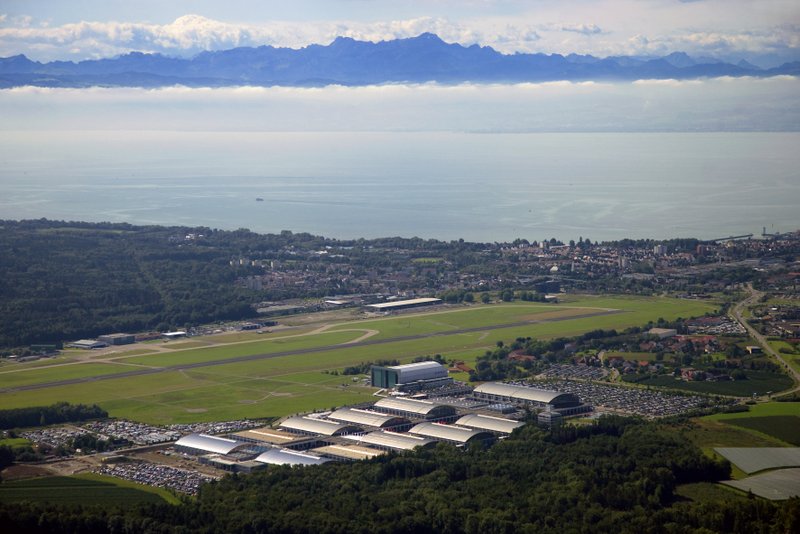
The Friedrichshafen exhibition grounds. (Photo: Ham Radio Friedrichshafen)

Many thanks to SWLing Post contributor, Alexander (DL4NO), who shared a few notes with me from his visit at the Friedrichshafen Ham Radio convention. Alexander has kindly allowed me to post his notes here on the SWLing Post. Alexander writes:

The first booth I visited was of Dokufunk (http://www.dokufunk.org/). They collect QSLs and other information about wireless history for scientific evaluation. Its head Wolf, OE1WHC, was a moderator for the Austrian shortwave service which does not exist anymore. But ORF still supports Dokufunk. They have a large archive and even the equipment to digitize large quantities if information. I brought them a package of ham radio periodicals, mostly issues of DL-QTC, the predecessor of cqDL, and got some QSPs (magazine of OEVSV) back. I collect those periodicals to gain and provide access. Seehttp://www.dl4no.de/thema/amateurfunk-zeitschriftenarchiv.htm, catalog at the bottom.

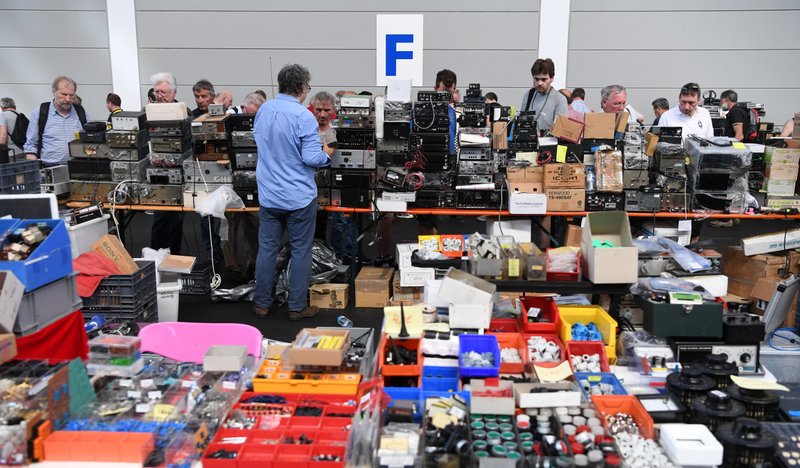
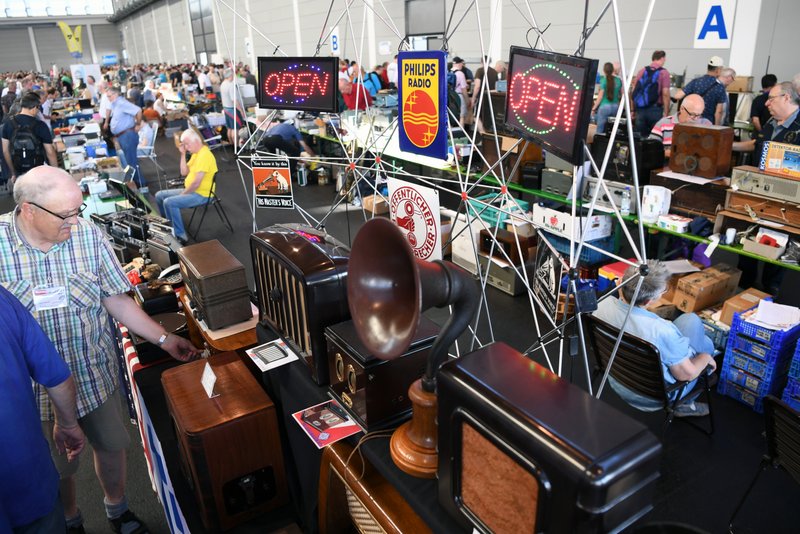
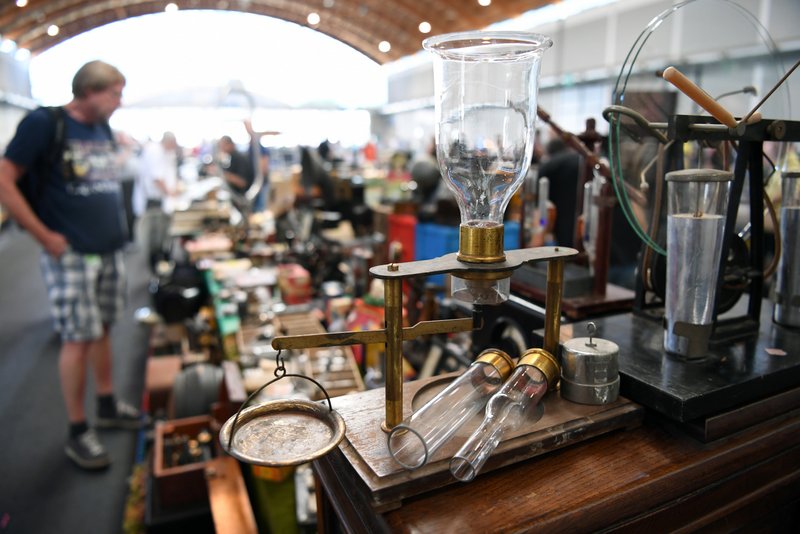
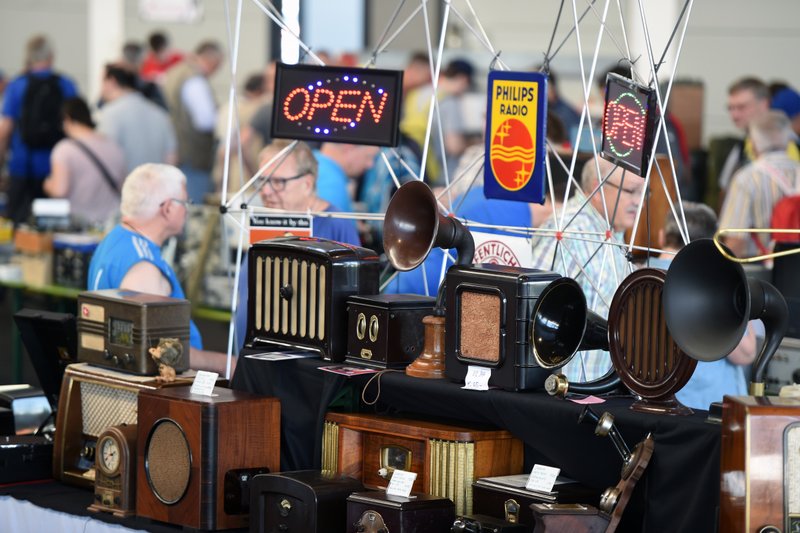
The flea market filled three exhibit halls. If you needed a tube heating for your shack you had a wide choice, from radios to ham equipment to scopes. On the newer side you could get Windows XP packages with the appropriate hardware.

Flea Market Photos Courtesy of Ham Radio Friedrichshafen

A3: Stand mit historischem Radiogeräten (Photo: Ham Radio Friedrichshafen)

A3: Stand mit historischem Radiogeräten

A3: Stand mit Empfängern und Messgeräten

A3: Stand mit Empfängern und Messgeräten (Photo: Ham Radio Friedrichshafen)

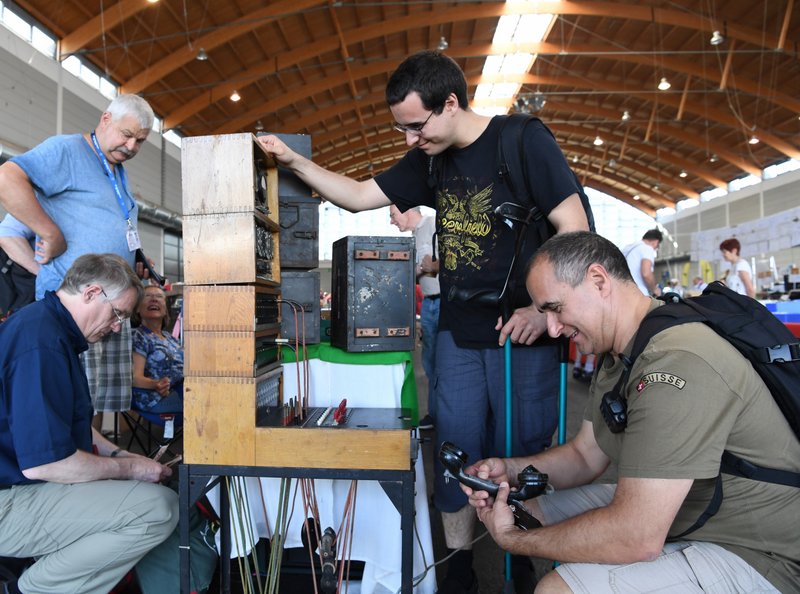
A3: Stand mit Empfängern und Messgeräten, hier zwei Schweizer an einer historischen Feld-Telefonzentrale

A3: Stand mit Empfängern und Messgeräten, hier zwei Schweizer an einer historischen Feld-Telefonzentrale (Photo: Ham Radio Friedrichshafen)

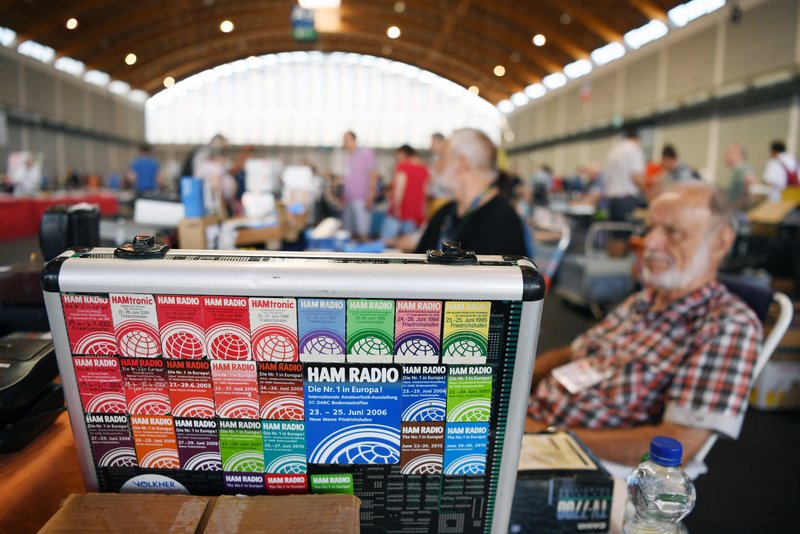
A3: Koffer mit Ham-Radio-Aufklebern aus mehreren Jahrzehnten

A3: Koffer mit Ham-Radio-Aufklebern aus mehreren Jahrzehnten (Photo: Ham Radio Friedrichshafen)

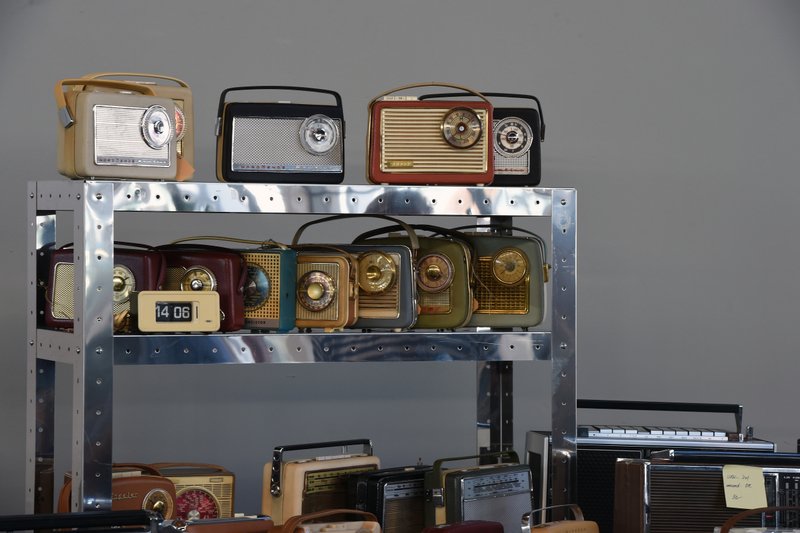
A3: Alte Radiogeräte

A3: Alte Radiogeräte (Photo: Ham Radio Friedrichshafen)

A3: Alte Empfänger und Radios

A3: Alte Empfänger und Radios (Photo: Ham Radio Friedrichshafen)

A3: Stand mit Empfängern und Messgeräten

A3: Stand mit Empfängern und Messgeräten (Photo: Ham Radio Friedrichshafen)

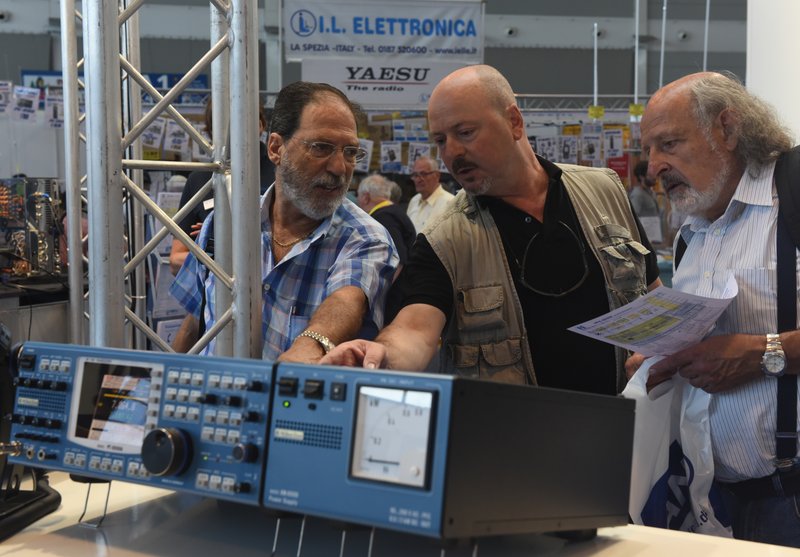
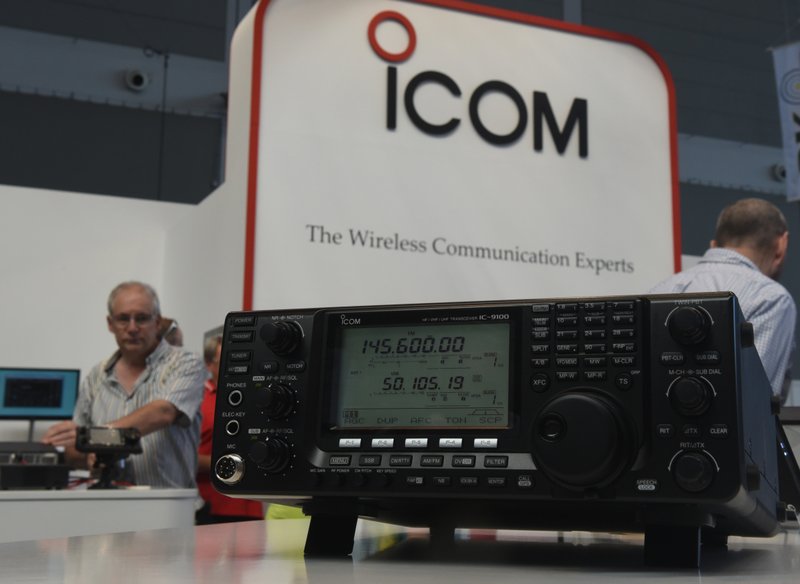
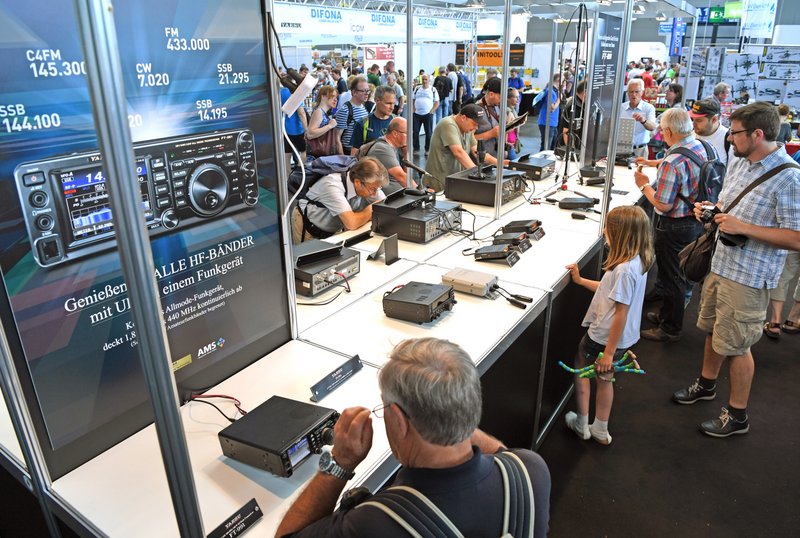
Yaesu, Icom & Co where there, of course. A large part of Hall 1 had booths for most of the European ham radio societies and other entities. Several attractions for the youths were there: A fox hunt around the hall, possibilities to solder simple circuits and more. The exhibit center even provides a kindergarden.

A1: Hilberling PT 8000A

A1: Hilberling PT 8000A (Photo: Ham Radio Friedrichshafen)

A1: ICOM

A1: ICOM (Photo: Ham Radio Friedrichshafen)

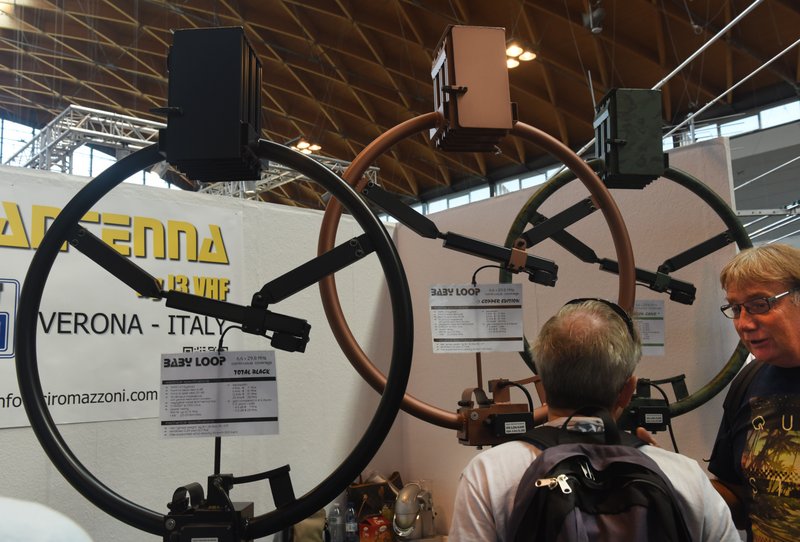
A1: Wimo, BABY Loop

A1: Wimo, BABY Loop (Photo: Ham Radio Friedrichshafen)

A1: YAESU Funkgeräte

A1: YAESU Funkgeräte (Photo: Ham Radio Friedrichshafen)

Hamradio had lots of presentations. The “SDR Academy” run all over Saturday – completely in English. See http://www.sdra-2016.de. Last year’s presentations are on Youtube. Search for “SDRA-2015”.

My presentation was titled “HAMNET On 70 cm – Possibilities and Limitations”. I should explain that HAMNET is our way to use the 44.0.0.0/8 TCP address space reserved for Ham Radio use. Starting in Germany and especially Austria we use more or less standard WLAN equipment to build a ham radio intranet. User access is mostly on 2.3 GHz and links on 5 GHz. Where we have gaps in the wireless coverage we use Internet wormholes. This way you can access for example packet radio sites in Canada. See http://hamnetdb.net.

2,3 GHz and up means exclusively line-of sight connections. Quite some OMs cannot reach access points this way. The only alternative up to now has been VPN connections through the Internet. I think we could provide relatively fast access on 70 cm. Here in Germany we have two 200-kHz channels for such uses. They were defined in the 1980s for packet radio access up to 76 kbps. This technology is next to dead.

Theoretical calculations show that we could provide up to 1 Mbps and cover up to 50 km if we use modern modulation schemes. You could even improve throughput by making TCP/IP less gossipy. I proposed to use SDR blocks like HackRF or LimeSDR and combine them with a RF frontend (filter, preamp, PA, fast switching). The hardware is more or less readily available, but this is mostly a software topic. While HAMNET relies on standard WLAN equipment with all its limitations for ham radio usage, this system could be completely open. We could it adapt to all our needs and ideas. In the end we could port it back to the microwave bands.

Even if we only work on the lowest protocol levels this will pose quite some challenges. We would need programmers with quite varied expertise from TCP/IP protocols to SDR technology. My presentation was to attract such people. Personally I will not program anything. As a technical writer with a quite wide expertise I might be a bracket for the project and write documentation for it.

PICT3344

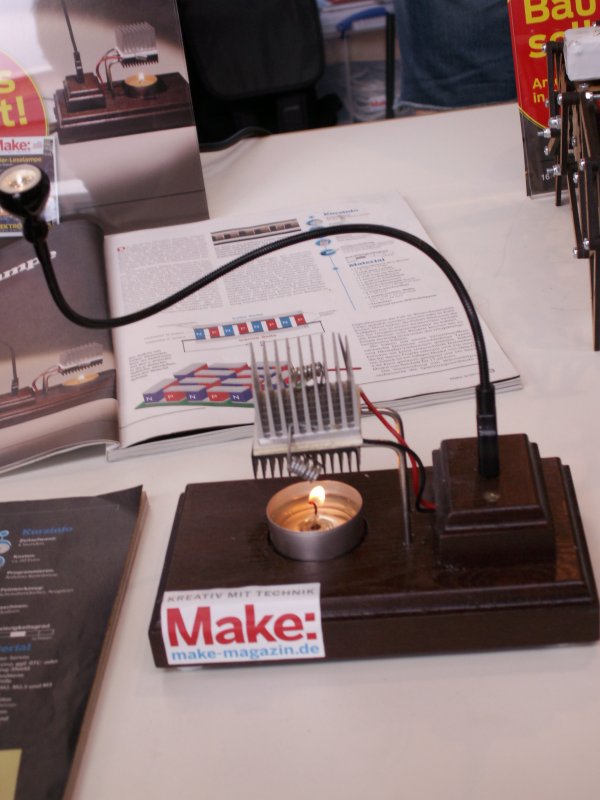
A “Peltier Lamp”: The candle heats one side of the Peltier element while the other is cooled by the heat sink. This produces enough electricity to light a LED. (Photo: Alexander DL4NO)

At the opposite end of the exhibit center another fair went on, called Maker Faire. In former times you would have called it “make it yourself”. The exhibits there went from computer modding to 3D printing, knitting and also ham radio. For this I modified my presentation a bit: “WLAN Below 1 GHz – Do You Want To Program For It?” The technology I talked about is near hot topics like Internet of Things or traffic telematics.

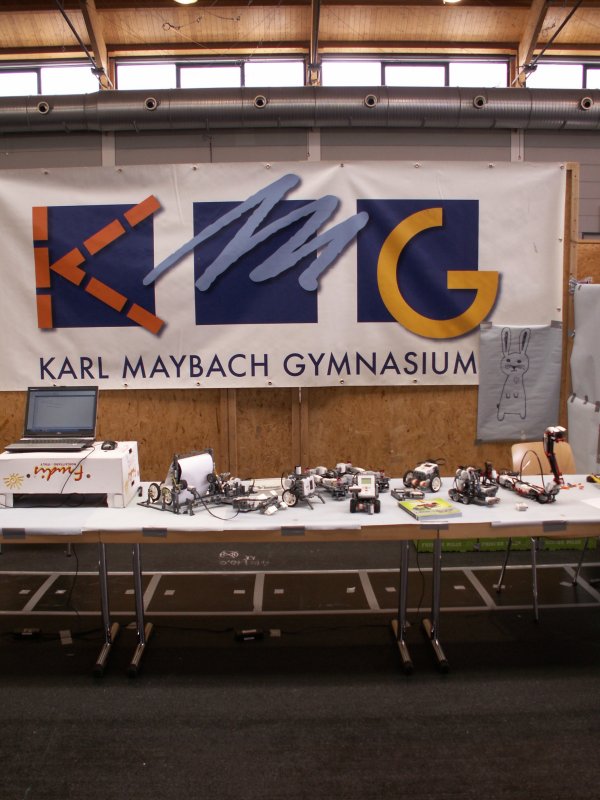
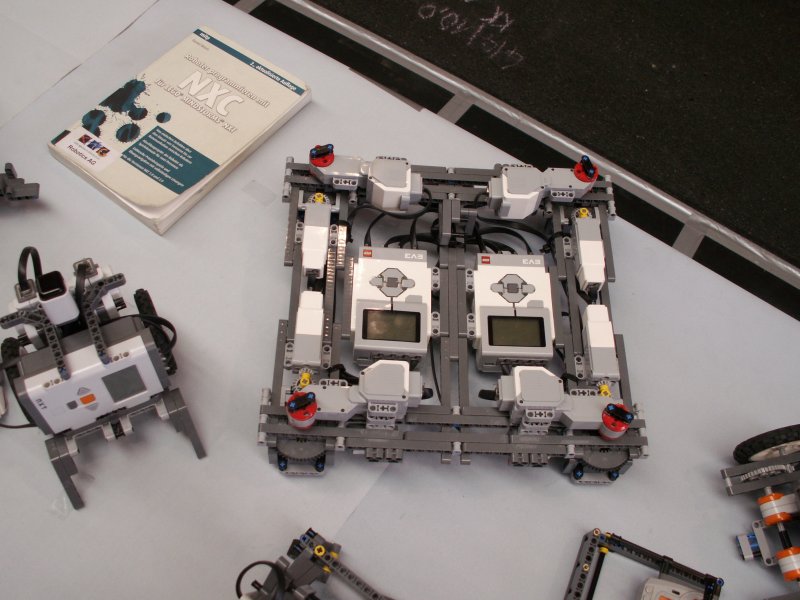
Booth of a high school showing the robots they built. (Photo: Alexander DL4NO)

Booth of a high school showing the robots they built. (Photo: Alexander DL4NO)

PICT3337

Booth of a high school showing the robots they built. (Photo: Alexander DL4NO)

vy 73
Alexander
DL4NO
Thanks so much for sharing your notes from Friedrichshafen, Alexander. I look forward to attending one year myself!  I’m fascinated with the fact that the bulk of the event is indoors–what an incredible venue.

Any other Post readers attend Ham Radio Friedrichshafen? Please comment!
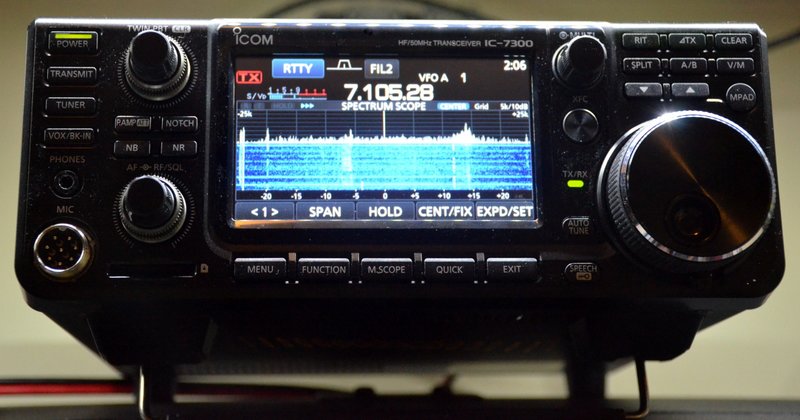
Icom IC-7300: Field Day reports?

Icom-IC-7300-Front

I’m curious: any Post readers use the new Icom IC-7300 on Field Day?

While I gave Icom’s new transceiver a very positive review, it was based on operation at my home QTH. There were no significant contests in progress during my review window.

Field Day has, arguably, some of the toughest receiver conditions out there.  If a transceiver/receiver performs well during Field Day’s dense signal environment, without overloading or distorting, it’s a good receiver.

I’m very curious if anyone tested the IC-7300. I assume someone took it out to play on Field Day!

Please consider commenting with your report!

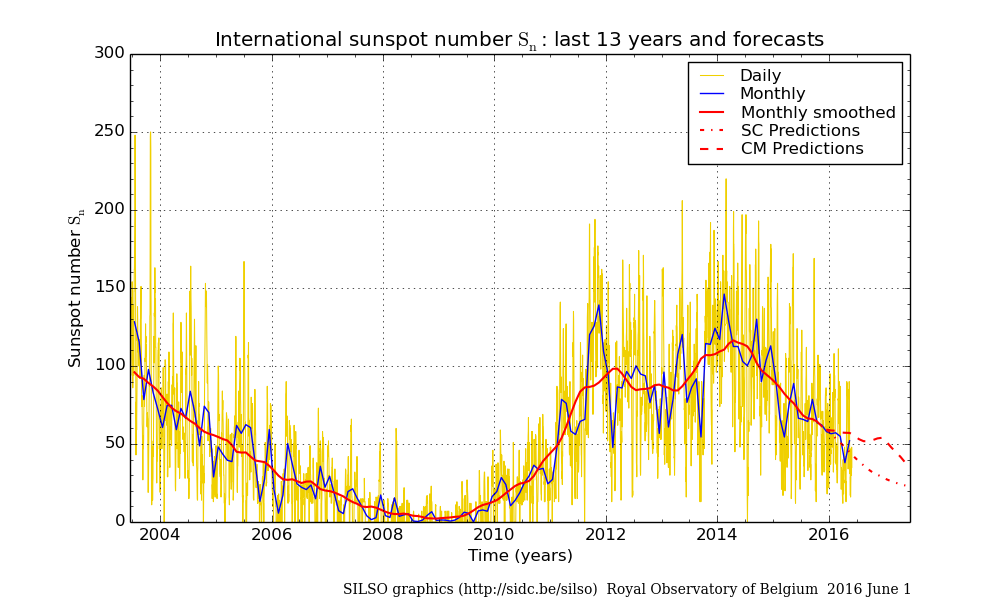
Some scientists believe sun may be crossing into “magnetic middle age”

 (SILSO data/image, Royal Observatory of Belgium, Brussels)

(SILSO data/image, Royal Observatory of Belgium, Brussels)

I just received the following link to a Forbes article from my buddy Charlie (W4MEC).

If this research turns out to be correct–and time will only tell–it could mean very low solar activity from here on out (let’s hope not!):

(Source: Forbes Magazine via Charlie W4MEC)

The Sun has likely already entered into a new unpredicted long-term phase of its evolution as a hydrogen-burning main sequence star — one characterized by magnetic sputtering indicative of a more quiescent middle-age. Or so say the authors of a new paper submitted to The Astrophysical Journal Letters.

Using observations of other sunlike stars made by NASA ’s Kepler Space Telescope, the team found that the Sun is currently in a special phase of its magnetic evolution.

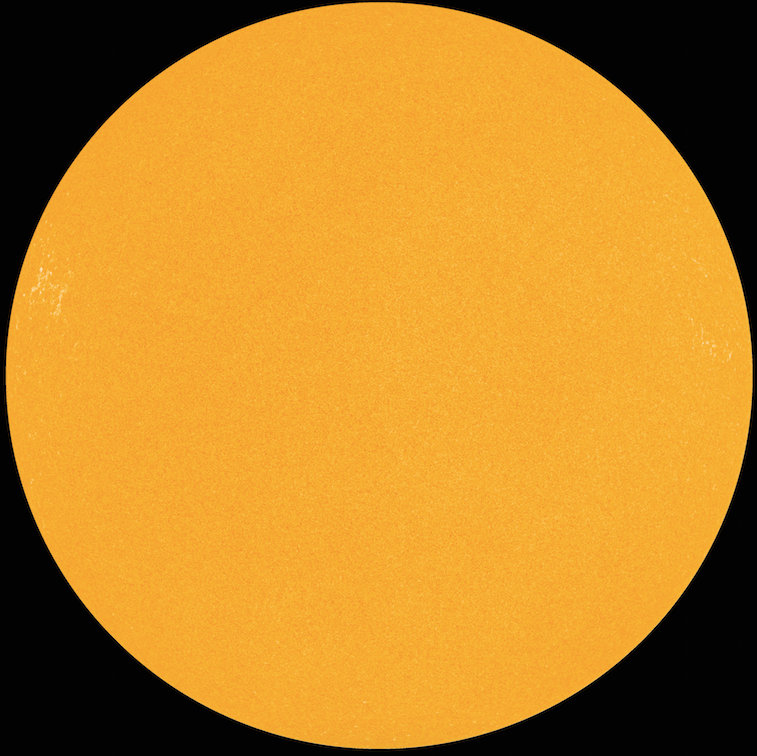
At time of posting, the Sun has no Sun spots at all. The sun is blank--no sunspots, which means very low solar activity. Credit: SDO/HMI (Click to enlarge)

At time of posting (June 28, 2016) the Sun has no Sun spots at all, which means very low solar activity. Credit: SDO/HMI (Click to enlarge)

Heretofore, the Sun was thought to have been just a more slowly rotating version of a normal yellow dwarf (G-spectral type) star. These results offer the first real confirmation that the Sun is in the process of crossing into its magnetic middle age, where its 11-year Sunspot cycles are likely to slowly disappear entirely. That is, from here on out, the Sun is likely to have fewer sunspots than during the first half of its estimated 10 billion year life as a hydrogen-burning star.

“The Sun’s 11-year sunspot cycle is likely to disappear entirely, not just get less pronounced; [since] other stars with similar rotation rates show no sunspot cycles,” Travis Metcalfe, the paper’s lead author and an astronomer at the Space Science Institute in Boulder, Colo., told me.[…]

Continue reading the full article at Forbes online.

13 Colonies Special Event

13-colonies

13 Colonies operating event runs from 1300Z July 1 – 0400Z July 7

Once again, the 13 Colonies Special Event will take place between 1300z, July 1st and 0400z July 7th. The certificate is printed on heavy card stock. Stations working one state or, as many as all 15, will be eligible for the certificate. A “Clean Sweep” indicator will be affixed, for those lucky enough to “Q” all 15.

A special endorsement will be attached for stations contacting their sister operation, WM3PEN, in Philadelphia, PA, where independence was declared. New since 2015, the 13 Colonies have added a second sister event station GB13COL will operate from Durham, England. The 13 Colonies certificate will have a Liberty Bell added for a contact with WM3PEN. They will also offer a special QSL card printed just for this event.

There should be at least two stations from each on the 13 colonies on the air, as well as Super contest stations, multi-operator Club stations and OM and XYL teams. The thirteen orginal U.S. colonies are CT-DE- GA-MA-MD-NC-NH-NJ-NY-PA-RI-SC-VA. Special events stations mentioned are: K2A (NY), K2B (VA), K2C (RI), K2D (CT), K2E (DE), K2F (MD), K2G (GA), K2H (MA), K2I (NJ), K2J (NC), K2K (NH), K2L (SC), and K2M (PA).

All HF bands will be in play, including the WARC bands, with the exception of 60 meters. 2 meters and 6 meter simplex are encouraged. All modes of operation should be represented – SSB, CW, RTTY, Digital, and the Satellites. The mode of operation is up to the individual colony state station. For more details on the stations, suggested frequencies, QSL info and on how to obtain the special certificate, see: http://www.13colonies.info

Thanks to the Southgate Amateur radio News for this information


This is one of my favorite events each year – and it also represents some of the best of the traditions of amateur operation. I have always found the operators to be kind and helpful and patient, and they really seem to enjoy the event. Why not give it a go  this year?!

Robert Gulley, AK3Q, is the author of this post and a regular contributor to the SWLing Post. Robert also blogs at All Things Radio.

It’s Field Day weekend 2016: find a local event, have fun

2016 Field Day Logo

If you live in North America and have an interest in becoming a ham radio operator, this is the weekend to check out what amateur radio is all about, and meet local radio enthusiasts.  

It’s Field Day!

What is Field Day?  I’ll quote from the ARRL, who sponsors the event:

“ARRL Field Day is the single most popular on-the-air event held annually in the US and Canada. On the fourth weekend of June of each year, more than 35,000 radio amateurs gather with their clubs, groups or simply with friends to operate from remote locations.

Field Day is a picnic, a camp out, practice for emergencies, an informal contest and, most of all, FUN!

It is a time where many aspects of Amateur Radio come together to highlight our many roles. While some will treat it as a contest, other groups use the opportunity to practice their emergency response capabilities. It is an excellent opportunity to demonstrate Amateur Radio to the organizations that Amateur Radio might serve in an emergency, as well as the general public. For many clubs, ARRL Field Day is one of the highlights of their annual calendar.

The contest part is simply to contact as many other stations as possible and to learn to operate our radio gear in abnormal situations and less than optimal conditions.”

GOTAMany Field Day sites have a GOTA (Get On The Air) station where non-licensed individuals are welcome to play radio. It’s a fantastic way to try your hand at transmitting with a little guidance and encouragement from the more experienced. Indeed, even if there is no GOTA station, you will often be invited to try out the mic.

You’ll find that ham radio operators are very welcoming on Field Day–after all, spreading the word about the fun of amateur radio is what it’s all about. Indeed, I’ve shown up unannounced to a number of Field Days over the years; once I even got some serious radio time with the Charlotteville Amateur Radio Club while on vacation in Prince Edward Island, Canada.

This year, I’m joining the Québec Amateur Radio Club (Club Radio Amateur de Québec) and I’m looking forward to it very much!

Keep in mind that there are many shortwave listeners among the amateur radio community; indeed, many hams became interested in the hobby through SWLing.

The ARRL has made it quite easy to find registered Field Day locations in your region. Click here to find a local Field Day event near you–and have a great Field Day!

SDRuno: SDRplay introduces a free native app for the RSP

(Source: SDRplay Press Release)

SDRplay-Logo

SDRplay is pleased to announce the official release of SDRuno for the RSP. SDRuno is the new name for the RSP compatible version of Studio1, the rights to which we obtained and announced on 28th April. SDRuno contains native support for the SDRplay RSP and no extra plugins are required. Third party hardware can also be supported via the ExtIO interface, but with reduced functionality.

SDRuno provides a rugged and flexible, high performance SDR receiver capability and boasts some excellent features:

  • Multiple ‘Virtual Receivers’ which allow for simultaneous reception and demodulation of different types of signals within the same receiver bandwidth.
  • A selectivity filter with an ultimate rejection greater than 140 dB.
  • A unique distortion-free double stage AGC with fully adjustable parameters.
  • Multiple notch filters with BW adjustable down to 1 Hz, Notch Lock feature.
  • A unique synchronous AM mode with selectable/adjustable sidebands, dedicated PLL input filter, and selectable PLL time constants.
  • SNR (stereo noise reduction), featuring a proprietary noise reduction algorithm for stereo broadcast.
  • AFC for FM signals.
  • Calibration for receiver frequency errors.

Over time, we plan to add many more features to SDRuno to enhance the user’s experience of this very powerful piece of software. This software runs on Windows and we don’t yet know how easy it will be to migrate it to other platforms but this is something we will be investigating.

SDRuno will be made freely available to all current and future users of the RSP – to download a copy – simply go to http://www.sdrplay.com/windows.html

Our support for SDRuno in no way lessens our commitment to support HDSDR, SDR Console, Cubic SDR or ANY other software solution where the authors are willing to work with us. We fully recognise that many people have strong preferences for particular pieces of software and we do not want to do anything to undermine the options that people have to use their favoured software packages. Indeed, our view is quite the opposite. Our objective remains aim to have our hardware platforms support any and every SDR package out there. This of course may not be possible, but it is our philosophy and part of the ethos of our company.

About Studio 1:

Studio1 was developed in Italy by SDR Applications S.a.s. and has hundreds of happy customers around the world. Studio 1 is known for its user friendly stylish GUI, CPU efficiency and advanced DSP capabilities, including features not available on other SDR software packages.

www.sdrapplications.it

About SDRplay:

SDRplay limited is a UK company and consists of a small group of engineers with strong connections to the UK Wireless semiconductor industry. SDRplay announced its first product, the RSP1 in August 2014

www.sdrplay.com
Email: [email protected]