Category Archives: How To

Hidden feature: Calibrating the Tecsun PL-880 on medium wave

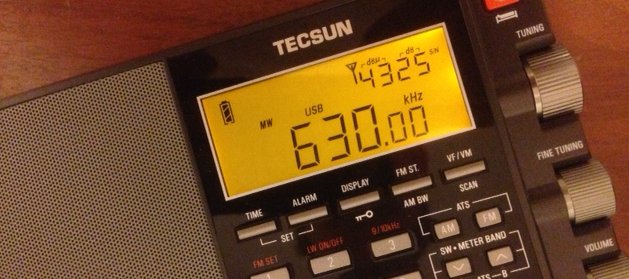
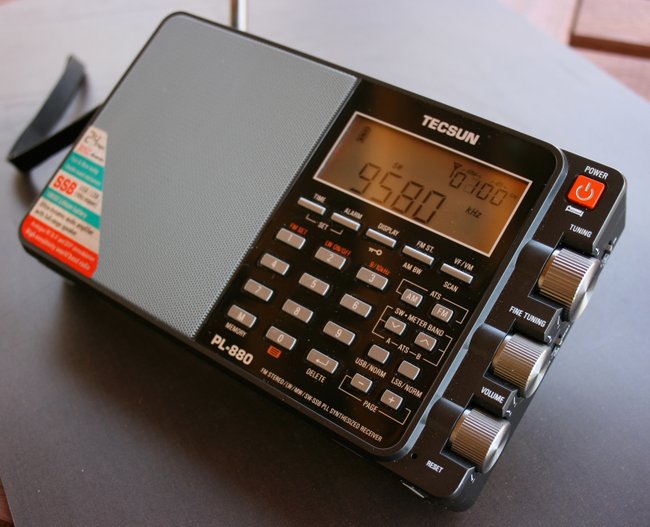
Tecsun-SSB-QRG-1This hidden feature was described by Diemtar on the Tecsun PL-880 Yahoo Group:

  1. Tune to a strong medium wave (AM broadcast) station
  2. Turn on on SSB mode USB/LSB
  3. Move the fine tuning control until you have a good SSB signal (i.e. obtain a good zero-beat of the AM station)
  4. Press and hold the Snooze Button, now you see a correction value in the display
  5. Press the Snooze Button again.

I just tried this on my PL-880 (firmware version 8820) and it worked well.

Many thanks, Dietmar!

You can follow all Tecsun PL-880 updates by bookmarking/checking this link.

Hidden feature: Adjusting the Tecsun PL-880 FM de-emphasis

Photo source: Tecsun PL-880 Yahoo Group

Photo source: Tecsun PL-880 Yahoo Group

There has been some confusion (mainly on my part) about the hidden feature behind button number 5.

Pressing and holding the number 5 will toggle the radio between 50 and 75 uS.

But what, exactly, is this function?

Thankfully, Eric Cottrell has the answer:

“The 50/75 uS setting is the FM De-emphasis. 75 uS in the US and 50 uS in Europe.”

Eric then pointed to a discussion about de-emphasis on DIY Audio’s website.

Many thanks, Eric, for clarifying this (and thanks to others SWLing Post readers who pointed this out in comments as well).

You can follow all Tecsun PL-880 updates by bookmarking/checking this link.

AM sync lessens noise in this The Voice of Greece broadcast

TheParthenonAthensSometimes, the Voice of Greece plays very little Greek music; October 10th was one of those occasions.  Nonetheless, I recorded that evening’s broadcast.

Using AM sync for sideband noise

In the first hour of the 10/10 VOG broadcast, you’ll hear a pulsating noise from an unknown origin (possibly a jammer?). The noise was centered about 20 kHz above VOG.

Fortunately, most of the noise was in the upper side band of the VOG signal, so I was able to mitigate it by using an AM sync lock on the lower side band. Without AM sync, this VOG broadcast––and its music mix––was almost inaudible.

If you have a synchronous detector on your receiver and tune in a station with interference, always try turning on sync lock and locking it on either the upper or lower sideband. If most of the noise resides in one of the sidebands, the lock can help tremendously. I often use this method while listening to AM pirate radio stations in noisy conditions.

A confession…

I have no idea what she’s talking about–it could be something absolutely mundane–but I love this radio host’s voice as she speaks and Pink Floyd’s Comfortably Numb begins(Start listening around 26:00)

Click here to download more than two hours of the Voice of Greece, recorded on October 10, 2013, starting around 03:15 UTC on 9,420 kHz, or simply listen via the embedded player below. Most of the noise disappears around 00:21:

Purple Power: Another solution for sticky radios

Many thanks to Mike Nikolich (N9OVQ), who writes with another solution for sticky radios:

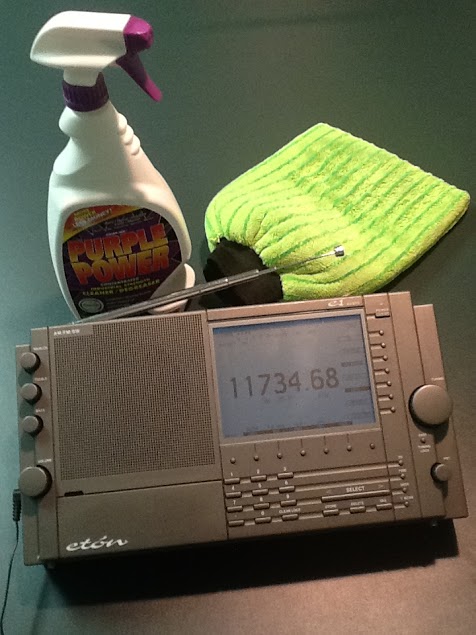
Eton-E1-Purple-Power-2013-10-16

After the display on my Eton E-1 receiver died, the good folks at Universal Radio swapped my broken but lightly used radio for a factory reconditioned unit. Fred Osterman warned me that the plastic case was sticky and somewhat gross and he wasn’t kidding, but I was still grateful that he had a replacement radio.

After searching around the Internet (including your blog) and trying various cleaners and solutions that didn’t remove the dirt and grime from the radio (such as rubbing alcohol, Gunk and dishwasher detergent), I went to my local O’Reilly Auto Parts store and asked if they had a recommendation. Their solution was a product called Purple Power ($4.49) and a microfiber shammy mitt ($4.50). In less time than it took me to watch an episode of “Dr. Phil,” my Eton cleaned up beautifully, with no damage to the unit — it looks and feels brand new. The plastic retained that nice tacky feel without all of the stickiness that attracts gunk like dust, hair and other crud.

Purple Power is made by Aiken Chemical. You’ll want to have a clean bucket of water to remove the gunk that Purple Power removes from the plastic — it really was disgusting but I won’t hesitate to give the radio a Purple Power bath the next time it starts getting gross. And, no, I’m not affiliated with Purple Power, Eton or anyone else, including the microfiber shammy!

Click this link to find Purple Power retailers.

Frank’s maritime radio suggestions

In response to my previous post, The Best Shortwave Receiver for Your Boat or Yacht, Frank (VK3JFH/VP8DNM) writes:

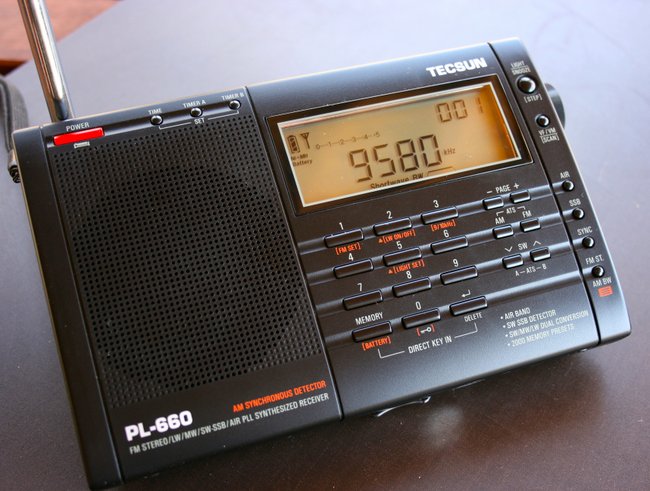
“I have all three of the portables mentioned, the Sony SW7600GR, the Sangean 909X, and the Tecsun PL-660. The latter is currently my portable of choice. Having just read this post re radios afloat I took the time to suck down a fax from Charleville, Queensland.

(Click to enlarge)

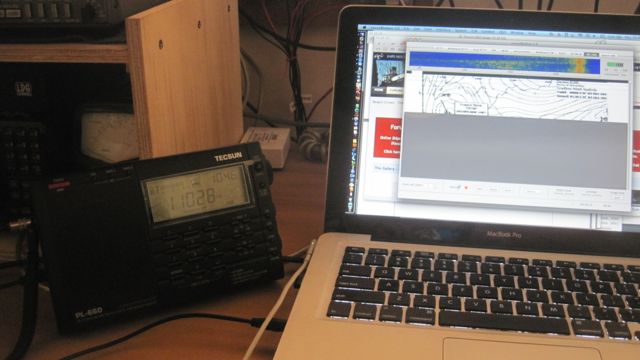
Frank’s Tecsun PL-660 and Macbook Pro decoding a weather fax with Cocoa Modem 2.0 (Click to enlarge)

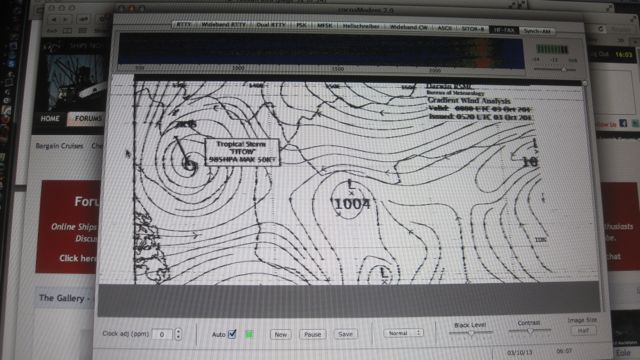
Results shown..

This was with the Tecsun 660 attached directly to a (near) horizontal longwire at my home QTH, inserted directly into a Macbook Pro running CocoaModem 2.0 via the headphone socket on the Tecsun.
I have had similar results with the Sony and the Sangean

To all intents the result is as good as with my other radios ( K5000 etc.).

(Click to enlarge)

Screenshot of the weather fax image (Click to enlarge)

However if I was starting from scratch afloat I would get an Icom IC-718. Only $689.95 from Universal Radio. You may choose to simply use it as a receiver or as a Ham TX/RX. However it can also be ‘opened up’ with a simple diode snip to transmit on all the marine bands. Not strictly legal [nor is the IC-718 designed for those bands] but there are a lot of ‘opened’ 718s out there and in an emergency you can transmit a mayday on anything…. even a couple of jam tins and string although you may need a fair old length of string….

If you wish to transmit on your IC-718 you will need a tuner. I have an LDG IT-100 on mine.

Hooking up a consumer receiver to a marine antenna….? Simply make up a pigtail with a 3.5mm jack at one end and a BNC or SO -259 at the other.

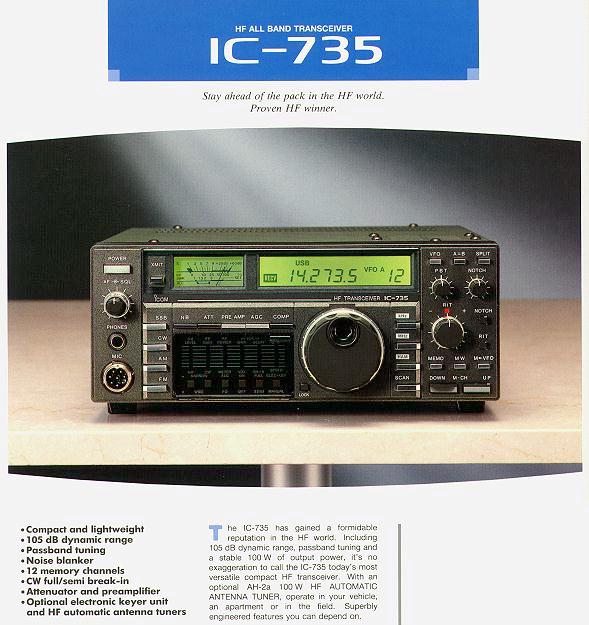
Non-marine radios afloat…. ? I had an IC-735 aboard from Cyprus (1992) until Patagonia (2007). Since 2007 I have had an IC-706Mk2G afloat…. no problem with either one.”

Many thanks for your input, Frank!

The best shortwave receiver for your boat or yacht

[Updated: October, 23 2017]

SWLing Post reader, Bob, recently emailed the following question:

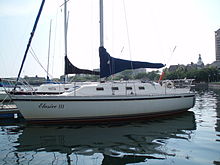
Yacht“My wife and I live on a boat and plan to go to the Bahamas this season. We cannot afford to install a SSB radio – costs $7K to $8K. But we need to be able to hear the weather reports and forecasts

So we are thinking of just getting a SW radio receiver.

A friend has purchased a Grundig satellite 750 but it does not seem to have the range, and he has not been successful connecting an antenna.

I think I need a SW radio I can connect to an antenna. I am thinking of a CommRadio CR-1 ?

What do you think?”

Thanks for your question, Bob.  I’m going to give you a few suggestions, then open this one up to your fellow SWLing Post readers, as I suspect there may be some with experience setting up and using an HF receiver on the water.

ImportantAs Bryan commented, just after I posted this review, readers should note that none of the receivers/transceivers I offer here are designed for maritime use, thus they lack features like GMDSS, DSC and DGPS and have no extra protection from the corrosion of salt water on their circuit boards.

Receivers

The CommRadio CR-1

The CommRadio CR-1

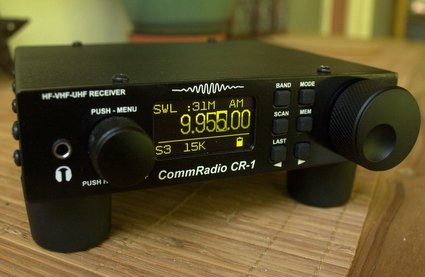
For my part, as an inlander, I think you’re on the right track with the CommRadio CR-1 or CR-1a.  Not only will it cover the entire HF spectrum (for HF weather fax, RTTY and many ship-to-shore communications), but it also covers VHF (64 – 260 MHz) and UHF (437 – 512 MHz) frequencies. The CR-1 is also a very stable receiver and covers all of the modes you’ll need (upper side-band, lower side-band, AM and FM).

If you’re space conscious, fortunately the CR-1 has a very small footprint; you could mount it nearly anywhere. The CR-1 also has a built-in battery pack and can run/charge on an array of DC voltages (6-18 VDC).

You may also wish to consider the Alinco DX-R8T (see our review) or the Icom R-75. The Alinco has a detachable face plate, thus may also be easily accommodated. The Icom R-75 is a great receiver for your application, as well, but is larger than the CR-1 and does not have a detachable face plate option.

Again, I think you’re on the right track with the CommRadio CR-1.

Another option to consider…general coverage ham transceiver

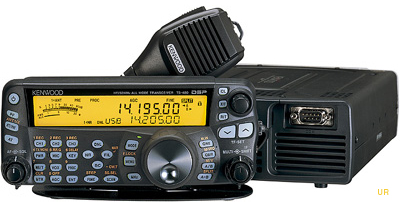
The Kenwood TS-480SAT is full-featured, small, and has a detachable face plate.

The Kenwood TS-480SAT is full-featured, small, and has a detachable face plate.

Here my advice is going to sound a bit like that which I gave reader Phil recently: I would strongly urge you to get your amateur radio license.

It’s a simple process–even elementary kids do it–and the license no longer requires a knowledge of Morse code (CW), (although I am a devotee of code and would suggest pursuing a knowledge of this at a future date).

Moreover, the testing material will make for an excellent primer on radio communications, so if something goes wrong in the middle of the ocean, you’ll be better prepared to diagnose and fix it.

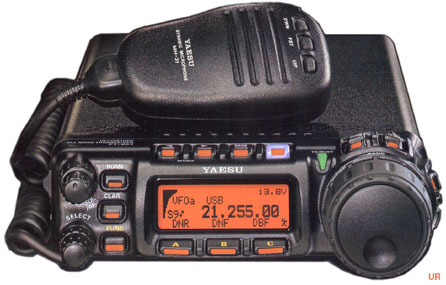
The Yaesu FT-857D

The Yaesu FT-857D

Additionally, in case of an emergency, a ham radio transceiver would provide yet another means of calling SOS to a community that is well-versed in handling emergency communications.

Check out this previous post for suggestions on getting your amateur radio license.

Ham radio transceivers also offer excellent stability and the modes you’ll need to decode any voice or digital mode.

Keeping in mind that you’ll need a transceiver 1) in the same price range as the CR-1, 2) that is compact or has a detachable face plate, 3) has a general coverage receiver, and 4) is rated for 100 watts of output power, I would suggest the following:

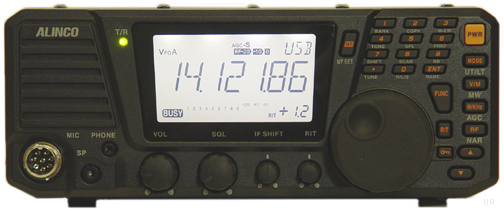
The Linco DX-SR8T

The Alinco DX-SR8T

  • The Alinco DX-SR8T. While not a small radio, this rig has a detachable face plate (with optional extension cord), a sensitive receiver and is a great value at $520 new. I favorably reviewed the receiver-only version of this radio two years ago. I’ve heard that the receiver in the DX-R8T is identical to the one in the DX-SR8T. I would purchase this from Universal Radio or Ham Radio Outlet.
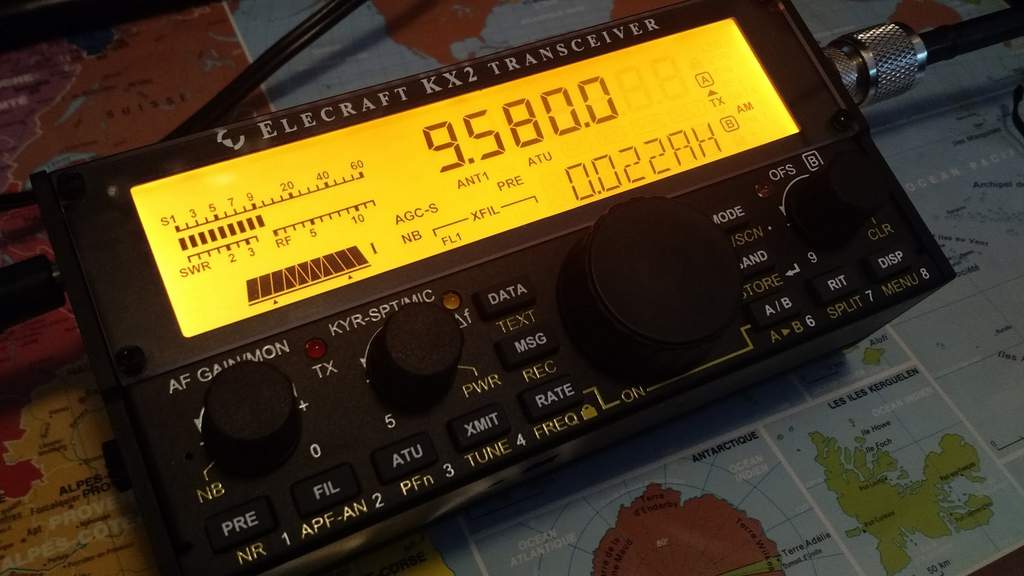
  • The Elecraft KX2

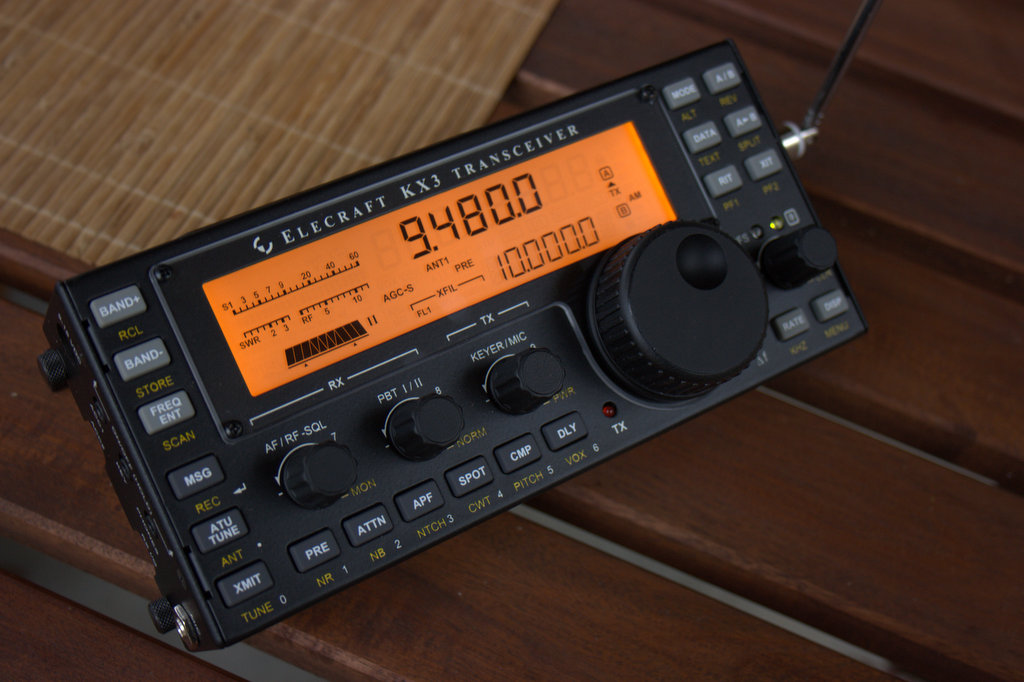
    The Elecraft KX3 or Elecraft KX2 are two of my favorite general coverage transceivers–I own both. They can both be powered from a modest 12 VDC source and/or internal batteries. Both are limited to QRP (12 or 15W) transmit power, but an external portable 100W amp can be added. Both are exceptional radios in terms of performance.

  • The Kenwood TS-480SAT. Also worth considering, this transceiver has an excellent receiver with better filters and a smaller footprint than the Alinco DX-SR8T. Though it costs nearly twice as much as the Alinco, it’s on sale until 11/30/13 for $974 from Universal Radio.
  • The Yaesu FT-857D.  This is probably the most compact among the transceiver options listed above. The FT-857D has been on the market for many years and has proven itself a capable mobile transceiver. The detachable face plate could easily be mounted anywhere you wish. The Yaesu FT-857D can be purchased at Universal radio or Ham Radio Outlet.
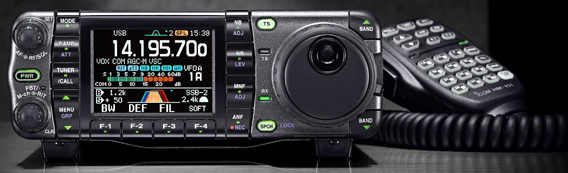
  • The Icom IC-7000 is an excellent choice for maritime operation. It's possible to find a used one at a good value.

    The Icom IC-7000 is an excellent choice for maritime operation. It’s possible to find a used one at a good value.

    Also consider buying a good-quality used general coverage transceiver from a reputable retailer like Universal Radio, Ham Radio Outlet, The Ham Station or Amateur Electronic Supply. Search for the three models listed above, but I would also consider the Icom IC-706MKII and the Icom IC-7000.

Of course, you will need a good HF antenna for any of these options to work, even the CommRadio CR-1; a radio, after all, is only as good as its antenna.  The type of antenna you can use will be limited by your ability to mount it on on your boat: some are limited-space wire antennas, others are whip antennas.  Make sure the antenna will resonate on the frequencies important for your maritime travels.

Fortunately, most of the retailers listed above have experience in this capacity.

Portables

If I were on a boat, I would also carry a portable shortwave radio as a backup. Some to consider are the Tecsun PL-660, Tecsun PL-880Sony ICF-SW7600GR or the Sangean 909X. All of these have SSB mode and good sensitivity, selectivity and stability, although the Sangean ATS-909X requires an external antenna for optimal sensitivity.

There are also a few compact travel radios worth considering as well, although sensitivity generally isn’t as good as the larger, full-featured portables mentioned above. I would consider the CountyComm GP-SSB, Digitech AR-1780, or the C. Crane CC Skywave SSB as a nice spare radio to tuck away on board.

Hope this helps, Bob!  Happy sailing!

SWLing Post readers: if you have experience in maritime HF operation, we welcome your comments and suggestions…

Update: Check out Frank’s maritime radio suggestions.

Living off-grid? The ideal shortwave radio system for you

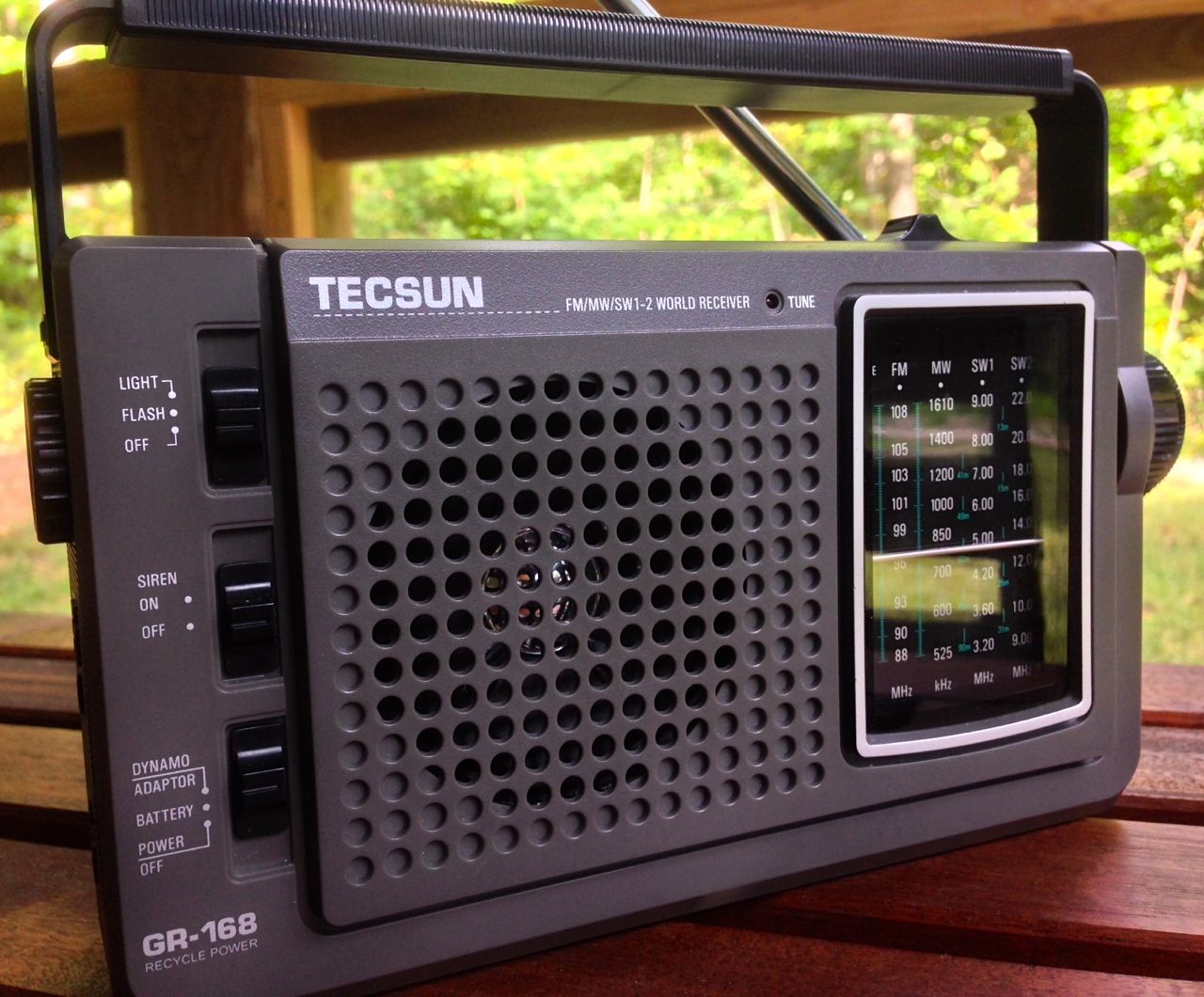
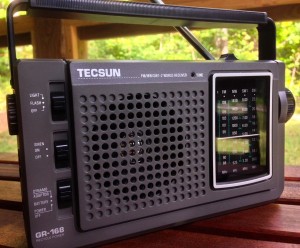
While the Tecsun GR-168 is my current pick amongst self-powered shortwave radios, their performance is only mediocre compared to a proper, hobby-grade receiver with SSB.

While the Tecsun GR-168 is my current pick amongst self-powered shortwave radios, performance is only mediocre compared with a proper, hobby-grade receiver with SSB.

What’s the best system for off-grid living? From time to time, I’m asked this question in the “comments” section of the website or via email.  Recently it came up again, and I thought it might make sense to answer it here, and also open it for discussion.

Specifically, SWLing Post reader, Phil, writes:

“[H]i, I am looking for a SW radio that can be used in an off-grid location (rechargeable/ wind-up/ 12 volt DC/ or solar powered), that can pick up a wide range of English speaking stations from here in SW Spain, fantastic audio quality, in the £100-200 price range, and can pick up ham etc transmissions in an emergency (with SSB?).  I know NOTHING about SW, so the CCRadio-SW looked about right, except it doesn’t have SSB.  Any other suggestions?

SolarQTH2

Our little solar cottage, where The SWLing Post is often produced from the sun’s energy

Phil, I’m glad you asked. I may be uniquely qualified to answer this question, as I live in and work from a solar house that is off-grid at least some of the time, and I run a charitable non-profit, Ears To Our World (ETOW), that uses shortwave radio for educational purposes.  ETOW works in schools, homes, and entire communities that are very often extremely remote, and, by default, off-grid.

So, you have a number of great options to choose from–and whatever options I overlook, our fellow SWLing Post readers will surely supply.

As the ability to receive SSB signals is important to you (and I agree), all of these options will take this requirement into account. You’ll notice that I’m not elaborating on crank/wind-up radios; while there are many of these on the market, none include SSB as an option. Fewer and fewer even include shortwave radio as an option. With that said, my current pick is the Tecsun GR-168 (photo above). Another to consider is the EU/Asian version of the Eton Rover (US versions lack SW, but feature NOAA frequencies).

Following are the options I would suggest for you–or for anyone looking to add a solar-powered radio system to their off-grid set-up.
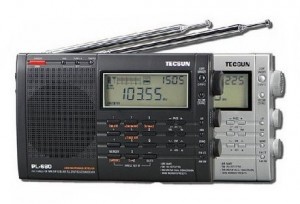
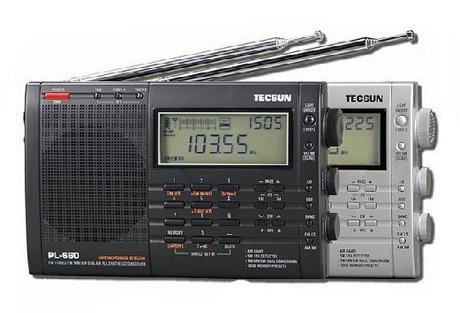
The Tecsun PL-660

The Tecsun PL-660

Option 1: Portable radio

Most of the good portable radios on the market use AA batteries and can run quite a long time on a set.  I would recommend purchasing the Tecsun PL-660, Sangean ATS-909X, or the Sony ICF-SW7600GR. The PL-660 is possibly the best choice for ease of use and overall value; it’s an impressive little radio, and has good audio fidelity for the size.

Since these radios operate from AA batteries, I would simply purchase a 12V AA battery charger, if you have 12 volts DC available.
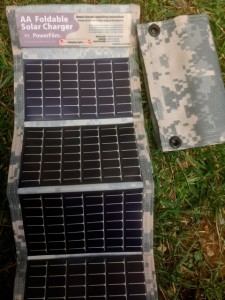
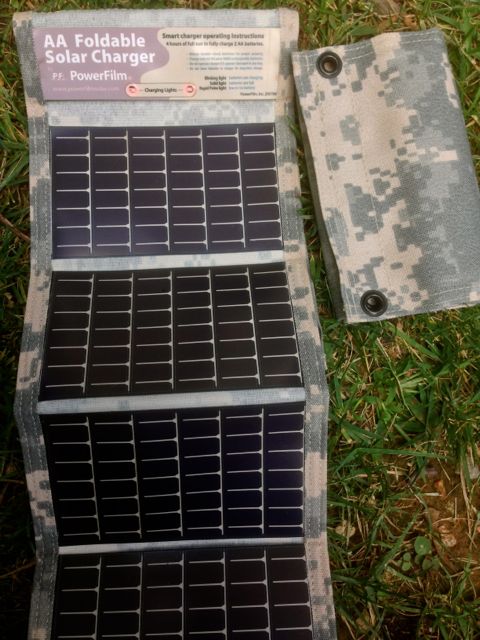
A PowerFilm Solar AA charger unfolded and charging on left, folded panel on right.

A PowerFilm Solar AA charger unfolded and charging on left, folded panel on right.

The other option would be to purchase a solar AA battery charger. I’ve tested a lot of these, and the best I’ve found are made by PowerFilm Solar here in the USA. What I like about these solar chargers is that they can charge either two or four batteries at a time––the panel folds out and has enough wattage to charge depleted cells within a few hours of sunlight exposure.  Folded up, they’re small enough (a little larger than a wallet) to be used for travel.

I have used PowerFilm’s solar chargers extensively and they continue to impress.  Note, however, that they are not waterproof––you cannot leave them outside in rainy conditions.

This radio/panel combo can be purchased for under $250 US (£155/185 EUR).

Option 2: Tabletop receiver
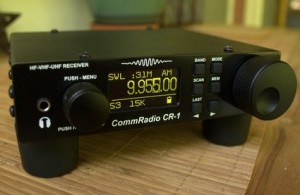
The CommRadio CR-1

The CommRadio CR-1

If you have access to 12 volts DC in your home or cabin, and you’re less concerned about portability, then a tabletop receiver might fit your price range and will offer you better performance, when coupled with a reasonable outdoor wire antenna.

You would want to find a tabletop receiver that could run on 12-13.8 volts DC. Many amateur radio-class communications receivers will do this. I would recommend one of the following:

  • The Alinco DX-R8: an excellent receiver for the price. You can find them used for around $350 US. I ran one off solar power here at my home for almost 2 years.
  • The CommRadio CR-1: A new product this year. A bit out of your £100-200 price range, Phil, but worth considering as not only is it beautifully engineered, but it’s portable, and operates anywhere from 6 to 18 VDC! As a bonus, it has a built-in battery that will power it for hours.  I’m due to publish the full review of the CR-1 very soon–here’s a quickie.
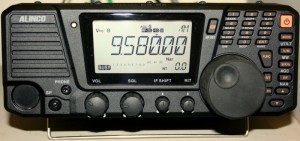
AlincoDX-R8T

The Alinco DX-R8T tabletop shortwave receiver

One side note: It’s possible–depending on the type you use–that your home’s solar charge controller(s) could inject a lot of noise into your daytime shortwave radio listening.  My charge controller does this, but I can turn it off and, if it becomes too much of a problem, actually modify it to do charging with less switching.
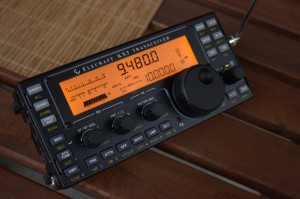
The Elecraft KX3 general coverage Transceiver (Click to enlarge)

The Elecraft KX3 general coverage Transceiver (Click to enlarge)

Option 3: Get your amateur radio ticket and a transceiver

This option is identical to option 2, other than instead of buying a receiver, you buy a transceiver. I’m talking about becoming a licensed amateur radio operator or “ham.” Living where you do, and being a bit of a preparation guru, I can assure you that a ham radio license is a true asset and can keep you connected with the world when everything else fails or when you want to chat with a friend 3,000 miles away.

It’s well beyond the scope of my advice here to cover amateur radio–it’s a vast and multi-faceted hobby–but as a ham (callsign K4SWL–and, formerly, M0CYI in the UK) I can tell you that becoming one is a decision you’re not likely to regret.
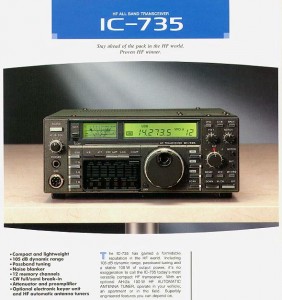
A brochure of the original IC-735. These can be easily found for $300-350 US used.

A brochure of the original IC-735. These can be easily found used for $300-350 US (220-260 EUR).

If you’re licensed, you can purchase a general coverage ham radio transceiver and not only be able to use the rig for ham radio purposes, but also for all aspects of shortwave radio listening. I spent many years using the (now very affordable) Icom IC-735 as my shortwave receiver. Though I have dedicated receivers at home, I now use the Elecraft KX3 for ham radio and receiving on the go.  I recently posted a review of the KX3 that can better explain in detail.

Phil, since you’re from the UK, consider contacting the RSGB and asking about becoming a ham in Spain (or getting licensed in the UK and getting a Spanish call sign). If you lived in the US, I’d advise you contact the ARRL, or in Canada the RAC.  Most countries, however, have a support organization for amateur radio–the IARU can help guide you.

More options?

I’m sure SWLing Post readers may also have suggestions for off-grid SWLing–please check this post’s comments.

Readers: be sure to check out Phil’s website about simple, off-grid living in southern Spain.  Phil, thanks for the question!