Category Archives: Mediumwave

BBC sets plans for next decade

BBC-AT-WARMany thanks to SWLing Post reader, Bill, for sharing a link to this article which summarizes the BBC’s plans for the next ten years.

BBC director general, Tony Hall, said the corporation will become an “open BBC for the internet age”.

While Hall was quick to add that funding cuts would equate to “the loss or reduction of some services” he also highlighted several efforts that would include shortwave and mediumwave broadcasts, including:

  • “Significant investment” in the BBC World Service, including a daily news programme for North Korea and more broadcasts to Russia, India and the Middle East
  • A news service for Ethiopia and Eritrea on medium wave and short wave

Of course, we can expect more cuts to BBC World Service shortwave broadcasting over the next ten years even if it wasn’t specifically mentioned in Hall’s speech. If we’re lucky, the BBC will continue to broadcast into those parts of the world that still rely on shortwave. Specifically mentioning North Korea, Ethiopia and Eritrea appears to be a nod in that direction.

Click here to read this article on the BBC News website.

Also, The Guardian has posted the full text of Tony Hall’s speech. It’s worth reading.

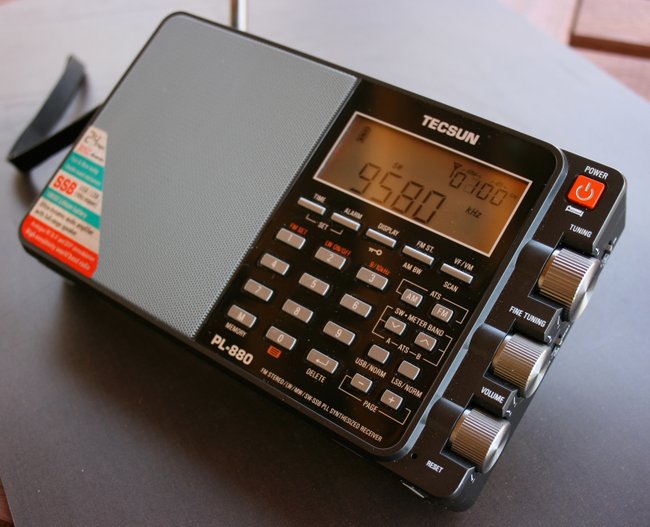
Tecsun PL-880: Evans notes signal meter and other discrepencies

PL-880 (1)

SWLing Post reader, Evans (in Greece) writes:

I would like your opinion regarding two strange points we noticed in two different Tecsun PL-880 models, which a friend and I have recently purchased. In particular:

  1. The signal meter is supposed to measure up to 99dBu (my Tecsun PL-390 s-meter goes indeed up to 95-97dBu for very strong amateur signals in my area included mine in mw zone). The point is that for both devices (both of which have 8820 firmware) the signal meter does not exceed 85 dBu and in particular my Tecsun PL-880 signal meter does not goes over 70dBu (ie. even lower measurement). Why this behaviour?

  2. Another strange point is that my friend’s Tecsun receiver displays for a “quiet” frequency (mw) a noise level of about 10-12dBu, while my Tecsun device shows only 2-3dBu noise (same frequency in the same spot!). We both tried the threshold muting adjustment (key 9) and this worked a bit but with minor results in sensitivity, especially for my Tecsun PL-880 receiver. Is it possible to adjust the noise level so that it can be 10-12dBu instead of being only 2-3dBu and hence better sensitivity? And is it possible to adjust the maximum signal level (99dBu instead of 85dBu or even worse 70dBu for my device)?

  3. I have noticed that the hidden feature regarding the external mw antenna didn’t work in my case, even though I did resets an tried many times. I pressume, hence, that maybe Tecsun disabled this hidden feature. Is there any modification available to “add something” into the radio hardware in order to be able to listen mw/lw frequences with external antenna and thus, increase sensitivity?

Many thanks for your questions, Evans. Since my PL-880 is a first production run unit, I’m hoping readers who’ve recently purchased the Tecsun PL-880 might comment.

I suspect Tecsun engineers give little thought to calibrating the S meters. I’m very curious if there is a hidden feature to do this, but I’m guessing this is limited only to those who can program the DSP functionality of the chip inside.

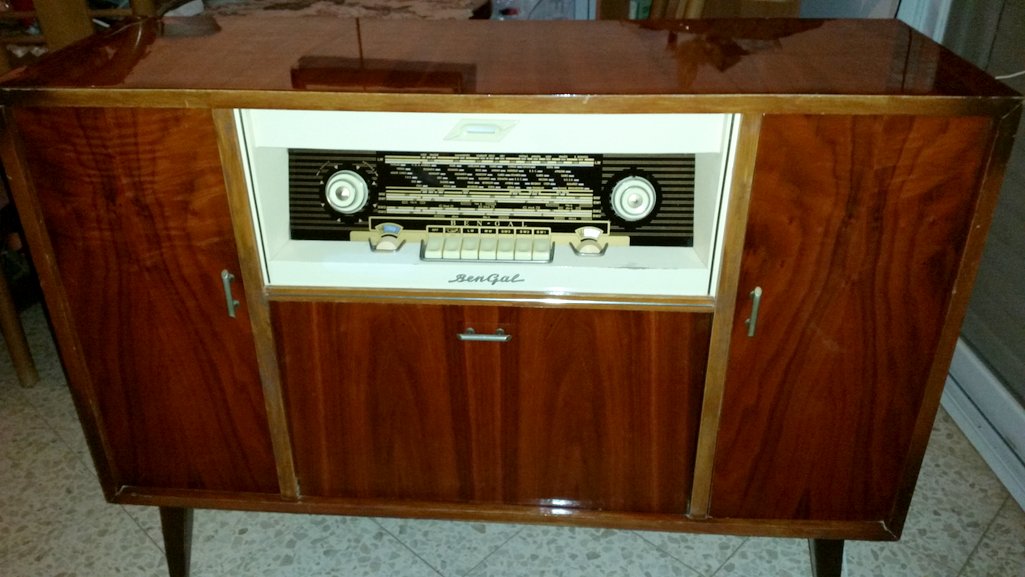
Moshe restores a Ben-Gal “Duet-Stereo”

Ben-Gal-Duet-Stereo-Full

Many thanks to SWLing Post contributor, Moshe, who writes:

About 2 weeks ago, a very good friend called me and exclaimed, “you just have to see this radio…I’m keeping it for you!”–so, I drove to his aunt’s house and saw this beauty.

After hauling the radio to my place, I started to check it out, to see what would be needed for restoration; it was working, with bad contacts, poor frequency response and low output.

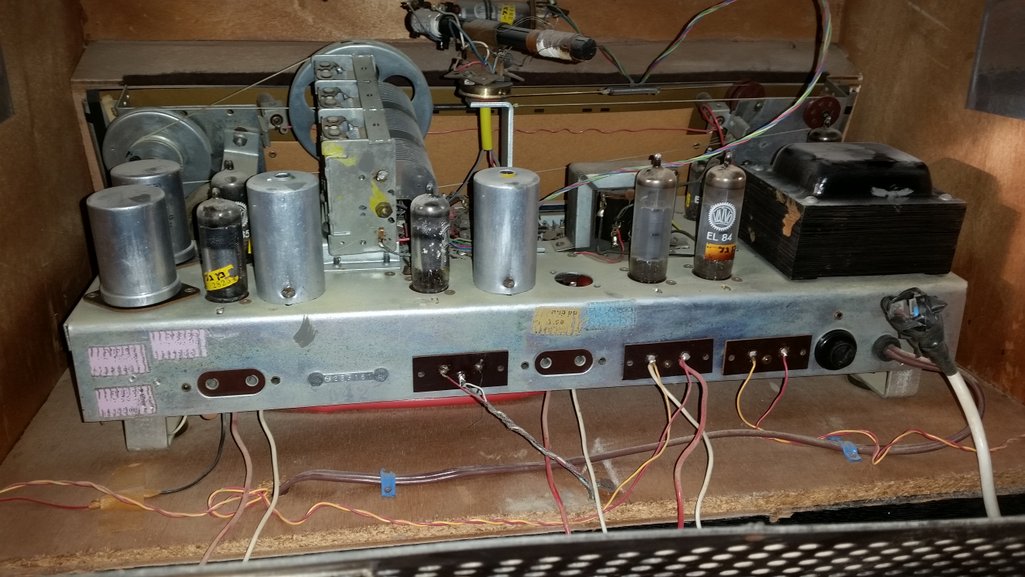
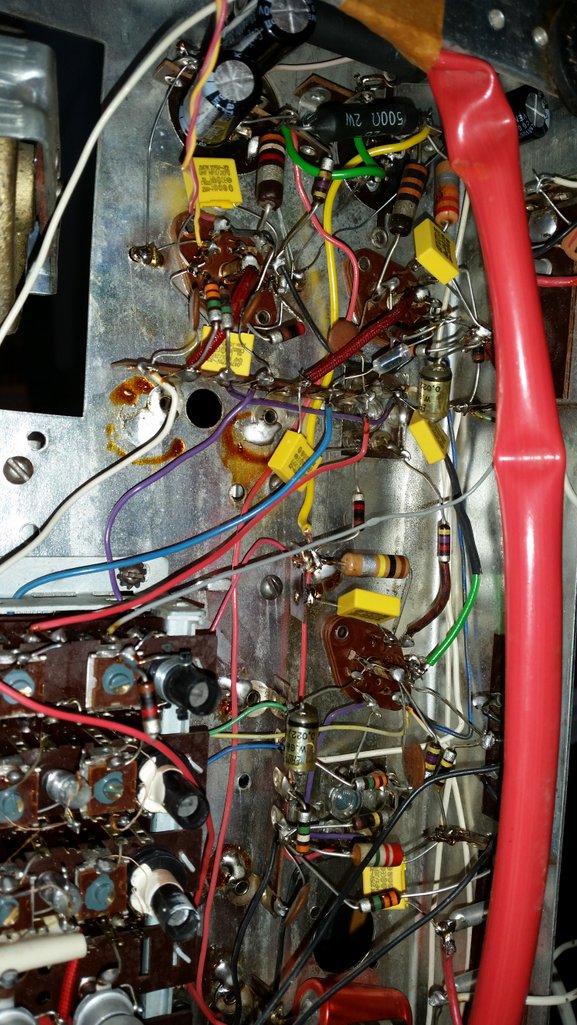
I took hi-res pictures of this radio, some during restoration. Now the radio sounds great. It has been recapped, a couple of bad resistors and bad wires replaced, contacts have been cleaned, and some good cleaning for the chassis as well.

Ben-Gal-Duet-Stereo-Board3

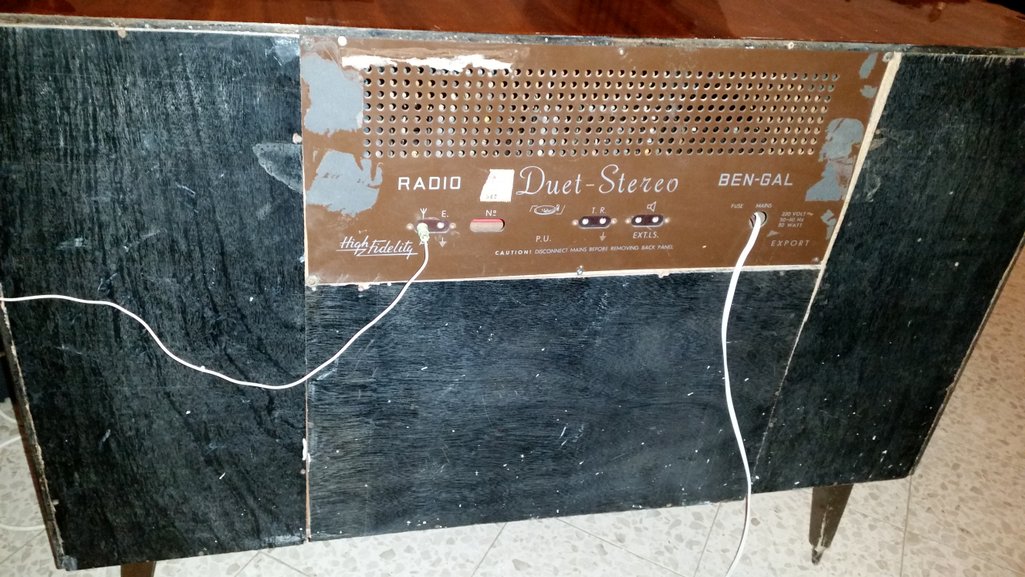
Ben-Gal-Duet-Stereo-Rear2

Ben-Gal-Duet-Stereo-Front-Detached

As I wanted to keep the original appearance of the chassis, I kept the original filter capacitors on board, but disconnected them from the circuit, added terminal strips and new capacitors from underneath.

Ben-Gal-Duet-Stereo-Board2 Ben-Gal-Duet-Stereo-Board1

The radio uses an EF85 tube as the RF stage. With the addition of a grounding connection and random wire antenna, it’s very sensitive on shortwave.

Ben-Gal-Duet-Stereo-FrontPanel

About the Ben-Gal Duet-Stereo:

It was made in Israel by Ben-Gal, a label inside shows it was made at 12th of December, 1965.

It is a console model with record player. As the model name suggests, the amplifier and record player are stereo (though the tuner is not…).

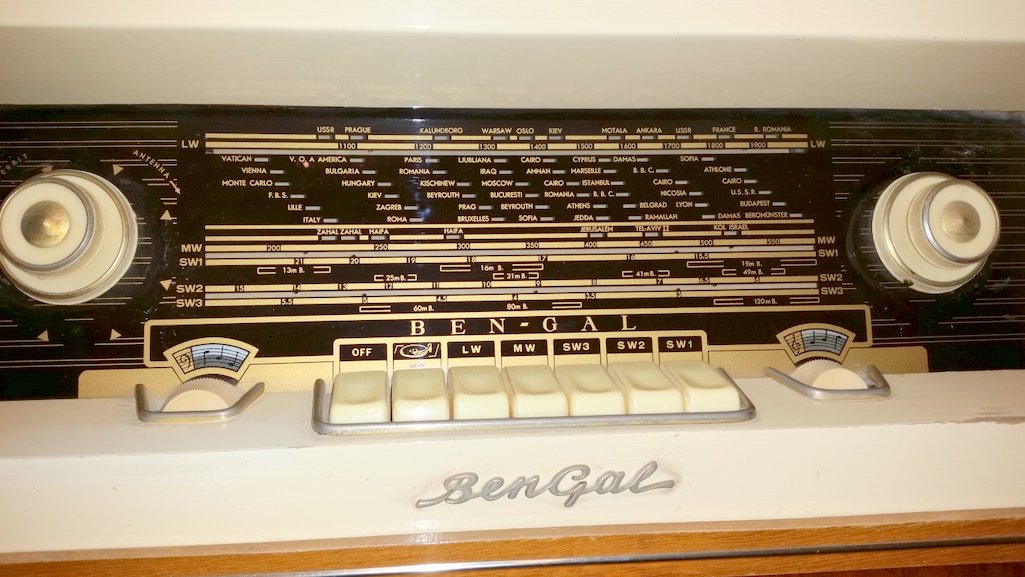
The radio has longwave (marked in meters), mediumwave (marked in meters) and 3 shortwave bands (with megacycle and meter band marks).

The shortwave bands overlaps with each other, so cover is continuous:

  • SW3 2.3MHz to 6MHz,
  • SW2 5.5MHz to 15.5MHz,
  • and SW1 14.5MHz to 23MHz.

Ben-Gal-Duet-Stereo-Open

Many thanks, Moshe, for sharing photos and this description of this beautiful Ben-Gal Duet-Stereo. I bet the audio fidelity is amazing. My father has a 1960’s console–with a similar configuration–made by Admiral, though it was limited to mediumwave and FM reception. Some day, I will try to restore it to its former glory!

Thanks for the inspiration, Moshe!

The Aiwa FR-C33 AM\FM\WX portable radio

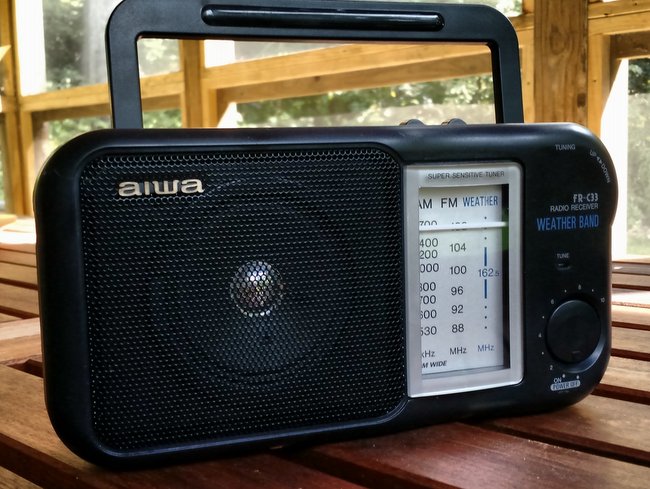
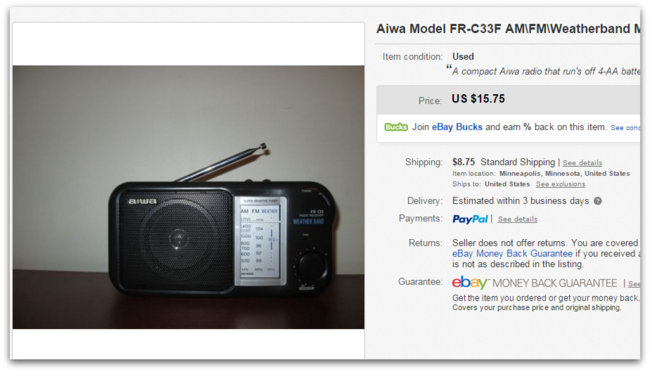
Aiwa-FR-C33-FrontA few weeks ago, SWLing Post contributor, Ron, sent me an eBay listing for a radio with which I was not familiar: the Aiwa FR-C33.

Ron wrote:

“I know you are primarily HF but here is something rather special and unique and inexpensive:

Fullscreen capture 8132015 32839 PM

Aiwa’s response to C-Quam in the late 90’s was “AM Wide.” Apparently all this meant was a somewhat wider Murita ceramic filter.

But…the bandwidth just matches the 10,200 cycle limit imposed on AM stations today…try a Sony SRF-42 or SRF-A1 C-Quam receiver at night on today’s band and note that they’re just too wide.

I have one of these and can tell you the build quality is great…it has a tone control and on Sony Walkman headphones stations like WSM are just flat-out unreal in sonic quality…the speaker isn’t bad, either.

A nice big ferrite bar makes it a bit of a DX machine, too.

FM is also very good; even the weather-band add-on works too.

Very much worth a go for your collection and enjoyment[.]”

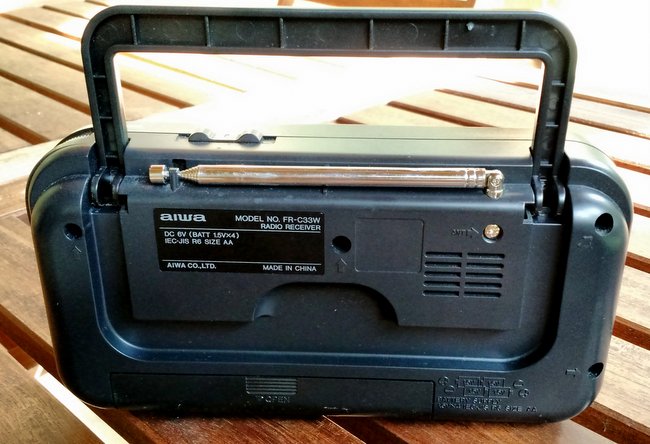
Aiwa-FR-C33-BackI’ve been enjoying the FR-C33 for a few weeks now; Ron’s assessment is spot-on.
The FR-C33 produces clear audio via its internal speaker, but where it really shines is with a pair of good headphones plugged in. Though it has no “Mega Bass” feature like many radios of its era, the Aiwa produces great bass tones via a good set of “cans” (I’ve been using my Sennheiser HD 428s).

Aiwa-FR-C33-RightSide

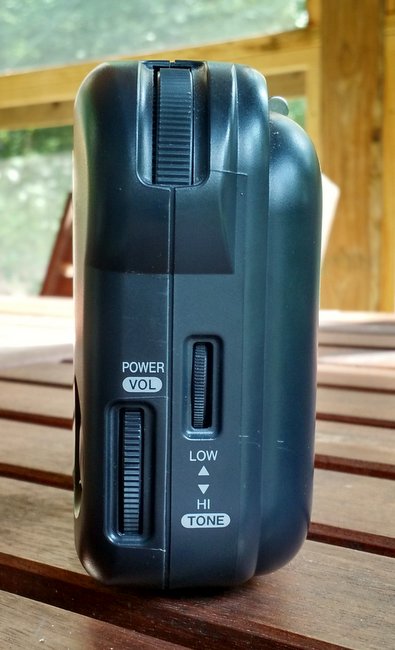
The FR-C33 has a very useful tone control with a smooth, wide spread between the full bass and treble settings.

All of the FR-C33’s controls are fluid and functional.

AM (mediumwave) reception is truly fantastic. I find that the analog tuning wheel is easy to use and there’s enough room for the needle to easily travel across the dial without skipping stations inadvertently (a problem I often find with smaller analog portables).

It really shines, however, when you can center on a local broadcaster with a quality AM signal. While the FR-C33W doesn’t receive C Quam stereo, of course, its wide AM filter offers up excellent fidelity.

FM reception is also sound. While I haven’t done a formal comparison on FM, it receives my benchmark FM stations with ease and produces great audio fidelity via headphones. Sensitivity-wise, it might lag slightly behind some of the better DSP-based radios out there, but for an inexpensive analog receiver, it must be at the lead of the pack.

Ron, I really appreciate the recommendation–thank you! The FR-C33 is a keeper for sure.

Though these don’t pop up regularily on eBay, you can search for an Aiwa FR-C33 by clicking this link.

Obtaining QSLs from AM broadcast stations?

RCA-Dial

SWLing Post reader, Paul Grodkowski, writes:

“Just a quick question to anyone at the SWLing Post:

Is the practice of sending a reception report to a AM broadcast station in return for a QSL card still accepted in the age of the internet ?

So many stations are broadcasting online now that I wonder if they have QSL cards at all?

I just want to keep up with the times and not bother busy people at radio stations and look out of date, yet at the same time would like to confirm report of reception.

Any information would be greatly appreciated.”

Thanks for your question, Paul! I’m no expert on AM broadcast QSLing, but I’m pretty sure many mediumwave stations still respond to listener reports. Indeed, I believe there are even radio enthusiasts who act as QSL managers of larger clear channel stations (CFZM comes to mind).

Of course, one brilliant resource for all things MW DX is the National Radio Club (NRC).

Readers: Can you help answer Paul’s question? Please comment. Also, if you have some AM broadcast QSL cards, please contact me as I would love to post some.

Tuning in to AM broadcast history and the venerable RF-2200

Panasonic-RF-2200-2

Many thanks to SWLing Post contributor, Eric (WD8RIF), for sharing a link to this excellent article in the Illinois Times by James Krohe Jr. Here’s an excerpt:

Tuning in: Making a small world bigger and the big one smaller

So much of happiness, I’ve realized, depends on getting tuned in. When he was a young married, my father used to tune in the console radio in the living room of the Krohe family mansion on Manor Avenue to the live broadcasts of big-band music “from the beautiful Blue Room in the Roosevelt Hotel” in downtown New Orleans. He was able to be in two places at once thanks to WWL-AM, whose 50,000-watt clear channel signal was beamed north. For all I know, while he tapped his toe on the sofa in Springfield, Inuit couples were jitterbugging on the tundra.

For Springfield teens in the 1950s and ’60s, getting a chance to listen to what kids in bigger cities had already decided they liked was important. WCVS-AM was just crawling out of its cocoon, having crawled into it as a country station and emerging as a rock station – although in the late ’50s there wasn’t that much difference. “Rock ’n’ roll” was, in stations like WVCS that catered to mostly white markets, rockabilly and pop-ish country ballads. (Geezers will recall when Brenda Lee was, briefly and laughably, marketed as a rock artist.)

For Top 40 music, as for so many other things, if you wanted to get the really good stuff you had to go to the big city. Around here that meant WLS-AM, WCFL-AM out of Chicago (whose Ron Britain made Soupy Sales look, or rather sound, like Noel Coward), and KXOK-AM out of St. Louis. George Lucas’s American Graffiti brilliantly captured the ways that car radios, transistors, radio stations blaring over PAs in drive-ins, permeated the bubble in which teenagers then lived.

Later I learned I could hear WBZ out of Boston if I acted as the antenna on my transistor. (“Turn on, tune in, drop out” to me meant losing the signal when I lighted a smoke.) WBZ was one of the first stations with the newest 45s from Britain, which allowed us yokels to hear The Yardbirds while the records were still on their way to Midwest stations by stagecoach from Boston harbor.

Continue reading…

Krohe also mentions the virtues of the Panasonic RF-2200 which is, in my opinion, one of the best AM broadcast portable receivers ever.

Click here to read the full article at the Illinois Times website.

Side note: The Panasonic RF-2200 still has a loyal following among mediumwave DXers of the world. The RF-2200 can be found on sites like eBay (click here to search), but make sure you’re purchasing from a reputable seller and not over-paying.

Radio France: mediumwave and longwave broadcasts to end

Maison_de_la_Radio_ParisMany thanks to SWLing Post reader, Marc, who sends this news from France Inter.

The article (in French) states that Radio France, in a cost-cutting measure, will end mediumwave transmissions by the end of this year (2015) and longwave transmissions by the end of 2016. It’s estimated that this will save 13 million Euros annually.

Though I haven’t listened to Radio France on mediumwave since I actually lived in France, I have been attempting to log France Inter on long wave from here in the States. This will certainly motivate me to put them in the books as soon as conditions are favorable.