Category Archives: Mediumwave

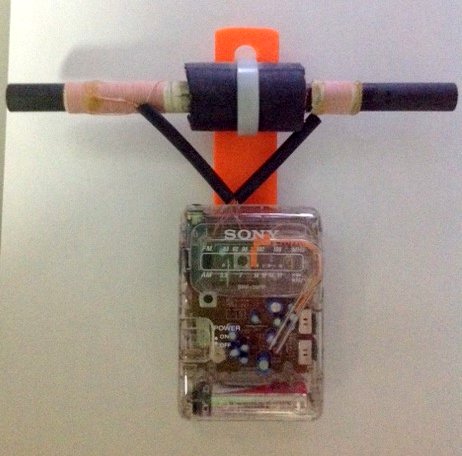
Robert’s modified version of the Sony SRF-39FP

srf-39fp

Many thanks to Robert who comments on our post about the Sony SRF-39FP:

Here’s a Suped-up Version of the SRF-39FP made for me by Gary DeBock. [see above]

As if the Prison Radio wasn’t already good enough…this 7 Inch loopstick gives it even more bang four the Buck!!

I call this Prison Radio the “Frankensteiner Prisoner” thus the 39FP monicker.

Robert, that’s a great SRF-39FP modification indeed and I bet it improves reception (and nulling abilities) quite dramatically. Plus, it was built by Gary DeBock–no doubt, a quality mod! Thanks for sharing!

Pocket DX: Finding the Sony SRF-59 and SRF-39FP

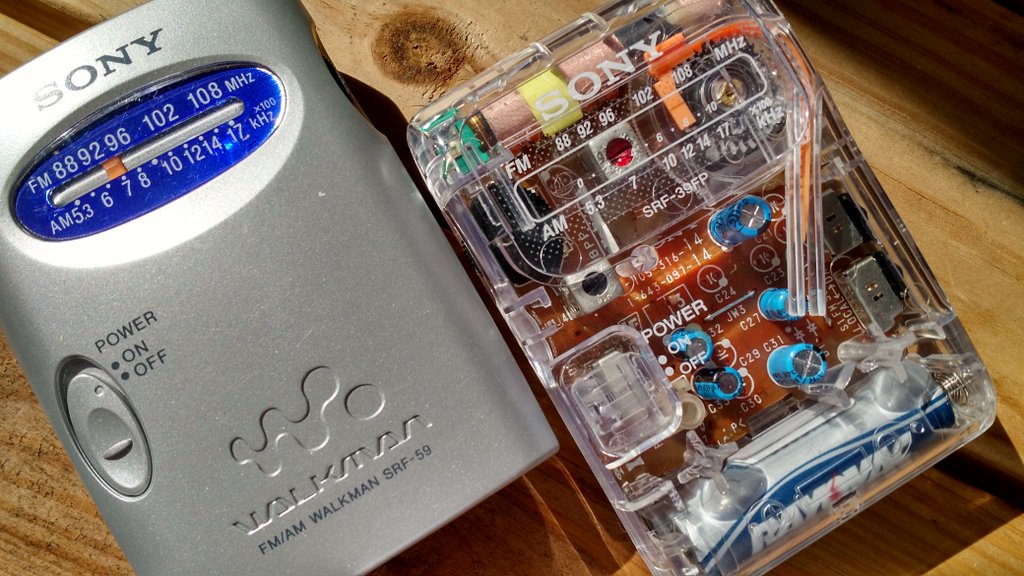
Sony-SRF-59-and-Sony-SRF-39FP

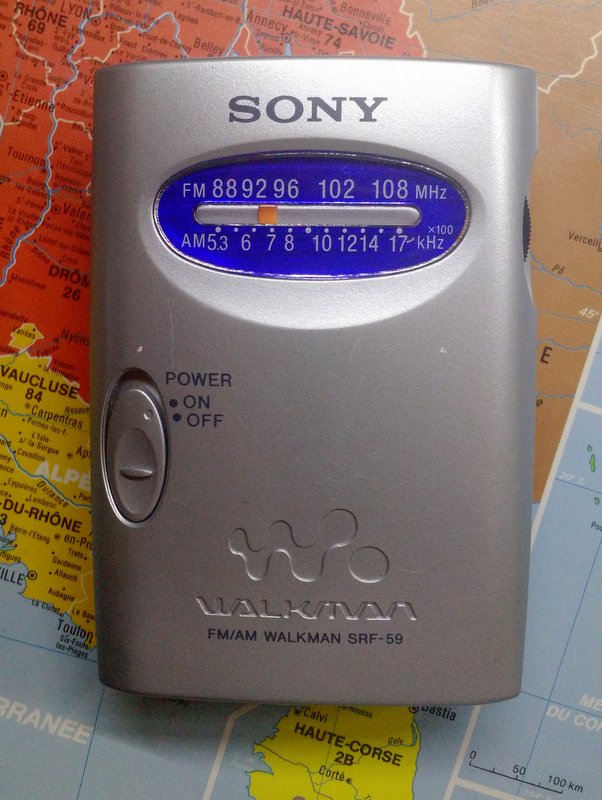
I have two of the Sony SRF series pocket AM/FM radios: the grey SRF-59 and the clear SRF-39FP.

The venerable SRF-59 has long been one of the least expensive, quality analog AM/FM receivers on the market. I originally purchased one new for $14.95 US including shipping. Here’s a short review I made of the ’59 several years ago.

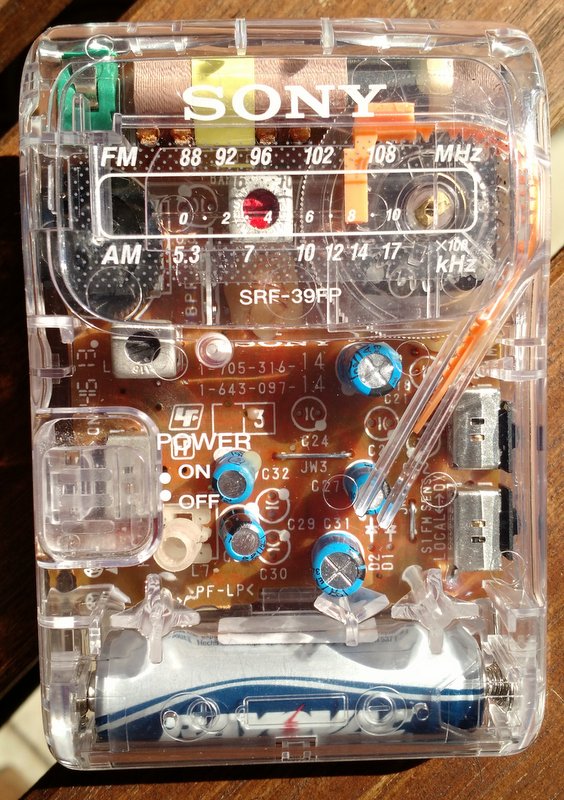
Sony_SRF-39FP-front

The Sony SRF-39FP (click to enlarge)

The SRF-39FP–the model with the clear case–was specifically designed by Sony radio for the prison market.

A couple years ago, someone on eBay had a lot of Sony SRF-39FP units on sale–I jumped at the opportunity to buy one new-in-box for $20 US. The entire lot of SRF-39FPs sold in a matter of hours. Indeed, the ’39FPs were so popular, by the time I prepared a post for the SWLing Post, the seller had already sold out. (I’m kicking myself for not buying at least one extra–!)

While most ultralight radio enthusiasts would give the SRF-39FP a performance edge over the SRF-59, they’re essentially the same radio–especially if you tweak the SRF-59 like my buddy Dave Richards did.

Click to enlarge

The Sony SRF-59 (click to enlarge)

Several weeks ago, while Steve researched the reason he was hearing shortwave broadcasters on his SRF-59, he also discovered that the SRF-59 had been discontinued and selling in many places for three or four times the original price.

He found one vendor still selling the SRF-59 for $14.99 plus shipping. I placed an order with this vendor over a month ago, but still haven’t received the product because the vendor hasn’t taken delivery of the final batch of units from Sony. I’m in contact with this vendor and when/if the units are received in stock next week, I’ll post an update here on the SWLing Post (if interested, follow this tag).

If you’re in the market for a Sony SRF-59, here are a few places you may find one new or used:

(If you know of other good suppliers, please comment!)

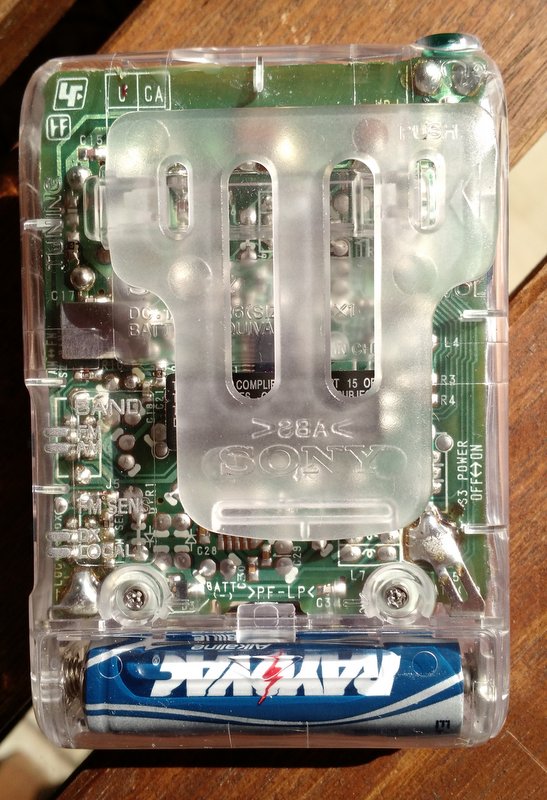
Sony_SRF-39FP-back

The SRF-39FP has a clear housing which is meant to prevent prison inmates from using it to smuggle contraband.

If you would prefer the Sony SRF-39FP, the only source I know of is eBay. When one becomes available, it typically sells for $45-50 US.

Click here to search eBay.

To be clear: while the SRF-59 is an exceptional ultralight receiver, $45-50 US would certainly place it in a price class with other excellent ultralights.

New from Heathkit: the Explorer Jr TRF AM radio receiver kit

HeathkitExplorerJr

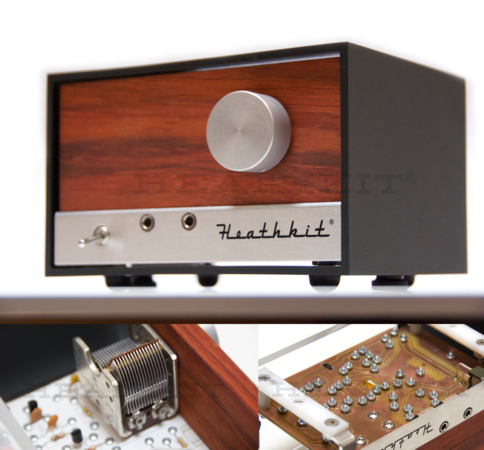
The Heathkit Explorer Jr. (Image Source: Heathkit)

Yes, the legendary Heathkit company is back and their first kit is a simple Tuned Radio Frequency (TRF) AM/mediumwave analog receiver: the Explorer Jr.

I knew Heathkit was back in business and under new management, but hadn’t heard any updates as of late. Their president, Andy, just sent a message to the “Heathkit Insiders” group explaining what the team has been up to:

“We’ve designed and developed a wide range of entirely new kit products. We authored the manuals for these kits, complete with the beautiful line art you rely on, preserving and respecting our iconic historic Heathkit style. We developed many new inventions and filed patents on them. We relocated Heathkit, and set up a factory, and a warehouse, and offices, in Santa Cruz, California, near Silicon Valley. We built the back office infrastructure, vendor and supply chain relationships, systems, procedures, operations methods, and well-thought-out corporate structure that a manufacturing company needs to support its customers, to allow us to scale instantly the day we resume major kit sales. All this effort enables us to introduce a fleet of new kits and helps ensure Heathkit can grow, prosper, and continue to bring you great new products for a very long time.”

The Insiders’ message goes into much more detail–I would encourage you to contact Heathkit about joining this group.

The big news in this message was the launch announcement of the Explorer Jr. kit which can be ordered from their website now. The price is $149.95 plus shipping. Heathkit anticipates a 30-day shipping time for the first set of orders.

Here’s a description of the kit from their website:

A Radio Kit Whose Time Has Come.

Again.

When Heath started designing & selling do-it-yourself airplane kits shortly after the Great War, the state-of-the-art in radio was the Tuned Radio Frequency (TRF) design.

A TRF radio was a great deal. If you had a great deal of money. A TRF receiver became a fixture in the homes of families around the world, receiving the news and music AM broadcasts of the day. A family AM radio was a big investment — $100 to $625 in 1929 dollars. (With inflation, that’s $1,400 to $8,700 in today’s dollars.)  Of course, at that price radios also were beautiful. They were made of fine wood, and designed to last. Radios were a visible and attractive furnishing you could be proud to have in your living room or parlor.

Heathkit’s TRF radio is a great deal. And a great deal of radio. This Explorer Jr TM radio is modeled on the original TRF designs, but better. You get to build it yourself. It’s safe and simple enough for beginners to assemble and understand. But it receives AM broadcast stations with performance superior to the vintage radios of 1930.

With the number of Heathkit enthusiasts out there, I suspect this first run of kits won’t last long. The kit trim is available in six colors: Silver, Cranberry, Cucumber Green, Plum Pie, Sapphire Blue, and Tangerine.

Click here to view and order the Explorer Jr on Heathkit’s webstore.

The Sangean ATS-909X: Marty’s bedside radio review

Sangean-ATS-909X-Marty

SWLing Post reader, Marty (W5MRM), comments:

I recently picked up a Sangean ATS-909X to use as a bedside radio.

This blog post inspired me to put together a video review of the ATS-909X as a bedside radio. The video review can be found on my youtube page [or via the embedded player below]:

Great video, Marty, and thanks for the thorough review!

You can follow all of Marty’s videos on YouTube by visiting this page.

The Oxo Good Grips Turntable for the Mediumwave DXer

turntable2

SWLing Post contributor, Robert Gulley, writes:

I recently purchased an Oxo Good Grips Turntable, 16” from Amazon. As the photos show, the size of the turntable can hold a fairly large radio (CC Radio EP and Select-a-tenna) on the turntable in almost any configuration. (Of course the CC Radio EP doesn’t need the Select-a-tenna, just used for illustration purposes for size.)

At $16.99 I think it is a good bargain, and seems quite capable of turning smoothly even with this amount of weight.

Click here to view on Amazon.com.

turntable1

Many thanks, Robert! I think that turntable is large enough to hold pretty much any portable radio; thanks so much for the photos (especially the one your kitty cat photo bombed, above!). I have several OXO products in my kitchen and have never been disappointed with quality, so I expect this turntable will last you a very long time.

Readers: If you haven’t checked out Robert’s radio blog, All Things Radio, I encourage you to do so!

Guest Post: Joris’ home brew Si4835-based receiver

Many thanks to Joris van Scheindelen (PE1KTH)–an SWLing Post contributor from the Netherlands–for the following guest post:


High Tech AM-FM DSP Receiver From
AM FM ontvanger P3060601

The old mode AM is still an interesting mode for amateur radio communication, also in amplitude CW.

Building your receiver is not difficult and quite fun. The semiconductor industry makes interesting integrated receiver chips today that will be useful for an AM receiver. Not only for broadcast reception but also for amateur AM reception or as part of an AM transceiver.

Silicon Labs also makes Si4734/35 receivers; these need a CPU to control the receiver, but are of interest for amateur use because the frequency can be tuned in 1 KHz steps and the audio channel bandwidth in 7 steps. There is no need for the transmitter to be on the receiving channel…

Si4835 AM-FM receiver

Looking for a small SW broadcast receiver design, and pocket size, I came to the excellent range of modern DSP receivers in a single chip from Slicon Labs.

I made a test bed set up has been made for the Si4835 AM-FM receiver.

The target specification was:

  • minimal components,
  • no micro-controller,
  • low power,
  • backlash free mechanical tuning,
  • good sensitivity,
  • earphone,
  • robust housing,
  • a short and small antenna system for outdoor use,
  • and minimal controls.

The Si4835 makes miniature design possible on a PCB (see photo Figure 1).

The red Dip (band) switch was replaced by a rotary switch in the final receiver design (Figure 4).

The receiver power is minimal 2 x 1.2 = 2.4 volts or a one cell LI-ION accu.
5 volts is the maximum for the Si4835 chip; current consumption is 30 mA.

Fig 1. Testbed setup for the Si4835.

Fig 1. Testbed setup for the Si4835.

The receiver has an RF pre-amplifier transistor and the LF amplifier is the TDA7050T.
All receiver functions are in the chip; the schematic is very simple and can be built with minimal components (see schematic appnote AN555 Fig 2. below).

Only an LF amplifier has to be added to complete the receiver.

schematic

Fig 2. Receiver schematic Si4835 in the AN555 application note.

The Si4835 receiver has the following frequency bands–they are divided in sub bands 800 or 900 KHz wide (See Figure 3). The frequency step tuning is 10 kHz on AM, following the international broadcast raster standard.

Fig 3. Si4835 receiver sub bands.

Fig 3. Si4835 receiver sub bands.

This means there are 80 or 90 receive channels in the sub bands and make finding the BC stations on the scale more easy. The 10 KHz scale steps are linear. The frequency stability is locked to the 32 kHz X-tal via the synthesizer so there is no frequency drift. The AM LF audio channel is 5 kHz wide set by the DSP filter. Volume control can be done width 2 up-down push switches or by a LF potentiometer..

Fig 4. The experimental pocket aluminium receiver housing on PCB2.

Fig 4. The experimental pocket aluminium receiver housing on PCB2.

Receiving results

I have been testing many hours and I am surprised about this little receiver.

The receiving results are excellent on FM and AM and signals of 2 -3 uV are well received.

Also the audio quality is good–especially on FM. As can be seen in the frequency table the 40 and 20 meter band are in the range. Clear AM phone amateur transmission has been received when the transmitter was tuned on the 10 kHz raster in 40 meter band on AM.

Also AM modulated CW signals can be received bud not un-modulated carrier CW–they sound “plop…plop”.

The 5 kHz wide LF channel is a bid too wide so many CW signals pass through the audio at the time, but if AM modulated that should not be a serious problem.

The broadcast stations in the SW bands (when the daytime conditions are good) up to 20 MHz are good and strong.

Conclusions

The Si4835 receiver can be a fine broadcast receiver for outdoor work and if an AM transmitter is tuned in the 10 kHz raster this receiver can also used for amateur phone reception.

Addendum: The Si4734/35 is a better amateur AM Receiver

The Si4734 and Si4735 are a better receiver choice for amateur AM purpose because the frequency tuning can be done in 1 kHz steps. Also the BW of the LF channel can be adjusted to 1 kHz wide.

In Fig 5. from the programming APP note you see the code 0X3102 AM CHANNEL_FILTER it is possible to adjust the audio width by sending this code to the Si4734/35.

Fig 5. From the programming APP note

Fig 5. From the programming APP note

The LF bandwidth can be set on 1, 1.8, 2.5, 2, 3, 4 and 6 kHz wide.

This is excellent for modulated CW and AM phone discrimination in the audio channel.

The disadvantage is the need of an CPU and LCD display, “away from a minimalistic design”.

See also the note 1 and 2 improved 100 Hz rejection. See data sheet of the Si4734/35.

It look like that this receiver is a good receiver for building a modern AM-(AM)CW receiver or in a transceiver application. Tuning can be done digitally.

Think about this receiver [and the Si4835 chipset] when you intent to build a high tech AM – T/RX.

73 ‘ Joris van Scheindelen PE1KTH


What a fantastic home-brew receiver, Joris! I love the simple design of your receiver and the fact that it’s quite portable.  Thanks so much for sharing your notes and documentation.

Frank shares 1991 recordings and original notes of station IDs and interval signals

Sony-ICF2010

SWLing Post reader, Frank, writes from Germany:

First let me say that I enjoy your blog a lot.

After a 2005-13 hiatus, I have rediscovered a childhood hobby and your reviews have helped me find my way to the post-Sony portable shortwave radio markets.

First, I obtained my “childhood dream” radio (Sony ICF 2001D), because at the time I made these recordings I was still in school and 1300 DM would have equaled over 1 year of pocket money, so a Supertech SR16HN had to do. I thought I got some fine results with this Sangean-Siemens re-branded receiver then, using a CB half-length antenna, a random wire, and much endurance.

The Supertech SR16HN (photo: Radiomuseum.com)

The Supertech SR16HN (photo: Radiomuseum.com)

I kept regular logs throughout the years, wrote to 50 international and pirate stations for QSL and compiled this cassette.

A few years before I got that trusty SR16HN, however, I recorded a few number stations (such as G3, Four Note Rising Scale etc) with an ordinary radio cassette recorder, and in 1991 I put them onto this tape as well. The other recordings are done with the same radio placed right in front of the SR 16HN.

Feel free to make use of these recordings. Most of it are the well-known international state-owned shortwave stations of the past; plus European pirates; plus number stations; and at the end, a few (off-topic) local Am and FM stations interval signals.

As I said, this collection I made shortly after the Wende/reunification period, when all former-GDR state broadcasters changed their names, sometimes more than once.

Please continue your good work on the blogs! Weather permitting I am often outside cycling and always have the tiny Sony ICF 100 with me (which I call my then-student’s dream radio of the later 90ies).

Cassette Side 1

Click to enlarge.

Frank’s original hand-written notes. Click to enlarge.

Click here to download Side 1, or listen via the embedded player below:

Cassette Side 2

Click to enlage.

Click to enlage.

Click here to download Side 2, or listen via the embedded player below:


Wow! Frank, what a treat to listen to all these station IDs!

I had forgotten how many interval signals have changed over time and how many, of course, have disappeared. This tape represents a flood of nostalgia for me.

I should add, too, that I’ve enjoyed hearing so many IDs in German. It’s funny, but we all get hooked on listening to language programming from our native or second languages. It makes me realize just how many broadcasters used to have German language services.

Again, many thanks, Frank, for taking the time to digitize these recordings and scan your original hand-written notes. This stuff is invaluable, in my book!