Category Archives: Nostalgia

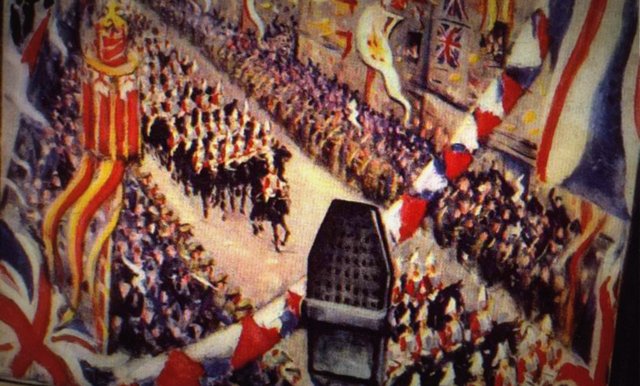
The BBC Genome Project

RadioTimes

Many thanks to Mike Barraclough who shares this news:

“BBC has today launched a website publishing every BBC programme ever broadcast by the Corporation from digitised editions of the Radio Times 1923-2009. Getting occasional internal errors at the moment presumably due to heavy use following publicity. Well designed and easy to search. http://genome.ch.bbc.co.uk/

The archive is quite deep–if you’re the nostalgic type, expect to spend a few hours browsing.

beHAVior Night celebrates 8 years on WBCQ

Gramophone

beHAVior Night’s host “Sir Scratchy” writes:

“This coming Friday marks the 8th anniversary of beHAVior Night on WBCQ! We will celebrate with an encore presentation of episode number one! Yes the first progamme to air on WBCQ. A blast from the past this Friday at 5:00pm Eastern on WBCQ The Planet. On the NEW WAVE at 7490 kHz or on the internet at WBCQ.com…”

I hope the propagation path to my home will open this Friday, as I would love to hear and record the show live (click here to listen to past recordings). WBCQ is an easy catch for me after daylight savings time ends in November.

Wartime radio: The secret listeners

RadioSecretService

After publishing the post about Geoff Hanley and the Radio Security Service last week, I discovered this brilliant 1979 documentary from the BBC which highlights civilian involvement in radio-based intelligence during WWI and WWII.

Here’s a description from the East Anglian Film Archive:

“It was the tireless work of amateur radio enthusiasts during World War I, that initially convinced the Admiralty to establish a radio intercept station at Hunstanton. Playing an integral role during the war, technological advances meant that radio operators could pinpoint signals, thus uncovering the movement of German boats, leading to the decisive Battle of Jutland in 1916.

Wireless espionage was to play an even more important role during World War II, with the Secret Intelligence Service setting up the Radio Security Service, which was staffed by Voluntary Interceptors, a band of amateur radio enthusiasts scattered across Britain. The information they collected was interpreted by some of the brightest minds in the country, who also had a large hand in deceiving German forces by feeding false intelligence.”

Click here to watch the 30 minute film. 

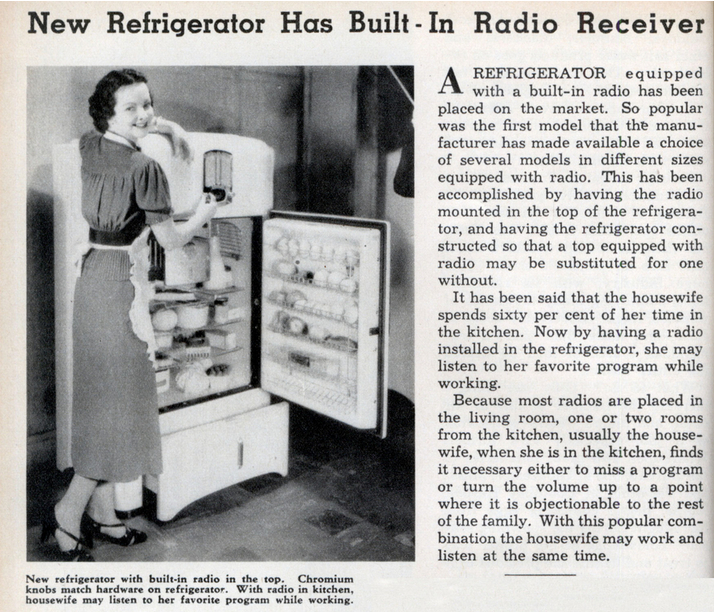
1930s refrigerator had built-in radio

Many thanks to Andy Sennitt for sharing this fascinating piece of radio nostalgia:

RefrigeratorRadio

Gizmodo columnist, Matt Novak, writes:

Jesse Walker, author of the book Rebels on the Air: An Alternative History of Radio in America, pointed me to this rather novel invention from 1937 — the refrigerator-radio combination unit. This may seem like an odd marriage of tech, but it makes perfect sense when you realise that it in the 1930s it was becoming harder to sell new radios and much easier to sell new fridges.

Despite the Great Depression, America saw an explosion of mechanical refrigerator ownership during the 1930s. In 1930, just 8 per cent of American households had a fridge. By the end of the decade, nearly half of American homes had one.

But the market for radios was pretty saturated in the late 1930s. Over 80 per cent of American households had a radio by the end of the decade. So radio set manufacturers tried to insert their products into new places that from the vantage point of the future, we can see didn’t pan out (like refrigerators) and others that did (like cars).

Continue reading on Gizmodo…

Geoff Hanley and the Radio Security Service

Geoff Hanley (Photo source: Express and Star)

Geoff Hanley (Photo source: Express and Star)

Many thanks to my friend, Phillip, for sharing this brilliant article from the Express and Star:

Researchers discover Wolverhampton man’s secret past

He was a happily married insurance agent with a secret that he took to the grave. 

Geoff Hanley was known to be a keen radio ham but nobody realised exactly what he was doing once he donned a pair of special issue headphones in his garden shed.

He would leave his family night after night to operate from the ‘radio shack’ that was specially blacked out for fear of air raids and in which he kept a sten gun, Lee Enfield 303 rifle and hand grenades.

When the siren sounded he ensured his wife, two children and dog were safe in the shelter he had dug in the garden of their Wolverhampton home but he would not join them. He stayed above ground at his post in the shed continuing to secretly monitor German military radio signals.

The operation was so hush-hush that even he may not have been entirely sure how the information he gathered was being used. But he was certain of two things – it was important and he could not speak about it to anybody outside those he worked with.

Continue reading…

Paul Litwinovich’s Vintage Radio series

SX-99-Dial

Many thanks to SWLing Post reader, Richard Cuff, for pointing out a brilliant series of articles called Vintage Radio by WSHU Chief Engineer, Paul Litwinovich.

Here are links to each article written thus far in the Vintage Radio series. If you would like to start at the beginning of the series, go to the bottom of the list first, then work your way up:

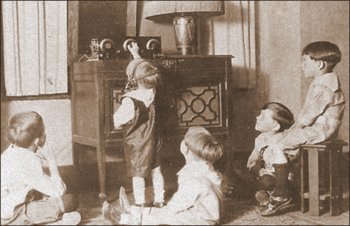
1-RadioListening

Paul Litwinovich is a shortwave listener, amateur radio operator and holds a commercial FCC license as well; here’s his bio, taken from the WSHU website:

“Paul caught the radio bug as a child. By age 12, he had taught himself the basics of vacuum tube theory.  He began repairing old, discarded radio sets, the kind that we now call vintage sets.  He loved listening, too, to local programs, DJs who picked their own music, talk shows designed to inform, not shock the listener.  But his favorite listening was to short wave radio, with its magic of music and programming from all around the world.

Hobby led to career.  Paul was a design engineer and engineering manager in the broadcast industry  for 14 years before coming to WSHU in 1990.  He holds an FCC commercial radio license, and an extra class Amateur radio license. And, oh yes, he’s still restoring and collecting vintage radio sets, for more than 45 years now, and counting.”

I’ve been in touch with Paul who tells me that an upcoming article will focus on one of my favorite WWII era receivers, the BC-348.

I can’t wait to read it!

Nothing on the bands? Check out the Shortwave Radio Audio Archive!

SWRAA-Shortwave-Archive-iTunes-LogoAlas! Lately, the sun has been playing tricks on those of us who enjoy the magic of radio wave propagation. Due to solar disruptions in the ionosphere, propagation has been fickle, albeit with a few good openings. And it’s not likely to get any better or more predictable over the next couple of days.

If you’re not hearing a lot on the bands, fear not: as history demonstrates, this solar interference will soon end, and conditions will again improve. But in the meantime, this is the perfect opportunity to listen to some of the hundreds of recordings in the Shortwave Radio Audio Archive.

Listening to the recordings and subscribing to the podcast is 100% free, and entirely void of any advertising. The fact is, I pay for this site out of my own pocket.  Not only does it serve as a historical record of radio, but it’s for listeners like us to enjoy.  We already have over 600 podcast subscribers, and invite you to subscribe–as well as to contribute content in the form of your own radio recordings.

Great content, great contributors

Speaking of contributors, check out some of Dan Robinson‘s recent offerings to the archive; many of these are very rare recordings, and all date back to the 1970s:

Brilliant stuff! I hope you will spend some time listening to these great recordings on the archive, and perhaps even join the many contributors by submitting your own recordings, too. Enjoy!