Shortwave listening and everything radio including reviews, broadcasting, ham radio, field operation, DXing, maker kits, travel, emergency gear, events, and more
Many thanks to SWLing Post contributor, Andrew, who correctly identified the radio Ed spotted in The Last Man On Earth as the Allocchio Bacchini RF4D. Andrew shared the following notes and links:
That radio is an Allocchio Bacchini RF4D (see photo below from this site):
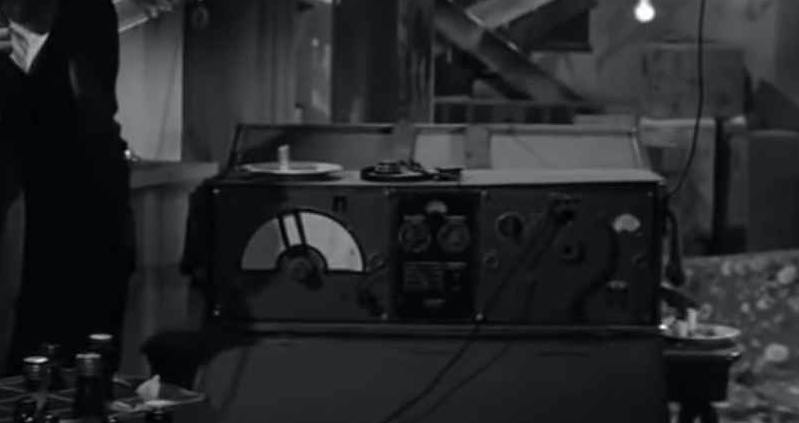
Here’s a snippet from an Italian movie showing the same rig:
Year : 1940 TX Frequency Range : 1,270 – 4,300 kHz in 3 bands RX Frequency range : 220 – 4,400 kHz in 5 bands Facilities : CW and RT Receiver Circuit (Valves) : Superhet. 7 tubes type 6RV (same as RF 4) Transmitter Circuit (Valves): MO(P C05), PA (2x P CO5) Mod.(3x 6RV) RF Output : 25 W Aerial : Dipole Power supply : 12 V storage batteries. Mains for battery charger.
And here you’ll find the shack of an Italian ham which shows an RF4D:
Wow! Thank you so much, Andrew! I would love someday to operate an original RF4D. What a fascinating WWII era radio. Thank you again for all of the details!
Post readers: I’m very curious if anyone here owns or has owned an RF4D. Please comment!
Many thanks for sharing this excellent bit of radio history, Ulis. I was just telling a friend that Radio Exterior de España still has one of the biggest signals out of Europe into North America these days on 9690 kHz.
Many thanks to SWLing Post contributor, Ed, who writes:
Recently I’ve been watching some pandemic-themed movies and found “The Last Man on Earth”, a pretty good 1964 post-apocalyptic science fiction horror film (which was remade in 1971 and 2007 with different titles.) In this film, the main character (well played by Vincent
Price) uses an HF transceiver in a fruitless effort to find other survivors of a global plague. It was shot in Italy, and the transceiver doesn’t look like any American radio I’ve ever seen. Perhaps some of your SWLing Post readers can identify it?
Many thanks to SWLing Post contributor, Mike Stutzer, who recently shared the following listener post:
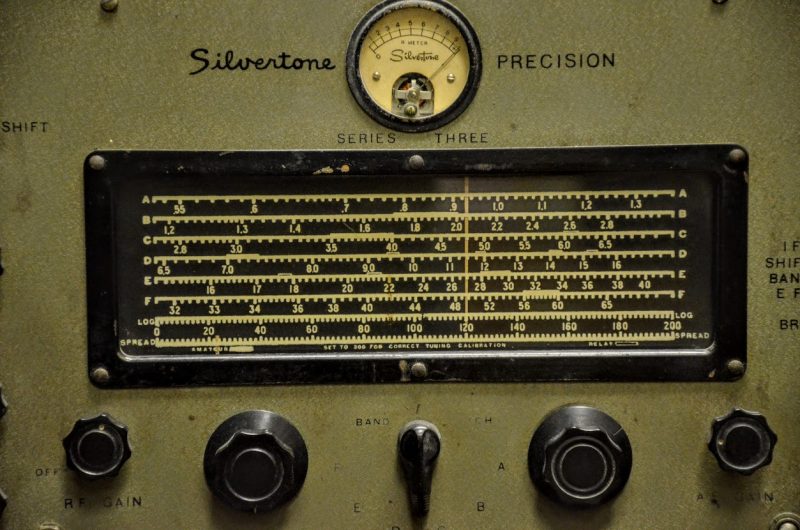
I started SWLing as a teenager. My favorite uncle gave me a Hallicrafters S-120.
My dad hung a longwire under an eave and through a casement window frame into my bedroom. I marveled at all the AM international stations broadcasting in English, listening to everything from BBC cricket coverage on Saturday morning to hysterically unbelievable Albanian political news coverage.
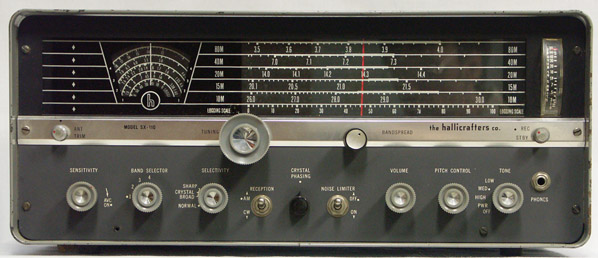
After college I could afford something better, so I upgraded to a “boat anchor” Hallicrafters SX 110. It had a useful crystal filter to improve selectivity, but it was still nigh on impossible to decipher a Ham on SSB.
Photo: Universal Radio
Many decades later I bought a house on a steep foothill. Realizing that it was a perfect QTH for a Ham station, I got licensed and now am President of the local ARC. Here is a loving look at the original SWL receiver that got me hooked.
Radio Waves: Stories Making Waves in the World of Radio
Because I keep my ear to the waves, as well as receive many tips from others who do the same, I find myself privy to radio-related stories that might interest SWLing Post readers. To that end: Welcome to the SWLing Post’sRadio Waves, a collection of links to interesting stories making waves in the world of radio. Enjoy!
Many thanks to SWLing Post contributors Tracy Wood, Dennis Dura, David Goren, and Kim Elliott for the following tips:
Dame Vera Lynn, who has died at the age of 103, was Britain’s wartime Forces’ Sweetheart, and remained one of the country’s most potent symbols of resilience and hope.
With songs such as We’ll Meet Again and The White Cliffs of Dover, she inspired both troops abroad and civilians at home during World War Two.
As Britain’s cities came under attack, her wistful songs, with their messages of yearning and optimism, were heard in millions of British homes.
And 75 years later, the country turned to her once again as it faced another stern test.[…]
THERE ARE NO BBC radio recordings surviving from before 1931, so the job of representing the 1920s falls to this curiosity from the Columbia Graphophone Company. It’s a 12” 78rpm disc made in 1928 in association with the Daily Mail newspaper.
It seems likely that the disc was somehow tied in with a Daily Mail campaign over urban traffic noise. The commentator on both sides of the disc is a man named Commander Daniel and he doesn’t approve of everything he hears in the city streets.
The recordings were made from single, static locations in Leicester Square and Beauchamp Place on Tuesday 11th and Thursday 20th September respectively. Columbia probably used a recording van equipped with a disc-cutter.[…]
When Michael Pack takes over as the first politically-appointed CEO of the U.S. Agency for Global Media, his first task will be to comprehend the bewildering array of international broadcasting entities under the USAGM. This includes two government agencies: Voice of America and Office of Cuba Broadcasting (Radio and TV Martí), and four government funded corporations: Radio Free Europe/Radio Liberty, Radio Free Asia, Middle East Broadcasting Networks (the Arabic-language Alhurra and Radio Sawa) and the anti-censorship Open Technology Fund. Within this structure are broadcasting outlets that straddle two entities, such as the Russian-language Current TV. All told, the entities distribute content in 61 languages.
When past that hurdle, Pack must then decide if he wants to maintain the journalistic independence of USAGM’s entities, or if he wants to move them towards advocacy of the administration’s policies.[…]
High-frequency traders will famously do almost anything to get the latest market data and send their buy and sell orders a few milliseconds ahead of the competition. They blasted through mountains to build the most direct fiber-optic routes possible between exchanges in a competition that transformed global markets and was made famous by Michael Lewis’s book Flash Boys. Soon, pinging light through glass fiber at more than 124,000 miles per second wasn’t fast enough—the glass slows things down—so traders moved on to microwave transmitters that send signals through the air.
But that has problems, too. Microwaves travel only roughly as far as the eye can see before they peter out and need a signal boost. Now two rival market telecommunications companies have signed a pact that they say will give traders more access to experimental wireless signals which can travel across oceans.
To do that, signals need a longer wavelength—known as a shortwave rather than microwave—that bounces between the water and atmosphere. It’s an imperfect solution. The waves can handle only a fraction of the data that fiber can, carrying about a kilobit per second vs. gigabits. And some signals can be lost.
Raft Technologies Inc., a startup based in Tel Aviv, says the trade-offs are worth it. Raft says it can send data over shortwave from Chicago to Frankfurt in 31.4 milliseconds, which it says is about 4.5 milliseconds faster than the best available fiber route. That’s an eternity in an industry that tends to measure improvements by the thousandth of a millisecond. The company says the signal is about 85% reliable, compared with 100% for fiber. Clients can use a fiber line in parallel as a fail-safe measure.[…]
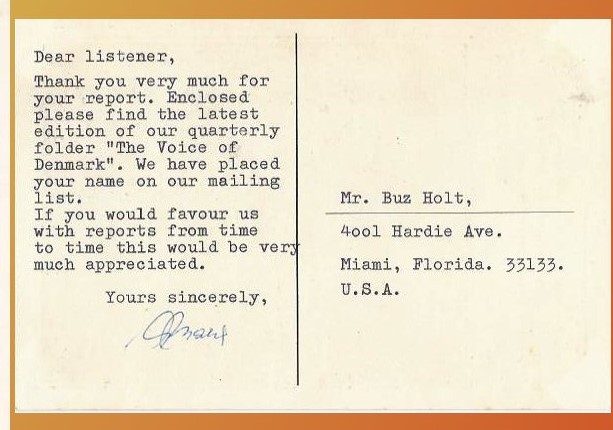
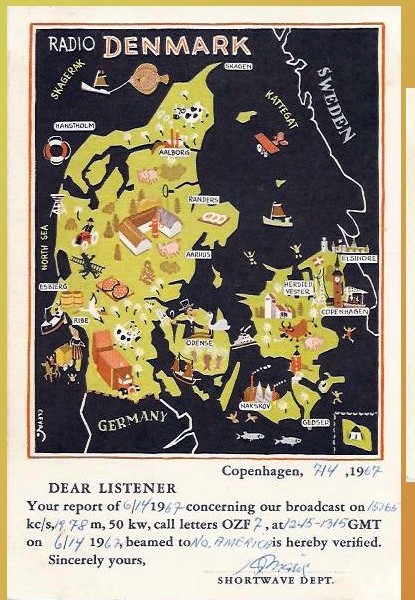
Many thanks to SWLing Post contributor, Al Holt, who shared the following QSL and note on Twitter:
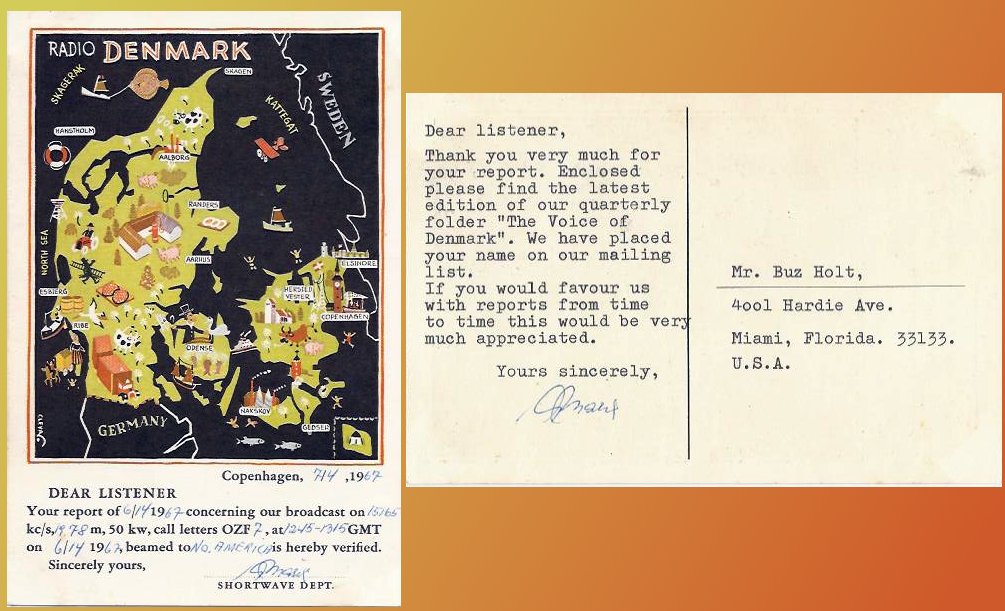
The posting about WRM and its originating from Denmark got me thinking about my early days SWLing and the wonderful QSL card I got from R. Denmark.
I hope to tune WRM on 19m soon!
Thank you for sharing this, Al! That particular Radio Denmark QSL cards is one of my all-time favorites. I never received one myself, but I’ve always been fond of maps like this that highlight regional attractions/specialties.
Radio Waves: Stories Making Waves in the World of Radio
Because I keep my ear to the waves, as well as receive many tips from others who do the same, I find myself privy to radio-related stories that might interest SWLing Post readers. To that end: Welcome to the SWLing Post’sRadio Waves, a collection of links to interesting stories making waves in the world of radio. Enjoy!
Many thanks to SWLing Post contributors Heath Hall, Tom Daly, and Alexander (DL4NO) for the following tips:
[Note: this article may require login to read at the NY Times]
Afghans once tuned into Radio Afghanistan twice a day to hear the reading of death notices. But in an age of social media, the voice of the nation has lost much of its sway.
KABUL, Afghanistan — Through decades of coups, invasions and endless war, Afghans tuned their radios to Radio Afghanistan every morning at 7 and every afternoon at 4:05 to hear the names of the newly dead.
One of the voices they often heard reading those death notices belongs to Mohamad Agha Zaki, at the mic for the state broadcaster for more than 42 years now. For much of that stretch, his counterpart at the station has been Ziauddin Aziz, the clerk who rushes to Mr. Zaki with the messages the public brings to the station’s small “Death Advertisements” window.
“Ads today?” Mr. Zaki, half asleep, asked on a recent dawn after opening the door to Mr. Aziz’s knock. Outside, birds chirped and the new day’s soft light covered the peaks of the tall pine trees in the station’s compound in Kabul, the capital.
No, said Mr. Aziz, who had waited behind the door in the kind of deference saved for masters of a different era. They had gone weeks without anyone arriving at the little window — just four ads in 40 days, though certainly many more had died.[…]
The US Postal Service (USPS) has temporarily suspended international mail acceptance for items addressed to certain destinations due to service impacts related to the COVID-19 pandemic. This situation could result in the return or loss of mail, such as QSL cards, addressed to affected parts of the world. The USPS has posted a list of affected countries, which is updated regularly. The Postal Service will, upon request, refund postage and fees on mail bearing a customs stamp that’s returned due to the suspension of service, or the sender may re-mail returned items with existing postage once service has been restored. When re-mailing under this option, customers should cross out the markings “Mail Service Suspended — Return to Sender.”[…]
In this video Shannon Morse KM6FPP visits coastal radio station KPH which provided ship to shore communications using Morse code. Volunteers have preserved it and operate weekends
Watch The Last Active Morse Code Station in the US – KPH Radio Station
More information about the Software Defined Radio Academy (Upper-Bavarian Bulletin)
Hamradio online
The Hamradio normally is the largest ham radio exhibition in Europe. But this year it cannot be held.
At the beginning of April, a team around the project manager Markus Heller, DL8RDS, started the project “Hamradio online”. This was only possible as DARC, the German hamradio society, started to introduce electronic collaboration tools long before Corona.
Within this virtual working environment a concept was developed of presentations, distinctions, and more. The program is being prerecorded and will partly be produced as live as possible. Especially the SDR Academy heavily depends on viewer feedback. There will also be videos from the Hamradio Convention that was held last March im Munich. These videos have not been published before.
The infrastructure is being maintained by the teams of the SDR Academy and “Facination Hamradio”. They produce the videos and streamline the installation so all action on the last weekend of June will happen smoothly. These transmissions will be transmitted through several Youtube cannels.
Obviously, personal meetings would be preferable. The advantage of this new solution are the possibly much more participants on both sides: audience and lecturers. The advantage is especially valid for the SDR Academy as most of it is done in English.

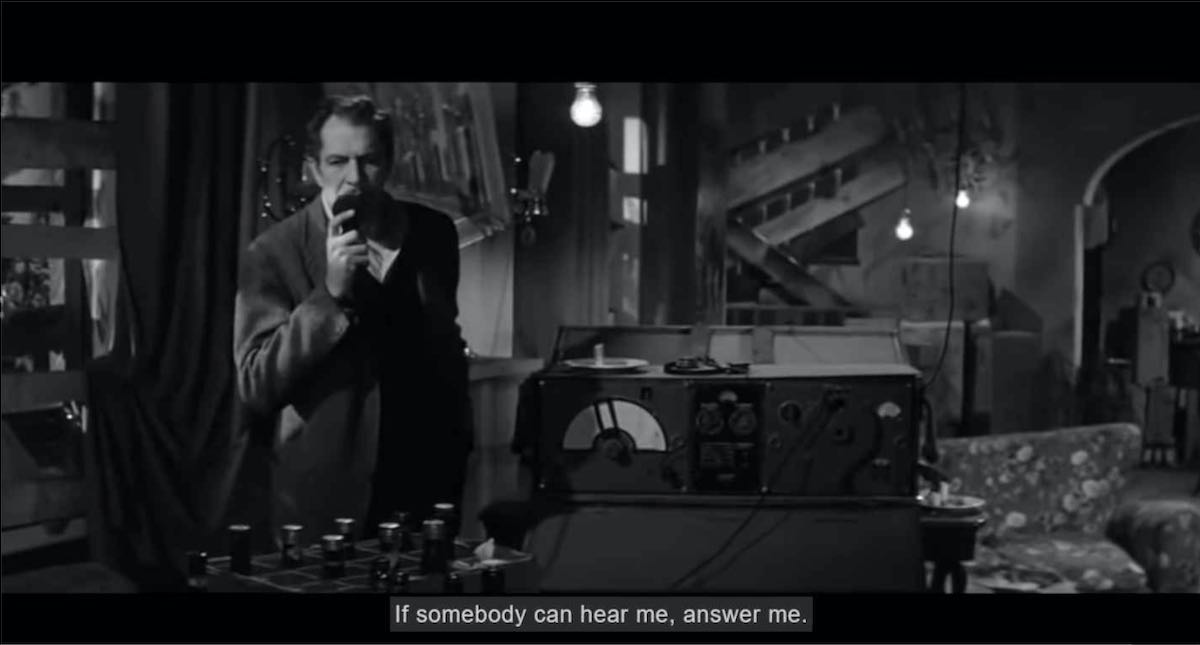 Many thanks to SWLing Post contributor, Andrew, who correctly identified the radio Ed spotted in The Last Man On Earth as the Allocchio Bacchini RF4D. Andrew shared the following notes and links: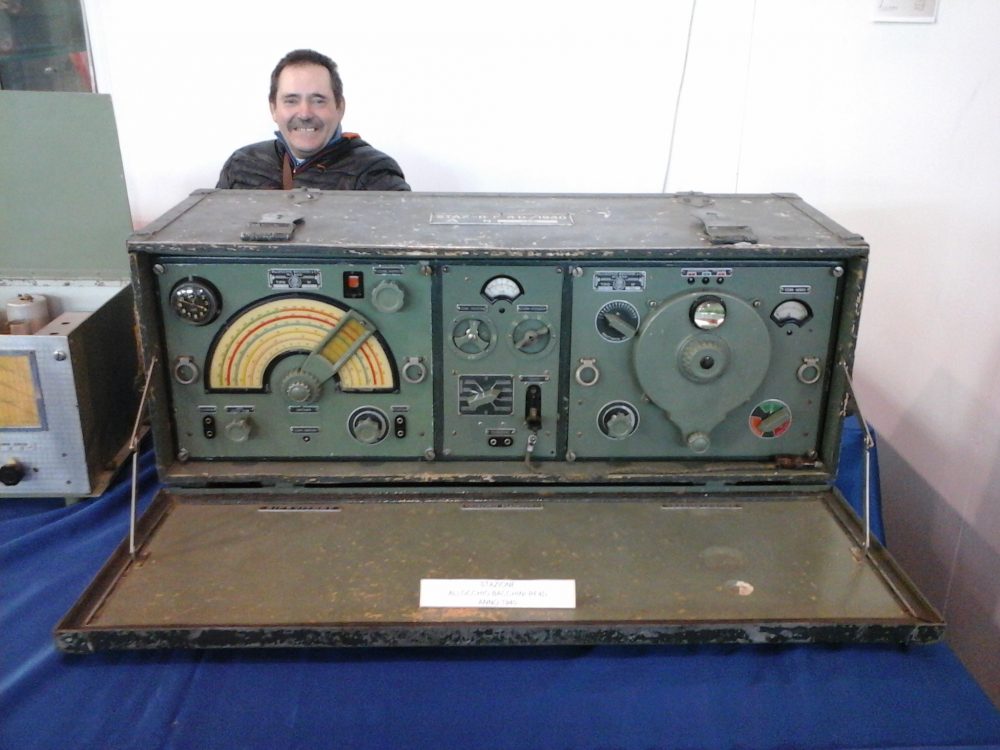
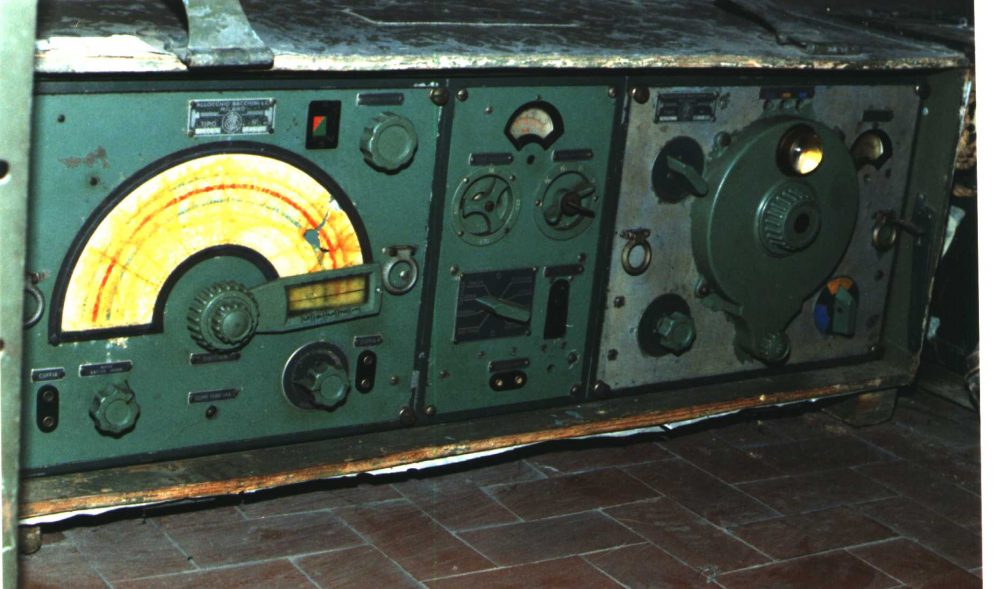
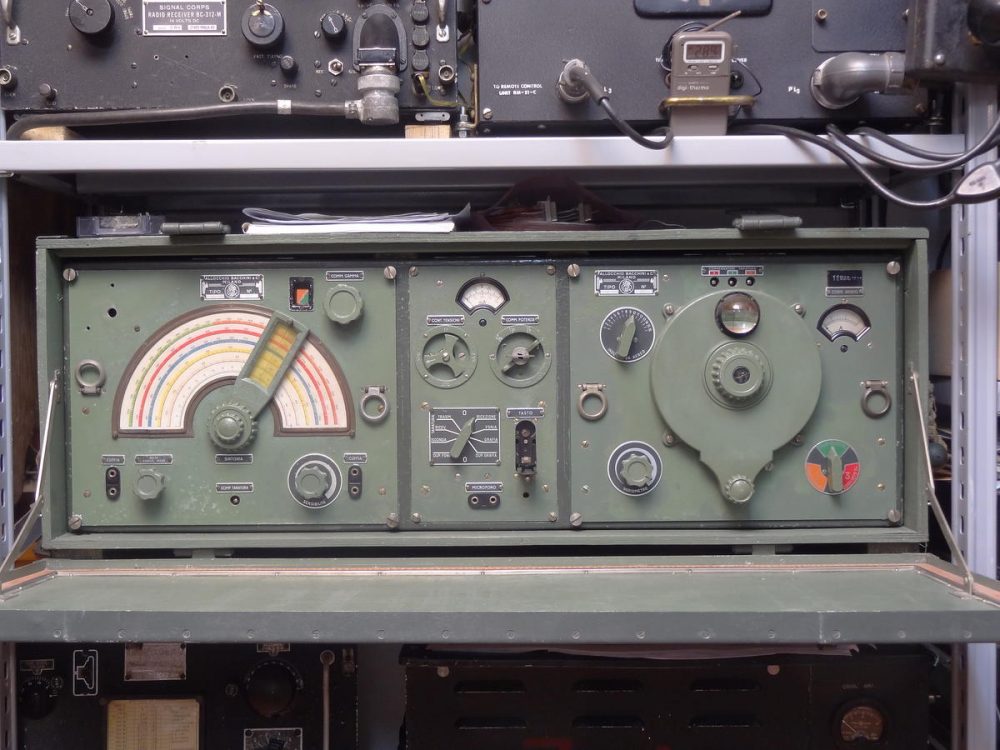
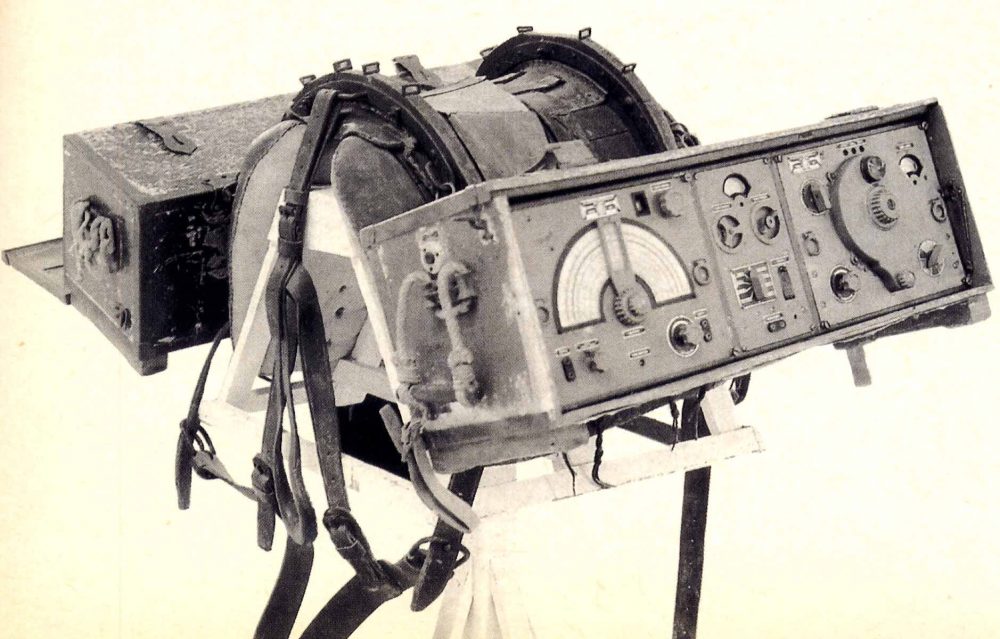 Wow! Thank you so much, Andrew! I would love someday to operate an original RF4D. What a fascinating WWII era radio. Thank you again for all of the details!