Category Archives: Radio History

US Signal Corps: Horseback mobile

SignalCorpsHorse

Source: Time Magazine; BETTMANN / CORBIS

Yesterday, I stumbled upon this 1940 photograph of the US Army Signal Corps communicating via radio in the field.

I bet that radio kit weighs almost as much as or more than the typical soldier!

Does anyone know what model of Signal Corps radio that would be?

Update…

Richard comments:

Thomas,

The original photo is at the site below.

At the link, https://tinyurl.com/hxp5akx

It’s a Radio Set SCR-203 (Phillip pack saddle mounted). Consisted of:
BC-228 transmitter – Transmitter, 2.1-3.1 MHz, 2 ea VT-25 & VT-50, Part of SCR-203
BC-227 receiver – Receiver, 2.1-3.1 MHz, Part of SCR-203
BC-235 control box – Control box, Part of SCR-203

The unit was powered by various battery packs and a GN-35 hand cranked generator and used a 25 ft whip antenna (Image: W.J. Schweitzer collection)

Thanks so much for identifying the equipment, Richard!

Paul Litwinovich on “The Life, Decline and Possible Rebirth of AM”

Zenith-Shuttle-DialMany thanks to the SWLing Post reader who noted this latest post by Paul Litwinovich at WSHU (Paul is frequently referenced here on the Post).

A short excerpt:

“AM occurs elsewhere in nature. A lightning strike or manmade electrical discharge will produce a burst of electrical noise that varies in amplitude. Since AM radios are designed to detect variations in amplitude, this is why they are prone to interference from such things. AM held sway as the primary method of modulating a radio wave up to WWII, not only for broadcasting, but for all types of radio communications.

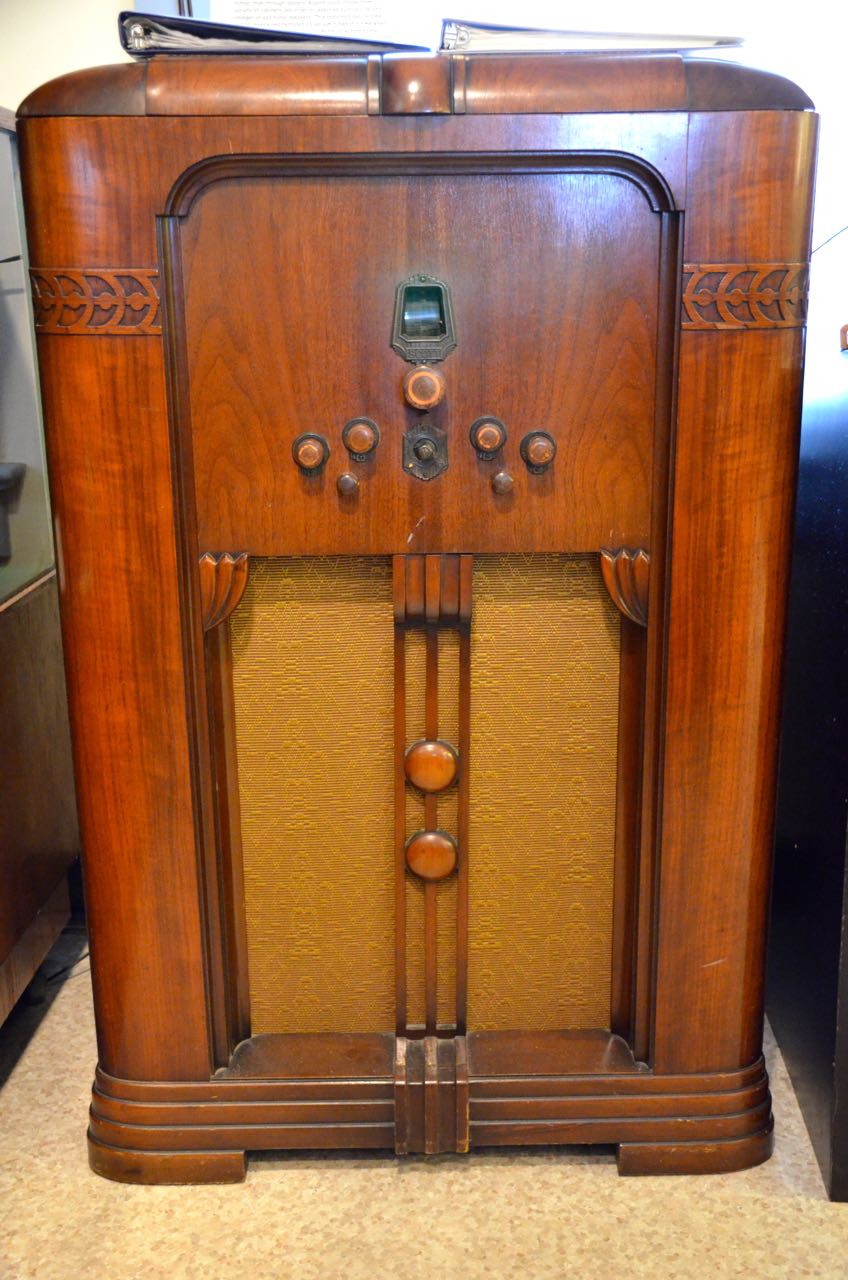
Every vintage consumer radio, be it standard broadcast or shortwave, up to WWII, received amplitude modulated signals. Nowadays, AM broadcast stations are associated with lower quality audio, but such was not always the case. Receiver design really came of age in the 1930s with the superheterodyne circuit and advancements in loudspeaker design. The grand floor consoles of the late 1930s leading up to WWII were capable of producing audio that was very good, even by today’s standards, the only exception being that they were monaural, as stereo technology was still a ways off.”[…]

Litwinovich’s article is a must-read as he gives a concise overview of amplitude modulation, AM vs. FM, and even covers current proposed uses of the broadcast band (something we’ve also recently mentioned).

Click here to read The Life, Decline and Possible Rebirth of AM.

KIRO saves radio history by accident

Crosley-Dial-BlackAndWhiteMany thanks to SWLing Post reader, William Lee, who shared the following story from Mynorthwest.com about how radio station KIRO saved a bit of radio history through “accidental preservation.” Here’a an excerpt:

One of the most important events of the 20th century was World War II. The Cold War that followed and many of the national borders that exist to this day were largely created during that deadly, years-long conflict from the late 1930s to 1945.

An expert speaking at the Library of Congress at the first-ever Radio Preservation Task Force Conference described how one of the most important tools for understanding World War II is available to researchers only because of an “accident” at KIRO Radio more than 70 years ago.

During his keynote address last week in Washington, DC, longtime archivist and librarian Sam Brylawski spoke of KIRO Radio’s role in saving a priceless audio record of American history.

It was a case of “accidental preservation,” Brylawski told the audience of more than 200 radio history scholars from around the US and Canada, that resulted in the creation of a nearly complete archive of CBS news broadcasts during World War II.

“KIRO is the station in Seattle that cut lacquer discs to timeshift,” Byrlawski said, explaining how the scheduling of live broadcasts of CBS Radio’s news coverage was aimed at the Eastern time zone, which was not convenient for West Coast audiences. KIRO, as Brylawski described, violated network radio policies to make recordings of news programs on giant, 16-inch diameter discs, and then play them back a few hours later at times that were more convenient to Seattle-area listeners.

Continue reading the full article and listen to the audio report at Mynorthwest.com…

Radio 4 Doc: Learning to Listen

Atwater-Kent-DialLooking back through my notes this morning, I re-discovered this excellent documentary on the early days of radio listening; how radio changed the way we interacted with music and how we interacted with our radios.

(Source: BBC Radio 4)

As broadcasting took the world by storm in the 1920s, the radio quickly became the hub of many households. Entire families would huddle around their receiver, each person individually connected with their own headset.

But for this first generation of radio listeners, the flexible styles of listening that we habitually employ today were by no means innate – many sat silent and fully attentive, listening just as they would in a concert hall.

Historian Dominic Sandbrook charts how a new, more informal style of listening gradually evolved through the 1920s and 30s, by delving into the diaries of the Austrian musician Heinrich Schenker.

Schenker began to record what he heard on the radio within days of the inaugural broadcast from Austria’s first official station, Radio Wien. This rare and fascinating record, which spans just over a decade, offers tangible evidence of how new approaches to listening emerged over these formative years. We’ll follow Schenker’s journey as the radio shifts from being something that demanded his rapt attention, to eventually becoming an integrated part of his domestic life.

Click here to listen to the full documentary on Radio 4.

Vintage advert: The 1938 Bush S.W.45

Click to enlarge.

Click to enlarge.

Many thanks to SWLing Post contributor, Christopher Brennen, who shares this retro advert (above) from Retropia.

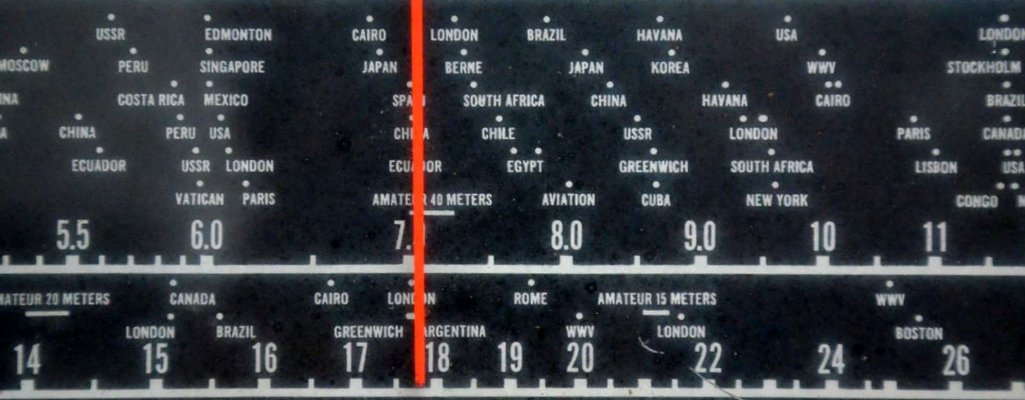
I’m very curious what it must have been like to tune the Bush S.W.45. Seems the big selling feature was its ability to reliably tune closely-spaced stations. The ad claims:

“[T]he Teleflic comes to your assistance by giving you the equivalent of a dial 12 feet long, every station with its own number!”

I’m sure this was a brilliant innovation at the time.

I found this image of a fully-restored S.W.45 in an album by Photobucket user Retired2000:

http://i1085.photobucket.com/albums/j436/retired2000/Vintage%20Bush%20SW45%20radio/Fullyrestored.jpg

Indeed, he did an amazing job restoring this radio–check out the full album here.

I love the S.W.45’s dial. From a distance, the graphics almost look like sci-fi–like a panel on the star ship Enterprise.

Thanks again, Christopher!

CBS considering the sale of its radio division

When Charlie Chaplin finally allowed the world to hear his voice after 20 years of mime, he chose CBS's airwaves to do it on. (Source: Wikipedia)

When Charlie Chaplin allowed the world to hear his voice after twenty years of silent performance, he chose CBS for the broadcast.

(Source: LA Times)

CBS Corp. is poised to exit the radio business that it helped create.

Eighty-eight years ago, the company’s founder, William S. Paley, bought the nascent Columbia Broadcasting System, and those radio stations became the nucleus of a budding broadcast empire.

But on Tuesday, CBS Chairman and Chief Executive Leslie Moonves said the company was exploring strategic options, including a sale or spinoff, of its entire radio division.

“The aim here is to unlock value for our shareholders,” said Moonves, who made the announcement during an investor day in New York.

The decision marks the end of an era and highlights the waning influence of commercial radio, which is no longer considered a growth industry. Young adults spend more time listening to digital music files, podcasts and subscription Internet radio services such as Spotify and Pandora. The shift has prompted major advertisers, including car dealerships, wireless phone companies and financial services firms, to steer more of their marketing dollars to digital platforms.

Continue reading at the LA Times’ website…

Radio World: Schenectady Shortwave Transmitters, 1941

philco38-4_dial_1Many thanks to SWLing Post contributor, Dan Robinson, for sharing a link to the following article in Radio World:

The General Electric Co. was truly among America’s premier broadcasting companies.

In addition to developing much of early broadcast technology and building a trio of high-power AM stations in the early 1920s — WGY Schenectady, N.Y.; KOA Denver; and KGO Oakland, Calif. — GE was also the country’s pioneer shortwave broadcaster.

GE’s initial shortwave station, 2XI, first broadcast in 1923, and in 1924 it was used to relay WGY’s programs for to KOA and KGO for rebroadcast in the western U.S.

By 1925, there were two experimentally licensed shortwave stations in Schenectady: W2XAD and W2XAF. A third GE station in San Francisco, W6XBE, was added in 1939.

That was the year that the Federal Communications Commission allowed the country’s experimental shortwave stations to relicense as commercial operations, and these three GE stations received the call signs WGEA, WGEO and KGEI, respectively.

Continue reading the full article at Radio World.