Shortwave listening and everything radio including reviews, broadcasting, ham radio, field operation, DXing, maker kits, travel, emergency gear, events, and more
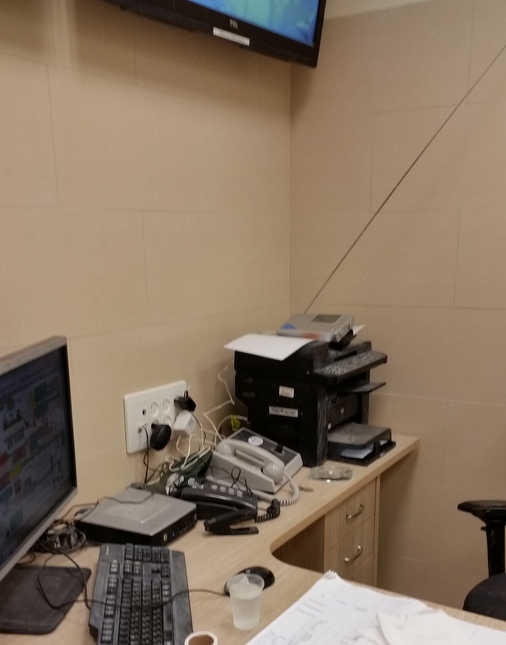
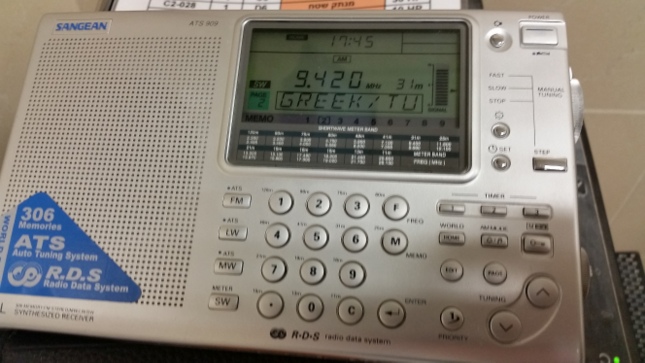
In the attached photos my Sangean receives Elliniki Radiophonia at 9420kHz at my working post. Note the amount of computers, screens and the fact that the radio sits on top of an HP printer.
Still audio is clear and clear reception with only telescopic antenna.
The other radio is my beloved Ben-Gal 1958 tube radio (Israeli made). It looks very much like German radios of the time.
[The Ben-Gal] is in daily use. Anyone seeing this radio loves it, especially when I turn it on!”
Many thanks for sharing these photos, Moshe! Your reception of Elliniki Radiophonia must be exceptional in Israel to overcome all of that office RFI.
The Ben-Gal must produce some rich audio; I bet it’s a champ on medium wave with that large internal ferrite bar! Beautiful set! Thanks again for sharing!
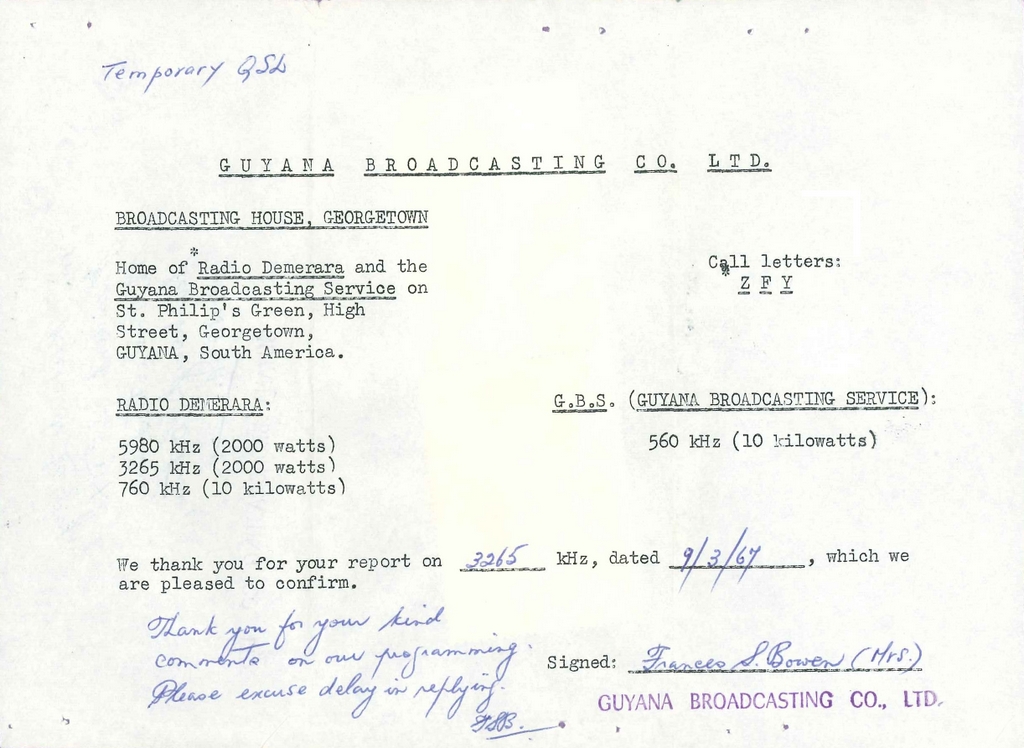
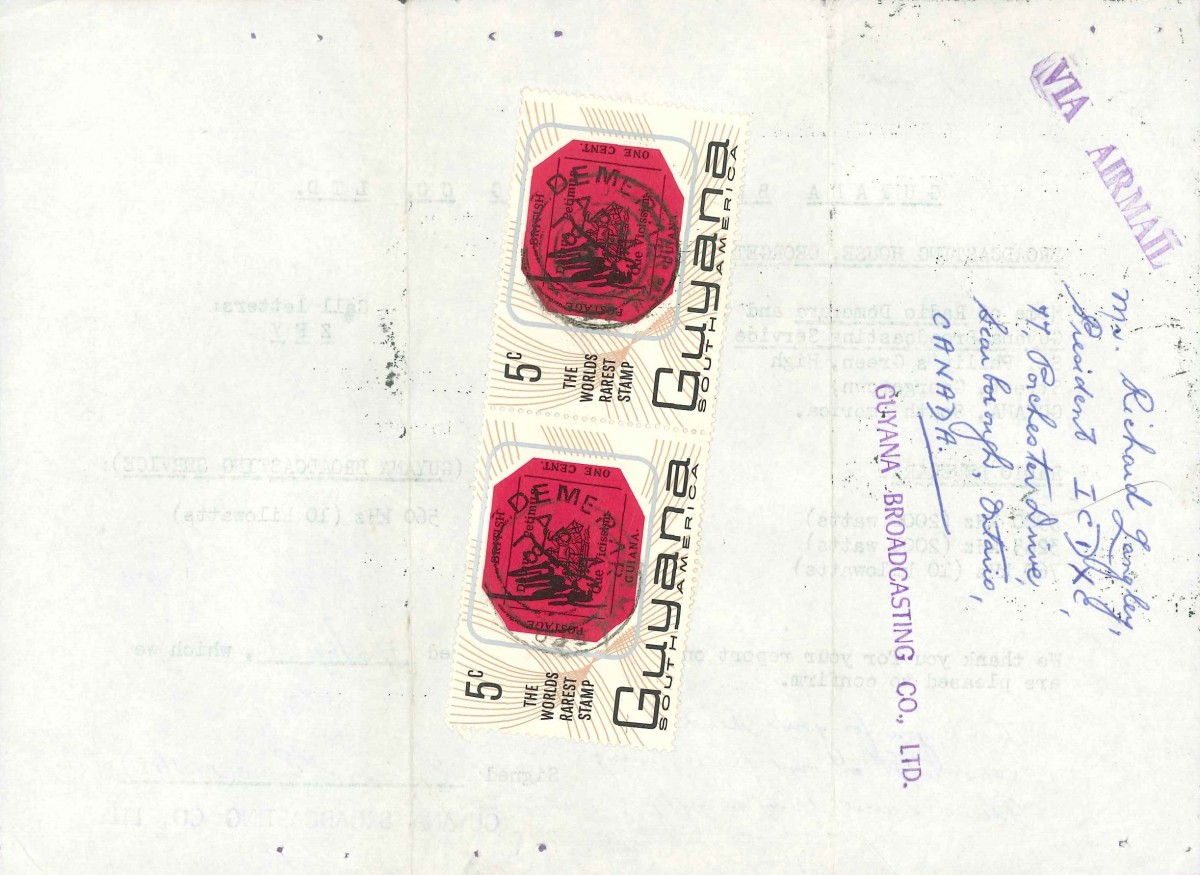
“Your recent post sent me to my archives and I’ve found my QSL from Radio Demerara, the predecessor of the Voice of Guyana. Copies of the front and back of the QSL letter I received are attached.
The QSL was for reception on 13 December 1966 at 01:00 UTC at my home in Scarborough, a suburb of Toronto. This was in the same year that Guyana achieved independence from the United Kingdom.
In addition to a commercial for Ovaltine, I heard a program of announcements including births, birthdays, deaths, and personal messages. I used a two-tube Knight-Kit Span Master regenerative receiver, which I built a couple of years earlier when I was in Grade 10, along with a 43-foot inverted-L antenna attached to the top of my mother’s clothesline.
Along with a friend, I had established the Intercontinental DX Club, which we ran for a few years until it came time to go to university. But that’s another story.”
The Intercontinental DX Club? What a great name! You’ll have to share that story sometime, Richard!
Many thanks for scanning this QSL from Radio Demerara. I love the fact that they noted “Temporary QSL” at the top of the letter and apologized for the delay in response. What a great piece of radio history and so relevant as we hear the Voice of Guyana return to the shortwaves.
Shortwave Radio Audio Archive contributor, Richard Langley, has digitized another set of historic off-air recordings–this time, documenting the independence of Lithuania through Radio Vilinus.
Many thanks to Richard for the following guest post and archived audio:
Radio Vilnius 1990-1991
On 11 March 1990, Lithuania was the first Soviet republic to declare its independence. The Soviet Union issued an ultimatum to the Lithuanian authorities to renounce independence or suffer the consequences.
On 17 March 1990, Lithuania rejected the demand and the Soviet Union responded by applying economic sanctions and occupied parts of Vilnius, the capital city. In January 1991, the Soviets launched a larger scale operation against Lithuania. On 11 January, Soviet military units seized several building in Vilnius and elsewhere. On 12 January, civilians congregated outside some strategically important buildings such as those of the Supreme Council (the Seimas Palace), the Radio and Television Committee, the Vilnius TV Tower, and the main telephone exchange in an attempt to prevent them from falling into the hands of the Soviet military. In the early hours of 13 January, tanks and soldiers attacked the TV tower. Fourteen Lithuanians and one Russian soldier died.
Subsequently, Soviet forces surrounded and entered the Radio and Television Committee building and forced the TV station off the air. Shortly thereafter, a small TV studio in Kaunas was used to resume TV transmissions and put out a call for help. Radio transmissions were also affected. Although Soviet forces were in the vicinity of the Supreme Council building, they retreated instead of attacking. The occupation and military raids continued for several months following the attacks.
Subsequent Lithuanian-Russian negotiations resulted in the signing of a treaty on 31 January. A referendum on independence held on 9 February overwhelmingly supported the full and total independence of Lithuania. Other republics of the Soviet Union declared their independence and following the resignation speech by Mikhail Gorbachev on 25 December, the Soviet Union was dissolved the next day. The last Russian troops left Lithuania on 31 August 1993.
Radio Vilnius, the external service of Lithuanian Radio, transmitted news about events in Lithuania and the other Baltic republics even at the height of the Soviet attacks. The broadcasts were made, in part, using transmitters elsewhere in the Soviet Union. However, there was a temporary interruption in these broadcasts after the occupation of the Radio and TV Centre by Soviet troops early in the morning of 13 January. They resumed on 25 January.
Radio Nederland’s “Media Network” programs of 20 January 1991 and 14 January 1992 featured reports on Radio Vilnius and the Soviet occupation. The sound files of these programs are available on the Web (“Media Network Vintage Vault“).
I have six recordings of Radio Vilnius English Service shortwave broadcasts between March 1990 and January 1991. These were received in Hanwell, New Brunswick, Canada, using a Sony ICF-7600D receiver and supplied wire antenna draped around the listening room.
28 March 1990, 22:00 UTC, 11770 kHz (00m:00s – 00m:55s)
Strong signal. Interval signal (IS) and station identification (ID) but the transmission was cut off in mid-sentence: “This is Radio Vilnius. Hello and welcome to our daily broad” All that could be heard faintly on this frequency then was Radio Liberty in Russian (“Govorit Radio Svoboda”). Initially could hear nothing on Radio Vilnius parallel frequencies until about four minutes into the broadcast when a very faint signal on 12060 kHz could be heard (not recorded).
29 March 1990, 22:00 UTC, 12060 kHz (00m:55s – 02m:04s)
Weak signal. IS, station identification, and first part of “News About Lithuania.” Radio teletype interference. Checked other frequencies.
3 April 1990, 22:00 UTC, 17665 kHz (02m:06s – 30m:02s)
Improved signal. Receiver briefly switched to other frequencies to check quality during the recording. IS, ID, “News About Lithuania,” report on the occupation of the Lithuanian Prosecutor’s Office on Friday night (30 March), music, sports news, “Lithuanian by Radio.”
Strong signal. Some co-channel interference from Radio Liberty. Receiver briefly switched initially to other frequencies to check signal quality during the recording. IS, ID, “News About Lithuania,” report about the Lithuanian Mission in Moscow, “Around Lithuania,” program in Esperanto (begins around 23m:08s) — a regular feature at the end of Monday broadcasts from Radio Vilnius in English. Interesting sign-off statement: “It’s goodbye and good luck.” On the recording, the Radio Vilnius transmission is followed at 29m:29s (on the same frequency), by the first approximately 15 minutes of a transmission from pro-Moscow Radio Minsk in Belorussian (now usually referred to as Belarusian). The transmission begins with the IS and ID (“Havorits Minsk … Radyjostancyja Saviecki Bielaru?”), followed by a news program.
Strong signal. Recording actually starts at about 22:58 UTC with music, the tail-end of a transmission on this frequency, likely from Radio Kiev. Some transmitter hum. Then, Radio Vilnius IS and ID. “We’re still hold up and we hope you can still hear us.” “News About Lithuania” including occupation news, commentary, and reports from the neighbouring Baltic states. Receiver briefly switched to other usual frequencies to check on signal quality (9750, 15180, 17690, and 17720 kHz; 6100 kHz not heard). Transmission ends with “And that’s all we have for our today’s broadcast, we hope not the last one, from Radio Vilnius in the Republic of Lithuania.” This is followed by the transmission schedule and contact information. After about 45 seconds, the Radio Minsk transmission begins with IS and ID.
Strong signal. Initial mix-up of interval signals. The first IS is believed to be that of Moskovskaya Radio, the Russian Service of Radio Moscow, followed by a bit of the Radio Moscow World Service IS, and then finally the Radio Vilnius IS. The transmission begins with the statement “We’re still broadcasting from Vilnius.” This is followed by the Lithuanian news reporting on the acts of aggression of the Soviet occupying forces and “Correspondents’ Reports.” The latter includes a report that the exam session at Vilnius University has been postponed to allow students to help protect buildings from the occupation forces, including the Radio and Television Building, and a report on the restrictions on travel. The reports were interrupted with “some news just come in” about a group trying to break into the building of the Council of Ministers. The announcer subsequently reported that the attackers had been put off and so the conflict has been neutralized. The broadcast ends with the statement “We hope to be with you tomorrow again” followed by the transmission schedule and contact information. The Radio Vilnius transmission is followed by the one from Radio Minsk. News organizations reported that Soviet troops entered the Radio and Television Building about 15 minutes after this Radio Vilnius transmission.
Strong signal on this and other frequencies usually received except 17690 kHz; only background noise on that frequency. However, there was no Radio Vilnius transmission on any frequency. It had been replaced by light classical and contemporary orchestral music. No IS or announcement of any kind. Music was faded out at 29m:03s before ending. During the recording, the receiver was briefly tuned to other Radio Vilnius frequencies to check on signal quality.
Strong signal. The recording begins with a few seconds of music from the previous transmission on this frequency. Then, after about one minute (there was no IS), the Radio Vilnius transmission starts with the beginning of the patriotic song “Lietuvninkai Mes Esam Gim?” (Lithuanians We Are Born) and an introduction stating that the broadcast is coming “from the capital of the independent Republic of Lithuania.” This is followed by “News About Lithuania” including items on further acts of violence by Soviet troops and severe winter weather. Then, there are reports on Lithuanian-Polish relations and the work of the commission on Soviet aggression. Next is an eye-witness report on the attack on the TV tower on the night of 13 January, a report on the current feelings of Lithuanians under occupation, and how music and the arts keep the people going. During the recording, the receiver was briefly tuned to other Radio Vilnius frequencies to check on signal quality. In addition to 7400 kHz, only 9750 and 17690 kHz could be heard.
Richard: Thank you so kindly for sharing these amazing off-air recordings.
My friend, Gary Wise (W8EEY), recently wrote with an inquiry; I’m hoping an SWLing Post reader can help…
Gary writes:
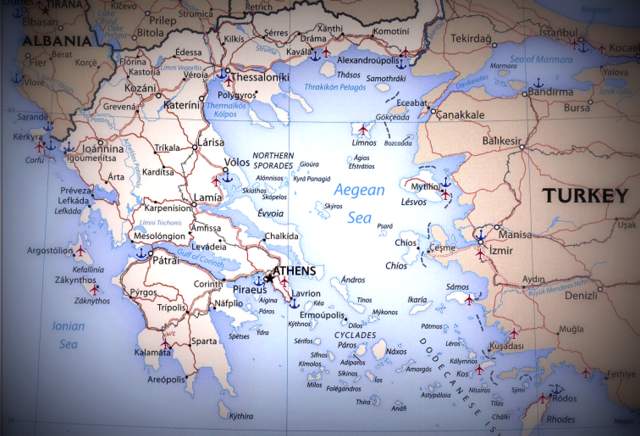
“As you might know I was the Station Manager of the VOA Greece Transmitting Station when it closed down in 2006. I’ve been contacted by one of the Greek employees. They are planning a reunion of former employees in April and would like to put together an audio montage of station sounds. They have some material, but would like to find a recording of the Greece Station ID (and possibly the one from Rhodes too). This was a male announcer stating that “This transmission came to you from Greece” or words to that effect.
Would you have such a thing, or know who might? I know the crew would greatly appreciate anything you might have along these lines.”
I don’t believe we have a recording of this in the SW Radio Audio Archive, nor in my local archives.
Does anyone out there have a recording of the VOA Greece Station ID? Please comment below or contact me.
[The following is a] recording of the penultimate English broadcast from Radio Berlin International (RBI) and the last broadcast in the particular time slot. It was also the last broadcast of the popular DX program DX-tra.
RBI ceased broadcasting at the end of the day on 2 October 1990, the day before German reunification took place.
In addition to the final episode of DX-tra, the recording features the news (in progress as the recording starts a minute or two after 00:45), Commentary, RBI Press Review, and Spotlight on Sport. There are several “goodbye” songs including “The Final Countdown” by the Swedish hard rock band Europe, and “Goodbye Blue Sky” by Pink Floyd and some announcer goodbye comments like “the voice of the disappearing German Democratic Republic,” “that was it,” and “the last day of the good old GDR.”
The 45-minute recording ends with the familiar RBI interval signal and, at 01:30 UTC, the first part of the German-language transmission, also the last in its time slot.
This recording was made in Hanwell, NB, Canada, with a Sony ICF-7600D receiver and supplied wire antenna draped around Richard’s home office. This recording begins around 0045 UTC, October 2, 1990 on a frequency of 9,730 kHz.
A series of special Radio Netherlands broadcasts will begin on January 17th and 18th, 2015. Presenters will be John van den Steen, Jerry Cowan and Tim Thomasson. See frequencies and times below:
0100 to 0200 UTC on 7,570 kHz
0100 to 0200 UTC on 11,790 and perhaps 13700
Peter sent no more information than this, so I’m not sure where the transmissions will originate. Since RNW is no longer on the air, I’m certain these broadcasts aren’t coming from Hilversum.
Hopefully, someone will attempt to record these broadcasts in case I’m not in the broadcast footprint. Would like to add this to the SW Radio Audio Archive.
One of the advantages of hosting a contributor-driven shortwave radio audio archive, is receiving off-air recordings of defining moments in our world history. This is certainly one of them.
SRAA contributor, Richard Langley, writes:
“I’ve started to convert some of my old cassette shortwave recordings to mp3 files. I’ve uncovered a box of about 25 tapes with recordings mostly from 1990 and 1991. This was an interesting era for shortwave. There was the reunification of Germany, the breakups of the Soviet Union and Yugoslavia, and the invasion of Kuwait by Iraq and then the First Gulf War. I monitored some of these events using my venerable Sony ICF-7600D receiver with the supplied wire antenna draped around my home office. I bought this receiver during a trip to Hong Kong (and the P.R.C.) in 1985. It was my first decent shortwave radio and I still have it but it has since been joined by several other receivers.
[…]
[The following] is a recording of President Mikhail Gorbachev’s resignation speech as broadcast live by the World Service of Radio Moscow. As the announcer says, “a moment of history in the making.” It begins at about the three-minute mark of the recording (at 17:00 UTC). The speech is followed by a program of classical music (filler), the News in Brief at 17:30 UTC, followed by part of the program “Africa as We See It.”
Richard: many, many thanks for sharing this recording–I can’t wait to hear the other treasures you uncover in your collection.
For your listening pleasure: Radio Moscow World Service from December 25, 1991 on 17,670 kHz, beginning at 1657 UTC. Click here to download this recording as an mp3, or simply listen via the embedded player below:
Please support this website by adding us to your whitelist in your ad blocker. Ads are what helps us bring you premium content! Thank you!