Category Archives: Radios

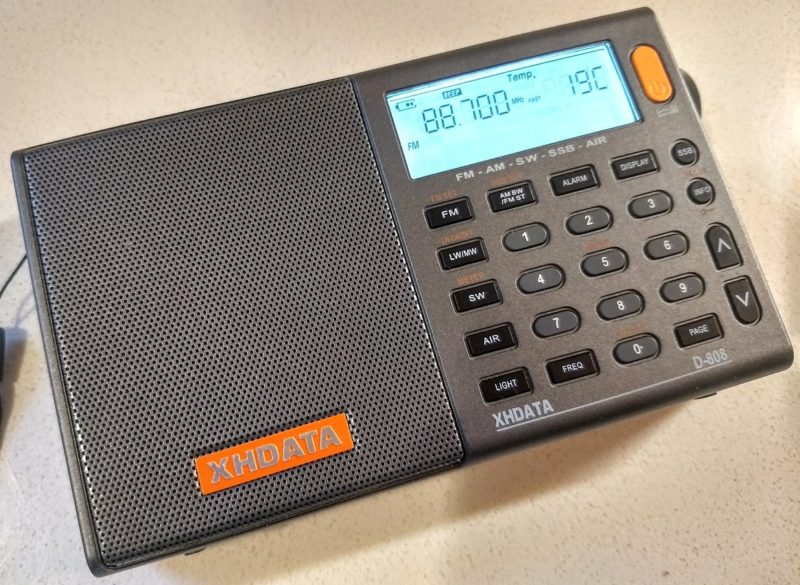
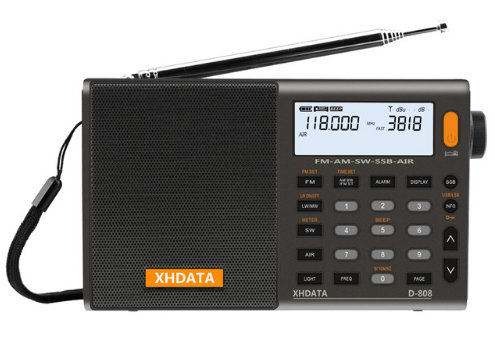
Georges’ review of the XHDATA D-808

Many thanks to SWLing Post contributor, Georges (F6DFZ), who writes:

After the first information from your wonderful website, I immediately ordered the XHDATA D-808 receiver from Aliexpress for €62 including shipment to France.

I got it very quickly, shipped from Amazon UK!

I did a few tests on SSB. MDS is outstanding, the minimum signal from my HP generator at -127 dBm (0,1uV), is strong even on 28 MHz. Selectivity is also good, and the opposite sideband rejection is audibly also good. However I was unable to measure it because the S meter give the same indication over a few kHz around the signal of the generator. I suspect the opposite sideband rejection to be done by the DSP chip at AF, but I cannot confirm this.

Reception is very good on FM, and the AF from the loudspeaker is reasonable. On headphones, it’s very good. RDS works as it should and sets the clock of the receiver.

I did only a few minutes test on LW and MW, and it seemed OK, even if I don’t have a lot of experience on these bands.

SW AM listening was very good; good audio, great selectivity. I suspect that the bandwidths given are AF bandwidths as even the most selective were not too much muffled. If it was IF selectivity, the AF bandwidths would have been half the values and much muffled.

SSB and CW reception are also very good even if the DSP chip has a long attack time and hence gives distortion during the beginning of each message.

About SSB: I think that this receiver is better than the [Tecsun] PL-880 and comparable to the PL-660.

Reception is good on the short but sturdy telescopic antenna.

If you connect the receiver to a large external antenna, you will encounter many IMD signals. As there is no built-in attenuator, you will need an external one.

The manual is correct, but very short about the memories.

ATS logs its findings into the first pages, so if you want to keep some memories, log them a few pages away.

The available pages are different with bands, FM has its pages, SW its pages etc…

Unfortunately, memories don’t keep the mode on SW–only the frequency and selectivity. After calling a memory, you will have to choose between AM, USB and LSB.

I was totally unable to light the “Preset” label on the display ?!?

Display and backlighting are very nice.

Somewhat odd, but the squelch seems to work sometimes on other bands than Air band !

Ergonomics are reasonable, quality of construction is good for the price.

Overall, for the price, this receiver is quite outstanding.

Best regards from France .

Georges F6DFZ

Thank you, Georges! Excellent thoughts on the D-808.  Your note about squelch control working outside the AIR band reflects what the Digitech AR-1780 does as well–hinting that firmware is very similar.

I fully suspect the D-808 is on the path to being one of the best radio values under $100 US.

Merci bien, Georges!

CommRadio CTX-10 availability update

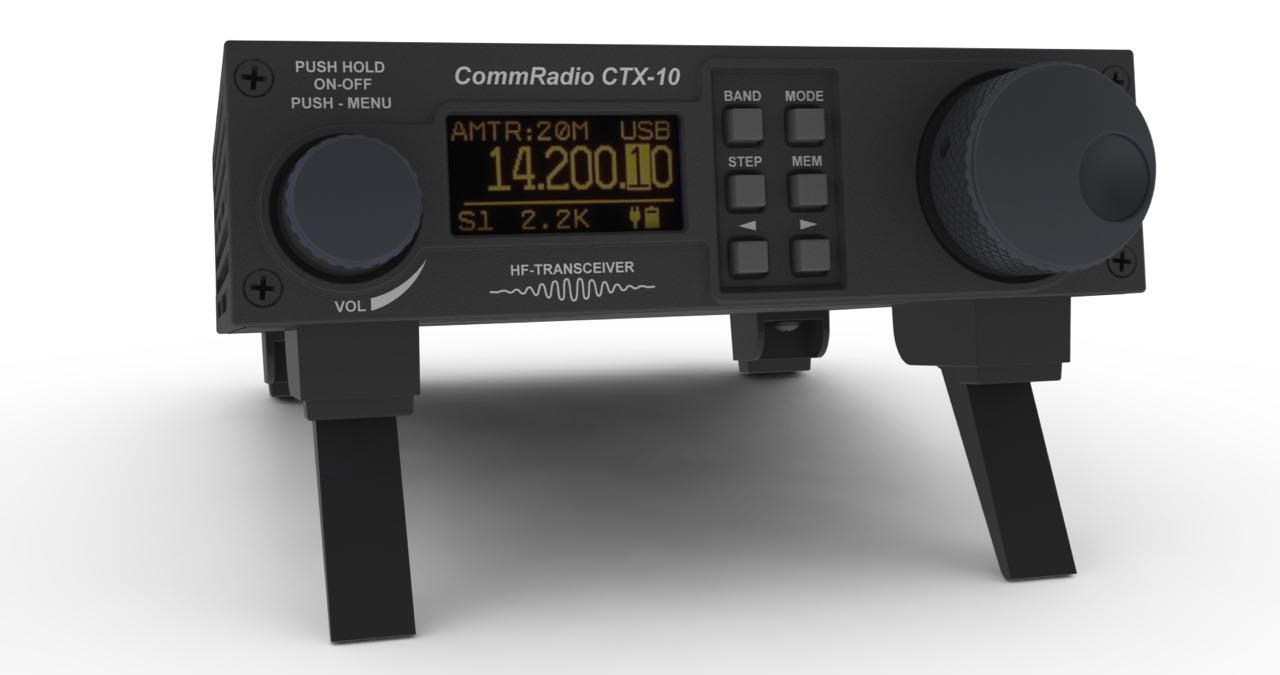
The CommRadio CTX-10 QRP transceiver

Universal Radio is now taking orders for the CommRadio CTX-10 QRP transceiver. The price is $999.99 and the expected shipping date is March 1, 2018. Universal notes that they will not charge customers until the units begin shipping.

Once radios are in production, I plan to review the CTX-10.

Click here to view the CTX-10 at Universal Radio.

Radio Deals: Eton Satellit and Orphan CC Skywave


Many thanks to SWLing Post contributor, Chris Frietas, who writes:

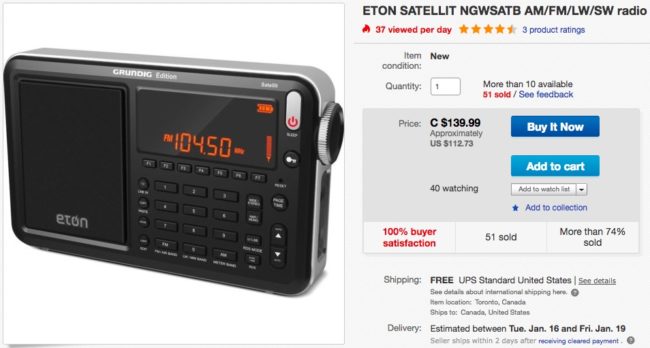
Hey Thomas, if anyone is looking for a new Eton Satellit radio…RadioWorld.ca is having a huge sale on new ones. They’re roughly $112-115 US:

Click here to view on eBay.

Thanks for the tip, Chris!  Happy to see RadioWorld still have this sale available! At time of posting, eBay claims they’re 74% sold.

Original CC Skywave

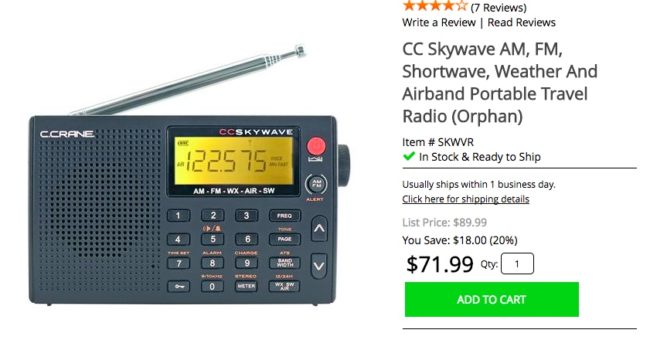
Additionally, I just received an e-flyer from C. Crane.  They’re having an inventory reduction sale which includes some “Orphaned” CC Skywave units.

C. Crane orphaned radios are typically open box units that have been checked over carefully by C. Crane technicians and carry a full warranty. I’ve purchased their orphaned products in the past and would hesitate to jump on this deal if I didn’t already have the original CC Skywave.

Click here to view at C. Crane.

Pacific Island Results from Gary DeBock’s Hawaii Ultralight DXpedition

Clearing the southern coastline of Maui en route to the Big Island. (Photo by Gary DeBock)

Many thanks to SWLing Post contributor and intrepid Ultralight DXer, Gary DeBock, who shares this DXpedition summary with recordings:


Kona, Hawaii DXpedition– Pacific Island Results

by Gary DeBock

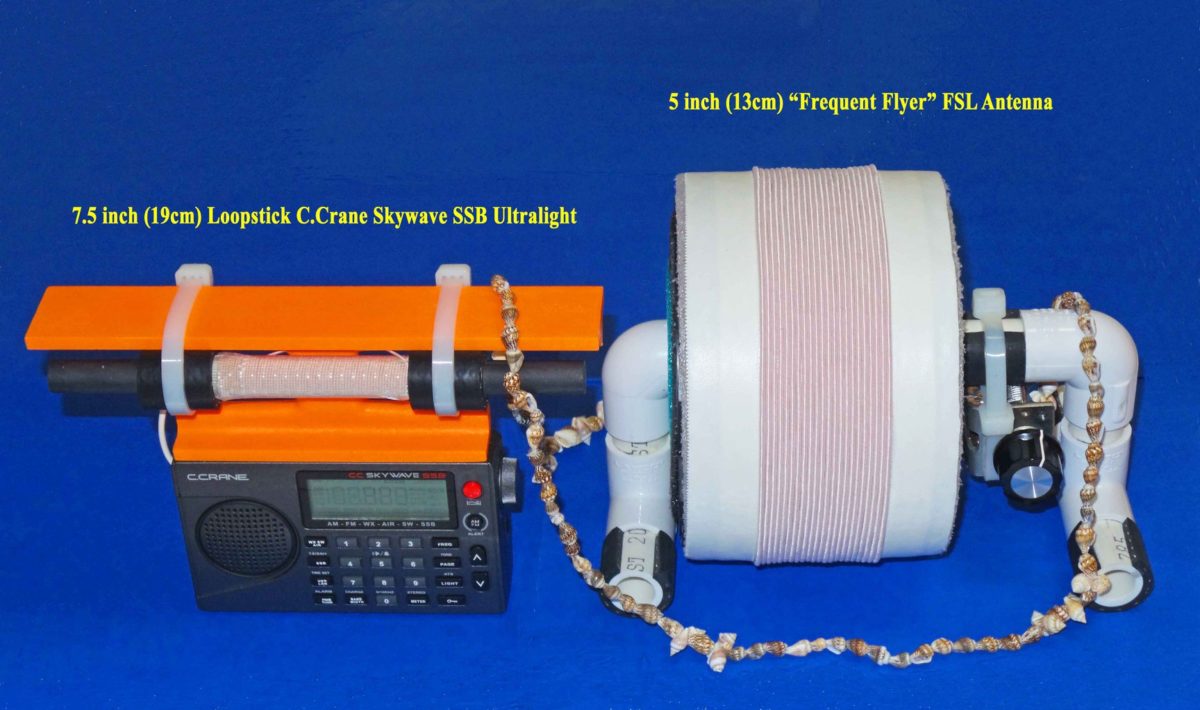
From December 17-20 a Mini-DXpedition was conducted in Kona, Hawaii with a 5 inch (13cm) “Frequent Flyer” FSL antenna and a 7.5 inch (19cm) loopstick C.Crane Skywave Ultralight radio.

The FSL antenna was a new type designed to easily pass through TSA security checkpoints at airports, and provide inductive coupling gain roughly similar to that of a 4 foot air core box loop. South Pacific island reception was generally good from 0630-0800 UTC daily, but usually became problematic after that when powerful Asian stations tended to drown out the exotic Pacific island stations as sunset progressed over Japan, Korea and China. By 0900 daily only the most powerful Pacific island stations on 621, 846, 1098 and 1440 had much of a chance of surviving the Asian signal onslaught, and even some of those were drowned out. During a similar visit to Kona, Hawaii with identical gear in April (DXing at the same motel) the Pacific island stations were generally stronger, and had no co-channel competition from the Asians from 0800-1030 UTC. As such the South Pacific results during this trip were slightly down from April, although there were still plenty of strong signals to record.

The new 846-Kiribati on Christmas Island was a star performer as the strongest island DU station, with local-like signals shortly after the Hawaiian sunset each evening. Despite this it had an intermittent transmitter cutout issue, with the signal failing to transmit at odd intervals (including one stretch with six signal dropouts within one minute, as documented in an MP3 linked below). In addition 846-Christmas Island’s programming had a variable time delay with that of distant 1440-Kiribati in Tarawa, with both a 19-second and 35 second time delay noted. This may be related to the transmitter cutout issue, with the time delay changing after a major dropout. DXers looking for a parallel with 1440 should keep this programming quirk in mind. Although both 846 and 1440-Kiribati signed off at the usual 0936 UTC time on the first couple days of the trip, they had both switched to a 1009 UTC sign off on the last couple of days. Whether this is a permanent programming change is unknown, but the loud 1000 Hz audio tone is still being broadcast before power is cut, resulting in a very easy way to distinguish the stations at sign off time (even in heavy domestic QRM).

846 and 1440 weren’t the only exotic DU’s with transmitter issues. 621-Tuvalu came down with distorted audio on December 18th, a problem which got worse and worse on the remaining two days. By the last day it was sounding very garbled, making a bizarre combination with 621-Voice of Korea’s buzzing Japanese service transmitter. Whether 621-Tuvalu has repaired its garbled audio is also unknown.

540-2AP was somewhat weaker than it was in April, while 558-Radio Fiji One was MIA during the entire trip (probably because of Asian QRM). Efforts were made to track down 630-Cook Islands but only a weak UnID was recorded. 801-Guam was possibly received during a Pyongyang BS/ Jammer fade, but 990-Fiji Gold was given a golden knockout by 990-Honolulu. 1017-Tonga showed up for a couple of good recordings, but got slammed by Asian co-channels after 0830. Efforts to track down 1035-Solomons ran into heavy 1040-Honolulu splatter, while 1098-Marshalls became the only Pacific island station to have stronger signals than in April. Its overwhelming signals after 0700 daily were one of the bright spots in Pacific island reception. Finally the new 1611-DWNX in Mindanao, Philippines was received at a strong level at 0855 on December 19th, apparently with a major boost from sunset skip propagation.

540 2AP Apia, Samoa, 5 kW Christian worship music at a good level through the T-storms at 0751 on 12-17, but not nearly as strong as in April:

Click here to download audio.

621 R. Tuvalu Funafuti, Tuvalu, 5 kW This station had very strong signals until around 0800 on most evenings, when it usually began to be pestered by Asian QRM (China, N. Korea and NHK1). It also came down with a garbled audio issue on December 18th, which continued to get progressively worse until I left Hawaii. Sign off time is still around 1006, but by that time it ran the gauntlet of powerful Asian co-channels during the December propagation.
Local employment offers read by the usual lady announcer at an S9 level at 0750 on 12-18. This was the last undistorted audio signal recorded from the station during this trip; after this the audio went “south”:

Click here to download audio.

Guest speaker in Japanese-accented English, followed by local island-type music at 0835 on 12-18– the first sign of audio distortion:

Click here to download audio.

Full Radio Tuvalu sign off routine at 1003 on 12-18, but with China QRM initially. Tuvalu’s signal prevails during the national anthem, but the audio distortion is quite noticeable. The carrier apparently stays on for over a minute after the audio stops:

Click here to download audio.

630 UnID While trying for the Cook islands (Rarotonga) I came across this weak Christmas music with English speech at 0742 on 12-17, although this could just as easily be a west coast domestic station playing the “exotic” to fool a hopeful DXer. Walt says this station is a notorious underperformer:

Click here to download audio.

801 UnID (Guam?) Apparent Christian female vocal music received during Pyongyang BS/ Jammer fade at 0931 on 12-18, but no definite ID clues:

Click here to download audio.

846 R. Kiribati Christmas Island, 10 kW This newly rejuvenated station had awesome signals, and was overall the strongest Pacific island station received. Of all the Pacific island DU’s it faded in at the earliest time after sunset, and maintained its strength even during strong Asian propagation — as long as it managed to transmit without its signal dropping out. Unfortunately this seemed to be a pretty common occurrence while I was in Kona. Island-type music at typical S9 strength at 0735 on 12-18:

Click here to download audio.

This segment at 0620 UTC on December 17th features 6 signal dropouts within one minute:

Click here to download audio.

This segment at 0944 UTC on December 18th is even worse– 9 dropouts in 90 seconds:

Click here to download audio.

After a prolonged 846 transmitter dropout it seemed like the programming time delay between the distant 1440-Kiribati on Tarawa Island and the new 846-Kiribati on Christmas Island would change. On December 17th I recorded two different time delays– 19 seconds, as in the following recording (the MP3 starts out on 846 at 0635, switches to 1440 at the 1:02 point, then switches back to 846 at the 1:34 point, with a 19-second time delay evident between the 1440 and 846 programming (846 lags behind):

Click here to download audio.

Later on the same evening there was a 36 second time delay between 1440 and 846, with this MP3 starting off on 1440 at 0645, and switching to 846 at the 11 second point:

Click here to download audio.

1017 A3Z Nuku’alofa, Tonga, 10 kW Female native language speech at a very good level at 0858 on 12-19:

Click here to download audio.

Somewhat weaker through the T-storms on 12-17 at 0734:

Click here to download audio.

1098 R. Marshalls (V7AB) Majuro, Marshall Islands, 25 kW This station was very strong in Kona with its island music every night, and rarely had any Asian co-channels.
S9 Island music and native language speech (and possible ID) across the 0700 TOH on 12-17:

Click here to download audio.

Equally strong island music and native speech at 0813 on 12-18:

Click here to download audio.

1440 R. Kiribati Bairiki, Tarawa, 10 KW Somewhat weaker than its rejuvenated 846-Christmas Island parallel (which has variable programming delay times, as explained above), this home transmitter could hold down the frequency until around 0800 every night, after which it was usually hammered by JOWF in Sapporo. Despite this it often put up a good fight until its new sign off time of 1009, and it continues to use the loud 1000 Hz tone right before the power is cut (an awesome aid for DXers hoping to ID the station through heavy QRM).

Typical island language speech and strength level at 0830 on 12-18, just as it is starting to get jumbled by JOWF (a Japanese female “Sapporo desu” ID is at 25 seconds):

Click here to download audio.

Full sign off routine at 1005 on 12-19, including the National Anthem and the 1000 Hz tone before the power is cut. The tone gets through the JOWF QRM like a DXer’s dream:

Click here to download audio.

1611 DWNX Naga City, Mindanao, Philippines, 10 kW (Thanks to Hiroyuki Okamura, Satoshi Miyauchi and Mauno Ritola for ID help) Received at 0855 on 12-19, this station was a mystery until the Japanese friends matched the advertising format with that of a new, unlisted station which just came on the air in the Philippines. The propagation apparently got a major boost during sunset at the transmitter:

Click here to download audio.

73 and Good DX,
Gary DeBock (DXing at the Royal Kona Motel with a 7.5″ loopstick C.Crane Skywave Ultralight+
5 inch (127mm) “Frequent Flyer” FSL antenna.

Demo video of the “Frequent Flyer” FSL antenna:

Click here to view demo on YouTube.


Thank you for sharing your Hawaiian DXpedition with us, Gary! Your mediumwave DX catches with modest equipment reminds us all that when HF propagation is poor, there is still so much signal hunting below 2 MHz!

Interested in Ultralight DX? Check out archived posts in our Ultralight DX category.

XHDATA D-808 modification to allow an external mediumwave antenna

Many thanks to SWLing Post contributor, Rolf Snijder, who writes:

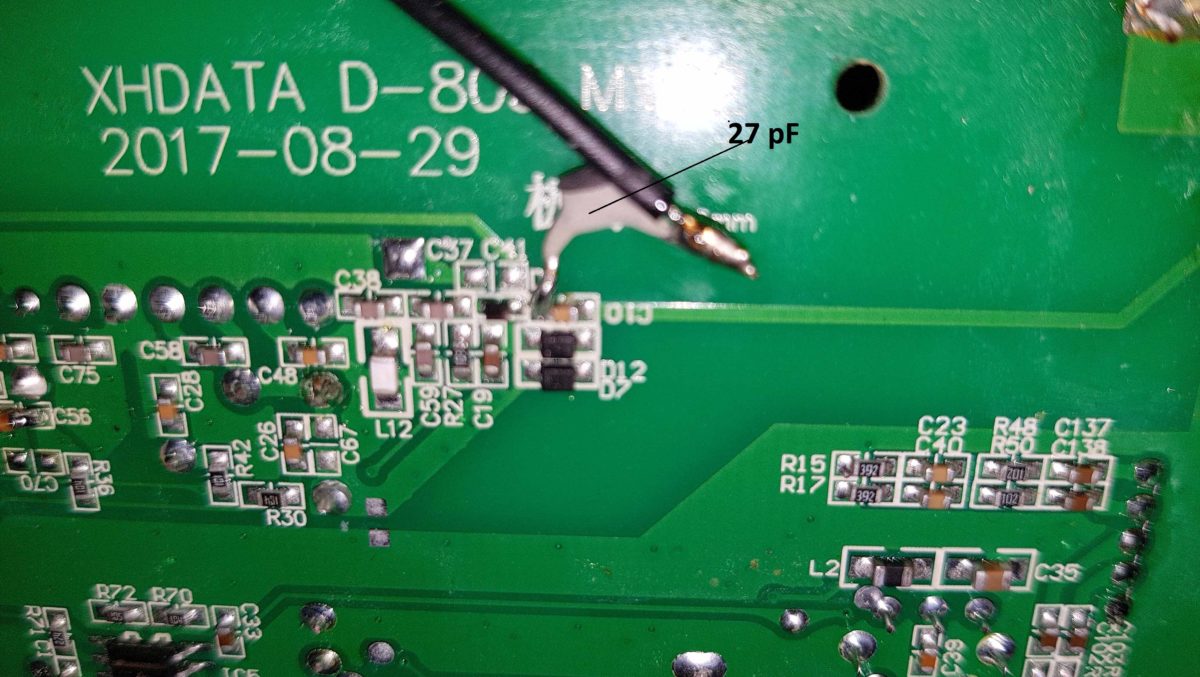
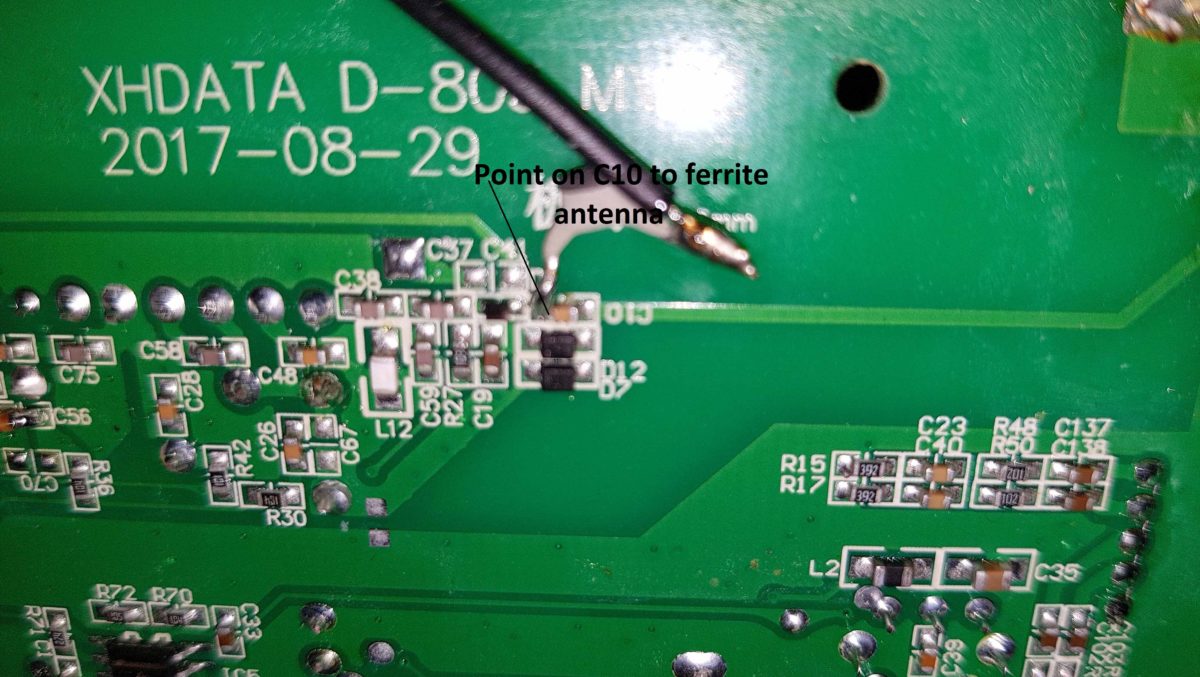
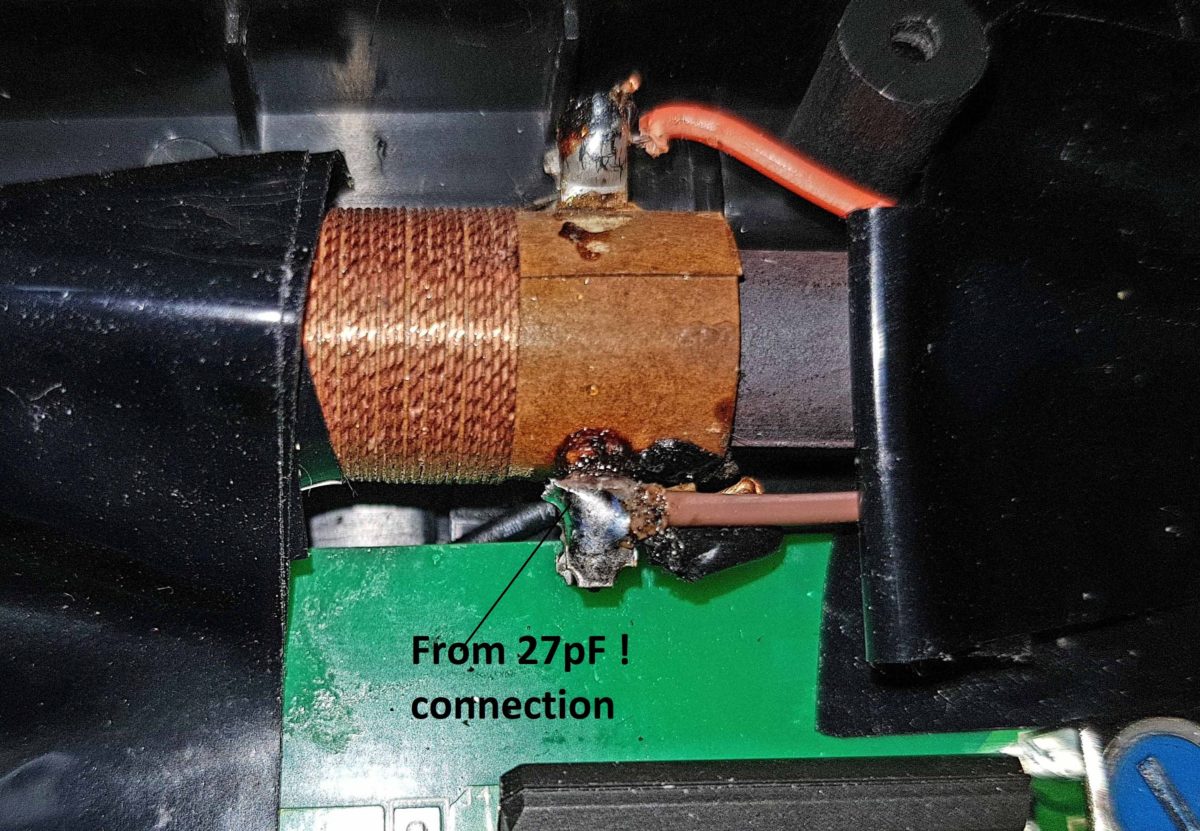
I have added an external antenna capability for mediumwave on the XHData D-808.

Simply add a 27 pF capacitor on the backside of the PCB on C10 to the the ferrite antenna.

The mod causes no loss on FM or shortwave!

I also replaced the Ferrite antenna with a bigger one so I now have more performance on MW!

Longwave is not good in my radio, even with an external antenna, it is not performing well.

Thanks once again, Rolf! I must assume that the Digitech AR-1780 could be modified in the same way as the radios appear to be near identical. Perhaps someone can verify this at some point!

Rolf’s LED backlight mod for Sony ICF-SW35

Many thanks to SWLing Post contributor, Rolf Snijder, who writes:

This is a simple LED backlight modification for the Sony ICF-SW35.

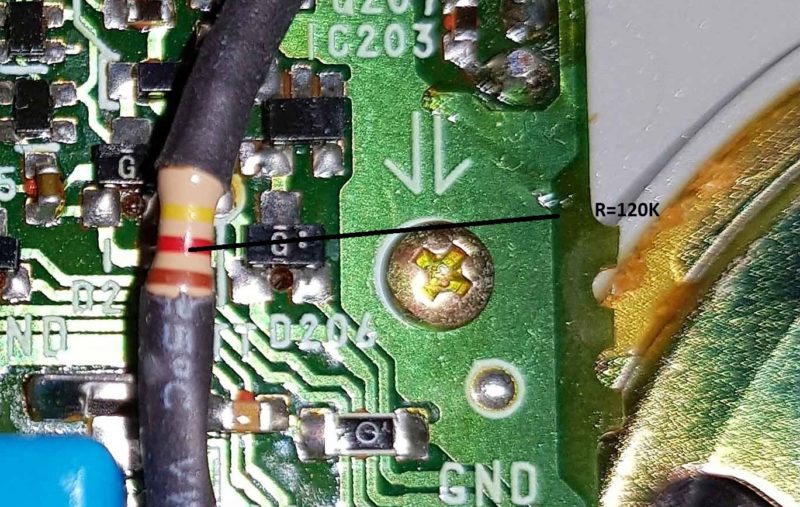
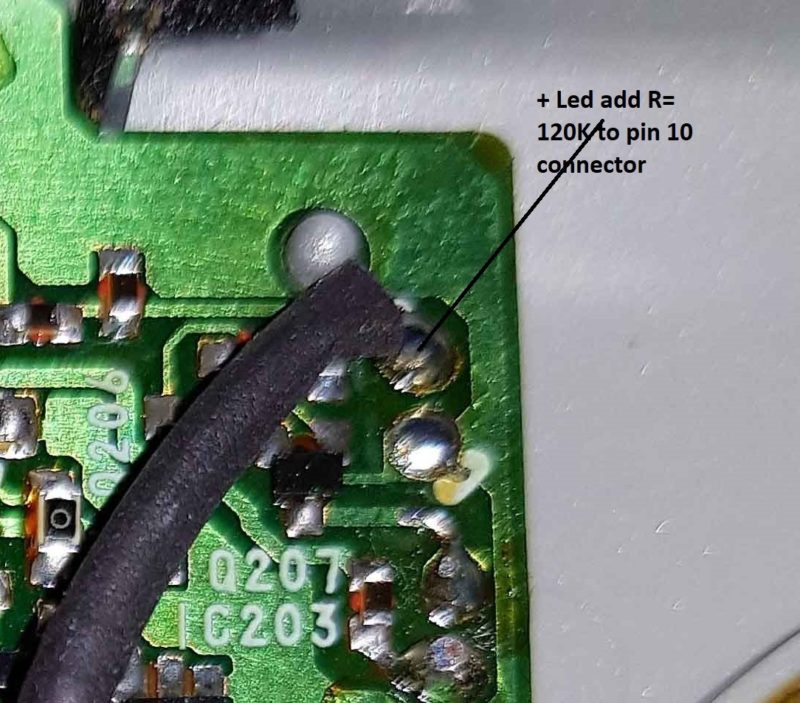
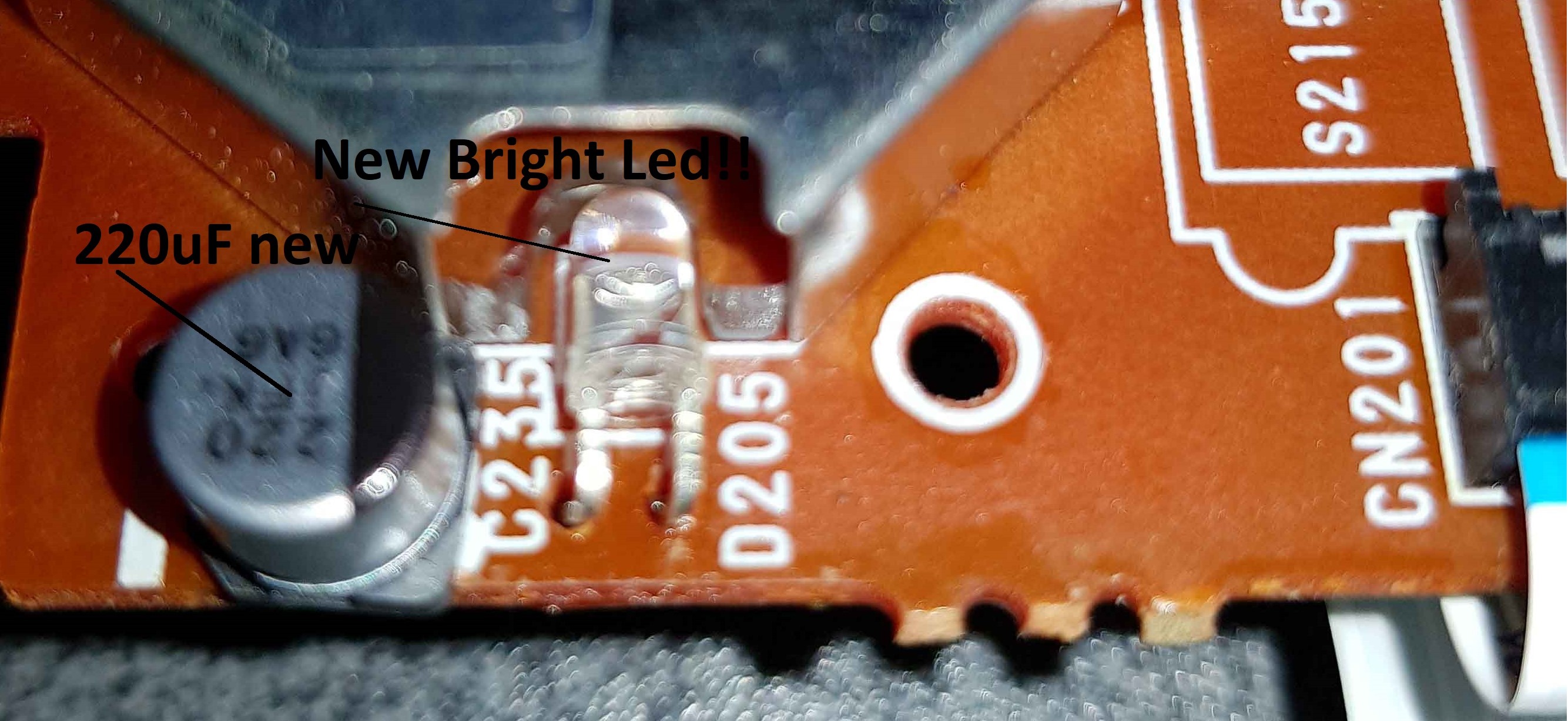
Simply add a 120K resistor and a bright LED:

Overview of resistor placement. (Click to enlarge)

Detail of Pin 10 (Click to enlarge)

Detail of resistor. (Click to enlarge)

Detail of Pin 10 (Click to enlarge)

Detail of LED placement–replacement of capacitor is not necessary. (Click to enlarge)

When you push the backlight switch, the light stays on.

When radio is turned off, the light goes off–then push light switch and backlight will stay on for 15 seconds or so.

Thanks for sharing this simple mod, Rolf!

Jack reviews the Digitech AR-1780

Many thanks to SWLing Post contributor, Jack Kratoville, who shares the following guest post:
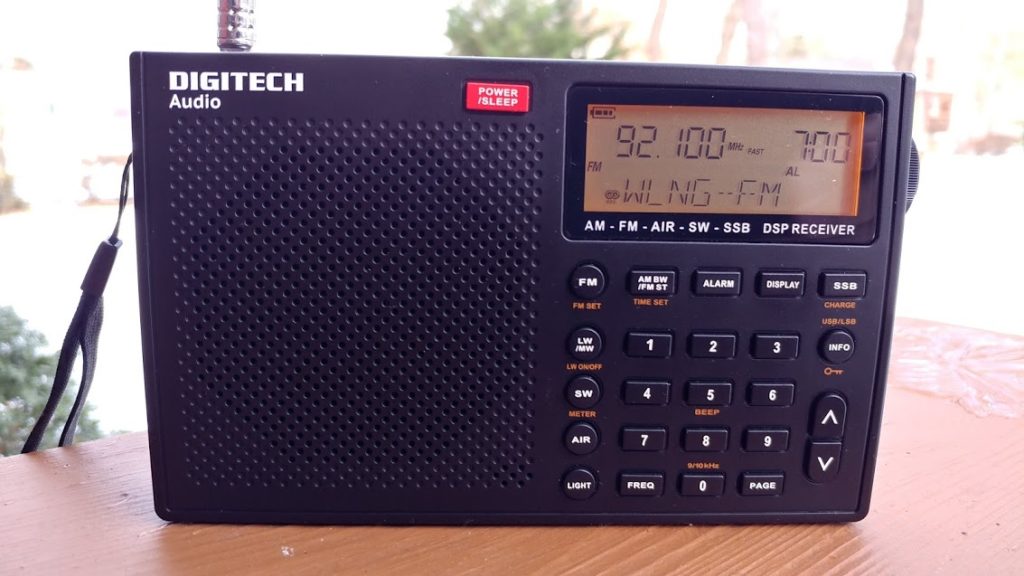

A review of the Digitech AR-1780

by Jack Kratoville

As a previous post noted, the quest for the perfect radio drives us far and wide; in this case, as far as Australia. Since it’s rare these days to be able to walk into brick and mortar to touch, play and even bring home a radio to test; I’m grateful for online communities like the SWLing Post to research new and existing product. The caveat being “another must-have for my collection.”

I truly thought I had found happiness with my traveling Grundig tandem of the G5 and G6 – that is until the DSP chip was introduced. For the past 2 years, I’ve been satisfied packing the CCrane Skywave, Tecsun PL-360 and one wild card for domestic travel. My bottom line is when I’m listening to a certain radio in a given location, did I ever regret not bringing something else? The Skywave has satisfied over 95% of the time.

When the AR1780 popped up on this site, something about it piqued my interest. I had heard the Digitech name and it was always associated with a less than favorable opinion. This radio, however, was drawing unexpected praise. It was the video reviews that put me over the top with rich audio coming through even cheap condenser mics. I called Jaycar and had one shipped. Now you can add me to the list of those who are quite pleased with this addition to my radio family.

I’ll start with the primary reason to consider this radio – the sound emanating from the on board speaker. The AR1780 sounds better or as good as any unit this size. And this isn’t just a benefit for FM listening, but for AM/SW/AIR as well. I’ve never seen such tonal balance across all bands.

If you’re looking for a smaller portable with above par performance and excellent audio, you can stop here and place your order. Otherwise, on to my observations:

FM

I enjoy FM DXing and the fidelity of this band. Even though I’ve become accustomed to the sound of the Skywave (it does mellow with age), the AR1780 blows me away. Crisp highs and lows with rich bass that highlights both music and vocals. There is no tonal adjustment on this radio and, frankly to my ears, it doesn’t need one.

Performance is on par with the Skywave and other DSP units. While the Skywave has slightly better selectivity, the 1780 pulls in a tad more signal with its longer whip. The RDS feature works great and is a plus when skips and trop bring in distant signals.

Mediumwave / AM

As sensitive as the Skywave and G5. I’ve gone up and down the dial and my unit doesn’t produce birdies or hets anywhere. Very happy about that. For local signals, once again the sound is wonderful with choices of wide bandwidth. And even with distant music stations, rare as they may be, the AR1780 produces more fidelity than noise. When Zoomer 740 comes in full strength, this radio sounds as good as it gets. Where the Skywave has a tonal advantage is when filtering is at its narrowest. I can still hear signals clearly, whereas the Digitech can get a bit muddy. Depends on signal.

I’ll mention here that the advantage of CCrane’s products is upgraded filtering. The AR1780 burps and clicks when you enter anything on the keypad – even from the Skywave’s keypad if the radios are close to each other! Otherwise, they are very similar in response to outside RF and other noise producing electronics.

Shortwave

I receive everything on this radio as I do on the Skywave & G5.

Where I find weakness with the AR1780 is the soft muting and the scan feature is far, far slower than the Skywave. I’ve scanned for signals on other radios and loaded the presets on the Digitech.

I haven’t found any birdies yet, but it will whistle while starting up on Radio Miami, then calm down completely once fully captured. But that’s only when 9395 is the start up frequency. If I switch to SW and it starts elsewhere and I hit the preset for 9395 – nothing! Strange, but an acceptable artifact. I have to admit, it sounds great listening to music on WRMI!

SSB

I don’t have the Skywave SSB, but the Digitech is slightly less sensitive than the G5. Not sure if it’s due to filtering, antenna length, the DSP chip or all of the above. It’s there, but sometimes not worth straining to listen to. I haven’t tried an external antenna as of yet. The G5 doesn’t feature the USB / LSB option, so the Digitech is easier to tune. Full disclosure, SSB was never a deal breaker for me and I’m satisfied with what I can hear.

AIR Band

A touch more sensitive than the Skywave here. As all my testing is done strictly from the whip – that might be the advantage.

General

I have to say the build of this radio is very impressive. Buttons are very firm and responsive. The tuning knob is superb. As the weakest physical part of the Skywave, the AR1780’s knob, and its fine tuning counterpart, are spot on perfect. Nothing sloppy here.

Battery consumption (4 AA) seems above average, although not super-impressive. It’s hard for me to analyze at the moment as I’ve been playing with this radio constantly. I probably take more notice when I’m replacing 4 instead of 2 and may eventually jump over to rechargeable AAs. Interestingly, I took the 4 batteries I had worn down just one notch in the AR1780 and stuck them in a Sangean PDR-18. The meter on the PDR-18 showed only one bar or less.

The Skywave gives you 10 pages of 10 memories, the AR1780 gives you 50 pages! Even without explanation in the manual, setting these up are very intuitive.

The dial provides plenty of information. Curiously, if tilted while off, there are indicators for Music, Voice, Snyc, DAB & WB. While none are employed by the AR1780, perhaps there’s something else in the works!

What I find annoying

The display defaults to the temperature or the alarm. If you use signal strength or time during operation, it defaults to temp when you turn it off. Both of my Tecsuns will let you set display for both radio on and off. It bugs me most because holding the radio always sends the thermometer up by 10-12 degrees!

It takes a good 3 seconds to power up or switch bands. I’ve heard of other radios having this trait, but this is my first experience. And this action does use a bit of power because switching bands, not the dial light, will show the first signs of battery wear. (Again, I’ve had no issues with severe battery draw and compare 4 alkaline usage with my G5.)

The Skywave has spoiled me with its super-fast scanning. The Digitech is similar to most Tecsuns. I’ve noticed them all skipping segments on the SW band.

I hear a difference between FM stereo and monaural from the onboard speaker. This is the result of a right or left channel only feed to the speaker when the radio is in stereo. The Grundig Mini 100 did this and without a mono setting, it drove me crazy. I like to see the stereo indicator, but it looks like the AR1780 needs to be set in Mono when listening to FM through the speaker.

There are a number of general traits that the AR1780 shares with the Skywave that I would have preferred to be more like the CC Pocket:

  • I prefer a lock switch over a long-press lock button.
  • When you switch to a different page on the Pocket, it only changes that band and stays on the current frequency. Both the Digitech and Skywave switch over all bands to that page number.
  • One last minor annoyance (getting very picky here), the dial light seems to flash when you turn the radio off. The Pocket doesn’t.

OK, the bad

As a portable / travel radio, I can’t image why there is no pouch!

Add $5 and provide something to protect this in the go bag. At least this problem can be remedied. A pouch from the Sangean ATS-606 fits perfectly.

But the biggest flaw I found (and this may answer the power consumption others have noted) is the light continues to function in the locked position! All buttons are disabled, but press anything and the light comes on. I can imagine packing this radio and as it gets pressed against something else, the light remains on until the batteries are drained. A major design error here.

Conclusion

I’m more than impressed and extremely happy I made this purchase. I have no doubt this radio will be a primary travel companion. Since I always take a few on the road, surprisingly this won’t displace the Skywave. (I really enjoy that radio), but rather the veteran Grundig G5. While still considered one of my favorites, the Digitech provides as much performance and a few more features in a smaller package.

If I were choosing between the Digitech AR1780 and the Skywave SSB – that would be a touch choice. As I mentioned before, SSB has never been a deal breaker during travel and I love the original Skywave as is. Portable means smaller and the Skywave is the perfect size. I use the weather band more than LW, but the fidelity on the AR1780 is absolutely superb.

And while I’ve read the Skywave SSB is going through initial run growing pains, CCrane has been stellar when it comes to customer service and final product. They’re radio geeks like us – Digitech is simply a badge on a product manufactured by another company. (Jaycar seems like decent people.) Bottom line – let’s see how the Digitech is holding up after 2-3 years of usage.

I treat my radios like babies, but I’ve seen most wear down with unresponsive buttons, scratchy volume or fading displays. In fact, the only two grizzled veterans still operating at 100% are my Grundig G6 and Tecsun PL-360. Even my 7600GR’s volume is failing.

Worth it so far? Absolutely – without a doubt. Any future quirks, discoveries and disappointments will be shared.


Jack, thank you for sharing this excellent review!

I couldn’t agree with you more–the AR-1780 must have the best on-board audio of any compact shortwave portable I’ve tested. As you state, what makes it stand out is the fact that audio is wonderfully balanced across the bands. And what better way to check mediumwave audio? Why Zoomer Radio (CFZM) of course! One of my favorite night time catches. 

Thanks for the note about switching FM to mono while listening via the built-in speaker. I don’t believe I had tried that yet.

And, like you, I find the active backlight during keylock such an odd behavior. I actually opened one of my travel bags during the holidays to find that the backlight was somehow fixed in the “on” position…with keylock engaged! I supposed the LED backlight has little effect on battery consumption because I imagine this the backlight was engaged for as much as three days, yet the battery still showed full bars. 

The AR-1780 is a quirky radio, but by golly it’s a good one and a great value! Thanks again for the excellent review, Jack.