Category Archives: Radios

The Como Audio Solo and Duetto radios on Kickstarter

ComoAudio-Solo

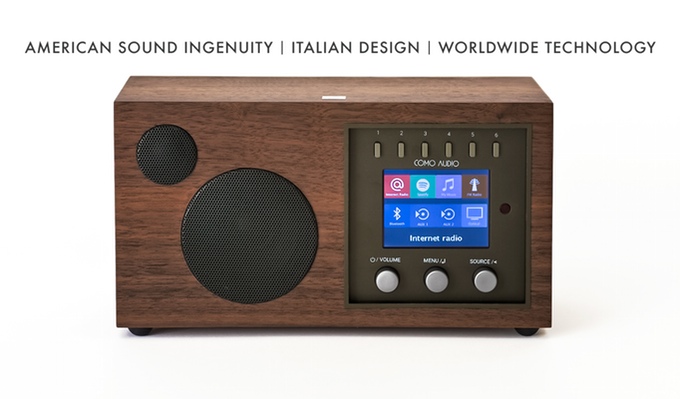
The Como Audio Solo

Alas, I find that I’m frequently blamed by SWLing Post readers who cite this blog as the reason they spend so much money on radios.

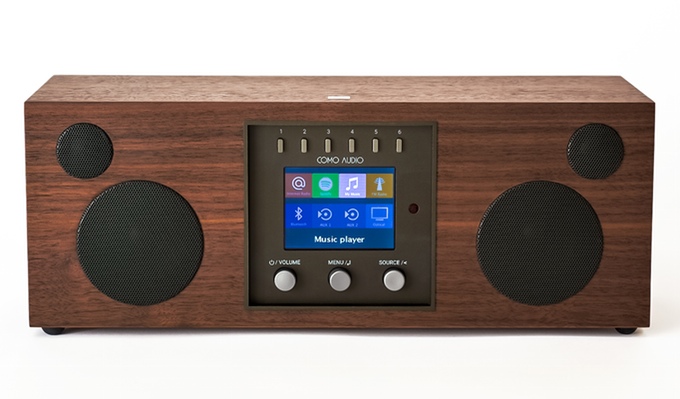
But for the record, I’d like you to know that such spending is actually a two-way street!  A couple of days ago, Post contributor Robert Gulley sent me a link to a cool Kickstarter campaign for two new multi-format digital radios: the Solo and the Duet by Como Audio.

https://www.kickstarter.com/projects/819585793/solo-and-duetto-one-touch-music-streaming-with-hif

Having just completed an in-depth review of several WiFi radios for The Spectrum Monitor magazine, the good-looking Solo in its wood casing really caught my attention! (the Duet, meanwhile, is a two-speaker version of the same rig).  At first glance, the Solo appears to be  compatible with a much wider range of digital formats than many of its competitors, so naturally I’m eager to determine if this is so. Here’s a list:

  • Internet radio accessing 20,000+ stations
  • Spotify
  • Bluetooth with aptX
  • NFC Android Bluetooth connection
  • DLNA WIFI
  • Music player allowing easy navigation and playback through a USB or network-shared library of music files, including AAC+, MP3, WMA, WAV, and FLAC
  • 4 High-Res inputs: 2 analog, 1 Optical, and 1 USB.
  • Google Cast-ready
  • Amazon Dot-ready

It even has a “high-performance” FM tuner and is DAB+ compatible, especially great if you live in Europe.

It also sounds like they’ve spent time designing a proper acoustic chamber/chassis and are fueling a 3″ woofer and 3/4″ dome tweeter with a 2 X 30 watt RMS amplifier. This radio should pack some audio punch.

The Como Audio Duetto

The Como Audio Duetto

The only obvious thing I see missing on the Como Audio WiFi radios is an internal battery.

Still, after watching the video and reviewing the specs, I backed the campaign to receive a walnut Kickstarter Edition Solo. If all goes well––and I never actually expect a campaign to produce and ship a product in the amount of time they expect––they may be shipping the radios as early as October.

The campaign has already met it’s goal of $50,000 and is now stretching for $100,000 with more incentives.

So, I didn’t really need another WiFi radio, but thanks to Robert’s email––yep, I bought one! Now the only question remains:  can you actually make impulse purchases on Kickstarter? I think I just proved that you can.

The Sony ICF-SW55 and the Voice of Greece: a wonderful travel combo

Sony-ICF-SW55-2
I’m currently in Sainte-Anne-de-Beaupré, Québec (Canada) and having a brilliant time. I’ve been sans Internet for the better part of a week (save a little online time at local cafés) which is why I’m quite far behind on correspondence.

The lack of Internet, though, has a positive side: it has given me uninterrupted time to surf the shortwaves!

The only bad news is that I’m staying in a condo and the radio interference is…well…a little high.

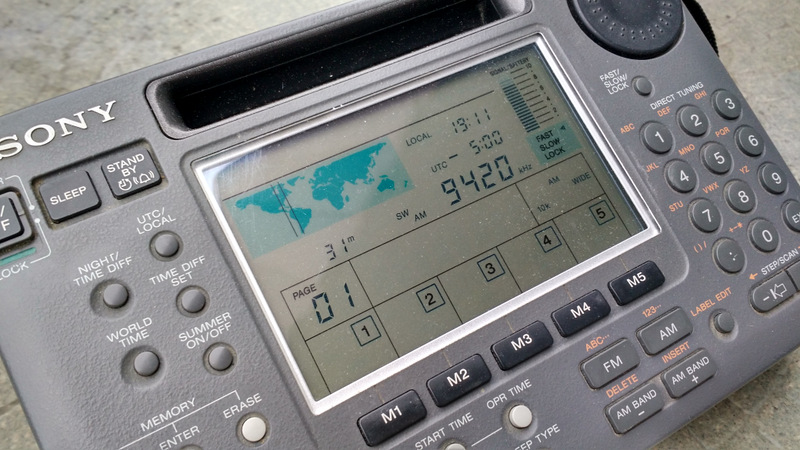
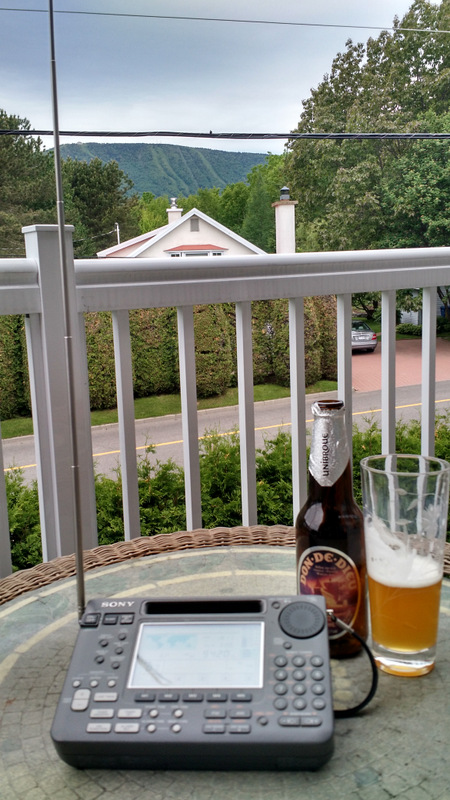
Still, I’m fortunate to have a balcony where I can relax and listen to my Sony ICF-SW55 outdoors. In truth, I’m truly amazed with the reception I’ve had each evening this week from the Voice of Greece. Though, VOG’s broadcasts have been somewhat unpredictable after their official return to the airwaves, I’m appreciative every time they fire up their Avlis transmitter and pump out music on 9,420 kHz.
Sony-ICF-SW55

I should mention that Radio Romania International is also a very easy catch and, like VOG, punches through the RFI with colors flying.

This is one of the great things about shortwave radio–even when you’re far away from home, you can still hear a familiar voice on the air.

eBay find: LNR Precision LD-11 transceiver

LD-11 eBay

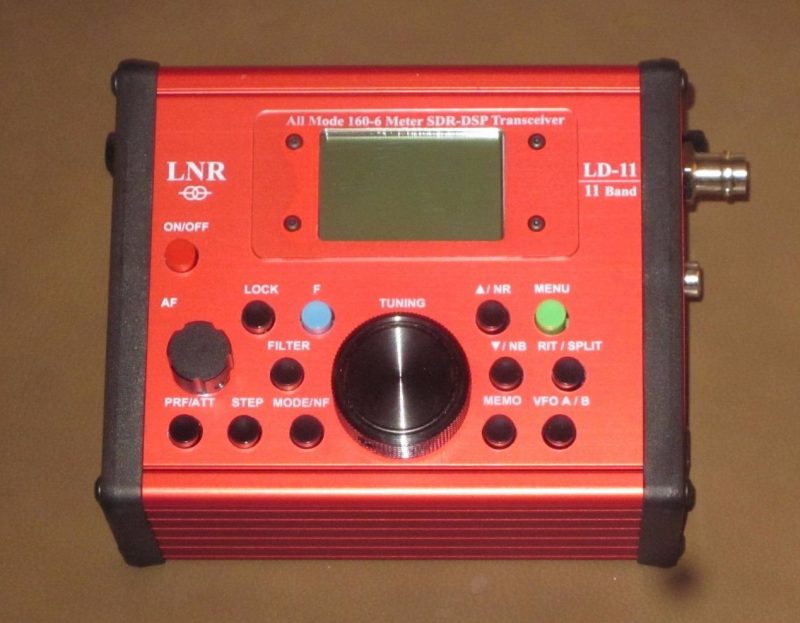
Many thanks to SWLing Post contributor, Mario, who notes this first appearance of the LNR Precision LD-11 transceiver on eBay.

I must say, I’ve been using the LD-11 for the past couple of months and have been pleased–it’s a fun little radio with the added bonus of broadcast band reception (see my previous post). I’ve used it in no less than four NPOTA activations.

Mario and I do not know this eBay seller, but it appears the seller is in decent standing with eBay.  In the past 12 months, the seller has had one negative review that appears to have been in error (the comment in questions was very positive, but marked as negative by a new eBay user).  Do your research if you consider bidding.

Click here to view this LD-11 on eBay.

Very Scarce Kneisner + Doering KWZ-30 DSP Receiver Surfaces on Ebay

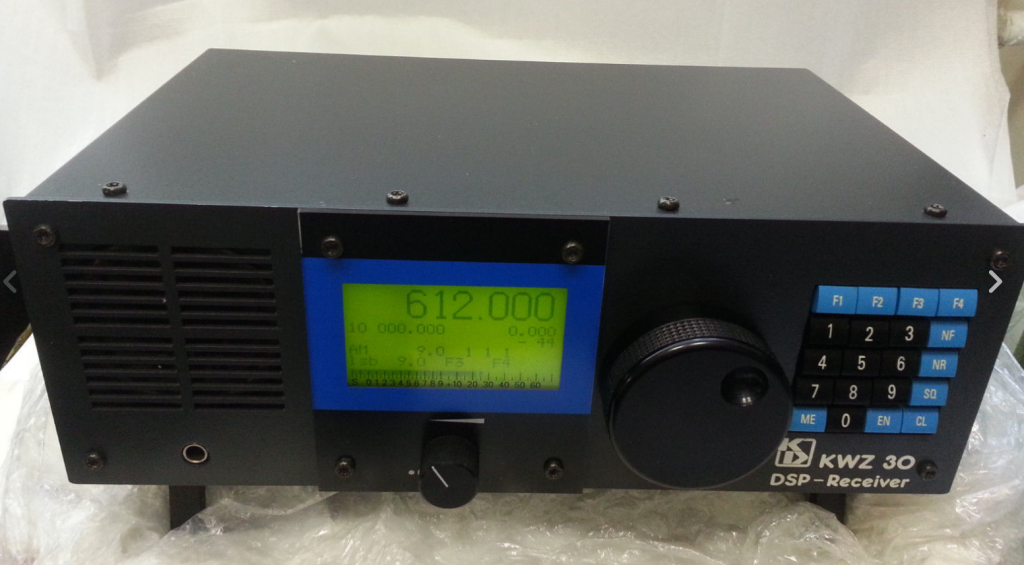
Hailing from Germany, the KWZ-30 communications receiver was one of the first DSP receivers available. This collectable and high performance receiver is rarely seen for sale, but one is now available for a $1890.00 Buy-It-Now price from a Russian Ebay seller. Even with the few dings visible on the radio’s case, it’s likely worth the asking price to a collector.

KWZ-30

The extensive Fenu-Radio web site has a nice capsule review of the KWZ-30, including some excellent photos.

At the $1890.00 price of this KWZ-30, you could buy a dozen SDRPlay receivers, or roughly a couple of the highly rated Perseus SDRs. Assuming available funds, is the KWZ-30 a receiver you would add to your radio shack? If so, why… or why not?

Guy Atkins is a Sr. Graphic Designer for T-Mobile and lives near Seattle, Washington.  He’s a regular contributor to the SWLing Post.

David enjoys hammock mobile SWLing with his Icom IC-92AD

Icom-ID-92AD-Shortwave

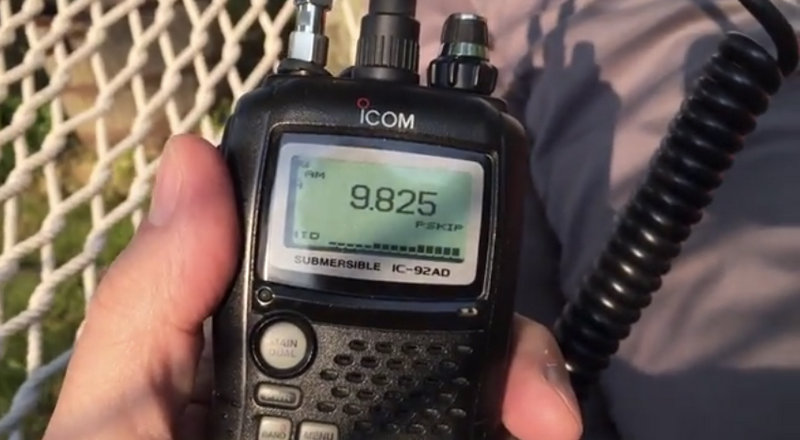
Many thanks to SWLing Post contributor, David Korchin (K2WNW), for sharing this short video demonstrating the shortwave receive capabilities of the Icom IC-92AD handheld transceiver:

Click here to view on YouTube.

Frankly, I’m quite amazed at the clarity and fidelity of the Voice of Turkey interval signal on this handheld. Goes to show that with a proper antenna, and decent conditions, wide-band handhelds can certainly be used for shortwave radio listening! It also helps that David is outdoors, away from RFI, and was located on the coast of Long Island, NY.

Post readers: Have you had good fortune SWLing with wide-band handled transceivers? Please comment!

Tubes and Valves: Dan’s research uncovers three vintage films

Hammarlund-SP-600

Many thanks to SWLing Post contributor, DanH, who writes:

I have been working on my Hammarlund SP600-JX-21 for the last two weeks. Results of the filter cap replacement were encouraging. I’m going after an AVC issue that is probably capacitor-related as well before doing a re-alignment with the signal generator.

All of this activity has turned my attention toward vacuum tubes. I found three vintage industrial films online that caught my interest…

The Mullard Radio Valve Company produced The Blackburn Story in 1962. The film was shot at what must have been close the peak of vacuum tube mass production. This presentation is unique in its finely detailed documentation of miniature tube construction. The hand labor required to build some of these tubes is incredible, considering it is a mass production operation. A surprising degree of automation is present for manufacture of some of the more popular tube types. The video resolution is not the best but I found myself ignoring this limitation after the film got underway. I have a few Mullard tubes in my tube boxes.

Click here to view on YouTube.

Western Electric presents A Modern Aladdin’s Lamp (1940). This look at the electron tube is hosted by none other than Lowell Thomas. From the age of four pin and octal base tubes animation shows how tubes work.

Click here to view on YouTube.

Electronics at Work (1943) is a WWII offering by Westinghouse. The description of vacuum tube technology is a little more detailed and again animation is employed for visual impact. A variety of vacuum tube applications in industry and the military are shown from curing plywood to producing X-rays. The excellent animation was contributed by Famous Studios (when they weren’t doing the wartime Popeye cartoons).

Click here to view on YouTube.

Wow–thanks for sharing these excellent videos, Dan!

One week of Hamvention, Air Force Museum, Wright Brothers and National Parks On The Air

DSC_4449I returned home last night from my week-log Dayton Hamvention trip around 8:30 PM.

The Hamvention actually ended at 1:00 PM on Sunday, May 22, but my buddy Eric McFadden (WD8RIF), his son Miles (KD8KNC) and I stayed Sunday night in Dayton, and Monday night at Eric’s home in Athens, Ohio.

After packing up our Hamvention booth (for Ears To Our World) on Sunday, we made our way to the nearby National Museum of the USAF–the largest aviation museum in the world. We visit the museum every year–and every year I discover something new.

BC-348-B29

This BC-348 can be found in one of the museum’s B-29 displays.

DSC_4443 DSC_4455

In June, the Air Force museum is actually opening a fourth building which will house an additional 70 aircraft in four new galleries.

If you’re an aviation buff–trust me–the  National Museum of the USAF is worth a pilgrimage to Dayton, Ohio.

NPOTA activations

Monday morning, Eric, Miles and I packed up, ran a few errands on Wright Patterson Air Force Base, then made our way to our first National Parks On The Air activation: the Dayton Aviation Heritage National Historical Park (HP11) and North Country National Scenic Trail (TR04) “two-fer” at Huffman Prairie Flying Field Interpretive Center in Dayton, Ohio.

Eric worked CW on 20 meters and I worked SSB on 40 meters using the LNR Precision LD-11 transceiver (which I’m currently reviewing) and my recently-purchased Hardened Power Systems QRP Ranger.

For all of my Monday NPOTA activations, I used the EFT Trail Friendly antenna I purchased at the Hamvention:

EFT-Trail-Friendly-Antenna-QRP

The EFT Trail Friendly Antenna made set-up a breeze: simply throw a line into a tree, hang the end of the antenna, then hook up the other end to the feedline/transceiver. No antenna tuner is needed for 40, 20 or 10 meters once the antenna is tuned for resonance. It packs up into a small bundle that easily fits in my radio go-kit (see photo above).

The LD-11/QRP Ranger/EFT antenna combo worked amazingly well and made for very quick deployment.

LNR-LD-11 and QRP Ranger NPOTA

I can easily fit the LD-11 transceiver and QRP Ranger on a foldable metal chair (my make-shift field table!).

My buddy Eric, I should mention, is typically on the leaderboard for NPOTA as he’s an avid QRP field operator.

WD8RIF-20M-Vertical-NPOTA

Eric (WD8RIF) operating NPOTA with his field-portable vertical HF antenna.

You can follow Eric’s activations on QRZ.com or his website.

Eric's field-portable HF vertical packs up into this small canvas bag.

Eric’s field-portable HF vertical packs up into this small canvas bag.

We had a tight NPOTA activation schedule to meet Monday, but after packing up from our first sites, we took 30 minutes to stop by the Wright-Dunbar Interpretive Center and The Wright Cycle Co. museum in downtown Dayton.

IMG_20160523_135344026

Well worth the short visit! Next year, I’ll plan to revisit both museums when I have more time.

Next, we made our way to the second scheduled NPOTA activation site: the Charles Young Buffalo Soldiers National Monument (MN18).

NPOTA-QRP-LD-11-QRP-Ranger

Despite not having my antenna very far off the ground (my antenna line fell down one branch in the process of hanging) I still managed to work a pile-up of stations from Georgia, North Carolina, Ohio, Illinois, Connecticut, Michigan and Indiana. After Eric and I racked up a number of QSOs, we packed up our site in haste and made our way to the final activation of the day: the Hopewell Culture National Historical Park (HP15). We arrived as the Park Ranger was getting in his car to leave for the day!

At Hopewell, I managed to deploy the EFT antenna much higher off the ground. I worked a small pile up of stations from all over the region which, to my surprise, included two radio friends (Ed and Eileen) in Franklin, NC. Eric also worked blogging buddy John Harper, AE5X on 20 meters CW (got your message, John!).

NPOTA-QRP-LD-11-QRP-Ranger-Hopewell

All in all, it was a fantastic day to be outdoors and on the air.

Of course, a side benefit of doing National Parks On The Air activations is that you get to check out all of these amazing park sites.

Without a doubt, this was one fun-filled and radio-centric Hamvention week! It couldn’t have been better.

NPOTA Log

Part of my log sheet for NPOTA HP11 and TRO4 “Two-Fer” activations. Not bad for such a tight schedule!

Thank you

Many thanks to my friends Eric (WD8RIF), Miles (KD8KNC), Mike (K8RAT) and Christine (KM4PDS) for volunteering to manage our Hamvention booth for Ears To Our World. It was a record year for collecting donations. Many thanks to all of you for the support!

I’d also like to thank the SWLing Post readers who stopped by to visit our new location in the Silver Arena–it was great seeing everyone!

Now that I’m back home, I essentially have one week of emails and comments in my backlog to sort before hitting the road again rather soon. I appreciate your patience as I catch up. If you don’t hear back from me soon, it’s okay to give me a nudge! 🙂