Category Archives: Recordings

Carlos’ Shortwave Art and recording of the Voice of Korea (October 13, 2022)

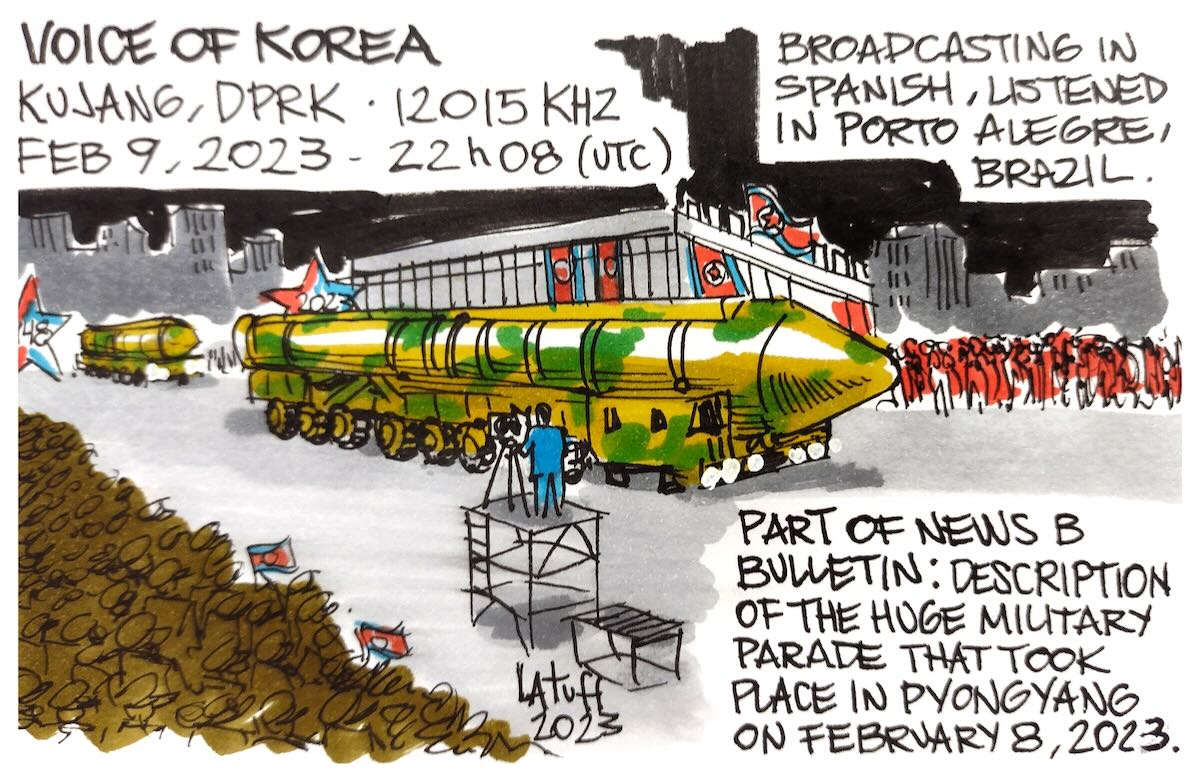
Many thanks to SWLing Post contributor and noted political cartoonist, Carlos Latuff, who shares his radio log art of a recent Voice of Korea broadcast.


Carlos notes:

Voice of Korea, 11865 kHz, broadcasting in Japanese from Kujang, North Korea.
Kim Jong Un guides test-firing of long-range strategic cruise missiles.
Listened this morning [13 Oct 2022] in Porto Alegre, Brazil.

Click here to view/listen on YouTube.

Audio journalist seeking Radio Free Grenada recordings

I received the following message from Ted Muldoon via the Shortwave Radio Audio Archive contact form. If you happen to have any recordings of Radio Free Grenada, please comment so we may add these to the archive and preserve them for all to enjoy:

Hello,

My name is Ted Muldoon. I’m an audio journalist at The Washington Post.

I’m currently working on an audio project examining the U.S. invasion of Grenada in 1983. Among the many lasting impacts on the island from that year, was the loss of the Radio Free Grenada archive, which was bombed and destroyed by the Americans. From what I understand from speaking with people on Grenada, it was huge cultural loss for the island.

Doing a quick search, this post (https://shortwavearchive.com/archive/radio-free-grenada-january-1980) was one of the few results returned with a snippet of archival audio from that time. I’m curious whether there’s any chance that the author, Jim Nall [or other contributors] might have more recordings from Radio Free Grenada?

Best,
Ted Muldoon

I realize how unlikely it is that anyone still has a recording of Radio Free Grenada, but if you do please comment or contact us so that we can digitize, archive, and share this with the wider world.

Keith discovers a Radio Bougainville recording on the Shortwave Archive: “A 50-year old tape takes me back”

We’ve published thousands of off-air recordings on Shortwave Radio Audio Archive over the past decade. They’re freely available for everyone to search and download.

For those of us who work on the archive, it’s a pure labor of love. We are not compensated for the time and effort we put into running and curating it, although we use Patreon and Coffee Fund contributions to help pay for the site and online archives.

Quite frequently, our recordings are discovered and are intensely meaningful to individuals. Listening to radio recordings has an amazing ability to summon up memories and moments in time.

We recently discovered the following article on the blog PNG Attitude written by Keith Jackon. Keith has kindly given us permission to post it in its entirety here on the SWLing Post. Thank you, Keith, and we’re pleased this recording was so relevant to you:


A 50-year old tape takes me back

KEITH JACKSON

NOOSA – It had dropped into my Twitter feed via @Laselki, the account of the Lebanon-based Arab Amateur Radio Network, and @Stret_Pasin, a valued supporter and one of my 8,700 Twitter followers.

It had originated in Ontario, Canada, from the historic village of Ancaster close by the US border and Niagara Falls.

It was a fleeting recording of a shortwave broadcast.

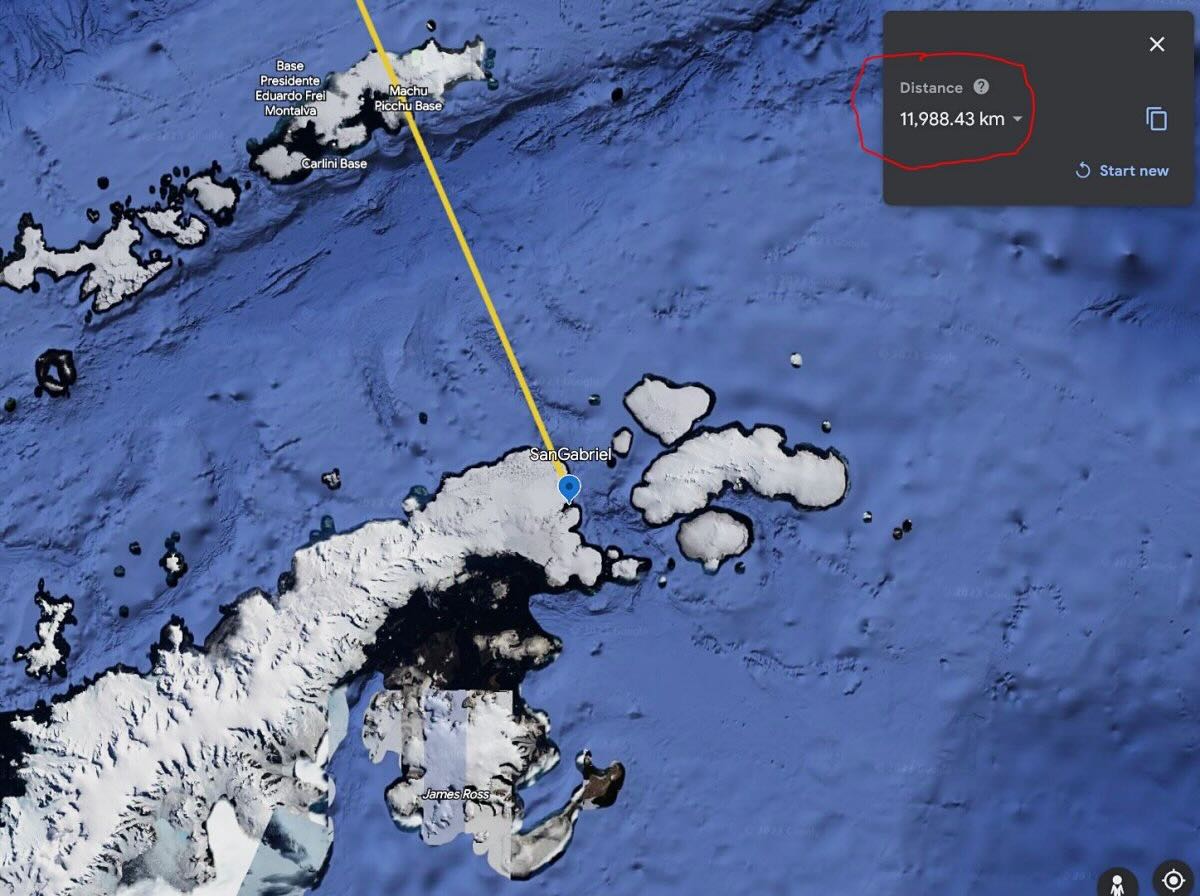
Map showing location of Ancaster, Canada

A broadcast from Radio Bougainville transmitted 51 years ago on 21 October 1971, which had travelled 13,300 km to Ancaster and been recorded.

Then saved on a cassette tape until, for some reason, recently retrieved and shared.

“Sound is a bit crackly,” wrote @Stret_Pasin, “but this will bring back memories of Radio Bougainville.”

Truer words never were tweeted.

When you link to the brief recording here (scroll down to the black audio bar), you will pick up in rapid succession the sound of chanting to the famous Bougainville kaur flute, then an announcer’s voice and finally a snatch of Bougainville string band music.

Click here to listen on the Shortwave Radio Audio Archive.

I thought I recognised this sequence as the pre-recorded station identification put to air each time the station’s transmitters were fired up at Toniva, just south of Kieta, from a switch in the main studio down a ladder beside my house.

But the more I listen to it, the less convinced I am of its provenance.

All I can say for sure is that anything the captured snatch of radio was broadcast at about 12 noon on Bougainville on 22 October 1971.

This was at a time when Radio Bougainville usually broadcast for 11 hours a day in three separate sessions: 6 am – 9 am, 12 noon – 2 pm and 4 pm – 10pm.

In a small town in Canada it was late morning the day before, and a young Dan Greenall was tuning his Hallicrafters shortwave radio seeking out distant stations he would register as finding in the ether.

Even in our modern digital age, there are shortwave junkies who ferret out remote radio stations and seek QSL cards: written proof of reception. (One issued by Radio Bougainville in 2016 is pictured here.)

QSL reception confirmation from NBC Bougainville, 2016

’I heard this at such time on your station; tell me it is true.” And we’d check the log and return a QSL postcard. Yes, you had indeed heard our station.

Collecting these cards became popular with radio listeners 100 years ago and continues to this day

Dan had been doing just that 51 years ago when he happened upon a distant signal struggling through heavy interference to be captured by his outdoor copper wire aerial and delivered to the sturdy Hallicrafters S-52 receiver.

Keith’s appointment to manage Radio Bougainville was greeted by this headline in the Bougainville News

Dan has written for the Shortwave Radio Audio Archive:

“The morning of 21 October 1971 provided some of the best reception of Papua New Guinea stations in the 90 metre band that I ever experienced.

“These stations were rare visitors to my headphones but I was able to make a couple of short recordings of two PNG stations that morning, and they have survived to this day on that same audio cassette (now 51 years old).

“This one of Radio Bougainville begins with a local chant followed by announcement on the hour. The station ran 2.5 kw and their signal made it over 13,300 km to my receiver that day.

“Audio quality is passable considering the recording was made using an open mic to the speaker of the Hallicrafters S-52.”

Technical data:

Broadcaster: Radio Bougainville
Date of recording: 21/10/1971
Starting time: 1100
Frequency: 3.322.5 MHz
Receiver location: Ancaster, Ontario, Canada
Receiver and antenna: Hallicrafters S-52 using a longwire antenna

When I linked to the thin signal that had managed to land so far away so long ago, I was momentarily overcome with emotion.

I had known those sounds so well from too many early mornings wondering whether the breakfast announcer would arrive in time to open the station.

A recording something like that told me he’d arrived, fired up the transmitter and was ready to begin proceedings.

Through the static of 51 years – two-thirds of my life – came a once-familiar sequence of bamboo flute / announcer / stringband, transporting me back to a time when I was young and in my first management job which, bad bits and all, I was enjoying as if born to it.

Keith Jackson at the time of his appointment to Radio Bougainville

They were tough years for the people of Bougainville, especially in the villages around Kieta and its hinterland.

Bougainville Copper had started to dig the ore that produced great quantities of copper, gold and silver on alienated land amidst an alienated people.

Despite the volatile social and political climate, I had enjoyed the challenge of Bougainville.

I felt I’d been made for it and that it was making me.

And I enjoyed working with talented station staff, most from Bougainville, like Tom Kathoa, Sam Bena, Perpetua Tanuku, Justin Kili, Aloysius Sahoto, Aloysius Nase and Aloysius Rumina – most now gone from our midst. That’s what 51 years does.

And that simple recording – made so long ago and so far away – brought it all rushing back.

You can read more about my Bougainville years here in Brink of Secession.

So thanks to Dan Greenall, the Arab Amateur Radio Network and @Stret_Pasin for giving me a free ticket to fly back more than half a century. I really enjoyed the trip.

Read this full article and check out Keith’s website PNG Attitude here.

Also, a very special thanks to Dan Greenall and all of our contributors on the Shortwave Radio Audio Archive. 

Solid copy: Tom receives JG2XA in the Netherlands on his PL-365

CountyComm GP5/SSB, aka Tecsun PL-to 365

Many thanks to SWLing Post contributor, Tom Kamp (PA/DF5JL), who shares the following brief report and video:

Today (September 21, 2022) around 2015 UT strong signal on 5006 kHz (CF) from JG2XA beacon from Japan (0.2 kW) near Den Helder, in North-Holland, The Netherlands.

JG2XA transmits continuously at 200 W on 5006 kHz and 8006 kHz. The type of radio signal is H2A (amplitude modulation with coded tones in the single sideband).

Received with the Tecsun PL-368 and the built-in telescopic antenna! The dBm display of the unit is very inaccurate (in USB), yet S5-S7 should be rated appropriately. Top signal, top RX ?

73 Tom Kamp PA/DF5JL

That’s quite a catch for the PL-365. Thanks for sharing this, Tom!

Paul’s recording of “La Voix de la Corée” interval signal and broadcast intro

Many thanks to SWLing Post contributor, Paul Jamet, who writes:

Hello Thomas,

I hope everything is fine.

To complete Carlos Latuff’s contribution, here is a recording of the French language program of “La Voix de la Corée” made the afternoon of May 30, 2022 at 14h00 UTC on the frequency 13760 kHz with a TECSUN PL-365 connected to a 5m wire antenna of about 5 meters length.

Recording:

I attach the picture of the receiver on an old wall (see above); the screen displays the frequency and the signal characteristics: Signal strength unit: 27 dBu – Signal to Noise Ratio (S/N) unit: 08 dB

The other frequency used at the same time is 15245 kHz but I could not hear anything!

I hope that this information will hold your attention. See you next time. Sincerely yours.

Paul JAMET
Radio Club du Perche :
http://radioclub.perche.free.fr/

Thank you for sharing your recording, Paul!

Carlos’ Shortwave Art and recording of the Voice of Korea (May 26, 2022)

Many thanks to SWLing Post contributor and noted political cartoonist, Carlos Latuff, who shares his radio log art of a recent Voice of Korea broadcast.


Carlos notes:

Part of news bulletin from Radio Voice of Korea shortwave broadcast in English about efforts of North Korea’s government to fight covid-19 pandemic.

Listened in Porto Alegre, Brazil, May 26, 2022, 21h09 (UTC), frequency of 15245 kHz.

Click here to view on YouTube.

Matt’s Rooftop Receiver Shootout: Round Two!

Many thanks to SWLing Post contributor, Matt Blaze, for the following guest post:


Matt’s Rooftop Receiver Shootout, Round Two.

by Matt Blaze

You may recall that back in April, I dragged eight of my favorite receivers up to the roof, hooked them up to a portable antenna, and compared their abilities to demodulate various signals at the same time. For the most part, the similarities between radios were more striking than their differences. I hinted that there’d be a second installment to come, including more receivers and more challenging signals, to further expose and highlight the practical real-world performance differences between the radios we use.

So, as promised, here we are with Round Two of my Rooftop Receiver Shootout.

This time around, I used approximately the same setup, but with a total of fifteen different radios. And once again, I took advantage of nice weather and brought a multitude of receivers, recording gear, cables, and an antenna up to my roof to listen to and record shortwave signals under the open sky.

Our fifteen receivers included everything from “dream radios” from the 1980’s to current-production desktop models to less expensive modern portables to high-performance bench-top lab measurement gear. I tried to curate samples of a wide range of radios you may be familiar with as well as some you probably aren’t.

The lineup consisted of:

  • Icom R-8600, a current production “DC to Daylight” (or up to 3 GHz, at least) general coverage communications receiver, with highly regarded shortwave performance.
  • AOR AR-ONE, another DC to 3 GHz general coverage radio, less well known due to the high price and limited US availability. Excellent performer, but a counterintuitive and awkward (menu-driven) user interface is less than ideal for shortwave, in my opinion.
  • Reuter RDR Pocket, a very cute, if virtually impossible to get in the US, small production, high performance SDR-based shortwave portable receiver. It’s got an excellent spectrum display and packs near desktop performance into a surprisingly small package.
  • AOR 7030Plus, an extremely well regarded mobile/desktop HF receiver from the late 90’s. Digital but retaining some important analog-era features like mechanical filters. Designed and (mostly) built in the UK, it’s got a quirky menu-driven user interface but is a lot of fun once you get used to it.
  • Drake R8B, the last of the much-beloved Drake receivers. Probably the chief competitor to the 7030+.
  • Drake R7A, an excellent analog communications receiver (but with a digital VFO) from the early 80’s. It still outperforms even many current radios.
  • Sony ICF-6800W, a top of the line “boom box”-style consumer receiver from the early 80’s. Great radio, but hard to use on SSB, as we saw in Round One.
  • Panasonic RF-4900, the main competition for the Sony. Boat-anchor form factor, but (improbably) can run on internal D-cell batteries. Generally impressive performer on AM, but, like the Sony 6800, difficult to tune on SSB.

You may remember the above radios from Round One back in April. The new radios this time were:

  • Tecsun 501x, a larger-format LW/MW/HF/FM portable released last year. As noted below, it’s a generally good performer, but regrettably susceptible to intermod when connected to a wideband external antenna (as we’ll see in Part One).
  • Tecsun PL-990x, a small-format portable (updating the PL880), with many of the same features as the 501x. Like the H501x, good performance as a stand-alone radio, but disappointing susceptibility to intermod when fed with an external antenna.
  • Sangean ATS-909x, a recent LW/MW/HF/FM portable with a good reputation as well as a few quirks, such as only relatively narrow IF bandwidth choices on HF. Excellent performance on an external antenna.
  • Sangean ATS-909×2, an updated, current production version of the ATS-909x that adds air band and a few performance improvements. Overall excellent, though I would prefer an addition wider IF bandwidth choice. My go-to travel receiver if I don’t want to take the Reuter Pocket.
  • Sony ICF-7600GR, a small-format digital LW/MW/SW/FM portable introduced in 2001 and the last of the Sony shortwave receivers. Showing its age, but still competitive in performance.
  • Belka DX, the smallest radio in our lineup, made in Belarus. You’ll either love or hate the minimalist interface (one knob and four buttons). If you’re going to secretly copy numbers stations in your covert spy lair, this is a good radio to use. Can be difficult to obtain right now due to sanctions.
  • Finally, a bit of a ringer: the Narda Signal Shark 3310, a high performance SDR-based 8.5 GHz RF spectrum and signal analyzer. As with most test equipment like this, demodulation (especially of HF modes) is a bit of an afterthought. But it has an excellent front end and dynamic range, intended for identifying, extracting, and analyzing weak signals even in the presence of strong interference. Not cheap, but it’s intended as measurement-grade lab equipment, not consumer gear. Demodulated audio is noticeably delayed (several hundred ms) compared with other receivers due to the multi-stage DSP signal path.


The antenna was my portable “signal sweeper” Wellbrook FLX-1530 on a rotatable tripod, using a power splitter and a pair of Stridsberg Engineering 8-port HF distribution amplifiers to feed the fifteen radios. So every radio was getting pretty close to exactly the same signal at its RF input. Continue reading