Many thanks to SWLing Post contributor, Paul Walker, who notes that CountyComm has announced a 48 hour sale on the GP5-SSB (read our review here).
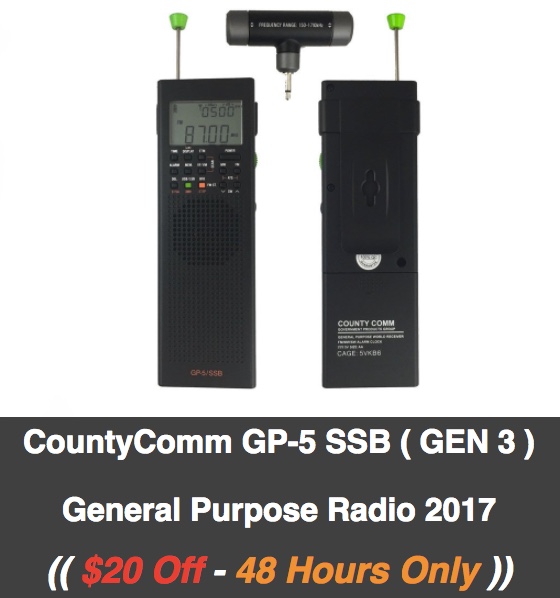 The price is currently $71.99 US plus shipping.

Many thanks to SWLing Post contributor, Paul Walker, who notes that CountyComm has announced a 48 hour sale on the GP5-SSB (read our review here).
The price is currently $71.99 US plus shipping.
Many thanks to SWLing Post contributor, Cap Tux, who writes:
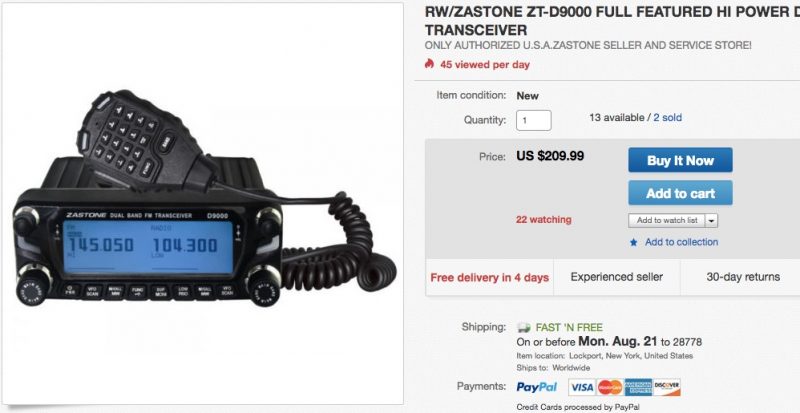
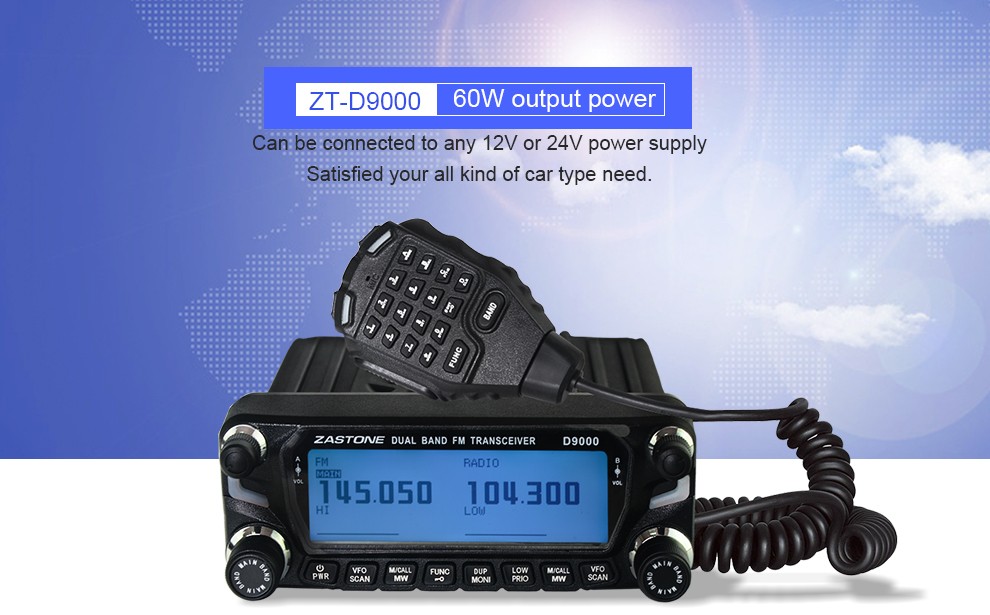
The Zastone ZT-D9000 radio has actually been out for a while and is a Dual Band Mobile (Triband with option), nothing fancy there and bears a striking resemblance to the Icom IC-2820H (clone?). Options include GPS, Bluetooth, 220Mhz and LW (The latter is really weird!).
What caught my eye is the 2.3-30 MHz Shortwave coverage, a quick search on YouTube turns up a video showing Shortwave working!
Yes, probably as wide as a barn door with no filtering except the 12kHz default but an extremely useful feature if you did need a dual band mobile in your jeep/car.
Two other noteworthy features are a dedicated RX BNC antenna socket and a built in FM Transmitter so you can listen to it on the FM Radio in your car/jeep, very cool. A bit like a pimped IC-2820H. Also has all the bells and whistles a Dual Bander should have,
This is the OEM site:
http://zastonetech.com/2-7-mobile-transceiver/291931This site has the spec:
http://radioaficion.com/cms/zastone-d9000/YouTube video showing Shortwave in use:
Click here to view on YouTube.
Some Specs:
A/B Band RX:
136-174MHz
200-260MHz (OPTION)
400-470MHz
470-520MHzB Band RX:
153-279kHz (AM) (OPTION)
0.5MHz-1.8MHz (AM)
2.3-30MHz (AM)
64-108MHz (WFM)
113-137MHz (Airband – AM)TX:
136MHz-174MHz
222-225MHz (Type USA 200-260MHz) (OPTION)
400-520MHzChannel Steps: 1.5, 6, 6.25, 10, 12.5, 15, 20, 25, 50, 100kHz
Frequency Stability: +-2.5ppm
Repeater Shift: +-600kHz(144MHz), +-5MHz (430MHz)
Emission Type: F1D, F2D, F3E
Antenna Impedance: 50 ohms
Supply Voltage: Nominal: 13.8VDC, Neg Gnd, Operating: 12-24V Neg Gnd
Operating Temp: -40F to +-1400F(-20C to +-60C)
RF power Output: UHF: 40W/25W/5W VHF:50W/25W/5W
Case Size: (WxHxD) 6″ x 2.3″ x 1.3″ (Panel w/o knobs and connectors)
6″x6″x 1.8″ (Rear chassis w/o connectors)
Weight: 3.7 lbsTransmitter:
RF Power Output: UHF: 40W/25W/5W, VHF: 50W/25W/5W
Modulation Type: Variable Reactance F1 D, F2D, F3E
Maximum Deviation: +- 5KHz
Spurious Emission: at least 60 dB below
Microphone Impedance: 2 k ohmsReceiver:
Sensitivity Radio Band:
B Band:
5uV TYP for 10db SN (153-279 KHz, AM)
5UV TYP for 10 db SN (0.5-1.7 MHz, AM)
2uV TYP for 10db SN (203-30 MHz, AM)
2Uv TYP for 12db SINAD (64-108 MHz, WFM)
0.8 uV TYP for 10 db SN 9113-134 MHz, AM)A&B Band:
0.2 uV for 12db SINAD (136-174 MHz, FM)
0.2 uV TYP for 12db SINAD (200-260 MHz, FM)
0.2 uV for 12 db SINAD (400-470 MHz, FM)
0.2 uV TYP for 12 db SINAD (470-520 MHz, FM)
Squelch Sensitivity: 0.16 uV (144/430 MHz Band)
Selectivity: NFM, AM 12 KHz/30KHz(-6dB/-60dB)AF Output:
6W@4 ohm for 10% THD (@13.8V) EXP SP
3W@ 8 ohm for 10% THD (@13.8V) Normal EXP SP/CH
AF Output Impedance: 4-16 ohm
3 SpeakersIncluded in Purchase:
– Radio
– Microphone
– Power Cables
– Remote Install Kit
– Software CD
– Programming Cable
– All Mounting Hardware
– 1 Year WarrantyOptions:
– Bluetooth
– GPS
– Barometric altimeter and thermometer
– 220MHz
– LW Band
Very interesting, Cap! Thank you for sharing. Honestly, I have a very difficult time keeping up with the radio equipment being produced and sold out of China.
And you’re right: what a surprise to find HF coverage on a dual-band mobile radio and especially longwave coverage! Like you, I wouldn’t anticipate stellar performance. The price is certainly “bargain basement” at $210 US shipped.
SWLing Post readers: Has anyone purchased and tested the ZT-D9000? Please comment!
[UPDATE: Click here to read our full review of the Digitech AR-1780.]
Yesterday, prior to heading out the door for two days of travel, I received the Digitech AR-1780 I ordered ten days ago from an Australian eBay vendor. I’m very pleased with how quickly the order was processed and delivered via the post. The radio arrived in a rugged mail pouch and was double boxed inside.
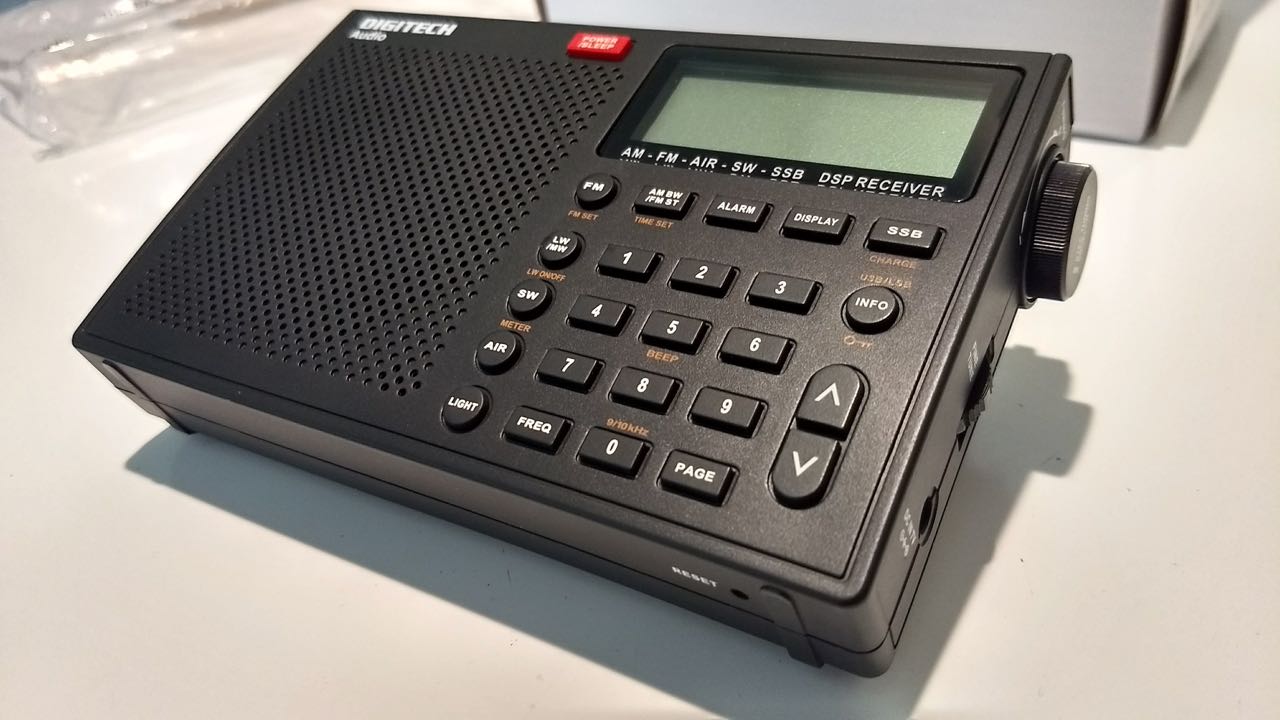
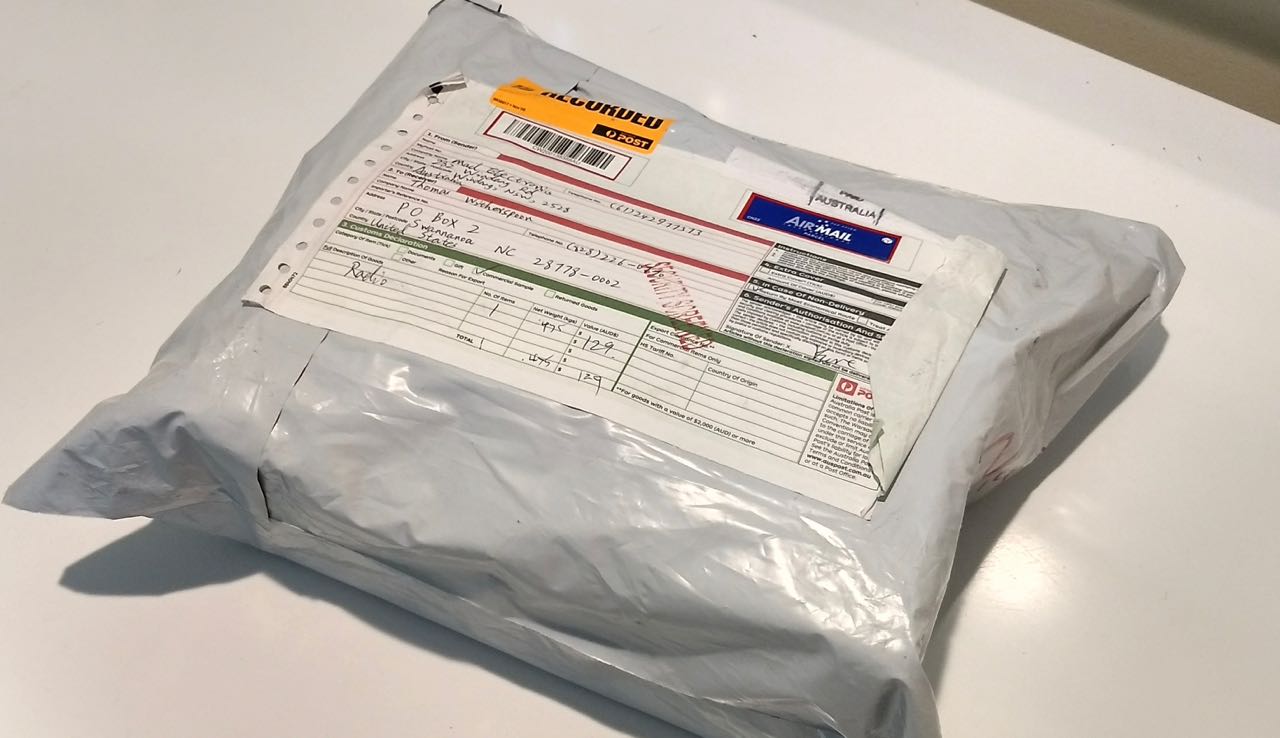 I’ve had no time to evaluate the radio’s performance yet, but I thought I’d post a few photos I took while unboxing the AR-1780.
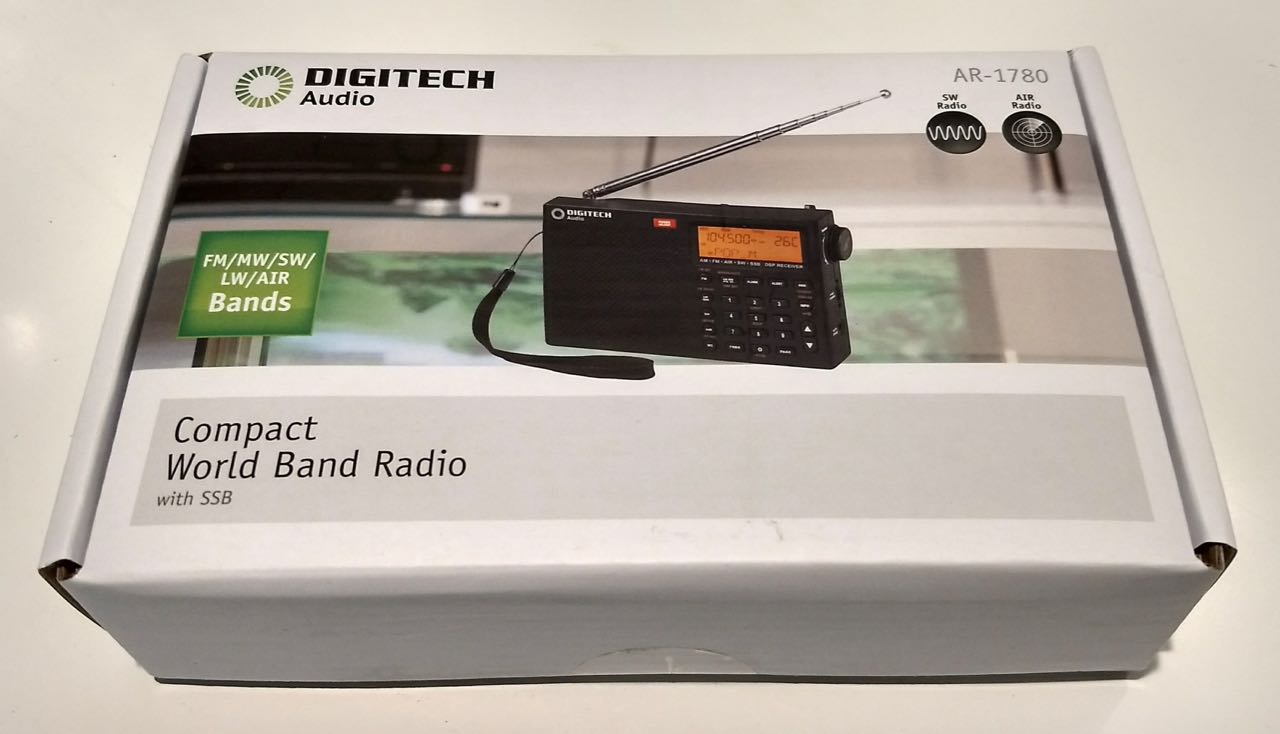
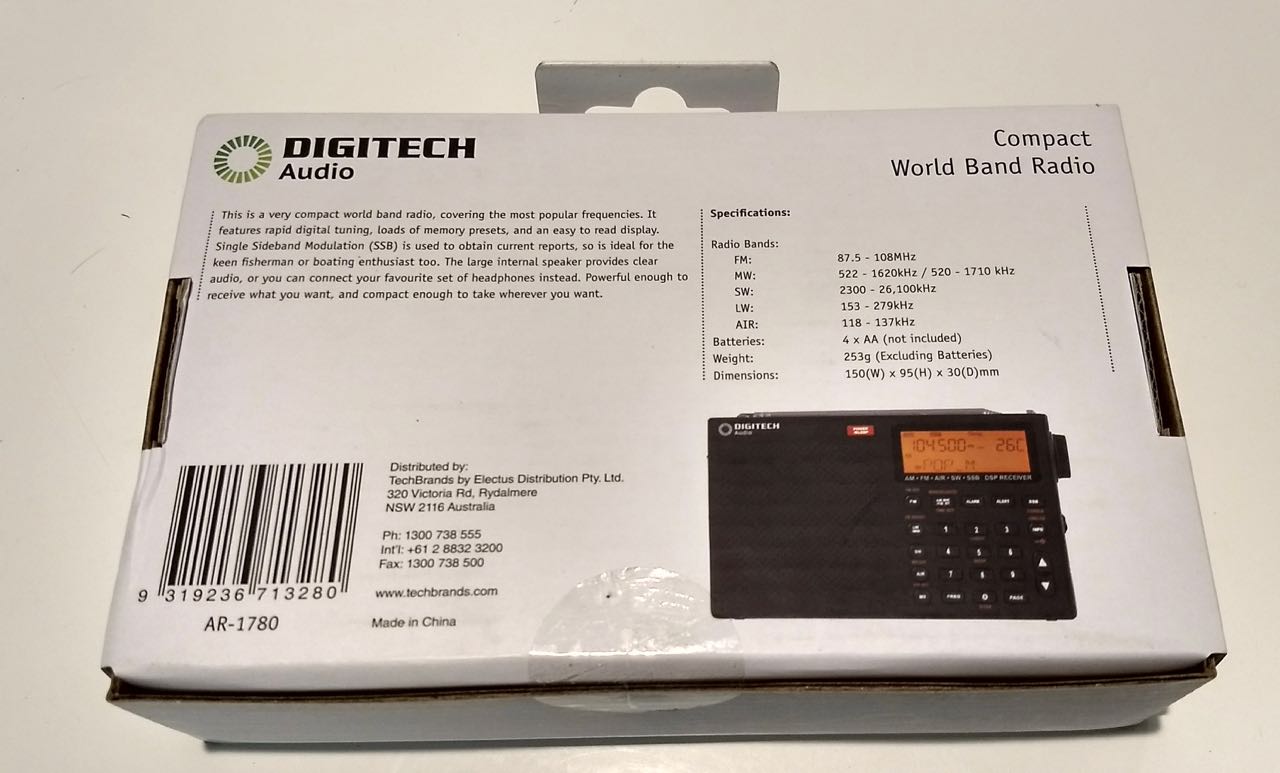
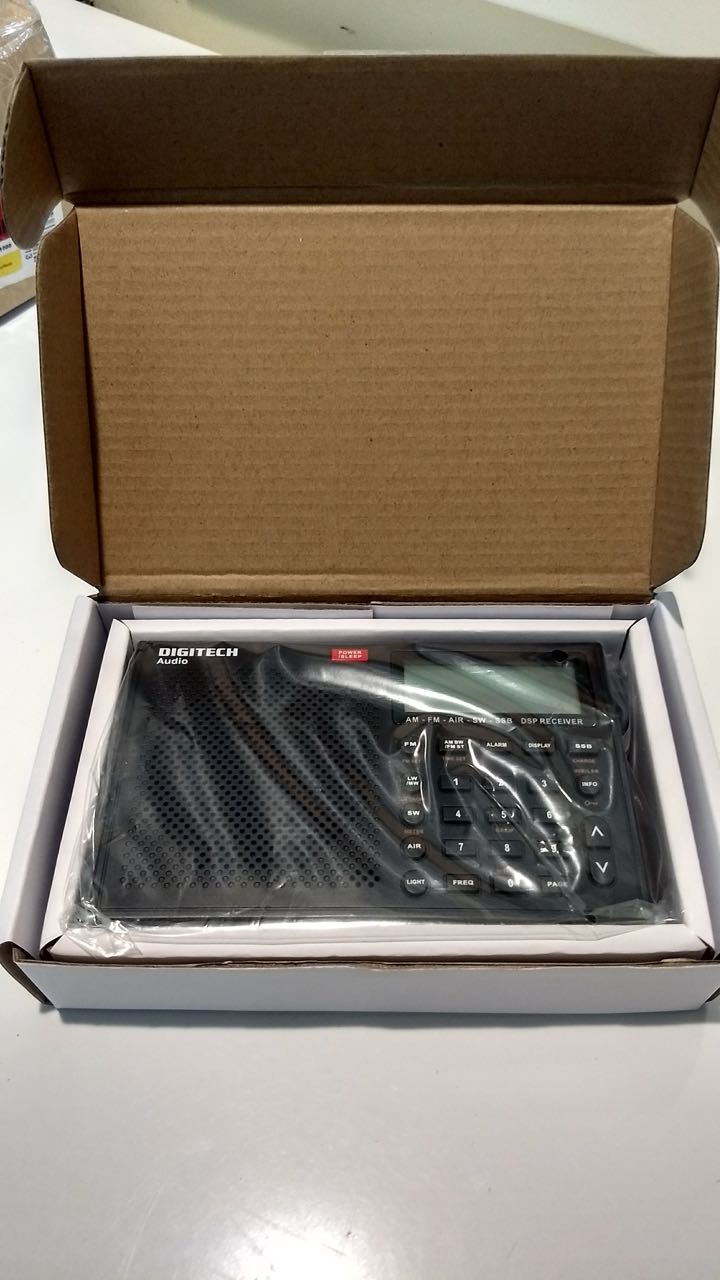
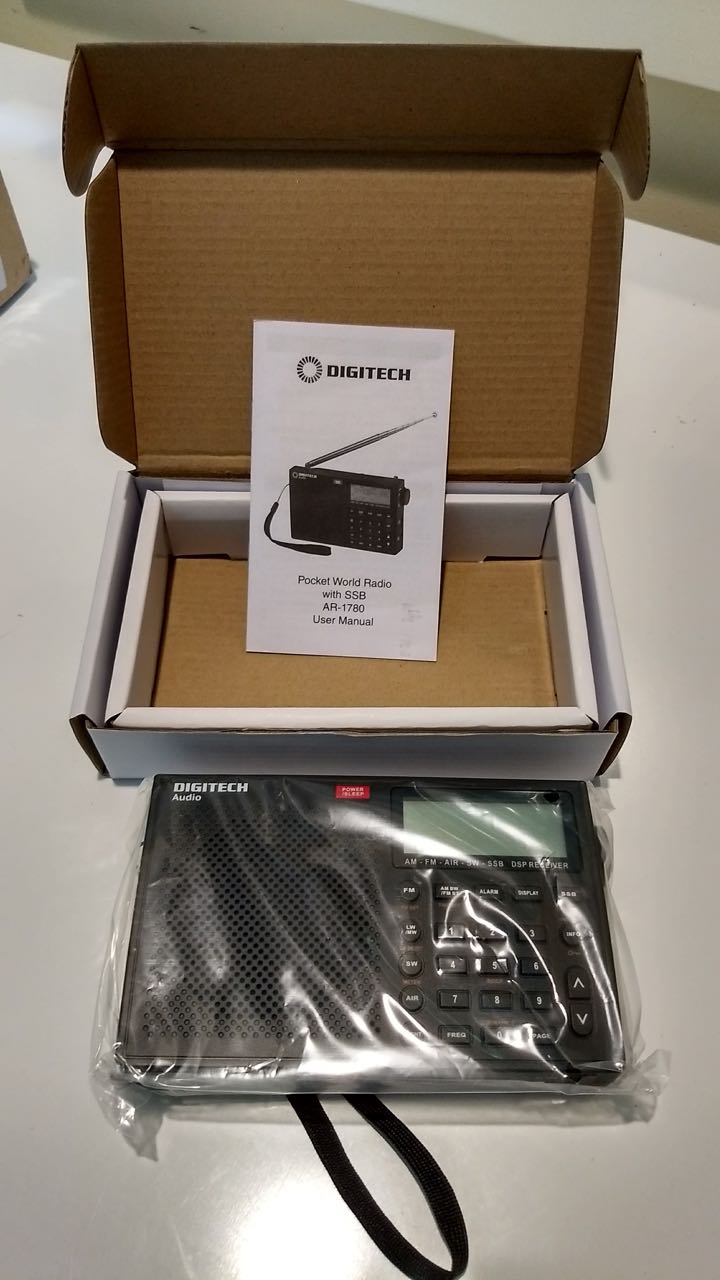 There’s not much in the box: just the radio and an owner’s manual. There are no batteries, no charger, and no case or carry bag. That’s okay though as the AR-1780 takes standard AA cells and I have an assortment of bags that can protect it in my suitcase.
 The buttons all have a responsive, tactile feel. The hard plastic chassis feels durable.
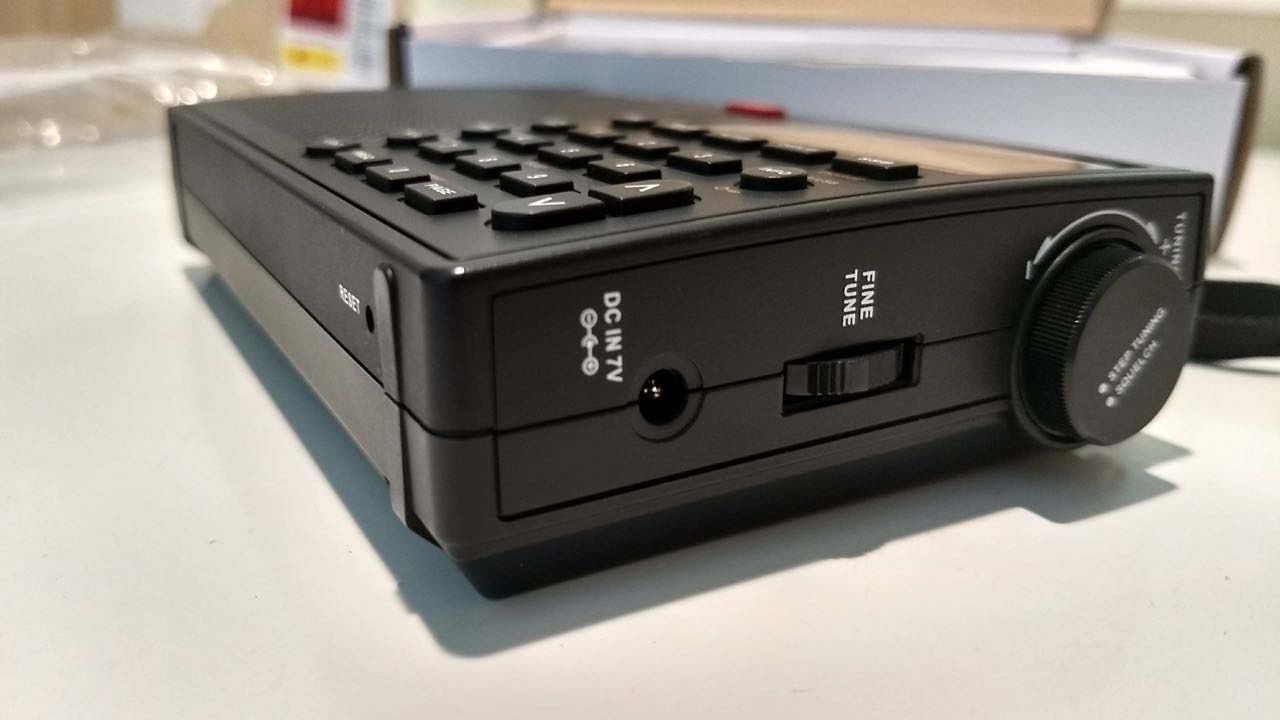 I really like the dedicated fine tune control on the right side of the radio. Nice touch! But 7 VDC in? That’s an odd voltage for a power supply. That’s okay by me as I never use wall wart type power supplies due to inherent noise–rechargeable Enloop AA batteries are how I power all of my portables.
 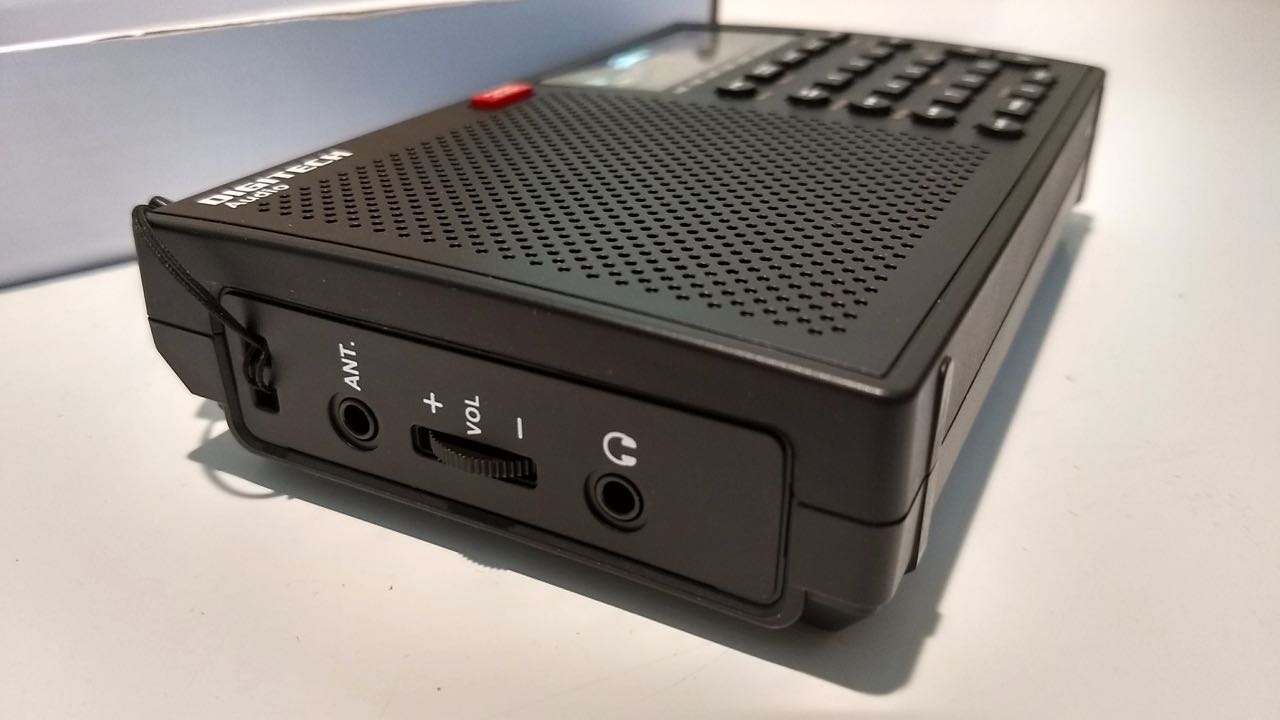 Bonus! There’s also a dedicated external antenna jack! One odd thing, though, is the AR-1780 breaks the convention of having the volume control on the right side of the radio–it’s on the left instead.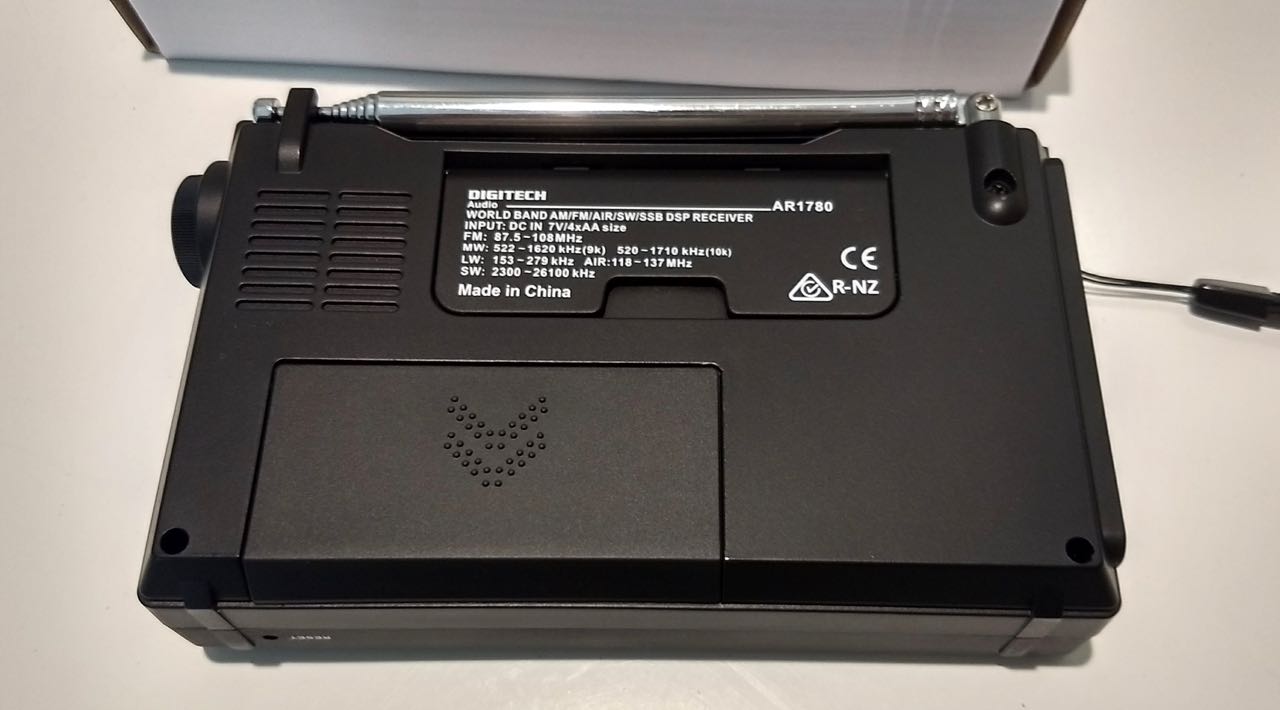
 Last night, I tuned around the 31 meter band and the AM broadcast band. I listened to the French language service of Radio Romania International from inside a noisy house–armchair copy.
The AR-1780 has an impressive 7 AM bandwidth settings: 6, 4, 3, 2.5, 2, 1.8 and 1 kHz. My radio defaulted to 2.5 kHz, so you’ll want to widen that to 4 or 6 kHz before listening to most broadcasts.
I really like the display–it’s compact, yet contains quite a lot of info and even has a dedicated line for FM RDS content.
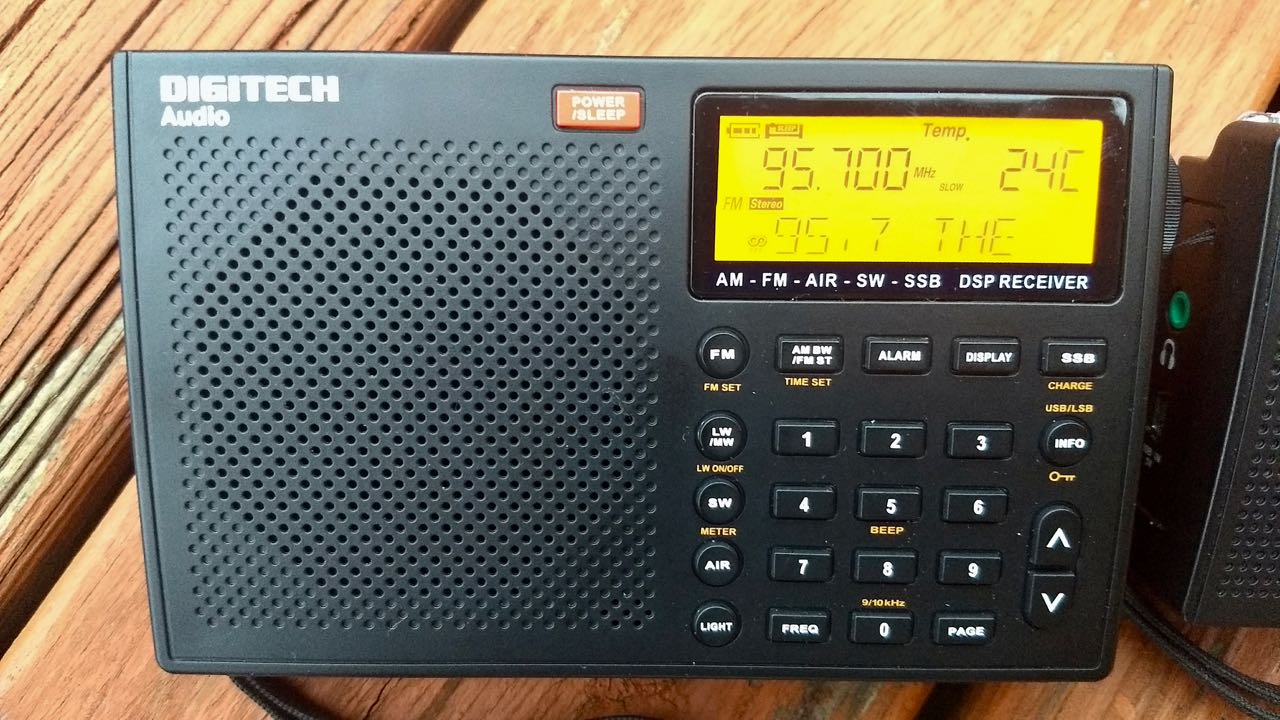 This morning, I took a couple shots of the AR-1780 next to the venerable CC Skywave. The Skywave is slightly smaller in every dimension.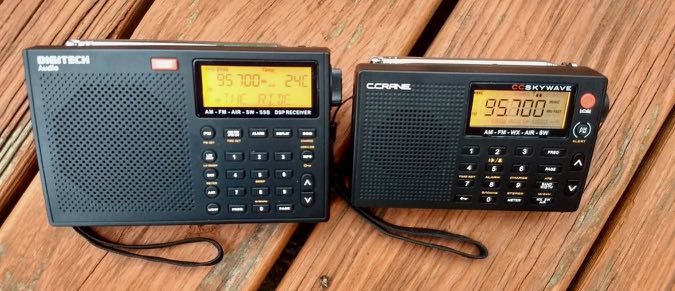

Stay tuned! Though this is a very busy week for me–with travels and total solar eclipse preparations–I plan to put the Digitech AR-1780 through the paces. I’ll try to post updates as I have time. Follow the tag: Digitech AR-1780

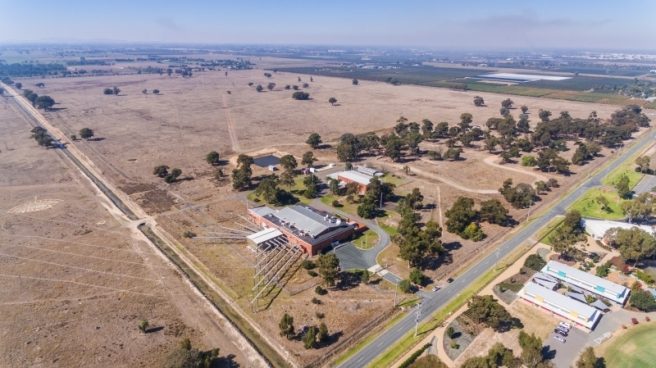
The Arecibo Radio Telescope, at Arecibo, Puerto Rico. At 1000 feet (305 m) across, it is the second largest dish antenna in the world. (Source: Wikipedia)
Many thanks to SWLing Post contributor, Ivan Cholakov, who writes:
Thomas, I did not see a story on the blog about the HF atmospheric heating experiments conducted by the Arecibo observatory a couple of weeks ago.
Thomas Cholakov N1SPY made a video about it but I am also sure a bunch of other listeners were able to tune to the super-strong signal on 5125 and 5095 kHz.
Great video, Thomas!
Indeed, I did miss posting this item. The event timing conflicted with my travel schedule in a bad way. Sadly, I only had one opportunity to tune in and I did too late (by just a couple of minutes!) that day.
Did anyone else catch the on-air experiments from Arecibo?
(Source: Radio Info)
Bill to restore shortwave rejected by Senate Committee
A Senate Committee inquiring into the possibility of restoring ABC Shortwave services has rejected proposed legislation to restore the international radio service.
Several members of the committee presented dissenting reports.
The ABC ended its shortwave transmission service in the Northern Territory and to international audiences from 31 January 2017, in line with the national broadcaster’s commitment to dispense with outdated technology and to expand its digital content offerings.
On 16 February 2017, the Senate referred the Australian Broadcasting Corporation Amendment (Restoring Shortwave Radio) Bill 2017 to the Senate Environment and Communications Legislation Committee for inquiry and report in May but an extension of time to report was granted, until yesterday, 9 August.
Read more at: https://www.radioinfo.com.au/news/bill-restore-shortwave-rejected-senate-committee
UPDATE: Many thanks to SWLing Post contributor, Richard Langley, who also shares an informative link to the Parliament of Australia’s website.

(Source: news.com.au via Ian P)
ON MAPS, this site was marked as a children’s playground. That couldn’t be further from the truth.
When the Chernobyl nuclear explosion happened in 1986, it shook the world in many ways. Not only did it put the now ghost town of Pripyat on the map for all the wrong reasons, it also exposed the world to what was really at this site in Ukraine — the dreaded Duga radar, also known as the Russian Woodpecker.
A Soviet engineering and scientific feat of its time, the Russian Woodpecker was an over-the-horizon radar system designed to provide early detection of an intercontinental ballistic missile attack.
[…]Air traffic controls, television and radio broadcasters would be irked by the mysterious pecking noises it emitted, hence its nickname, the Russian Woodpecker.
Built just outside the city of Pripyat, it was completely off limits and unknown to outsiders.
It was erected near Chernobyl due to its high power demands. On maps, it was marked as a summer camp for children hidden in the depths of the forest. Locals were told that the imposing skyscraper was a radio tower.[…]
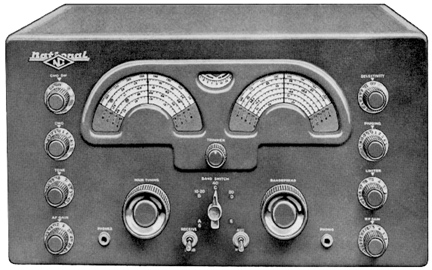
The National NC-173
Many thanks to SWLing Post contributor, Kris Partridge (G8AUU), who sent the following feedback a few days ago. Sorry for missing the boat, Kris!
Kris writes:
Just under two weeks ago I was watching a Norwegian film on Polish TV (no, don’t ask) and knowing how the sight of old radio’s in films is of interest to you and your readers I was going to write but travel and work, Passendale100 commemorations in Belgium, got in the way. The radio in question was a National NC-173 receiver. And the film Kon-Tiki.
There is much written about the exploits of the voyage and the operators of LI2B. I give as an example from PA7MDJ http://pa7mdj.blogspot.co.uk/2016/10/the-kon-tiki-expedition-and-heroes-of.html?m=1 I leave it to PA7MDJ’s most excellent blog to tell more, he has some Nation Radio Company images from 1947 illustrating his piece and at the end there is a very extensive links listing.
But another reason for writing is that tomorrow, Monday, 07 August is the 70th anniversary of the end of the voyage as the raft landed on the reef. On the 67th anniversary the ARRL did an article on LI2B, why the 67th?
What happened on the 7th of August 1947, and in the 36 hours after, says much about the build quality of the National NC-173.
How many radios today would survive a dunking in seawater and after drying out still be working?
I’ve just been to my book shelves and after a small search found my copy of The Kon-Tiki Expedition published in 1950 given to me not too many years later.
You find LI2B in the book’s index twice. Once describing the operation of the radio ‘corner’ and a very QRP contact between the raft and Oslo Norway. 6 watts CW on 13990 kc. per second, the book being written in 1949 no kHz.
LI2B had been given permission to operate out of but adjacent to as well as in the 20 metre band. The second entry concerns what happen after the raft ends up on the reef and the radio shack and equipment got flooded.
They had been in contact before hitting the reef and there was a 36 hour window before the air search and rescue operations would begin. The drying out of the equipment took no little time and the writer describes how slowly the receiver came to life but no transmitter.
Finally they were able make contact, just before the 36 hrs ended,using a WW2 hand cranked resistance, the book says sabotage, transmitter.
Both the radio operators on the Kon-Tiki had been radio operators in the Norwegian resistance in WW2, only 2 years earlier.
If one puts LI2B into Google images quite an interesting assortment of radio related images are found (click here to view search), including QSL cards but the one I like best is this http://f6blk.net/photos/LI2Bshack_x1.jpg:
I’m sure I’ve seen an English language version, this one looks slightly cropped since the end of the ‘Earth’ wire is out of vision
Regards es 73 de
Kris G8AUU
How fascinating! Thanks so much for sharing this, Kris.
Again, apologies I didn’t get this posted prior to the 70th anniversary–I’m a tad behind (understatement alert) on email at the moment.
I have a particular affinity for The Kon-Tiki Expedition. I found a 1950s copy of the book while doing my undergraduate degree ages ago.
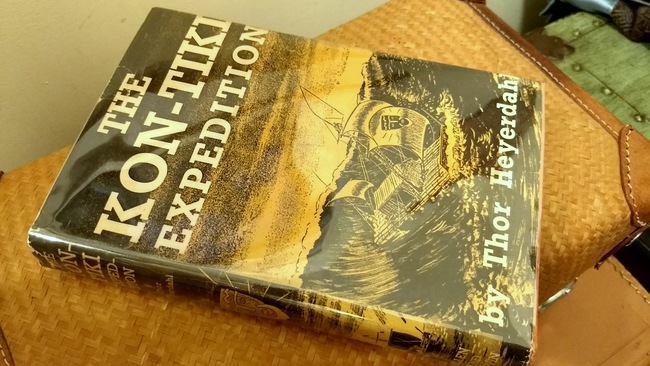
My 1950s copy of The Kon-Tiki Expedition in an archival cover.
The book played no small part in my fascination with anthropology–especially Heyerdahl’s version of “applied” anthropology. I went on to do my post grad work in anthropology at the London School of Economics. Indeed, I re-read that book before my finals to remind myself the significance of anthropology.
If you haven’t read The Kon-Tiki Expedition, I highly recommend you do so! Indeed, it’s about time I read it again.
I’m very curious how many SWLing Post readers have a National NC-173 sitting in their shack? Thor would tell you to take care of it, because it certainly took care of his crew!