Shortwave listening and everything radio including reviews, broadcasting, ham radio, field operation, DXing, maker kits, travel, emergency gear, events, and more
Today, BBC Radio 4 will air The Sound of Soft Power, a documentary presented by Josephine McDermott exploring the history of international broadcasting and the role shortwave radio played as a tool of soft power during the Second World War and Cold War.
The program features a number of familiar voices from shortwave history, including Lord Haw-Haw, Mildred Gillars, Doris Maxina of Moscow Mailbag, and June Taylor.
The documentary also revisits stations and programs remembered fondly by many DXers, including Radio Netherlands’ Happy Station Show and Radio Berlin International.
I was pleased to play a small role in assisting with research for the program, and recordings from the Shortwave Radio Audio Archive were also used in the production.
For anyone interested in the history of shortwave broadcasting and international radio, this will be well worth a listen.
I bring to the brothers-in-radio of SWLing Post a short report on my recent listening sessions of the BBC’s emergency radio service, which broadcasts half an hour of Arabic-language programming from Sunday to Thursday to Sudan and Gaza on the frequency of 15280 kHz. The programming consists of a podcast entitled “Middle East Diaries,” which can be accessed on the BBC Arabic website. Basically, it consists of news about Gaza, the West Bank, Lebanon, Sudan, and other regions of the Middle East, and in one specific case, a public service announcement teaching water purification techniques, vital information for those who live (or try to survive) in regions whose civilian infrastructure has been destroyed by bombings.
These listening sessions were conducted between April 20th and May 21st of this year, in front of the Guaiba River in Porto Alegre, Brazil. The receiver was the reliable Xhdata D-808, and a 3-meter long wire antenna. Transmissions always begin at 12:00 PM Brasília time (3:00 PM UTC), the worst time since the sun is at its zenith, which negatively impacts shortwave reception. The signal is weak; most of the time, it was only possible to save a few audible fragments, and in some cases, it wasn’t possible to record anything; it was almost all noise. Reception usually improves slightly after 12:30 PM. Now, the transmitter, located in Talata Volonondry, Madagascar (about 9800 km from Porto Alegre), is directed towards Sudan and Gaza, so receiving this signal in Brazil is already a stroke of luck!
(Listening session held on May 1st, one of the days with better reception)
One problem I detected was on April 30th, when the Radio Romania interval signal interrupted the end of the programming. Radio Romania broadcasts in Arabic on the same frequency, but at 12:30 PM. The interval signal started at 12:27 PM, when the BBC program had not yet finished.
I also noticed interruptions that seemed to stem from technical problems and/or power outages, as happened on May 4th, when I missed the first three minutes of the broadcast due to a signal interruption.
Four days ago, I was in another city in southern Brazil, Florianopolis, 463 km from Porto Alegre, and there, on the campus of the Federal University of Santa Catarina, I tried to listen to the BBC broadcast but noticed strong interference from a Chinese radio station (CNR ?) on the same frequency. I imagined it was something related to my geographical location. However, today, May 21st, back to Porto Alegre, I found the same problem, which practically made listening impossible. I’m not sure when I’ll be able to listen to those broadcasts again.
Too bad, ’cause I was really enjoying listening to the BBC’s emergency radio service, as it became the only time BBC broadcasts in Arabic, since the station ended its regular service in that language in January 2023. I’m making available here a PDF with all the illustrated radio listening reports I produced during this period.
It’s back to the track for amateur radio station W9IMS. Less than 2 weeks after concluding their first special event of the year, members of the Indianapolis Motor Speedway Amateur Radio Club will take to the airwaves from now through Sunday, May 24, to commemorate the legendary Indianapolis 500.
If you already worked or tuned in W9IMS during the initial event, the IndyCar Grand Prix, this is your chance to snare the second of three contacts required for the 2026 Checkered Flag Award. To earn this certificate, radio amateurs must contact all three W9IMS events in the same year (SWLs may substitute reception reports). The third special event, honoring the NASCAR Brickyard 400, will fire up from July 20-26.
Even if you missed the Grand Prix, you’re still eligible for a colorful and collectible QSL card marking the 110th running of the Indy 500. The current operation is slated to conclude at 11:59 p.m. Sunday, May 25 (Indy time) or 0359 UTC Monday, May 26.
Tips on finding W9IMS:
Check DX Summit (www.dxsummit.fi) for spots listing the current frequency or frequencies of W9IMS. You can customize your search by typing “W9IMS” in the box at upper right.
Go to the W9IMS page on QRZ.com (short cut: www.w9ims.com) and look for the heading, “2026 Operating Schedule.” The Indianapolis 500 link opens into a weeklong schedule of individual operators and their reserved time slots. Although the special event can be activated at any time throughout Race Week, your odds of snaring the station improve dramatically during hours with a listed op.
Look for the Indy 500 station on 20 and 40 meters – on or near 14.245 and 7.245 MHz – and there’s a bonus band if you plan to attend the race or be in the Indianapolis area on Race Day. Each year on the morning of the 500, W9IMS operates simplex FM on 146.52 MHz, working hams situated in the grandstands and the infield of the track, as well as those en route or residing in the local area.
Remember that the published schedule can be shortened by adverse circumstances, such as local thunderstorms, solar flares, and a lack of calling stations. Don’t wait till the final hour to hunt W9IMS!
However, radio amateurs who still haven’t worked W9IMS by Sunday may benefit from the policy changes that usually kick in at the end of Race Week. W9IMS ops tend to start calling for “only stations that have not worked this event” and may switch to contest-style operations, exchanging only signal reports to put more contacts in the log.
Keep in mind that both hams and SWLs are eligible for QSL cards and the certificate. So if you’re unable to work W9IMS by Sunday night, you can create a reception report by copying down details of other contacts – such as date, frequency, UTC, and the callsigns of a few stations you heard W9IMS working. SWL reports count as credits too, but the certificate will likely feature your name instead of your call.
If you succeed in bagging W9IMS, congratulations! The station website (www.w9ims.com) contains everything you’ll need to know about obtaining your QSL cards and certificate.
Hams: If you can hear W9IMS but can’t complete a QSO in the waning minutes of the special event, don’t give up. You can still create an SWL report by jotting down the details of other W9IMS contacts – including frequency, UTC, a signal report and the callsigns of several stations that you heard W9IMS contact. A valid report satisfies the requirements for a Grand Prix QSL card and the first of three credits for a certificate. SWL certificates feature operators’ names instead of callsigns but are otherwise indistinguishable from awards issued to amateur radio operators.
Remember to stay on your toes once the Grand Prix operation is over – the Indy 500 special event begins only nine days later!
Hi to all SWLing Post community. Here’s news of what Imaginary Stations will be bringing to those shortwave transmitter sites this week coming.
Thanks to the services of Shortwave Gold we have a few programmes this week coming. The first show is WMMR – Mystery Mix Radio. As usual, the show has a theme that you the short-wave listener, will have to guess what it is. There’ll be a special e-QSL for the lucky winner, and as ever, we will not give any clues away here (even on the flyer above), the clues are in the show. Tune in and play some guessing games via the shortwaves.
The schedule for the show is on Saturday 23rd May at 1100 hrs UTC on 6160 kHz and then again on Sunday 24th May at 0900/1300 UTC on 6160 kHz and 2000 hrs on 3975 kHz/6160 kHz. Hoist up your antenna and tune in!
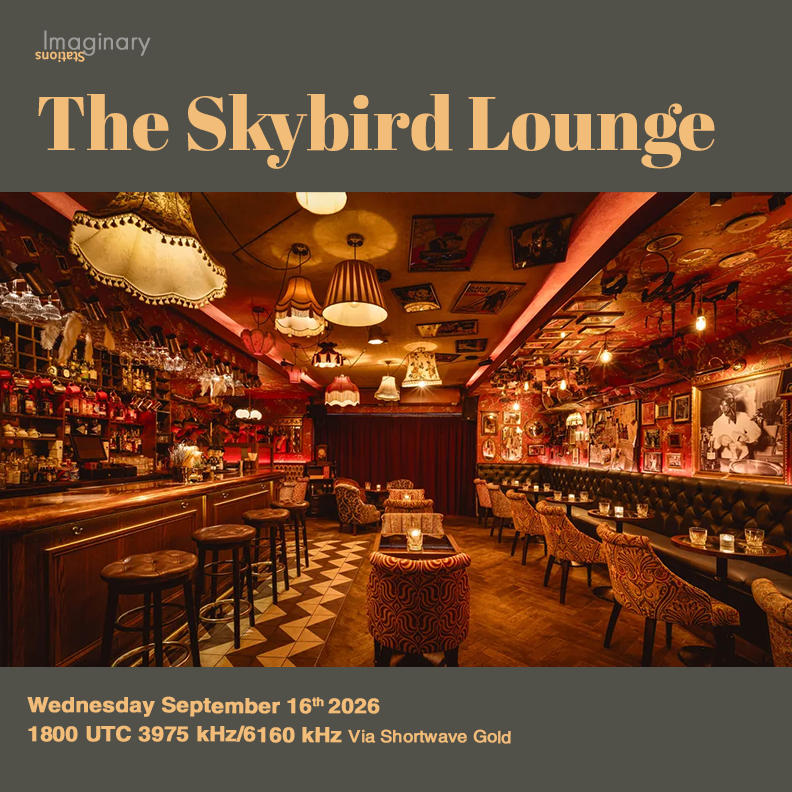
Then on Monday 25th Mayat 20:00 UTC on 3975 kHz/6160 kHz, we have the repeat of “Skybird Soul on Shortwave 2”. There’s more wonderful examples of Soul and Soul inspired tunes on this special Monday night slot.
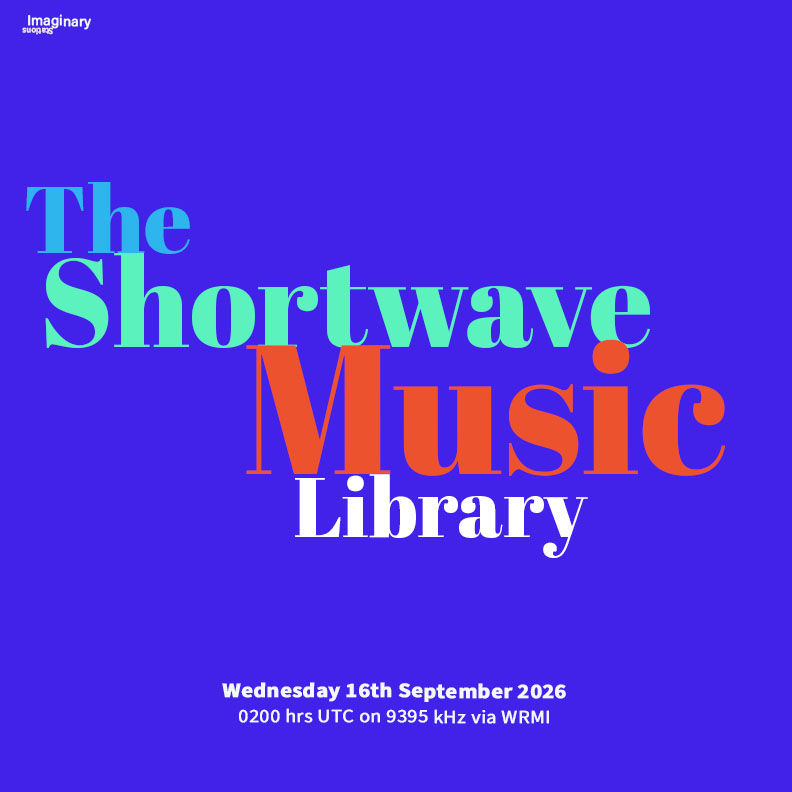
On WRMI on Wednesday 27th May 2026 at 0200 UTC on 9395 kHz we have TheAncient Analogue Archive, where DJ Frederick selects and picks all sorts of genres from out of the archives. Tune in and be surprised yet again.
For more information on all our shows, please write to us at [email protected] and check out our old shows at our Mixcloud page here.
Marconi watching associates raising the kite (a “Levitor” by B.F.S. Baden-Powell[47]) used to lift the antenna at St. John’s, Newfoundland, December 1901 (via Wikipedia)
Many thanks to SWLing Post contributor Markku (VA3MK), for sharing this BBC article marking the centenary of the world’s first shortwave transatlantic telecommunication link between Canada and Somerset, England. Among other things, this article also highlights the historic Marconi Beam Wireless Station at Bridgwater and the challenges of early shortwave radio experimentation. Read the full article here: BBC: Pioneering’ message that changed the world