Category Archives: Shortwave Radio

Radio Northern Ireland WRMI Broadcast

RNIe!SLnew

Radio Northern Ireland will be broadcasting via WRMI on 9955khz at 0130 UTC on Monday. This is a regular show from Radio Northern Ireland. Jordan Heyburn from Radio Northern Ireland has made changes to his show and he has included a news segment! Jordan said “I decided to include a news segment to bring the news of Northern Ireland to your own home no matter where you are in the world. Not many people hear about Northern Ireland in the news in all corners of the world!  The news brings a full round up of what has been happening in Northern Ireland including events which are happening in Northern Ireland which might interest any listeners” 

Radio Northern Ireland happily accepts reception reports to the email address [email protected]

They welcome a $2 donation via paypal to their email address if you wish to cover postage for a QSL card by post.


Jordan Heyburn (MI6JVC) is the author of this post and a regular contributor to the SWLing Post. Jordan is an avid shortwave listener, ham radio operator and shortwave presenter/owner of Radio Northern Ireland. Jordan is based in Northern Ireland.

The Mighty KBC: two shows on shortwave tonight

Scott-Marine-SLR-M-Dial

Sunday, August 7, 00:00 – 02:00 UTC, The Mighty KBC will broadcast on 9925 kHz for two hours:

  • 00:00 – 01:00 UTC It’s Radio, But Not As We Know It – Dave Mason
  • 01:00 – 02:00 UTC The Giant Jukebox – Eric van Willegen

Note that for those of us in North America, the broadcasts will start at 20:00 (EDT) tonight (Saturday).

I’m planning to tune “Scottie”–my Scott Marine Model SLR-M (above)–to the KBC signal and enjoy the shows!

Patrick comments on his newly-restored Sony CRF-320

Sony-CRF-320

Many thanks to SWLing Post reader, Patrick Mason, who writes from Juneau, Alaska:

I am the owner of the radio that Paul Carlson restored in the video. The serial number is 31358.

I wanted to comment about a statement regarding the receiver’s sensitivity.

After Paul concluded his final tune-up of the radio I can confirm on the shortwave bands, particularly 80 and 40 meters, the sensitivity on AM was better than 0.2 uV/m. That’s outrageous! The VFO is rock solid with no detectable drift whatsoever.

Also, Paul replaced all nylon gears with custom metal gears… they will never fail again.

Anyone considering acquiring this radio, buyer beware! There are many on the WEB who will claim it to be in some ‘totally restored’ condition…when mine arrived from the seller it ‘seemed’ to be ok…..until the counter went fruit loops shortly after unpacking. When Paul got inside the radio it had been ‘tweaked and peeked’….all wrong.

I have a CONSIDERABLE sum invested in this SONY. If I could have known it’s ACTUAL condition BEFORE my purchase, I may have passed….however, I now own what I consider to be the quintessential example of SONY’s best engineering. All I can say, it’s an absolute joy to use

Patrick, you no doubt have a benchmark Sony in that CRF-320.

It’s funny: I was just attending a local hamfest here in North Carolina and a vintage radio vendor pointed out Carlson’s repair video for your CRF-320! He said (and I agree), that your CFR-320 was restored to a level that’s almost in a league of its own. I know you invested a lot in this radio, but you certainly have a fine example now–that is fully-functional–and will most likely outlast us all! Enjoy!

Shortwave Logs From Alaska July 17 to August 2

Alaska-Paul-Walker-Wellbrook

As is my typical style, I’ll do some DX’ing for weeks, if not a month or more before I sit down and write out logs. I focus on logging and recording first, then writing reports later as I’m worried i’ll miss something on the dials.

I have a few good ones this time around, like usual. Lets get on with the logs!

There are a few good ones here, including The Voice of Mongolia 12035 kHz, Vivdh Bharati on 9870 kHz and others along with some usuals.

2850 kHz, 3250 kHz & 3320 kHz, The Voice of Korea via Pyongyang to North Korea and the Far East in Korean on August 2, 2016 from 1623 to 1627UTC. The tropical band signals of VoK are somewhat rare and kind of weak during the summer but much more regular and stronger in the winter. This time around, 2850 kHz is the strongest with a woman singing in Korean. The signal is weak but easy to understand despite the noise.  3250 kHz and 3320 kHz both featured a man talking, 3250 had a song shortly after my recording began. 3560 kHz wasn’t heard on this date, but it was heard back on July 23, 2016 at 1502UTC with a pretty weak signal, full of noise, yet music was definately heard above the buzzing!

2850 kHz audio here: https://soundcloud.com/onairdjpaulwalker/vok-2850-august-2-2016-8-23-35.

https://soundcloud.com/onairdjpaulwalker/vok-2850-august-2-2016-8-23-35

3250 kHz audio here: https://www.youtube.com/watch?v=Y2Fzy7bm_3A

3320 kHz audio here: https://www.youtube.com/watch?v=EEB0Qx9bZLg

3560 kHz audio here: https://www.youtube.com/watch?v=djJIa4JLWow

4885 kHz, Echo of Hope to North Korea in Korean on July 28, 2016 at 1623UTC. Their other frequencies always seem to be jammed but I’ve not heard this Anti North Korean station have it’s 4885 kHz signal jammed. It’s a pretty good signal, clean, clear, fairly steady with only some light fading. Audio here: https://www.youtube.com/watch?v=sgZUOjZaQPE

https://www.youtube.com/watch?v=sgZUOjZaQPE

5020 kHz, Solomon Islands Broadcasting Corporation via Honiara to the Solomon Islands on August 1, 2016 at 0953UTC. The SIBC is here just about nightly and at least very poor levels. The signal on this night with local music is fair but with a good amount of fading and noise. Audio here: https://www.youtube.com/watch?v=A67vQd04Uj0

5857 kHz “HLL Seoul” on July 28, 2016 at 1634UTC.  A weather broadcasting station from Seoul, South Korea often with digital data but does have voice from time to time, I’ve heard both but never this clear. The voice isn’t usually this clear or loud. Audio here: https://www.youtube.com/watch?v=a5eICMqMCaQ

https://www.youtube.com/watch?v=a5eICMqMCaQ

7280 kHz, The Voice of Vietnam in Russian via Hanoi to Europe on July 26, 2016 at 1639UTC. A poor signal with lots of fading, static and noise and possibly some interference as well. A man was heard talking in Russian. Audio here: https://www.youtube.com/watch?v=h7nt1J0QGWQ

9390 kHz, Radio Thailand World Service in English via Udon Thani on July 23, 2016 at 1955UTC. Radio Thailand is here from time to time and while it may be strong sometimes, it’s usually a pretty fade-y signal. This signal would be on the high side of fair if it wasn’t for all the noise and fading.  The recording starts off with what sounds like ad’s for a business marketed to english speaking ex pats and tourists. A sign off message then airs but the carrier doesn’t drop as far as I can tell before the German service starts at 2000UTC. Audio here: https://soundcloud.com/onairdjpaulwalker/radio-thailand-9390-july-23

9420 kHz, The Voice of Greece via Avlis to Europe. on August 1, 2016 at 2326UTC.  The Voice of Greece is not heard here too often and when it is, it’s often a noise, static and fade-y ridden signal like this is with a woman talking, but about what, I don’t know.  Audio here: https://www.youtube.com/watch?v=ul6kf5cdvho

9635 kHz, The Voice of Turkey in French via Emirler to Western Europe on July 23, 2016 at 2021UTC. The Voice of Turkey is pretty rare here, I can’t recall it paying a visit very often. The is about as good as I can recall hearing them here Despite the extreme noise, It is still a steady signal with a musical selection, a man talking and then a musical selection before the carrier is turned off. Audio here: https://www.youtube.com/watch?v=MMXlIHiDl7U

9735 kHz, Radio Taiwan International in Japanese via Paochung/Baujong to Japan on July 31, 2016 at 2258UTC. A man in Japanese mentioning Tapei, a short musical selection plays before a few beep tones and a carrier being cut. The signal is pretty steady and strong with some light fading, but still a listenable signal. Audio here: https://www.youtube.com/watch?v=-K6NVvrriwY

https://www.youtube.com/watch?v=-K6NVvrriwY

9790 kHz, Radio Romania International in English via Tiganesti to the Far East. The English service broadcast with a lady talking about a contest with the giveaway being a CD. Details are given how to enter the contest. The signal was somewhat weak but there was a moderate amount of nosie with some fading on the channel. I detected the 9760 kHz in english to Western Europe and I could hear audio, but nothing worthy of recording or logging it “officially”. 9790 kHz audio here: https://www.youtube.com/watch?v=BGiD1OHVWKw

9870 kHz, All India Radio Vividh Bharati Service in Hindi via Bangalore to South Asia on July 27, 2016 at 1700UTC. They are here just about everyday, sometimes at poor levels but usually at least fair. However, some days like this time, they are good to excellent with great audio, steady signal and no real noise or fading. I love hearing the music they play! Audio here: https://soundcloud.com/onairdjpaulwalker/air-9870-july-27-2016-8-59-1

https://soundcloud.com/onairdjpaulwalker/air-9870-july-27-2016-8-59-1

9997 kHz LSB, RWM  Moscow Russia on July 27, 2016 at 1643UTC. Every source I’ve seen places them on 3 frequencies, including 9996 kHz. I swear each time I’ve heard them, it is clearer on LSB and 9997 kHz then 9996 kHz! They are a fairly regular visitor here, not every day, but at least weekly but usually, they are buried in the noise between slop from WWV/H and atmospheric crud. Well, this today the beep from RWM was very very much in the clear.  Audio here: https://soundcloud.com/onairdjpaulwalker/rwm-9997lsb-july-27-2016-8

11540 kHz, VOA Radio Ashna in Pastho via Udon Thani to Iran on August 2, 2016 at 1654UTC. A very weak signal, barely above the static and fading with a man talking in the Pashto language. Audio here: https://soundcloud.com/onairdjpaulwalker/voa-ashna-11540-in-pashto-to

11800 kHz, Radio Romania International in Romanian via Tiganesti to the Middle East on July 27, 2016 at 1647UTC. The signal was fair with a moderate amount of fading and atmospheric noise. I heard a romanian language tune followed by a man then a woman talking. Later on, I heard what may have sounded like feature report of some kind, I don’t think it was a news broadcast. Audio here: https://soundcloud.com/onairdjpaulwalker/rri-11800-july-27-2016-8-47-16

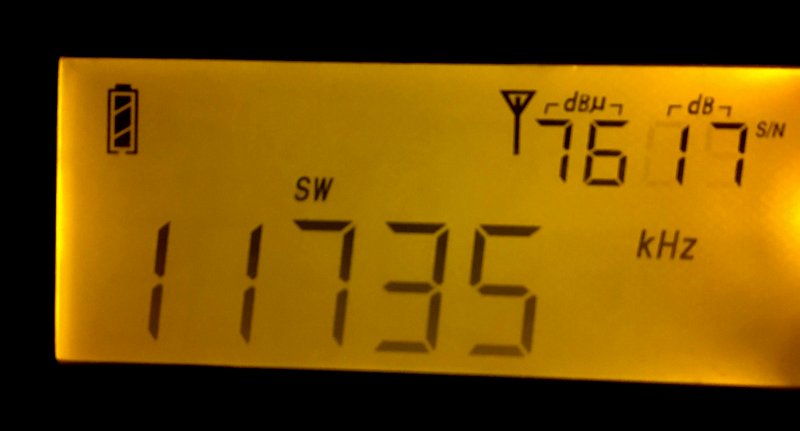
11735 kHz, Zanzibar Broadcasting Corporation in Swahili via Dole, Zanzibar on July 28 at 1659UTC. They are only 50KW and while some sites list them as non directional, they aren’t. A directional curtain antenna has been spotted on Google maps, but I don’t know what their beam is. That being said, I can count on them being here daily. Somedays it’s poor, some days it’s fair and other days it’s somewhat good like this. There are even days when it’s near excellent with a clear, steady signal and good audio. In this clip, the audio sounds like a cross between being full of digital artifacts and some propagation issues. The audio is not as good as usual, but still pretty listenable with not much fading and little noise or interference. There was a song, followed by a little dead air then a station promotional announcement and another song. ZBC, when playing music, is an enjoyable listen! Audio here: https://www.youtube.com/watch?v=SSvyT-Do1cE

https://www.youtube.com/watch?v=SSvyT-Do1cE

11950 kHz, Radio Romania International in French via Galbeni to Southern Europe on August 1, 2016 at 1640UTC. The signal was fair but with a moderate amount of fading. Thankfully, no interference or too much atmospheric noise. A woman talking in french, presumably reading the news. Audio is here: https://www.youtube.com/watch?v=PioNenuF358

12019 kHz, The Voice of Vietnam in Chinese(?) via Hanoi to Indonesia on July 31, 2016 at 2236UTC. I can usually hear the Voice of Vietnam shortwave broadcasts in multiple languages from their Vietnam based transmitter sites across very frequencies. This signal is fairly weak with some nooise and fading. It sounds like a news broadcast or feature report to me. Audio here: https://www.youtube.com/watch?v=L5GRlWGQbBg

12035 kHz, Voice of Mongolia via Ulaanbatar with 180 degree beam south from Mongolia On August 1, 2016 at 0900UTC, I had the best signal ever from time. If it wasn’t for all the atmospheric noise and fading present, the signal would’ve been an incredibly pleasant listen. During this time, I happened to catch the DX’ers mailbox program in which they read out a letter from me. However, this is the second time the July 4th broadcast has been replayed. Still great to get them so well here, usually they are weak and barely above the noise floor. My Wellbrook ALA1530LNP was used here instead of the 225 foot longwire. The loop provided noise reduction and nulling/directional capabilities that really helped out! Audio here: https://www.youtube.com/watch?v=bqTox0j8P3k (Here’s a tip when looking for VOM on 12035 and trying to log in: I think the carrier is turned on several minutes before the 0900UTC broadcast in english. The interval tune starts just a little before 0859UTC and I think the program runs the entire 30 minutes till 0930UTC, unlike what I think some sites suggest)

12060 kHz, Radio Algerienne via Issoudun to West Africa in French on July 26, 2016 at 2038UTC. none of Radio Algerienne’s signals are regular visitors and pretty weak as I recall, like this one with lots of noise and buzzing. Music and chat barely detectable above the noise floor.  Audio here: https://www.youtube.com/watch?v=2pqdQKRrG0E

12095 kHz, BBC World Service in English to East Africa via Meyerton on July 23, 2016 at 1625UTC. A news broadcast in english, two men are discussing sports then a news anchor comes on to read the top stories. Audio here: https://soundcloud.com/onairdjpaulwalker/12095-bbc-english-to-east

13660 kHz, Radio Romania International in Romanian via Tiganesti to the Middle East on July 28, 2016 at 1655UTC. This was a GOOD signal with only a light amount of fading and very little noise.  There was a woman talking for a bit then a man came on and mentioned the name of the station. A song played and the carrier was cut mid song without their usual interval tune.  Audio is here: https://www.youtube.com/watch?v=WR7p0537mbc

15170 kHz, Radio Romania International in Spanish via Tiganesti to South America on August 1st, 2016 at 2101UTC. This signal was pretty weak with only a light amount of fading but plenty of atmospheric noise. It was hard to understand the woman talking, but you could clear make out the RRI news sounder noise part of the way through my recording. Audio here: https://www.youtube.com/watch?v=jzYQ3l4iPWE

15205 kHz, BSKSA Holy Quran in Arabic via Ryadh on August 2, 2016 at 1704UTC. A fair to good signal but with a moderate amount of nosie and fading while a man chants. Audio here: https://soundcloud.com/onairdjpaulwalker/bsksa-holy-quran-15205-august

15235 kHz, Channel Africa in English via Meyerton to Western South Africa on August 2, 2016 at 1708UTC.  Channel Africa is somewhat of a regular visitor up here as of late when conditions are good. They broadcast an hour long news segment in French from 1600 to 1700UTC followed by an hour long english broadcast. The signal this time around is fair but there’s alot of fading. The signal can be weak at times, but is usually steadier then this.  Audio here: https://www.youtube.com/watch?v=7k0-lx8aLXM

15275 kHz & 11740 kHz, Deutsche Welle via Issoudun in French to Africa (17740 kHz) and West Africa (15275 kHz)on July 31, 2016 and August 2, 2016 bewteen 1700 and 1730UTC. 15275 kHz french service to Africa was heard on July 31 and August 1st. July 31st produced a fair to good signal with moderate fading but still very listenable. The August 1st broadcast proved a bit harder, it was weaker and with a fairly high amount of fading and noise.  The 17740 kHz was heard on July 31st and was fair but with LOTS of noise and fading which made it hard to understand. 15275 kHz audio here: https://www.youtube.com/watch?v=eNBfkK4-UT4 (July 31) and https://www.youtube.com/watch?v=zhcZ6ZLLDP8 (August 2). 17740 kHz audio here: https://www.youtube.com/watch?v=4fdirw8RxKs

15400 kHz, Radio Romania International in Spanish via Tiganesti to South America on August 1, 2016 at 2259UTC. There is a fair amount of noise in the signal and it’s somewhat weak, but still fairly listenable. The signal starts off with the usual and easily identified interval signal followed the opening of the broadcast, introducing it in spanish and continuing on with the news. Audio here: https://www.youtube.com/watch?v=jzYQ3l4iPWE

15770 kHz, DigiDX via WRMI Okeechobee, Florida on July 31, 2016 at 2149UTC. It is a very weak signal plagued with lots of noise and fading but I did get plenty of MFSK32 text to decode and a picture to come through on FLDigi. It wasn’t error free, but it was pretty good considering what the signal sounded like. Audio is here: https://www.youtube.com/watch?v=tFMxYTrGA6Q (Bring up FLDigi on your computer and play this video in the background, and you’ll see, stuff DOES decode!)

https://www.youtube.com/watch?v=tFMxYTrGA6Q

Paul Walker is an avid Shortwave DX’er located in Galena, Alaska working at “Community Radio For Alaska: KIYU” as Program Director and is a regular contributor to the SWLing Post. Be sure to check out Paul’s YouTube channel and SoundCloud channel where everything he logs is recorded and posted. Click here to read his other contributions on the SWLing Post.

Paul’s review of the Kaito KA108

Many thanks to SWLing Post contributor, Paul Dobosz (K8PD) who shares his review of the Kaito KA108. Paul originally wrote this for the Michigan Area Radio Enthusiasts and has kindly allowed us to post it here:

Kaito KA-108 Review

Kaito-KA108-AM

by Paul Dobosz (K8PD)

Kaito just introduced a pocket sized DSP based MW/SW/FM receiver with some interesting features missing in other SW receivers its size. I just got my hands on one for the first time a couple of months ago and am getting familiar with its features, performance, and quirks. I first saw the KA-108 at the Consumer Electronics Show in early January when I visited the Kaito booth and spoke with Walter about their newest radios. There are no schematics included with the KA-108 and I haven’t cracked open the case but based on the functionality, size, and price point it appears that the KA-108 utilizes the now common DSP based receiver architecture found in most of the new portable radios.

First of all, a brief run down on the features and functions of this compact little radio.

  1. Compact Size –  5.5” x 3.25” x 1.1” Weight 9 oz
  2. Frequency Coverage – MW: 520 – 1710 KHz, FM: 64 – 108 Mhz, SW: 2300 – 23000 KHz
  3. Memories – 400 (100 MW, 100 FM, 200 SW)
  4. Power – BC-5 Rechargeable LiPo 3.7V battery
  5. Other Features
    • Timer/Clock radio dual alarm function
    • MP3 Timer record & playback to/from a Micro SD card
    • Standard USB port that accepts a thumb drive.
    • Exceptional Bass Response for travel sized radio
    • “Auto Store” feature will scan and store frequencies
    • Battery charging via micro USB (no wall wart to carry)
    • Audio “line In” can be used as computer or MP3 speaker

Most radios have their good and not so good points and the Kaito KA-108 is no exception. Here is a rundown on the LA-108’s “HITS & MISSES”

The HITS

This radio is small and lightweight which makes it an ideal travel radio.  The control layout features a full keyboard for frequency entry as well as up and down keys that will search for signals when held down.  The fit and finish are excellent and the keys have good positive tactile feel.  There are two rocker switches, one for volume up/down and the other for band/mode selection.  The radio comes with a decent user manual and quick start guide.  The manual’s English is a little awkward in places but is fully understandable.

The backlit LCD display is brightly lit with large white numbers on a blue background.  It is easy for older eyes to read, even without glasses.  The signal strength meter is actually fairly useful which is rare for radios at this price point.  

The standard frequency step is matched to channel spacing for the band in use with exception of the FM band which tunes in 100 KHz increments instead of the US standard 200KHz steps when the frequency range is set to the North American band.  The FM band can be set up to tune all the way down to 64 MHz if desired but since TV has migrated from analog to digital the usefulness of that coverage is minimal for North American users.  AM is 9 or 10 KHz step capable with a frequency range to match all parts of the world.  In addition to the standard frequency steps, the thumbwheel encoder can be used to fine adjust the frequency between the standard increments in 1 KHz steps.

The MP3 playback is very pleasant to listen to.  I tested it with several different genres of music with consistently good sound quality.  I haven’t tried the recording function yet but it is definitely a nice feature, especially in such a compact package.  The KA-108 has a standard USB input (not mini or micro) behind a sliding door on top of the radio for external memory devices like thumb drives.  MP3s can be played and audio recorded to/from this port as well as the Micro SD card slot aside of it.   I’m also hopeful that the USB port may be capable of upgrading the radio firmware in the field.   If not, that’s another feature that Kaito should definitely consider for future versions of the KA-108.  (More on that later)

One feature I really like is the rotary tuning thumbwheel encoder on the side of the radio.  It has a light detent feel that allows you to manually tune the radio in 1 KHz steps to easily allow you to move to one side of a signal.  Frequency entry via the numeric keyboard is straight forward and intuitive with exception of the non-standard location of the zero key to the right of the bottom row of the numeric keys.  

The FM reception is excellent with bass response that makes you wonder how such a mellow sound comes out of such a small box.  Despite the 1.5” speaker, the audio has lots of bass and lacks the “tinny “sound of most travel portables with small speakers.  It plays loudly without distortion.

MW reception was typical for a radio with limited space for a small ferrite antenna and I was able to hear the usual SWBC stations and time/frequency UTE’s on the HF bands.  SW reception using just the 20” whip was just OK with easily listenable strong signals found on most of the active SW bands 2MHz and above.  The KA-108 is AM only on the HF bands (no SSB or CW).  There are some quirks with the MW and AM reception that I’ll cover in the MISSES section of this review

The MISSES

I never thought I would complain about a portable receiver with a “too tight” a bandpass filter but the KA-108 is a first.  The bandpass filter for MW &SW are extremely narrow which when coupled with the KA108’s exceptionally strong bass response, reduces the intelligibility of the received audio on the MW and Shortwave bands.  I have been able to mitigate the situation a little bit acoustically by covering a portion of the speaker grille with my hand or placing a small tube in front of it which seems to attenuate the bass and improve the overall audio response but the audio is still lacking in the higher frequencies that make things like music and the human voice more intelligible.  

Tuning 1-2 KHz off of the carrier frequency with the thumbwheel helped improve things a little bit similar to the way you might use IF shift on a high end tabletop receiver.  I also noticed that stronger stations that have a signal that spills further down the filter’s skirts had better audio response than those that lacked sufficient strength to spill over the filter response curve. I am hopeful that Kaito will offer a firmware upgrade to open up the bandwidth.  If the USB port used to play thumb drives has hooks into the radio’s CPU then it might be possible to open up the bandwidth and improve the MW and SW audio without cracking open the radio case to re-flash the CPU or make a hardware change.  The bandwidth issue is the largest single miss for the KA-108 in my opinion

I found a few buzzes and whistles on the MW band and you can hear the CPU clock oscillator strongly at 12MHz.  I haven’t looked inside of the radio yet but I would imagine that some of the MW noise can be tamed with a bit of internal shielding.  

I also found the AGC setting to be a bit too abrupt, jumping up and down in almost a step function with a signal whose level was fluctuating quite a bit.  That’s another minor software adjustment to consider for the next edition.

Due to the KA-108’s small size, the whip antenna is rather short (only about 20”) which means the front end must have a lot of gain leaving it more vulnerable to overload.  I was able to receive a the stronger SWBC stations while sitting in the middle of my house but I also heard another faint signal under the SW stations.  The interfering signal turned out to be a local 1KW AM station on 145o KHz whose transmitter is about 4 miles from my home.  It was present in the background while listening to SWBC and was heard standalone on its 2nd and 3rd harmonics which were most likely generated internally due to the high gain front end.  The short SW antenna does create the need for higher front end gain but should be accompanied by a high pass filter behind the SW whip antenna or at least a 10dB attenuator.  Either or both of those features would reduce AM BCB intrusion while listening to SWBC.  

In the coming weeks I’d like to do some parametric measurements on the KA-108 and will also see how it behaves with a longer antenna and antenna tuner with low pass filter ahead of it.  That should be a good test to see if a simple filter can eliminate the AM intrusion.  Improvements to widen the AM/SW filter bandwidth and reduce the AM overload should be high priority improvements for the next version of the KA-108.  

Summing It Up

I found the KA-108 easy to operate as I’ve explored the AM/SW/FM and MP3 operating modes and it’s a nice sized radio for casual listening when I’m at home or to take with me as I travel for use as an alarm clock, music player, and radio in one compact package.  

The KA-108 has potential with a few software and hardware tweaks. Fixing the MW/SW bandwidth is #1.  A simple high pass filter that rolls off just above the AM broadcast band behind  the SW whip antenna is #2.  I can live with a few buzzes and tones but why not fix them with a little inexpensive shielding while adding the other fixes.  

The KA-108 will never match the performance of tabletop or lunchbox sized portables, but if you’re looking for a nice little radio that will almost fit in your shirt pocket with nothing more than a micro USB cable to tote along for battery charging, and a radio that sounds twice its size, this radio fits the bill.  I hope that Kaito will address the issues I’ve noted with future software/hardware revisions to improve the performance of the KA-108 and maybe even offer a way for current owners to field upgrade their radios.  


That’s a thoughtful and fair assessment of the Kaito KA108, Paul. It’s a reminder that, with a few strategic tweaks, the KA108 could be a great little portable. Thank you for sharing your review with us! 

Back at the dial again…!

Ship-Throttle

Many of you might have noticed I’ve been absent on Facebook/Twitter , slower to correspond, and not posting quite as often this summer.

Yes, you guessed it: I’ve been on the road again.

Starting in mid-May, we made our annual pilgrimage to Dayton, Ohio, where we hosted an inside exhibit at the Hamvention, made some NPOTA activations, and visited the phenomenal National Museum of the USAF.

The LNR Precision LD-11 and QRP Ranger during a National Parks On The Air (NPOTA) activation in Ohio.

The LNR Precision LD-11 and QRP Ranger during a National Parks On The Air (NPOTA) activation in Ohio.

I then returned to the shack for one week, frantically finished a few projects, then hit the road again.  Headed even farther north this time….Destination: Canada.

The Udvar-Hazy Center houses a number of large aircraft including the Concorde, the SR-71 and even the space shuttle Discovery.

The Smithsonian’s Udvar-Hazy Center houses a number of large aircraft including the Concorde, the SR-71 and even the space shuttle Discovery.

Stopped in the Washington, DC area for a few nights and spent the better part of one day at the Udvar-Hazy Center. The aviation geek in me was in the skies––wow, what an amazing place!

By June 5th, i was just outside Québec City in the town of Beaupré.

My station on Field Day operating as VE2CQ.

My station on Field Day operating as VE2CQ.

While in Québec, I participated in a Field Day event with the incroyable members of the Club Radio Amateur de Québec. I practiced my French, the club members treated me like one of their own––hosting an excellent lunch and dinner––and I even got a few hours on the air as VE2CQ.

Oh, and you might recall a post from June in which I shared photos from an aerial display in Québec City featuring the Snowbirds. It was our first time seeing them, and it was, as you might expect, just spectacular.

DSC_5113

We spent the rest of June and part of July in Québec, then made our way to Prince Edward Island via New Brunswick and Nova Scotia where a rustic off-grid cabin awaited us.

The view from our off-grid cabin on PEI.

The view from our off-grid cabin on PEI.

While the condo in Quebec had all of the radio interference one would expect, the off-grid cabin was blissfully quiet, free of radio interference. As you might imagine, I played a lot of radio…

7BDA6D19-2FC6-4D6D-8C3C-B34E9EF8ADE3

I also sampled a lot of Island craft brews!

We spent several relaxed weeks in Prince Edward Island, then made our way back to the States.

I’ve only been home since last Wednesday, and found quite a pile-up in the work zone, so I’m busily catching up.  However, I’m finally starting to see the light at the end of the tunnel and I should be current with correspondence by next week.  Thanks for your patience, email friends!

And if you’re interested, just for fun, I plan to write a more detailed trip report later this summer or fall. I do have a few pics from side trips I’ll likely share in the meantime.

Yet again, we had a terrific adventure in Canada!  But it’s sure good to be back home…and back at the dial.

Anyone else done a bit of traveling this season? Feel free to share & comment!

RFE and the 1956 Hungarian Revolution (Part 1)

HalliDial

Many thanks to Richard Cummings of the website, Cold War Radio Vignettes, who notes that he has posted a new article about Radio Free Europe and the 1956 Hungarian Revolution (Part 1).

The article spotlights Operation FOCUS, which was the combined balloon/leaflet and RFE broadcast endeavours 1954-56. Richard notes that Part 2 will be posted next week and will cover the controversial RFE broadcasts during the revolution.

Click here to read at the Cold War Radio Vignettes website.